
BuddhistCatholicContemplativeEvangelicalGeneral ChristianHinduJewishLatter-day SaintMuslimNew VisionsProgressive Christian
Beliefs
- Buddhist
- Catholic
- Contemplative
- Evangelical
- General Christian
- Hindu
- Jewish
- Latter-day Saint
- More Voices
- Muslim
- New Visions
- Pagan
- Progressive Christian
Topics
- Religion News
- Food and Religion
- Sports and Religion
- Religious Art
- Religious Music and Entertainment
- Religious Events
- History and Religion
- Style and Religion
- Politics and Religion
- Women in Religion
- Recreation Outdoors and Religion
- Business Finance and Religion
- Careers Workplace and Religion
- Education and Religion
- Family Parenting and Religion
- Health Fitness and Religion
- Home and Religion
- Relationships and Religion
- Technology and Religion
- Travel and Religion
Columnists
- Buddhist Columnists
- Business Finance and Religion Columnists
- Careers Workplace and Religion Columnists
- Catholic Columnists
- Contemplative Columnists
- Education and Religion Columnists
- Evangelists Columnists
- Family Parenting and Religion Columnists
- General Christian Columnists
- Health Fitness and Religion Columnists
- Hindu Columnists
- History and Religion Columnists
- Home and Religion Columnists
- Jewish Columnists
- More Voices Columnists
- Latter Day Columnists
- Muslim Columnists
- New Visions Columnists
- Nonreligious Columnists
- Pagan Columnists
- Politics and Religion Columnists
- Progressive Columnists
- Recreation Outdoors and Religion Columnists
- Relationships and Religion Columnists
- Religion News Columnists
- Religious Art Columnists
- Religious Events Columnists
- Religious Music and Entertainment Columnists
- Sports and Religion Columnists
- Style and Religion Columnists
- Technology and Religion Columnists
- Travel and Religion Columnists
- Women in Religion Columnists
Resource Library
- 2026 Calendar
- Library of World Religions
- The 100 Most Holy Places on Earth
- Patheos Answers
- Podcasts
- Videos
- Faith Leaders Database
- Anglican Episcopalian
- Bahai
- Baptist
- Buddhism
- Christianity
- Confucianism
- Eastern Orthodoxy
- Hinduism
- Holiness and Pentecostal
- ISKCON
- Islam
- Judaism
- Lutheran
- Methodist
- The Church of Jesus Christ of Latter-day Saints
- New Age
- Paganism
- Presbytarian and Reformed
- Protestantism
- Religion Behind the Scenes
- Roman Catholic
- Scientology
- Shia Islam
- Sikhism
- Sufism
- Sunni Islam
- Taoism
- Zen
- See all religions
Research Tools
 Ad-Free & Subscriber Log-In Subscription Support
Ad-Free & Subscriber Log-In Subscription Support
Follow Patheos 

- Trending:
- Forgiveness
- |
- Marriage
- |
- Consciousness
- |
- Death Penalty
- |
- Election
- |
- Halloween

-
About
-
Catholic Apologetics
-
Church History
-
Great Apologists
-
Christian Worldview
-
Protestantism & Misc.
- Home
- Catholic
- History and Religion
- Hays’ Calvinist Prooftexts #1: “Hardening Hearts”
Hays’ Calvinist Prooftexts #1: “Hardening Hearts”
Last updated on: October 23, 2021 at 7:01 pm by Dave Armstrong
Hays’ Calvinist Prooftexts #1: “Hardening Hearts” 2021-10-23T19:01:22-04:00 Dave Armstrong
Patheos Explore the world's faith through different perspectives on religion and spirituality! Patheos has the views of the prevalent religions and spiritualities of the world.
The late Steve Hays was a Protestant Reformed, anti-Catholic apologist, very active online, who ran the site, Triablogue. In this series of articles, I will be critiquing many portions of a collection of his entitled “Annotated prooftexts [for Calvinism]” (7-7-14). Hays writes in his introductory section:
I’m going to quote a number of Reformed prooftexts, in canonical order, then quote interpretive comments by various scholars. . . . Taken by themselves, Reformed prooftexts might seem to beg the question by presupposing a Reformed interpretation thereof. . . . I’ve gone beyond bare prooftexting to provide exegetical arguments for the Reformed interpretation. . . .
Although both Calvinists and Arminians have their one-verse prooftexts, Reformed theological method is based less on snappy one-liners than tracing out the flow of argument or narrative arc in larger blocks of Scripture (e.g. Gen 37-50; Exod 4-14; Isa 40-48; Jn 6, 10-12, 17; Rom 9-11; Eph 1-2, 4).
Hays utilizes the English Standard Version (ESV) of the Bible, which was produced by over one hundred evangelical Protestant scholars, and follows the literary tradition of the KJV and especially the RSV. When I cite additional Scripture in my replies, it will be the RSV version.
*****
Exod 4:21; 7:3-5
21 And the Lord said to Moses, “When you go back to Egypt, see that you do before Pharaoh all the miracles that I have put in your power. But I will harden his heart, so that he will not let the people go.
3 But I will harden Pharaoh’s heart, and though I multiply my signs and wonders in the land of Egypt, 4 Pharaoh will not listen to you. Then I will lay my hand on Egypt and bring my hosts, my people the children of Israel, out of the land of Egypt by great acts of judgment. 5 The Egyptians shall know that I am the Lord, when I stretch out my hand against Egypt and bring out the people of Israel from among them.”
Pharaoh’s heart was particularly important because the Egyptians believed it was the all-controlling factor in both history and society. It was further held that the hearts of the gods Ra and Horus were sovereign over everything. Because Pharaoh is the incarnation of those two gods, his heart was thought to be sovereign over creation.
Yahweh hardens Pharaoh’s heart to demonstrate that only the God of the Hebrews is the Sovereign of the universe. J. Currid, Exodus: Chapters 1-18 (EP 2000), 113-14.
All passages taken together show that Pharaoh hardened his own heart; when the Bible says God did it in some passages it is figurative. See:
Reply to a Calvinist: Hardening of Pharaoh’s Heart (vs. Colin Smith) [10-14-06]
God “Hardening Hearts”: How Do We Interpret That? [12-18-08; expanded on 1-4-17]
Does God “Want” Men to Sin? Does He “Ordain” Sin? [2-17-10 and 3-16-17]
By indicating that he would control Pharaoh’s resistance to the exodus, God assured Moses that he was totally in control of Pharaoh in every way, able to make him resist as long as necessary even during a buildup of increasingly painful plagues and then make him give up and let the Israelites go at the moment of God’s choosing (which was already the essential message of 3:19-20).
His purpose in preventing Pharaoh from giving in too easily and too early was, as will be seen in subsequent parts of the narrative, to allow himself fully to demonstrate his sovereignty over Pharaoh, the Egyptians, the land of Egypt itself, and the gods in which Pharaoh and the Egyptians trusted. D. Stuart, Exodus (B&H 2006), 146-47.
Pharaoh acted in and of his own free will. God, knowing that He would do that (just as with the Patriarch Joseph’s brothers, etc.), arranged the outcome to His liking, in His providence; as He habitually does in all situations, without violating human free will. God doesn’t ordain evil; that would make Him a monster, who couldn’t possibly be the loving God of Holy Scripture.
The significance of this pattern lies in the observation that even when Pharaoh is subject of the hardening, or when the subject is unmentioned, these statements describe a resulting condition traceable to a previous hardening action caused by God (cf 7:13, 14, 22; 8:15[19]; 9:7, 35). Therefore these statements cannot refer to Pharaoh independently hardening his heart, as many commentators argue. This is not to say that the reality of Pharaoh’s volitional decisions and accountability should be overlooked or ignored; the concern of this study is about the ultimate cause of the hardening.
Typical Calvinist circular reasoning . . .
It is never stated in Exod 4-14 that Yahweh hardens Pharaoh in judgment because of any prior reason or condition residing in him. Rather, as stated in the exegetical conclusion, the only purpose or reason given for the hardening is that it would glorify Yahweh. Therefore, the divine hardening of Pharaoh was unconditional. (Source) [“AN EXEGETICAL AND THEOLOGICAL CONSIDERATION OF THE HARDENING OF PHARAOH’S HEART IN EXODUS 4-14 AND ROMANS 9”, G. K. Beale, Gordon-Conwell Theological Seminary, Trinity Journal 5 NS (1984) 129-154)
God didn’t harden Pharaoh’s heart in the first place. This is the false premise everywhere in play in the above citations. It’s a figure of speech commonly employed in the Bible; a species of idiom. E. W. Bullinger’s Figures of Speech Used in the Bible (London, 1898;eprinted in 1968 by Baker Book House) explains:
I. Verbs in General
i. Idiomatic usages of Verbs
[ . . . ]
- Active verbs were used by the Hebrews to express, not the doing of the thing, but the permission of the thing which the agent is said to do. Thus:
Genesis 31:7.-Jacob says to Laban: “God did not give him to do me evil”: i.e., as in A.V. [Note: The Authorized Version, or current Text of our English Bible, 1611.] , God suffered him not, etc.
Exodus 4:21.-“I will harden his heart (i.e., I will permit or suffer his heart to be hardened), that he shall not let the people go.” So in all the passages which speak of the hardening of Pharaoh’s heart. As is clear from the common use of the same Idiom in the following passages.
Exodus 5:22.-“Lord, wherefore hast thou so evil entreated this people?” i.e., suffered them to be so evil entreated.
Psalms 16:10.-“Thou wilt not give thine Holy One (i.e., suffer Him) to see corruption.” So the A.V. [Note: The Authorized Version, or current Text of our English Bible, 1611.]
Jeremiah 4:10.-“Lord God, surely thou hast greatly deceived this people”: i.e., thou hast suffered this People to be greatly deceived, by the false prophets, saying: Ye shall have peace, etc.
Ezekiel 14:9.-“If the prophet be deceived when he hath spoken a thing, I the Lord have deceived that prophet”: i.e., I have permitted him to deceive himself.
Matthew 6:13.-“Lead us not (i.e., suffer us not to be led) into temptation.”
Matthew 11:25.-“I thank thee, O Father … because thou hast hid (i.e., not revealed) these things,” etc.
Matthew 13:11.-“It is given to know unto you,” etc. (i.e., ye are permitted to know … but they are not permitted to know them.
Acts 13:29.-“When they (i.e., the rulers, verse 27) had fulfilled all that was written of him, they took him down from the tree, and laid him in a sepulchre”: i.e., they permitted Joseph of Arimathea and Nicodemus to do so.
Romans 9:18.-“Whom he will he hardeneth”: i.e., he suffereth to be hardened. Not that this in any way weakens the absolute sovereignty of God.
Romans 11:7.-“The rest were hardened”: i.e., were suffered to become blind (as in A.V. [Note: The Authorized Version, or current Text of our English Bible, 1611.] marg. [Note: arg. Margin.] ).
Romans 11:8.-“God hath given them the spirit of slumber”: i.e., hath suffered them to fall asleep.
2 Thessalonians 2:11.-“For this cause God shall send them strong delusion, that they should believe a lie”: i.e., God will leave them and suffer them to be deceived by the great Lie which will come on all the world. (pp. 821, 823-824) [link]
Acts 13:29 is particularly instructive and educational in grasping the workings of this idiom in the Bible. It states (figuratively) that the Jewish rulers took Jesus “down from the tree [the cross], and laid him in a sepulchre”. But we know (from other passages) that this was not literally the case, and that these rulers permitted Joseph of Arimathea and Nicodemus to do so. But according the way the idiom works, the Bible states that the rulers did this action because they allowed it to happen by means of other human beings.
Likewise, the Bible often states that God did something when He merely allowed or permitted it. Because He allowed Pharaoh to harden His own heart, Scripture says (using this form of idiom) that He Himself did it.
***
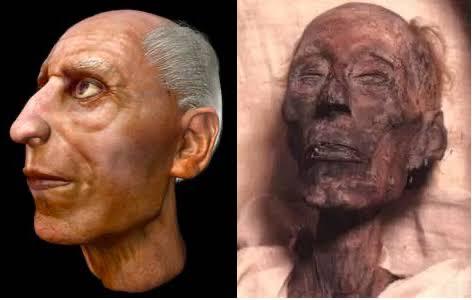
Photo credit: Facial reconstruction of Pharaoh Ramses [or Rameses or Ramesses] II (r. 1279-1213 BC): believed by many Christians scholars to be the Pharaoh who resisted Moses and hardened his heart against God. [Reddit]
***
Summary: I take on some of Steve Hays’ prooftexts for Calvinism. In this instance, the issue is whether God hardened Pharaoh’s heart, or whether the latter did so himself.
Calvinism & General Protestantism
Previous Post

October 22, 2021
Defenses of Pope Francis
Next Post

October 24, 2021 Alt-Reality
Browse Our Archives
Select a Category & Last Things About Me Anti-Catholicism Atheism & Agnosticism Baptism and Sacramentalism Bible and Tradition Blessed Virgin Mary Books by Dave Armstrong C. S. Lewis Calvinism & General Protestantism Catholic Apologetics Catholic Apologists Catholic conversion Catholic converts Christmas Church (Ecclesiology) Church History Conversion and Converts Development of Doctrine Eastern Orthodoxy Ecumenism & Christian Unity Eucharist & Liturgy Fathers of the Church French Translations G. K. Chesterton Hell Hell & Satan Hell & Satan & Last Things Heresies & Comparative Religion Holistic Health Inquisition & Crusades & Scandals James White Jews & Judaism & Old Testament John Calvin John Henry Newman Liberal / Modernist Theology Life Issues Literary Resume Lutheranism Mariology Martin Luther Music Orthodoxy Papacy & Infallibility Personal Page Philosophy & Science Political & Ethical & Moral Issues Protestant Persecution & Intolerance Protestantism Purgatory Purgatory & Penance Romantic & Imaginative Theology Saints & Purgatory & Penance Salvation Salvation & Justification Satan & Last Things Sexuality and Gender Issues Spanish Translations Traditionalism vs. Radical Catholic Reactionaries Traducciones al español / tradução para português Trinitarianism & Christology Uncategorized Videos
Select a Month October 2026 September 2026 August 2026 July 2026 June 2026 May 2026 April 2026 March 2026 February 2026 January 2026 December 2025 November 2025 October 2025 September 2025 August 2025 July 2025 June 2025 May 2025 April 2025 March 2025 February 2025 January 2025 December 2024 November 2024 October 2024 September 2024 August 2024 July 2024 June 2024 May 2024 April 2024 March 2024 February 2024 January 2024 December 2023 November 2023 October 2023 September 2023 August 2023 July 2023 June 2023 May 2023 April 2023 March 2023 February 2023 January 2023 December 2022 November 2022 October 2022 September 2022 August 2022 July 2022 June 2022 May 2022 April 2022 March 2022 February 2022 January 2022 December 2021 November 2021 October 2021 September 2021 August 2021 July 2021 June 2021 May 2021 April 2021 March 2021 February 2021 January 2021 December 2020 November 2020 October 2020 September 2020 August 2020 July 2020 June 2020 May 2020 April 2020 March 2020 February 2020 January 2020 December 2019 November 2019 October 2019 September 2019 August 2019 July 2019 June 2019 May 2019 April 2019 March 2019 February 2019 January 2019 December 2018 November 2018 October 2018 September 2018 August 2018 July 2018 June 2018 May 2018 April 2018 March 2018 February 2018 January 2018 December 2017 November 2017 October 2017 September 2017 August 2017 July 2017 June 2017 May 2017 April 2017 March 2017 February 2017 January 2017 December 2016 November 2016 October 2016 September 2016 August 2016 July 2016 June 2016 May 2016 April 2016 March 2016 February 2016 January 2016 December 2015 November 2015 October 2015 September 2015 August 2015 July 2015 June 2015 May 2015 April 2015 March 2015 February 2015 January 2015 December 2014 November 2014 October 2014 September 2014 August 2014 July 2014 June 2014 April 2014 March 2014 February 2014 January 2014 December 2013 November 2013 October 2013 September 2013 August 2013 July 2013 June 2013 April 2013 March 2013 February 2013 January 2013 December 2012 November 2012 October 2012 September 2012 August 2012 July 2012 June 2012 May 2012 April 2012 March 2012 February 2012 January 2012 December 2011 November 2011 October 2011 September 2011 August 2011 July 2011 June 2011 April 2011 March 2011 February 2011 October 2010 September 2010 August 2010 July 2010 April 2010 March 2010 December 2009 October 2009 August 2009 July 2009 June 2009 May 2009 March 2009 February 2009 October 2008 September 2008 April 2008 March 2008 February 2008 January 2008 December 2007 November 2007 October 2007 May 2007 March 2007 February 2007 January 2007 November 2006 October 2006 September 2006 August 2006 July 2006 June 2006 May 2006 April 2006 March 2006 February 2006 October 2005 June 2005 April 2005 February 2005 July 2004 May 2004 April 2004
Follow Us!
TAKE THE
Religious Wisdom Quiz
Who was stoned to death for preaching about Jesus?
Select your answer to see how you score.
Peter Paul Stephen James
Books by This Author Books by Dave Armstrong
Related posts from Biblical Evidence for Catholicism

On Protestant Explanations of Catholic Conversion
Biblical Evidence for Catholicism

Three More Anti-Catholic Lies About Catholicism (#6-4)
Biblical Evidence for Catholicism

Top Ten Anti-Catholic Lies (#10-7)
Biblical Evidence for Catholicism

Protestant Confessions & "Ever-Virgin" Mary
Biblical Evidence for Catholicism
TRENDING AT PATHEOS Catholic

Janie Learns the Way of the Cross: A...
Teaching children about Jesus' Passion can be challenging. Many parents and educators...

Looking For Good Catholic Writing - October 2026
He alone extends the heavens, and he walks upon the waves of...

In "Irreplaceable," our book on vocation and technology, Trevor Sutton and I...

I was strolling through the top floor of the brand new Parthenon...

What Does Gêvâh Mean For Kimberley Guifoyle &...
This week, a lot of the news is focused on Kimberly Guilfoyle....

INNER CIRCLE: Profound Mystery (Of Christ In All...
Ephesians 5:31-32 “For this reason, a man will leave his father and...
view all Catholic blogs
Ad-Free & Subscriber Log-In Subscription Support
- About Us
- 2026 Calendar
- Videos
- Podcasts
- Library of World Religions
- Faith In Media Tracker
- Advertise With Us
- Write for Us
- Privacy Policy
- Terms of Service
- Do Not Sell My Data
- Contact Us
- Radiant Digital
- Manage Newsletter Subscriptions
- Unsubscribe From Notifications
- Sitemap
Copyright 2008-2026, Patheos. All rights reserved.
Subscription Support Ad-Free & Subscriber Log-In
Follow Patheos