
BuddhistCatholicContemplativeEvangelicalGeneral ChristianHinduJewishLatter-day SaintMuslimNew VisionsProgressive Christian
Beliefs
- Buddhist
- Catholic
- Contemplative
- Evangelical
- General Christian
- Hindu
- Jewish
- Latter-day Saint
- More Voices
- Muslim
- New Visions
- Pagan
- Progressive Christian
Topics
- Religion News
- Food and Religion
- Sports and Religion
- Religious Art
- Religious Music and Entertainment
- Religious Events
- History and Religion
- Style and Religion
- Politics and Religion
- Women in Religion
- Recreation Outdoors and Religion
- Business Finance and Religion
- Careers Workplace and Religion
- Education and Religion
- Family Parenting and Religion
- Health Fitness and Religion
- Home and Religion
- Relationships and Religion
- Technology and Religion
- Travel and Religion
Columnists
- Buddhist Columnists
- Business Finance and Religion Columnists
- Careers Workplace and Religion Columnists
- Catholic Columnists
- Contemplative Columnists
- Education and Religion Columnists
- Evangelists Columnists
- Family Parenting and Religion Columnists
- General Christian Columnists
- Health Fitness and Religion Columnists
- Hindu Columnists
- History and Religion Columnists
- Home and Religion Columnists
- Jewish Columnists
- More Voices Columnists
- Latter Day Columnists
- Muslim Columnists
- New Visions Columnists
- Nonreligious Columnists
- Pagan Columnists
- Politics and Religion Columnists
- Progressive Columnists
- Recreation Outdoors and Religion Columnists
- Relationships and Religion Columnists
- Religion News Columnists
- Religious Art Columnists
- Religious Events Columnists
- Religious Music and Entertainment Columnists
- Sports and Religion Columnists
- Style and Religion Columnists
- Technology and Religion Columnists
- Travel and Religion Columnists
- Women in Religion Columnists
Resource Library
- 2026 Calendar
- Library of World Religions
- The 100 Most Holy Places on Earth
- Patheos Answers
- Podcasts
- Videos
- Faith Leaders Database
- Anglican Episcopalian
- Bahai
- Baptist
- Buddhism
- Christianity
- Confucianism
- Eastern Orthodoxy
- Hinduism
- Holiness and Pentecostal
- ISKCON
- Islam
- Judaism
- Lutheran
- Methodist
- The Church of Jesus Christ of Latter-day Saints
- New Age
- Paganism
- Presbytarian and Reformed
- Protestantism
- Religion Behind the Scenes
- Roman Catholic
- Scientology
- Shia Islam
- Sikhism
- Sufism
- Sunni Islam
- Taoism
- Zen
- See all religions
Research Tools
 Ad-Free & Subscriber Log-In Subscription Support
Ad-Free & Subscriber Log-In Subscription Support
Follow Patheos 

- Trending:
- Forgiveness
- |
- Marriage
- |
- Consciousness
- |
- Death Penalty
- |
- Election
- |
- Halloween

-
About
-
Catholic Apologetics
-
Church History
-
Great Apologists
-
Christian Worldview
-
Protestantism & Misc.
- Home
- Catholic
- History and Religion
- Debate: Matthew 16:18-19 & the Papacy (vs. Steve Hays)
Debate: Matthew 16:18-19 & the Papacy (vs. Steve Hays)
Last updated on: June 6, 2026 at 12:45 am by Dave Armstrong
Debate: Matthew 16:18-19 & the Papacy (vs. Steve Hays) 2026-06-06T00:45:44-04:00 Dave Armstrong
Patheos Explore the world's faith through different perspectives on religion and spirituality! Patheos has the views of the prevalent religions and spiritualities of the world.
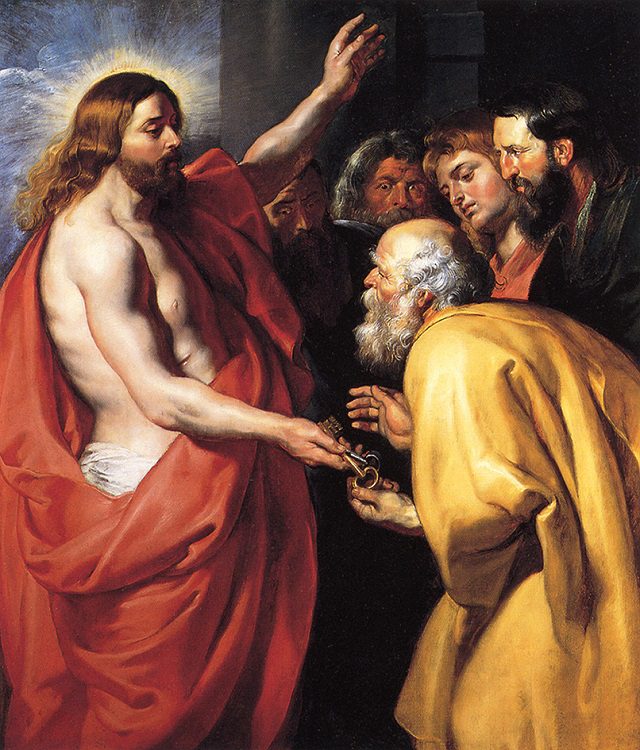
The late Steve Hays was a Protestant Reformed, anti-Catholic apologist, very active online, who ran the site, Triablogue. I am critiquing a portion of his article entitled “Catholic prooftexts” (12-17-17). His words will be in blue.
*****
i) Caesarea Philippi is situated on a rocky terrace at the base of Mt. Hermon. As such, it’s natural to suppose the rocky metaphor was suggested by the immediate surroundings. Jesus was standing on rocky ground, and standing in the shadow of Mt. Hermon, at the time he made his statement.
*
The location does have a large rock facade, which is what Jesus was referring to. But of course metaphors often have a double meaning in Scripture, and Jesus was also quite specifically calling St. Peter the Rock, with the large rock in the background to nail down the point in the imagination of those present. I’ve been there. The spot is actually on the cover of my book about my trip to Israel in 2014. You can’t really see Mt. Hermon from this spot, even though technically it is at the base of it.
*
This also goes to a difference between the written word and the spoken word. Consider the demonstrative pronoun: “this”. In that setting, it’s easy to imagine him pointing to an actual rocky object. “I will build my church on this!”–accompanied by an illustrative gesture. The repetition of “rock” may well include a reference to Simon, but the double reference may also include a reference to the rocky surroundings. Indeed, that may be primary.
*
We contend that the rocky surroundings are secondary, and the reference to Peter primary. Jesus says, “you are Peter [“rock”], and on this rock [Peter] I will build my church . . .” (Mt 16:18, RSV).
*
“Rock” is probably a double entendre, both for Peter and especially the emblematic location.
*
That far we agree.
*
“Rocky” is a pun in honor of Peter’s insightful confession, but what the church is built on is what the location symbolizes.
*
Many renowned Protestant commentators believe that the “rock” referred to here is St. Peter himself, not merely — or only — his confession of faith. These include William Hendriksen, Gerhard Maier, J. Knox Chamblin, in Walter A. Eldwell, ed., Evangelical Commentary on the Bible, Gerhard Friedrich, ed., and Geoffrey W. Bromley, trans. and ed., Theological Dictionary of the New Testament, Craig L. Blomberg, William E. McCumber, in William M. Greathouse and Willard H. Taylor, eds., Beacon Bible Expositions, M. Eugene Boring, in Pheme Perkins et al, eds., The New Interpreter’s Bible, John A. Broadus, Albert Barnes, David Hill, in Ronald E. Clements and Matthew Black, eds., The New Century Bible Commentary, The New Bible Commentary, Herman N. Ridderbos, R. T. France (see the documentation for all these).
*
Others include D. W. O’Connor, “Peter,” Micropedia, Encyclopaedia Britannica, 1985 edition, vol. 9, 330-333, Henry Alford, William F. Albright, and C.S. Mann, Anchor Bible, D. A. Carson, Donald A. Hagner, in David A. Hubbard and others, editors, World Biblical Commentary (see further sources for these). Obviously, then, it’s not merely “Catholic bias” that leads to such an exegesis of the passage.
*
ii) In Revelation, the Netherworld is subdivided into a realm of the dead (Rev 20:13-14) and a realm of the demonic (9:1-11; 11:17; 17:8). And keys are associated with each (Rev 1:18; 9:1-2.; cf. 20:1-3). My point is not to use Revelation to interpret Mt 16 directly. Rather, this seems to be stock imagery that was in circulation in Jewish circles.
*
The only problem is that these references refer to a key to the nether world and/or hell, whereas Jesus gave to St. Peter (and him alone), “the keys of the kingdom of heaven” (Mt 16:19). So there is a difference there. Hades and hell are not the “kingdom of heaven”.
*
iii) Caesarea Philippi was pagan territory. In OT times, it may well have been a site of Baal-worship. Later on, it was a shrine for the Greek god Pan. So it would have demonic associations.
*
Exactly. We agree again. And it has a large cave with a huge opening, that was thought by the ancients to go down to Hades.
*
iv) Although Matthew doesn’t fill in the details, the implicit imagery involves a parallel between hades and heaven, where they stand in contrast. Gates imply keys and keys imply gates. If we mentally flesh it out, the reader should visualize both heaven and hades as gated locations.
*
Precisely! But I suspect that Hays would not accept the deeper implications here. Here are what some prominent Protestant commentators think the keys signify:
The keys are the symbol of authority, and Roland de Vaux (Ancient Israel, tr. by John McHugh [New York: McGraw-Hill, 1961], 129 ff.) rightly sees here the same authority as that vested in the vizier, the master of the house, the chamberlain of the royal household in ancient Israel. –W. F. Albright and C. S. Mann, The Anchor Bible: Matthew, (Garden City, NY: Doubleday, 1971), 196.
The image of keys (plural) perhaps suggests not so much the porter, who controls admission to the house, as the steward, who regulates its administration (Is 22:22, in conjunction with 22:15). The issue then is not that of admission to the church (which is not what the kingdom of heaven means; see pp. 45-47) but an authority derived from a delegation of God’s sovereignty. – R. T. France, Tyndale New Testament Commentaries.
The keys of the kingdom would be committed to the chief steward in the royal household and with them goes plenary authority. –George Buttrick and others, eds., The Interpreter’s Bible, (New York: Abingdon, 1951), 453.
These terms [binding and loosing] thus refer to a teaching function, and more specifically one of making halakhic pronouncements [i.e., relative to laws not written down in the Jewish Scriptures but based on an oral interpretation of them] which are to be ‘binding’ on the people of God. In that case, Peter’s ‘power of the keys’ declared in [Matthew] 16:19 is not so much that of the doorkeeper, who decides who may or may not be admitted to the kingdom of heaven, but that of the steward . . . . whose keys of office enable him to regulate the affairs of the household. –R. T. France, Matthew: Evangelist and Teacher, (Grand Rapids, MI: Zondervan, 1989), 247.
In the . . . exercise of the power of the keys, in ecclesiastical discipline, the thought is of administrative authority (Is 22:22) with regard to the requirements of the household of faith. The use of censures, excommunication, and absolution is committed to the Church in every age, to be used under the guidance of the Spirit . . . So Peter, in T.W. Manson’s words, is to be `God’s vicegerent . . . The authority of Peter is an authority to declare what is right and wrong for the Christian community. His decisions will be confirmed by God’ (The Sayings of Jesus, 1954, p. 205). (4: 1018) — New Bible Dictionary.
vi) Given the associations with heathen idolatry, I think hades more likely connotes the realm of the demonic in this evocative setting. Jesus may be boldly saying he will build his Church on top of hellmouth.
It’s the secondary meaning. But the primary meaning of building His church is as He said: “you are Peter [“rock”], and on this rock [Peter] I will build my church . . .” (Mt 16:18). He’s talking about human administration of His Church, which is why He refers to binding and loosing in the next verse: which were rabbinic practices having to do with authority.
*
And the function of the gate may be to block the demonic realm from storming the church.
*
Or vice versa, and the gates cannot retrain the Church from overpowering death and Hades in the end.
*
3. Catholic apologists typically allege that v19 is an allusion to Isa 22:22, then imports the entire Isaian context into v19. However, the related metaphors of keys, gates, and doors are stock imagery (e.g. Mt 23:13; 25:10; Lk 11:52; Jn 10:9; Acts 14:27; 1 Cor 16:9; Col 4:3; Rev 1:18; 3:7-8,20; 9:1; 20:1), so it doesn’t require any special explanation, in terms of literary dependence, to account for the imagery.
*
That’s what Hays thinks. He’s not the sum of Protestant thinking on this. Many Protestant commentators see plenty of allusions to Isaiah 22:
Isaiah 22:15 ff. undoubtedly lies behind this [Mat 16:19] saying. –W. F. Albright and C. S. Mann, The Anchor Bible: Matthew, (Garden City, NY: Doubleday, 1971), 196.
‘The keys of the kingdom of heaven: the phrase [from Mat 16:19] is almost certainly based on Is. 22:22 where Shebna the steward is displaced by Eliakim and his authority transferred to him. –D. Guthrie and others, The New Bible Commentary, (Grand Rapids, MI: Eerdmans, 1953) [reprinted by Intervarsity Press], 837.
The master of the palace had similar functions at the court of Judah. Announcing the promotion of Elyaqim, Isaiah 22:22 says: ‘I lay the key of the house of David upon his shoulder, if he opens, none will shut; if he shuts, none will open.’ The Egyptian vizier’s instructions are described in a very similar fashion. Every morning ‘the vizier will send someone to open the gates of the kings house, to admit those who have to enter, and to send out those who have to go out.’ One is reminded of the Lord’s words to Peter, the Vizier of the Kingdom of Heaven (Matthew 16:19). –Roland de Vaux, Ancient Israel, trans. John McHugh (New York: McGraw-Hill, 1961), 130.
In Matthew 16:19 it is presupposed that Christ is the master of the house, who has the keys to the Kingdom of Heaven, with which to open to those who come in. Just as in Isaiah 22:22 the Lord lays the keys of the house of David on the shoulders of his servant Eliakim, so Jesus commits to Peter the keys of his house, the Kingdom of Heaven, and thereby installs him as administrator of the house. –Oscar Cullman, Peter: Disciple, Apostle, Martyr, trans. Floyd V. Filson, (Philadelphia: Westminster, 1953), 203.
[Isaiah 22:22 is] generally regarded as the Old Testament background to the metaphor of keys here [Mt 16:19] . . . .” –R. T. France, Matthew: Evangelist and Teacher, (Grand Rapids, MI: Zondervan, 1989), 247.
5. Catholic apologists sometimes say binding and loosing is a rabbinical concept. Well, that’s one possible meaning. But the binding/loosing metaphor needs to be related to the keys metaphor.
*
Why do they need to be directly related? Hays answers himself in his comment two paragraphs before: “even if it was an allusion to Isa 22:22, it doesn’t follow that Jesus is reproducing the entire context of Isa 22, rather than mining the passage for picturesque metaphors or theological motifs.”
Very well, then. If Jesus doesn’t have to allude to every element of Isaiah 22, then by the same token, the “keys” and “binding and loosing” need not be directly related either, or tied to Isaiah 22. Goose and gander . . .
4. To ascribe certain prerogatives to Peter does not imply that he alone has these prerogatives. Mt 16 doesn’t contrast Peter with what is said about the other disciples in the Gospel. It doesn’t say Peter had these prerogatives to the exclusion of the other disciples. It’s illogical to infer that what is said about one person can’t therefore be said about someone else.
*
In fact, no one else is called “Rock”; only Peter. And no one else but Peter is given the “keys of the kingdom.” Protestants try to get out of that by equating the keys with “binding and loosing” (which other disciples can also do)– but there is no reason to believe that binding and loosing is the entire function of the keys. Hays later utilizes this fallacy in stating, “in Mt 18:18-20, the same authority conferred on Peter is conferred on local churches.” He assumes this equation in his description “same authority” but that is not self-evident. Moreover, even though all the disciples bind and loose: only Peter is addressed in the singular; the others are only in a collective sense. And that is because Peter is preeminent.
*
Likewise, Peter is unique as the only disciple regarding whom Jesus said, “I have prayed for you that your faith may not fail” (Lk 22:32; no one else is referred to by name in this regard); the only one told to “strengthen” his “brethren” (Lk 22:32), and the only one Jesus commanded to “feed my lambs” (Jn 21:15), “tend my sheep” (21:16), and “feed my sheep” (21:16). That’s a lot of unique stuff; and if these aren’t enough I have collected fifty: 50 New Testament Proofs for Petrine Primacy & the Papacy.
*
6. When Catholic apologists point to NT statements about “the church” in Matthew and elsewhere, there’s the danger of committing the illegitimate totality transfer fallacy, where they read a theological construct, based on all the varied occurrences of “the church” in NT usage, back into any particular occurrence. We need to avoid making “church” a loaded word wherever it occurs in the NT.
*
Sure, but again, Hays answers himself in making the objection. The particular meaning of “church” (what he refers to as “varied occurrences”) has to be determined by context. In the passage under consideration, again, He said, “you are Peter [“rock”], and on this rock [Peter] I will build my church . . .” is difficult to apply merely to a local congregation. Rather, it makes much more sense to interpret it as “the church of God which he obtained with the blood of his own Son” (Acts 20:28), or the “church of God” that Paul “persecuted” (1 Cor 15:9; Gal 1:13); the “church of the living God” which is “the pillar and bulwark of the truth” (1 Tim 3:15), or the “body” (1 Cor 12:12-20, 22-25) which is the “body of Christ” (1 Cor 12:27; Eph 4:12) = “the [one true] Church.”
*
When a modern reader sees “the church” in the NT, he has the entire NT at his fingertips, as well as 2000 years of church history behind him, in addition to his personal experience with whatever denominations he’s attended. But the original audience for Matthew didn’t have that frame of reference. For them, “the church” didn’t trigger all those associations. When we read the NT, we need to screen all the anachronistic connotations of “the church” which that word evokes for a modern reader.
*
That’s right. On the other hand, the word ekklesia at that time had a background in the Septuagint, where it was used for “assembly of Israel”. Holman Bible Dictionary (“Church”) explains:
[T]he Greek term was used more than one hundred times in the Greek translation of the Old Testament in common use in the time of Jesus. The Hebrew term (qahal) meant simply ‘assembly’ and could be used in a variety of ways, referring for example to an assembling of prophets (1 Sam. 19:20), soldiers (Num. 22:4), or the people of God (Deut. 9:10). The use of the term in the Old Testament in referring to the people of God is important for understanding the term ‘church’ in the New Testament.
The first Christians were [mostly] Jews who used the Greek translation of the Old Testament. For them to use a self-designation that was common in the Old Testament for the people of God reveals their understanding of the continuity that links the Old and New Testaments. The early Christians understood themselves as the people of the God who had revealed Himself in the Old Testament (Heb. 1:1-2), as the true children of Israel (Rom. 2:28-29) with Abraham as their father (Rom. 4:1-25), and as the people of the New Covenant prophesied in the Old Testament (Heb. 8:1-13).
***
Practical Matters: if any of my 3,850+ free online articles and 50 books have helped you (by God’s grace) to decide to become Catholic or to return to the Church, or better understand some doctrines and why we believe them, and/or if you believe my work is worthy to support for the purpose of apologetics and evangelism in general, please seriously consider a much-needed financial contribution. 1 December 2021 will be my 20th anniversary as a full-time Catholic apologist.
*
PayPal donations are the easiest: just send to my email address: apologistdave [at] gmail [dot] com (change the “[at]” to @ and “[dot]” to an actual dot, and take out spaces). “Catholic Used Book Service” is my old side-business. To learn about the different methods of contributing, including 100% tax deduction, etc., see my page: About Catholic Apologist Dave Armstrong / Donation Information. Thanks a million from the bottom of my heart!
***
Photo credit: Christ Surrendering the Keys to St. Peter (c. 1614), by Peter Paul Rubens (1577-1640) [public domain / Wikimedia Commons]

*
***
*
Summary: Debate on the exegesis of Matthew 16:18-19 & the Papacy. The late Steve Hays: anti-Catholic Protestant Reformed apologist, gave it all he had and abysmally failed.
Previous Post
October 30, 2021
"Nature Miracles": Natural Hypotheses for God's Actions
Next Post

November 4, 2021 WHAT?! Vaccinated = Higher Overall Death Rate in UK
Browse Our Archives
Select a Category & Last Things About Me Anti-Catholicism Atheism & Agnosticism Baptism and Sacramentalism Bible and Tradition Blessed Virgin Mary Books by Dave Armstrong C. S. Lewis Calvinism & General Protestantism Catholic Apologetics Catholic Apologists Catholic conversion Catholic converts Christmas Church (Ecclesiology) Church History Conversion and Converts Development of Doctrine Eastern Orthodoxy Ecumenism & Christian Unity Eucharist & Liturgy Fathers of the Church French Translations G. K. Chesterton Hell Hell & Satan Hell & Satan & Last Things Heresies & Comparative Religion Holistic Health Inquisition & Crusades & Scandals James White Jews & Judaism & Old Testament John Calvin John Henry Newman Liberal / Modernist Theology Life Issues Literary Resume Lutheranism Mariology Martin Luther Music Orthodoxy Papacy & Infallibility Personal Page Philosophy & Science Political & Ethical & Moral Issues Protestant Persecution & Intolerance Protestantism Purgatory Purgatory & Penance Romantic & Imaginative Theology Saints & Purgatory & Penance Salvation Salvation & Justification Satan & Last Things Sexuality and Gender Issues Spanish Translations Traditionalism vs. Radical Catholic Reactionaries Traducciones al español / tradução para português Trinitarianism & Christology Uncategorized Videos
Select a Month October 2026 September 2026 August 2026 July 2026 June 2026 May 2026 April 2026 March 2026 February 2026 January 2026 December 2025 November 2025 October 2025 September 2025 August 2025 July 2025 June 2025 May 2025 April 2025 March 2025 February 2025 January 2025 December 2024 November 2024 October 2024 September 2024 August 2024 July 2024 June 2024 May 2024 April 2024 March 2024 February 2024 January 2024 December 2023 November 2023 October 2023 September 2023 August 2023 July 2023 June 2023 May 2023 April 2023 March 2023 February 2023 January 2023 December 2022 November 2022 October 2022 September 2022 August 2022 July 2022 June 2022 May 2022 April 2022 March 2022 February 2022 January 2022 December 2021 November 2021 October 2021 September 2021 August 2021 July 2021 June 2021 May 2021 April 2021 March 2021 February 2021 January 2021 December 2020 November 2020 October 2020 September 2020 August 2020 July 2020 June 2020 May 2020 April 2020 March 2020 February 2020 January 2020 December 2019 November 2019 October 2019 September 2019 August 2019 July 2019 June 2019 May 2019 April 2019 March 2019 February 2019 January 2019 December 2018 November 2018 October 2018 September 2018 August 2018 July 2018 June 2018 May 2018 April 2018 March 2018 February 2018 January 2018 December 2017 November 2017 October 2017 September 2017 August 2017 July 2017 June 2017 May 2017 April 2017 March 2017 February 2017 January 2017 December 2016 November 2016 October 2016 September 2016 August 2016 July 2016 June 2016 May 2016 April 2016 March 2016 February 2016 January 2016 December 2015 November 2015 October 2015 September 2015 August 2015 July 2015 June 2015 May 2015 April 2015 March 2015 February 2015 January 2015 December 2014 November 2014 October 2014 September 2014 August 2014 July 2014 June 2014 April 2014 March 2014 February 2014 January 2014 December 2013 November 2013 October 2013 September 2013 August 2013 July 2013 June 2013 April 2013 March 2013 February 2013 January 2013 December 2012 November 2012 October 2012 September 2012 August 2012 July 2012 June 2012 May 2012 April 2012 March 2012 February 2012 January 2012 December 2011 November 2011 October 2011 September 2011 August 2011 July 2011 June 2011 April 2011 March 2011 February 2011 October 2010 September 2010 August 2010 July 2010 April 2010 March 2010 December 2009 October 2009 August 2009 July 2009 June 2009 May 2009 March 2009 February 2009 October 2008 September 2008 April 2008 March 2008 February 2008 January 2008 December 2007 November 2007 October 2007 May 2007 March 2007 February 2007 January 2007 November 2006 October 2006 September 2006 August 2006 July 2006 June 2006 May 2006 April 2006 March 2006 February 2006 October 2005 June 2005 April 2005 February 2005 July 2004 May 2004 April 2004
Follow Us!
TAKE THE
Religious Wisdom Quiz
In Hebrews, Abel's blood spoke, but what does Jesus' blood speak?
Select your answer to see how you score.
The same message as Abel's Words of warning Words of judgment A better word than the blood of Abel
Books by This Author Books by Dave Armstrong
Related posts from Biblical Evidence for Catholicism

Top Three Anti-Catholic Lies About Catholicism
Biblical Evidence for Catholicism

Three More Anti-Catholic Lies About Catholicism (#6-4)
Biblical Evidence for Catholicism

Top Ten Anti-Catholic Lies (#10-7)
Biblical Evidence for Catholicism

Was Peter "Any Old" Apostle? 10 Anti-Papal Arguments
Biblical Evidence for Catholicism
TRENDING AT PATHEOS Catholic

Letters on Living the Faith by C.S. Lewis
Most of us met C.S. Lewis as a public intellectual. Mere Christianity....

When Halloween Unmasks Married Hearts
Written by Dr. David K. Ewen from Eternal Truth Bible College Behind...

Aristotle. He’s been called the father of logic, the father of the...

Methodist Central Hall and Westminster Abbey
Situated on the same square is Methodist Central Hall and Westminster Abbey. ...

57th Dove Awards Honor Dolly Parton, Crown New...
On gospel music’s biggest night, the 57th annual GMA Dove Awards honored...

The First Eucharistic Controversy: Christ’s Real Presence
For Catholics, the Eucharist is the source and summit of the Christian...
view all Catholic blogs
Ad-Free & Subscriber Log-In Subscription Support
- About Us
- 2026 Calendar
- Videos
- Podcasts
- Library of World Religions
- Faith In Media Tracker
- Advertise With Us
- Write for Us
- Privacy Policy
- Terms of Service
- Do Not Sell My Data
- Contact Us
- Radiant Digital
- Manage Newsletter Subscriptions
- Unsubscribe From Notifications
- Sitemap
Copyright 2008-2026, Patheos. All rights reserved.
Subscription Support Ad-Free & Subscriber Log-In
Follow Patheos