
BuddhistCatholicContemplativeEvangelicalGeneral ChristianHinduJewishLatter-day SaintMuslimNew VisionsProgressive Christian
Beliefs
- Buddhist
- Catholic
- Contemplative
- Evangelical
- General Christian
- Hindu
- Jewish
- Latter-day Saint
- More Voices
- Muslim
- New Visions
- Pagan
- Progressive Christian
Topics
- Religion News
- Food and Religion
- Sports and Religion
- Religious Art
- Religious Music and Entertainment
- Religious Events
- History and Religion
- Style and Religion
- Politics and Religion
- Women in Religion
- Recreation Outdoors and Religion
- Business Finance and Religion
- Careers Workplace and Religion
- Education and Religion
- Family Parenting and Religion
- Health Fitness and Religion
- Home and Religion
- Relationships and Religion
- Technology and Religion
- Travel and Religion
Columnists
- Buddhist Columnists
- Business Finance and Religion Columnists
- Careers Workplace and Religion Columnists
- Catholic Columnists
- Contemplative Columnists
- Education and Religion Columnists
- Evangelists Columnists
- Family Parenting and Religion Columnists
- General Christian Columnists
- Health Fitness and Religion Columnists
- Hindu Columnists
- History and Religion Columnists
- Home and Religion Columnists
- Jewish Columnists
- More Voices Columnists
- Latter Day Columnists
- Muslim Columnists
- New Visions Columnists
- Nonreligious Columnists
- Pagan Columnists
- Politics and Religion Columnists
- Progressive Columnists
- Recreation Outdoors and Religion Columnists
- Relationships and Religion Columnists
- Religion News Columnists
- Religious Art Columnists
- Religious Events Columnists
- Religious Music and Entertainment Columnists
- Sports and Religion Columnists
- Style and Religion Columnists
- Technology and Religion Columnists
- Travel and Religion Columnists
- Women in Religion Columnists
Resource Library
- 2026 Calendar
- Library of World Religions
- The 100 Most Holy Places on Earth
- Patheos Answers
- Podcasts
- Videos
- Faith Leaders Database
- Anglican Episcopalian
- Bahai
- Baptist
- Buddhism
- Christianity
- Confucianism
- Eastern Orthodoxy
- Hinduism
- Holiness and Pentecostal
- ISKCON
- Islam
- Judaism
- Lutheran
- Methodist
- The Church of Jesus Christ of Latter-day Saints
- New Age
- Paganism
- Presbytarian and Reformed
- Protestantism
- Religion Behind the Scenes
- Roman Catholic
- Scientology
- Shia Islam
- Sikhism
- Sufism
- Sunni Islam
- Taoism
- Zen
- See all religions
Research Tools
 Ad-Free & Subscriber Log-In Subscription Support
Ad-Free & Subscriber Log-In Subscription Support
Follow Patheos 

- Trending:
- Forgiveness
- |
- Marriage
- |
- Consciousness
- |
- Death Penalty
- |
- Election
- |
- Halloween

-
About
-
Catholic Apologetics
-
Church History
-
Great Apologists
-
Christian Worldview
-
Protestantism & Misc.
- Home
- Catholic
- History and Religion
- The Tabernacle: Egyptian & Near Eastern Precursors
The Tabernacle: Egyptian & Near Eastern Precursors
Last updated on: June 5, 2026 at 11:59 pm by Dave Armstrong
The Tabernacle: Egyptian & Near Eastern Precursors 2026-06-05T23:59:23-04:00 Dave Armstrong
Patheos Explore the world's faith through different perspectives on religion and spirituality! Patheos has the views of the prevalent religions and spiritualities of the world.
Archaeology Entirely Backs Up the Extraordinary Accuracy of Holy Scripture Yet Again
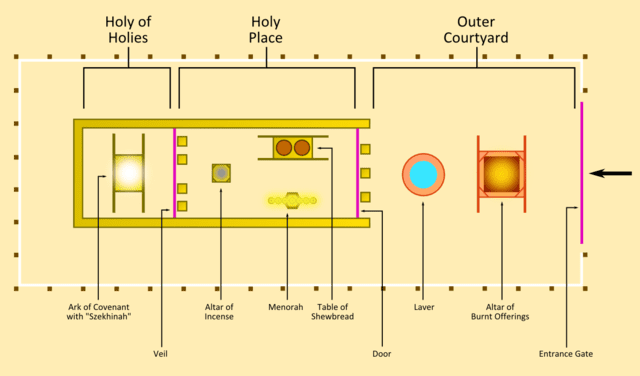
The tabernacle, in the Old Testament, was the forerunner of the temple. It was a portable tent (used in the wilderness wanderings and before the temple was completed under Solomon, that contained an outer court for sacrifices, and the inner holy of holies, which contained the famous ark of the covenant. The old 1911 Catholic Encyclopedia article on it provides a helpful description:
In this sanctuary we should distinguish the tent or tabernacle proper from the sacred enclosure in which the tent stood. The “court of the tabernacle” (Exodus 27:9) was a rectangular space, measuring 100 by 50 cubits (probably the Egyptian cubit, 203/4 ins.), screened off by curtains of “fine twisted linen” (xxvii, 9), 5 cubits high, 100 cubits long on the north and south sides, 50 on the east and 15 on the west, and 20 cubits on either side of the entrance. The entrance was closed by a hanging of fine twisted linen, embroidered in violet, purple, and scarlet and “twice dyed” on a white ground (probable meaning of Exodus 27:16).
All these curtains were suspended from sixty pillars, but not in a “loose and flowing manner”, as Josephus wrongly states, since the total length of the curtains is exactly the same as the perimeter of the court, one pillar being assigned to every five cubits of curtain. These pillars of setimwood, five cubits high, stood on bases (“sockets”, Exodus 39:39) of brass and were held in position by means of cords (ibid., xxxix, 40) fastened to brass pegs (“pins”, ibid., xxxv, 18) which were stuck in the ground; the pillars ended in a capital (“head”, Exodus 39:17, etc.; we must believe that the height given above includes both the base and capital of the pillar) with a band or necking (to hang the curtain) overlaid with silver.
East of the entrance were found successively: the altar of holocausts (Exodus 27:1-8, etc.), the brazen layer (xxx, 18-21; xxxviii, 8, etc.), and the tabernacle proper. The latter was conceived to be the dwelling-tent of God; hence it consisted essentially of curtains, the wooden framework, though indispensable, being only of secondary importance. The whole structure measured 30 by 10 cubits, and was divided into two sections; the one to the west, the “Holy Place”, containing the altar of incense, the golden candlestick, and the table of shewbreads; and the other, the “Holy of Holies”, containing the Ark of the Covenant with the propitiatory and the cherubim. These sections were respectively 20 and 10 cubits long.
Jewish exegetical tradition, followed by almost every Christian exponent of the Bible, understood the wooden framework to be made up of 48 massive boards (rather beams) of setim wood, measuring 10 by 11/2 by 1 cubit, placed side by side. This means a weight (about fifty tons) out of proportion with what these beams would have to bear and very difficult of transportation. Some modern scholars having studied more closely the technical terms used in the original adopt another view. According to them the “boards” of the tabernacle must be understood as light frames consisting of two uprights joined (probably at the top, middle, and bottom) by ties or cross-rails (the “mortises” in Exodus 26:17).
Of these frames, overlaid with gold (xxvi, 29), there were 20 on the north side of the tabernacle, 20 on the south, and 6 on the east. To provide solidity and rigidity, a slanting frame was put at the north-east and south-east corners to buttress the structure (xxvi, 23); the lower part of the uprights was sunk deep into silver sockets or bases, probably to be understood as square blocks (about 1 cubit high and 3/4 cubit square); finally, five wooden bars, passing through rings attached to the frames, ran along the sides (xxvi, 26-28). On the west the frames were to be replaced by five pillars of setimwood overlaid with gold, sunk in brass bases, and crowned with golden capitals (xxvi, 37). Four pillars of the same workmanship, with silver bases, separated the Holy Place from the Holy of Holies.
A curtain, two pieces of fine tapestry joined by golden rings, was spread over the whole framework; each piece of tapestry consisted of five strips, 28 by 4 cubits, fitted together by loops. The total dimension of this being 20 by 40 cubits, it must have reached on the north and south the top of the bases, against which it was possibly fixed (there were loops at the top of the curtains likely for this purpose), whereas on the east it reached to the ground. Covering this curtain was another woven of goats’ hair (the ordinary tent material), fitted in somewhat similarly; its dimensions, 11 (6+5)x4=44 by 30 cubits, were so calculated as to cover entirely the inside curtain on the north, east, and south sides and to hang down doubled on the west side, thus covering the tops and capitals of the pillars (Exodus 26:7-13). Two outer coverings (no dimensions are given), one of dyed rams’ skin and one of dugongs’ skin, protected the whole structure. A hanging of apparently the same workmanship as that closing the entrance of the court, screened the entrance of the tabernacle (ibid., 36); finally, a veil of the same tapestry as the inner curtain, hooked from the four pillars mentioned above, completed the separation of the Holy of Holies from the Holy Place.
Egyptologist, archaeologist, and evangelical Protestant, Kenneth A. Kitchen, probably the greatest living biblical “maximalist” archaeologist, in his book, On the Reliability of the Old Testament, Grand Rapids and Cambridge: William B. Eerdmans Publishing Company, 2003), made a case for the 13th century origin and building of the tabernacle (i.e., in Moses’ time, and during the wanderings in the desert after the Exodus), over against the “minimalist” archaeologists. Here is how he constructs it:
There can be no excuse nowadays for artificially down-dating the Hebrew usages by six or seven centuries, for purely nineteenth-century doctrinaire reasons. . . .
Well over a century ago Wellhausen and others . . . [thought that a divine] command [to build the tabernacle] was originally followed only by a summary note of its fulfillment, and all else that we read now is material added at later time(s).
However, much more recent investigation has shown this “modern” concept to be wrong, and the existing format of Exod. 25-40, etc., to be original, i.e., true to ancient usage in the third and second millennia [BC] in particular. . . .
Thus the old nineteenth-century dogmas must be abandoned in the face of those facts. . . .
Thus, for the Sinai tabernacle, in retrospect, we possess a considerable — and growing — amount of valuable comparative data (much of it very old, and much, contemporary; far less, of later date) that favor the hypothesis that a small but well-decorated dismountable tent shrine (based on usages of its time) accompanied the Hebrews from Sinai to Canaan, . . . (pp. 282-283)
Wikipedia (“Tabernacle”) notes the present fashionable skepticism as to the date of its origins:
Many scholars contend that it is of a far later date than the time of Moses, and that the description reflects the structure of Solomon’s Temple, while some hold that the description derives from memories of a real pre-monarchic shrine, perhaps the sanctuary at Shiloh. Traditional scholars contend that it describes an actual tabernacle used in the time of Moses and thereafter.
Kitchen contends that every aspect of the Hebrew tabernacle has similarities to prior such structures in surrounding cultures: especially Egypt. All of these parallels suggest (by analogy and correspondence to the biblical text) a 13th century origin, and not a later one. He explains the scholarly options, earlier in his treatment of this topic:
In biblical studies, for over a century, “critical orthodoxy” (current “minimalism” being no different) has decreed that the tabernacle is an exilic or postexilic figment of the imagination of Jewish priests (ca. sixth to fourth centuries B.C.), seeking to glorify their cult, giving it a long “history” before the monarchy by projecting a “tented” form of Solomon’s temple back to the time of Moses, their first national leader. . . .
[I]f inquiry demonstrates clear analogues from earlier epochs, an in particular before the Hebrew monarchy, and with very little such data after circa 1000, then it would be in order to suggest that there could well have been a tent shrine in early Israel that was eventually replaced by the temple of Solomon’s time. Late-period priests might conceivably have preserved record of an early structure; but mere imagination would not then have originated it. (pp. 275-276)
He then systematically describes all sorts of parallels to the Hebrew tabernacle, in or before the period where it was traditionally believed to have been first made (13th c. BC):
[I]n the 1920s, . . . a brilliant discovery by Reisner at the Giza pyramids in Egypt opened up the final tomb of Queen Hetepheres, mother of Khufu, the builder of the Great Pyramid, circa 2600. He found the disassembled parts of a “secular tabernacle” . . . It consisted of a wooden framework, gold covered, that fitted together with tenon and socket joints. The top horizontal beams were supported by vertical poles set in base beams. The corners were held by special fitments, a feature also of the biblical tabernacle (Exod. 26:23). The whole framework was once draped with curtains that had not survived. . . .
Thus, in Egypt, most of the biblical tabernacle’s technology was literally “as old as the Pyramids,” in fact older. But all this is still a thousand years before even a Moses, never mind exilic priests. (p. 276).
However, our story is not done. Recent publications of texts from the famous kingdom of Mari on the Middle Euphrates of circa eighteenth (or seventeenth) century now yield mention of tents or “tabernacles” borne on wooden frames . . . and units of (seemingly) fencing, latticework, perhaps to form an enclosure as with the biblical tabernacle (Exod. 27:9-10). . . .
Thus large tents over wooden frames set in socketed bases were used for both ritual and royal purposes at Mari, still half a millennium before any Moses. (p. 277)
He provides further similar examples from the tomb of Tutankhamun (ca. 1336 1327 BC): “concentric tabernacle-like shrines . . . gold-plated, dismountable, and fitted together with tenons in sockets like the Hebrew tabernacle . . . a wooden framework carrying a pall of faded linen decorated with gilded bronze rosettes, for all the world like a skeletal tabernacle” (p. 278).
Pharaoh Ramesses, around 1275 BC — very near the time of the Exodus, had a “rectangular tent . . . divided into two parts, with an outer room twice the length of the inner room of the king himself. In some representations the inner room has figures of divine falcons facing each other and shadowing the royal name with their wings, much as the cherubim did for the cover of the ark in the tabernacle” (p. 278)
Kitchen noted that “multicolored curtains . . . would be in no way too elaborate” in the 13th c. BC. “Such techniques were ages old by then, even commonplace” (p. 278). A ship of Pharaoh Sahure (c. 2465 -c. 2325 BC) had “squared-off rosettes and stars” and a “New Kingdom [1570 BC and after] tomb has a boat with a checker-patterned red-and-white sail” (p. 278)
He goes on to cite further striking precursors of sacred and ritualistic Hebrew items:
On furnishings we may cite the ark of the covenant (Exod. 25:10-22; 37:1-9) and the special silver trumpets of Num. 10:1-10. The former was essentially a gilded box on four feet, with four rings (two each side) to take two carrying-poles. The arrangement is identical to that of a famous box from Tutankhamun’s tomb, with just such rings and poles. . . . Thus the ark is a typical Late Bronze Age item.
[T]he silver trumpets . . . were long tubes with flared mouths. These too were in type and use characteristic of New Kingdom Egypt. From Tutankhamun’s tomb (again!) we have two such trumpets, one of silver, one of copper and bronze overlaid with gold. Such instruments are commonly shown in scenes, used exactly in the functions described in Num. 10. . . . Of the Late Bronze Age (not later), as others have pointed out, are the tabernacle’s lampstand and various other facets. (p. 280)
***
Photo credit: Adik86 (9-18-09) [Wikimedia Commons / Creative Commons Attribution-Share Alike 3.0 Unported license]

***
Summary: Egyptologist & archaeologist Kenneth Kitchen shows the parallels between the wilderness Hebrew Tabernacle from Moses’ time (13th c. BC), & Egyptian & other precursors.
Jews & Judaism & Old Testament
archaeology of the Old Testament
historical accuracy of the Bible
Previous Post

September 8, 2021
Mind-Reading Priest: I'm a Polemicist, Not an Apologist
Next Post
September 9, 2021 Reactionary Civil War Heating Up Over Taylor Marshall?
Browse Our Archives
Select a Category & Last Things About Me Anti-Catholicism Atheism & Agnosticism Baptism and Sacramentalism Bible and Tradition Blessed Virgin Mary Books by Dave Armstrong C. S. Lewis Calvinism & General Protestantism Catholic Apologetics Catholic Apologists Catholic conversion Catholic converts Christmas Church (Ecclesiology) Church History Conversion and Converts Development of Doctrine Eastern Orthodoxy Ecumenism & Christian Unity Eucharist & Liturgy Fathers of the Church French Translations G. K. Chesterton Hell Hell & Satan Hell & Satan & Last Things Heresies & Comparative Religion Holistic Health Inquisition & Crusades & Scandals James White Jews & Judaism & Old Testament John Calvin John Henry Newman Liberal / Modernist Theology Life Issues Literary Resume Lutheranism Mariology Martin Luther Music Orthodoxy Papacy & Infallibility Personal Page Philosophy & Science Political & Ethical & Moral Issues Protestant Persecution & Intolerance Protestantism Purgatory Purgatory & Penance Romantic & Imaginative Theology Saints & Purgatory & Penance Salvation Salvation & Justification Satan & Last Things Sexuality and Gender Issues Spanish Translations Traditionalism vs. Radical Catholic Reactionaries Traducciones al español / tradução para português Trinitarianism & Christology Uncategorized Videos
Select a Month October 2026 September 2026 August 2026 July 2026 June 2026 May 2026 April 2026 March 2026 February 2026 January 2026 December 2025 November 2025 October 2025 September 2025 August 2025 July 2025 June 2025 May 2025 April 2025 March 2025 February 2025 January 2025 December 2024 November 2024 October 2024 September 2024 August 2024 July 2024 June 2024 May 2024 April 2024 March 2024 February 2024 January 2024 December 2023 November 2023 October 2023 September 2023 August 2023 July 2023 June 2023 May 2023 April 2023 March 2023 February 2023 January 2023 December 2022 November 2022 October 2022 September 2022 August 2022 July 2022 June 2022 May 2022 April 2022 March 2022 February 2022 January 2022 December 2021 November 2021 October 2021 September 2021 August 2021 July 2021 June 2021 May 2021 April 2021 March 2021 February 2021 January 2021 December 2020 November 2020 October 2020 September 2020 August 2020 July 2020 June 2020 May 2020 April 2020 March 2020 February 2020 January 2020 December 2019 November 2019 October 2019 September 2019 August 2019 July 2019 June 2019 May 2019 April 2019 March 2019 February 2019 January 2019 December 2018 November 2018 October 2018 September 2018 August 2018 July 2018 June 2018 May 2018 April 2018 March 2018 February 2018 January 2018 December 2017 November 2017 October 2017 September 2017 August 2017 July 2017 June 2017 May 2017 April 2017 March 2017 February 2017 January 2017 December 2016 November 2016 October 2016 September 2016 August 2016 July 2016 June 2016 May 2016 April 2016 March 2016 February 2016 January 2016 December 2015 November 2015 October 2015 September 2015 August 2015 July 2015 June 2015 May 2015 April 2015 March 2015 February 2015 January 2015 December 2014 November 2014 October 2014 September 2014 August 2014 July 2014 June 2014 April 2014 March 2014 February 2014 January 2014 December 2013 November 2013 October 2013 September 2013 August 2013 July 2013 June 2013 April 2013 March 2013 February 2013 January 2013 December 2012 November 2012 October 2012 September 2012 August 2012 July 2012 June 2012 May 2012 April 2012 March 2012 February 2012 January 2012 December 2011 November 2011 October 2011 September 2011 August 2011 July 2011 June 2011 April 2011 March 2011 February 2011 October 2010 September 2010 August 2010 July 2010 April 2010 March 2010 December 2009 October 2009 August 2009 July 2009 June 2009 May 2009 March 2009 February 2009 October 2008 September 2008 April 2008 March 2008 February 2008 January 2008 December 2007 November 2007 October 2007 May 2007 March 2007 February 2007 January 2007 November 2006 October 2006 September 2006 August 2006 July 2006 June 2006 May 2006 April 2006 March 2006 February 2006 October 2005 June 2005 April 2005 February 2005 July 2004 May 2004 April 2004
Follow Us!
TAKE THE
Religious Wisdom Quiz
I made a rash vow that cost me my only child after a military victory. Who am I?
Select your answer to see how you score.
Jephthah Samson Gideon Barak
Books by This Author Books by Dave Armstrong
Related posts from Biblical Evidence for Catholicism

God's Presence, the Ark, the Eucharist, & Death
Biblical Evidence for Catholicism
Garden of Eden’s Location Verified by Science
Biblical Evidence for Catholicism
Unregenerate Good Works in the Old Testament
Biblical Evidence for Catholicism
Perfectly Keeping the Law: Top Ten Bible Proofs
Biblical Evidence for Catholicism
TRENDING AT PATHEOS Catholic

The Sermon on the Mount, Part I: Matthew...
The Sermon on the Mount, Part I (Matthew 4:12-5:12) St. Matthew moves...

What's up from Crossway: Reviewing some of their latest A few weeks...

Janie Learns the Way of the Cross: A...
Teaching children about Jesus' Passion can be challenging. Many parents and educators...

Looking For Good Catholic Writing - October 2026
He alone extends the heavens, and he walks upon the waves of...

In "Irreplaceable," our book on vocation and technology, Trevor Sutton and I...

I was strolling through the top floor of the brand new Parthenon...
view all Catholic blogs
Ad-Free & Subscriber Log-In Subscription Support
- About Us
- 2026 Calendar
- Videos
- Podcasts
- Library of World Religions
- Faith In Media Tracker
- Advertise With Us
- Write for Us
- Privacy Policy
- Terms of Service
- Do Not Sell My Data
- Contact Us
- Radiant Digital
- Manage Newsletter Subscriptions
- Unsubscribe From Notifications
- Sitemap
Copyright 2008-2026, Patheos. All rights reserved.
Subscription Support Ad-Free & Subscriber Log-In
Follow Patheos