
BuddhistCatholicContemplativeEvangelicalGeneral ChristianHinduJewishLatter-day SaintMuslimNew VisionsProgressive Christian
Beliefs
- Buddhist
- Catholic
- Contemplative
- Evangelical
- General Christian
- Hindu
- Jewish
- Latter-day Saint
- More Voices
- Muslim
- New Visions
- Pagan
- Progressive Christian
Topics
- Religion News
- Food and Religion
- Sports and Religion
- Religious Art
- Religious Music and Entertainment
- Religious Events
- History and Religion
- Style and Religion
- Politics and Religion
- Women in Religion
- Recreation Outdoors and Religion
- Business Finance and Religion
- Careers Workplace and Religion
- Education and Religion
- Family Parenting and Religion
- Health Fitness and Religion
- Home and Religion
- Relationships and Religion
- Technology and Religion
- Travel and Religion
Columnists
- Buddhist Columnists
- Business Finance and Religion Columnists
- Careers Workplace and Religion Columnists
- Catholic Columnists
- Contemplative Columnists
- Education and Religion Columnists
- Evangelists Columnists
- Family Parenting and Religion Columnists
- General Christian Columnists
- Health Fitness and Religion Columnists
- Hindu Columnists
- History and Religion Columnists
- Home and Religion Columnists
- Jewish Columnists
- More Voices Columnists
- Latter Day Columnists
- Muslim Columnists
- New Visions Columnists
- Nonreligious Columnists
- Pagan Columnists
- Politics and Religion Columnists
- Progressive Columnists
- Recreation Outdoors and Religion Columnists
- Relationships and Religion Columnists
- Religion News Columnists
- Religious Art Columnists
- Religious Events Columnists
- Religious Music and Entertainment Columnists
- Sports and Religion Columnists
- Style and Religion Columnists
- Technology and Religion Columnists
- Travel and Religion Columnists
- Women in Religion Columnists
Resource Library
- 2026 Calendar
- Library of World Religions
- The 100 Most Holy Places on Earth
- Patheos Answers
- Podcasts
- Videos
- Faith Leaders Database
- Anglican Episcopalian
- Bahai
- Baptist
- Buddhism
- Christianity
- Confucianism
- Eastern Orthodoxy
- Hinduism
- Holiness and Pentecostal
- ISKCON
- Islam
- Judaism
- Lutheran
- Methodist
- The Church of Jesus Christ of Latter-day Saints
- New Age
- Paganism
- Presbytarian and Reformed
- Protestantism
- Religion Behind the Scenes
- Roman Catholic
- Scientology
- Shia Islam
- Sikhism
- Sufism
- Sunni Islam
- Taoism
- Zen
- See all religions
Research Tools
 Ad-Free & Subscriber Log-In Subscription Support
Ad-Free & Subscriber Log-In Subscription Support
Follow Patheos 

- Trending:
- Forgiveness
- |
- Marriage
- |
- Consciousness
- |
- Death Penalty
- |
- Election
- |
- Halloween

-
About
-
Catholic Apologetics
-
Church History
-
Great Apologists
-
Christian Worldview
-
Protestantism & Misc.
- Home
- Catholic
- History and Religion
- Pearce’s Potshots #46: Who Wrote the Gospel of John?
Pearce’s Potshots #46: Who Wrote the Gospel of John?
Last updated on: June 6, 2026 at 12:45 am by Dave Armstrong
Pearce’s Potshots #46: Who Wrote the Gospel of John? 2026-06-06T00:45:24-04:00 Dave Armstrong
Patheos Explore the world's faith through different perspectives on religion and spirituality! Patheos has the views of the prevalent religions and spiritualities of the world.
Atheist anti-theist Jonathan M. S. Pearce is the main writer on the blog, A Tippling Philosopher. His “About” page states: “Pearce is a philosopher, author, blogger, public speaker and teacher from Hampshire in the UK. He specialises in philosophy of religion, but likes to turn his hand to science, psychology, politics and anything involved in investigating reality.” His words will be in blue.
*****
This is a reply to the article, The Author of the Gospel of John (9-1-21). Pearce thinks that the apostle John did not write the Gospel that bears his name.
I will be drawing from An Introduction to the New Testament (1st edition, 1992, Grand Rapids, Michigan: Zondervan, by D. A. Carson, Douglas J. Moo, and Leon Morris). These are very reputable evangelical Protestant Bible scholars. Pearce, of course, cites almost all liberal scholars, who (too often)barely even believe in the Christian doctrines they write about. This has been standard atheist practice for three centuries.
Pearce also (as usual) presents one side, as if there is no other (thoughtful, scholarly, non-fundamentalist) side. And that’s standard anti-theist atheist practice today. The authors will immediately be considered suspect, according to this mentality of “only liberal / dissident Bible scholars are smart and intellectually honest and trustworthy” so let me note their credentials.
D.A. Carson (b. 1946) is research professor of New Testament at Trinity Evangelical Divinity School in Deerfield, Illinois. He received a Master of Divinity degree from Central Baptist Seminary in Toronto, and the Doctor of Philosophy in New Testament from the University of Cambridge. Carson is an active guest lecturer in academic and church settings around the world. He has written or edited about sixty books.
Douglas J. Moo (b. 1950) received his Ph.D from the University of St. Andrews and is professor of New Testament, Wheaton College Graduate School. He has written or edited about fifteen books.
Leon Morris (1914-2006) was ordained to the Anglican ministry in 1938. He earned a Master of Theology from from the University of London and his PhD at the University of Cambridge. He served as principal of Ridley College in Melbourne (1964-1979), Australia and Visiting Professor of New Testament at Trinity Evangelical Divinity School. He has written or edited about seventeen books.
Pearce can smugly say, I suppose, that these scholars are “dumbbells” and “troglodytes” because they aren’t liberal Christians. He says a lot of clueless and absurd things, I’m afraid. I haven’t been able to stop him with mere facts and contrary reasoning.
[1] . . . the key for Christians is to attempt to show that this so-called “Beloved Disciple” is John himself.
Carson et al devote no less than six-and-a-half pages to the question of the identity of the “beloved disciple” alone. All agree that this is a key question. So let’s debate it. Pearce provides no argument. I will present numerous ones from Carson et al. Let the reader decide after hearing more than one jaded point of view (and baldly and inadequately stated at that, as if no one could possibly doubt it, based on Pearce’s one-sentence supposed “argument”).
1) He was at the Last Supper, and so was one of the twelve disciples (Jn 13:23). According to the synoptics, they were the only ones there.
2) He is repeatedly distinguished from Peter (13:23-24; 20:2-9; 21:20).
3) He is obviously not any of the other disciples named in John: Andrew (1:40), Philip (1:43-44), Nathanael [aka Bartholomew] (1:44-49), Thomas (11:16), Judas Iscariot (6:71), and Jude / Thaddeus (14:22). That leaves five disciples: one of whom he was. He is one of seven disciples who go fishing (Jn 21:1-3, 7). The logical possibility is that he is one of the sons of Zebedee (James and John, as we know from Mt 4:21; 10:2; Mk 1:19; 3:17; 10:35; Lk 5:10) or one of the two unnamed disciples (21:2). He cannot be James, because he was the first disciple martyred (in c. 44: cf. Acts 12:1-2). That leaves John, James the Lesser, Matthew, or Simon the Zealot as the four remaining possibilities, by straightforward deduction.
4) The “beloved disciple” is constantly hanging around Peter. The Gospel of Mark (Mk 5:37; 9:2; 14:33 ff.), Acts (3:1-4:23; 8:15-25), and Galatians 2:9 link Peter and John (Mk 5:37; 9:2; 14:33 ff.).
5) Carson et al state: “the traditional reason seems most plausible: the beloved disciple is none other than John, and he deliberately avoids using his personal name” . . . the internal evidence is very strong, though not beyond dispute, that the beloved disciple is John the apostle, the son of Zebedee. What, then, is the relationship between the beloved disciple and the fourth evangelist? The traditional answer is that they are one and the same. Today this is commonly denied.” (pp. 145, 147-148).
6) It’s argued that no Christian would describe himself as loved by Jesus, because this smacks of pride and exclusivism. But this doesn’t follow. St. Paul wrote that Jesus “loved me and gave himself for me” (Gal 2:20, RSV).
7) Carson et al observe: “if the evangelist is someone other than John the son of Zebedee, his failure to mention the apostle John by name, when he mentions so many others, is even more difficult to explain” (p. 149). And it’s difficult in light of the obvious importance of John in the synoptics. In my first book, A Biblical Defense of Catholicism, I noted (p. 236) that “Peter’s name is mentioned more often than all the other disciples put together: 191 times . . . John is next in frequency, with only forty-eight appearances, and Peter is present fifty percent of the time we find John in the Bible.”
I also noted that I included 13 instances of “the disciple whom Jesus loved” etc. and five from Revelation, in John’s tally. If we omit those, it still adds up to 30 mentions in the three synoptic Gospels. Fulton Sheen estimated that the disciples besides Peter were mentioned 130 times. Thus, John would make up 23% of that total, even though he is one of eleven disciples besides Peter. Thus out of 321 references to disciples, Peter made up 60%. John is second with 9%, 11%, or 15%: depending on what the figure includes. No one else is remotely close even to John’s total. All this makes it quite implausible that the author of John would never mention John the disciple if in fact he were someone other than him.
[1] John admits that his account is hearsay – non-eyewitness – by saying in verse 21: 20-24 that it represents a compilation of the testimony of the oft-debated and unnamed “Beloved Disciple” of Jesus. . . .
[2] The author never declares himself as the Beloved Disciple.
John 21:20-24 certainly seems to assert (at the very least it is an altogether reasonable interpretation) that the “beloved disciple” is the (self-understood) author of John:
John 21:20-24 Peter turned and saw following them the disciple whom Jesus loved, who had lain close to his breast at the supper and had said, “Lord, who is it that is going to betray you?” [21] When Peter saw him, he said to Jesus, “Lord, what about this man?” [22] Jesus said to him, “If it is my will that he remain until I come, what is that to you? Follow me!” [23] The saying spread abroad among the brethren that this disciple was not to die; yet Jesus did not say to him that he was not to die, but, “If it is my will that he remain until I come, what is that to you?” [24] This is the disciple who is bearing witness to these things, and who has written these things; and we know that his testimony is true.
[3] The Gospel has dependency on the previous Gospels.
Indeed. But so what? No one disagrees with that.
[6] The author speaks in the third person, including in John 21: 24 where he says “we know that his testimony is true”.
[7] Further to the above, the author is included in the “we” who knows that “his” (ie, the Beloved Disciple’s) testimony is true. Thus, grammatically speaking, the claim that John is the Beloved Disciple, as per tradition, is problematic. When the Gospel does use “I”, oddly, it is in opposition to the “Beloved Disciple” references in the third person (such confusion leads many to believe it was written as a group effort, or with many revisions).
[8] New Testament scholar Robert Kysar states concerning the authorship of the Gospel of John (my emphasis): “The supposition that the author was one and the same with the beloved disciple is often advanced as a means of insuring that the evangelist did witness Jesus’ ministry. Two other passages are advanced as evidence of the same – 19:35 and 21:24. But both falter under close scrutiny. 19:35 does not claim that the author was the one who witnessed the scene but only that the scene is related on the sound basis of eyewitness. 21:24 is part of the appendix of the gospel and should not be assumed to have come from the same hand as that responsible for the body of the gospel. Neither of these passages, therefore, persuades many Johannine scholars that the author claims eyewitness status.” The Anchor Bible Dictionary, vol. 3, p. 919-920)
Use of the third person to refer to oneself is what is known as “illeism”. A book devoted to this very topic stated:
[T]his phenomenon occurs frequently in the Bible and, in the vast majority of its use in direct discourse (over 80 percent), it is used by Yahweh in the Old Testament (OT) and Jesus in the Gospels.
That means 20% of the time this technique is used by mere creatures (like the author of John). Jesus habitually did this in referring to Himself as “the Son of Man.”
Bible scholar E. W. Bullinger, in his 1104-page volume, Figures of Speech Used in the Bible (London: 1898; see the online complete book link too, and the paginated Internet Archive version), dealt with this literary technique, under the category of “Heterosis of Person and Number (Verbs). Heterosis as a larger category takes up 25 pages of his book (pp. 510-534). But as for person and number he documents massive biblical use of this figure of speech. Note John 21:24 under category number 4:
In order to make what is said more emphatic, Hebrew idiom sometimes changes the number and person of the verb. In most of these cases the figure is correctly rendered in the A.V. [Note: The Authorized Version, or current Text of our English Bible, 1611.] , so that we need only give a few examples which are there passed over.
- The First Person for the Third
Ecclesiastes 3:18.-“I said in my heart according to the reasoning of the sons of men”: i.e., according to the reasoning of man, or human reasoning: i.e., man says in his heart.
In Romans 7:1-25, Paul, though speaking in the first person, is saying what is true of all who share his experience: and not merely speaking of his own case as being peculiar or different from others.
Romans 10:18.-“But I say.” Who says it? David! But by the Holy Spirit what David said is now repeated by Paul in the first person.
- The Second Person for the Third
Isaiah 1:29.-“They shall be ashamed for the oaks which ye (i.e., they) have desired,” etc.
For they desired them, of course: yet the persons addressed were equally guilty and are thus by the sudden change of persons charged with the same sin.
Isaiah 42:20.-“Seeing many things, but thou observest not”: (i.e., he observes not) as in the rest of the verse.
Jeremiah 29:19.-“But ye (i.e., they) would not hear.”
Galatians 6:1.-“Ye that are spiritual restore such an one, in the spirit of meekness, considering thyself (instead of yourselves).” This is in order to emphasize the fact that those who are thus addressed stand each in the same individual danger.
- The Third person for the First or Second
Genesis 49:4.-“Because thou wentest up to thy father’s bed; then defiledst thou it: he went (i.e., thou wentest) up to my couch.”
Isaiah 54:1.-Here the third person is rendered correctly in A.V. [Note: The Authorized Version, or current Text of our English Bible, 1611.] by the second.
Lamentations 3:1.-“I am the man, he hath (i.e., I have) seen affliction.”
Micah 7:18.-Here we have “his” inheritance, after the address “like thee.”
- The Plural for the Singular
Genesis 29:27.-“Fulfil her week, and we (i.e., I) will give thee this also for thy service.”
Numbers 22:6.-“Peradventure I shall prevail, that we (i.e., I) may smite them.”
2 Samuel 16:20.-“Then said Absalom to Ahithophel, Give counsel among you What shall we (i.e., I) do?”
Job 18:2.-“How long will it be ere ye (i.e., thou) make an end of words? mark, and afterwards we (i.e., I) will speak.”
Daniel 2:36.-“This is the dream; and we (i.e., I) will tell the interpretation thereof.”
Mark 4:30.-“Whereunto shall we (i.e., I) liken the kingdom of God?”
John 3:11.-“We (i.e., I) speak that we (i.e., I) know, and testify that we (i.e., I) have seen; and ye receive not our (i.e., my) witness.”
John 21:24.-“And we (i.e., I) know that his testimony is true.”
Romans 1:5.-“By whom we (i.e., I, Paul) have received grace and apostleship.” (See also Hendiadys).
1 Timothy 2:15.-“She will be saved through the child-bearing if they (i.e., Eve and all her daughters) abide in faith,” etc.
- The Singular for the Plural
Numbers 32:25.-“Spake” is (sing) “he spake”: i.e., the tribe as composed of the children of Gad,” etc. It is put for the plural, “they spake”; and it should really be “they spake” (viz., the children of Gad and the children of Reuben), according to the Sevir. This extra-official reading is the Textual reading in several MSS.; in the Samaritan Text, in the Targums of Jonathan and Onkelos, the Septuagint, the Syriac, and the Vulgate. See the note in Dr. Ginsburg’s Hebrew Bible. So 1 Samuel 16:4 : i.e., one particular elder spoke for all. But the sing. [Note: The Singular Number.] is put for the plural: for here, again, according to the note in Dr. Ginsburg’s Text, the verb should be in the plural. This is not only the reading according to the Sevir, but it is in the Text of many MSS., the Editio princeps of the Prophets (Soncino, 1485-6), the first edition of the Hebrew Bible (1488), the Targum, the LXX. [Note: The Septuagint Version (325 b.c.).] Syriac, and the Vulgate. (pp. 524-525; my italics for the subtitles)
[12] The Gospel is a work of sophisticated Greek and well-developed theology – almost impossible to have come from an uneducated fisherman, for example. Confusing matters, John 21:24 states “This is the disciple who is bearing witness about these things, and who has written these things, and we know that his testimony is true.” This makes John the son of Zebedee, a Galilean fisherman, unlikely to be the author. The literacy level of the original Twelve seems to preclude any of them realistically being authors of the Gospels.
This is untrue. Carson et al refute it:
Although in the past it has been argued that a Palestinian could not write such fluent Greek, the argument no longer stands. There is now a powerful consensus [i.e., in 1992: 29 years ago] that at least in Galilee, and perhaps elsewhere in first-century Palestine, the populace was at least bilingual. . . . if John lived abroad for years before writing [in Ephesus, as tradition attests], he had ample time to practice his Greek. Moreover, although the Greek of John’s gospel is reasonably competent, it is not elegant, and it betrays a fair number of Semitizing “enhancements.” . . . This sort of evidence is perfectly consonant with what little we know of the background of John the son of Zebedee. (p. 147)
Now we shall examine what Pearce ignored: external evidence for the book being written by St. John:
1) The first writer to unquestionably cite the fourth Gospel and attribute it to John is Theophilus of Antioch (c. AD 181) (see Carson et al, 139).
2) Before that date several writers, including Tatian (c. 120-c. 180), Claudius Apollinaris (2nd century), and Athenagoras (c. 133-c. 190), clearly quote the Gospel as authoritative.
3) Polycarp (d. 156) knew St. Irenaeus (130-202), and the latter recalled talking to him about Polycarp’s friendship with St. John (Eusebius, History of the Church: 6.20.5-6).
4) St. Irenaeus wrote: “John the disciple of the Lord, who leaned back on his breast, published the Gospel while he was resident at Ephesus in Asia” (Against Heresies, II: 1:2).
5) According to Eusebius (History of the Church, 6.14.7), Clement of Alexandria (c. 150-c. 215) stated that John wrote “a spiritual Gospel”.
6) Carson et al conclude:
Certainly from the end of the second century on, there is virtual agreement in the church as to the authority, canonicity, and authorship of the gospel of John. . . . even if we must turn to Irenaeus, toward the end of the second century, to find one of the first totally unambiguous witnesses, his personal connection with Polycarp, who knew John, means the distance in terms of personal memories is not very great. . . .
[A] large majority of contemporary scholars reject [Johannine authorship]. As we shall see, much of their argumentation turns on their reading of the internal evidence. Nevertheless, it requires their virtual dismissal of the external evidence. This is particularly regrettable. Most historians of antiquity, other than New Testament scholars, could not so easily set aside evidence as plentiful and as uniform. (p. 141).
See also:
“Busting Seven Arguments Against the Traditional Authorship of John” (Erik Manning, 8-15-20)
“The Authorship of John’s Gospel. An Assessment of the Recent Debates” (Oladotun Paul, 2019)
“Who Wrote John’s Gospel?” (Andreas Köstenberger, Biblical Foundations, 2008)
“The Circumstantial Case For John’s Authorship” (J. Warner Wallace, Cold-Case Christianity, 11-18-16)
“Authorship of the Gospel of John” (Andrew Huff, 10-22-16)
***
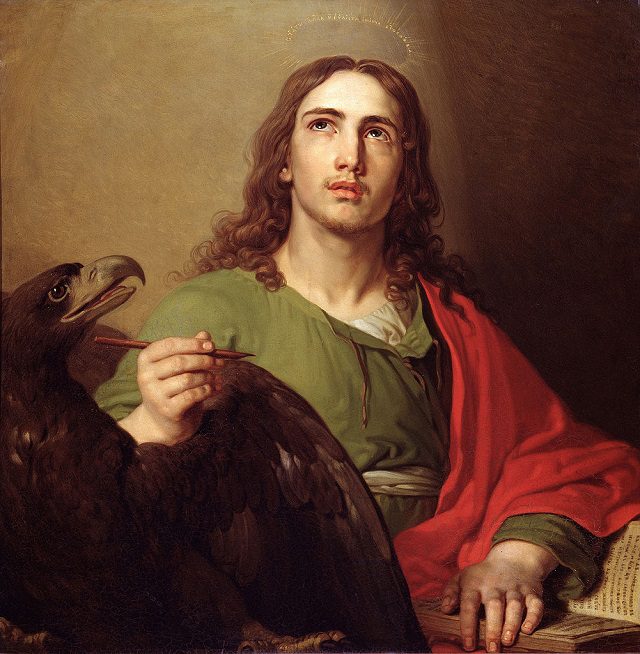
Photo credit: St John the Evangelist (1804-1809), by Vladimir Borovikovsky (1757-1825) [public domain / Wikimedia Commons]

***
Summary: Atheist Jonathan MS Pearce sez John didn’t write the Gospel of John, citing skeptics of the traditional view. I argue the contrary from extensive internal and external historical evidence.
Previous Post
September 1, 2021
Limited Atonement: Refutation of James White
Next Post

September 3, 2021 COVID: Catholics Can't Avoid "Remote Cooperation with Evil"
Browse Our Archives
Select a Category & Last Things About Me Anti-Catholicism Atheism & Agnosticism Baptism and Sacramentalism Bible and Tradition Blessed Virgin Mary Books by Dave Armstrong C. S. Lewis Calvinism & General Protestantism Catholic Apologetics Catholic Apologists Catholic conversion Catholic converts Christmas Church (Ecclesiology) Church History Conversion and Converts Development of Doctrine Eastern Orthodoxy Ecumenism & Christian Unity Eucharist & Liturgy Fathers of the Church French Translations G. K. Chesterton Hell Hell & Satan Hell & Satan & Last Things Heresies & Comparative Religion Holistic Health Inquisition & Crusades & Scandals James White Jews & Judaism & Old Testament John Calvin John Henry Newman Liberal / Modernist Theology Life Issues Literary Resume Lutheranism Mariology Martin Luther Music Orthodoxy Papacy & Infallibility Personal Page Philosophy & Science Political & Ethical & Moral Issues Protestant Persecution & Intolerance Protestantism Purgatory Purgatory & Penance Romantic & Imaginative Theology Saints & Purgatory & Penance Salvation Salvation & Justification Satan & Last Things Sexuality and Gender Issues Spanish Translations Traditionalism vs. Radical Catholic Reactionaries Traducciones al español / tradução para português Trinitarianism & Christology Uncategorized Videos
Select a Month October 2026 September 2026 August 2026 July 2026 June 2026 May 2026 April 2026 March 2026 February 2026 January 2026 December 2025 November 2025 October 2025 September 2025 August 2025 July 2025 June 2025 May 2025 April 2025 March 2025 February 2025 January 2025 December 2024 November 2024 October 2024 September 2024 August 2024 July 2024 June 2024 May 2024 April 2024 March 2024 February 2024 January 2024 December 2023 November 2023 October 2023 September 2023 August 2023 July 2023 June 2023 May 2023 April 2023 March 2023 February 2023 January 2023 December 2022 November 2022 October 2022 September 2022 August 2022 July 2022 June 2022 May 2022 April 2022 March 2022 February 2022 January 2022 December 2021 November 2021 October 2021 September 2021 August 2021 July 2021 June 2021 May 2021 April 2021 March 2021 February 2021 January 2021 December 2020 November 2020 October 2020 September 2020 August 2020 July 2020 June 2020 May 2020 April 2020 March 2020 February 2020 January 2020 December 2019 November 2019 October 2019 September 2019 August 2019 July 2019 June 2019 May 2019 April 2019 March 2019 February 2019 January 2019 December 2018 November 2018 October 2018 September 2018 August 2018 July 2018 June 2018 May 2018 April 2018 March 2018 February 2018 January 2018 December 2017 November 2017 October 2017 September 2017 August 2017 July 2017 June 2017 May 2017 April 2017 March 2017 February 2017 January 2017 December 2016 November 2016 October 2016 September 2016 August 2016 July 2016 June 2016 May 2016 April 2016 March 2016 February 2016 January 2016 December 2015 November 2015 October 2015 September 2015 August 2015 July 2015 June 2015 May 2015 April 2015 March 2015 February 2015 January 2015 December 2014 November 2014 October 2014 September 2014 August 2014 July 2014 June 2014 April 2014 March 2014 February 2014 January 2014 December 2013 November 2013 October 2013 September 2013 August 2013 July 2013 June 2013 April 2013 March 2013 February 2013 January 2013 December 2012 November 2012 October 2012 September 2012 August 2012 July 2012 June 2012 May 2012 April 2012 March 2012 February 2012 January 2012 December 2011 November 2011 October 2011 September 2011 August 2011 July 2011 June 2011 April 2011 March 2011 February 2011 October 2010 September 2010 August 2010 July 2010 April 2010 March 2010 December 2009 October 2009 August 2009 July 2009 June 2009 May 2009 March 2009 February 2009 October 2008 September 2008 April 2008 March 2008 February 2008 January 2008 December 2007 November 2007 October 2007 May 2007 March 2007 February 2007 January 2007 November 2006 October 2006 September 2006 August 2006 July 2006 June 2006 May 2006 April 2006 March 2006 February 2006 October 2005 June 2005 April 2005 February 2005 July 2004 May 2004 April 2004
Follow Us!
TAKE THE
Religious Wisdom Quiz
Who prayed for rain after a long drought and sent his servant to look seven times?
Select your answer to see how you score.
Elijah Isaiah Samuel Hosea
Books by This Author Books by Dave Armstrong
Related posts from Biblical Evidence for Catholicism

A Few "Worst" & "Best" Arguments vs. Protestantism
Biblical Evidence for Catholicism

Jerusalem Council vs. James White & Sola Scriptura
Biblical Evidence for Catholicism

Biblical Perspicuity: Absurd Anti-Catholic "Defense"
Biblical Evidence for Catholicism

50 Biblical Disproofs of "Evident Clearness" of the...
Biblical Evidence for Catholicism
TRENDING AT PATHEOS Catholic

I was strolling through the top floor of the brand new Parthenon...

What Does Gêvâh Mean For Kimberley Guifoyle &...
This week, a lot of the news is focused on Kimberly Guilfoyle....

INNER CIRCLE: Profound Mystery (Of Christ In All...
Ephesians 5:31-32 “For this reason, a man will leave his father and...

Do Not Rejoice When Your Enemy Falls: The...
Turning an execution into a public spectacle is a disturbing expression of...

'The Chosen' S6 Trailer: The Passion Gets Very...
Not many watching 'The Chosen' worry about spoilers, but just because they...

The purpose-driven labor priest
A labor activist reads Rick Warren and it gets me wondering about...
view all Catholic blogs
Ad-Free & Subscriber Log-In Subscription Support
- About Us
- 2026 Calendar
- Videos
- Podcasts
- Library of World Religions
- Faith In Media Tracker
- Advertise With Us
- Write for Us
- Privacy Policy
- Terms of Service
- Do Not Sell My Data
- Contact Us
- Radiant Digital
- Manage Newsletter Subscriptions
- Unsubscribe From Notifications
- Sitemap
Copyright 2008-2026, Patheos. All rights reserved.
Subscription Support Ad-Free & Subscriber Log-In
Follow Patheos