
BuddhistCatholicContemplativeEvangelicalGeneral ChristianHinduJewishLatter-day SaintMuslimNew VisionsProgressive Christian
Beliefs
- Buddhist
- Catholic
- Contemplative
- Evangelical
- General Christian
- Hindu
- Jewish
- Latter-day Saint
- More Voices
- Muslim
- New Visions
- Pagan
- Progressive Christian
Topics
- Religion News
- Food and Religion
- Sports and Religion
- Religious Art
- Religious Music and Entertainment
- Religious Events
- History and Religion
- Style and Religion
- Politics and Religion
- Women in Religion
- Recreation Outdoors and Religion
- Business Finance and Religion
- Careers Workplace and Religion
- Education and Religion
- Family Parenting and Religion
- Health Fitness and Religion
- Home and Religion
- Relationships and Religion
- Technology and Religion
- Travel and Religion
Columnists
- Buddhist Columnists
- Business Finance and Religion Columnists
- Careers Workplace and Religion Columnists
- Catholic Columnists
- Contemplative Columnists
- Education and Religion Columnists
- Evangelists Columnists
- Family Parenting and Religion Columnists
- General Christian Columnists
- Health Fitness and Religion Columnists
- Hindu Columnists
- History and Religion Columnists
- Home and Religion Columnists
- Jewish Columnists
- More Voices Columnists
- Latter Day Columnists
- Muslim Columnists
- New Visions Columnists
- Nonreligious Columnists
- Pagan Columnists
- Politics and Religion Columnists
- Progressive Columnists
- Recreation Outdoors and Religion Columnists
- Relationships and Religion Columnists
- Religion News Columnists
- Religious Art Columnists
- Religious Events Columnists
- Religious Music and Entertainment Columnists
- Sports and Religion Columnists
- Style and Religion Columnists
- Technology and Religion Columnists
- Travel and Religion Columnists
- Women in Religion Columnists
Resource Library
- 2026 Calendar
- Library of World Religions
- The 100 Most Holy Places on Earth
- Patheos Answers
- Podcasts
- Videos
- Faith Leaders Database
- Anglican Episcopalian
- Bahai
- Baptist
- Buddhism
- Christianity
- Confucianism
- Eastern Orthodoxy
- Hinduism
- Holiness and Pentecostal
- ISKCON
- Islam
- Judaism
- Lutheran
- Methodist
- The Church of Jesus Christ of Latter-day Saints
- New Age
- Paganism
- Presbytarian and Reformed
- Protestantism
- Religion Behind the Scenes
- Roman Catholic
- Scientology
- Shia Islam
- Sikhism
- Sufism
- Sunni Islam
- Taoism
- Zen
- See all religions
Research Tools
 Ad-Free & Subscriber Log-In Subscription Support
Ad-Free & Subscriber Log-In Subscription Support
Follow Patheos 

- Trending:
- Forgiveness
- |
- Marriage
- |
- Consciousness
- |
- Death Penalty
- |
- Election
- |
- Halloween

-
About
-
Catholic Apologetics
-
Church History
-
Great Apologists
-
Christian Worldview
-
Protestantism & Misc.
- Home
- Catholic
- History and Religion
- Limited Atonement: Refutation of James White
Limited Atonement: Refutation of James White
Last updated on: September 1, 2021 at 12:05 pm by Dave Armstrong
Limited Atonement: Refutation of James White 2021-09-01T12:05:50-04:00 Dave Armstrong
Patheos Explore the world's faith through different perspectives on religion and spirituality! Patheos has the views of the prevalent religions and spiritualities of the world.
This is a reply to an article by Bishop “Dr.” [???] James White: Was Anyone Saved at the Cross? (8 May 1998). Back in 1998, Bishop White used to actually write articles, rather than simply talk on his podcast all the time (ah, the good ol’ Internet days). “Dr.” [???] White is, in my opinion, the most influential, well-known, and able Protestant anti-Catholic apologist / sophist / polemicist of our time: and certainly most published and “heard”: through his podcasts and oral debates. His words will be in blue.
*****
We say Christ so died that he infallibly secured the salvation of a multitude that no man can number, who through Christ’s death not only may be saved, but are saved, must be saved, and cannot by any possibility run the hazard of being anything but saved. —Charles Haddon Spurgeon
It’s true of the actual elect: that they “are saved, must be saved, and cannot by any possibility run the hazard of being anything but saved.” God knows in His omniscience who those folks are. We don’t (and John Calvin also noted this). But it doesn’t follow from the statement above that 1) human beings have no free will, or that 2) any who claim to be (or actually are) “saved” now, are utterly incapable of falling away, or 3) that we infallibly “know”, from our human perspective that individual X (a seeming serious Christian) is inexorably saved for all eternity.
There was a time when I called myself a “four-point Calvinist.” There are a lot of people who use that term, and, almost all the time, the one point of the five that they reject is the terrible, horrible, “L”. Limited atonement. There is just something about the term that doesn’t sound right. How can Christ’s atonement be limited? And that is exactly what I said until I began to seriously think about the whole issue.
Let it be known!: Bishop James White at one time held the biblical position on the atonement of Jesus Christ! But as time went on, he fell into the usual anti-biblical “either/or” thinking of five-point Calvinism, and got into line.
It is my experience that most of those who reject the specific, or limited atonement of Christ, do not really believe in the complete sovereignty of God, or the total depravity of man, or the unconditional election of God.
The first thing is not true. Non-Calvinists do not necessarily reject the sovereignty of God. They just have a different view on how it works out in practice, in relation to human free will. Total depravity is a false doctrine, that ought, therefore, to be rejected. God elects the elect, but it’s not unconditional, insofar as He does so without violating their free will choice to accept this election.
Most objections that are lodged against the doctrine are actually objections to one of the preceding points, not against limited atonement itself.
Again, it’s true of the second and third things, but not of God’s sovereignty. My argument against it is based on the Bible; period.
The “break” in my thinking came from reading Edwin Palmer’s book*, The Five Points of Calvinism*. [Edwin H. Palmer, The Five Points of Calvinism (Grand Rapids: Baker Book House, 1980) pp. 41-55.] In doing a radio program on the truth of God’s electing grace, I was challenged by a caller in regards to the death of Christ. “Why would Christ die for the whole world if God did not intend to save everyone?” I looked at my co-host, and he looked at me, and I made a mental note to do more study into that particular question. I grabbed Palmer’s book as soon as I returned home, and began to read the chapter on the atoning work of Christ.
It’s always good to know the origin of someone’s adoption of any particular theological error.
I became a full “five-pointer” upon reading the following section:
The question that needs a precise answer is this: Did He or didn’t He? Did Christ actually make a substitutionary sacrifice for sins or didn’t He? If He did, then it was not for all the world, for then all the world would be saved. (Palmer, The Five Points of Calvinism, p. 47.)
Of course this involves the false premise of no free will of man to reject the free offer of salvation. Universal atonement means that Jesus made a way on the cross for absolutely every human being to be saved. If they are saved, it is all grace (with even their meritorious good works made possible by said grace). If they’re not, it’s because they rejected God’s free offer of grace. God didn’t create a bunch of robots, who could do nothing other than follow His will at every turn. We must choose to follow God or reject Him:
Deuteronomy 30:15, 19 (RSV) . . . I have set before you this day life and good, death and evil. . . . [19] . . . I have set before you life and death, blessing and curse; therefore choose life, that you and your descendants may live,
Joshua 24:15, 20-24 And if you be unwilling to serve the LORD, choose this day whom you will serve, whether the gods your fathers served in the region beyond the River, or the gods of the Amorites in whose land you dwell; but as for me and my house, we will serve the LORD.” . . . If you forsake the LORD and serve foreign gods, then he will turn and do you harm, and consume you, after having done you good.” [21] And the people said to Joshua, “Nay; but we will serve the LORD.” [22] Then Joshua said to the people, “You are witnesses against yourselves that you have chosen the LORD, to serve him.” And they said, “We are witnesses.” [23] He said, “Then put away the foreign gods which are among you, and incline your heart to the LORD, the God of Israel.” [24] And the people said to Joshua, “The LORD our God we will serve, and his voice we will obey.”
Matthew 11:28 Come to me, all who labor and are heavy laden, and I will give you rest.
I was faced with a decision. If I maintained a “universal” atonement, that is, if I said that Christ died substitutionarily in the place of every single man and woman in all the world, then I was forced to either say that 1) everyone will be saved, or 2) the death of Christ is insufficient to save without additional works.
This doesn’t logically or biblically follow at all. Again, he falsely presupposes that human beings have no free will by which they can reject God and His grace and salvation. They clearly do have such a will and an ability, according to the Bible. Nor is it “works” to simply accept a free offer of salvation. I critiqued this mistaken mentality in my recent reply to White on baptismal regeneration. St. Paul repeatedly teaches that we do indeed “do something” in the matter of our own salvation, but that this is not “a dead work by an unregenerate person.” It is part of the grace that God gives us. We simply cooperate with it.
I knew that I was not willing to believe that Christ’s death could not save outside of human actions. So I had to understand that Christ’s death was made in behalf of God’s elect, and that it does accomplish its intention, it does save those for whom it is made. At this point I realized that I had “limited” the atonement all along. In fact, if you do not believe in the Reformed doctrine of “limited atonement,” you believe in a limited atonement anyway! How so? Unless you are a universalist (that is, unless you believe that everyone will be saved), then you believe that the atonement of Christ, if it is made for all men, is limited in its effect. You believe that Christ can die in someone’s place and yet that person may still be lost for eternity. You limit the power and effect of the atonement. I limit the scope of the atonement, while saying that its power and effect is unlimited!
Yes, God is limited in His perfect will by the rebellious choices of men. This is how God chose for things to be: for us to have free will to accept or reject Him. And so some men reject His grace and forgiveness:
Matthew 23:37-38 O Jerusalem, Jerusalem, killing the prophets and stoning those who are sent to you! How often would I have gathered your children together as a hen gathers her brood under her wings, and you would not! [38] Behold, your house is forsaken and desolate.
One writer expressed it well when he said,
Let there be no misunderstanding at this point. The Arminian limits the atonement as certainly as does the Calvinist. The Calvinist limits the extent of it in that he says it does not apply to all persons…while the Arminian limits the power of it, for he says that in itself it does not actually save anybody. The Calvinist limits it quantitatively, but not qualitatively; the Arminian limits it qualitatively, but not quantitatively. For the Calvinist it is like a narrow bridge that goes all the way across the stream; for the Arminian it is like a great wide bridge that goes only half-way across. As a matter of fact, the Arminian places more severe limitations on the work of Christ than does the Calvinist. (Lorraine Boettner, The Reformed Doctrine of Predestination (Phillipsburg, New Jersey: Presbyterian and Reformed Publishing Company, 1932) p. 153.)
This is sheer nonsense. The non-Calvinist is not saying that the atonement “does not actually save anybody.” That’s an outrageous caricature. It saves all who are saved in the end, and all who are willing to be saved (the possibility and free gift are there for everyone), and unwilling to reject God. The free gift is available to all:
Psalm 86:5 For thou, O Lord, art good and forgiving, abounding in steadfast love to all who call on thee.
Isaiah 53:5-6 But he was wounded for our transgressions, he was bruised for our iniquities; upon him was the chastisement that made us whole, and with his stripes we are healed. [6] All we like sheep have gone astray; we have turned every one to his own way; and the LORD has laid on him the iniquity of us all.
Isaiah 55:1 Ho, every one who thirsts, come to the waters; . . . (cf. 45:22; Joel 2:32)
Zechariah 1:3 Therefore say to them, Thus says the LORD of hosts: Return to me, says the LORD of hosts, and I will return to you, says the LORD of hosts.
Matthew 9:13 . . . For I came not to call the righteous, but sinners.
Mark 2:17 And when Jesus heard it, he said to them, “Those who are well have no need of a physician, but those who are sick; I came not to call the righteous, but sinners.”
Luke 5:31-32 And Jesus answered them, “Those who are well have no need of a physician, but those who are sick; [32] I have not come to call the righteous, but sinners to repentance.”
Luke 19:10 For the Son of man came to seek and to save the lost.
John 1:29 The next day he saw Jesus coming toward him, and said, “Behold, the Lamb of God, who takes away the sin of the world!”
John 3:14-17 “And as Moses lifted up the serpent in the wilderness, so must the Son of man be lifted up, [15] that whoever believes in him may have eternal life.” [16] For God so loved the world that he gave his only Son, that whoever believes in him should not perish but have eternal life. [17] For God sent the Son into the world, not to condemn the world, but that the world might be saved through him.
John 4:42 “. . . this is indeed the Savior of the world.”
John 6:33 For the bread of God is that which comes down from heaven, and gives life to the world. (cf. 8:12; 9:5)
John 6:51 I am the living bread which came down from heaven; if any one eats of this bread, he will live for ever; and the bread which I shall give for the life of the world is my flesh.
John 11:51-52 He did not say this of his own accord, but being high priest that year he prophesied that Jesus should die for the nation, [52] and not for the nation only, but to gather into one the children of God who are scattered abroad.
John 12:32 and I, when I am lifted up from the earth, will draw all men to myself.
John 12:46 If any one hears my sayings and does not keep them, I do not judge him; for I did not come to judge the world but to save the world. (cf. 12:46: “light into the world”)
John 17:21 that they may all be one; even as thou, Father, art in me, and I in thee, that they also may be in us, so that the world may believe that thou hast sent me. (cf. 17:23)
Acts 2:21 And it shall be that whoever calls on the name of the Lord shall be saved. (cf. Rom 10:13)
Romans 5:6 While we were still weak, at the right time Christ died for the ungodly.
Romans 5:15 But the free gift is not like the trespass. For if many died through one man’s trespass [original sin], much more have the grace of God and the free gift in the grace of that one man Jesus Christ abounded for many. [universal atonement] (cf. 5:17, 20-21)
Romans 11:32 For God has consigned all men to disobedience, that he may have mercy upon all.
2 Corinthians 5:14-15, 19 For the love of Christ controls us, because we are convinced that one has died for all; therefore all have died. [15] And he died for all, that those who live might live no longer for themselves but for him who for their sake died and was raised.. . . [19] that is, in Christ God was reconciling the world to himself, not counting their trespasses against them, and entrusting to us the message of reconciliation.
1 Timothy 1:15 The saying is sure and worthy of full acceptance, that Christ Jesus came into the world to save sinners. And I am the foremost of sinners;
1 Timothy 2:3-6 . . . God our Savior, [4] who desires all men to be saved and to come to the knowledge of the truth. [5] For there is one God, and there is one mediator between God and men, the man Christ Jesus, [6] who gave himself as a ransom for all, . . .
1 Timothy 4:10 For to this end we toil and strive, because we have our hope set on the living God, who is the Savior of all men, especially of those who believe.
Titus 2:11 For the grace of God has appeared for the salvation of all men
Hebrews 2:9 But we see Jesus, who for a little while was made lower than the angels, crowned with glory and honor because of the suffering of death, so that by the grace of God he might taste death for every one.
2 Peter 2:1, 15 But false prophets also arose among the people, just as there will be false teachers among you, who will secretly bring in destructive heresies, even denying the Master who bought them, bringing upon themselves swift destruction.. . . [15] Forsaking the right way they have gone astray . . .
2 Peter 3:9 The Lord is not slow about his promise as some count slowness, but is forbearing toward you, not wishing that any should perish, but that all should reach repentance.
That’s undeniable biblical teaching. But the fact that all are not saved is also biblical teaching. Therefore, what causes them not to be saved? Their free rejection of God’s grace . . .
Therefore, we are not talking about presenting some terrible limitation on the work of Christ when we speak of “limited atonement.”
Not in the slightest. God chose to give us free will. That doesn’t limit the work of Christ. But it does allow a scenario whereby some could reject Him, just as Satan and the fallen angels rejected Him and God didn’t prevent that from happening by turning them into robots who could do no other. God could have simply disallowed them to do as they did (as it’ll be in heaven, where we literally aren’t able to sin any more, and in fact do not sin). But God chose not to. And that choice is also part of His sovereignty.
In fact, we are actually presenting a far greater view of the work of Christ on Calvary when we say that Christ’s death actually accomplishes something in reality rather than only in theory.
Actually saved — eschatologically saved — elect are not merely a “theory.” Jesus’ work on the cross “actually” accomplished that eventuality “in reality”! White is now embarrassing himself (as he does so often) with transparently ludicrous reasoning and a twisted caricature of opposing positions.
The atonement, we believe, was a real, actual, substitutionary one, not a possible, theoretical one that is dependent for its efficacy upon the actions of man.
The efficacy is not dependent on man. It is what it is: sufficient to save all men who will accept it. What is dependent upon man is whether each person will accept or reject God and His free offer of mercy and salvation. If a person accepts it, it was only because God’s grace enabled him or her to do so. If he or she rejects it, it’s because they chose in their free will to do so, just as Adam and Eve chose to listen to and follow the advice of the serpent rather than God. They chose their own wisdom over God’s: which is what every reprobate person does.
And, as one who often shares the gospel with people involved in false religious systems, I will say that the biblical doctrine of the atonement of Christ is a powerful truth that is the only message that has real impact in dealing with the many heretical teachings about Christ that are present in our world today. Jesus Christ died in behalf of those that the Father had, from eternity, decreed to save.
That’s not what the Bible teaches, per the many passages seen above. The most explicit biblical passages contrary to the false teaching of limited atonement are from St. Paul: “Christ died for the ungodly” (Rom 5:6). and “one has died for all. . . he died for all” (2 Cor 5:14-15). Neither “the ungodly” nor “all” are synonyms for “the elect.”
There is absolute unity between the Father and the Son in saving God’s people. The Father decrees their salvation, the Son dies in their place, and the Spirit sanctifies them and conforms them to the image of Christ. This is the consistent testimony of Scripture.
He certainly elects the elect. The question is how free will is related to that. Calvinists say man has no free will in this regard. Every other Christian group (the vast majority of Christians now and for two thousand years) — following the Bible, I would say — say he does.
The Intention of the Atonement
Why did Christ come to die? Did He come simply to make salvation possible, or did He come to actually obtain eternal redemption (Hebrews 9:12)? Let’s consider some passages from Scripture in answer to this question.
For the Son of Man came to seek and to save what was lost (Luke 19:10).
Here the Lord Jesus Himself speaks of the reason for His coming. He came to seek and to save the lost. Few have a problem with His seeking; many have a problem with the idea that He actually accomplished all of His mission. Jesus, however, made it clear that He came to actually save the lost. He did this by His death.
He saved whoever is saved. No problem there; no disagreement . . . White apparently thinks that all non-Calvinist Christians are Pelagians, or work-salvationists, thinking that anyone who is saved, saves himself with no necessary enabling of God’s grace. This is the caricature that Calvinists have used for 500 years. But even John Calvin rejected limited atonement in his later years:
He makes this favor common to all, because it is propounded to all, and not because it is in reality extended to all; for though Christ suffered for the sins of the whole world, and is offered through God’s benignity indiscriminately to all, yet all do not receive him. (Commentary on Romans 5:18)
Here is a trustworthy saying that deserves full acceptance: Christ Jesus came into the world to save sinners—of whom I am the worst (1 Timothy 1:15).
Paul asserts that the purpose of Christ’s coming into the world was to actually save sinners. Nothing in Paul’s words leads us to the conclusion that is so popular today—that Christ’s death simply makes salvation a possibility rather than a reality. Christ came to save. So, did He? And how did He? Was it not by His death? Most certainly. The atoning death of Christ provides forgiveness of sins for all those for whom it is made. That is why Christ came.
Christ came to save. We’re all sinners (original sin and actual sin). Therefore, whoever is saved, is a sinner. In other words, “sinners” is simply a synonym for “human beings” since we’re all sinners. Therefore, it means “Christ Jesus came into the world to save [men].” Again, if we go to the Bible and search “to save” we find that Jesus came “to save the lost” (Lk 19:10) [we’re all lost], “to save the world” (Jn 12:46). To “save sinners” is not different from these other things because we’re all sinners and lost.
Christ’s Intercessory Work
But because Jesus lives forever, he has a permanent priesthood. Therefore he is able to save completely those who come to God through him, because he always lives to intercede for them (Hebrews 7:24-26).
The New Testament closely connects the work of Christ as our High Priest and intercessor with His death upon the cross. In this passage from Hebrews, we are told that the Lord Jesus, since He lives forever, has an unchangeable or permanent priesthood. He is not like the old priests who passed away, but is a perfect priest, because He remains forever. Because of this He is able to save completely those who come to God through Him. Why? Because He always lives to make intercession for them.
Exactly! He saves them, provided they are willing to “come” to Him.
Now, before considering the relationship of the death of Christ to His intercession, I wish to emphasize the fact that the Bible says that Christ is able to save men completely. He is not limited simply to a secondary role as the great Assistor who makes it possible for man to save himself.
No kidding. No one who understands historic Christianity at all disbelieves this. So the good bishop is flailing at windmills again, as he is wont to do. It’s humorous, but doesn’t advance intelligent discussion.
Those who draw near to God through Christ will find full and complete salvation in Him.
Again, we “draw near” with our free will, enabled by His grace. He totally saves us’; we cooperate. White, as a good five-point Calvinist, wants to deny that we have free will, and “do” anything at all with regard to salvation. But this is unbiblical, as shown.
Furthermore, we must remember that Christ intercedes for those who draw near to God. I feel that it is obvious that Christ is not interceding for those who are not approaching God through Him. Christ’s intercession is in behalf of the people of God. We shall see how important this is in a moment.
The text doesn’t say this. It says He intercedes for “those who come to God through him.” It doesn’t say that He doesn’t intercede for those who don’t, and prays only for those who do. That’s just Calvinist preconceptions and traditions of men. If God desires that none perish (1 Tim 2:4), then certainly, Jesus is praying for all people, that they will be saved. The love and prayer would naturally go together. He certainly prayed for the obdurate in Jerusalem, over whom He lamented (Mt 23:37-38 above).
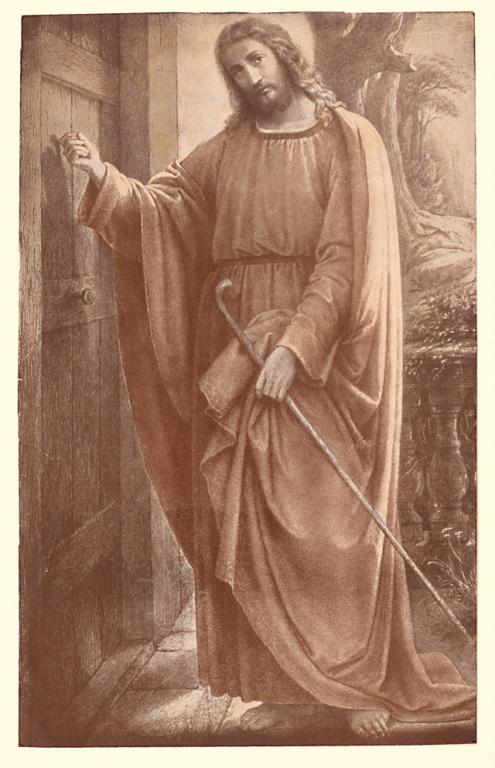
Jesus says: “Behold, I stand at the door and knock; if any one hears my voice and opens the door, I will come in to him and eat with him, and he with me” (Rev 3:20). He doesn’t say, “if the elect hear my voice . . . ” He says “if any one . . .” Yet Bishop White would have us believe that He doesn’t knock on the door of those who are not in the elect, and He doesn’t pray for them, either. He doesn’t know that. The Bible never says that He doesn’t pray for the lost, and it contains much that strongly suggests otherwise.
It is impossible that anyone for whom the Son did not die could receive Christ’s intercession. If Christ did not die in behalf of a certain individual, how could Christ intercede for that individual, since He would have no grounds upon which to seek the Father’s mercy?
Now Bishop White becomes even more absurd and unbiblical. He not only asserts that Jesus doesn’t pray for any ultimately lost / damned person, but moreover, that it is “impossible” for Him to do so. This is (I must say) blasphemy and turns Jesus into a demon and uncaring person, with no compassion. Jesus prays for all people on the basis of many Bible passages:
Ezekiel 18:23, 32 Have I any pleasure in the death of the wicked, says the Lord GOD, and not rather that he should turn from his way and live? . . . [32] For I have no pleasure in the death of any one, says the Lord GOD; so turn, and live.
Ezekiel 33:11 Say to them, As I live, says the Lord GOD, I have no pleasure in the death of the wicked, but that the wicked turn from his way and live; turn back, turn back from your evil ways; for why will you die, O house of Israel?
Luke 5:32 I have not come to call the righteous, but sinners to repentance.”
Luke 19:10 For the Son of man came to seek and to save the lost.
John 12:32 and I, when I am lifted up from the earth, will draw all men to myself.
Romans 5:6 While we were still weak, at the right time Christ died for the ungodly.
2 Corinthians 5:15 And he died for all, that those who live might live no longer for themselves but for him who for their sake died and was raised.. . .
1 Timothy 2:3-4 . . . God our Savior, [4] who desires all men to be saved and to come to the knowledge of the truth.
2 Peter 3:9 The Lord is not slow about his promise as some count slowness, but is forbearing toward you, not wishing that any should perish, but that all should reach repentance.
It is impossible that anyone for whom the Son intercedes could be lost. Can we imagine the Son pleading before the Father, presenting His perfect atonement in behalf of an individual that He wishes to save, and the Father rejecting the Son’s intercession? The Father always hears the Son (John 11:42). Would He not hear the Son’s pleas in behalf of all that the Son desires to save? Furthermore, if we believe that Christ can intercede for someone that the Father will not save, then we must believe either 1) that there is dissension in the Godhead, the Father desiring one thing, the Son another, or 2) that the Father is incapable of doing what the Son desires Him to do. Both positions are utterly impossible.
Nonsense. Again, the Bible clearly teaches that human beings can reject God’s free offer of grace:
Matthew 23:37-38 O Jerusalem, Jerusalem, killing the prophets and stoning those who are sent to you! How often would I have gathered your children together as a hen gathers her brood under her wings, and you would not! [38] Behold, your house is forsaken and desolate.
The Triune God desired for these people (along with everyone else who ever lived) to be saved, but they “would not.” God gives them the free will even to make a choice against Him.
That Christ does not act as High Priest for all men is clearly seen in His “High Priestly Prayer” in John 17. The Lord clearly distinguishes between the “world” and those who are His throughout the prayer, and verse 9 makes our point very strongly:
I pray for them. I am not praying for the world, but for those you have given me, for they are yours.
When Christ prays to the Father, He does not pray for the “world” but for those that have been given to Him by the Father (John 6:37).
Again, the “Dr.” [???] Bishop thinks illogically and concludes things that don’t follow. He’s simply praying for His disciples at this one point of time, and for the Church (17:20). We can’t conclude from this that He prays for no one else.
Jesus would not act in a way directly contrary to what St. Paul wrote in inspired, infallible Holy Scripture: “I urge that supplications, prayers, intercessions, and thanksgivings be made for all men” (1 Tim 2:1). And in context, he says of God three verses later: “who desires all men to be saved.” It makes no sense whatever that an apostle would command us to pray for all men, and that God desires all men to be saved, yet that Jesus (i.e., God) supposedly doesn’t pray for all men? That’s completely convoluted and unbiblical.
White then notes that Jesus died for “many” (Mt 20:28; Is 53:11), and for the “sheep” (Jn 10:11, 15), and the Church (Gal 2:20; Eph 5:2, 25-27; Titus 2:13-14), and “his friends” (Jn 15:13). It’s the same “either/or” fallacious thinking again. One thing doesn’t exclude a wider category. If I say “I love my wife” does it follow that I don’t love my children, too? If I tell one of my four children that I love them, does it follow that I don’t love the other three? The fact remains that the Bible says that Jesus died for all men. I’ve already proven that. See the passages above in the long listing. This is what White needs to harmonize. The Bible is in perfect harmony with itself. It’s only White’s thinking that is viciously self-contradictory.
Christ gave Himself in behalf of His Church, His Body, and that for the purpose of cleansing her and making her holy. If this was His intention for the Church, why would He give Himself for those who are not of the Church?
Obviously because He loves all men, as the Bible says, and therefore gives them the opportunity to be saved, if they will simply accept it.
Would He not wish to make these “others” holy as well?
Yes of course. But He won’t do so at the expense of their free will choices. If a person “must” do something and can do no other, he can’t get credit for doing it. Yet the Bible does refer to differential rewards in heaven.
Yet, if Christ died for all men, there are many, many who will remain impure for all eternity. Was Christ’s death insufficient to cleanse them? Certainly not.
We fully agree!
We have seen, then, that the Word teaches that Christ died for many, for His sheep, for the Church, for the elect of God, for His friends, for a people zealous for good works, for His people, for each and every Christian.
Yes He did. And that’s not all. White (like the classic selective proof texter) completely ignores the several passages that say He died for “all men” (Jn 12:32; 1 Tim 4:10), the “world” (Jn 1:29; 3:17; 4:42, 6:43, 51; 12:46; 2 Cor 5:29), “whoever believes” (Jn 3:15-16), “the ungodly” (Rom 5:6), “all” (2 Cor 5:14-15; 1 Tim 2:6), “sinners” (1 Tim 1:15), and “every one” (Heb 2:9). That’s an awful lot of Bible to ignore and to pretend is nonexistent, ain’t it?
***
Photo credit: Loren Biser [PublicDomainPictures.Net]
***
Summary: Anti-Catholic polemicist James White gives it all he’s got to defend the blasphemous and false doctrine of limited atonement, but I show how he ignores scores of contrary Bible passages.
Calvinism & General Protestantism
James White & limited atonement
Previous Post

August 31, 2021
Bible on Germ Theory: An Atheist Hems & Haws
Next Post
September 2, 2021 Pearce’s Potshots #46: Who Wrote the Gospel of John?
Browse Our Archives
Select a Category & Last Things About Me Anti-Catholicism Atheism & Agnosticism Baptism and Sacramentalism Bible and Tradition Blessed Virgin Mary Books by Dave Armstrong C. S. Lewis Calvinism & General Protestantism Catholic Apologetics Catholic Apologists Catholic conversion Catholic converts Christmas Church (Ecclesiology) Church History Conversion and Converts Development of Doctrine Eastern Orthodoxy Ecumenism & Christian Unity Eucharist & Liturgy Fathers of the Church French Translations G. K. Chesterton Hell Hell & Satan Hell & Satan & Last Things Heresies & Comparative Religion Holistic Health Inquisition & Crusades & Scandals James White Jews & Judaism & Old Testament John Calvin John Henry Newman Liberal / Modernist Theology Life Issues Literary Resume Lutheranism Mariology Martin Luther Music Orthodoxy Papacy & Infallibility Personal Page Philosophy & Science Political & Ethical & Moral Issues Protestant Persecution & Intolerance Protestantism Purgatory Purgatory & Penance Romantic & Imaginative Theology Saints & Purgatory & Penance Salvation Salvation & Justification Satan & Last Things Sexuality and Gender Issues Spanish Translations Traditionalism vs. Radical Catholic Reactionaries Traducciones al español / tradução para português Trinitarianism & Christology Uncategorized Videos
Select a Month October 2026 September 2026 August 2026 July 2026 June 2026 May 2026 April 2026 March 2026 February 2026 January 2026 December 2025 November 2025 October 2025 September 2025 August 2025 July 2025 June 2025 May 2025 April 2025 March 2025 February 2025 January 2025 December 2024 November 2024 October 2024 September 2024 August 2024 July 2024 June 2024 May 2024 April 2024 March 2024 February 2024 January 2024 December 2023 November 2023 October 2023 September 2023 August 2023 July 2023 June 2023 May 2023 April 2023 March 2023 February 2023 January 2023 December 2022 November 2022 October 2022 September 2022 August 2022 July 2022 June 2022 May 2022 April 2022 March 2022 February 2022 January 2022 December 2021 November 2021 October 2021 September 2021 August 2021 July 2021 June 2021 May 2021 April 2021 March 2021 February 2021 January 2021 December 2020 November 2020 October 2020 September 2020 August 2020 July 2020 June 2020 May 2020 April 2020 March 2020 February 2020 January 2020 December 2019 November 2019 October 2019 September 2019 August 2019 July 2019 June 2019 May 2019 April 2019 March 2019 February 2019 January 2019 December 2018 November 2018 October 2018 September 2018 August 2018 July 2018 June 2018 May 2018 April 2018 March 2018 February 2018 January 2018 December 2017 November 2017 October 2017 September 2017 August 2017 July 2017 June 2017 May 2017 April 2017 March 2017 February 2017 January 2017 December 2016 November 2016 October 2016 September 2016 August 2016 July 2016 June 2016 May 2016 April 2016 March 2016 February 2016 January 2016 December 2015 November 2015 October 2015 September 2015 August 2015 July 2015 June 2015 May 2015 April 2015 March 2015 February 2015 January 2015 December 2014 November 2014 October 2014 September 2014 August 2014 July 2014 June 2014 April 2014 March 2014 February 2014 January 2014 December 2013 November 2013 October 2013 September 2013 August 2013 July 2013 June 2013 April 2013 March 2013 February 2013 January 2013 December 2012 November 2012 October 2012 September 2012 August 2012 July 2012 June 2012 May 2012 April 2012 March 2012 February 2012 January 2012 December 2011 November 2011 October 2011 September 2011 August 2011 July 2011 June 2011 April 2011 March 2011 February 2011 October 2010 September 2010 August 2010 July 2010 April 2010 March 2010 December 2009 October 2009 August 2009 July 2009 June 2009 May 2009 March 2009 February 2009 October 2008 September 2008 April 2008 March 2008 February 2008 January 2008 December 2007 November 2007 October 2007 May 2007 March 2007 February 2007 January 2007 November 2006 October 2006 September 2006 August 2006 July 2006 June 2006 May 2006 April 2006 March 2006 February 2006 October 2005 June 2005 April 2005 February 2005 July 2004 May 2004 April 2004
Follow Us!
TAKE THE
Religious Wisdom Quiz
What does "Bartholomew" mean in Aramaic?
Select your answer to see how you score.
Servant of God The Lord is my Shepherd Fisher of Men Son of Talmai
Books by This Author Books by Dave Armstrong
Related posts from Biblical Evidence for Catholicism

On Protestant Explanations of Catholic Conversion
Biblical Evidence for Catholicism

Bible & Catholicism on Mortal Sin (vs. John...
Biblical Evidence for Catholicism

Dialogue on Eternal Security / Absolute Assurance
Biblical Evidence for Catholicism

Protestant Confessions & "Ever-Virgin" Mary
Biblical Evidence for Catholicism
TRENDING AT PATHEOS Catholic

Pope Leo Celebrates Mass for Nurses & Docs...
I don't have any idea how he did it, but Pope Leo...

The Sermon on the Mount, Part I: Matthew...
The Sermon on the Mount, Part I (Matthew 4:12-5:12) St. Matthew moves...

What's up from Crossway: Reviewing some of their latest A few weeks...

Janie Learns the Way of the Cross: A...
Teaching children about Jesus' Passion can be challenging. Many parents and educators...

Looking For Good Catholic Writing - October 2026
He alone extends the heavens, and he walks upon the waves of...

In "Irreplaceable," our book on vocation and technology, Trevor Sutton and I...
view all Catholic blogs
Ad-Free & Subscriber Log-In Subscription Support
- About Us
- 2026 Calendar
- Videos
- Podcasts
- Library of World Religions
- Faith In Media Tracker
- Advertise With Us
- Write for Us
- Privacy Policy
- Terms of Service
- Do Not Sell My Data
- Contact Us
- Radiant Digital
- Manage Newsletter Subscriptions
- Unsubscribe From Notifications
- Sitemap
Copyright 2008-2026, Patheos. All rights reserved.
Subscription Support Ad-Free & Subscriber Log-In
Follow Patheos