
BuddhistCatholicContemplativeEvangelicalGeneral ChristianHinduJewishLatter-day SaintMuslimNew VisionsProgressive Christian
Beliefs
- Buddhist
- Catholic
- Contemplative
- Evangelical
- General Christian
- Hindu
- Jewish
- Latter-day Saint
- More Voices
- Muslim
- New Visions
- Pagan
- Progressive Christian
Topics
- Religion News
- Food and Religion
- Sports and Religion
- Religious Art
- Religious Music and Entertainment
- Religious Events
- History and Religion
- Style and Religion
- Politics and Religion
- Women in Religion
- Recreation Outdoors and Religion
- Business Finance and Religion
- Careers Workplace and Religion
- Education and Religion
- Family Parenting and Religion
- Health Fitness and Religion
- Home and Religion
- Relationships and Religion
- Technology and Religion
- Travel and Religion
Columnists
- Buddhist Columnists
- Business Finance and Religion Columnists
- Careers Workplace and Religion Columnists
- Catholic Columnists
- Contemplative Columnists
- Education and Religion Columnists
- Evangelists Columnists
- Family Parenting and Religion Columnists
- General Christian Columnists
- Health Fitness and Religion Columnists
- Hindu Columnists
- History and Religion Columnists
- Home and Religion Columnists
- Jewish Columnists
- More Voices Columnists
- Latter Day Columnists
- Muslim Columnists
- New Visions Columnists
- Nonreligious Columnists
- Pagan Columnists
- Politics and Religion Columnists
- Progressive Columnists
- Recreation Outdoors and Religion Columnists
- Relationships and Religion Columnists
- Religion News Columnists
- Religious Art Columnists
- Religious Events Columnists
- Religious Music and Entertainment Columnists
- Sports and Religion Columnists
- Style and Religion Columnists
- Technology and Religion Columnists
- Travel and Religion Columnists
- Women in Religion Columnists
Resource Library
- 2026 Calendar
- Library of World Religions
- The 100 Most Holy Places on Earth
- Patheos Answers
- Podcasts
- Videos
- Faith Leaders Database
- Anglican Episcopalian
- Bahai
- Baptist
- Buddhism
- Christianity
- Confucianism
- Eastern Orthodoxy
- Hinduism
- Holiness and Pentecostal
- ISKCON
- Islam
- Judaism
- Lutheran
- Methodist
- The Church of Jesus Christ of Latter-day Saints
- New Age
- Paganism
- Presbytarian and Reformed
- Protestantism
- Religion Behind the Scenes
- Roman Catholic
- Scientology
- Shia Islam
- Sikhism
- Sufism
- Sunni Islam
- Taoism
- Zen
- See all religions
Research Tools
 Ad-Free & Subscriber Log-In Subscription Support
Ad-Free & Subscriber Log-In Subscription Support
Follow Patheos 

- Trending:
- Forgiveness
- |
- Marriage
- |
- Consciousness
- |
- Death Penalty
- |
- Election
- |
- Halloween

-
About
-
Catholic Apologetics
-
Church History
-
Great Apologists
-
Christian Worldview
-
Protestantism & Misc.
- Home
- Catholic
- History and Religion
- Jesus’ “Brothers” (Not Siblings) 0101: vs. Jason Engwer
Jesus’ “Brothers” (Not Siblings) 0101: vs. Jason Engwer
Last updated on: September 23, 2021 at 2:52 pm by Dave Armstrong
Jesus’ “Brothers” (Not Siblings) 0101: vs. Jason Engwer 2021-09-23T14:52:36-04:00 Dave Armstrong
Patheos Explore the world's faith through different perspectives on religion and spirituality! Patheos has the views of the prevalent religions and spiritualities of the world.
The Actual Biblical Data Brought to Bear, Rather Than Late (Post-Luther and Post-Calvin) Protestant Traditions of Men
Protestant anti-Catholic apologist and polemicist Jason Engwer follows the standard theologically liberal take that Jesus had literal blood brothers / siblings. This was not Martin Luther’s or John Calvin’s view. It didn’t come from classic, original Protestantism, but from skeptical theological liberalism hundreds of years later.
Jason wrote an article entitled, “Some Undesigned Coincidences Related To Peter’s Names” (9-19-21) that presupposed the existence of siblings of Jesus. His words will be in blue:
[T]wo of the gospels report that Jesus had a brother named Simon (Matthew 13:55, Mark 6:3), . . . the two gospels that name Jesus’ brothers. Even in Matthew and Mark, the reference to a brother named Simon is brief and occurs in passing, and that brother didn’t have the sort of later prominence that James and Jude had.
. . . both Jesus and James were drawing a connection to the name of one of their brothers, . . . Simon was their youngest brother. . . . Youngest children often get treated differently because of their status as the youngest. Jesus may have had more affection for his brother Simon accordingly. . . . The angel didn’t have a brother named Simon, as Jesus and James did.
Okay. Why don’t we take a look at the two passages he cites, and cross-reference them to other related ones, to see if it makes any sense to believe that all four persons mentioned were Jesus’ literal siblings. Protestants always want the Bible first and foremost. I’m happy to bring up much more of it (relevant to the topic) than Jason does.
Matthew 13:55-56 (RSV) Is not this the carpenter’s son? Is not his mother called Mary? And are not his brothers James and Joseph and Simon and Judas? [56] And are not all his sisters with us? . . .
Mark 6:3 “Is not this the carpenter, the son of Mary and brother of James and Joses and Judas and Simon, and are not his sisters here with us?” . . .
***
Matthew 27:55-56 There were also many women there [at the crucifixion], looking on from afar, who had followed Jesus from Galilee, ministering to him; [56]among whom were Mary Mag’dalene, and Mary the mother of James and Joseph, . . .
Mark 15:40-41 There were also women looking on from afar, among whom were Mary Mag’dalene, and Mary the mother of James the younger and of Joses, and Salo’me, [41] who, when he was in Galilee, followed him, and ministered to him; . . .
John 19:25 . . . standing by the cross of Jesus were his mother, and his mother’s sister, Mary the wife of Clopas, and Mary Mag’dalene.
Therefore, “brothers” James and Joseph are the sons of Mary, wife of Clopas. This other Mary (Mt 27:61; 28:1) is called Our Lady’s adelphe [Greek for brother or sister or more distant relative, kin, friend, etc.] in John 19:25. Assuming that there are not two women named “Mary” in one family (which seems reasonable!), they cold then be Jesus’ “cousins” (beyond first cousin) or more distant relatives. Matthew 13:55-56 and Mark 6:3 mention Simon, Jude and “sisters” along with James and Joseph, calling all adelphoi.
The most plausible interpretation of all this related data is a use of adelphos as “cousins” rather than “siblings.” We know for sure, from the above information, that James and Joseph were not Jesus’ siblings.
But there is another option, too. Eusebius, in his History of the Church (III, 2), documents Hegesippus (c. 110 – c. 180) stating that Clopas (husband of Mary’s sister) was the brother of Joseph, her husband. That would make this “other Mary” the Blessed Virgin Mary’s sister-in-law, and her sons (James and Joseph named), Jesus’ first cousins.
Neither Hebrew nor Aramaic have words for “cousin.” The New Testament was written in Greek, which does have such a word (sungenis), but Jesus and His disciples spoke Aramaic (a late version of Hebrew), and the Hebrew word ach is literally translated as adelphos, the literal equivalent of the English “brother.” In the Bible, it has a very wide range of meanings beyond “sibling”: just as “brother” does in English. Thus, it is routinely used in the New Testament to describe cousins or kinsmen, etc.
It’s true that sungenis and its cognate sungenia appear in the New Testament fifteen times (sungenia: Lk 1:61; Acts 7:3, 14; sungenis: Mk 6:4; Lk 1:36, 58; 2:44; 14:12; 21:16; Jn 18:26; Acts 10:24; Rom 9:3; 16:7, 11, 21). But they are usually translated kinsmen, kinsfolk, or kindred in KJV: that is, in a sense wider than cousin: often referring to the entire nation of Hebrews. Thus, the eminent Protestant linguist W. E. Vine, in his Expository Dictionary of New Testament Words, lists sungenis not only under “Cousin” but also under “Kin, Kinsfolk, Kinsman, Kinswoman.”
Jesus Himself uses “brethren” (adelphos) in the non-sibling sense. In Matthew 23:8 (cf. 12:49-50), He calls, for example, the “crowds” and His “disciples” (23:1) “brethren.” In other words, they are each other’s “brothers”: the brotherhood of Christians.
Luke was a Greek Gentile. Paul, though Jewish, was raised in the very cosmopolitan, culturally Greek town of Tarsus. But even so, both still clearly used adelphos many times with the meaning of non-sibling:
- Luke 10:29 But he, desiring to justify himself, said to Jesus, “And who is my neighbor?”
- Acts 3:17 “And now, brethren, I know that you acted in ignorance, as did also your rulers.”
- Acts 7:23, 25-26 “When he was forty years old, it came into his heart to visit his brethren, the sons of Israel.. . . [25] He supposed that his brethren understood that God was giving them deliverance by his hand, but they did not understand. [26] And on the following day he appeared to them as they were quarreling and would have reconciled them, saying, `Men, you are brethren, why do you wrong each other?’”
- Romans 1:13 I want you to know, brethren, . . .
- Romans 9:3 For I could wish that I myself were accursed and cut off from Christ for the sake of my brethren, my kinsmen by race.
- 1 Thessalonians 1:4 For we know, brethren beloved by God, that he has chosen you;
Strikingly, it looks like every time St. Paul uses adelphos (unless I missed one or two), he means it as something other than blood brother or sibling. He uses the word or related cognates no less than 138 times in this way. Yet we often hear about Galatians 1:19: “James the Lord’s brother.” 137 other times, Paul means non-sibling, yet amazingly enough, here he must mean sibling, because (so we are told) he uses the word adelphos? That doesn’t make any sense.
Some folks think it is a compelling argument that sungenis isn’t used to describe the brothers of Jesus. But they need to examine the following passage, where sungenis appears:
Mark 6:4 And Jesus said to them, “A prophet is not without honor, except in his own country, and among his own kin, and in his own house.” (cf. Jn 7:5: “For even his brothers did not believe in him”)
What is the context? Let’s look at the preceding verse, where the people in “his own country” (6:1) exclaimed:
Mark 6:3 “Is not this the carpenter, the son of Mary and brother of James and Joses and Judas and Simon, and are not his sisters here with us?” And they took offense at him.
It can plausibly be argued, then, that Jesus’ reference to kin (sungenis) refers (at least in part) back to this mention of His “brothers” and “sisters”: His relatives. Since we know that sungenis means cousins or more distant relatives, that would be an indication of the status of those called Jesus’ “brothers”.
*
If Jude (Mt 13:55 and Mk 6:3 above) is the same Jude who wrote the epistle bearing that name (as many think), he calls himself “a servant of Jesus Christ and brother of James” (Jude 1:1). Now, suppose for a moment that he was Jesus’ blood brother. In that case, he refrains from referring to himself as the Lord’s own sibling (we are told that such a phraseology occurs several times in the New Testament, referring to a sibling relationship) and chooses instead to identify himself as James‘ brother.
This is far too strange and implausible to believe. Now that we have seen that James is Jesus’ cousin (either first or more distant), then if Jude is his sibling (assuming that is the meaning of Jude 1:1), then he is also Jesus’ cousin (the same sort of cousin as James).
Moreover, James also refrains from calling himself Jesus’ brother, in his epistle (James 1:1: “servant of God and of the Lord Jesus Christ”): even though St. Paul calls him “the Lord’s brother” (Gal 1:19).
This is serious and [what we used to call as evangelicals] “meaty” Bible study, not the highly selective, “milky” and surfacey fluff of Jason Engwer. He wouldn’t know in-depth Bible study if it hit him on the head. And he (knowing better, from past experience, including leaving right in the middle of a widely advertised written debate) won’t interact with this, because he ignores every reply I make to his arguments, and (can’t be too safe!) I am banned on his Tribalblogue site (not one of the “tribe”!).
We have, then, either compelling or very good, plausible biblical arguments showing that neither James, Joseph, nor Jude are Jesus’ siblings. The only named “brother” left to explain is the fourth one named Simon: the one Jason Engwer blithely assumes is Jesus’ sibling in his remarks above. In his case, we only have indirect deduction from the biblical data, as to his exact relation to Jesus (analogy to James and Joseph). But we have strong early Christian tradition, from the best historian in the early Church: Eusebius, who, in the same passage cited above, wrote:
After the martyrdom of James and the capture of Jerusalem which instantly followed, there is a firm tradition that those of the apostles and disciples of the Lord who were still alive assembled from all parts together with those who, humanly speaking, were kinsmen of the Lord – for most of them were still living. Then they all discussed together whom they should choose as a fit person to succeed James, and voted unanimously that Symeon, son of the Clopas mentioned in the gospel narrative [note: Jn 19:25; perhaps Lk 24:18], was a fit person to occupy the throne of the Jerusalem see. He was, so it is said, a cousin of the Saviour, for Hegesippus tells us that Clopas was Joseph’s brother. (The History of the Church, translated by G.A. Williamson, Baltimore: Penguin Books, 1965, 123-124)
It turns out, then, that early tradition, from the second-century historian Hegesippus (whom we have no reason to doubt in his non-theological reporting of relationships) tells us that “Symeon” is also a son of Clopas. Thus, he is another first cousin, not a blood brother. That would identify three of these four named “brothers” as cousins, based on clear biblical evidence (James and Joseph) and a combination of sound early historical tradition and the Bible (Simon or Symeon). Jude, by other biblical evidence (see above) and plausible extrapolation is very likely no different.
***
Related Reading
Bible on the Perpetual Virginity of Mary [1996]
*
Why Believe in Mary’s Perpetual Virginity? [2-28-04]
*
James the Lord’s “Brother” (i.e., Cousin) + Who Wrote the Book of James? [11-6-08]
*
Jesus’ “Brothers” Always “Hangin’ Around” Mary … (Doesn’t This Prove That They Are Actually His Siblings?) [8-31-09]
*
Biblical Arguments for Mary’s Perpetual Virginity [2015]
*
“Holy Ground” & Mary’s Perpetual Virginity [5-24-16]
*
Biblical and Patristic Evidence for Mary’s “In Partu” Virginity [National Catholic Register, 11-14-19]
*
Mary’s Perpetual Virginity: Bombshell from Matthew 1:25 [4-3-20; rev. 6-17-20]
*
***
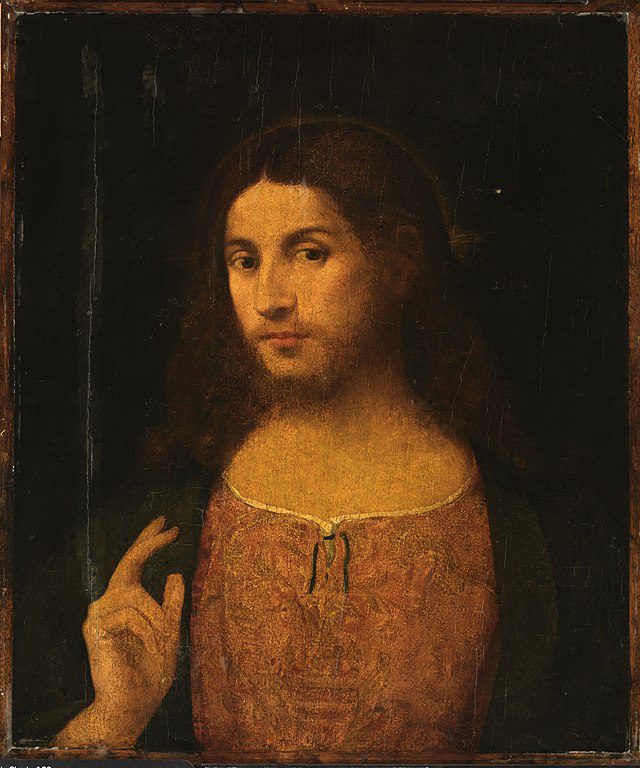
Photo credit: Head of Christ, by Palma il Vecchio (c. 1480-1528) [public domain / Wikimedia Commons]

***
Summary: Ever wonder about Jesus’ “brothers” or “brethren” in the New Testament? Prima facie, it looks like they are siblings. But in-depth biblical, exegetical, & linguistic analysis proves otherwise.
Previous Post

September 22, 2021
Brief Exchange with Atheists (Including Archaeology)
Next Post

September 24, 2021 How Dare Pope Francis Defend the Church!
Browse Our Archives
Select a Category & Last Things About Me Anti-Catholicism Atheism & Agnosticism Baptism and Sacramentalism Bible and Tradition Blessed Virgin Mary Books by Dave Armstrong C. S. Lewis Calvinism & General Protestantism Catholic Apologetics Catholic Apologists Catholic conversion Catholic converts Christmas Church (Ecclesiology) Church History Conversion and Converts Development of Doctrine Eastern Orthodoxy Ecumenism & Christian Unity Eucharist & Liturgy Fathers of the Church French Translations G. K. Chesterton Hell Hell & Satan Hell & Satan & Last Things Heresies & Comparative Religion Holistic Health Inquisition & Crusades & Scandals James White Jews & Judaism & Old Testament John Calvin John Henry Newman Liberal / Modernist Theology Life Issues Literary Resume Lutheranism Mariology Martin Luther Music Orthodoxy Papacy & Infallibility Personal Page Philosophy & Science Political & Ethical & Moral Issues Protestant Persecution & Intolerance Protestantism Purgatory Purgatory & Penance Romantic & Imaginative Theology Saints & Purgatory & Penance Salvation Salvation & Justification Satan & Last Things Sexuality and Gender Issues Spanish Translations Traditionalism vs. Radical Catholic Reactionaries Traducciones al español / tradução para português Trinitarianism & Christology Uncategorized Videos
Select a Month October 2026 September 2026 August 2026 July 2026 June 2026 May 2026 April 2026 March 2026 February 2026 January 2026 December 2025 November 2025 October 2025 September 2025 August 2025 July 2025 June 2025 May 2025 April 2025 March 2025 February 2025 January 2025 December 2024 November 2024 October 2024 September 2024 August 2024 July 2024 June 2024 May 2024 April 2024 March 2024 February 2024 January 2024 December 2023 November 2023 October 2023 September 2023 August 2023 July 2023 June 2023 May 2023 April 2023 March 2023 February 2023 January 2023 December 2022 November 2022 October 2022 September 2022 August 2022 July 2022 June 2022 May 2022 April 2022 March 2022 February 2022 January 2022 December 2021 November 2021 October 2021 September 2021 August 2021 July 2021 June 2021 May 2021 April 2021 March 2021 February 2021 January 2021 December 2020 November 2020 October 2020 September 2020 August 2020 July 2020 June 2020 May 2020 April 2020 March 2020 February 2020 January 2020 December 2019 November 2019 October 2019 September 2019 August 2019 July 2019 June 2019 May 2019 April 2019 March 2019 February 2019 January 2019 December 2018 November 2018 October 2018 September 2018 August 2018 July 2018 June 2018 May 2018 April 2018 March 2018 February 2018 January 2018 December 2017 November 2017 October 2017 September 2017 August 2017 July 2017 June 2017 May 2017 April 2017 March 2017 February 2017 January 2017 December 2016 November 2016 October 2016 September 2016 August 2016 July 2016 June 2016 May 2016 April 2016 March 2016 February 2016 January 2016 December 2015 November 2015 October 2015 September 2015 August 2015 July 2015 June 2015 May 2015 April 2015 March 2015 February 2015 January 2015 December 2014 November 2014 October 2014 September 2014 August 2014 July 2014 June 2014 April 2014 March 2014 February 2014 January 2014 December 2013 November 2013 October 2013 September 2013 August 2013 July 2013 June 2013 April 2013 March 2013 February 2013 January 2013 December 2012 November 2012 October 2012 September 2012 August 2012 July 2012 June 2012 May 2012 April 2012 March 2012 February 2012 January 2012 December 2011 November 2011 October 2011 September 2011 August 2011 July 2011 June 2011 April 2011 March 2011 February 2011 October 2010 September 2010 August 2010 July 2010 April 2010 March 2010 December 2009 October 2009 August 2009 July 2009 June 2009 May 2009 March 2009 February 2009 October 2008 September 2008 April 2008 March 2008 February 2008 January 2008 December 2007 November 2007 October 2007 May 2007 March 2007 February 2007 January 2007 November 2006 October 2006 September 2006 August 2006 July 2006 June 2006 May 2006 April 2006 March 2006 February 2006 October 2005 June 2005 April 2005 February 2005 July 2004 May 2004 April 2004
Follow Us!
TAKE THE
Religious Wisdom Quiz
What famous cathedral is in Paris, known for its flying buttresses and rose windows?
Select your answer to see how you score.
Notre Dame St. Paul's St. Peter's Canterbury
Books by This Author Books by Dave Armstrong
Related posts from Biblical Evidence for Catholicism

Holy Ground: Why Mary Had NO Other Children...
Biblical Evidence for Catholicism
Protestant Confessions & "Ever-Virgin" Mary
Biblical Evidence for Catholicism

Mary Wife of Clopas (Jn 19:25): Mary's Sister-in-Law?
Biblical Evidence for Catholicism

Jesus Had Four Brothers? The Bible Sez No!
Biblical Evidence for Catholicism
TRENDING AT PATHEOS Catholic

In "Irreplaceable," our book on vocation and technology, Trevor Sutton and I...

I was strolling through the top floor of the brand new Parthenon...

What Does Gêvâh Mean For Kimberley Guifoyle &...
This week, a lot of the news is focused on Kimberly Guilfoyle....

INNER CIRCLE: Profound Mystery (Of Christ In All...
Ephesians 5:31-32 “For this reason, a man will leave his father and...

Do Not Rejoice When Your Enemy Falls: The...
Turning an execution into a public spectacle is a disturbing expression of...

'The Chosen' S6 Trailer: The Passion Gets Very...
Not many watching 'The Chosen' worry about spoilers, but just because they...
view all Catholic blogs
Ad-Free & Subscriber Log-In Subscription Support
- About Us
- 2026 Calendar
- Videos
- Podcasts
- Library of World Religions
- Faith In Media Tracker
- Advertise With Us
- Write for Us
- Privacy Policy
- Terms of Service
- Do Not Sell My Data
- Contact Us
- Radiant Digital
- Manage Newsletter Subscriptions
- Unsubscribe From Notifications
- Sitemap
Copyright 2008-2026, Patheos. All rights reserved.
Subscription Support Ad-Free & Subscriber Log-In
Follow Patheos