
BuddhistCatholicContemplativeEvangelicalGeneral ChristianHinduJewishLatter-day SaintMuslimNew VisionsProgressive Christian
Beliefs
- Buddhist
- Catholic
- Contemplative
- Evangelical
- General Christian
- Hindu
- Jewish
- Latter-day Saint
- More Voices
- Muslim
- New Visions
- Pagan
- Progressive Christian
Topics
- Religion News
- Food and Religion
- Sports and Religion
- Religious Art
- Religious Music and Entertainment
- Religious Events
- History and Religion
- Style and Religion
- Politics and Religion
- Women in Religion
- Recreation Outdoors and Religion
- Business Finance and Religion
- Careers Workplace and Religion
- Education and Religion
- Family Parenting and Religion
- Health Fitness and Religion
- Home and Religion
- Relationships and Religion
- Technology and Religion
- Travel and Religion
Columnists
- Buddhist Columnists
- Business Finance and Religion Columnists
- Careers Workplace and Religion Columnists
- Catholic Columnists
- Contemplative Columnists
- Education and Religion Columnists
- Evangelists Columnists
- Family Parenting and Religion Columnists
- General Christian Columnists
- Health Fitness and Religion Columnists
- Hindu Columnists
- History and Religion Columnists
- Home and Religion Columnists
- Jewish Columnists
- More Voices Columnists
- Latter Day Columnists
- Muslim Columnists
- New Visions Columnists
- Nonreligious Columnists
- Pagan Columnists
- Politics and Religion Columnists
- Progressive Columnists
- Recreation Outdoors and Religion Columnists
- Relationships and Religion Columnists
- Religion News Columnists
- Religious Art Columnists
- Religious Events Columnists
- Religious Music and Entertainment Columnists
- Sports and Religion Columnists
- Style and Religion Columnists
- Technology and Religion Columnists
- Travel and Religion Columnists
- Women in Religion Columnists
Resource Library
- 2026 Calendar
- Library of World Religions
- The 100 Most Holy Places on Earth
- Patheos Answers
- Podcasts
- Videos
- Faith Leaders Database
- Anglican Episcopalian
- Bahai
- Baptist
- Buddhism
- Christianity
- Confucianism
- Eastern Orthodoxy
- Hinduism
- Holiness and Pentecostal
- ISKCON
- Islam
- Judaism
- Lutheran
- Methodist
- The Church of Jesus Christ of Latter-day Saints
- New Age
- Paganism
- Presbytarian and Reformed
- Protestantism
- Religion Behind the Scenes
- Roman Catholic
- Scientology
- Shia Islam
- Sikhism
- Sufism
- Sunni Islam
- Taoism
- Zen
- See all religions
Research Tools
 Ad-Free & Subscriber Log-In Subscription Support
Ad-Free & Subscriber Log-In Subscription Support
Follow Patheos 

- Trending:
- Forgiveness
- |
- Marriage
- |
- Consciousness
- |
- Death Penalty
- |
- Election
- |
- Halloween

-
About
-
Catholic Apologetics
-
Church History
-
Great Apologists
-
Christian Worldview
-
Protestantism & Misc.
- Home
- Catholic
- History and Religion
- Reply to Engwer’s Alleged “Absence of a Papacy”
Reply to Engwer’s Alleged “Absence of a Papacy”
Last updated on: June 5, 2026 at 11:59 pm by Dave Armstrong
Reply to Engwer’s Alleged “Absence of a Papacy” 2026-06-05T23:59:23-04:00 Dave Armstrong
Patheos Explore the world's faith through different perspectives on religion and spirituality! Patheos has the views of the prevalent religions and spiritualities of the world.
Protestant anti-Catholic apologist Jason Engwer has attempted several of these sorts of arguments against the papacy. I have (I think) refuted him many times along these lines, especially after he sought to overthrow some of my own arguments in favor of the papacy:
Dialogue on Development of Doctrine (Esp. the Papacy) [2000]
Dialogue on Doctrinal Development (Papacy & NT Canon) [2-26-02]
*
Reply to Critique of “50 NT Proofs for the Papacy” [3-14-02]
*
Refutation of a Satirical “Pauline Papacy” Argument [9-30-03]
*
Papal Passages Lk 22:31-34 & Jn 21:15-17 [5-12-20]
*
St. Peter Listed First in Lists of Disciples: A Debate [10-12-20]
*
*
My own basic biblical defenses of the papacy can be found (most concisely) in the following papers:
*
50 New Testament Proofs for Petrine Primacy & the Papacy [1994]
*
Primacy of St. Peter Verified by Protestant Scholars [1994]
*
Bible on Papal & Church Infallibility [2007]
*
Infallible Individuals: Scriptural Examples & Analogies [2009]
*
Peter the “Rock”: Protestant Contra-Catholic Exegetical Bias [7-7-09]
*
The Biblical Argument for Papal Succession [12-12-15]
*
Papal Succession: A Straightforward Biblical Argument [4-28-17]
*
See many many more related articles on my Papacy web page.
Jason Engwer has been so soundly refuted over and over in these matters, that it’s difficult to come up with anything fresh and new that hasn’t already been presented, but I’ll give it the old college try. His recent attack is entitled “The Widespread Absence Of A Papacy” (Tribalblogue, 8-8-21). His words below will be in blue. I reproduce his entire article.
*
One of the reasons for rejecting the papacy is the lack of justification for it. There are apparent contradictions of the concept of the papacy in some New Testament documents and other early sources, but the lack of evidence for the office would be enough reason to not accept it, even if such contradictions didn’t exist.
*
Funny; I see evidence all over the place, per my various biblical and patristic / historical arguments along these lines.
*
However, Protestants often focus on too narrow a range of contexts in which the papacy is absent in the early sources. A lot of attention is given to passages about Peter in the gospels and Acts and material about church government in the early sources, for example, but we ought to think more broadly about where a papacy could have been mentioned if it existed. A papacy wouldn’t have to be mentioned at every conceivable opportunity. But the larger the number and variety of contexts in which a papacy could have been mentioned, but wasn’t, the more likely it is that the office didn’t exist. What I want to do in this post is provide a few examples of contexts that are often neglected.
*
Jason is great at producing skeptical summary statements like the above (where he can create his own little thought-world, disconnected from biblical and Christian reality). When he actually attempts to make arguments to establish his erroneous cases, however, he does far less well. Here is basically presenting arguments from silence over and over again, and they never hold much weight. As the Wikipedia article on this form of argument bluntly states: “arguments from silence themselves are also generally viewed as rather weak in many cases; or considered as fallacies.”
*
The apostles sometimes discussed their upcoming death, what was being done to preserve their teachings, and how Christians should conduct themselves going forward (e.g., Acts 20:17-38, 2 Timothy 3:10-4:8, 2 Peter 1:12-21). If the papacy was considered the foundation of the church, the infallible center of Christian unity throughout church history, the absence of any mention of such an resource in passages like these is significant.
*
Acts 20 is from St. Paul: the same Paul who submitted to Church authority, including Peter: “James and Cephas [Peter] and John, who were reputed to be pillars, gave to me and Barnabas the right hand of fellowship” (Gal 2:9, RSV). Paul was no “lone ranger.” He had been commissioned by the Church at Antioch as well:
Acts 13:1-3 (RSV) Now in the church at Antioch there were prophets and teachers, Barnabas, Simeon who was called Niger, Lucius of Cyre’ne, Man’a-en a member of the court of Herod the tetrarch, and Saul. [2] While they were worshiping the Lord and fasting, the Holy Spirit said, “Set apart for me Barnabas and Saul for the work to which I have called them.” [3] Then after fasting and praying they laid their hands on them and sent them off.
Paul was again sent by the Church at Antioch (Acts 14:26-28) — “appointed to go up to Jerusalem to the apostles and the elders about this question” [of who was required to be circumcised]: Acts 15:2. This was the Jerusalem Council. All that Paul and Barnabas did there: that we know from the record, in any event, was give a “praise report” of their missionary activities (15:4, 12). St. Peter: obviously of much more authority, gave the primary address (15:7-12). He quelled the debate (15:7), resulting in “silence” in the assembly (15:12). James, the bishop of Jerusalem, stated: “Simeon [i.e., Simon Peter] has related how God first visited the Gentiles, to take out of them a people for his name.
And with this the words of the prophets agree . . .” (15:14-15).
*
After all, it was St. Peter who had already received a revelation from God about all foods being clean (Acts 10:9-16). For some reason God thought it was more important to give him this vision rather than St. Paul. Then in the same chapter, St. Peter’s encounter with the righteous Gentile Cornelius, shows him that non-Jews were to be fully accepted into the Christian community, with the implication that they were not bound to keep the entire Mosaic Law (10:17-43).
*
The Jerusalem Council then commissioned Paul and Barnabas and Silas (15:22, 25, 27, 30), who made “their way through the cities” and “delivered to them for observance the decisions which had been reached by the apostles and elders who were at Jerusalem” (16:4).
*
In sum, then, Paul is receiving an awful lot of Church and papal (Petrine) guidance, as we see above. Just because he may not have mentioned Peter in one discourse (argument from silence) does not wipe out all of this relevant information. The same applies to his discourse in 2 Timothy 3:10 ff. All that is, is an example of apostolic succession: from Paul to Timothy. It has no implications for papal succession, which is based on other biblical grounds. A fallacious argument from silence cannot overcome that.
*
Jason gives us also the example 2 Peter 1:12-21. This was written by St. Peter. Protestant scholars D. A. Carson et al, in their Introduction to the New Testament (first edition, 1992, pp. 434-435, 437) state:
Generally speaking, conservative authors have held to the Petrine authorship . . .
The letter plainly indicates that Peter was the author. . . .
Church Tradition [subtitle] Such tradition uniformly ascribes the letter to Peter. There is no other name linked with it in the tradition. . . .
No conclusive reason has been given for denying that the letter is by the author it claims as its writer. None of the objections can be sustained, and it seems better to accept it at face value, as a genuine writing of the apostle Peter.
Very well, then; this question of authorship out of the way, does the letter read like something a self-understood “pope” would have written? Yes. St. Paul’s letters are to local churches of individuals. But this one is to all Christians (“To those who have obtained a faith . .”: 1:1). He continues to write to all Christians, in asserting: “Therefore, brethren, be the more zealous to confirm your call and election, for if you do this you will never fall” (1:10). It makes perfect sense for Peter to exhort all Christians, since, after all, our Lord Jesus told him specifically (and no other disciple) to “Feed my lambs . . . Tend my sheep . . . feed my sheep” (Jn 21:15-17).
*
So here (in 2 Peter) is Peter doing just that, as he was shown doing all through the first half of the book of Acts: the primary account of the very earliest Church. He states: “I intend always to remind you [all Christians!] of these things . . . to arouse you by way of reminder” (1:12-13). Likewise, Jesus had also said to him, specifically: “I have prayed for you that your faith may not fail; and when you have turned again, strengthen your brethren” (Lk 22:32). Once again, St. Peter is commissioned as the indefectible leader of the Christian Church: whose faith would never again fail as it did when he denied his Lord three times. Nor does (importantly) Holy Scripture record Jesus praying for any other of the disciples, individually, as it does in this passage. And when He does so, it is regarding the pastoral office of the papacy: strengthening the Christian brethren with an unfailing faith. These passages have been defended and explained to Jason in the past.
*
In the very passage that Jason thinks indicates a lack of a papacy, Peter expressly says: “we have the prophetic word made more sure. You will do well to pay attention to this” (1:19). What more does he require? All agree that the Bible must be interpreted by considering it as a whole, and especially all passages on a theme, so as to get the whole picture. This is the Petrine picture. He’s the leader of the Church, and he knows it and acts like it, as my 50 NT Petrine Proofs shows over and over and over.
Another group of relevant contexts is the imagery used to refer to relevant entities, such as what imagery is used to refer to the apostles or the church. We get twelve thrones without Peter’s throne being differentiated (Matthew 19:28), three pillars without Peter’s being differentiated (Galatians 2:9), twelve foundation stones without Peter’s being differentiated (Ephesians 2:20, Revelation 21:14), etc.
This is absolutely classic Jason Engwer pseudo-“argumentation”: which means that it is a classic instance of fallacy and taking things entirely out of context. The essential problem is the typically Protestant “either/or” outlook; whereas the biblical and Hebrew worldview is “both/and.” Not everything has to be mentioned every time. There is more than enough biblical indication of the papacy (see my papers on that; I need not repeat everything), without it having to be noted in every remotely “ecclesiological” context.
The Bible massively teaches that Peter was the leader of the twelve disciples and the early Church. I just showed two passages where Jesus clearly treated him as preeminent. Two more famous ones are Jesus building His Church upon Peter, whom He renamed “the Rock” (Mt 16:18), and His giving Peter (and him only) the “keys to the kingdom” (16:19). The above considerations do not nullify all this. It’s “both/and.” Then there is the aspect of peter being singled out in lists of the disciples and apostles, which I have already dealt with, directly in reply to Jason.
Jesus had just conferred these extraordinary responsibilities and the office of papacy on St. Peter in Matthew 16, but says that twelve disciples will sit on twelve thrones in Matthew 19:28, just three chapters later; and Jason concludes, therefore, that Petr is not a white different from the other twelve. It simply doesn’t follow. Jesus Himself elsewhere refers to “the twelve” (Mk 14:20; Jn 6:70) without singling out Peter; yet in other passages He does precisely that. “Both/and.” In fact, Judas is included in “the twelve”: and sometimes mentioned by name as included in their number (Mt 26:14, 47; Mk 14:10, 43; Lk 22:3, 47; Jn 6:71), including by Jesus Himself (Mk 14:20; Jn 6:70).
Therefore, if Jesus and the Bible can repeatedly refer to “the twelve” [disciples], yet this number can include an evil betrayer, Judas; then by the same token and logic it can include the leader of the twelve, who is often differentiated or singled out in other lists of the disciples (Mk 1:36; Lk 9:28, 32; Acts 2:37; 5:29; 1 Cor 9:5). The same goes for the list of foundation stones. It’s not a “contradiction.” It’s biblical “either/or” thinking.
If Jason wants to press the point of a supposed “egalitarianism” and lack of hierarchy, we can also point to examples of Jesus making Himself “equal” to His own disciples, even though we know He was God and infinitely higher than they were. He calls them “friends” (Jn 15:15) and notes that to be “first” is to be “be last of all and servant of all” (Mk 9:35); He washes their feet (Jn 13:3-16). He submits Himself as a child to Joseph and Mary (“obedient to them”: 2:51). Even in one of Jason’s examples (Eph 2:20), Jesus includes Himself with the disciples as of the foundation stones: “built upon the foundation of the apostles and prophets, Christ Jesus himself being the cornerstone,”. Obviously, He is not lesser than they are; yet He includes Himself.
If He can be described in such terms, and talk in such terms, then all the more so can St. Peter as one of the twelve disciples. It’s much ado about nothing, as always in Jason’s anti-Catholic polemics and sophistry.
St. Paul wrote:
Philippians 4:2-3 I entreat Eu-o’dia and I entreat Syn’tyche to agree in the Lord. [3] And I ask you also, true yokefellow, help these women, for they have labored side by side with me in the gospel together with Clement and the rest of my fellow workers,
Note that Paul commanded Eu-o’dia and Syn’tyche “to agree in the Lord.” So he was higher in authority than them. Yet he calls them (along with Clement) “fellow workers”. Doe this “prove” then, that Eu-o’dia, Syn’tyche, St. Paul, and St. Clement are all “on the same level”: because they are “fellow workers”? No, of course not.
The early Christians often interact with the objections of their opponents. The gospels respond to the charge that Jesus performed miracles by the power of Satan, Paul responds to his critics in his letters, Justin Martyr wrote a response to Jewish arguments against Christianity, Origen wrote a response to Celsus’ anti-Christian treatise, and so on. See here regarding the lack of reference to a papacy in such contexts.
It’s important for Protestants (and other opponents of the papacy) to bring up considerations like these, since the absence of early references to a papacy becomes more significant when the absence occurs across a broader range of contexts. If only two pages of early Christian literature were extant, the absence of a papacy (or whatever other concept) would be much less significant than its absence across two million pages. The number of pages matters (assuming the usual diversity of topics you’d get with an increase in such a page number).
One of the reasons why it’s become so popular for Catholics to argue for the papacy by an appeal to something like typology or Old Testament precedent is that there’s such a lack of evidence in the New Testament and the early patristic literature. So, there’s a turn to other sources to try to find what isn’t present where we’d most expect to see it.
Jason acts as if there is nothing to indicate the papacy in early patristics. But in fact we have a fabulous, clear example of St. Clement of Rome, the fourth pope, who reigned from approximately 88-99 AD. The Corinthian church wrote to him for advice and guidance. It so happens that I wrote about this just about a month ago, and discovered some very striking facts:
Why is it that Clement is speaking with authority from Rome, settling the disputes of other regions? Why don’t the Corinthians solve it themselves, if they have a proclaimed bishop or even if they didn’t claim one at the time? Why do they appeal to the bishop of Rome? These are questions that I think [a Protestant] needs to seriously consider and offer some sort of answer for.
St. Clement writes (I use the standard Schaff translation: no Catholic “bias” there!):
You therefore, who laid the foundation of this sedition, submit yourselves to the presbyters, and receive correction so as to repent, bending the knees of your hearts. Learn to be subject, laying aside the proud and arrogant self-confidence of your tongue. For it is better for you that you should occupy a humble but honourable place in the flock of Christ, than that, being highly exalted, you should be cast out from the hope of His people. (57)
If, however, any shall disobey the words spoken by Him through us, let them know that they will involve themselves in transgression and serious danger; . . . (59, my bolding and italics)
Joy and gladness will you afford us, if you become obedient to the words written by us and through the Holy Spirit root out the lawless wrath of your jealousy according to the intercession which we have made for peace and unity in this letter. (63, my bolding and italics)
Clement definitely asserts his authority over the Corinthian church far away. Again, the question is: “why?” What sense does that make in a Protestant-type ecclesiology where every region is autonomous and there is supposedly no hierarchical authority in the Christian Church? Why must they “obey” the bishop from another region (sections 59, 63)? Not only does Clement assert strong authority; he also claims that Jesus and the Holy Spirit are speaking “through” him.
That is extraordinary, and very similar to what we see in the Jerusalem Council in Acts 15:28 (“For it has seemed good to the Holy Spirit and to us to lay upon you no greater burden than these necessary things”: RSV) and in Scripture itself. It’s not strictly inspiration but it is sure something akin to infallibility (divine protection from error and the pope as a unique mouthpiece of, or representative of God).
The Jerusalem Council was an example of a pope presiding over but acting jointly in concert with bishops and even regular elders (much like ecumenical councils function). But Pope St. Clement was acting unilaterally, which popes can also do. The Jerusalem Council claimed divine guidance and de facto infallibility for the collective group. St. Clement, however, applies it to himself as an individual. If that’s not the papacy in action I don’t know what it would look like. What else could Jason possibly demand as proof? Here we have the papacy in full color and authority even before the first century was over with, and part of the Bible (Revelation) was possibly still being written.
***
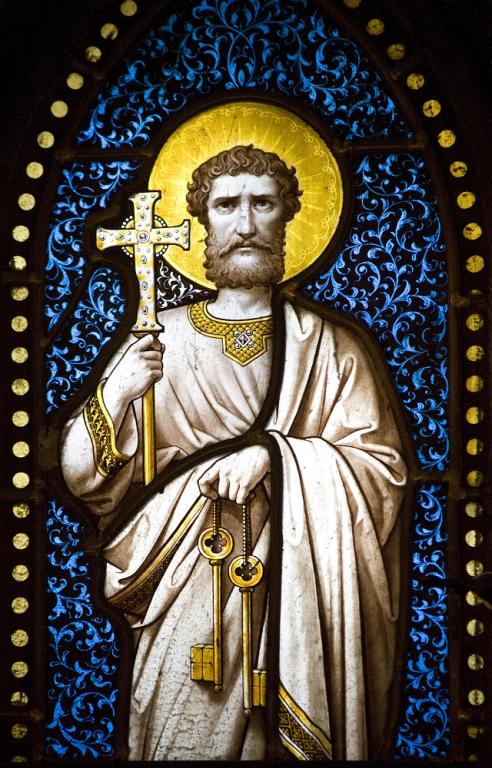
Photo credit: Lawrence OP (8-10-09). 19th-century depiction of St Peter holding the keys of the kingdom of heaven. This window is in the crypt of a chapel of the Upper Basilica in Lourdes [Flickr / CC BY-NC-ND 2.0 license]
***
Summary: Protestant anti-Catholic apologist Jason Engwer attempts to establish the “absence of a papacy” in the NT & in early patristic literature. He’s dead wrong on both counts, as I demonstrate.
Previous Post

August 25, 2021
Genesis 10 "Table of Nations": Authentic History
Next Post

August 26, 2021 My Supposed "Papolatry": Outrageous Reactionary Lies
Browse Our Archives
Select a Category & Last Things About Me Anti-Catholicism Atheism & Agnosticism Baptism and Sacramentalism Bible and Tradition Blessed Virgin Mary Books by Dave Armstrong C. S. Lewis Calvinism & General Protestantism Catholic Apologetics Catholic Apologists Catholic conversion Catholic converts Christmas Church (Ecclesiology) Church History Conversion and Converts Development of Doctrine Eastern Orthodoxy Ecumenism & Christian Unity Eucharist & Liturgy Fathers of the Church French Translations G. K. Chesterton Hell Hell & Satan Hell & Satan & Last Things Heresies & Comparative Religion Holistic Health Inquisition & Crusades & Scandals James White Jews & Judaism & Old Testament John Calvin John Henry Newman Liberal / Modernist Theology Life Issues Literary Resume Lutheranism Mariology Martin Luther Music Orthodoxy Papacy & Infallibility Personal Page Philosophy & Science Political & Ethical & Moral Issues Protestant Persecution & Intolerance Protestantism Purgatory Purgatory & Penance Romantic & Imaginative Theology Saints & Purgatory & Penance Salvation Salvation & Justification Satan & Last Things Sexuality and Gender Issues Spanish Translations Traditionalism vs. Radical Catholic Reactionaries Traducciones al español / tradução para português Trinitarianism & Christology Uncategorized Videos
Select a Month October 2026 September 2026 August 2026 July 2026 June 2026 May 2026 April 2026 March 2026 February 2026 January 2026 December 2025 November 2025 October 2025 September 2025 August 2025 July 2025 June 2025 May 2025 April 2025 March 2025 February 2025 January 2025 December 2024 November 2024 October 2024 September 2024 August 2024 July 2024 June 2024 May 2024 April 2024 March 2024 February 2024 January 2024 December 2023 November 2023 October 2023 September 2023 August 2023 July 2023 June 2023 May 2023 April 2023 March 2023 February 2023 January 2023 December 2022 November 2022 October 2022 September 2022 August 2022 July 2022 June 2022 May 2022 April 2022 March 2022 February 2022 January 2022 December 2021 November 2021 October 2021 September 2021 August 2021 July 2021 June 2021 May 2021 April 2021 March 2021 February 2021 January 2021 December 2020 November 2020 October 2020 September 2020 August 2020 July 2020 June 2020 May 2020 April 2020 March 2020 February 2020 January 2020 December 2019 November 2019 October 2019 September 2019 August 2019 July 2019 June 2019 May 2019 April 2019 March 2019 February 2019 January 2019 December 2018 November 2018 October 2018 September 2018 August 2018 July 2018 June 2018 May 2018 April 2018 March 2018 February 2018 January 2018 December 2017 November 2017 October 2017 September 2017 August 2017 July 2017 June 2017 May 2017 April 2017 March 2017 February 2017 January 2017 December 2016 November 2016 October 2016 September 2016 August 2016 July 2016 June 2016 May 2016 April 2016 March 2016 February 2016 January 2016 December 2015 November 2015 October 2015 September 2015 August 2015 July 2015 June 2015 May 2015 April 2015 March 2015 February 2015 January 2015 December 2014 November 2014 October 2014 September 2014 August 2014 July 2014 June 2014 April 2014 March 2014 February 2014 January 2014 December 2013 November 2013 October 2013 September 2013 August 2013 July 2013 June 2013 April 2013 March 2013 February 2013 January 2013 December 2012 November 2012 October 2012 September 2012 August 2012 July 2012 June 2012 May 2012 April 2012 March 2012 February 2012 January 2012 December 2011 November 2011 October 2011 September 2011 August 2011 July 2011 June 2011 April 2011 March 2011 February 2011 October 2010 September 2010 August 2010 July 2010 April 2010 March 2010 December 2009 October 2009 August 2009 July 2009 June 2009 May 2009 March 2009 February 2009 October 2008 September 2008 April 2008 March 2008 February 2008 January 2008 December 2007 November 2007 October 2007 May 2007 March 2007 February 2007 January 2007 November 2006 October 2006 September 2006 August 2006 July 2006 June 2006 May 2006 April 2006 March 2006 February 2006 October 2005 June 2005 April 2005 February 2005 July 2004 May 2004 April 2004
Follow Us!
TAKE THE
Religious Wisdom Quiz
What type of building was Jesus born in?
Select your answer to see how you score.
A cave A tent A castle A stable
Books by This Author Books by Dave Armstrong
Related posts from Biblical Evidence for Catholicism

Three More Anti-Catholic Lies About Catholicism (#6-4)
Biblical Evidence for Catholicism

Top Ten Anti-Catholic Lies (#10-7)
Biblical Evidence for Catholicism

Was Peter "Any Old" Apostle? 10 Anti-Papal Arguments
Biblical Evidence for Catholicism

Jesus Founded the [Catholic] Church. If Not Him,...
Biblical Evidence for Catholicism
TRENDING AT PATHEOS Catholic

Janie Learns the Way of the Cross: A...
Teaching children about Jesus' Passion can be challenging. Many parents and educators...

Looking For Good Catholic Writing - October 2026
He alone extends the heavens, and he walks upon the waves of...

In "Irreplaceable," our book on vocation and technology, Trevor Sutton and I...

I was strolling through the top floor of the brand new Parthenon...

What Does Gêvâh Mean For Kimberley Guifoyle &...
This week, a lot of the news is focused on Kimberly Guilfoyle....

INNER CIRCLE: Profound Mystery (Of Christ In All...
Ephesians 5:31-32 “For this reason, a man will leave his father and...
view all Catholic blogs
Ad-Free & Subscriber Log-In Subscription Support
- About Us
- 2026 Calendar
- Videos
- Podcasts
- Library of World Religions
- Faith In Media Tracker
- Advertise With Us
- Write for Us
- Privacy Policy
- Terms of Service
- Do Not Sell My Data
- Contact Us
- Radiant Digital
- Manage Newsletter Subscriptions
- Unsubscribe From Notifications
- Sitemap
Copyright 2008-2026, Patheos. All rights reserved.
Subscription Support Ad-Free & Subscriber Log-In
Follow Patheos