
BuddhistCatholicContemplativeEvangelicalGeneral ChristianHinduJewishLatter-day SaintMuslimNew VisionsProgressive Christian
Beliefs
- Buddhist
- Catholic
- Contemplative
- Evangelical
- General Christian
- Hindu
- Jewish
- Latter-day Saint
- More Voices
- Muslim
- New Visions
- Pagan
- Progressive Christian
Topics
- Religion News
- Food and Religion
- Sports and Religion
- Religious Art
- Religious Music and Entertainment
- Religious Events
- History and Religion
- Style and Religion
- Politics and Religion
- Women in Religion
- Recreation Outdoors and Religion
- Business Finance and Religion
- Careers Workplace and Religion
- Education and Religion
- Family Parenting and Religion
- Health Fitness and Religion
- Home and Religion
- Relationships and Religion
- Technology and Religion
- Travel and Religion
Columnists
- Buddhist Columnists
- Business Finance and Religion Columnists
- Careers Workplace and Religion Columnists
- Catholic Columnists
- Contemplative Columnists
- Education and Religion Columnists
- Evangelists Columnists
- Family Parenting and Religion Columnists
- General Christian Columnists
- Health Fitness and Religion Columnists
- Hindu Columnists
- History and Religion Columnists
- Home and Religion Columnists
- Jewish Columnists
- More Voices Columnists
- Latter Day Columnists
- Muslim Columnists
- New Visions Columnists
- Nonreligious Columnists
- Pagan Columnists
- Politics and Religion Columnists
- Progressive Columnists
- Recreation Outdoors and Religion Columnists
- Relationships and Religion Columnists
- Religion News Columnists
- Religious Art Columnists
- Religious Events Columnists
- Religious Music and Entertainment Columnists
- Sports and Religion Columnists
- Style and Religion Columnists
- Technology and Religion Columnists
- Travel and Religion Columnists
- Women in Religion Columnists
Resource Library
- 2026 Calendar
- Library of World Religions
- The 100 Most Holy Places on Earth
- Patheos Answers
- Podcasts
- Videos
- Faith Leaders Database
- Anglican Episcopalian
- Bahai
- Baptist
- Buddhism
- Christianity
- Confucianism
- Eastern Orthodoxy
- Hinduism
- Holiness and Pentecostal
- ISKCON
- Islam
- Judaism
- Lutheran
- Methodist
- The Church of Jesus Christ of Latter-day Saints
- New Age
- Paganism
- Presbytarian and Reformed
- Protestantism
- Religion Behind the Scenes
- Roman Catholic
- Scientology
- Shia Islam
- Sikhism
- Sufism
- Sunni Islam
- Taoism
- Zen
- See all religions
Research Tools
 Ad-Free & Subscriber Log-In Subscription Support
Ad-Free & Subscriber Log-In Subscription Support
Follow Patheos 

- Trending:
- Forgiveness
- |
- Marriage
- |
- Consciousness
- |
- Death Penalty
- |
- Election
- |
- Halloween

-
About
-
Catholic Apologetics
-
Church History
-
Great Apologists
-
Christian Worldview
-
Protestantism & Misc.
- Home
- Catholic
- History and Religion
- A “Biblical” Immaculate Conception? (vs. James White)
A “Biblical” Immaculate Conception? (vs. James White)
Last updated on: June 6, 2026 at 12:45 am by Dave Armstrong
A “Biblical” Immaculate Conception? (vs. James White) 2026-06-06T00:45:24-04:00 Dave Armstrong
Patheos Explore the world's faith through different perspectives on religion and spirituality! Patheos has the views of the prevalent religions and spiritualities of the world.
This is a reply to an article by Bishop “Dr.” [???] James White: A Biblical Basis for the “Immaculate Conception”? (29 April 1998). White is, in my opinion, the most influential, well-known, and able (and certainly most published and “heard”: through his podcasts and oral debates) Protestant anti-Catholic apologist / sophist / polemicist of our time. His words will be in blue.
*****
White is here responding to a December 1991 article in This Rock (from Catholic Answers) by Patrick Madrid, entitled, “Ark of the New Covenant”. He cites him making a biblical argument (which is one of my big interests, as is well-known):
In [Luke 1] verse 28, the angel Gabriel greets Mary as “kecharitomene” (“full of grace” or “highly favored”). This is a recognition of her sinless state.
It seems like very little, but as that is unpacked below, we shall see that it’s very telling and compelling indeed.
Does Mr. Madrid’s interpretation stand up to scrutiny? It most certainly does not. Let us begin with the first assertion. Luke 1:28 says,
The angel went to her and said, “Greetings, you who are highly favored! The Lord is with you” (NIV).
Mr. Madrid’s sole comment on this passage is, “This is a recognition of her sinless state.” How does Pat know this? He doesn’t say. But Pat’s boss, the head of Catholic Answers, Karl Keating, at least attempted a fuller discussion in his book, Catholicism and Fundamentalism. In speaking of the Greek term, kecaritomene, he alleged:
The newer translations leave out something the Greek conveys,
something the older translation conveys, which is that this
grace (and the core of the word kecharitomene is charis, after
all) is at once permanent and of a singular kind. The Greek
indicates a perfection of grace. A perfection must be perfect
not only intensively, but extensively. The grace Mary enjoyed
must not only have been as “full” or strong or complete as
possible at any given time, but it must have extended over the
whole of her life, from conception. That is, she must have been
in a state of sanctifying grace from the first moment of her
existence to have been called “full of grace” or to have been
filled with divine favor in a singular way. This is just what
the doctrine of the Immaculate Conception holds… (p. 269).
Perhaps Pat just didn’t have the room to put all that into his article. Or, we could hope, he didn’t include it, because he recognizes that the above quotation goes so far beyond anything a serious exegete of the passage in Greek could possibly say that it rivals the attempts made by Mormons to substantiate the concept of men being exalted to the status of a God by citing Romans 8:17. This can be seen by examining the term in question, the perfect passive participle kecaritwmenh. Does the term carry an entire doctrine, unknown in the rest of the New Testament, unheard of by the first three centuries of the Christian Church, in itself?
No one is claiming the latter. I shall argue that — closely examined — a strong case can be made that it is asserting the sinlessness of Mary, which is the kernel and essence of the doctrine of her Immaculate Conception.
Or are modern Roman Catholic interpreters reading into this term a tremendous amount of material that was never intended by Luke?
No; I would say that Protestants have insufficiently grappled with its implications, and have simply ignored it.
[I]f we look at Mr. Keating’s presentation, it seems clear that he is basing his interpretation not primarily upon the lexical meaning of the word caritow, but upon the form it takes in Luke 1:28, that being the perfect passive participle, kecaritomene.
That’s correct. What does the angel mean by saying this to Mary? I don’t know Greek, and so I go to the experts who do. Baptist linguist A. T. Robertson is obviously thought to be dependable by Bishop White, since he cited him in support of one of his arguments in his article that I replied to earlier today. He likes him so much that he cited him six times in the footnotes of an article dated 4-22-99. What does Robertson have to say about this word, as used in Luke 1:28?:
“Highly favoured” (kecharitomene). Perfect passive participle of charitoo and means endowed with grace (charis), enriched with grace as in Ephesians. 1:6, . . . The Vulgate gratiae plena “is right, if it means ‘full of grace which thou hast received‘; wrong, if it means ‘full of grace which thou hast to bestow‘” (Plummer). (Word Pictures in the New Testament, Nashville: Broadman Press, 1930, 6 volumes; II, 13)
Of course, this is indeed the meaning that Catholics attribute to Luke 1:28: Mary is receiving grace, and is made “full of grace” at her very conception. Obviously, this would be purely an act of God and none of her own (not even in a cooperating sense).
Kecharitomene has to do with God’s grace, as it is derived from the Greek root, charis (literally, “grace”). Thus, in the KJV, charis is translated “grace” 129 out of the 150 times that it appears. Greek scholar Marvin Vincent noted that even Wycliffe and Tyndale (no enthusiastic supporters of the Catholic Church) both rendered kecharitomene in Luke 1:28 as “full of grace” and that the literal meaning was “endued with grace” (Word Studies in the New Testament, Grand Rapids, Michigan: Eerdmans, 1946, four volumes, from 1887 edition; New York: Charles Scribner’s Sons; I, 259).
Likewise, well-known Protestant linguist W. E. Vine defines it as “to endue with Divine favour or grace” (An Expository Dictionary of New Testament Words, Old Tappan, New Jersey: Fleming H. Revell Co., four volumes-in-one edition, 1940; II, 171). All these men (except Wycliffe, who probably would have been, had he lived in the 16th century or after it) are Protestants, and so cannot be accused of Catholic translation bias.
James White himself couldn’t totally avoid the fact that kecharitomene (however translated) cannot be divorced from the notion of grace, and stated in one of his books that the term referred to “divine favor, that is, God’s grace” (The Roman Catholic Controversy, Minneapolis: Bethany House Publishers, 1996, 201).
[I]t is obvious that when Keating says that the Greek indicates that Mary “must have been in a state of sanctifying grace from the first moment of her existence to have been called `full of grace’ or to have been filled with divine favor in a singular way,” he is, in point of fact, not deriving this from the Greek at all, but from his own theology, which he then reads back into the text. There is simply nothing in the Greek to support the pretentious interpretation put forward by Keating and Madrid. Therefore, Madrid’s statement, “This is a recognition of her sinless state,” falls for lack of support.
Let’s look at this more closely, then. What does it mean (biblically speaking) to be “full of grace”: a rendering that even Baptist A. T. Robertson grants is “right”? Charis often refers to a power or ability which God grants in order to overcome sin (and this is how we interpret Luke 1:28). This sense is a biblical one, as Greek scholar Gerhard Kittel points out:
Grace is the basis of justification and is also manifested in it ([Rom.] 5:20-21). Hence grace is in some sense a state (5:2), although one is always called into it (Gal. 1:6), and it is always a gift on which one has no claim. Grace is sufficient (1 Cor. 1:29) . . . The work of grace in overcoming sin displays its power (Rom. 5:20-21) . . . (Theological Dictionary of the New Testament, edited by Gerhard Kittel and Gerhard Friedrich, translated and abridged into one volume by Geoffrey W. Bromiley, Grand Rapids, Michigan: Eerdmans Publishing Co., 1985, 1304-1305)
Protestant linguist W.E. Vine concurs that charis can mean “a state of grace, for example: Rom. 5:2; 1 Pet. 5:12; 2 Pet. 3:18” (Vine, II, 170). One can construct a strong biblical argument from analogy, for Mary’s sinlessness. For St. Paul, grace (charis) is the antithesis and “conqueror” of sin (emphases added in the following verses):
Romans 6:14 (RSV) For sin will have no dominion over you, since you are not under law but under grace. (cf. Rom 5:17, 20-21; 2 Cor 1:12; 2 Tim 1:9)
We are saved by grace, and grace alone (Catholics fully agree!):
Ephesians 2:8-10 For by grace you have been saved through faith; and this is not your own doing, it is the gift of God – not because of works, lest any man should boast. For we are his workmanship, created in Christ Jesus for good works, which God prepared beforehand, that we should walk in them. (cf. Acts 15:11; Rom 3:24; 11:5; Eph 2:5; Titus 2:11; 3:7; 1 Pet 1:10)
Grace is possessed in different measure by different believers, as seen elsewhere in Scripture:
2 Peter 3:18 But grow in the grace and knowledge of our Lord and Savior Jesus Christ. To him be the glory both now and to the day of eternity. Amen.
Ephesians 4:7 But grace was given to each of us according to the measure of Christ’s gift. (cf. Acts 4:33, Rom 5:20, 6:1, James 4:6, 1 Pet 5:5, 2 Peter 1:2)
Thus, the biblical argument outlined above proceeds as follows:
Grace saves us.
Grace gives us the power to be holy and righteous and without sin.
Therefore, for a person to be full of grace is both to be saved and to be completely, exceptionally holy. It’s a “zero-sum game”: the more grace one has, the less sin. One might look at grace as water, and sin as the air in an empty glass (us). When you pour in the water (grace), the sin (air) is displaced. A full glass of water, therefore, contains no air (see also, similar zero-sum game concepts in 1 John 1:7, 9; 3:6, 9; 5:18). To be full of grace is to be devoid of sin. Thus we might re-apply the above two propositions:
To be full of the grace that saves is surely to be saved.
To be full of the grace that gives us the power to be holy, righteous, and without sin is to be fully without sin, by that same grace.
A deductive, biblical argument for the Immaculate Conception, with all premises derived directly from Scripture, might look like this:
The Bible teaches that we are saved by God’s grace.
To be “full of” God’s grace, then, is to be saved.
Therefore, Mary is saved (Luke 1:28).
The Bible teaches that we need God’s grace to live a holy life, free from sin.
To be “full of” God’s grace is thus to be so holy that one is sinless.
Therefore, Mary is holy and sinless.
The essence of the Immaculate Conception is sinlessness.
Therefore, the Immaculate Conception, in its essence, can be directly deduced from Scripture.
The only way out of the logic would be to deny one of the two premises, and hold either that grace does not save or that grace is not that power which enables one to be sinless and holy. It is highly unlikely that any Evangelical Protestant would take either position, so the argument is a very strong one, because it proceeds upon their own premises. Certainly all mainstream Christians agree that grace is required both for salvation and to overcome sin. So in a sense my argument is only one of degree, deduced (almost by common sense, I would say) from notions that all Christians hold in common.
Therefore, I have presented a purely biblical argument: all from Scripture, with interpretations of words provided solely by non-Catholic scholars, to the effect that Mary’s being “full of grace” is the same as saying that she was without sin: which is in turn the essence of her Immaculate Conception. God simply extended it back to the womb, which (it’s true) there is no biblical evidence for. But there are numerous biblical analogies of “exceptional holiness in the womb for God’s purposes”:
Samson was one such person:
Judges 16:17 And he told her all his mind, and said to her, “A razor has never come upon my head; for I have been a Nazirite to God from my mother’s womb. If I be shaved, then my strength will leave me, and I shall become weak, and be like any other man.”
A Nazirite was a person who separated himself and was specially consecrated to God: one who made special vows that went beyond the ordinary requirements of the Law. But we know that Samson was not without sin, so his example suffices only to show that being called by God before birth is not unknown in Holy Scripture. The same notion occurs in relation to Isaiah the prophet:
Isaiah 49:1, 5 . . . The LORD called me from the womb, . . . [5] And now the LORD says, who formed me from the womb to be his servant, to bring Jacob back to him, and that Israel might be gathered to him, for I am honored in the eyes of the LORD, and my God has become my strength –
We find the same in the book of Job:
Job 31:15, 18 Did not he who made me in the womb make him? And did not one fashion us in the womb? . . . (for from his youth I reared him as a father, and from his mother’s womb I guided him);
We also observe in Sacred Scripture that God has plans for His servants from even before they were conceived (God being out of time in the first place):
Psalm 139:13-16 For thou didst form my inward parts, thou didst knit me together in my mother’s womb. [14] I praise thee, for thou art fearful and wonderful. Wonderful are thy works! Thou knowest me right well; [15] my frame was not hidden from thee, when I was being made in secret, intricately wrought in the depths of the earth. [16] Thy eyes beheld my unformed substance; in thy book were written, every one of them, the days that were formed for me, when as yet there was none of them.
Thus, the idea that a person is somehow spiritually formed and molded by God and called from the very time of their conception (and before) is an explicit biblical concept. But we can produce even more than that: having to do also with holiness. The prophet Jeremiah reported the Lord’s revelation to him (as confirmed by another writer of Scripture):
Jeremiah 1:5 “Before I formed you in the womb I knew you, and before you were born I consecrated you; I appointed you a prophet to the nations.” (KJV: “sanctified thee”)
“Consecrated” or “sanctified” in Jeremiah 1:5 is the Hebrew word quadash (Strong’s word #6942). According to Gesenius’ Hebrew-Chaldee Lexicon of the Old Testament (Grand Rapids, Michigan: Baker Book House, 1979 reprint, p. 725), in this instance it meant “to declare any one holy.” And this was, remember, “before” Jeremiah was formed by God in the womb.
Jeremiah was thus consecrated or sanctified from the womb; possibly from conception (the text is somewhat vague as to the exact time). This is fairly analogous to the doctrine of the Immaculate Conception. It approximates it. We know Jeremiah was a very holy man. Was he sinless, though? Perhaps he was. I don’t recall reading accounts of Jeremiah sinning.
We know, after all, that the Bible is very frank about exposing sins where they existed (David’s adultery, Noah’s drunkenness, Moses’ murder, Isaiah’s “unclean lips,” Elijah’s and Jonah’s lapses of faith, Doubting Thomas, Peter’s betrayals, Paul’s persecutions, etc.). Therefore, though the lack of such an account of sin does not prove sinlessness, it is consistent with its possibility.
The retort at this point might be that there is a lack of such a notion in the New Testament. But that’s not true. We have the example of John the Baptist:
Luke 1:15 for he will be great before the Lord, and he shall drink no wine nor strong drink, and he will be filled with the Holy Spirit, even from his mother’s womb.
Luke 1:41, 44 And when Elizabeth heard the greeting of Mary, the babe leaped in her womb; and Elizabeth was filled with the Holy Spirit. . . For behold, when the voice of your greeting came to my ears, the babe in my womb leaped for joy.
We know that John the Baptist was also a very holy man. Was he sinless? We can’t know that for sure from the biblical data. I don’t recall any mention of a sin from John the Baptist, in Scripture. St. Catherine of Siena, for one, believed that he never sinned (A Treatise of Prayer). But we know that he was sanctified from the womb. And that forms some plausible analogy to the Immaculate Conception. Lastly, St. Paul refers to being called before he was born:
Galatians 1:15 . . . he who had set me apart before I was born, and had called me through his grace,
Therefore, by analogy and plausibility, based on many biblical cross-references, we can and may conclude that it is “biblical” and reasonable to believe in faith that Mary was immaculately conceived. Nothing in the Bible contradicts this belief. And there is much that suggests various elements of it, as we have seen. It does require faith, of course, but based on the biblical data alone it is not an unreasonable or “unbiblical” belief at all.
Her sinlessness is taught in Luke 1:28, so we need only extrapolate the sinlessness back into the womb (which is easy to do), and with regard to original sin as well (not as easy, assuredly, but not impossible to imagine, either).
If God calls and predestines people for a specific purpose from all eternity, from before they were ever born, as David states and as Jeremiah strongly implies, then what inherent difficulty is there in His sanctifying a very important person in salvation history, centrally involved in the Incarnation, from conception?
The possibility simply can’t be ruled out. And if God can call Jeremiah and John the Baptist from the womb and (possibly) from conception, why not Mary as well? The one case is no less plausible than the other, and so we believe it, by analogy.
It’s not foreign to biblical thinking, and makes perfect sense. According to the Catholic Church, God restored to Mary the innocence of Eve before the Fall, and filled her with grace, in order to prepare her for her unspeakably sublime, sanctified task as the Mother of God the Son. Why should He not do so?
Neither the notion nor the fact of a sinless created being is impossible. The angels (excepting the fallen ones, or demons) are sinless and always have been. They never sinned. They never rebelled against God. They’re creatures as we are, with a free will to sin or not sin. Adam and Eve were originally sinless and could have remained so had they not rebelled against God’s commands.
Babies in the womb are without actual sin (though not without original sin), and even after birth they cannot sin mortally (with full subjective awareness necessary for mortal sin) for quite some time, until they attain the age of reason.
The Immaculate Conception was not, strictly speaking, absolutely necessary for God to do. God could possibly have gone about things a different way. That said, we contend that the Immaculate Conception is a completely plausible act of God, and most fitting and proper and should not be at all “surprising,” in light of several analogous variables in Scripture.
Lastly, a third wholly biblical argument can be made from the “proximity to God”: in other words, “the closer one gets to God, the more holy one must be.” I developed this at some length in my first book, A Biblical Defense of Catholicism (pp. 178-185). The presence of God imparts holiness (Deuteronomy 7:6; 26:19; Jeremiah 2:3). The temple site was sacred and holy (Isaiah 11:9; 56:7; 64:10), and the Holy of Holies where God was specially present above the ark of the covenant (Exodus 25:22), was the holiest place of all within the temple. When we are ultimately with God in heaven, sin is abolished once and for all (1 John 3:3-9; Revelation 14:5; 21:27).
[see a fuller exposition of this reasoning in my paper, Blessed Virgin Mary & God’s Special Presence in Scripture (1994) ]
In order to be such a magnificent vessel for the Incarnate God Himself, it stands to reason that God would make the Blessed Virgin Mary an exceptional human being: not only full of grace and therefore sinless (Luke 1:28), but ordained as completely free from original sin, from the moment of her conception: to be preserved by a special act of grace from God, from all sin whatever: original and actual, in order to “undo” the original sin that none of us would have, had it not been for the rebellion of the human race (all of us being part of that) against God our Creator.
***
*
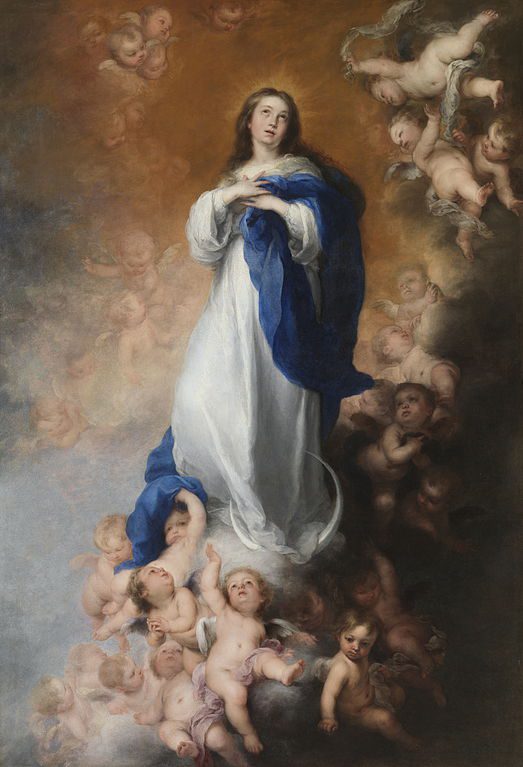
Photo credit: The Immaculate Conception (c. 1678), by Bartolomé Esteban Murillo (1617-1682) [public domain / Wikimedia Commons]

*
***
Summary: I explain (over against Bishop White’s objections) how Luke 1:28 and “full of grace” (kecharitomene) inexorably lead to a sinless Mary: the essence of the Immaculate Conception.
Previous Post

August 27, 2021
Baptismal Regeneration: Refutation of James White
Next Post

August 29, 2021 Pearce’s Potshots #45: "Unholy Questions" for God
Browse Our Archives
Select a Category & Last Things About Me Anti-Catholicism Atheism & Agnosticism Baptism and Sacramentalism Bible and Tradition Blessed Virgin Mary Books by Dave Armstrong C. S. Lewis Calvinism & General Protestantism Catholic Apologetics Catholic Apologists Catholic conversion Catholic converts Christmas Church (Ecclesiology) Church History Conversion and Converts Development of Doctrine Eastern Orthodoxy Ecumenism & Christian Unity Eucharist & Liturgy Fathers of the Church French Translations G. K. Chesterton Hell Hell & Satan Hell & Satan & Last Things Heresies & Comparative Religion Holistic Health Inquisition & Crusades & Scandals James White Jews & Judaism & Old Testament John Calvin John Henry Newman Liberal / Modernist Theology Life Issues Literary Resume Lutheranism Mariology Martin Luther Music Orthodoxy Papacy & Infallibility Personal Page Philosophy & Science Political & Ethical & Moral Issues Protestant Persecution & Intolerance Protestantism Purgatory Purgatory & Penance Romantic & Imaginative Theology Saints & Purgatory & Penance Salvation Salvation & Justification Satan & Last Things Sexuality and Gender Issues Spanish Translations Traditionalism vs. Radical Catholic Reactionaries Traducciones al español / tradução para português Trinitarianism & Christology Uncategorized Videos
Select a Month October 2026 September 2026 August 2026 July 2026 June 2026 May 2026 April 2026 March 2026 February 2026 January 2026 December 2025 November 2025 October 2025 September 2025 August 2025 July 2025 June 2025 May 2025 April 2025 March 2025 February 2025 January 2025 December 2024 November 2024 October 2024 September 2024 August 2024 July 2024 June 2024 May 2024 April 2024 March 2024 February 2024 January 2024 December 2023 November 2023 October 2023 September 2023 August 2023 July 2023 June 2023 May 2023 April 2023 March 2023 February 2023 January 2023 December 2022 November 2022 October 2022 September 2022 August 2022 July 2022 June 2022 May 2022 April 2022 March 2022 February 2022 January 2022 December 2021 November 2021 October 2021 September 2021 August 2021 July 2021 June 2021 May 2021 April 2021 March 2021 February 2021 January 2021 December 2020 November 2020 October 2020 September 2020 August 2020 July 2020 June 2020 May 2020 April 2020 March 2020 February 2020 January 2020 December 2019 November 2019 October 2019 September 2019 August 2019 July 2019 June 2019 May 2019 April 2019 March 2019 February 2019 January 2019 December 2018 November 2018 October 2018 September 2018 August 2018 July 2018 June 2018 May 2018 April 2018 March 2018 February 2018 January 2018 December 2017 November 2017 October 2017 September 2017 August 2017 July 2017 June 2017 May 2017 April 2017 March 2017 February 2017 January 2017 December 2016 November 2016 October 2016 September 2016 August 2016 July 2016 June 2016 May 2016 April 2016 March 2016 February 2016 January 2016 December 2015 November 2015 October 2015 September 2015 August 2015 July 2015 June 2015 May 2015 April 2015 March 2015 February 2015 January 2015 December 2014 November 2014 October 2014 September 2014 August 2014 July 2014 June 2014 April 2014 March 2014 February 2014 January 2014 December 2013 November 2013 October 2013 September 2013 August 2013 July 2013 June 2013 April 2013 March 2013 February 2013 January 2013 December 2012 November 2012 October 2012 September 2012 August 2012 July 2012 June 2012 May 2012 April 2012 March 2012 February 2012 January 2012 December 2011 November 2011 October 2011 September 2011 August 2011 July 2011 June 2011 April 2011 March 2011 February 2011 October 2010 September 2010 August 2010 July 2010 April 2010 March 2010 December 2009 October 2009 August 2009 July 2009 June 2009 May 2009 March 2009 February 2009 October 2008 September 2008 April 2008 March 2008 February 2008 January 2008 December 2007 November 2007 October 2007 May 2007 March 2007 February 2007 January 2007 November 2006 October 2006 September 2006 August 2006 July 2006 June 2006 May 2006 April 2006 March 2006 February 2006 October 2005 June 2005 April 2005 February 2005 July 2004 May 2004 April 2004
Follow Us!
TAKE THE
Religious Wisdom Quiz
What did Isaiah say about Egypt's future in his oracles?
Select your answer to see how you score.
It would conquer Israel It would be conquered It would prosper It would rule Persia
Books by This Author Books by Dave Armstrong
Related posts from Biblical Evidence for Catholicism

Holy Ground: Why Mary Had NO Other Children...
Biblical Evidence for Catholicism
Protestant Confessions & "Ever-Virgin" Mary
Biblical Evidence for Catholicism

Mary Wife of Clopas (Jn 19:25): Mary's Sister-in-Law?
Biblical Evidence for Catholicism

Jesus Had Four Brothers? The Bible Sez No!
Biblical Evidence for Catholicism
TRENDING AT PATHEOS Catholic

In "Irreplaceable," our book on vocation and technology, Trevor Sutton and I...

I was strolling through the top floor of the brand new Parthenon...

What Does Gêvâh Mean For Kimberley Guifoyle &...
This week, a lot of the news is focused on Kimberly Guilfoyle....

INNER CIRCLE: Profound Mystery (Of Christ In All...
Ephesians 5:31-32 “For this reason, a man will leave his father and...

Do Not Rejoice When Your Enemy Falls: The...
Turning an execution into a public spectacle is a disturbing expression of...

'The Chosen' S6 Trailer: The Passion Gets Very...
Not many watching 'The Chosen' worry about spoilers, but just because they...
view all Catholic blogs
Ad-Free & Subscriber Log-In Subscription Support
- About Us
- 2026 Calendar
- Videos
- Podcasts
- Library of World Religions
- Faith In Media Tracker
- Advertise With Us
- Write for Us
- Privacy Policy
- Terms of Service
- Do Not Sell My Data
- Contact Us
- Radiant Digital
- Manage Newsletter Subscriptions
- Unsubscribe From Notifications
- Sitemap
Copyright 2008-2026, Patheos. All rights reserved.
Subscription Support Ad-Free & Subscriber Log-In
Follow Patheos