
BuddhistCatholicContemplativeEvangelicalGeneral ChristianHinduJewishLatter-day SaintMuslimNew VisionsProgressive Christian
Beliefs
- Buddhist
- Catholic
- Contemplative
- Evangelical
- General Christian
- Hindu
- Jewish
- Latter-day Saint
- More Voices
- Muslim
- New Visions
- Pagan
- Progressive Christian
Topics
- Religion News
- Food and Religion
- Sports and Religion
- Religious Art
- Religious Music and Entertainment
- Religious Events
- History and Religion
- Style and Religion
- Politics and Religion
- Women in Religion
- Recreation Outdoors and Religion
- Business Finance and Religion
- Careers Workplace and Religion
- Education and Religion
- Family Parenting and Religion
- Health Fitness and Religion
- Home and Religion
- Relationships and Religion
- Technology and Religion
- Travel and Religion
Columnists
- Buddhist Columnists
- Business Finance and Religion Columnists
- Careers Workplace and Religion Columnists
- Catholic Columnists
- Contemplative Columnists
- Education and Religion Columnists
- Evangelists Columnists
- Family Parenting and Religion Columnists
- General Christian Columnists
- Health Fitness and Religion Columnists
- Hindu Columnists
- History and Religion Columnists
- Home and Religion Columnists
- Jewish Columnists
- More Voices Columnists
- Latter Day Columnists
- Muslim Columnists
- New Visions Columnists
- Nonreligious Columnists
- Pagan Columnists
- Politics and Religion Columnists
- Progressive Columnists
- Recreation Outdoors and Religion Columnists
- Relationships and Religion Columnists
- Religion News Columnists
- Religious Art Columnists
- Religious Events Columnists
- Religious Music and Entertainment Columnists
- Sports and Religion Columnists
- Style and Religion Columnists
- Technology and Religion Columnists
- Travel and Religion Columnists
- Women in Religion Columnists
Resource Library
- 2026 Calendar
- Library of World Religions
- The 100 Most Holy Places on Earth
- Patheos Answers
- Podcasts
- Videos
- Faith Leaders Database
- Anglican Episcopalian
- Bahai
- Baptist
- Buddhism
- Christianity
- Confucianism
- Eastern Orthodoxy
- Hinduism
- Holiness and Pentecostal
- ISKCON
- Islam
- Judaism
- Lutheran
- Methodist
- The Church of Jesus Christ of Latter-day Saints
- New Age
- Paganism
- Presbytarian and Reformed
- Protestantism
- Religion Behind the Scenes
- Roman Catholic
- Scientology
- Shia Islam
- Sikhism
- Sufism
- Sunni Islam
- Taoism
- Zen
- See all religions
Research Tools
 Ad-Free & Subscriber Log-In Subscription Support
Ad-Free & Subscriber Log-In Subscription Support
Follow Patheos 

- Trending:
- Forgiveness
- |
- Marriage
- |
- Consciousness
- |
- Death Penalty
- |
- Election
- |
- Halloween

-
About
-
Catholic Apologetics
-
Church History
-
Great Apologists
-
Christian Worldview
-
Protestantism & Misc.
- Home
- Catholic
- History and Religion
- Pope St. Clement of Rome & Papal Authority
Pope St. Clement of Rome & Papal Authority
Last updated on: June 6, 2026 at 12:45 am by Dave Armstrong
Pope St. Clement of Rome & Papal Authority 2026-06-06T00:45:24-04:00 Dave Armstrong
Patheos Explore the world's faith through different perspectives on religion and spirituality! Patheos has the views of the prevalent religions and spiritualities of the world.
This is a reply to an article from a (Reformed) Protestant apologist, Matt Hedges, entitled, “Does Clement of Rome’s Letter to the Corinthians Prove Papal Authority?” (7-27-21). His words (every single one is cited) will be in blue.
*****
One of the earliest examples in church history appealed to by Roman Catholic apologists is when Clement (bishop of Rome at the time) wrote a letter to the Corinthians settling a disruption which had taken place there. Basically what had happened was that the congregation was deposing some of their presbyters. Clement (though his name is not in the letter, virtually everyone today accepts him to be its author) wrote to the church in Corinth to settle the controversies.
Roman Catholic apologists claim that this letter has the tone of a superior speaking to an inferior, and that this thus proves the idea of papal authority over other churches. [my bolding and italics added]
This aspect shouldn’t be lightly passed over. Why is it that Clement is speaking with authority from Rome, settling the disputes of other regions? Why don’t the Corinthians solve it themselves, if they have a proclaimed bishop or even if they didn’t claim one at the time? Why do they appeal to the bishop of Rome? These are questions that I think Matt needs to seriously consider and offer some sort of answer for.
St. Clement writes (I use the standard Schaff translation: no Catholic “bias” there!):
You therefore, who laid the foundation of this sedition, submit yourselves to the presbyters, and receive correction so as to repent, bending the knees of your hearts. Learn to be subject, laying aside the proud and arrogant self-confidence of your tongue. For it is better for you that you should occupy a humble but honourable place in the flock of Christ, than that, being highly exalted, you should be cast out from the hope of His people. (57)
If, however, any shall disobey the words spoken by Him through us, let them know that they will involve themselves in transgression and serious danger; . . . (59, my bolding and italics)
Joy and gladness will you afford us, if you become obedient to the words written by us and through the Holy Spirit root out the lawless wrath of your jealousy according to the intercession which we have made for peace and unity in this letter. (63, my bolding and italics)
Clement definitely asserts his authority over the Corinthian church far away. Again, the question is: “why?” What sense does that make in a Protestant-type ecclesiology where every region is autonomous and there is supposedly no hierarchical authority in the Christian Church? Why must they “obey” the bishop from another region (sections 59, 63)? Not only does Clement assert strong authority; he also claims that Jesus and the Holy Spirit are speaking “through” him.
That is extraordinary, and very similar to what we see in the Jerusalem Council in Acts 15:28 (“For it has seemed good to the Holy Spirit and to us to lay upon you no greater burden than these necessary things”: RSV) and in Scripture itself. It’s not strictly inspiration but it is sure something akin to infallibility (divine protection from error and the pope as a unique mouthpiece of, or representative of God).
Moreover, Max Lackmann, a Lutheran, makes the observation:
Clement, as the spokesman of the whole People of God . . . admonishes the Church of Corinth in serious, authoritative and brotherly tones to correct the internal abuses of their ecclesiastical community. He censures, exhorts, cautions, entreats . . . The use of the expression send back in the statement: Send back speedily unto us our messengers (1 Clement 65,1), is not merely a special kind of biblical phrase but also a form of Roman imperial command. The Roman judge in a province of the empire sent back a messenger or a packet of documents to the imperial capital or to the court of the emperor (Acts 25:21). Clement of Rome doubtless also knew this administrative terminology of the imperial government and used it effectively. (In Hans Asmussen, et al, The Unfinished Reformation, translated by Robert J. Olsen, Notre Dame, Indiana: Fides Publishers Association, 1961, 84-85)
Catholic apologist Joe Heschmeyer adds:
It’s also worth noticing that Clement is involved in this situation at all. It’s clear from the outset of the letter, in which he apologies for being “somewhat tardy in turning our attention to the points respecting which you consulted us,” that it was actually the Corinthians who reached out to Clement and the Church at Rome. This isn’t a case of a meddlesome Roman bishop but of a Greek church reaching out to the Roman bishop to settle a strictly internal dispute.
Consider also the reception of St. Clement’s letter. If the early Church were Protestant, we might expect them to pay little heed to St. Clement, treating him merely as another churchman or as a threat to the apostolic order . . .
[T]he mere fact that there was a question on this point tells us something about how Church members beyond Rome viewed the bishops of Rome following St. Peter. . . .
What makes Pope Clement’s involvement in the Corinthian dispute more shocking is that it happened around the year 96, while the apostle John is still alive. In a colorful 1914 anti-Catholic sermon, pastor George Rutledge proclaimed to a crowd of about 1,500 people that the Catholic claims to the papacy couldn’t be true because “the apostle John lived a number of years after Peter’s death. Yet Rome declares a fellow by the name of Linus was made pope while an apostle was living!”
Rutledge argued that since apostles are the highest order within the Church (1 Cor. 12:28), St. John would have “had a just grievance and could have bankrupted the whole business.” Yet St. Clement’s letter is evidence that St. Peter’s successors did play a central role in the governance of the early Church, even during the lifetime of the apostle John—and that John, as far as is recorded, did not object. (“The Papacy in the Early Church”, Catholic Answers, 10-23-19)
There have been many responses from Reformed folks concerning this argument in the past (especially during the 19th century around Vatican I when you have tons of books from both sides on the historical facts surrounding the papacy). One popular argument against Rome in this situation is to say that Clement was writing not on behalf of himself solely, but on behalf of the church of Rome.
Even if we assume that to be true, I submit that the essential questions I have asked, remain: why does Corinth have to obey Rome? Who determined that set-up? Why does it even cross their mind to write to a local church far away to settle their problems, and why does Clement assume that they should obey him, and that it would be “transgression and serious danger” if they don’t? Why does Matt pass over these crucial questions, that cry out for an answer?
While this argument may be true, I take a slightly different approach to answering the Roman Catholic argument.
Well, give it a shot! Frankly, Matt’s argument so far is distinctly unimpressive. He’s raised more unanswered questions than given plausible answers. I am thankful, however, for the opportunity to strengthen this particular argument (Clement’s authority) more than I ever have in 30 years of Catholic apologetics. I always learn new things in defending Holy Mother Church and Holy Scripture, and that’s a great blessing.
Take notice of the following language from Clement:
“But not to dwell upon ancient examples, let us come to the most recent spiritual heroes. Let us take the noble examples furnished in our own generation. Through envy and jealousy, the greatest and most righteous pillars [of the Church] have been persecuted and put to death. Let us set before our eyes the illustrious apostles. Peter, through unrighteous envy, endured not one or two, but numerous labours and when he had at length suffered martyrdom, departed to the place of glory due to him. Owing to envy, Paul also obtained the reward of patient endurance, after being seven times thrown into captivity, compelled to flee, and stoned. After preaching both in the east and west, he gained the illustrious reputation due to his faith, having taught righteousness to the whole world, and come to the extreme limit of the west, and suffered martyrdom under the prefects. Thus was he removed from the world, and went into the holy place, having proved himself a striking example of patience.” (Chapter 5 in Epistle to the Corinthians)
Clement speaks of Peter and Paul here on the same level, language which would seem to be inconsistent with the RC view of Peter’s authority and position. This part of the letter would seem to be a proper place for Clement to at least say something of Peter’s authority as the bishop of Rome. But he does not, for the simple reason that he knew of no such thing.
The last section is an argument from silence, which amounts to no argument at all. As for the rest, I have at least seven separate replies:
1) Philippians 4:2-3 (RSV) I entreat Eu-o’dia and I entreat Syn’tyche to agree in the Lord. [3] And I ask you also, true yokefellow, help these women, for they have labored side by side with me in the gospel together with Clement and the rest of my fellow workers,
Note that Paul commanded Eu-o’dia and Syn’tyche “to agree in the Lord.” So he was higher in authority than them. Yet he calls them (along with Clement) “fellow workers”. Doe this “prove” then, that Eu-o’dia, Syn’tyche, St. Paul, and St. Clement are all “on the same level”: because they are “fellow workers”? No, of course not.
2) 1 Peter 5:1 So I exhort the elders among you, as a fellow elder . . .
This also illustrates the biblical and Catholic “both/and” outlook (which is crucial to understand throughout this whole discussion). Peter humbly calls himself a “fellow elder.” But it doesn’t follow that he has no more authority than the other bishops. In fact, he assumes authority throughout his epistle: “gird up your minds” (1:13); “be holy yourselves in all your conduct” (1:15); “love one another earnestly from the heart” (1:22); “So put away all malice and all guile and insincerity and envy and all slander” (2:1); “long for the pure spiritual milk” (2:2); “abstain from the passions of the flesh” (2:11); “Maintain good conduct among the Gentiles” (2:12); “Be subject for the Lord’s sake to every human institution” (2:13); “Honor all men. Love the brotherhood. Fear God. Honor the emperor.” (2:17); ” wives, be submissive to your husbands” (3:1); “Likewise you husbands, live considerately with your wives, bestowing honor on the woman” (3:7); “have unity of spirit, sympathy, love of the brethren, a tender heart and a humble mind.” (3:8); “Do not return evil for evil or reviling for reviling” (3:9); “in your hearts reverence Christ as Lord. Always be prepared to make a defense” (3:15: apologetics!); ” keep your conscience clear” (3:16); “keep sane and sober for your prayers” (4:7); “hold unfailing your love for one another” (4:8); “Practice hospitality ungrudgingly to one another” (4:9); “As each has received a gift, employ it for one another” (4:10); “Tend the flock of God that is your charge” (5:2: addressed specifically to other bishops); “you that are younger be subject to the elders” (5:5); “Humble yourselves therefore under the mighty hand of God” (5:6); “Be sober, be watchful” (5:8); and “Resist him, firm in your faith” (5:9).
Are all these simply optional pseudo-commands? It’s authority!
3) St. Paul and St. Peter at the Jerusalem Council. Paul is by no means even Peter’s equal, let alone superior, as evidence from the council proves, in my opinion. I wrote elsewhere:
From Acts 15, we learn that “after there was much debate, Peter rose” to address the assembly (15:7). The Bible records his speech, which goes on for five verses. Then it reports that “all the assembly kept silence” (15:12). Paul and Barnabas speak next, not making authoritative pronouncements, but confirming Peter’s exposition, speaking about “signs and wonders God had done through them among the Gentiles” (15:12). Then when James speaks, he refers right back to what “Simeon [Peter] has related” (15:14). To me, this suggests that Peter’s talk was central and definitive. James speaking last could easily be explained by the fact that he was the bishop of Jerusalem and therefore the “host.”
St. Peter indeed had already received a relevant revelation, related to the council. God gave him a vision of the cleanness of all foods (contrary to the Jewish Law: see Acts 10:9-16). St. Peter is already learning about the relaxation of Jewish dietary laws, and is eating with uncircumcised men, and is ready to proclaim the gospel widely to the Gentiles (Acts 10 and 11).
This was the secondary decision of the Jerusalem Council, and Peter referred to his experiences with the Gentiles at the council (Acts 15:7-11). The council then decided — with regard to food –, to prohibit only that which “has been sacrificed to idols and from blood and from what is strangled” (15:29).
4) Paul’s Rebuke of Peter. This was for hypocrisy, and doesn’t imply a denial of Peter’s authority. Likewise, in Catholic history, popes have been rebuked by saints and laymen: St. Catherine of Siena, St. Dominic, and St. Francis of Assisi, to name three. See my papers:
Is St. Paul Superior to St. Peter? (Dialogue) [1998; expanded 5-13-02]
Paul Rebuked Peter: Disproof of Papacy? [2007]
Did St. Paul Seek St. Peter’s Approval for His Ministry? (+ Does The Word Order in Galatians 2:9 Suggest a Lowering of Peter’s Primacy?) [4-27-17 and 9-4-17]
Does Paul’s Rebuke of Peter Disprove Papal Infallibility? [National Catholic Register, 3-31-18]
5) Paul Referred to Himself as a “Deacon”.
I wrote in my book, A Biblical Defense of Catholicism:
It is also incorrect to regard St. Paul as some kind of spiritual “lone ranger,” on his own with no particular ecclesiastical allegiance, since he was commissioned by Jesus Himself as an Apostle. In his very conversion experience, Jesus informed Paul that he would be told what to do (Acts 9:6; cf. 9:17). He went to see St. Peter in Jerusalem for fifteen days in order to be confirmed in his calling (Galatians 1:18), and fourteen years later was commissioned by Peter, James, and John (Galatians 2:1-2,9). He was also sent out by the Church at Antioch (Acts 13:1-4), which was in contact with the Church at Jerusalem (Acts 11:19-27). Later on, Paul reported back to Antioch (Acts 14:26-28).
The New Testament refers basically to three types of permanent offices in the Church (Apostles and Prophets were to cease): bishops (episkopos), elders (presbyteros, from which are derived Presbyterian and priest), and deacons (diakonos). Bishops are mentioned in Acts 1:20, 20:28, Philippians 1:1, 1 Timothy 3:1-2, Titus 1:7, and 1 Peter 2:25. Presbyteros (usually elder) appears in passages such as Acts 15:2-6, 21:18, Hebrews 11:2, 1 Peter 5:1, and 1 Timothy 5:17. Protestants view these leaders as analogous to current-day pastors*,* while Catholics regard them as priests. Deacons (often, minister in English translations) are mentioned in the same fashion as Christian elders with similar frequency (for example, 1 Corinthians 3:5, Philippians 1:1, 1 Thessalonians 3:2, 1 Timothy 3:8-13).
As is often the case in theology and practice among the earliest Christians, there is some fluidity and overlapping of these three vocations (for example, compare Acts 20:17 with 20:28; 1 Timothy 3:1-7 with Titus 1:5-9). But this doesn’t prove that three offices of ministry did not exist. For instance, St. Paul often referred to himself as a deacon or minister (1 Corinthians 3:5, 4:1, 2 Corinthians 3:6, 6:4, 11:23, Ephesians 3:7, Colossians1:23-25), yet no one would assert that he was merely a deacon, and nothing else. Likewise, St. Peter calls himself a fellow elder (1 Peter 5:1), whereas Jesus calls him the rock upon which He would build His Church, and gave him alone the keys of the kingdom of heaven (Matthew 16:18-19). These examples are usually indicative of a healthy humility, according to Christ’s injunctions of servanthood (Matthew 23:11-12, Mark 10:43-44).
Upon closer observation, clear distinctions of office appear, and the hierarchical nature of Church government in the New Testament emerges. Bishops are always referred to in the singular, while elders are usually mentioned plurally. (pp. 251-252)
I elaborated upon the “Paul as a Deacon” theme in another paper:
St. Paul calls himself a “deacon” (i.e., Greek diakonos) in many places, as I noted in the book (RSV):
1 Corinthians 3:5: What then is Apol’los? What is Paul? Servants through whom you believed, as the Lord assigned to each.
2 Corinthians 3:5-6: Not that we are competent of ourselves to claim anything as coming from us; our competence is from God, who has made us competent to be ministers of a new covenant, not in a written code but in the Spirit; for the written code kills, but the Spirit gives life.
2 Corinthians 6:3-4: We put no obstacle in any one’s way, so that no fault may be found with our ministry [diakonia], but as servants of God we commend ourselves in every way: through great endurance, in afflictions, hardships, calamities,
2 Corinthians 11:22-23: Are they Hebrews? So am I. Are they Israelites? So am I. Are they descendants of Abraham? So am I. Are they servants of Christ? I am a better one . . .
Ephesians 3:7: Of this gospel I was made a minister according to the gift of God’s grace which was given me by the working of his power.
Colossians 1:23,25: . . . the hope of the gospel which you heard, which has been preached to every creature under heaven, and of which I, Paul, became a minister. . . . of which I became a minister according to the divine office which was given to me for you, to make the word of God fully known, . . .
Compare Paul’s similar use of diakonia as a description of what he does:
Acts 20:24: But I do not account my life of any value nor as precious to myself, if only I may accomplish my course and the ministry which I received from the Lord Jesus, to testify to the gospel of the grace of God.
Romans 11:13: Inasmuch then as I am an apostle to the Gentiles, I magnify my ministry
Romans 15:31: . . . that my service for Jerusalem may be acceptable to the saints,
2 Corinthians 4:1: Therefore, having this ministry by the mercy of God, we do not lose heart.
1 Timothy 1:12: I thank him who has given me strength for this, Christ Jesus our Lord, because he judged me faithful by appointing me to his service,
And also diakoneo:
2 Corinthians 8:19-20: and not only that, but he has been appointed by the churches to travel with us in this gracious work which we are carrying on, for the glory of the Lord and to show our good will. We intend that no one should blame us about this liberal gift which we are administering,
So that is at least fifteen times (I may have missed some) that the Apostle Paul uses the term deacon or related term for himself (diakonos: 7; diakonia: 6; diakoneo: 2).
6) The Bible Firmly Establishes Petrine Primacy and the Papacy
I demonstrated this in my article, 50 New Testament Proofs for Petrine Primacy & the Papacy [1994]. In many places, I have collected Protestant commentaries on the issue of Peter’s authority. Two of my favorites come from the great Bible scholar F. F. Bruce:
The keys of a royal or noble establishment were entrusted to the chief steward or majordomo; . . . About 700 B.C. an oracle from God announced that this authority in the royal palace in Jerusalem was to be conferred on a man called Eliakim . . . (Isa. 22:22). So in the new community which Jesus was about to build, Peter would be, so to speak, chief steward. (The Hard Sayings of Jesus, Downers Grove, Illinois: InterVarsity Press, 1983, 143-144)
A Paulinist (and I myself must be so described) is under a constant temptation to underestimate Peter . . . An impressive tribute is paid to Peter by Dr. J.D.G. Dunn towards the end of his Unity and Diversity in the New Testament [London: SCM Press, 1977, 385; emphasis in original]. Contemplating the diversity within the New Testament canon, he thinks of the compilation of the canon as an exercise in bridge-building, and suggests that
it was Peter who became the focal point of unity in the great Church, since Peter was probably in fact and effect the bridge-man who did more than any other to hold together the diversity of first-century Christianity.
Paul and James, he thinks, were too much identified in the eyes of many Christians with this and that extreme of the spectrum to fill the role that Peter did. Consideration of Dr. Dunn’s thoughtful words has moved me to think more highly of Peter’s contribution to the early church, without at all diminishing my estimate of Paul’s contribution. (Peter, Stephen, James, and John, Grand Rapids, Michigan: Eerdmans, 1979, 42-43)
Here are two more great Protestant observations about Peter:
In the . . . exercise of the power of the keys, in ecclesiastical discipline, the thought is of administrative authority (Is 22:22) with regard to the requirements of the household of faith. The use of censures, excommunication, and absolution is committed to the Church in every age, to be used under the guidance of the Spirit . . .
So Peter, in T. W. Manson’s words, is to be ‘God’s vicegerent . . . The authority of Peter is an authority to declare what is right and wrong for the Christian community. His decisions will be confirmed by God’ (The Sayings of Jesus, 1954, p. 205). (New Bible Dictionary, edited by J. D. Douglas, Grand Rapids, Michigan: Eerdmans Pub. Co., 1962, 1018)
Just as in Isaiah 22:22 the Lord puts the keys of the house of David on the shoulders of his servant Eliakim, so does Jesus hand over to Peter the keys of the house of the kingdom of heaven and by the same stroke establishes him as his superintendent. There is a connection between the house of the Church, the construction of which has just been mentioned and of which Peter is the foundation, and the celestial house of which he receives the keys. The connection between these two images is the notion of God’s people. (Oscar Cullmann, St. Peter: Disciple, Apostle, Martyr, Neuchatel: Delachaux & Niestle, 1952 [French edition], 183-184)
7) Jason Engwer and the Half-Serious “Pauline Papacy” Counter-Argument
Protestant apologist Engwer, reacting to my above list, tried to create a rhetorical / satirical tongue-in-cheek one for Paul being more likely to be a pope: if there was one (which he, of course, denies). See:
“Reply to Critique of “50 NT Proofs for the Papacy,” (vs. Jason Engwer) [3-14-02]
*
Refutation of a Satirical “Pauline Papacy” Argument (vs. Jason Engwer) [9-30-03]
*
Peter and Paul are both referred to as “spiritual heroes”, “the good Apostles”, “the greatest and most righteous pillars of the Church”, and “noble examples”.
*
So what? I don’t see that this proves anything; especially not in light of all of the above data I brought to the table (most of it from Holy Scripture). The “heroes of the faith” passages in Hebrews 11 does similarly, but we need not consider all of these heroes as equal in stature (Rahab with Moses and Abraham, etc.).
*
Clement does not seem to view Peter as being “above” Paul in the sense that Roman Catholicism would (i.e. as the Vicar of Christ on earth who possesses universal jurisdiction over the entire church).
*
This is largely an argument from silence again. But Clement in effect assumes that Peter had this authority, in how he exercised his own authority, received through apostolic succession and papal successions. It remains for Matt to explain why the Corinthians treat Clement they way they do (as an authority who can resolve their problems), and why St. Clement claims to speak as the mouthpiece of Jesus and the Holy Spirit.
*
St. Paul also referred to “James and Cephas and John, who were reputed to be pillars” (Gal 2:9). Does it follow that they were “on the same level”. I doubt that even many Protestants would claim that James and John were on the same level of authority as Peter.
*
More than that, the idea of a monarchial episcopate does not seem to present in Clement’s letter. Notice this portion from chapter 44:
“Our apostles also knew, through our Lord Jesus Christ, and there would be strife on account of the office of the episcopate. For this reason, therefore, inasmuch as they had obtained a perfect fore-knowledge of this, they appointed those [ministers] already mentioned, and afterwards gave instructions, that when these should fall asleep, other approved men should succeed them in their ministry. We are of opinion, therefore, that those appointed by them, or afterwards by other eminent men, with the consent of the whole Church, and who have blamelessly served the flock of Christ in a humble, peaceable, and disinterested spirit, and have for a long time possessed the good opinion of all, cannot be justly dismissed from the ministry. For our sin will not be small, if we eject from the episcopate those who have blamelessly and holily fulfilled its duties. Blessed are those presbyters who, having finished their course before now, have obtained a fruitful and perfect departure [from this world]; for they have no fear lest any one deprive them of the place now appointed them. But we see that ye have removed some men of excellent behaviour from the ministry, which they fulfilled blamelessly and with honour.” (Chapter 44)
This seems to put presbyters and bishops on the same level.
The word is monarchical, by the way (with a second “c”). This was already dealt with in my data concerning Paul calling himself a deacon, and the semi-fluidity of the offices as presented in the New Testament. “Episcopate” still is directly concerned with bishops, since the Greek episkopos = bishop.
*
St. Clement three times distinguishes between deacons and bishops in section 42. This doesn’t (neither logically nor ecclesiologically) imply a “same level” anymore than similar biblical language implies a “same level” that no Christian would assert (all differentiating between bishop and deacon). Paul refers to “bishops and deacons” in Philippians 1:1. But Scripture clearly differentiates their roles: bishops in 1 Timothy 3:1-2; Titus 1:7 and deacons in 1 Timothy 3:8, 10, 12-13; Romans 16:1.
*
“While Clement’s position as a leading presbyter and spokesman of the Christian community at Rome is assured, his letter suggests that the monarchical episcopate had not yet emerged there, and it is therefore impossible to form any precise conception of his constitutional role.” (J.N.D. Kelly, Oxford Dictionary of Popes [Oxford University Press 2005], pg. 8)
*
This reply disposes of that assertion, too, in my opinion. St. Ignatius of Antioch also has a very strong view of bishops and hierarchical authority shortly after the time of Clement.
*
“The unity of style suggests that the letter is the work of a single author. While the letter, which was sent οη behalf of the whole church (see the subscription), does not name its writer, well-attested ancient tradition and most manuscripts identify it as the work of Clement whose precise identity, however, is not clear. Tradition identifιes him as the third bishop of Rome after Peter, but this is unlikely because the offιce of monarchical bishop, in the sense intended by this later tradition, does not appear to have existed in Rome at this time. Leadership seems to have been entrusted to a group of presbyters or bishops (the two appear to be synonymous in 1 Clement; see 44.1-6), among whom Clement almost certainly was a (if not the) leading fιgure.” (Michael Holmes, The Apostolic Fathers, pg. 35)
*
I have that book in my library. Again, I think those who take this position need to grapple with the sorts of arguments I have brought forth. But usually in my experience, Protestants split as soon as the discussion gets interesting, and we provide our counter-arguments. If a view can’t be defended against aggressive and substantive criticism, it’s not worth much.
*
***
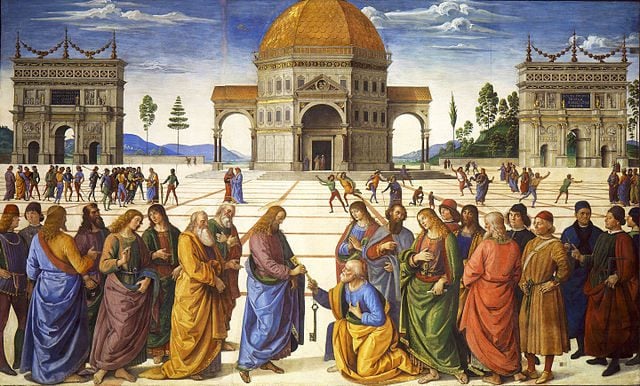
Photo credit: Delivery of the Keys of the Kingdom to St. Peter (c. 1482), by Pietro Perugino (1448-1523) [public domain / Wikimedia Commons]

***
Summary: Protestant apologist Matt Hedges attempts to make the argument that Clement of Rome, in his letter to the Corinthians, is not exercising papal authority. I contest this with many arguments.
***
Tags: apostolic succession, Bible & Papacy, biblical authority, biblical ecclesiology, bishops, Christian Church, Church offices, ecclesiology, elders, fathers & the papacy, papacy, patristic ecclesiology, Petrine primacy, popes, primacy of Rome, St. Peter, Clement of Rome, Clement & the papacy, Matt Hedges
Previous Post

July 27, 2021
Was Sodom Destroyed by a Meteor in Abraham's Time?
Next Post
July 31, 2021 Abraham, Warring Kings of Genesis 14, & History
Browse Our Archives
Select a Category & Last Things About Me Anti-Catholicism Atheism & Agnosticism Baptism and Sacramentalism Bible and Tradition Blessed Virgin Mary Books by Dave Armstrong C. S. Lewis Calvinism & General Protestantism Catholic Apologetics Catholic Apologists Catholic conversion Catholic converts Christmas Church (Ecclesiology) Church History Conversion and Converts Development of Doctrine Eastern Orthodoxy Ecumenism & Christian Unity Eucharist & Liturgy Fathers of the Church French Translations G. K. Chesterton Hell Hell & Satan Hell & Satan & Last Things Heresies & Comparative Religion Holistic Health Inquisition & Crusades & Scandals James White Jews & Judaism & Old Testament John Calvin John Henry Newman Liberal / Modernist Theology Life Issues Literary Resume Lutheranism Mariology Martin Luther Music Orthodoxy Papacy & Infallibility Personal Page Philosophy & Science Political & Ethical & Moral Issues Protestant Persecution & Intolerance Protestantism Purgatory Purgatory & Penance Romantic & Imaginative Theology Saints & Purgatory & Penance Salvation Salvation & Justification Satan & Last Things Sexuality and Gender Issues Spanish Translations Traditionalism vs. Radical Catholic Reactionaries Traducciones al español / tradução para português Trinitarianism & Christology Uncategorized Videos
Select a Month October 2026 September 2026 August 2026 July 2026 June 2026 May 2026 April 2026 March 2026 February 2026 January 2026 December 2025 November 2025 October 2025 September 2025 August 2025 July 2025 June 2025 May 2025 April 2025 March 2025 February 2025 January 2025 December 2024 November 2024 October 2024 September 2024 August 2024 July 2024 June 2024 May 2024 April 2024 March 2024 February 2024 January 2024 December 2023 November 2023 October 2023 September 2023 August 2023 July 2023 June 2023 May 2023 April 2023 March 2023 February 2023 January 2023 December 2022 November 2022 October 2022 September 2022 August 2022 July 2022 June 2022 May 2022 April 2022 March 2022 February 2022 January 2022 December 2021 November 2021 October 2021 September 2021 August 2021 July 2021 June 2021 May 2021 April 2021 March 2021 February 2021 January 2021 December 2020 November 2020 October 2020 September 2020 August 2020 July 2020 June 2020 May 2020 April 2020 March 2020 February 2020 January 2020 December 2019 November 2019 October 2019 September 2019 August 2019 July 2019 June 2019 May 2019 April 2019 March 2019 February 2019 January 2019 December 2018 November 2018 October 2018 September 2018 August 2018 July 2018 June 2018 May 2018 April 2018 March 2018 February 2018 January 2018 December 2017 November 2017 October 2017 September 2017 August 2017 July 2017 June 2017 May 2017 April 2017 March 2017 February 2017 January 2017 December 2016 November 2016 October 2016 September 2016 August 2016 July 2016 June 2016 May 2016 April 2016 March 2016 February 2016 January 2016 December 2015 November 2015 October 2015 September 2015 August 2015 July 2015 June 2015 May 2015 April 2015 March 2015 February 2015 January 2015 December 2014 November 2014 October 2014 September 2014 August 2014 July 2014 June 2014 April 2014 March 2014 February 2014 January 2014 December 2013 November 2013 October 2013 September 2013 August 2013 July 2013 June 2013 April 2013 March 2013 February 2013 January 2013 December 2012 November 2012 October 2012 September 2012 August 2012 July 2012 June 2012 May 2012 April 2012 March 2012 February 2012 January 2012 December 2011 November 2011 October 2011 September 2011 August 2011 July 2011 June 2011 April 2011 March 2011 February 2011 October 2010 September 2010 August 2010 July 2010 April 2010 March 2010 December 2009 October 2009 August 2009 July 2009 June 2009 May 2009 March 2009 February 2009 October 2008 September 2008 April 2008 March 2008 February 2008 January 2008 December 2007 November 2007 October 2007 May 2007 March 2007 February 2007 January 2007 November 2006 October 2006 September 2006 August 2006 July 2006 June 2006 May 2006 April 2006 March 2006 February 2006 October 2005 June 2005 April 2005 February 2005 July 2004 May 2004 April 2004
Follow Us!
TAKE THE
Religious Wisdom Quiz
What does "Pentateuch" mean?
Select your answer to see how you score.
Five Scrolls God's Law Sacred Teachings Holy Writings
Books by This Author Books by Dave Armstrong
Related posts from Biblical Evidence for Catholicism

Was Peter "Any Old" Apostle? 10 Anti-Papal Arguments
Biblical Evidence for Catholicism

Jesus Founded the [Catholic] Church. If Not Him,...
Biblical Evidence for Catholicism

17 Church Fathers on Purgatory (Esp. 1 Cor...
Biblical Evidence for Catholicism

Deuterocanon & Javier Perdomo's Straw Men
Biblical Evidence for Catholicism
TRENDING AT PATHEOS Catholic

In "Irreplaceable," our book on vocation and technology, Trevor Sutton and I...

I was strolling through the top floor of the brand new Parthenon...

What Does Gêvâh Mean For Kimberley Guifoyle &...
This week, a lot of the news is focused on Kimberly Guilfoyle....

INNER CIRCLE: Profound Mystery (Of Christ In All...
Ephesians 5:31-32 “For this reason, a man will leave his father and...

Do Not Rejoice When Your Enemy Falls: The...
Turning an execution into a public spectacle is a disturbing expression of...

'The Chosen' S6 Trailer: The Passion Gets Very...
Not many watching 'The Chosen' worry about spoilers, but just because they...
view all Catholic blogs
Ad-Free & Subscriber Log-In Subscription Support
- About Us
- 2026 Calendar
- Videos
- Podcasts
- Library of World Religions
- Faith In Media Tracker
- Advertise With Us
- Write for Us
- Privacy Policy
- Terms of Service
- Do Not Sell My Data
- Contact Us
- Radiant Digital
- Manage Newsletter Subscriptions
- Unsubscribe From Notifications
- Sitemap
Copyright 2008-2026, Patheos. All rights reserved.
Subscription Support Ad-Free & Subscriber Log-In
Follow Patheos