
BuddhistCatholicContemplativeEvangelicalGeneral ChristianHinduJewishLatter-day SaintMuslimNew VisionsProgressive Christian
Beliefs
- Buddhist
- Catholic
- Contemplative
- Evangelical
- General Christian
- Hindu
- Jewish
- Latter-day Saint
- More Voices
- Muslim
- New Visions
- Pagan
- Progressive Christian
Topics
- Religion News
- Food and Religion
- Sports and Religion
- Religious Art
- Religious Music and Entertainment
- Religious Events
- History and Religion
- Style and Religion
- Politics and Religion
- Women in Religion
- Recreation Outdoors and Religion
- Business Finance and Religion
- Careers Workplace and Religion
- Education and Religion
- Family Parenting and Religion
- Health Fitness and Religion
- Home and Religion
- Relationships and Religion
- Technology and Religion
- Travel and Religion
Columnists
- Buddhist Columnists
- Business Finance and Religion Columnists
- Careers Workplace and Religion Columnists
- Catholic Columnists
- Contemplative Columnists
- Education and Religion Columnists
- Evangelists Columnists
- Family Parenting and Religion Columnists
- General Christian Columnists
- Health Fitness and Religion Columnists
- Hindu Columnists
- History and Religion Columnists
- Home and Religion Columnists
- Jewish Columnists
- More Voices Columnists
- Latter Day Columnists
- Muslim Columnists
- New Visions Columnists
- Nonreligious Columnists
- Pagan Columnists
- Politics and Religion Columnists
- Progressive Columnists
- Recreation Outdoors and Religion Columnists
- Relationships and Religion Columnists
- Religion News Columnists
- Religious Art Columnists
- Religious Events Columnists
- Religious Music and Entertainment Columnists
- Sports and Religion Columnists
- Style and Religion Columnists
- Technology and Religion Columnists
- Travel and Religion Columnists
- Women in Religion Columnists
Resource Library
- 2026 Calendar
- Library of World Religions
- The 100 Most Holy Places on Earth
- Patheos Answers
- Podcasts
- Videos
- Faith Leaders Database
- Anglican Episcopalian
- Bahai
- Baptist
- Buddhism
- Christianity
- Confucianism
- Eastern Orthodoxy
- Hinduism
- Holiness and Pentecostal
- ISKCON
- Islam
- Judaism
- Lutheran
- Methodist
- The Church of Jesus Christ of Latter-day Saints
- New Age
- Paganism
- Presbytarian and Reformed
- Protestantism
- Religion Behind the Scenes
- Roman Catholic
- Scientology
- Shia Islam
- Sikhism
- Sufism
- Sunni Islam
- Taoism
- Zen
- See all religions
Research Tools
 Ad-Free & Subscriber Log-In Subscription Support
Follow Patheos 

- Trending:
- Advent
- |
- Forgiveness
- |
- Thanksgiving
- |
- Election
- |
- Seasonal Holidays
- |
- Marriage

-
About
-
Catholic Apologetics
-
Church History
-
Great Apologists
-
Christian Worldview
-
Protestantism & Misc.
- Home
- Catholic
- History and Religion
- Pearce’s Potshots #41: 13th c. BC Canaanite Iron Chariots
Pearce’s Potshots #41: 13th c. BC Canaanite Iron Chariots
Last updated on: June 5, 2026 at 11:59 pm by Dave Armstrong
Pearce’s Potshots #41: 13th c. BC Canaanite Iron Chariots 2026-06-05T23:59:03-04:00 Dave Armstrong
Patheos Explore the world's faith through different perspectives on religion and spirituality! Patheos has the views of the prevalent religions and spiritualities of the world.
Atheist anti-theist Jonathan M. S. Pearce is the main writer on the blog, A Tippling Philosopher. His “About” page states: “Pearce is a philosopher, author, blogger, public speaker and teacher from Hampshire in the UK. He specialises in philosophy of religion, but likes to turn his hand to science, psychology, politics and anything involved in investigating reality.” His words will be in blue.
*****
I am responding to a portion of Pearce’s article, Exodus Sidebar: Replying to Armstrong about Camels (5-24-21). Pearce enlists Donald B. Redford, whom he describes as an “eminent Canadian Egyptologist and archaeologist” for his cause of biblical skepticism:
[A]nachronisms do indeed abound, robbing the book [Judges] of the credence one might have placed in it. Iron is common for chariots and implements (cf. Jud. 1:19; 4:3 13; cf. 1 Sam. 13:19-21), although historically it did not replace bronze until well into the monarchy. [Egypt, Canaan, and Israel In Ancient Times, Princeton University Press, 1992, p. 277]
Let’s look at those Bible passages (and another related one):
Joshua 17:16 (RSV) The tribe of Joseph said, “The hill country is not enough for us; yet all the Canaanites who dwell in the plain have chariots of iron, both those in Beth-she’an and its villages and those in the Valley of Jezreel.”
Judges 1:19 And the LORD was with Judah, and he took possession of the hill country, but he could not drive out the inhabitants of the plain, because they had chariots of iron.
Judges 4:2-3 And the LORD sold them into the hand of Jabin king of Canaan, who reigned in Hazor; the commander of his army was Sis’era, who dwelt in Haro’sheth-ha-goiim. [3] Then the people of Israel cried to the LORD for help; for he had nine hundred chariots of iron, and oppressed the people of Israel cruelly for twenty years.
Judges 4:13 Sis’era called out all his chariots, nine hundred chariots of iron, . . .
1 Samuel 13:19 . . . Now there was no smith to be found throughout all the land of Israel . . .
Redford seems to assume that “smith” in the latter passage presupposes work with iron, but historically, blacksmiths were not confined to working with iron. Wikipedia (“Blacksmith”; section, “Before the Iron Age”) noted that “During the Chalcolithic era and the Bronze Age, humans in the Mideast learned how to smelt, melt, cast, rivet, and (to a limited extent) forge copper and bronze.” So it’s not a foregone conclusion that “smiths” here is referring to a blacksmith who worked with iron; and even if this was the intent, note that it said there was no such person in Israel; the Philistines dominated the trade in the area (1 Sam 13:20). In 1 Samuel, in RSV, “iron” appears only once, referring to shekels (coins): in 17:7. The Hebrew word here, charash (Strong’s word #2796) is defined by the Brown-Driver-Briggs Lexicon as “worker in metal.”
Joshua, the successor of Moses, is thought by many to have lived in the 13th century BC, and this is the time of the “conquest” of Canaan by Israel. Judges 1:1 announces his death. I gave evidences from archaeology for these events in my papers, No Evidence for Joshua’s Conquest? (5-28-21), and Joshua’s Altar on Mt. Ebal: Findings of Recent Archaeology (7-22-14). This period is right at the end of the Bronze Age and the beginning of the Iron Age (1200 BC). I shall argue that iron chariots, or at least, iron-plated chariots, were indeed historically plausible in Canaan at this time. And this is the claim: that Israel’s enemies possessed them and were, therefore, difficult to defeat in battle.
The book of Judges (whether compiled later or not) deals with the historical period from approximately 1200 BC (again, the beginning of the Iron Age) to the appearance of Saul as Israel’s first king, around 1037-1010 BC: which event is dealt with in 1 Samuel. Thus, the first thing to recognize is that we are already in the Iron Age; thus, use of iron in chariots would seem to be at least possible, though perhaps not prevalent. Remember, the skeptical claim is that iron chariots in these passages are anachronisms, that ought not be there at all. They are supposed to be historically inaccurate.
But let’s examine this question a bit more detail, shall we? Is what Judges reports so far-fetched, and some kind of myth? Wikipedia (“Blacksmith”) noted:
The Hittites of Anatolia first discovered or developed the smelting of iron ores around 1500 BC. They seem to have maintained a near monopoly on the knowledge of iron production for several hundred years, but when their empire collapsed during the Eastern Mediterranean upheavals around 1200 BC, the knowledge seems to have escaped in all directions.
The empire of the Hittites (c. 1600-c. 1180 BC), as one educational article devoted to it explained, took up roughly the eastern half of Asia Minor (present-day Turkey) and extended into the Levant, down to the city of Byblos (present-day Lebanon / ancient Phoenicia), as a map of the empire illustrates. The same article stated:

The Hittite military made successful use of chariots. Although their civilization thrived during the Bronze Age, the Hittites were the forerunners of the Iron Age and were manufacturing iron artifacts from as early as the 14th century BCE. Correspondence with rulers from other empires reveal a foreign demand for iron goods.
Wikipedia (“Canaan”) is clear that the Hittites played a key role among the Canaanites. It observes:
Canaan had significant geopolitical importance in the Late Bronze Age Amarna period (14th century BC) as the area where the spheres of interest of the Egyptian, Hittite, Mitanni and Assyrian Empires converged.
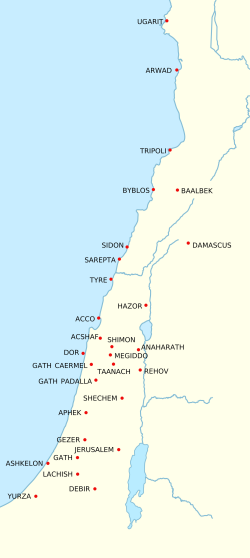
This article mentions the Hittites 13 times. The book of Judges mentions them twice (1:26; 3:5). Its map of ancient Canaan overlaps the map of the Hittite Empire, with three cities north of Byblos.
Nathaniel L. Erb-Satullo, an archaeologist who specializes in ancient metallurgy, wrote the article, “The Innovation and Adoption of Iron in the Ancient Near East” (Journal of Archaeological Research volume 27, pp. 557–607 [2019]). He wrote in the Abstract:
Current evidence supports an Anatolian origin for extractive iron metallurgy on a limited scale sometime in the early 2nd millennium BC. However, the first major expansion of iron, both in Anatolia and across the wider Near East, occurred in the late second and early first millennium BC.
This exactly corresponds to the Hittites being in the forefront of iron production. We know that they had chariots (very good ones), and that they were part of the Canaanites. Everything fits into the scenario that the Bible describes. There is no anachronism here!
The Biblical Archaeology Society’s Bible Review (April 1990) included a fascinating little snippet: “Did the Canaanites Really Have Iron Chariots?” It noted:
As recently as 1983, one commentator [J. F. A. Sawyer] has told us, “It is historically highly improbable… that the Canaanites were equipped with iron chariots before the end of the second millennium B.C.”
But the archaeological evidence is clearly to the contrary. The biblical text does not require us to suppose that the Canaanite chariots were wholly iron, but only that they were strengthened with it, as several commentators have realized. But as the evidence in the accompanying article [link] shows, iron was sufficiently available in the Late Bronze Age to make iron-plated chariots plausible. . . .
It is noteworthy that after the Book of Judges, the Hebrew writers never again describe chariots of “iron.” Either the metal was later a normal component of a chariot and so did not deserve mention, or “iron chariots” were in fashion only for a short period, perhaps as an experimental weapon. In any event, the evidence indicates that there is no reason to conclude that the Canaanite chariots of iron are an anachronism inserted by a later editor.
Dr. Alan Millard, Professor Emeritus of Hebrew and Ancient Semitic languages, and Honorary Senior Fellow (Ancient Near East), at the School of Archaeology, Classics and Egyptology (SACE) in the University of Liverpool, wrote a book chapter in 1992 entitled, “Back to the Iron Bed: Og’s or Procrustes’?” In it, he contends:
Chariots wholly of iron are unlikely; a form of iron plating is the commonly accepted understanding of the Hebrew words in Joshua and Judges (Josh. xvii 16,18; Judg. i 19, iv 3,13). After noting the very lightweight construction of Late Bronze Age chariots found in Egypt, Drews asserted, “iron plating would have immediately collapsed the fragile and flimsy frame” and “an ‘iron plated’ chariot is thus technological nonsense”. Moreover, “nowhere in the ancient world, at any period, are iron plated chariots attested” ([n. 2], p. 18). Initially, the impracticality of iron-plated chariots seems a major objection, but it depends upon the amounts and the application of the iron. Small-scale fittings, holding the axles or hubs, would be insufficient to give a distinctive name to the chariots, so a visible covering of some sort is best envisaged. That it was wholesale plating is not so certain, or necessary. In the Late Bronze Age bronze scales were commonly sewn on to cloth or leather garments to protect men and horses, they even covered helmets, and there are administrative ac counts of “hides for the storehouses for the coats of mail (to equip) 20 war chariots”. Although iron scale armour is not attested until much later, in neo-Assyrian times, the possibility of an experiment with iron in the 13th or 12th centuries B.C. cannot be ruled out. Whether in plates or scales, the iron would add greatly to the weight of the chariots, as Drews emphasized, yet only in proportion to the amount applied. Three or four thin plates hung over the front to protect the charioteer’s legs, which his hauberk did not cover, might have been thought worth the extra load. Once the heavier chariots were moving, they would be hard for opponents, especially foot-soldiers, to withstand. In the relatively rough and uneven terrain of much of Canaan, even in the plains where the iron chariots were stationed, the opportunity for long, fast runs would be limited, unlike Egypt and parts of Syria. Thus iron chariots become intelligible in the contexts where Joshua and Judges place them, and the threat they would pose to the Israelites is seen to be great.
Moreover, we have the evidence of chariot use by the Hittites (against the Egyptians) from the Battle of Kadesh (at a site in present-day Syria, in the Levant), from 1274 BC, or some 74 years or so before the time under consideration, referred to in the book of Judges. According to the Wikipedia article on the topic:
[It] is the earliest pitched battle in recorded history for which details of tactics and formations are known. It is believed to have been the largest chariot battle ever fought, involving between 5,000 and 6,000 chariots in total. As a result of discovery of multiple Kadesh inscriptions and the Egyptian–Hittite peace treaty, it is the best documented battle in all of ancient history.
I couldn’t find anything specifically referencing iron or iron-plated chariots in this battle, but it is a quite reasonable surmise that it was involved, seeing that the Hittites were probably the foremost practitioners of the use of iron in the world at the time.
Lord Edwin E. Hitti’s article, “Hittite Chariots” adds additional fascinating insights, as to how iron might have created a better chariot:
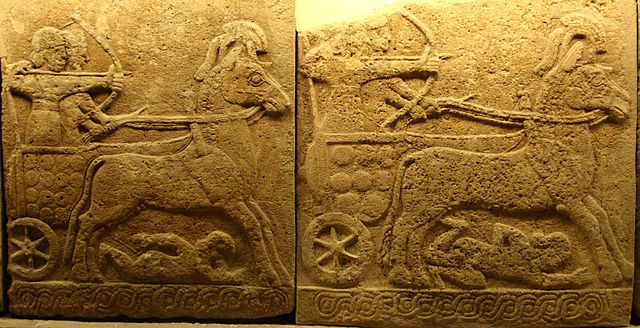
The Hittites were not inventors of the chariot, but did make major modifications, developed and produced chariots in huge quantities. Specifically, by creating the six-spoke wheels for the chariots to make them lighter and faster, yet still durable . . .
The Hittite chariots had a box serving as a cab, with an axle passing beneath it, which held 2 six-spoke wheels. The six-spoke wheel was an innovation developed by them. Other contemporary chariots of the Hittites had eight spoke[s], . . . The six-spoke[s] allowed the chariots to move faster because the wheels were light. Thus, with speed and light wheels, it became maneuverable.
The Egyptian chariot placed the wheels in the back of the box, and only held two men, a charioteer and a warrior. The limitation was weight; with the wheels so far back, leverage placed most of the weight on the horses, thereby slowing them down.
The Hittite chariot, in contrast, placed the wheels farther forward under the center of the box, which put the weight of the warriors over the axle and took the strain off of the horses, This allowed three men to ride, the charioteer and two warriors, which in effect doubled the number of fighting men that could be deployed with the same number of chariots.
The Hittite war chariot was made with iron hub wheels; this made their war chariot stronger, faster, and longer lasting. Also, the warriors in the chariot were armed with superior weapons. Their iron tipped arrows had much greater penetrating power that the copper and bronze arrows of the Egyptians, who were the Hittites main rivals. The war chariot was sometimes equipped with iron swords on the hubs to cut opposing infantry units [Ben Hur-style!].
Likewise, James D. Muhly, Emeritus Professor of Asian and Middle Eastern Studies at the University of Pennsylvania, in his article, “How Iron Technology Changed the Ancient World and Gave the Philistines a Military Edge” (Biblical Archaeology Review, vol. 8:6, Nov/Dec 1982), states:
The actual use of iron must have been confined to fittings, such as the hubs of the chariot’s wheels, perhaps even parts of the wheel itself. (The same explanation probably applies to the iron bedstead of Og, king of Bashan, in Deuteronomy 3:11.) Such iron chariot fittings have been recovered at Taanach, but unfortunately in an uncertain archaeological context.
Thus, it looks like we have two viable theories as to the use of iron in Hittite chariots: either as plating and/or in parts of the wheels only. In both cases, the extra weight wouldn’t be so great as to be a hindrance to performance, but the iron would provide a distinct advantage. This would explain why the Israelites had trouble defeating their opponents with chariots that included iron in some capacity.
***
Related Reading
The Hittites: Atheist “DagoodS” Lies About Christian Apologists Supposedly Lying About How Biblical Critics Once Doubted Their Historical Existence [1-10-11, at Internet Archive]
Habitually “Lying” Christian Apologists?: 19th Century “Hittites Didn’t Exist” Radical Skepticism and Examination of Atheist DagoodS’ Replies and Charges [1-15-11, at Internet Archive]
Hittite Skeptics Chronicles, Part III: Specific Citations of Denial (Budge, Sumner, & Conder) and Biblical Historical Accuracy (in the Time of Elisha) [1-19-11, at Internet Archive]
Great Hittite Wars, Part IV: Lying Christian Egyptologist M. G. Kyle?: Atheist DagoodS Disputes Sir A. E. Wallis Budge’s Reported Hittite Skepticism [1-21-11, at Internet Archive]
“Higher” Hapless Haranguing of Hypothetical Hittites (19th C.) [7-7-20; abridgement of the four posts above]
***
Photo credit: Frank K. (8-12-08). Orthostat relief in basalt; battle chariot, Carchemish, 9th century BC; Late Hittite style with Assyrian influence. Reconstructed panel on the left, original on the right [Wikimedia Commons / Creative Commons Attribution 2.0 Generic license]

***
Summary: Critics of the Bible have attacked the mention of Canaanite iron chariots in Judges and Joshua, as alleged proof of historical inaccuracy and anachronism. I show how they are wrong.
***
Tags: alleged Bible contradictions, alleged biblical anachronisms, ancient Hebrews, ancient Israelites, ancient Jews, anti-theism, archaeology & the Bible, archaeology & the Old Testament, atheists & the Bible, Bible “contradictions”, Bible “difficulties”, Bible & History, biblical accuracy, biblical anachronisms, biblical archaelogy, Bronze Age, Canaanite iron chariots, Canaanites, Hebrews, Hittites, Holy Bible, infallibility, Iron Age, iron chariots, Judges & iron chariots, Late Bronze Age, Old Testament & history
Jews & Judaism & Old Testament
archaeology & the Old Testament
Previous Post

July 14, 2021
Jeremiad Against Fascist Facebook / My Departure
Next Post

July 16, 2021 Pope Francis' Traditionis Custodes is for the Sake of Unity
Browse Our Archives
Select a Category & Last Things About Me Anti-Catholicism Atheism & Agnosticism Baptism and Sacramentalism Bible and Tradition Blessed Virgin Mary Books by Dave Armstrong C. S. Lewis Calvinism & General Protestantism Catholic Apologetics Catholic Apologists Catholic conversion Catholic converts Christmas Church (Ecclesiology) Church History Conversion and Converts Development of Doctrine Eastern Orthodoxy Ecumenism & Christian Unity Eucharist & Liturgy Fathers of the Church French Translations G. K. Chesterton Hell Hell & Satan Hell & Satan & Last Things Heresies & Comparative Religion Holistic Health Inquisition & Crusades & Scandals James White Jews & Judaism & Old Testament John Calvin John Henry Newman Liberal / Modernist Theology Life Issues Literary Resume Lutheranism Mariology Martin Luther Music Orthodoxy Papacy & Infallibility Personal Page Philosophy & Science Political & Ethical & Moral Issues Protestant Persecution & Intolerance Protestantism Purgatory Purgatory & Penance Romantic & Imaginative Theology Saints & Purgatory & Penance Salvation Salvation & Justification Satan & Last Things Sexuality and Gender Issues Spanish Translations Traditionalism vs. Radical Catholic Reactionaries Traducciones al español / tradução para português Trinitarianism & Christology Uncategorized Videos
Select a Month November 2026 October 2026 September 2026 August 2026 July 2026 June 2026 May 2026 April 2026 March 2026 February 2026 January 2026 December 2025 November 2025 October 2025 September 2025 August 2025 July 2025 June 2025 May 2025 April 2025 March 2025 February 2025 January 2025 December 2024 November 2024 October 2024 September 2024 August 2024 July 2024 June 2024 May 2024 April 2024 March 2024 February 2024 January 2024 December 2023 November 2023 October 2023 September 2023 August 2023 July 2023 June 2023 May 2023 April 2023 March 2023 February 2023 January 2023 December 2022 November 2022 October 2022 September 2022 August 2022 July 2022 June 2022 May 2022 April 2022 March 2022 February 2022 January 2022 December 2021 November 2021 October 2021 September 2021 August 2021 July 2021 June 2021 May 2021 April 2021 March 2021 February 2021 January 2021 December 2020 November 2020 October 2020 September 2020 August 2020 July 2020 June 2020 May 2020 April 2020 March 2020 February 2020 January 2020 December 2019 November 2019 October 2019 September 2019 August 2019 July 2019 June 2019 May 2019 April 2019 March 2019 February 2019 January 2019 December 2018 November 2018 October 2018 September 2018 August 2018 July 2018 June 2018 May 2018 April 2018 March 2018 February 2018 January 2018 December 2017 November 2017 October 2017 September 2017 August 2017 July 2017 June 2017 May 2017 April 2017 March 2017 February 2017 January 2017 December 2016 November 2016 October 2016 September 2016 August 2016 July 2016 June 2016 May 2016 April 2016 March 2016 February 2016 January 2016 December 2015 November 2015 October 2015 September 2015 August 2015 July 2015 June 2015 May 2015 April 2015 March 2015 February 2015 January 2015 December 2014 November 2014 October 2014 September 2014 August 2014 July 2014 June 2014 April 2014 March 2014 February 2014 January 2014 December 2013 November 2013 October 2013 September 2013 August 2013 July 2013 June 2013 April 2013 March 2013 February 2013 January 2013 December 2012 November 2012 October 2012 September 2012 August 2012 July 2012 June 2012 May 2012 April 2012 March 2012 February 2012 January 2012 December 2011 November 2011 October 2011 September 2011 August 2011 July 2011 June 2011 April 2011 March 2011 February 2011 October 2010 September 2010 August 2010 July 2010 April 2010 March 2010 December 2009 October 2009 August 2009 July 2009 June 2009 May 2009 March 2009 February 2009 October 2008 September 2008 April 2008 March 2008 February 2008 January 2008 December 2007 November 2007 October 2007 May 2007 March 2007 February 2007 January 2007 November 2006 October 2006 September 2006 August 2006 July 2006 June 2006 May 2006 April 2006 March 2006 February 2006 October 2005 June 2005 April 2005 February 2005 July 2004 May 2004 April 2004
Follow Us!
TAKE THE
Religious Wisdom Quiz
Return to me, for I desire mercy and not sacrifice, and the knowledge of God more than what?
Select your answer to see how you score.
Fasting Prayer Worship Burnt offerings
Books by This Author Books by Dave Armstrong
Related posts from Biblical Evidence for Catholicism

God, Modern Physics, & Dark Energy: An Analogy
Biblical Evidence for Catholicism
God's Presence, the Ark, the Eucharist, & Death
Biblical Evidence for Catholicism
Garden of Eden’s Location Verified by Science
Biblical Evidence for Catholicism

Unregenerate Good Works in the Old Testament
Biblical Evidence for Catholicism
TRENDING AT PATHEOS Catholic

How to Have Financial Transparency in Marriage
Despite the fact that financial issues and money problems are the number...
The Healing Power of Forgiveness in Marriage
Learning how to give and accept apologies are essential ingredients of a...

The West's Christian Moral Inheritance: A Legacy Denied
Whether we like it or not, our environment matters, shaping us both...

How Does Tôḏâ Connect Florida & Thanksgiving?
The big news this weekend has been about the continued flooding on...

Were Early Christians Drinking Psychedelic Wine?
The Secret Sacrament the Church Took Away The early Christian church was...

As we in the United States approach the national Thanksgiving holiday...
view all Catholic blogs
Ad-Free & Subscriber Log-In Subscription Support
- About Us
- 2026 Calendar
- Videos
- Podcasts
- Library of World Religions
- Faith In Media Tracker
- Advertise With Us
- Write for Us
- Privacy Policy
- Terms of Service
- Do Not Sell My Data
- Contact Us
- Radiant Digital
- Manage Newsletter Subscriptions
- Unsubscribe From Notifications
- Sitemap
Copyright 2008-2026, Patheos. All rights reserved.
Subscription Support Ad-Free & Subscriber Log-In
Follow Patheos