
BuddhistCatholicContemplativeEvangelicalGeneral ChristianHinduJewishLatter-day SaintMuslimNew VisionsProgressive Christian
Beliefs
- Buddhist
- Catholic
- Contemplative
- Evangelical
- General Christian
- Hindu
- Jewish
- Latter-day Saint
- More Voices
- Muslim
- New Visions
- Pagan
- Progressive Christian
Topics
- Religion News
- Food and Religion
- Sports and Religion
- Religious Art
- Religious Music and Entertainment
- Religious Events
- History and Religion
- Style and Religion
- Politics and Religion
- Women in Religion
- Recreation Outdoors and Religion
- Business Finance and Religion
- Careers Workplace and Religion
- Education and Religion
- Family Parenting and Religion
- Health Fitness and Religion
- Home and Religion
- Relationships and Religion
- Technology and Religion
- Travel and Religion
Columnists
- Buddhist Columnists
- Business Finance and Religion Columnists
- Careers Workplace and Religion Columnists
- Catholic Columnists
- Contemplative Columnists
- Education and Religion Columnists
- Evangelists Columnists
- Family Parenting and Religion Columnists
- General Christian Columnists
- Health Fitness and Religion Columnists
- Hindu Columnists
- History and Religion Columnists
- Home and Religion Columnists
- Jewish Columnists
- More Voices Columnists
- Latter Day Columnists
- Muslim Columnists
- New Visions Columnists
- Nonreligious Columnists
- Pagan Columnists
- Politics and Religion Columnists
- Progressive Columnists
- Recreation Outdoors and Religion Columnists
- Relationships and Religion Columnists
- Religion News Columnists
- Religious Art Columnists
- Religious Events Columnists
- Religious Music and Entertainment Columnists
- Sports and Religion Columnists
- Style and Religion Columnists
- Technology and Religion Columnists
- Travel and Religion Columnists
- Women in Religion Columnists
Resource Library
- 2026 Calendar
- Library of World Religions
- The 100 Most Holy Places on Earth
- Patheos Answers
- Podcasts
- Videos
- Faith Leaders Database
- Anglican Episcopalian
- Bahai
- Baptist
- Buddhism
- Christianity
- Confucianism
- Eastern Orthodoxy
- Hinduism
- Holiness and Pentecostal
- ISKCON
- Islam
- Judaism
- Lutheran
- Methodist
- The Church of Jesus Christ of Latter-day Saints
- New Age
- Paganism
- Presbytarian and Reformed
- Protestantism
- Religion Behind the Scenes
- Roman Catholic
- Scientology
- Shia Islam
- Sikhism
- Sufism
- Sunni Islam
- Taoism
- Zen
- See all religions
Research Tools
 Ad-Free & Subscriber Log-In Subscription Support
Ad-Free & Subscriber Log-In Subscription Support
Follow Patheos 

- Trending:
- Forgiveness
- |
- Marriage
- |
- Consciousness
- |
- Death Penalty
- |
- Election
- |
- Halloween

-
About
-
Catholic Apologetics
-
Church History
-
Great Apologists
-
Christian Worldview
-
Protestantism & Misc.
- Home
- Catholic
- History and Religion
- Local Flood & Atheist Ignorance of Christian Thought
Local Flood & Atheist Ignorance of Christian Thought
Last updated on: July 4, 2021 at 7:21 pm by Dave Armstrong
Local Flood & Atheist Ignorance of Christian Thought 2021-07-04T19:21:49-04:00 Dave Armstrong
Patheos Explore the world's faith through different perspectives on religion and spirituality! Patheos has the views of the prevalent religions and spiritualities of the world.
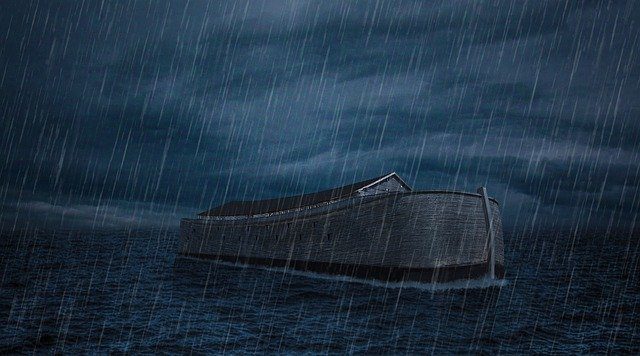
One “eric”: a regular (and thoughtful, friendly, and articulate) commenter on atheist antitheist Jonathan Pearce’s blog, made an argument there having to do with the volume and water and other difficulties in a “universal flood” view:
I vaguely recall an old Panda’s Thumb post where someone worked out the rain density/flow necessary to cover the Earth (up a few km from sea level) in 40 days. It worked out to be stronger than a firehose over every square inch of surface. The ark wouldn’t have floated, it would’ve been destroyed – flattened by the water pressure coming down.
A very quick back-of-the-envelope calculation: Everest = 8,848m above sea level. Divide by 40 days gives a flood rise of about 2E-3 meters per second. This can be considered cubic meters though since the rain has to ‘fill up’ the space. While that doesn’t sound like much, the flow rate out of a firehose is about 3E-4 m3/s (5 gallons per minute where 1 gpm = 6E-5 m3/s). So the rain was coming down with a force of about 10x the force of a firehose. The ark would’ve been kindling. Even if it was magically structurally sound, it would’ve been pounded under the water instead of floating on top, the same way floatable things get pushed under the water at the bottom of a waterfall. (7-2-21)
Well first, I brought it up mainly because I find it amusing.
Second, I think replacing most believers’ mental images of rain falling around a boat with what it really would’ve looked like – essentially, the entire Earth sitting under Niagara falls, the water pounding anything and everything into dust – can be a useful way to bring home the sheer unfeasibility of the scenario.
Last, Mr. Armstrong seems to go to great lengths to try and figure out how various biblical events could’ve occurred within the bounds of physics (e.g. nativity star = Jupiter). So there may be some value in showing those sorts of believers that no, there is no way this story can be explained by any appeal to nature. “It only rained for 40 days, then the water took 150 days to recede” isn’t a viable solution to the DH identification of inconsistencies, because “it only rained for 40 days” is a huge problem in itself. It would’ve had to have been more like 4,000 days to get down to even the level of torrential downpour. (7-2-21)
This is delicious (and yes, highly “amusing” on this end, too!), in light of the fact that Pearce had just been lecturing me as follows:
[N]o serious Pentateuchal scholar adheres to the mosaic authorship and single-source proposal for the Pentateuch. I have listened to countless scholars attest to this. No conference, no symposium, no meeting for the Society of Biblical Literature entails any scholar advocating for mosaic authorship or a single source of the Pentateuch. It just doesn’t happen.
Yet the view of Mosaic authorship is very common. In apologetics only. There is a vast chasm that separates serious Hebrew Bible scholarship and Christian apologetics.
This is simply untrue. Many Christian scholars accept the Documentary Hypothesis, but by no means all, as I showed in my previous paper. Pearce was merely over-arguing it, as he so often does, absurdly exaggerating, in the service of condescension, and making his usual overzealous “universal negative” statements.
Right after that (after he misrepresents Christian thinking), eric comes along and strongly insinuates that all or virtually all Christian thinkers believe in a universal Flood, rather than a local one. This is the very common tendency of atheists (many of whom were themselves formerly fundamentalist Protestants) collapsing all of Christian thought into a brand that is a tiny fringe position compared to the whole.
Fundamentalists are a small portion of a sector (traditional or “conservative” Protestants) of a small minority among all Christians (Protestantism). In no sense or way does this represent all of Christian thinking. It’s (without question) intellectually dishonest to ever imply that it does. Yet this regularly occurs in anti-theist atheist polemics and rhetoric, thus opening up the way for massive and clueless bashing of straw men.
Note that eric above simply assumes that the biblical flood accounts must be interpreted as literally universal in nature (including the waters literally covering every mountain, which would include Mt. Everest: 29,032 feet elevation above sea level). He never qualifies or nuances his statement above; never notes that any Christian thinkers believe in a local flood (let alone the vast majority of them, as is the case, and as I will show). Eric takes for granted that the language of “all the high mountains under the whole heaven were covered” (Gen 7:19) was intended to be absolutely literal in the first place. If it’s not literal, then (applying that interpretation consistently) there is no necessity for the Flood waters to literally cover even Mt. Ararat.
It’s hard to say with precision, but I shall consider Mesopotamia as constituting the land area of present-day Iraq, Syria, the eastern quarter of Turkey, Armenia, Lebanon, Jordan, and Israel: basically what was also known as the “Fertile Crescent”: minus Egypt. Here are the square miles in land of all these regions:

Iraq 169,235
Syria 71,498
Turkey (one-fourth) 75,634
Armenia 11,484
Lebanon 4,036
Jordan 34,495
Israel 8,550Total square miles = 374,932 [the square miles of Texas and Arizona combined is 375,556]
The square miles of the entirety of the earth’s surface (including oceans) add up to 197 million square miles. Dividing this figure by 374,932, we find that the surface area of the entire earth (universal Flood) is 525 times larger than the area of Mesopotamia (local Flood). So the comparison of local to universal Flood is as follows:
Flood water (of far, far less depth) in and around an area of approximately 374,932 square miles.
vs.
29,054 feet of water covering the entire earth: an area of approximately 197 million square miles (525 times larger)
It’s obviously vastly less water in any version of the local Flood scenario, which would have nothing to do with eric’s calculations of “the entire Earth sitting under Niagara falls, the water pounding anything and everything into dust” etc. A rough estimate of a local Flood in Mesopotamia covers an area 525 times smaller.
For further reading on the interpretation of a local Flood, see geologist Carol A. Hill’s article, “The Noachian Flood: Universal or Local?” (Perspectives on Science and Christian Faith, Volume 54, Number 3, September 2002). She writes:
Earth. The Hebrew for “earth” used in Gen. 6–8 (and in Gen. 2:5–6) is eretz (‘erets) or adâmâh, both of which terms literally mean “earth, ground, land, dirt, soil, or country.” In no way can “earth” be taken to mean the planet Earth, as in Noah’s time and place, people (including the Genesis writer) had no concept of Earth as a planet and thus had no word for it. Their “world” mainly (but not entirely) encompassed the land of Mesopotamia—a flat alluvial plain enclosed by the mountains and high ground of Iran, Turkey, Syria, and Saudi Arabia (Fig. 1); i.e., the lands drained by the four rivers of Eden (Gen. 2:10–14). The biblical account must be interpreted within the narrow limit of what was known about the world in that time, not what is known about the world today.
Biblical context also makes it clear that “earth” does not necessarily mean the whole Earth. For example, the face of the ground, as used in Gen. 7:23 and Gen. 8:8 in place of “earth,” does not imply the planet Earth. “Land” is a better translation than “earth” for the Hebrew eretz because it extends to the “face of the ground” we can see around us; that is, what is within our horizon. It also can refer to a specific stretch of land in a local geographic or political sense. For example, when Zech. 5:6 says “all the earth,” it is literally talking about Palestine—a tract of land or country, not the whole planet Earth. Similarly, in Mesopotamia, the concept of “the land” (kalam in Sumerian) seems to have included the entire alluvial plain. This is most likely the correct interpretation of the term “the earth,” which is used over and over again in Gen. 6-8: the entire alluvial plain of Mesopotamia was inundated with water. The clincher to the word “earth” meaning ground or land (and not the planet Earth) is Gen. 1:10: God called the dry land earth (eretz). If God defined “earth” as “dry land,” then so should we. . . .
An excellent example of how a universal “Bible-speak” is used in Genesis to describe a non-universal, regional event is Gen. 41:46:
“And the famine was over all the face of the earth.” This is the exact same language as used in Gen. 6:7, 7:3, 7:4, 8:9 and elsewhere
when describing the Genesis Flood. “All (kowl) the face of the earth” has the same meaning as the “face of the whole (also kowl)
earth.” So was Moses claiming that the whole planet Earth (North America, Australia, etc.) was experiencing famine? No, the
universality of this verse applied only to the lands of the Near East (Egypt, Palestine, Mesopotamia), and perhaps even the Mediterranean area; i.e., the whole known world at that time.The same principle of a limited universality in Gen. 41:46 also applies to the story of the Noachian Flood. The “earth” was the land (ground) as Noah knew (tilled) it and saw it “under heaven”—that is, the land under the sky in the visible horizon, and “all flesh” were those people and animals who had died or were perishing around the ark in the land of Mesopotamia. The language used in the scriptural narrative is thus simply that which would be natural to an eyewitness (Noah). Woolley aptly described the situation this way: “It was not a universal deluge; it was a vast flood in the valley of the Tigris and Euphrates which drowned the whole of the habitable land … for the people who lived there that was all the world (italics mine).”
Regarding specifically the water covering “all the high mountains” (Gen 7:19), Hill states:
[T]he Hebrew word har for “mountain” in Gen. 7:20 . . . can also be translated as “a range of hills” or “hill country,” implying with Gen. 7:19 that it was “all the high hills” (also har) that were covered rather than high mountains.
This being the case, Genesis 7:19-20 could simply refer to “flood waters . . . fifteen cubits above the ‘hill country’ of Mesopotamia (located in the northern, Assyrian part)”. The Hebrew word har (Strong’s #2022) can indeed mean “hills” or “hill country”, as the Brown-Driver-Briggs Lexicon defines it. Specifically for Genesis 7:19-20, this lexicon classifies the word as following:
mountain, indefinite, Job 14:18 (“” צוּר); usually plural mountains, in General, or the mountains, especially in poetry & the higher style; often figurative; הָרִים, הֶהָרִים, covered by flood Genesis 7:20 compare Genesis 7:19; . . .
In the New American Standard Version, that Jonathan Pearce believes is “renowned as the most accurate” (7-2-21), har is rendered as “hill country” many times in the Hebrew Bible: Genesis 10:30; 14:10; 31:21, 23, 25; 36:8-9; Numbers 13:17, 29; 14:40, 44-45; Deuteronomy 1:7, 19-20, 24, 41, 43-44; 2:37; 3:12, 25; Joshua 2:16, 22-23; 9:1; 10:6, 40; 11:2-3, 16; 11:21; 12:8; 13:6; 14:12; 15:48; 16:1; 17:15-16, 18; 18:12; 19:50; 20:7; 21:11, 21; 24:30, 33; Judges 1:9, 19, 34; 2:9; 3:27; 4:5; 7:24; 10:1; 12:15; 17:1, 8; 18:2, 13; 19:1, 16, 18; 1 Samuel 1:1; 9:4; 13:2; 14:22; 23:14; 2 Samuel 20:21; 1 Kings 4:8; 12:25; 2 Kings 5:22; 1 Chronicles 6:67; 2 Chronicles 13:4; 15:8; 19:4.
The same version translates har as “hill” or “hills” nine times too: Deuteronomy 8:7; 11:11; Joshua 13:19; 18:13-14, 16; 1 Kings 16:24; 2 Kings 1:9; 4:27.
Even the location of the present-day Mt. Ararat as the landing place of the ark is not required in the biblical text. Hill continues:
[T]he Bible does not actually pinpoint the exact place where the ark landed, it merely alludes to a region or range of mountains where the ark came to rest: the mountains of Ararat (Gen. 8:4). Ararat is the biblical name for Urartu (Isa. 37:38) as this area was known to the ancient Assyrians. This mountainous area, geographically centered around Lake Van and between Lake Van and Lake Urmia (Fig. 1), was part of the ancient region of “Armenia” (not limited to the country of Armenia today). “Mountain” in Gen. 8:4 is plural; therefore, the Bible does not specify that the ark landed on the highest peak of the region (Mount Ararat), only that the ark landed somewhere on the mountains or highlands of Armenia (both “Ararat” and “Urartu” can be translated as “highlands”). In biblical times, “Ararat” was actually the name of a province (not a mountain), as can be seen from its usage in 2 Kings 19:37: “… some escaped into the land of Ararat” and Jer. 51:27: “… call together against her (Israel) the kingdoms of Ararat, Minni, and Askkenaz …”
She additionally noted that:
Only in the eleventh and twelfth centuries AD did the focus of investigators begin to shift toward Mount Ararat as the ark’s final resting place, and only by the end of the fourteenth century AD does it seem to have become a fairly well established tradition. Before this, both Islamic and Christian tradition held that the landing place of the ark was on Jabel Judi, a mountain located about 30 miles (48 km) northeast of the Tigris River near Cizre, Turkey (Fig. 1).
Jabel Judi is 6,854 feet in elevation. The current Mt. Ararat wasn’t even known by that name until the Middle Ages (see more on its names in Wikipedia).
Lorence G. Collins is a geologist and petrologist. His Wikipedia page observed that he is “known for his opposition to creationist geological pseudo-science.” He has 36 articles on a website Opposition to Creationism that describe various views of young-earth creationists and their scientific errors in interpretations. He wrote a fascinating article, “Yes, Noah’s flood may have happened but not over the
whole earth” (Reports of the National Center for Science Education, 2009, 29(5): 38-41. He lays out geological evidence for a local Mesopotamian Flood:
REGIONAL EVIDENCE FOR THE NOACHIAN AND SIMILAR FLOODS
Two rivers, the Euphrates and Tigris flow through Mesopotamia, which is now the country of Iraq (Figure 1).There are several layers in exposed rocks near these two rivers in southeastern Mesopotamia (Iraq) that are likely flood deposits. Most are about a foot (0.3 m) thick, but one is as much as 3 meters thick (MacDonald 1988). Flood debris from this same thick deposit along the Euphrates River near the ancient Sumerian city of Shuruppak about 200 km southeast of Baghdad has been dated by the C14 method, giving an age of 2900 BCE (Best nd). Flood deposits 2.4 meters thick are also reported by MacDonald (1988) as far northeast as the ancient Babylonian city of Kish (120 km south of Baghdad). At any rate, the many flood-deposit layers show that flooding in southeastern Mesopotamia was not unusual in ancient times.
Reference Source:
MacDonald D. 1988. The Flood: Mesopotamian archaeological evidence. Creation/Evolution 8 (2): 14–20.
The Bible habitually uses phenomenological language. Collins makes note of this with regard to the Flood:
Northeast and southwest of the nearly flat surface that contains the two rivers, the topography rises to more than 455 m [1493 feet] in Saudi Arabia and in Iran. Calculations show that elevations of 455 m high cannot be seen beyond 86 km [53 miles] away, and these places are more than 160 km [99 miles] from the Euphrates or Tigris Rivers. Therefore, none of the high country in Saudi Arabia or Iran would be visible to a tribal chief (or Noah). On that basis, the “whole world” would definitely appear to be covered with water during the Flood, and that was the “whole world” for the people in this part of southeastern Mesopotamia at that time.
Here is a good topographical map of Mesopotamia (see also a second one). One can see that there is a sort of “basin” in the alluvial floodplain in this area. An article about the region referred to:
. . . the floodplain of the Tigris and Euphrates rivers, which is bordered by the Zagros Mountains to the east, the Himreen Mountains to the north, the Arabian Plateau to the west and the Persian Gulf to the south.
Now, all that remains is to show that the opinion of a local Flood is mainstream Christian thought. Its rather easy to do. First I go to the Catholic Encyclopedia (since I am a Catholic). It’s article on “Deluge” was written in 1908, so these are no recent developments in scholarly thinking.
Universality of the Deluge
The Biblical account ascribes some kind of a universality to the Flood. But it may have been geographically universal, or it may have been only anthropologically universal. In other words, the Flood may have covered the whole earth, or it may have destroyed all men, covering only a certain part of the earth. Till about the seventeenth century, it was generally believed that the Deluge had been geographically universal, and this opinion is defended even in our days by some conservative scholars (cf. Kaulen in Kirchenlexikon). But two hundred years of theological and scientific study devoted to the question have thrown so much light on it that we may now defend the following conclusions:
The geographical universality of the Deluge may be safely abandoned
Neither Sacred Scripture nor universal ecclesiastical tradition, nor again scientific considerations, render it advisable to adhere to the opinion that the Flood covered the whole surface of the earth.
(a) The words of the original text, rendered “earth” in our version, signify “land” as well as “earth”; in fact, “land” appears to have been their primary meaning, and this meaning fits in admirably with Genesis 4, 5 and 10; why not adhere to this meaning also in Genesis 6:9, or the Flood story. Why not read, the waters “filled all on the face of the land”, “all flesh was destroyed that moved in the land”, “all things wherein there is the breath of life in the land died”, “all the high mountains under the whole heaven (corresponding to the land) were covered”? The primary meaning of the inspired text urges therefore a universality of the flood covering the whole land or region in which Noah lived, but not the whole earth. . . .
(c) There are also certain scientific considerations which oppose the view that the Flood was geographically universal. Not that science opposes any difficulty insuperable to the power of God; but it draws attention to a number of most extraordinary, if not miraculous phenomena involved in the admission of a geographically universal Deluge.
- First, no such geological traces can be found as ought to have been left by a universal Deluge; for the catastrophe connected with the beginning of the ice-age, or the geological deluge, must not be connected with the Biblical.
- Secondly, the amount of water required by a universal Deluge, as described in the Bible, cannot be accounted for by the data furnished in the Biblical account. If the surface of the earth, in round numbers, amounts to 510,000,000 square kilometres, and if the elevation of the highest mountains reaches about 9000 metres, the water required by the Biblical Flood, if it be universal, amounts to about 4,600,000,000 cubic kilometres. Now, a forty days’ rain, ten times more copious than the most violent rainfall known to us, will raise the level of the sea only about 800 metres; since the height to be attained is about 9000 metres, there is still a gap to be filled by unknown sources amounting to a height of more than 8000 metres, in order to raise the water to the level of the greatest mountains.
For Protestant opinion, I cite the International Standard Bible Encyclopedia: a marvelous helpful work similar to the Catholic Encyclopedia. It dates from 1915. I quote from its article, “Deluge of Noah”. It was written by George Frederick Wright (a Congregationalist), about whom Wikipedia states:
. . . an American geologist and a professor at Oberlin Theological Seminary, first of New Testament language and literature (1881 – 1892), and then of “harmony of science and revelation” (until retirement in 1907). He wrote prolifically, publishing works in geology, history, and theology. Early in his career he was an outspoken defender of Darwinism, and later in life he emphasised his commitment to a form of theistic evolution.
And now from the article:
Was the Flood Universal?:
In considering the credibility of the Biblical story we encounter at the outset the question whether the narrative compels us to believe the Flood to have been universal. In answer, it is sufficient to suggest that since the purpose of the judgment was the destruction of the human race, all the universality which it is necessary to infer from the language would be only such as was sufficient to accomplish that object. If man was at that time limited to the Euphrates valley, the submergence of that area would meet all the necessary conditions. Such a limitation is more easily accepted from the fact that general phrases like “Everybody knows,” “The whole country was aroused,” are never in literature literally interpreted. When it is said (Genesis 41:54-57) that the famine was “in all lands,” and over “all the face of the earth,” and that “all countries came into Egypt …. to buy grain,” no one supposes that it is intended to imply that the irrigated plains of Babylonia, from which the patriarchs had emigrated, were suffering from drought like Palestine (For other examples of the familiar use of this hyperbole, see Deuteronomy 2:25; Job 37:3; Acts 2:25; Romans 1:8.)
As to the extent to which the human race was spread over the earth at the time of the Flood, two suppositions are possible. First, that of Hugh Miller (Testimony of the Rocks) that, owing to the shortness of the antediluvian chronology, and the violence and moral corruption of the people, population had not spread beyond the boundary of western Asia. An insuperable objection to this theory is that the later discoveries have brought to light remains of prehistoric man from all over the northern hemisphere, showing that long before the time of the Flood he had become widely scattered.
Another theory, supported by much evidence, is that, in connection with the enormous physical changes in the earth’s surface during the closing scenes of the Glacial epoch, man had perished from off the face of the earth except in the valley of the Euphrates, and that the Noachian Deluge is the final catastrophe in that series of destructive events.
Likewise, we can cite The Christian View of Science and Scripture (1954) an immensely influential work from Baptist theologian Bernard Ramm, representing mainstream evangelical [as opposed to “fundamentalist”] Protestant, post-World War II thinking:
Although many Christians still believe in the universal flood, most of the recent conservative scholarship of the church defends a local flood. (p. 238; he cites the article directly above as “the best discussion on the flood”)
Criticisms of the universal flood interpretation
. . . (i) It cannot demonstrate that totality of language necessitates a universal flood . Fifteen minutes with a Bible concordance will reveal many instances in which universality of language is used but only a partial quantity is meant. All does not mean every last one in all of its usages. Psa. 22: 17 reads: “I may tell all my bones,” and hardly means that every single bone of the skeleton stood out prominently. John 4: 39 cannot mean that Jesus completely recited the woman’s biography. Matt. 3: 5 cannot mean that every single individual from Judea and Jordan came to John the Baptist. There are cases where all means all, and every means every, but the context tells us where this is intended. Thus, special reference may be made to Paul’s statement in Romans about the universality of sin, yet even that “all” excludes Jesus Christ.
The universality of the flood simply means the universality of the experience of the man who reported it. When God tells the Israelites He will put the fear of them upon the people under the whole heaven , it refers to all the peoples known to the Israelites (Deut. 2: 25). When Gen. 41: 57 states that all countries came to Egypt to buy grain, it can only mean all peoples known to the Egyptians. Ahab certainly did not look for Elijah in every country of the earth even though the text says he looked for Elijah so thoroughly that he skipped no nation or kingdom (I Kings 18: 10). From the vantage point of the observer of the flood all mountains were covered, and all flesh died. (pp. 240-241)
There is the problem of the amount of water required by a universal flood. All the waters of the heavens, poured all over the earth, would amount to a sheath seven inches thick. If the earth were a perfect sphere so that all the waters of the ocean covered it, the depth of the ocean would be two and one-half to three miles. To cover the highest mountains would require eight times more water than we now have. It would have involved a great creation of water to have covered the entire globe, but no such creative act is hinted at in the Scriptures. (p. 244)
Getting rid of such a vast amount of water would have been as miraculous as providing it. If the entire world were under six miles of water, there would be no place for the water to drain off. Yet the record states that the water drained off with the help of the wind (Gen. 8: i). A local flood would readily account for this, but there is no answer if the entire world were under water. (p. 245)
The flood was local to the Mesopotamian valley. The animals that came, prompted by divine instinct, were the animals of that region; they were preserved for the good of man after the flood. Man was destroyed within the boundaries of the flood; the record is mute about man in America or Africa or China. The types of vegetation destroyed quickly grew again over the wasted area, and other animals migrated back into the area, so that after a period of time the damaging effects of the flood were obliterated. . . .
We judge, then, that within Christian and supernaturalistic premises, there is nothing in the Scriptures about geological matters which should cause offence to anyone; on the contrary, we may believe the Biblical records with full assurance of being in agreement with geological science according to the principles developed in this chapter. (p. 249; all page numbers correspond to my hardcover edition, published by Wm. B. Eerdmans Publishing Company [Grand Rapids, Michigan], in 1954; my copy reprinted in 1966).
Ramm also discusses “The Babylonian Flood account” on pages 247-249. It can be read online at the link. In the International Standard Bible Encyclopedia, George Frederick Wright (see the link above) also devotes significant space to it in his sections 9 and 10: for those who want to understand the true nature of the comparison of the Babylonian and biblical accounts. Here are a few striking differences, as elucidated by Wright:
The dimensions of the ark as given in Ge (6:15) are reasonable, while those of Berosus and the cuneiform tablets are unreasonable. According to Gen, the ark was 300 cubits (562 1/2 ft.) long, 50 cubits (93 2/3 ft.) wide, and 30 cubits (56 1/4 ft.) deep, which are the natural proportions for a ship of that size, being in fact very close to those of the great steamers which are now constructed to cross the Atlantic. The “Celtic” of the White Star line, built in 1901, is 700 ft. long, 75 ft. wide and 49 1/3 ft. deep. The dimensions of the “Great Eastern,” built in 1858 (692 ft. long, 83 ft. broad, and 58 ft. deep), are still closer to those of the ark. The cuneiform tablets represent the length, width and depth each as 140 cubits (262 ft.) (II. 22, 23, 38-41), the dimensions of an entirely unseaworthy structure. . . .
The accounts differ decidedly in the duration of the Flood. According to the ordinary interpretation of the Biblical account, the Deluge continued a year and 17 days; whereas, according to the cuneiform tablets, it lasted only 14 days (II. 103-7, 117-22). . . .
[T]he duration of the Deluge, according to Genesis, affords opportunity for a gradual progress of events which best accords with scientific conceptions of geological movements. If, as the most probable interpretation would imply, the water began to recede after 150 days from the beginning of the Flood and fell 15 cubits in 74 days, that would only be 3 2/3 inches per day–a rate which would be imperceptible to an ordinary observer.
Despite these massive differences, (((J_Enigma23))) on Pearce’s blog wrote:
As stated numerous times, the Biblical flood also reads very much like the Flood myth from the Epic of Gilgamesh.
Right. The Babylonian ark was 262 feet wide, deep, and long (a giant cube), whereas the biblical ark has similar proportions to actual ocean liners in our time. The biblical Flood lasted over a year, and the waters subsided over seven months’ time. But the Babylonian Flood lasted 14 days. That doesn’t sound “very much like” to me. There are several parallels that can be drawn, but having massively different boat descriptions and duration lengths are certainly essential differences.
See a summary of the major theological differences between the two stories in the article, “Down Came the Rain: Rabbi Prof. David Golinkin on Noah and Gilgamesh” (The Schechter Institutes, Inc., 1-10-19)
***
Photo credit: jeffjacobs1990 (7-20-18) [Pixabay / Pixabay License]
***
Summary: “eric”: an atheist who frequents Jonathan Pearce’s blog, blithely assumed that mainstream Christian thinking accepts a worldwide Flood. This is false: a local Flood is the norm.
Jews & Judaism & Old Testament
Previous Post
July 2, 2021
Pearce’s Potshots #37: Length of Noah’s Flood Redux
Next Post

July 4, 2021 Pearce’s Potshots #38: Chiasmus & "Redundancy" in Flood Stories
Browse Our Archives
Select a Category & Last Things About Me Anti-Catholicism Atheism & Agnosticism Baptism and Sacramentalism Bible and Tradition Blessed Virgin Mary Books by Dave Armstrong C. S. Lewis Calvinism & General Protestantism Catholic Apologetics Catholic Apologists Catholic conversion Catholic converts Christmas Church (Ecclesiology) Church History Conversion and Converts Development of Doctrine Eastern Orthodoxy Ecumenism & Christian Unity Eucharist & Liturgy Fathers of the Church French Translations G. K. Chesterton Hell Hell & Satan Hell & Satan & Last Things Heresies & Comparative Religion Holistic Health Inquisition & Crusades & Scandals James White Jews & Judaism & Old Testament John Calvin John Henry Newman Liberal / Modernist Theology Life Issues Literary Resume Lutheranism Mariology Martin Luther Music Orthodoxy Papacy & Infallibility Personal Page Philosophy & Science Political & Ethical & Moral Issues Protestant Persecution & Intolerance Protestantism Purgatory Purgatory & Penance Romantic & Imaginative Theology Saints & Purgatory & Penance Salvation Salvation & Justification Satan & Last Things Sexuality and Gender Issues Spanish Translations Traditionalism vs. Radical Catholic Reactionaries Traducciones al español / tradução para português Trinitarianism & Christology Uncategorized Videos
Select a Month October 2026 September 2026 August 2026 July 2026 June 2026 May 2026 April 2026 March 2026 February 2026 January 2026 December 2025 November 2025 October 2025 September 2025 August 2025 July 2025 June 2025 May 2025 April 2025 March 2025 February 2025 January 2025 December 2024 November 2024 October 2024 September 2024 August 2024 July 2024 June 2024 May 2024 April 2024 March 2024 February 2024 January 2024 December 2023 November 2023 October 2023 September 2023 August 2023 July 2023 June 2023 May 2023 April 2023 March 2023 February 2023 January 2023 December 2022 November 2022 October 2022 September 2022 August 2022 July 2022 June 2022 May 2022 April 2022 March 2022 February 2022 January 2022 December 2021 November 2021 October 2021 September 2021 August 2021 July 2021 June 2021 May 2021 April 2021 March 2021 February 2021 January 2021 December 2020 November 2020 October 2020 September 2020 August 2020 July 2020 June 2020 May 2020 April 2020 March 2020 February 2020 January 2020 December 2019 November 2019 October 2019 September 2019 August 2019 July 2019 June 2019 May 2019 April 2019 March 2019 February 2019 January 2019 December 2018 November 2018 October 2018 September 2018 August 2018 July 2018 June 2018 May 2018 April 2018 March 2018 February 2018 January 2018 December 2017 November 2017 October 2017 September 2017 August 2017 July 2017 June 2017 May 2017 April 2017 March 2017 February 2017 January 2017 December 2016 November 2016 October 2016 September 2016 August 2016 July 2016 June 2016 May 2016 April 2016 March 2016 February 2016 January 2016 December 2015 November 2015 October 2015 September 2015 August 2015 July 2015 June 2015 May 2015 April 2015 March 2015 February 2015 January 2015 December 2014 November 2014 October 2014 September 2014 August 2014 July 2014 June 2014 April 2014 March 2014 February 2014 January 2014 December 2013 November 2013 October 2013 September 2013 August 2013 July 2013 June 2013 April 2013 March 2013 February 2013 January 2013 December 2012 November 2012 October 2012 September 2012 August 2012 July 2012 June 2012 May 2012 April 2012 March 2012 February 2012 January 2012 December 2011 November 2011 October 2011 September 2011 August 2011 July 2011 June 2011 April 2011 March 2011 February 2011 October 2010 September 2010 August 2010 July 2010 April 2010 March 2010 December 2009 October 2009 August 2009 July 2009 June 2009 May 2009 March 2009 February 2009 October 2008 September 2008 April 2008 March 2008 February 2008 January 2008 December 2007 November 2007 October 2007 May 2007 March 2007 February 2007 January 2007 November 2006 October 2006 September 2006 August 2006 July 2006 June 2006 May 2006 April 2006 March 2006 February 2006 October 2005 June 2005 April 2005 February 2005 July 2004 May 2004 April 2004
Follow Us!
TAKE THE
Religious Wisdom Quiz
What was Paul’s profession before becoming an apostle?
Select your answer to see how you score.
Tentmaker Tax Collector Fisherman Carpenter
Books by This Author Books by Dave Armstrong
Related posts from Biblical Evidence for Catholicism

God, Modern Physics, & Dark Energy: An Analogy
Biblical Evidence for Catholicism

God's Presence, the Ark, the Eucharist, & Death
Biblical Evidence for Catholicism
Garden of Eden’s Location Verified by Science
Biblical Evidence for Catholicism

Unregenerate Good Works in the Old Testament
Biblical Evidence for Catholicism
TRENDING AT PATHEOS Catholic

I was strolling through the top floor of the brand new Parthenon...

What Does Gêvâh Mean For Kimberley Guifoyle &...
This week, a lot of the news is focused on Kimberly Guilfoyle....

INNER CIRCLE: Profound Mystery (Of Christ In All...
Ephesians 5:31-32 “For this reason, a man will leave his father and...

Do Not Rejoice When Your Enemy Falls: The...
Turning an execution into a public spectacle is a disturbing expression of...

'The Chosen' S6 Trailer: The Passion Gets Very...
Not many watching 'The Chosen' worry about spoilers, but just because they...

The purpose-driven labor priest
A labor activist reads Rick Warren and it gets me wondering about...
view all Catholic blogs
Ad-Free & Subscriber Log-In Subscription Support
- About Us
- 2026 Calendar
- Videos
- Podcasts
- Library of World Religions
- Faith In Media Tracker
- Advertise With Us
- Write for Us
- Privacy Policy
- Terms of Service
- Do Not Sell My Data
- Contact Us
- Radiant Digital
- Manage Newsletter Subscriptions
- Unsubscribe From Notifications
- Sitemap
Copyright 2008-2026, Patheos. All rights reserved.
Subscription Support Ad-Free & Subscriber Log-In
Follow Patheos