
BuddhistCatholicContemplativeEvangelicalGeneral ChristianHinduJewishLatter-day SaintMuslimNew VisionsProgressive Christian
Beliefs
- Buddhist
- Catholic
- Contemplative
- Evangelical
- General Christian
- Hindu
- Jewish
- Latter-day Saint
- More Voices
- Muslim
- New Visions
- Pagan
- Progressive Christian
Topics
- Religion News
- Food and Religion
- Sports and Religion
- Religious Art
- Religious Music and Entertainment
- Religious Events
- History and Religion
- Style and Religion
- Politics and Religion
- Women in Religion
- Recreation Outdoors and Religion
- Business Finance and Religion
- Careers Workplace and Religion
- Education and Religion
- Family Parenting and Religion
- Health Fitness and Religion
- Home and Religion
- Relationships and Religion
- Technology and Religion
- Travel and Religion
Columnists
- Buddhist Columnists
- Business Finance and Religion Columnists
- Careers Workplace and Religion Columnists
- Catholic Columnists
- Contemplative Columnists
- Education and Religion Columnists
- Evangelists Columnists
- Family Parenting and Religion Columnists
- General Christian Columnists
- Health Fitness and Religion Columnists
- Hindu Columnists
- History and Religion Columnists
- Home and Religion Columnists
- Jewish Columnists
- More Voices Columnists
- Latter Day Columnists
- Muslim Columnists
- New Visions Columnists
- Nonreligious Columnists
- Pagan Columnists
- Politics and Religion Columnists
- Progressive Columnists
- Recreation Outdoors and Religion Columnists
- Relationships and Religion Columnists
- Religion News Columnists
- Religious Art Columnists
- Religious Events Columnists
- Religious Music and Entertainment Columnists
- Sports and Religion Columnists
- Style and Religion Columnists
- Technology and Religion Columnists
- Travel and Religion Columnists
- Women in Religion Columnists
Resource Library
- 2026 Calendar
- Library of World Religions
- The 100 Most Holy Places on Earth
- Patheos Answers
- Podcasts
- Videos
- Faith Leaders Database
- Anglican Episcopalian
- Bahai
- Baptist
- Buddhism
- Christianity
- Confucianism
- Eastern Orthodoxy
- Hinduism
- Holiness and Pentecostal
- ISKCON
- Islam
- Judaism
- Lutheran
- Methodist
- The Church of Jesus Christ of Latter-day Saints
- New Age
- Paganism
- Presbytarian and Reformed
- Protestantism
- Religion Behind the Scenes
- Roman Catholic
- Scientology
- Shia Islam
- Sikhism
- Sufism
- Sunni Islam
- Taoism
- Zen
- See all religions
Research Tools
 Ad-Free & Subscriber Log-In Subscription Support
Ad-Free & Subscriber Log-In Subscription Support
Follow Patheos 

- Trending:
- Forgiveness
- |
- Marriage
- |
- Consciousness
- |
- Death Penalty
- |
- Election
- |
- Halloween

-
About
-
Catholic Apologetics
-
Church History
-
Great Apologists
-
Christian Worldview
-
Protestantism & Misc.
- Home
- Catholic
- History and Religion
- Resurrection #25: NT Writers: Unethical Mythmakers?
Resurrection #25: NT Writers: Unethical Mythmakers?
Last updated on: June 5, 2026 at 11:58 pm by Dave Armstrong
Resurrection #25: NT Writers: Unethical Mythmakers? 2026-06-05T23:58:46-04:00 Dave Armstrong
Patheos Explore the world's faith through different perspectives on religion and spirituality! Patheos has the views of the prevalent religions and spiritualities of the world.
Michael J. Alter is the author of the copiously researched, 913-page volume, The Resurrection: a Critical Inquiry (2015). I initially offered 59 “brief” replies to as many alleged New Testament contradictions (March 2021). We later engaged in amiable correspondence and decided to enter into a major ongoing dialogue about his book. He graciously (and impressively!) sent me a PDF file of it, free of charge, for my review.
Mike describes himself as “of the Jewish faith” but is quick to point out that labels are often “misleading” and “divisive” (I agree to a large extent). He continues to be influenced by, for example, “Reformed, Conservative, Orthodox, and Chabad” variants of Judaism and learns “from those of other faiths, the secular, the non-theists, etc.” Fair enough. I have a great many influences, too, am very ecumenical, and am a great admirer of Judaism, as I told Michael in a combox comment on my blog.
He says his book “can be described as Jewish apologetics” and one that provides reasons for “why members of the Jewish community should not convert to Christianity.” I will be writing many critiques of the book and we’ll be engaging in ongoing discussion for likely a long time. I’m quite excited about it and am most grateful for Mike’s willingness to interact, minus any personal hostility.
To see all the other installments, search “Michael J. Alter” on either my Jews and Judaism or Trinitarianism & Christology web pages. That will take you to the subsection with the series.
I use RSV for all Bible verses that I cite. His words will be in blue.
*****
In this installment, I document the views of Michael Alter regarding the motives and ethical standards of the writers of the New Testament; showing how he is indeed a very hostile witness when it comes to these writings, and engages not infrequently in ad hominem attacks. The biases that we all have in one way or another affect our reasoning and the premises we accept, as well as the conclusions that we arrive at, based on those premises. Thus, these false presuppositions adversely affect Alter’s reasoning all throughout his book.
Alter reiterated the gist of his many statements documented below, today (5-3-21) in a comment on my blog: “Throughout John’s Gospel, he has made up additional fictional elements.”
After now 24 replies to his book and also significant personal correspondence, I have never stated, nor implied, that Michael Alter is deliberately dishonest, deceptive, insincere, disingenuous, or a liar (or even a purely ignorant, unassuming, innocent mythmaker). I do not do so now. I think he is wrong about many things, because he has adopted false premises and built false conclusions upon them. I believe that he sincerely believes these things, and the demands of rudimentary Christian charity requires me to extend that benefit of the doubt in the first place. He simply sincerely believes what I firmly believe to be erroneous, untrue things. I hope to dissuade him of these falsehoods through the use of reason and explanation of the meanings of New Testament texts, as best I can ascertain them (with the guidance of Christian — and sometimes also Jewish — tradition).
All bolding is my own; italics are his own.
[I]t is, in fact, possible that the author of one of the gospels (or other portions of the Christian scriptures) was writing what he considered were actual facts and in so doing he was correcting and thus contradicting the earlier narratives . . . (p. 26)
Luke rejected Matthew’s historical narratives many times. (p. 120)
Perhaps Luke’s omission, in fact, confirms that the event is an invention of Matthew. (p. 146)
Why then did Luke omit such an important event that coincided with Jesus’s death? Perhaps his omission is, in fact, a deletion and confirms that the earthquake event is an invention, that is a “myth” developed by Matthew. Moreover, here too there is no historical verification from even one external source for this remarkable event. This omission from sources other than Mark, Luke, or even John should raise the proverbial red flag. (pp. 147-148)
Perhaps Luke’s omission is a deletion that confirmed that the event (i.e., “myth”) is an invention of Matthew. (p. 160)
Either the information in John was unknown to the synoptic authors, deliberately omitted, or a later fabrication. (p. 175)
[subtitle] John’s Invented Dubious Details and Theology (p. 182)
Luke’s omission suggests that either the event was invented by John after Luke had finished his narrative or that he was verifying the narratives of Mark and Matthew that no such event occurred. (p. 185)
Perhaps his omission, in fact, confirms that the event was an invention of John. (p. 238)
Nicodemus appears only in the Fourth Gospel. This remarkable absence casts doubt as to his historical existence. (p. 238)
A more probable explanation is that the synoptic authors did not record this detail because John invented it. (p. 267)
Of course, in addition, these speculations presume that the burial episode is historical. (p. 273)
The entire Joseph of Arimathea personality may be an invention. (p. 279)
It is speculated that Matthew employed unusual wording in 27:62 to deliberately obscure the fact that he would have the Jewish leadership violating the Sabbath. (p. 292)
Nonetheless, according to Christian apologists, members of the Sanhedrin, perhaps all of them, are now going to order non-Jews to work on the Sabbath in direct violation of God’s instruction and in full public view. Such a blatant and deliberate violation of the Torah in public refutes the historicity of this legendary episode [the story of the Roman guards at the tomb]. (p. 294)
[I]t makes perfect sense that Luke deliberately omits this event as a part of his narrative if, in fact, he doubts Matthew’s sources. (p. 295)
One of the foremost objectives of the Gospel of Matthew is to prove Jesus’s resurrection. In order to fulfill this objective its author invented the
episode of the guard at the tomb. Matthew 27:64 narrates that the purpose of the guard is to secure the tomb “least his disciples come by night, and steal him away, and say unto the people. He is risen from the dead: so the last error shall be worse than the first.” However, this uniquely written episode is nothing more than a clever façade of the author.
Having a guard at the tomb suggests that Jesus’s body could not have been stolen. Given that the body has not been stolen or the tomb mistaken
for another, there is one explanation for it being empty: Jesus’s miraculous resurrection from the dead. The presence of the guard is irrelevant. The issue of concern for Matthew is to create a fail-proof set of circumstances to prove that Jesus resurrected from the tomb. (pp. 297-298)
. . . the writing of this legendary episode [the Roman guards at the tomb] . . . (p. 298)
Yet another explanation is that the gospel writers were writing a legendary account. Gundry (1994, 623-40) has termed these legendary accounts [of the women visitors to Jesus’ tomb] as “Midrash.” (p. 318)
Obviously the three following gospel authors deliberately changed the text of Mark because they understood the inappropriateness between the women’s intention to anoint Jesus’s body and their initial oblivion to the problem of moving the large stone. (p. 326)
Matthew’s legendary earthquake probably occurred between 3:00 and 5:00 a.m. (p. 329)
Undoubtedly, without the empty tomb there could not be a resurrection legend. (p. 333)
[T]he writer did an excellent job not writing a lie but narrating a legendary account to further his theological agenda based on the Hebrew Bible. Specifically, Matthew creatively and skillfully weaves a legendary account incorporating passages from Joshua 10 and Daniel 6 that are supposedly fulfilled by Jesus. (p. 342)
The episode of the guards at the tomb is, in part, artificially created to serve a dual agenda: as an apologetic and as an ad hominem against the Jewish leaderships. (p. 344)
If the guards had made an accusation that they knew it was Jesus’s disciples who carried off his body, they would have had to make some arrests.
Yet there are no arrests or trial for this supposed crime. Furthermore, the guard would have needed some false witnesses to convict the accused body snatchers. Since these events never happened, it demonstrates that Matthew made up the entire episode. (p. 348)
There are several practical problems that challenge the assumed authenticity and historicity of Luke’s narration with the women entering the tomb. (p. 359)
[T]hese writers have omitted at least one other possibility: the entire episode was a fabrication and invention by its author or final redactors. (p. 384)
Later, of course, an unknown redactor of Mark added the final eleven verses not found in the original to cover up the discrepancy of Matthew 28:8 and Luke 24:9, which had the women going forth to tell the disciples. (p. 385)
The evolution of the clothes is apparent: (1) from no clothes (Mark and Matthew), (2) to clothes lying about (Luke), and finally (3) to clothes orderly arranged (John). Thus, the Gospels are clearly and unmistakably embellished. A second possibility advocated by detractors is that the entire burial and Resurrection narratives are ahistoric and written for evangelical and theological reasons. (p. 396)
There are several practical problems that challenge the authenticity and historicity of Peter and the other disciple entering the tomb (similar to the women) on Easter Sunday. (p. 405)
In conclusion, it is dubious that Peter was (1) told before by Jesus that he was going to be arrested, crucified, and resurrected multiple times (Mk 8:31; 9:31; 10:33-34; Mt 16:21; 17:22-23; 20:18-19; Lk 9:22; 18:31-33 and perhaps 24:6 by the women) and (2) Jesus performed multiple supernatural and miraculous events in Peter’s presence on almost a daily occurrence, and yet he did not believe. Rather than being historical, these events were written to serve a theological intent to demonstrate that faith was more important than seeing or witnessing miracles and signs. (p. 409)
[T]he gospel narrators probably lied in the modern sense of the word. When a witness in a court of law deliberately excludes, includes, or rearranges material according to his purposes, he is committing perjury. The authors and final redactors of the gospel narratives were liars in a modern sense. (p. 447)
John 12:1-8 substantially embellishes the text, making Judas appear progressively more heinous and odious than the synoptic narratives: . . . (p. 448)
For several reasons John’s addition that Judas was a one-time thief seems like an artificial embellishment. First, this highly significant fact that Judas was a thief is omitted from the earlier gospels. Second, this information has the ring of a literary design to entertain the reader by making Judas a more contemptible and despicable person. Third, this fact is dubious, . . . (p. 451)
Only Judas would ultimately know why he betrayed Jesus, assuming that this episode is historical. (p. 455)
The Gospels and the Acts of the Apostles present an ever-increasing evolution and embellishment of Judas’s life. (p. 458)
The significant embellishment of Luke was that Judas had now become a Satan-inspired character. (p. 463)
Matthew embellishes Mark in several ways. Matthew’s narrative contained 43 extra words and Jesus speaks 83 extra words (i.e., AV
translation). (p. 468)
This gospel embellished the synoptic Gospels by have the arresting party withdraw backward and falling to the ground. (p. 470)
After being apprehended, John further embellished the synoptic Gospels that not only Jesus was taken but that they also “bound him.” In no previous gospel was Jesus described as being bound. (p. 470)
[T]he Gospels and Acts present an obviously ever increasing evolution and embellishment of Judas’s life that portrayed him in an ever growing negative light. (p. 471)
By understanding this verse, it will be unequivocally apparent that Matthew’s citation is either erroneous or a deliberate embellishment to serve as a proof that the Hebrew Bible foreshadowed (typology) Judas’s heinous crime. (p. 473)
[T]he Judas episode was a legendary development that evolved many years after the events were reported to have occurred. (p. 525)
Assuming that there was an historical Judas . . . (p. 525)
The Judas episodes in the Gospels and Acts do not reflect historicity. (p. 530)
In other words, the narrative [the story of the disciples walking to Emmaus] is theological, not historical! (p. 538)
[A] practical explanation is that the story is Luke’s invention to serve his theological agenda. (p. 544)
Another subject that challenges the historicity and reliability of the Christian scriptures relates to the Emmaus narrative and the Passover. (p. 544)
This listing assumes that Paul is writing historicity [sic] and not theology. (p. 552)
The pertinent question is whether or not the Christian scriptures permit pious fraud to achieve this goal. Writing approximately twenty to thirty years prior to the synoptic Gospels, none other than the apostle Paul unequivocally declares that it was permissible to employ virtually any method to win converts and gain souls:
• Rom 3:7-8 For if the truth of God hath more abounded though my lie unto his glory; why yet am I also judged as a sinner? And not rather,
(as we be slanderously reported, and as some affirm that we say,) Let us do evil, that good may come? whose damnation is just.
• 1 Cor 9:20-23 And unto the Jews I become as a Jew, that I might gain the Jews; to them that are under the law, as under the law, that I might gain them that are under the law; To them that are without law, as without law, (being not without law to God, but under the law to Christ,) that I might gain them that are without law. To the weak become I as weak, that I might gain the weak: I am made all things to all men, that I might by all means save some. And this I do for the gospel’s sake, that I might partaker thereof with you. (Refuted by Brown 2000, 14-15)
• Phil 1:18 What then? notwithstanding, every way, whether in pretence, or in truth, Christ is preached; and I therein do rejoice, yea, and will rejoice.
This last reading is awkward and somewhat arcane. However, this verse is much easier to understand in the NIV rendering: “But what does it matter? The important thing is that in every way, whether from false motives or true, Christ is preached. And because of this I rejoice.”
Unequivocally, the Christian scriptures advocate and promote pious fraud. Given that the gospel narrators had access to Paul’s epistles, it is speculated that they followed the advice of Paul and employed pious fraud, that is, they incorporated ahistorical portions in their gospels to fulfill their theological agendas. (pp. 553-554)
[O]ne purpose of John’s narratives in 20:20 and 20:27 was to corroborate itself with details which seemingly created an illusion that the side-piercing episode was historical. . . . Here, history was being replaced with theology. (p. 579)
The historicity of Jesus’s response to his disciples on Easter Sunday evening in Jerusalem is questioned on three grounds. (p. 579)
The eating episodes [involving the risen Jesus] appear to be legendary embellishments that served a theological agenda. (p. 583)
[T]he Doubting Thomas episode was written to fulfill a theological agenda. In this episode of the Christian scriptures, there is no historicity. (p. 600)
John’s agenda was to write a missionary and theological text, not one that was historical. This agenda is clearly delineated in John 20:31: “But these are written, that ye might believe that Jesus is the Christ, the Son of God; and that believing ye might have life through his name.” . . . To recap, the deliberate agenda of John was both missionary and theological. One such agenda was promoting blind faith in a risen Jesus.
Although there may be “grains of truth” (historicity) within his gospel, many of the signs were nonhistorical and definitely unconfirmed. (p. 604)
It is speculated that the historicity of the call to the lake is doubtful. Instead of being a real historical event it is posited that this episode, recorded only in John 21, was really a larger call. . . . John’s call to the lake served as a theological metaphor. (p. 605)
[A] speculated alternative is that this episode [of Peter catching 153 fish] was a legendary account written to promote Peter over the other apostles. (p. 609)
[I]t is possible that this entire episode was a literary invention with a hidden symbolic or theological agenda. (p. 609)
[I]t must be remembered that the Christian scriptures approve of pious fraud when they support the spread of Christianity. (p. 628)
John, being the last of the Gospels, embellished and aggrandized the postresurrection appearances. (p. 632)
If Paul, in fact, lied [about there being 500 witnesses of the risen Jesus] and the lie was in fact discovered, he still would have gotten away with his deceit by claiming that it must have had something to do with a conspiracy against him. Such a potential argument is found in 2 Corinthians 11:2: “Lest Satan should get an advantage of us: for we are not ignorant of his devices” and in Thessalonians 2:2: “That ye be not soon shaken in mind, or be troubled, neither by spirit, nor by word, nor by letter as from us, as that the day of Christ is at hand.” Similarly, those who denied Paul’s claims could simply have been accused of being false teachers.
Rom 16:17-18 Now I beseech you, brethren, mark them [[false teachers]] which cause divisions and offences contrary to the doctrine which ye have learned; and avoid them. For they that are such serve not our Lord Jesus Christ, but their own belly; and by good words and fair speeches deceive the hearts of the simple. . . .
Furthermore, there is ample reason to believe that Paul’s claim was nothing more than a facade, knowing full well that his assertion could not have been successfully disproved. (pp. 673-674)
Perhaps his omission was, in fact, a deletion and Luke was, in fact, challenging the historicity of Paul’s claim. (p. 685)
Only Luke provided an exclusive description of Jesus’s ascension, although here there is much to doubt regarding the authenticity of this narrative. (p. 702)
Barnes’s apologetic that the differing accounts confirm that the two writers [Luke and Paul]: . . . (2) . . . are honest men is bogus. (p. 723)
It is the position of doubters and skeptics that the events recorded in Matthew and Luke were embellishments or legendary texts incorporated to fulfill a theological agenda. (p. 724)
On a prima facie level the episodes detailed in Acts [about Paul’s conversion] are historically dubious. (p. 731)
[T]here is a stronger argument that can be raised about Jesus employing this Greek proverb, an argument that raises doubt regarding the
historicity of the incident. . . . it seems highly dubious that Jesus would choose to quote a Greek proverb to Paul while speaking Aramaic even if the proverb was well-known. (p. 732)
Collectively, these and other differences in the three readings raise doubt to the historicity of this episode. (p. 733)
***
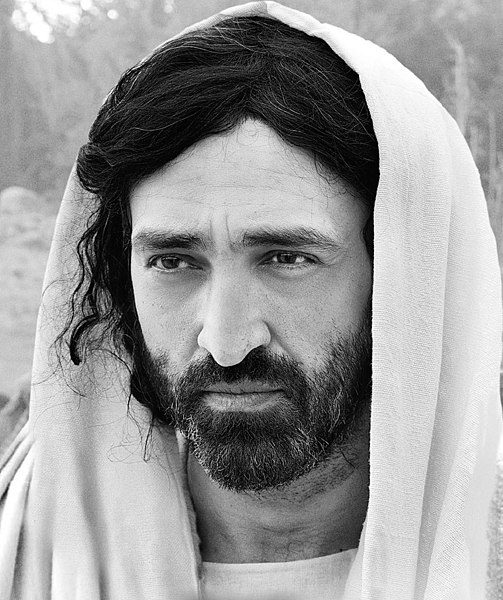
Photo credit: Selva Rasalingam as Jesus in the The Gospel of Luke (2016, Netflix USA) [Wikimedia Commons / Creative Commons CC0 1.0 Universal Public Domain Dedication]

Summary: I document Michael Alter’s many contentions in his book that the New Testament writers sought to produce ahistorical legends, fables, myths, & pure inventions of fictional accounts.
Tags: alleged Bible contradictions, alleged Resurrection contradictions, Bible “contradictions”, Bible “difficulties”, Bible Only, biblical inspiration, biblical prooftexts, biblical skeptics, biblical theology, exegesis, hermeneutics, Holy Bible, inerrancy, infallibility, Jewish anti-Christian polemics, Jewish apologetics, Jewish critique of Christianity, Jewish-Christian discussion, Michael J. Alter, New Testament, New Testament critics, New Testament skepticism, Resurrection “Contradictions”, Resurrection of Jesus, The Resurrection: A Critical Inquiry, NT writers: unethical mythmakers?, New Testament writers, the four evangelists, skeptical claims regarding biblical writers
Jews & Judaism & Old Testament
alleged Resurrection contradictions
Jewish anti-Christian polemics
Jewish critique of Christianity
NT writers: unethical mythmakers?
skeptical claims regarding biblical writers
The Resurrection: A Critical Inquiry
Previous Post
May 3, 2021
Resurrection #24: Judas & the Potter's Field
Next Post
May 4, 2021 Resurrection #26: "Twelve" or Eleven Disciples?
Browse Our Archives
Select a Category & Last Things About Me Anti-Catholicism Atheism & Agnosticism Baptism and Sacramentalism Bible and Tradition Blessed Virgin Mary Books by Dave Armstrong C. S. Lewis Calvinism & General Protestantism Catholic Apologetics Catholic Apologists Catholic conversion Catholic converts Christmas Church (Ecclesiology) Church History Conversion and Converts Development of Doctrine Eastern Orthodoxy Ecumenism & Christian Unity Eucharist & Liturgy Fathers of the Church French Translations G. K. Chesterton Hell Hell & Satan Hell & Satan & Last Things Heresies & Comparative Religion Holistic Health Inquisition & Crusades & Scandals James White Jews & Judaism & Old Testament John Calvin John Henry Newman Liberal / Modernist Theology Life Issues Literary Resume Lutheranism Mariology Martin Luther Music Orthodoxy Papacy & Infallibility Personal Page Philosophy & Science Political & Ethical & Moral Issues Protestant Persecution & Intolerance Protestantism Purgatory Purgatory & Penance Romantic & Imaginative Theology Saints & Purgatory & Penance Salvation Salvation & Justification Satan & Last Things Sexuality and Gender Issues Spanish Translations Traditionalism vs. Radical Catholic Reactionaries Traducciones al español / tradução para português Trinitarianism & Christology Uncategorized Videos
Select a Month October 2026 September 2026 August 2026 July 2026 June 2026 May 2026 April 2026 March 2026 February 2026 January 2026 December 2025 November 2025 October 2025 September 2025 August 2025 July 2025 June 2025 May 2025 April 2025 March 2025 February 2025 January 2025 December 2024 November 2024 October 2024 September 2024 August 2024 July 2024 June 2024 May 2024 April 2024 March 2024 February 2024 January 2024 December 2023 November 2023 October 2023 September 2023 August 2023 July 2023 June 2023 May 2023 April 2023 March 2023 February 2023 January 2023 December 2022 November 2022 October 2022 September 2022 August 2022 July 2022 June 2022 May 2022 April 2022 March 2022 February 2022 January 2022 December 2021 November 2021 October 2021 September 2021 August 2021 July 2021 June 2021 May 2021 April 2021 March 2021 February 2021 January 2021 December 2020 November 2020 October 2020 September 2020 August 2020 July 2020 June 2020 May 2020 April 2020 March 2020 February 2020 January 2020 December 2019 November 2019 October 2019 September 2019 August 2019 July 2019 June 2019 May 2019 April 2019 March 2019 February 2019 January 2019 December 2018 November 2018 October 2018 September 2018 August 2018 July 2018 June 2018 May 2018 April 2018 March 2018 February 2018 January 2018 December 2017 November 2017 October 2017 September 2017 August 2017 July 2017 June 2017 May 2017 April 2017 March 2017 February 2017 January 2017 December 2016 November 2016 October 2016 September 2016 August 2016 July 2016 June 2016 May 2016 April 2016 March 2016 February 2016 January 2016 December 2015 November 2015 October 2015 September 2015 August 2015 July 2015 June 2015 May 2015 April 2015 March 2015 February 2015 January 2015 December 2014 November 2014 October 2014 September 2014 August 2014 July 2014 June 2014 April 2014 March 2014 February 2014 January 2014 December 2013 November 2013 October 2013 September 2013 August 2013 July 2013 June 2013 April 2013 March 2013 February 2013 January 2013 December 2012 November 2012 October 2012 September 2012 August 2012 July 2012 June 2012 May 2012 April 2012 March 2012 February 2012 January 2012 December 2011 November 2011 October 2011 September 2011 August 2011 July 2011 June 2011 April 2011 March 2011 February 2011 October 2010 September 2010 August 2010 July 2010 April 2010 March 2010 December 2009 October 2009 August 2009 July 2009 June 2009 May 2009 March 2009 February 2009 October 2008 September 2008 April 2008 March 2008 February 2008 January 2008 December 2007 November 2007 October 2007 May 2007 March 2007 February 2007 January 2007 November 2006 October 2006 September 2006 August 2006 July 2006 June 2006 May 2006 April 2006 March 2006 February 2006 October 2005 June 2005 April 2005 February 2005 July 2004 May 2004 April 2004
Follow Us!
TAKE THE
Religious Wisdom Quiz
Which book of the Bible contains the most direct prophecies about the Messiah?
Select your answer to see how you score.
Micah Isaiah Zechariah Psalms
Books by This Author Books by Dave Armstrong
Related posts from Biblical Evidence for Catholicism

Jerusalem Council vs. James White & Sola Scriptura
Biblical Evidence for Catholicism

God, Modern Physics, & Dark Energy: An Analogy
Biblical Evidence for Catholicism

350 Bible Passages vs. Sola Scriptura
Biblical Evidence for Catholicism
Sola Scriptura: Self-Defeating, Unworkable, Unbiblical
Biblical Evidence for Catholicism
TRENDING AT PATHEOS Catholic

The Sermon on the Mount, Part I: Matthew...
The Sermon on the Mount, Part I (Matthew 4:12-5:12) St. Matthew moves...

What's up from Crossway: Reviewing some of their latest A few weeks...

Janie Learns the Way of the Cross: A...
Teaching children about Jesus' Passion can be challenging. Many parents and educators...

Looking For Good Catholic Writing - October 2026
He alone extends the heavens, and he walks upon the waves of...

In "Irreplaceable," our book on vocation and technology, Trevor Sutton and I...

I was strolling through the top floor of the brand new Parthenon...
view all Catholic blogs
Ad-Free & Subscriber Log-In Subscription Support
- About Us
- 2026 Calendar
- Videos
- Podcasts
- Library of World Religions
- Faith In Media Tracker
- Advertise With Us
- Write for Us
- Privacy Policy
- Terms of Service
- Do Not Sell My Data
- Contact Us
- Radiant Digital
- Manage Newsletter Subscriptions
- Unsubscribe From Notifications
- Sitemap
Copyright 2008-2026, Patheos. All rights reserved.
Subscription Support Ad-Free & Subscriber Log-In
Follow Patheos