
BuddhistCatholicContemplativeEvangelicalGeneral ChristianHinduJewishLatter-day SaintMuslimNew VisionsProgressive Christian
Beliefs
- Buddhist
- Catholic
- Contemplative
- Evangelical
- General Christian
- Hindu
- Jewish
- Latter-day Saint
- More Voices
- Muslim
- New Visions
- Pagan
- Progressive Christian
Topics
- Religion News
- Food and Religion
- Sports and Religion
- Religious Art
- Religious Music and Entertainment
- Religious Events
- History and Religion
- Style and Religion
- Politics and Religion
- Women in Religion
- Recreation Outdoors and Religion
- Business Finance and Religion
- Careers Workplace and Religion
- Education and Religion
- Family Parenting and Religion
- Health Fitness and Religion
- Home and Religion
- Relationships and Religion
- Technology and Religion
- Travel and Religion
Columnists
- Buddhist Columnists
- Business Finance and Religion Columnists
- Careers Workplace and Religion Columnists
- Catholic Columnists
- Contemplative Columnists
- Education and Religion Columnists
- Evangelists Columnists
- Family Parenting and Religion Columnists
- General Christian Columnists
- Health Fitness and Religion Columnists
- Hindu Columnists
- History and Religion Columnists
- Home and Religion Columnists
- Jewish Columnists
- More Voices Columnists
- Latter Day Columnists
- Muslim Columnists
- New Visions Columnists
- Nonreligious Columnists
- Pagan Columnists
- Politics and Religion Columnists
- Progressive Columnists
- Recreation Outdoors and Religion Columnists
- Relationships and Religion Columnists
- Religion News Columnists
- Religious Art Columnists
- Religious Events Columnists
- Religious Music and Entertainment Columnists
- Sports and Religion Columnists
- Style and Religion Columnists
- Technology and Religion Columnists
- Travel and Religion Columnists
- Women in Religion Columnists
Resource Library
- 2026 Calendar
- Library of World Religions
- The 100 Most Holy Places on Earth
- Patheos Answers
- Podcasts
- Videos
- Faith Leaders Database
- Anglican Episcopalian
- Bahai
- Baptist
- Buddhism
- Christianity
- Confucianism
- Eastern Orthodoxy
- Hinduism
- Holiness and Pentecostal
- ISKCON
- Islam
- Judaism
- Lutheran
- Methodist
- The Church of Jesus Christ of Latter-day Saints
- New Age
- Paganism
- Presbytarian and Reformed
- Protestantism
- Religion Behind the Scenes
- Roman Catholic
- Scientology
- Shia Islam
- Sikhism
- Sufism
- Sunni Islam
- Taoism
- Zen
- See all religions
Research Tools
 Ad-Free & Subscriber Log-In Subscription Support
Ad-Free & Subscriber Log-In Subscription Support
Follow Patheos 

- Trending:
- Forgiveness
- |
- Marriage
- |
- Consciousness
- |
- Death Penalty
- |
- Election
- |
- Halloween

-
About
-
Catholic Apologetics
-
Church History
-
Great Apologists
-
Christian Worldview
-
Protestantism & Misc.
- Home
- Catholic
- History and Religion
- Resurrection #23: How Did Judas Die?
Resurrection #23: How Did Judas Die?
Last updated on: June 5, 2026 at 11:58 pm by Dave Armstrong
Resurrection #23: How Did Judas Die? 2026-06-05T23:58:46-04:00 Dave Armstrong
Patheos Explore the world's faith through different perspectives on religion and spirituality! Patheos has the views of the prevalent religions and spiritualities of the world.
Michael J. Alter is the author of the copiously researched, 913-page volume, The Resurrection: a Critical Inquiry (2015). I initially offered 59 “brief” replies to as many alleged New Testament contradictions (March 2021). We later engaged in amiable correspondence and decided to enter into a major ongoing dialogue about his book. He graciously (and impressively!) sent me a PDF file of it, free of charge, for my review.
Mike describes himself as “of the Jewish faith” but is quick to point out that labels are often “misleading” and “divisive” (I agree to a large extent). He continues to be influenced by, for example, “Reformed, Conservative, Orthodox, and Chabad” variants of Judaism and learns “from those of other faiths, the secular, the non-theists, etc.” Fair enough. I have a great many influences, too, am very ecumenical, and am a great admirer of Judaism, as I told Michael in a combox comment on my blog.
He says his book “can be described as Jewish apologetics” and one that provides reasons for “why members of the Jewish community should not convert to Christianity.” I will be writing many critiques of the book and we’ll be engaging in ongoing discussion for likely a long time. I’m quite excited about it and am most grateful for Mike’s willingness to interact, minus any personal hostility.
To see all the other installments, search “Michael J. Alter” on either my Jews and Judaism or Trinitarianism & Christology web pages. That will take you to the subsection with the series.
I use RSV for all Bible verses that I cite. His words will be in blue.
*****
Alter wrote:
Acts omits any explicit details how Judas specifically died. (p. 505)
Acts states: “falling headlong he burst open in the middle and all his bowels gushed out” (Acts 1:18). But the explanation I agree with below holds that this occurred after he died, so it is not information about how he died (which was suicide by hanging).
Not only does the author of Acts omit discussion of a suicide but he also failed to hint, imply, or even insinuate anything about a means of death. In direct contradiction to Matthew, Acts 1:18 implies that Judas died by an act of God. That is, Judas’s death was a result of God’s wrath and fury is a fulfillment of scripture, God’s word. This fulfillment of God’s wrath is graphically detailed with Judas’s bowels bursting out. (p. 505)
It does not assert that it was a direct “act of God.” If the writer intended that, he would have made it very clear, like other passages which do detail a direct action of God resulting in death:
Genesis 19:24-25 Then the LORD rained on Sodom and Gomor’rah brimstone and fire from the LORD out of heaven; [25] and he overthrew those cities, and all the valley, and all the inhabitants of the cities, and what grew on the ground.
Numbers 16:25-35 Then Moses rose and went to Dathan and Abi’ram; and the elders of Israel followed him. [26] And he said to the congregation, “Depart, I pray you, from the tents of these wicked men, and touch nothing of theirs, lest you be swept away with all their sins.” [27] So they got away from about the dwelling of Korah, Dathan, and Abi’ram; and Dathan and Abi’ram came out and stood at the door of their tents, together with their wives, their sons, and their little ones. [28] And Moses said, “Hereby you shall know that the LORD has sent me to do all these works, and that it has not been of my own accord. [29] If these men die the common death of all men, or if they are visited by the fate of all men, then the LORD has not sent me. [30] But if the LORD creates something new, and the ground opens its mouth, and swallows them up, with all that belongs to them, and they go down alive into Sheol, then you shall know that these men have despised the LORD.” [31] And as he finished speaking all these words, the ground under them split asunder; [32] and the earth opened its mouth and swallowed them up, with their households and all the men that belonged to Korah and all their goods. [33] So they and all that belonged to them went down alive into Sheol; and the earth closed over them, and they perished from the midst of the assembly. [34] And all Israel that were round about them fled at their cry; for they said, “Lest the earth swallow us up!” [35] And fire came forth from the LORD, and consumed the two hundred and fifty men offering the incense.
Numbers 16:46 . . . wrath has gone forth from the LORD, the plague has begun.
Numbers 33:4 while the Egyptians were burying all their first-born, whom the LORD had struck down among them; upon their gods also the LORD executed judgments.
1 Samuel 25:38 And about ten days later the LORD smote Nabal; and he died.
2 Chronicles 13:20 Jerobo’am did not recover his power in the days of Abi’jah; and the LORD smote him, and he died.
2 Chronicles 21:18-19 And after all this the LORD smote him [Jehoram] in his bowels with an incurable disease. [19] In course of time, at the end of two years, his bowels came out because of the disease, and he died in great agony.
2 Chronicles 24:18 And they forsook the house of the LORD, the God of their fathers, and served the Ashe’rim and the idols. And wrath came upon Judah and Jerusalem for this their guilt.
2 Chronicles 32:25 But Hezeki’ah did not make return according to the benefit done to him, for his heart was proud. Therefore wrath came upon him and Judah and Jerusalem.
Acts 5:1-6 But a man named Anani’as with his wife Sapphi’ra sold a piece of property, [2] and with his wife’s knowledge he kept back some of the proceeds, and brought only a part and laid it at the apostles’ feet. [3] But Peter said, “Anani’as, why has Satan filled your heart to lie to the Holy Spirit and to keep back part of the proceeds of the land? [4] While it remained unsold, did it not remain your own? And after it was sold, was it not at your disposal? How is it that you have contrived this deed in your heart? You have not lied to men but to God.” [5] When Anani’as heard these words, he fell down and died. And great fear came upon all who heard of it. [6] The young men rose and wrapped him up and carried him out and buried him.
Acts 12:21-23 On an appointed day Herod put on his royal robes, took his seat upon the throne, and made an oration to them. [22] And the people shouted, “The voice of a god, and not of man!” [23] Immediately an angel of the Lord smote him, because he did not give God the glory; and he was eaten by worms and died.
Nothing like that is remotely present in Acts 1 with regard to Judas’ death (I provided two other passages in Acts where God does directly judge and smite). Both the Hebrew Bible and the New Testament make it very clear if and when God is exercising wrath and judging someone unto death. The suicide of Judas was an example of what St. Paul wrote about:
Romans 6:12-16 Let not sin therefore reign in your mortal bodies, to make you obey their passions. [13] Do not yield your members to sin as instruments of wickedness, but yield yourselves to God as men who have been brought from death to life, and your members to God as instruments of righteousness. [14] For sin will have no dominion over you, since you are not under law but under grace. [15] What then? Are we to sin because we are not under law but under grace? By no means! [16] Do you not know that if you yield yourselves to any one as obedient slaves, you are slaves of the one whom you obey, either of sin, which leads to death, or of obedience, which leads to righteousness?
Acts 1:16-20 presents five significant details omitted from Matthew’s narrative: . . .
2. Judas died but not from a suicide, (p. 505)
Acts 1 doesn’t deny that it was a suicide. It simply provides some of the gruesome details of what happened to Judas. It’s merely yet another of Alter’s innumerable “manufactured” pseudo-“contradictions.” Moreover, Acts 1:18 doesn’t say that Judas died from this fall it describes. If it had done so, it would have been an “incontrovertible” contradiction with Matthew. But because it didn’t, the account is perfectly harmonious with Judas having hanged himself, with this “bowel” incident occurring after he died, to his corpse. The New Testament is always internally harmonious: as we would expect of an inspired revelation.
In conclusion, Acts directly contradicts Matthew. . . . Acts also has no indication that Judas committed suicide by hanging. (p. 507)
This is a clear example of two NT books complementing each other: each one providing details the other doesn’t include, yet without contradiction. The death of Judas is one of the classic “chestnuts” of the atheist / Bible skeptic “the Bible has a zillion contradictions” mentality. Let’s examine how the two accounts are completely harmonious. The following theory is both plausible and entirely possible, and it incorporates both Judas’ hanging himself (Matthew), and his bowels gushing out (Luke’s Acts). Apologist J. Warner Wallace describes it:
But what about the manner of Judas’ death? Did he stumble to his death on that field or go off somewhere and hang himself? This aspect of the accounts can be reconciled if you know something about human anatomy and post-mortem bloating. Let me explain. . . .
[W]hy does Luke’s account say he fell headlong in this field? Note an important distinction here: Luke does not say Judas tripped or stumbled to his death. These words were available to Luke, but he described the event differently. Judas fell. This description makes sense if his body fell to the ground sometime after he successfully hanged himself. In fact, the additional gruesome description in which Luke says Judas “burst open in the middle and all his intestines gushed out” is also consistent with this reasonable inference. Unfortunately, I’ve had to respond to a number of suicides and death investigations in the many years I’ve investigated homicides. These investigations taught me a number of disturbing truths about what happens to the human body after death. I’ve described, for example, the Mortis Triad in prior posts related to the Resurrection of Jesus. When we die and our heart stops pumping, four things begin to happen. First we begin to cool (a condition known as “algor mortis”). We also become rigid (“rigor mortis”) and begin to show signs of blood pooling (“livor mortis”).
In addition to these changes, dead bodies begin to decompose, particularly if undiscovered for a period of time. As bodies decompose, they begin to experience post mortem “bloating”. Dead bodies swell as bacteria within the body cavity begins to ingest the post mortem tissues and organs. This bacterial activity produces decomposition gasses which inflate the body disproportionately. . . .
If Judas hanged himself in the Potter’s Field and remained undiscovered for a period of time, he would most likely experience such post-mortem bloating, especially if gasses couldn’t escape as the result of his ligature. If the rope eventually broke, his bloating body would fall to the ground and break open in the one area most distended by post-mortem bloating: his abdomen. If this was the case, he would have “burst open in the middle” and “all his intestines” would have “gushed out”. Luke wasn’t being overly dramatic in his description, and although this may at first appear unlikely to those unfamiliar with death scenes, post mortem bloating would result in precisely such a condition.
Judas committed suicide by hanging; therefore, his head and upper torso would have been closest to the tree limb that he was hanging from and his feet nearest to the ground. Consequently, from a hanging position, Judas would be falling feet first. Yet Acts reports that Judas fell head first without any mention of a hanging. It would seem that Judas would need to be hanging from a substantial height for his body to have adequate time to rotate or tumble into a head first position. (p. 509)
He could have hanged himself from a tree by a cliff. The field of blood where Judas killed himself is thought to be near the intersection of the Valley of Hinnom and the Kidron Valley in Jerusalem. These are both (by definition) places with many rocky cliffs. I walked the entirety of the latter when I visited Israel in 2014. There are at least two other conceivable scenarios that would explain “headlong.” The corpse of Judas, in a hypothetical scenario where the rope broke, could have been intercepted by a lower branch, which could have resulted in his head being on the bottom as the corpse fell. Or it could have hit a rocky outcrop on the way down, resulting in the same thing. Either scenario is entirely possible.
Even if Judas were assumed to be falling head first, he would have presumably split open his head, not his guts. (p. 509)
This doesn’t follow if the corpse was already bloated, per the scenario detailed above. The belly would split open upon falling, whether the head also did or not. But a head would bloat much less, since it has so much bone. The body could also have landed on some pointed rock in the area of the belly on the way down (if it was falling at any angle other than “straight down”). It’s obviously all speculation. The apologetic point is that none of these hypothetical scenarios are impossible; and they are sufficiently plausible to be brought up as possible explanations.
***
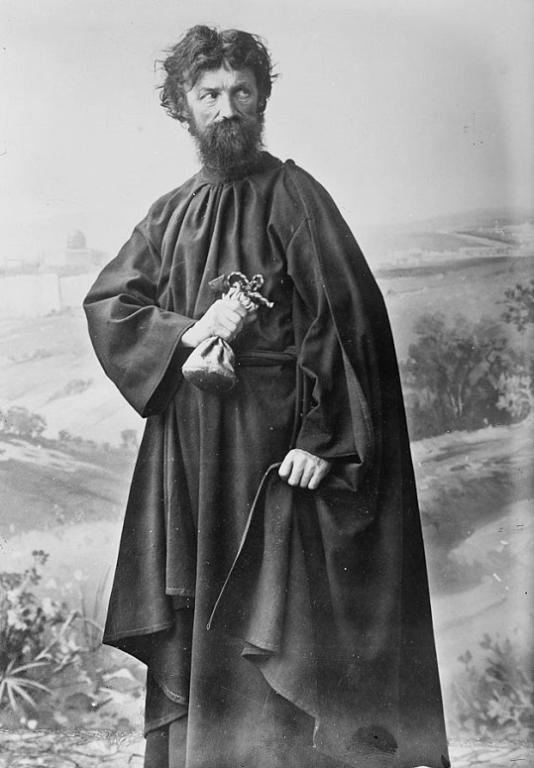
Photo credit: Judas (Johann Zwink) in passion play, Oberammergau, Germany (1900) [public domain / Library of Congress]
Summary: Michael Alter offers the classic supposed “contradiction” re: “how did Judas die?” Did he hang himself, or fall, with the result being that his intestines gushed out? Well, both, as I explain.
Tags: alleged Bible contradictions, alleged Resurrection contradictions, Bible “contradictions”, Bible “difficulties”, Bible Only, biblical inspiration, biblical prooftexts, biblical skeptics, biblical theology, exegesis, hermeneutics, Holy Bible, inerrancy, infallibility, Jewish anti-Christian polemics, Jewish apologetics, Jewish critique of Christianity, Jewish-Christian discussion, Michael J. Alter, New Testament, New Testament critics, New Testament skepticism, Resurrection “Contradictions”, Resurrection of Jesus, The Resurrection: A Critical Inquiry, Judas, how did Judas die?, Judas’ death, Judas’ suicide
Jews & Judaism & Old Testament
alleged Resurrection contradictions
Jewish anti-Christian polemics
Jewish critique of Christianity
The Resurrection: A Critical Inquiry
Previous Post
May 2, 2021
Resurrection #22: Did Judas Repent Or Not?
Next Post
May 3, 2021 Resurrection #24: Judas & the Potter's Field
Browse Our Archives
Select a Category & Last Things About Me Anti-Catholicism Atheism & Agnosticism Baptism and Sacramentalism Bible and Tradition Blessed Virgin Mary Books by Dave Armstrong C. S. Lewis Calvinism & General Protestantism Catholic Apologetics Catholic Apologists Catholic conversion Catholic converts Christmas Church (Ecclesiology) Church History Conversion and Converts Development of Doctrine Eastern Orthodoxy Ecumenism & Christian Unity Eucharist & Liturgy Fathers of the Church French Translations G. K. Chesterton Hell Hell & Satan Hell & Satan & Last Things Heresies & Comparative Religion Holistic Health Inquisition & Crusades & Scandals James White Jews & Judaism & Old Testament John Calvin John Henry Newman Liberal / Modernist Theology Life Issues Literary Resume Lutheranism Mariology Martin Luther Music Orthodoxy Papacy & Infallibility Personal Page Philosophy & Science Political & Ethical & Moral Issues Protestant Persecution & Intolerance Protestantism Purgatory Purgatory & Penance Romantic & Imaginative Theology Saints & Purgatory & Penance Salvation Salvation & Justification Satan & Last Things Sexuality and Gender Issues Spanish Translations Traditionalism vs. Radical Catholic Reactionaries Traducciones al español / tradução para português Trinitarianism & Christology Uncategorized Videos
Select a Month October 2026 September 2026 August 2026 July 2026 June 2026 May 2026 April 2026 March 2026 February 2026 January 2026 December 2025 November 2025 October 2025 September 2025 August 2025 July 2025 June 2025 May 2025 April 2025 March 2025 February 2025 January 2025 December 2024 November 2024 October 2024 September 2024 August 2024 July 2024 June 2024 May 2024 April 2024 March 2024 February 2024 January 2024 December 2023 November 2023 October 2023 September 2023 August 2023 July 2023 June 2023 May 2023 April 2023 March 2023 February 2023 January 2023 December 2022 November 2022 October 2022 September 2022 August 2022 July 2022 June 2022 May 2022 April 2022 March 2022 February 2022 January 2022 December 2021 November 2021 October 2021 September 2021 August 2021 July 2021 June 2021 May 2021 April 2021 March 2021 February 2021 January 2021 December 2020 November 2020 October 2020 September 2020 August 2020 July 2020 June 2020 May 2020 April 2020 March 2020 February 2020 January 2020 December 2019 November 2019 October 2019 September 2019 August 2019 July 2019 June 2019 May 2019 April 2019 March 2019 February 2019 January 2019 December 2018 November 2018 October 2018 September 2018 August 2018 July 2018 June 2018 May 2018 April 2018 March 2018 February 2018 January 2018 December 2017 November 2017 October 2017 September 2017 August 2017 July 2017 June 2017 May 2017 April 2017 March 2017 February 2017 January 2017 December 2016 November 2016 October 2016 September 2016 August 2016 July 2016 June 2016 May 2016 April 2016 March 2016 February 2016 January 2016 December 2015 November 2015 October 2015 September 2015 August 2015 July 2015 June 2015 May 2015 April 2015 March 2015 February 2015 January 2015 December 2014 November 2014 October 2014 September 2014 August 2014 July 2014 June 2014 April 2014 March 2014 February 2014 January 2014 December 2013 November 2013 October 2013 September 2013 August 2013 July 2013 June 2013 April 2013 March 2013 February 2013 January 2013 December 2012 November 2012 October 2012 September 2012 August 2012 July 2012 June 2012 May 2012 April 2012 March 2012 February 2012 January 2012 December 2011 November 2011 October 2011 September 2011 August 2011 July 2011 June 2011 April 2011 March 2011 February 2011 October 2010 September 2010 August 2010 July 2010 April 2010 March 2010 December 2009 October 2009 August 2009 July 2009 June 2009 May 2009 March 2009 February 2009 October 2008 September 2008 April 2008 March 2008 February 2008 January 2008 December 2007 November 2007 October 2007 May 2007 March 2007 February 2007 January 2007 November 2006 October 2006 September 2006 August 2006 July 2006 June 2006 May 2006 April 2006 March 2006 February 2006 October 2005 June 2005 April 2005 February 2005 July 2004 May 2004 April 2004
Follow Us!
TAKE THE
Religious Wisdom Quiz
I made a rash vow that cost me my only child after a military victory. Who am I?
Select your answer to see how you score.
Jephthah Samson Gideon Barak
Books by This Author Books by Dave Armstrong
Related posts from Biblical Evidence for Catholicism

Jerusalem Council vs. James White & Sola Scriptura
Biblical Evidence for Catholicism

God, Modern Physics, & Dark Energy: An Analogy
Biblical Evidence for Catholicism

350 Bible Passages vs. Sola Scriptura
Biblical Evidence for Catholicism
Sola Scriptura: Self-Defeating, Unworkable, Unbiblical
Biblical Evidence for Catholicism
TRENDING AT PATHEOS Catholic

The Sermon on the Mount, Part I: Matthew...
The Sermon on the Mount, Part I (Matthew 4:12-5:12) St. Matthew moves...

What's up from Crossway: Reviewing some of their latest A few weeks...

Janie Learns the Way of the Cross: A...
Teaching children about Jesus' Passion can be challenging. Many parents and educators...

Looking For Good Catholic Writing - October 2026
He alone extends the heavens, and he walks upon the waves of...

In "Irreplaceable," our book on vocation and technology, Trevor Sutton and I...

I was strolling through the top floor of the brand new Parthenon...
view all Catholic blogs
Ad-Free & Subscriber Log-In Subscription Support
- About Us
- 2026 Calendar
- Videos
- Podcasts
- Library of World Religions
- Faith In Media Tracker
- Advertise With Us
- Write for Us
- Privacy Policy
- Terms of Service
- Do Not Sell My Data
- Contact Us
- Radiant Digital
- Manage Newsletter Subscriptions
- Unsubscribe From Notifications
- Sitemap
Copyright 2008-2026, Patheos. All rights reserved.
Subscription Support Ad-Free & Subscriber Log-In
Follow Patheos