
BuddhistCatholicContemplativeEvangelicalGeneral ChristianHinduJewishLatter-day SaintMuslimNew VisionsProgressive Christian
Beliefs
- Buddhist
- Catholic
- Contemplative
- Evangelical
- General Christian
- Hindu
- Jewish
- Latter-day Saint
- More Voices
- Muslim
- New Visions
- Pagan
- Progressive Christian
Topics
- Religion News
- Food and Religion
- Sports and Religion
- Religious Art
- Religious Music and Entertainment
- Religious Events
- History and Religion
- Style and Religion
- Politics and Religion
- Women in Religion
- Recreation Outdoors and Religion
- Business Finance and Religion
- Careers Workplace and Religion
- Education and Religion
- Family Parenting and Religion
- Health Fitness and Religion
- Home and Religion
- Relationships and Religion
- Technology and Religion
- Travel and Religion
Columnists
- Buddhist Columnists
- Business Finance and Religion Columnists
- Careers Workplace and Religion Columnists
- Catholic Columnists
- Contemplative Columnists
- Education and Religion Columnists
- Evangelists Columnists
- Family Parenting and Religion Columnists
- General Christian Columnists
- Health Fitness and Religion Columnists
- Hindu Columnists
- History and Religion Columnists
- Home and Religion Columnists
- Jewish Columnists
- More Voices Columnists
- Latter Day Columnists
- Muslim Columnists
- New Visions Columnists
- Nonreligious Columnists
- Pagan Columnists
- Politics and Religion Columnists
- Progressive Columnists
- Recreation Outdoors and Religion Columnists
- Relationships and Religion Columnists
- Religion News Columnists
- Religious Art Columnists
- Religious Events Columnists
- Religious Music and Entertainment Columnists
- Sports and Religion Columnists
- Style and Religion Columnists
- Technology and Religion Columnists
- Travel and Religion Columnists
- Women in Religion Columnists
Resource Library
- 2026 Calendar
- Library of World Religions
- The 100 Most Holy Places on Earth
- Patheos Answers
- Podcasts
- Videos
- Faith Leaders Database
- Anglican Episcopalian
- Bahai
- Baptist
- Buddhism
- Christianity
- Confucianism
- Eastern Orthodoxy
- Hinduism
- Holiness and Pentecostal
- ISKCON
- Islam
- Judaism
- Lutheran
- Methodist
- The Church of Jesus Christ of Latter-day Saints
- New Age
- Paganism
- Presbytarian and Reformed
- Protestantism
- Religion Behind the Scenes
- Roman Catholic
- Scientology
- Shia Islam
- Sikhism
- Sufism
- Sunni Islam
- Taoism
- Zen
- See all religions
Research Tools
 Ad-Free & Subscriber Log-In Subscription Support
Follow Patheos 

- Trending:
- Advent
- |
- Forgiveness
- |
- Thanksgiving
- |
- Election
- |
- Seasonal Holidays
- |
- Marriage

-
About
-
Catholic Apologetics
-
Church History
-
Great Apologists
-
Christian Worldview
-
Protestantism & Misc.
- Home
- Catholic
- History and Religion
- Resurrection #21: Chronology of Judas’ Evil Plans
Resurrection #21: Chronology of Judas’ Evil Plans
Last updated on: June 5, 2026 at 11:58 pm by Dave Armstrong
Resurrection #21: Chronology of Judas’ Evil Plans 2026-06-05T23:58:46-04:00 Dave Armstrong
Patheos Explore the world's faith through different perspectives on religion and spirituality! Patheos has the views of the prevalent religions and spiritualities of the world.
Michael J. Alter is the author of the copiously researched, 913-page volume, The Resurrection: a Critical Inquiry (2015). I initially offered 59 “brief” replies to as many alleged New Testament contradictions (March 2021). We later engaged in amiable correspondence and decided to enter into a major ongoing dialogue about his book. He graciously (and impressively!) sent me a PDF file of it, free of charge, for my review.
Mike describes himself as “of the Jewish faith” but is quick to point out that labels are often “misleading” and “divisive” (I agree to a large extent). He continues to be influenced by, for example, “Reformed, Conservative, Orthodox, and Chabad” variants of Judaism and learns “from those of other faiths, the secular, the non-theists, etc.” Fair enough. I have a great many influences, too, am very ecumenical, and am a great admirer of Judaism, as I told Michael in a combox comment on my blog.
He says his book “can be described as Jewish apologetics” and one that provides reasons for “why members of the Jewish community should not convert to Christianity.” I will be writing many critiques of the book and we’ll be engaging in ongoing discussion for likely a long time. I’m quite excited about it and am most grateful for Mike’s willingness to interact, minus any personal hostility.
To see all the other installments, search “Michael J. Alter” on either my Jews and Judaism or Trinitarianism & Christology web pages. That will take you to the subsection with the series.
I use RSV for all Bible verses that I cite. His words will be in blue.
*****
Alter wrote:
CONTRADICTION #81 Contradictory Chronology When Judas Concocted His Plan
John’s chronology contradicts the synoptic narratives as to when Judas formed or first conceived his plan to betray Jesus. (p. 447)
It does not at all, as has been shown in Reply #19 and Reply #20, and will continue to be shown in this present installment.
Matthew thus states that Judas designed his plan immediately after the incident which took place in the house of Simon the leper at Bethany.
The episode of Simon the leper anointing Jesus while he was in Bethany is recorded in Matthew 26:6-13. This event occurred on Tuesday, two days before the Passover meal preparation. . . . It was now, immediately after this rebuking incident recorded in verses 14 and 15 that Matthew states that Judas went to the chief priests and asked what he would receive in exchange for delivering Jesus. Therefore, Matthew had Judas concocting his plan to betray Jesus before the Last Supper. (p. 448)
So far, we have no disagreement. But they’re never far away!
Mark 14:3-9 records the same incident. However, Mark differs from Matthew in several details: (1) the ointment was identified as spikenard, (p. 448)
It “differs” in that it offers details that Matthew doesn’t include. It’s not contradictory. Matthew has “very expensive ointment” (26:7), while Mark describes it as “ointment of pure nard, very costly” (14:3). That’s like one person saying he bought his wife a gift of “very expensive perfume” and his wife telling her girlfriends the brand name of the perfume. Are the two contradictory? No. Both are true and in harmony with each other.
(2) some of the disciples were described as indignant, (p. 448)
This isn’t even a difference from Matthew, which also describes “the disciples” as “indignant” and additionally saying (similarly to Mark), “Why this waste? For this ointment might have been sold for a large sum, and given to the poor” (Mt 26:8-9). Again: differing detail and no contradiction.
and (3) the value of the ointment was declared to be “more than three hundred pence.” (p. 448)
Great and “so what!” But at least this is an actual difference (though of course not a contradiction).
After Jesus spoke to the disciples, Mark 14:10 substantiates Matthew’s text: “And Judas Iscariot, one of the twelve, went unto the chief priests, to betray him unto them.” Therefore, Mark 14:10-11 also has Judas arranging to betray Jesus on Tuesday, two days before the Last Supper. (p. 448)
Thus, on the issue of timing of Judas’ consultation with the Jewish authorities, Alter agrees that Matthew and Mark are in agreement. It was two days before the Last Supper.
Luke 22:3-6 also records that Judas’s arrangement to betray Jesus occurred on Tuesday. (p. 448)
Cool. So Alter agrees that all three Synoptic Gospels concur on this.
John 12:1-8 substantially embellishes the text, making Judas appear progressively more heinous and odious than the synoptic narratives: (p. 448)
In light of Alter’s view that the evangelists are deceiving liars, we can interpret “embellishes” as adding untrue, made-up additional fictional elements. But as always, this is sheer arbitrary speculation from a hostile observer, with no hard evidence. What John adds is not contradictory to the Synoptics.
(1) he had Judas being the solitary disciple who challenged the anointment with three hundred pences worth of spikenard, . . . (p. 448)
If indeed John had specified that Judas was the “solitary” disciple protesting, then it would actually be a contradiction (!!!) of Mark’s and Matthew’s parallel accounts. But of course he doesn’t do that. He simply states “Judas Iscariot. . . said, . . .” (12:4). We see nothing there about “only Judas” or “Judas alone” or “Judas was the solitary disciple who said . . .” or “Judas and no other disciple” said . . ”
(2) he editorialized that Judas’s opposition to the anointing by Mary was not by any love for the poor but because he was at one time a thief and the purse bearer of the society, which had gathered around Jesus. In addition, John 11:1 and 12:3 identifies the previous anonymous anointer as Mary of Bethany, the sister of Lazarus. (p. 448)
All of which elaborates upon the other accounts without contradicting them . . .
Then, John 13:2 declares: “And supper being ended, the devil having now put into the heart of Judas Iscariot, Simon’s son, to betray him.” (p. 448)
As explained in Reply #20, this expression of a present tense is an outdated inaccurate rendering of the KJV. Virtually all modern translations indicate this intention to have been a past event, which is, of course, harmonious with the data from the Synoptic Gospels, summarized above.
Up to this exact moment John’s Judas had not held a conference with the chief priests and the Pharisees. (p. 449)
This is untrue. John doesn’t specifically mention it, but he doesn’t deny it, either (which would be one scenario that would establish a contradiction). What he does is allude to the fact that Judas had by then fully intended to betray Him (13:2). As we find out from the information provided by the Synoptics, this had occurred two days earlier.
As a matter of fact, John 13:27-30 narrates that it was none other than Jesus who told Judas during this meal to go and buy some things for the feast or that he should give something to the poor:
Jn 13:27 And after the sop Satan entered into him. Then said Jesus unto him, That thou doest, do quickly.
Jn 13:28 Now no man at the table knew for what intent he spake this unto him.
Jn 13:29 For some of them thought, because Judas had the bag, that Jesus had said unto him, Buy those things that we have need of against the feast; or, that he should give something to the poor.
Jn 13:30 He then having received the sop went immediately out: and it was night. (p. 449)
Alter completely botches the plain meaning of this text. Jesus, in saying “do [it] quickly” (Jn 13:37) is referring to Judas’ actual betrayal, which was to occur within a matter of hours. John 13:28-29 describes the disciples’ misunderstanding of what Jesus was saying to Judas (13:28: “no one at the table knew why he said this to him”). Further preceding context, additionally, proves beyond doubt what Jesus meant. He was referring to Judas going out to do his dirty deed:
John 13:21-27 When Jesus had thus spoken, he was troubled in spirit, and testified, “Truly, truly, I say to you, one of you will betray me.” [22] The disciples looked at one another, uncertain of whom he spoke. [23] One of his disciples, whom Jesus loved, was lying close to the breast of Jesus; [24] so Simon Peter beckoned to him and said, “Tell us who it is of whom he speaks.” [25] So lying thus, close to the breast of Jesus, he said to him, “Lord, who is it?” [26] Jesus answered, “It is he to whom I shall give this morsel when I have dipped it.” So when he had dipped the morsel, he gave it to Judas, the son of Simon Iscariot. [27] Then after the morsel, Satan entered into him. Jesus said to him, “What you are going to do, do quickly.”
Finally, John unequivocally demonstrates that his gospel contradicted the Synoptics. John 18:28-29 narrated that the arrested Jesus was brought before Pilate. Presumably, as a matter of civility or consideration, Pilate left the judgment hall to meet the Jewish leadership and Jesus. John explains the reason that the Jewish leadership would not enter the judgment hall: “Then led they Jesus from Caiaphas unto the hall of judgment: and it was early; and they themselves went not into the judgment hall, lest they should be defiled; but that they might eat the passover.” In other words, if the Jewish leadership entered the judgment hall, they would have been defiled (i.e., made themselves ritually unclean) and would not be able to partake of the passover. It makes no sense that the Jewish leadership would have been concerned about becoming ritually unclean and consequently disqualified from eating the passover if the Passover meal had already occurred. (p. 449)
Without getting into the many theories about the Last Supper as related to Passover, I merely note that the fear of defilement in Gentile houses went beyond just Passover. Thus (contrary to Alter’s final sentence) it does “make sense” that the Jews would have refused to enter the praetorium apart from the consideration of Passover alone:
Bengel’s Gnomen: John 18:28. Αὐτοὶ) they themselves.—ἳνα μὴ μιανθῶσιν, lest they should be defiled) as Pilate’s house was not cleared out of leaven: Deuteronomy 16:4, “There shall be no leavened bread seen with thee in all thy coasts seven days.”—φάγωσι τὸ πάσχα, that they might eat the Passover) So 2 Chronicles 30:22, ויאכלו המועד, “They ate the feast seven days.”
Pulpit Commentary: This defilement by entrance into the house of a Gentile was not an enactment of the Law, but was a purely rabbinic observance (Delitzsch, ‘Talmudische Studien,’ 14. (1874); ‘Zeitschrift fur die gesammte Luth. Theol.’). We find it operative in Acts 10:28, . . .
I found what looks like just the thing to understand this issue of ritual purity and defilement in first-century Judaism, in relation to the Romans and Gentiles in general: “Notions of Gentile Impurity in Ancient Judaism” (Jonathan Klawans, Journal of the Association for Jewish Studies, Volume 20 , Issue 2 , November 1995 , pp. 285 – 312). Unfortunately, I couldn’t access all of it for free, but the references are present. One of them reads:
Another important New Testament verse to consider is John 18:28, which states that there were Jews who refused to enter the praetorium lest they be denied and not be able to eat the Passover sacrifice. It should be noted that according to John 18, Matt. 27, and Mark 15, the praetorium is where Jesus was beaten. One can assume that any number of bloody activities took place there, and that there would have been a fear of contracting corpse impurity.
***
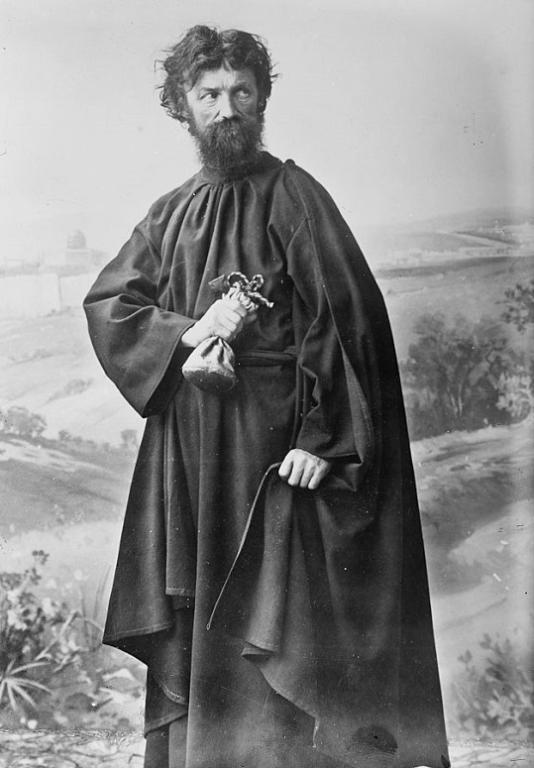
Photo credit: Judas (Johann Zwink) in passion play, Oberammergau, Germany (1900) [public domain / Library of Congress]
Summary: Michael Alter sought contradictions in the NT’s portrayal of the chronology of Judas’ evil plans in vain. Perhaps if he keeps observing the logical fallacies in his arguments, he’ll be more cautious.
Tags: alleged Bible contradictions, alleged Resurrection contradictions, Bible “contradictions”, Bible “difficulties”, Bible Only, biblical inspiration, biblical prooftexts, biblical skeptics, biblical theology, exegesis, hermeneutics, Holy Bible, inerrancy, infallibility, Jewish anti-Christian polemics, Jewish apologetics, Jewish critique of Christianity, Jewish-Christian discussion, Michael J. Alter, New Testament, New Testament critics, New Testament skepticism, Resurrection “Contradictions”, Resurrection of Jesus, The Resurrection: A Critical Inquiry, Judas, motives of Judas, chronology of Judas’ evil plans
Jews & Judaism & Old Testament
alleged Resurrection contradictions
chronology of Judas' evil plans
Jewish anti-Christian polemics
Jewish critique of Christianity
The Resurrection: A Critical Inquiry
Previous Post
April 30, 2021
Resurrection #20: Motivation of Judas' Betrayal
Next Post
May 2, 2021 Resurrection #22: Did Judas Repent Or Not?
Browse Our Archives
Select a Category & Last Things About Me Anti-Catholicism Atheism & Agnosticism Baptism and Sacramentalism Bible and Tradition Blessed Virgin Mary Books by Dave Armstrong C. S. Lewis Calvinism & General Protestantism Catholic Apologetics Catholic Apologists Catholic conversion Catholic converts Christmas Church (Ecclesiology) Church History Conversion and Converts Development of Doctrine Eastern Orthodoxy Ecumenism & Christian Unity Eucharist & Liturgy Fathers of the Church French Translations G. K. Chesterton Hell Hell & Satan Hell & Satan & Last Things Heresies & Comparative Religion Holistic Health Inquisition & Crusades & Scandals James White Jews & Judaism & Old Testament John Calvin John Henry Newman Liberal / Modernist Theology Life Issues Literary Resume Lutheranism Mariology Martin Luther Music Orthodoxy Papacy & Infallibility Personal Page Philosophy & Science Political & Ethical & Moral Issues Protestant Persecution & Intolerance Protestantism Purgatory Purgatory & Penance Romantic & Imaginative Theology Saints & Purgatory & Penance Salvation Salvation & Justification Satan & Last Things Sexuality and Gender Issues Spanish Translations Traditionalism vs. Radical Catholic Reactionaries Traducciones al español / tradução para português Trinitarianism & Christology Uncategorized Videos
Select a Month November 2026 October 2026 September 2026 August 2026 July 2026 June 2026 May 2026 April 2026 March 2026 February 2026 January 2026 December 2025 November 2025 October 2025 September 2025 August 2025 July 2025 June 2025 May 2025 April 2025 March 2025 February 2025 January 2025 December 2024 November 2024 October 2024 September 2024 August 2024 July 2024 June 2024 May 2024 April 2024 March 2024 February 2024 January 2024 December 2023 November 2023 October 2023 September 2023 August 2023 July 2023 June 2023 May 2023 April 2023 March 2023 February 2023 January 2023 December 2022 November 2022 October 2022 September 2022 August 2022 July 2022 June 2022 May 2022 April 2022 March 2022 February 2022 January 2022 December 2021 November 2021 October 2021 September 2021 August 2021 July 2021 June 2021 May 2021 April 2021 March 2021 February 2021 January 2021 December 2020 November 2020 October 2020 September 2020 August 2020 July 2020 June 2020 May 2020 April 2020 March 2020 February 2020 January 2020 December 2019 November 2019 October 2019 September 2019 August 2019 July 2019 June 2019 May 2019 April 2019 March 2019 February 2019 January 2019 December 2018 November 2018 October 2018 September 2018 August 2018 July 2018 June 2018 May 2018 April 2018 March 2018 February 2018 January 2018 December 2017 November 2017 October 2017 September 2017 August 2017 July 2017 June 2017 May 2017 April 2017 March 2017 February 2017 January 2017 December 2016 November 2016 October 2016 September 2016 August 2016 July 2016 June 2016 May 2016 April 2016 March 2016 February 2016 January 2016 December 2015 November 2015 October 2015 September 2015 August 2015 July 2015 June 2015 May 2015 April 2015 March 2015 February 2015 January 2015 December 2014 November 2014 October 2014 September 2014 August 2014 July 2014 June 2014 April 2014 March 2014 February 2014 January 2014 December 2013 November 2013 October 2013 September 2013 August 2013 July 2013 June 2013 April 2013 March 2013 February 2013 January 2013 December 2012 November 2012 October 2012 September 2012 August 2012 July 2012 June 2012 May 2012 April 2012 March 2012 February 2012 January 2012 December 2011 November 2011 October 2011 September 2011 August 2011 July 2011 June 2011 April 2011 March 2011 February 2011 October 2010 September 2010 August 2010 July 2010 April 2010 March 2010 December 2009 October 2009 August 2009 July 2009 June 2009 May 2009 March 2009 February 2009 October 2008 September 2008 April 2008 March 2008 February 2008 January 2008 December 2007 November 2007 October 2007 May 2007 March 2007 February 2007 January 2007 November 2006 October 2006 September 2006 August 2006 July 2006 June 2006 May 2006 April 2006 March 2006 February 2006 October 2005 June 2005 April 2005 February 2005 July 2004 May 2004 April 2004
Follow Us!
TAKE THE
Religious Wisdom Quiz
In what city was Jesus born?
Select your answer to see how you score.
Jerusalem Nazareth Bethlehem Capernaum
Books by This Author Books by Dave Armstrong
Related posts from Biblical Evidence for Catholicism
Filioque & Twelve Eastern Church Fathers
Biblical Evidence for Catholicism
Jerusalem Council vs. James White & Sola Scriptura
Biblical Evidence for Catholicism
God, Modern Physics, & Dark Energy: An Analogy
Biblical Evidence for Catholicism
350 Bible Passages vs. Sola Scriptura
Biblical Evidence for Catholicism
TRENDING AT PATHEOS Catholic

How to Have Financial Transparency in Marriage
Despite the fact that financial issues and money problems are the number...
The Healing Power of Forgiveness in Marriage
Learning how to give and accept apologies are essential ingredients of a...

The West's Christian Moral Inheritance: A Legacy Denied
Whether we like it or not, our environment matters, shaping us both...

How Does Tôḏâ Connect Florida & Thanksgiving?
The big news this weekend has been about the continued flooding on...

Were Early Christians Drinking Psychedelic Wine?
The Secret Sacrament the Church Took Away The early Christian church was...

As we in the United States approach the national Thanksgiving holiday...
view all Catholic blogs
Ad-Free & Subscriber Log-In Subscription Support
- About Us
- 2026 Calendar
- Videos
- Podcasts
- Library of World Religions
- Faith In Media Tracker
- Advertise With Us
- Write for Us
- Privacy Policy
- Terms of Service
- Do Not Sell My Data
- Contact Us
- Radiant Digital
- Manage Newsletter Subscriptions
- Unsubscribe From Notifications
- Sitemap
Copyright 2008-2026, Patheos. All rights reserved.
Subscription Support Ad-Free & Subscriber Log-In
Follow Patheos