
BuddhistCatholicContemplativeEvangelicalGeneral ChristianHinduJewishLatter-day SaintMuslimNew VisionsProgressive Christian
Beliefs
- Buddhist
- Catholic
- Contemplative
- Evangelical
- General Christian
- Hindu
- Jewish
- Latter-day Saint
- More Voices
- Muslim
- New Visions
- Pagan
- Progressive Christian
Topics
- Religion News
- Food and Religion
- Sports and Religion
- Religious Art
- Religious Music and Entertainment
- Religious Events
- History and Religion
- Style and Religion
- Politics and Religion
- Women in Religion
- Recreation Outdoors and Religion
- Business Finance and Religion
- Careers Workplace and Religion
- Education and Religion
- Family Parenting and Religion
- Health Fitness and Religion
- Home and Religion
- Relationships and Religion
- Technology and Religion
- Travel and Religion
Columnists
- Buddhist Columnists
- Business Finance and Religion Columnists
- Careers Workplace and Religion Columnists
- Catholic Columnists
- Contemplative Columnists
- Education and Religion Columnists
- Evangelists Columnists
- Family Parenting and Religion Columnists
- General Christian Columnists
- Health Fitness and Religion Columnists
- Hindu Columnists
- History and Religion Columnists
- Home and Religion Columnists
- Jewish Columnists
- More Voices Columnists
- Latter Day Columnists
- Muslim Columnists
- New Visions Columnists
- Nonreligious Columnists
- Pagan Columnists
- Politics and Religion Columnists
- Progressive Columnists
- Recreation Outdoors and Religion Columnists
- Relationships and Religion Columnists
- Religion News Columnists
- Religious Art Columnists
- Religious Events Columnists
- Religious Music and Entertainment Columnists
- Sports and Religion Columnists
- Style and Religion Columnists
- Technology and Religion Columnists
- Travel and Religion Columnists
- Women in Religion Columnists
Resource Library
- 2026 Calendar
- Library of World Religions
- The 100 Most Holy Places on Earth
- Patheos Answers
- Podcasts
- Videos
- Faith Leaders Database
- Anglican Episcopalian
- Bahai
- Baptist
- Buddhism
- Christianity
- Confucianism
- Eastern Orthodoxy
- Hinduism
- Holiness and Pentecostal
- ISKCON
- Islam
- Judaism
- Lutheran
- Methodist
- The Church of Jesus Christ of Latter-day Saints
- New Age
- Paganism
- Presbytarian and Reformed
- Protestantism
- Religion Behind the Scenes
- Roman Catholic
- Scientology
- Shia Islam
- Sikhism
- Sufism
- Sunni Islam
- Taoism
- Zen
- See all religions
Research Tools
 Ad-Free & Subscriber Log-In Subscription Support
Ad-Free & Subscriber Log-In Subscription Support
Follow Patheos 

- Trending:
- Forgiveness
- |
- Marriage
- |
- Consciousness
- |
- Death Penalty
- |
- Election
- |
- Halloween

-
About
-
Catholic Apologetics
-
Church History
-
Great Apologists
-
Christian Worldview
-
Protestantism & Misc.
- Home
- Catholic
- History and Religion
- Pearce’s Potshots #30: Passover Disproves God’s Omniscience?
Pearce’s Potshots #30: Passover Disproves God’s Omniscience?
Last updated on: May 27, 2021 at 11:11 am by Dave Armstrong
Pearce’s Potshots #30: Passover Disproves God’s Omniscience? 2021-05-27T11:11:46-04:00 Dave Armstrong
Patheos Explore the world's faith through different perspectives on religion and spirituality! Patheos has the views of the prevalent religions and spiritualities of the world.
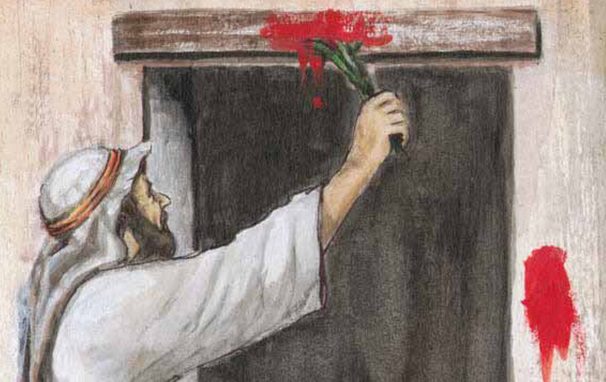
Atheist anti-theist polemicist Jonathan MS Pearce wrote in his screed, “Debunking the Exodus II: A Ridiculous Story with Ridiculous Claims” (5-19-21):
The Israelites mark their own doors as a symbol to the angels of death to Passover [sic] their houses so that only Egyptian firstborns die. [God is obviously not omniscient since he does not know where certain people live, and needs symbols so as not to accidentally kill the wrong people.]
The red font is his own. He explains that “writing in red” signifies why he thinks “the claim is entirely improbable”.
Exodus 12:13 (RSV) The blood shall be a sign for you, upon the houses where you are; and when I see the blood, I will pass over you, and no plague shall fall upon you to destroy you, when I smite the land of Egypt.
Exodus 12:21-27 Then Moses called all the elders of Israel, and said to them, “Select lambs for yourselves according to your families, and kill the passover lamb. [22] Take a bunch of hyssop and dip it in the blood which is in the basin, and touch the lintel and the two doorposts with the blood which is in the basin; and none of you shall go out of the door of his house until the morning. [23] For the LORD will pass through to slay the Egyptians; and when he sees the blood on the lintel and on the two doorposts, the LORD will pass over the door, and will not allow the destroyer to enter your houses to slay you. [24] You shall observe this rite as an ordinance for you and for your sons for ever. [25] And when you come to the land which the LORD will give you, as he has promised, you shall keep this service. [26] And when your children say to you, `What do you mean by this service?’ [27] you shall say, `It is the sacrifice of the LORD’s passover, for he passed over the houses of the people of Israel in Egypt, when he slew the Egyptians but spared our houses.'” And the people bowed their heads and worshiped. [cf. many passages about the Passover ritual]
First of all, this is obviously a religious ritual. People have lots of religious rituals, and most of them claim to hearken back to the instructions of a God or gods (as here). Passover is in fact, the central annual ritual and holy day for Jews, and has been since the time of Moses and the Exodus. It’s such an entrenched ritual that I had a Jewish atheist woman tell me (in person) that she and her larger family observe all of the Jewish holidays.
I saw how another atheist man, with whom I have had several debates (and met as well; just said “hi” to him again online a few days ago), wrote about how he loves to go to Christmas Eve services. He believes nothing that is talked about in those. But — atheist or no — he loves the ritual, as virtually all human beings do. We like routine and continuity, and annual observances. They give us warm fuzzies and a sense of much-needed community. It’s an important part of life.
We have Thanksgiving in America, and Halloween, and searching for Easter eggs at Easter. We celebrate the fall harvest in various ways (as the ancient Hebrews also did in a religious way). We celebrate patriotic holidays like the 4th of July in America. We honor and celebrate the war dead and veterans (Memorial Day / Veteran’s Day), and parents, and (in effect) people on their birthdays. Christians annually rejoice about when Jesus was born, and when He rose from the dead. Atheists join in on most of these, or join with some qualifications. But they do join.
So that’s one thing. God communicated this to His chosen people, so that it would be a unifying ritual for them, for all time, and so they would (most importantly) remember what God did for them. That’s a good thing. Gratefulness is a big part of human life, and it extends in the highest sense to God, for those of us who believe in Him as the Creator of the universe and the central purpose for our existence. It’s good to be thankful and to remember good things done for us. Atheists (lacking God) may “thank” lady luck or sheer happenstance or chance, when wonderful things happen to them, but they do thank, too, being human.
Secondly, from the exegetical perspective, the text nowhere says what Jonathan cynically assumed. Biblical exegesis is about what the “ridiculous” Bible passages actually assert. We can’t just read anything into them that we like (which is called eisegesis). But Jonathan — in his infinite “biblical wisdom” — did just that, because he doesn’t give a damn about proper exegesis, or respecting the Bible at all. He approaches it like a butcher approaches a hog.
As a general bit of advice: I would urge Jonathan (next time) to actually locate something in a biblical text, before lashing out at it, in his misguided zeal to make Christians (and Jews) look like clueless idiots and fools.
The passages in question never say a word about God not knowing how to find the houses of the Hebrews, let alone His supposed lack of omniscience (i.e., knowing everything). Putting blood on the lentil and doorposts was an act of religious faith and piety. God is God and we are human beings. He doesn’t need to be informed of anything. We do things for our sake.
It would be, for example, like a mother or father telling three little children of theirs to pin a star to their shirts if indeed they cleaned their rooms. Then at dinnertime the parents can reward them if they see the stars (knowing that they can verify the clean rooms simply by looking). The stars are not for the parents, but for ritualistic and reward purposes, for the kids. That’s how God is.
My third point (already just illustrated by analogy) is that it’s well-known (for those who actually seriously study the Bible), that there are things pertaining to how God condescends to us, called anthropomorphism and anthropopathism. The Bible itself clearly teaches it, as I show at length (follow the link). I wrote about it:
Anthropopathism is a fancy word for the attribution of non-physical human emotions and passions to God. The related term, anthropomorphism, is the attribution of physical human properties (or animal properties such as wings) to God. Most Christians — of any stripe — recognize the metaphorical nature of the many anthropomorphisms in Scripture since they agree that God the Father is a spirit. But there is some debate about anthropopathism.
The traditional Christian view (Catholic, Orthodox, classical Protestant) holds that God is immutable, impassible (without human passion or emotion), so that it would be impossible for Him to “repent” or “change His mind.” This is also inconsistent with omniscience. . . .
God “condescends” to the limited understanding of human beings, by expressing many truths about himself analogically (as compared to human actions and emotions) so that we can understand Him at all. Otherwise, we would not be able to comprehend a Being so startlingly different and distinct from us and greater than we are. Thus, the passages (in this framework) that say He doesn’t and cannot change are to be interpreted literally, while the ones stating the opposite are to be interpreted figuratively or metaphorically or anthropopathically.
That’s exactly what is going on in the Passover practices. God communicated to an ancient largely nomadic / agricultural and not formally educated people in simple terms that they could understand. Moses told them: “when he sees the blood on the lintel and on the two doorposts, the LORD will pass over the door” (Ex 12:23); and speaking for God: “when I see the blood, I will pass over you” (Ex 12:13). It’s simply the usual “concrete” Hebrew manner of communicating a deeper truth through analogical example: “if we observe this ritual in obedience, God will spare us.”
Fourthly, God’s omniscience would soon be taught plainly enough in the Hebrew Scriptures:
1 Chronicles 28:9 …the LORD searches all hearts, and understands every plan and thought.… (cf. 1 Ki 8:39; 2 Chr 6:30; Ps 44:21; Is 66:18; Ezek 11:5)
Psalm 147:5 Great is our LORD, and abundant in power; his understanding is beyond measure. (cf. Job 36:4; 37:16; Is 40:28; 46:10; 48:3)
The people didn’t necessarily have to understand that at first. It was an abstract, complex concept that would take a bit of doing to be able to grasp. The ancient Hebrews were not oriented by philosophy as the ancient Greeks were. But just because they didn’t yet understand it, it doesn’t follow that it was untrue.
Pearce again shows that he doesn’t have a clue about these matters (very well-understood in Christian and Jewish circles), in what he says about God “hardening” Pharaoh’s heart. He writes in the same terribly argued article:
God hardens Pharaoh’s heart. [The only way to understand this claim is 1) The Pharaoh would not have said no, would have said yes, and so God changes his mind so that he can then punish all of Egypt for the Pharaoh’s wicked denial; or 2) God was not sure whether Pharaoh would say yes or no, so God makes sure of him saying no. Therefore, God is not omniscient. God is either evil or not omniscient and evil. He sets up the whole situation SO THAT he could punish Egypt.] . . .
Pharaoh allows Moses to get out of Egypt quickly. [Evidence of the Pharaoh exercising his own will, freely.] . . .
Whilst the Israelites are in the desert, God hardens the Pharaoh’s heart AGAIN, so that he chases them with his army. [Free will again foiled with huge consequences. God has again set up a scenario where thousands upon thousands would end up dying, not because Pharaoh was bad, but because God MADE him bad, or choose in such a way.]
I’m glad Pearce uses so much red ink in this paper. The red basically means that he is spewing falsehood much more than he usually does, and as such, can serve as a helpful warning for those readers who actually care about proper research and truth; they’re like a traffic sign warning about a bump or multiples curves coming: “lots ‘o’ lies comin‘!”
I dealt with this years ago. Thankfully, this issue of God “hardening” Pharaoh’s heart is probably the best possible one to illustrate exactly what I am saying, because the Bible offers explicit explanations (most of them right in this same book of Exodus), which make it clear that it uses both literal and metaphorical language for the same thing. I have written at length about the issue twice:
Reply to a Calvinist: Hardening of Pharaoh’s Heart (10-14-06)
God “Hardening Hearts”: How Do We Interpret That? (12-18-08; expanded on 1-4-17)
I wrote in the second article:
God allows such people their freedom to rebel, which in turn entails the devil getting in there and making things worse (just as God allowed the devil to tempt Job: Job 1:12). So in a sense to say that “God did so-and-so” when He simply allowed it to take place, is an assertion of God’s overall Providence. God is asserting that He is in control. There is also a strong sarcastic element in this sort of biblical concept (that we see in Job and often in the prophets), as if God were saying, “okay; you don’t want to follow Me and do what is best for you? You know better than I do about that? Very well, then, I’ll let you become blind and deluded. See how well off you’ll be then.”
Strictly speaking, that isn’t how God thinks or acts, but it was an anthropomorphism to help practical, concrete, non-philosophical Hebrew man be able to relate to the mysterious, transcendent God.
The bottom line is that men harden themselves in rebellion and God allows it.
Then I proved that this is the case (in the Bible) by giving examples of both metaphorical / anthropopathic (God causing this “hardening”) and literal statements (man bringing about his own hardening, in free will):
God “Causing” it [Metaphor / Anthropopathism]
Exodus 4:21 And the LORD said to Moses, “When you go back to Egypt, see that you do before Pharaoh all the miracles which I have put in your power; but I will harden his heart, so that he will not let the people go.
Exodus 7:3 But I will harden Pharaoh’s heart, . . . (cf. 7:13-14, 22)
Exodus 9:12 But the LORD hardened the heart of Pharaoh, and he did not listen to them; as the LORD had spoken to Moses.
Exodus 10:1 Then the LORD said to Moses, “Go in to Pharaoh; for I have hardened his heart and the heart of his servants, that I may show these signs of mine among them,
Exodus 10:20 But the LORD hardened Pharaoh’s heart, and he did not let the children of Israel go.
Exodus 10:27 But the LORD hardened Pharaoh’s heart, and he would not let them go.
Exodus 11:10 Moses and Aaron did all these wonders before Pharaoh; and the LORD hardened Pharaoh’s heart, and he did not let the people of Israel go out of his land.
Exodus 14:4 And I will harden Pharaoh’s heart, . . .
Exodus 14:8 And the LORD hardened the heart of Pharaoh . . .
Exodus 14:17 And I will harden the hearts of the Egyptians . . .
Deuteronomy 2:30 But Sihon the king of Heshbon would not let us pass by him; for the LORD your God hardened his spirit and made his heart obstinate, . . .
Joshua 11:20 For it was the LORD’s doing to harden their hearts that they should come against Israel in battle, in order that they should be utterly destroyed, and should receive no mercy but be exterminated, as the LORD commanded Moses.
Isaiah 63:17 O LORD, why dost thou make us err from thy ways and harden our heart, so that we fear thee not? . . .
Man Causing it [Literal]
Exodus 8:15 But when Pharaoh saw that there was a respite, he hardened his heart, . . . (cf. 8:19)
Exodus 8:32 But Pharaoh hardened his heart this time also, and did not let the people go.
Exodus 9:34 But when Pharaoh saw that the rain and the hail and the thunder had ceased, he sinned yet again, and hardened his heart, he and his servants. (cf. 9:7, 35)
Deuteronomy 15:7 you shall not harden your heart or shut your hand against your poor brother,
1 Samuel 6:6 Why should you harden your hearts as the Egyptians and Pharaoh hardened their hearts? . . .
2 Chronicles 36:13 He also rebelled against King Nebuchadnez’zar, who had made him swear by God; he stiffened his neck and hardened his heart against turning to the LORD, the God of Israel.
Job 9:4 who has hardened himself against him, and succeeded?
Psalm 95:8 Harden not your hearts, as at Mer’ibah, as on the day at Massah in the wilderness,
Proverbs 28:14 . . . he who hardens his heart will fall into calamity. . . .
Thus, once again, in the act of trying to make the Bible and God Himself look ridiculous, irrational, and arbitrary, Jonathan MS Pearce winds up (“poetic justice”!) proving precisely these same things about himself: along with also removing any possible doubt (I already had none, after 29 times debating him in writing) that he is profoundly ignorant when it comes to anything biblical. The above is just a little bit above elementary information for Bible students (like a second course on a subject in college). But for Pearce, it may as well be hieroglyphics or rocket science.
All I can do is try to educate him. Pray for the man: that God would open his eyes and give him the grace to forsake his atheism, or, failing that, for him to at least stop misrepresenting the Bible and Christianity.
***
Photo credit: [Wycliffe Bible Translation: “A Conversation About Passover”]
***
Summary: Atheist anti-theist polemicist Jonathan MS Pearce again shows his rank ignorance of biblical exegesis, in vainly attempting to take a hatchet to both God’s omniscience & Passover.
***
Jews & Judaism & Old Testament
Previous Post

May 26, 2021
Pearce’s Potshots #29: No Pitch / Bitumen in Moses' Egypt?
Next Post

May 27, 2021 Pearce’s Potshots #31: How Many Israelites in the Exodus?
Browse Our Archives
Select a Category & Last Things About Me Anti-Catholicism Atheism & Agnosticism Baptism and Sacramentalism Bible and Tradition Blessed Virgin Mary Books by Dave Armstrong C. S. Lewis Calvinism & General Protestantism Catholic Apologetics Catholic Apologists Catholic conversion Catholic converts Christmas Church (Ecclesiology) Church History Conversion and Converts Development of Doctrine Eastern Orthodoxy Ecumenism & Christian Unity Eucharist & Liturgy Fathers of the Church French Translations G. K. Chesterton Hell Hell & Satan Hell & Satan & Last Things Heresies & Comparative Religion Holistic Health Inquisition & Crusades & Scandals James White Jews & Judaism & Old Testament John Calvin John Henry Newman Liberal / Modernist Theology Life Issues Literary Resume Lutheranism Mariology Martin Luther Music Orthodoxy Papacy & Infallibility Personal Page Philosophy & Science Political & Ethical & Moral Issues Protestant Persecution & Intolerance Protestantism Purgatory Purgatory & Penance Romantic & Imaginative Theology Saints & Purgatory & Penance Salvation Salvation & Justification Satan & Last Things Sexuality and Gender Issues Spanish Translations Traditionalism vs. Radical Catholic Reactionaries Traducciones al español / tradução para português Trinitarianism & Christology Uncategorized Videos
Select a Month October 2026 September 2026 August 2026 July 2026 June 2026 May 2026 April 2026 March 2026 February 2026 January 2026 December 2025 November 2025 October 2025 September 2025 August 2025 July 2025 June 2025 May 2025 April 2025 March 2025 February 2025 January 2025 December 2024 November 2024 October 2024 September 2024 August 2024 July 2024 June 2024 May 2024 April 2024 March 2024 February 2024 January 2024 December 2023 November 2023 October 2023 September 2023 August 2023 July 2023 June 2023 May 2023 April 2023 March 2023 February 2023 January 2023 December 2022 November 2022 October 2022 September 2022 August 2022 July 2022 June 2022 May 2022 April 2022 March 2022 February 2022 January 2022 December 2021 November 2021 October 2021 September 2021 August 2021 July 2021 June 2021 May 2021 April 2021 March 2021 February 2021 January 2021 December 2020 November 2020 October 2020 September 2020 August 2020 July 2020 June 2020 May 2020 April 2020 March 2020 February 2020 January 2020 December 2019 November 2019 October 2019 September 2019 August 2019 July 2019 June 2019 May 2019 April 2019 March 2019 February 2019 January 2019 December 2018 November 2018 October 2018 September 2018 August 2018 July 2018 June 2018 May 2018 April 2018 March 2018 February 2018 January 2018 December 2017 November 2017 October 2017 September 2017 August 2017 July 2017 June 2017 May 2017 April 2017 March 2017 February 2017 January 2017 December 2016 November 2016 October 2016 September 2016 August 2016 July 2016 June 2016 May 2016 April 2016 March 2016 February 2016 January 2016 December 2015 November 2015 October 2015 September 2015 August 2015 July 2015 June 2015 May 2015 April 2015 March 2015 February 2015 January 2015 December 2014 November 2014 October 2014 September 2014 August 2014 July 2014 June 2014 April 2014 March 2014 February 2014 January 2014 December 2013 November 2013 October 2013 September 2013 August 2013 July 2013 June 2013 April 2013 March 2013 February 2013 January 2013 December 2012 November 2012 October 2012 September 2012 August 2012 July 2012 June 2012 May 2012 April 2012 March 2012 February 2012 January 2012 December 2011 November 2011 October 2011 September 2011 August 2011 July 2011 June 2011 April 2011 March 2011 February 2011 October 2010 September 2010 August 2010 July 2010 April 2010 March 2010 December 2009 October 2009 August 2009 July 2009 June 2009 May 2009 March 2009 February 2009 October 2008 September 2008 April 2008 March 2008 February 2008 January 2008 December 2007 November 2007 October 2007 May 2007 March 2007 February 2007 January 2007 November 2006 October 2006 September 2006 August 2006 July 2006 June 2006 May 2006 April 2006 March 2006 February 2006 October 2005 June 2005 April 2005 February 2005 July 2004 May 2004 April 2004
Follow Us!
TAKE THE
Religious Wisdom Quiz
I lift my eyes to the _________, where does my help come from? My help comes from the LORD.
Select your answer to see how you score.
Heavens Seas Hills Sky
Books by This Author Books by Dave Armstrong
Related posts from Biblical Evidence for Catholicism

God, Modern Physics, & Dark Energy: An Analogy
Biblical Evidence for Catholicism

God's Presence, the Ark, the Eucharist, & Death
Biblical Evidence for Catholicism
Garden of Eden’s Location Verified by Science
Biblical Evidence for Catholicism

Unregenerate Good Works in the Old Testament
Biblical Evidence for Catholicism
TRENDING AT PATHEOS Catholic

In "Irreplaceable," our book on vocation and technology, Trevor Sutton and I...

I was strolling through the top floor of the brand new Parthenon...

What Does Gêvâh Mean For Kimberley Guifoyle &...
This week, a lot of the news is focused on Kimberly Guilfoyle....

INNER CIRCLE: Profound Mystery (Of Christ In All...
Ephesians 5:31-32 “For this reason, a man will leave his father and...

Do Not Rejoice When Your Enemy Falls: The...
Turning an execution into a public spectacle is a disturbing expression of...

'The Chosen' S6 Trailer: The Passion Gets Very...
Not many watching 'The Chosen' worry about spoilers, but just because they...
view all Catholic blogs
Ad-Free & Subscriber Log-In Subscription Support
- About Us
- 2026 Calendar
- Videos
- Podcasts
- Library of World Religions
- Faith In Media Tracker
- Advertise With Us
- Write for Us
- Privacy Policy
- Terms of Service
- Do Not Sell My Data
- Contact Us
- Radiant Digital
- Manage Newsletter Subscriptions
- Unsubscribe From Notifications
- Sitemap
Copyright 2008-2026, Patheos. All rights reserved.
Subscription Support Ad-Free & Subscriber Log-In
Follow Patheos