
BuddhistCatholicContemplativeEvangelicalGeneral ChristianHinduJewishLatter-day SaintMuslimNew VisionsProgressive Christian
Beliefs
- Buddhist
- Catholic
- Contemplative
- Evangelical
- General Christian
- Hindu
- Jewish
- Latter-day Saint
- More Voices
- Muslim
- New Visions
- Pagan
- Progressive Christian
Topics
- Religion News
- Food and Religion
- Sports and Religion
- Religious Art
- Religious Music and Entertainment
- Religious Events
- History and Religion
- Style and Religion
- Politics and Religion
- Women in Religion
- Recreation Outdoors and Religion
- Business Finance and Religion
- Careers Workplace and Religion
- Education and Religion
- Family Parenting and Religion
- Health Fitness and Religion
- Home and Religion
- Relationships and Religion
- Technology and Religion
- Travel and Religion
Columnists
- Buddhist Columnists
- Business Finance and Religion Columnists
- Careers Workplace and Religion Columnists
- Catholic Columnists
- Contemplative Columnists
- Education and Religion Columnists
- Evangelists Columnists
- Family Parenting and Religion Columnists
- General Christian Columnists
- Health Fitness and Religion Columnists
- Hindu Columnists
- History and Religion Columnists
- Home and Religion Columnists
- Jewish Columnists
- More Voices Columnists
- Latter Day Columnists
- Muslim Columnists
- New Visions Columnists
- Nonreligious Columnists
- Pagan Columnists
- Politics and Religion Columnists
- Progressive Columnists
- Recreation Outdoors and Religion Columnists
- Relationships and Religion Columnists
- Religion News Columnists
- Religious Art Columnists
- Religious Events Columnists
- Religious Music and Entertainment Columnists
- Sports and Religion Columnists
- Style and Religion Columnists
- Technology and Religion Columnists
- Travel and Religion Columnists
- Women in Religion Columnists
Resource Library
- 2026 Calendar
- Library of World Religions
- The 100 Most Holy Places on Earth
- Patheos Answers
- Podcasts
- Videos
- Faith Leaders Database
- Anglican Episcopalian
- Bahai
- Baptist
- Buddhism
- Christianity
- Confucianism
- Eastern Orthodoxy
- Hinduism
- Holiness and Pentecostal
- ISKCON
- Islam
- Judaism
- Lutheran
- Methodist
- The Church of Jesus Christ of Latter-day Saints
- New Age
- Paganism
- Presbytarian and Reformed
- Protestantism
- Religion Behind the Scenes
- Roman Catholic
- Scientology
- Shia Islam
- Sikhism
- Sufism
- Sunni Islam
- Taoism
- Zen
- See all religions
Research Tools
 Ad-Free & Subscriber Log-In Subscription Support
Ad-Free & Subscriber Log-In Subscription Support
Follow Patheos 

- Trending:
- Forgiveness
- |
- Marriage
- |
- Consciousness
- |
- Death Penalty
- |
- Election
- |
- Halloween

-
About
-
Catholic Apologetics
-
Church History
-
Great Apologists
-
Christian Worldview
-
Protestantism & Misc.
- Home
- Catholic
- History and Religion
- Pearce’s Potshots #28: Pharaoh Didn’t Know Joseph?!
Pearce’s Potshots #28: Pharaoh Didn’t Know Joseph?!
Last updated on: May 26, 2021 at 12:07 pm by Dave Armstrong
Pearce’s Potshots #28: Pharaoh Didn’t Know Joseph?! 2021-05-26T12:07:54-04:00 Dave Armstrong
Patheos Explore the world's faith through different perspectives on religion and spirituality! Patheos has the views of the prevalent religions and spiritualities of the world.
Atheist anti-theist polemicist Jonathan MS Pearce wrote in his screed, “Debunking the Exodus II: A Ridiculous Story with Ridiculous Claims” (5-19-21):
A new Pharaoh took up office and did not know Joseph (his brothers and all). [Is it likely that he would have NO knowledge of the second in command of his own country who single-handedly saved them from famine and who famously translated dreams as prophecies?]
The red font is his own. He explains that “writing in red” signifies why he thinks “the claim is entirely improbable”.
Exodus 1:8 (RSV) Now there arose a new king over Egypt, who did not know Joseph.
Jonathan casually assumes that this is right after Joseph died, and to be fair, the text just two verses earlier referenced that event. But we still must read in context. The Bible (like a lot of literature: both fiction and non-fiction) often makes great leaps in time without necessarily noting it.
But in any event, the text shows what general time-period Exodus 1:8 refers to, if one will simply keep reading 17 more verses (the original Hebrew Bible had neither chapters nor verse numbers): though there is also an indeterminate period of time within the narrative:
Exodus 1:11-12 Therefore they set taskmasters over them to afflict them [“people of Israel”: 1:9] with heavy burdens; and they built for Pharaoh store-cities, Pithom and Ra-am’ses. [12] But the more they were oppressed, the more they multiplied and the more they spread abroad. . . .
Exodus 1:15 commences the story that leads in an unbroken narrative to the birth of Moses. He is put into a basket in the Nile (2:3), and named (2:10).
The other internal clue we have that there is considerable time between Joseph’s death and Moses’ birth, is the genealogy laid out in Exodus 6:14-27. Charts of Moses’ ancestry (there are many) are very helpful to visualize the time involved. From it we learn that Levi (Gen 29:34), Joseph’s brother (Gen 30:23-24), bore Kohath (Gen 46:11), Kohath bore Amram (Ex 6:18), and Amram, Moses (Ex 6:20).
Therefore, Joseph is Moses’ great uncle, but three generations removed (brother of his great grandfather, Levi). A wonderful article by Charles F. Aling at Christian Answers.Net (“Is the Biblical story of Joseph in Egypt verified?”), describes the relationship in time of Joseph and Moses:
[T]wo major positions exist regarding the date of Joseph among serious students of the Joseph Story who accept its historicity. The majority of such modern scholars date Joseph to the Second Intermediate Period of Egyptian history [Hyksos period], ca. 1786-1570 BC (Vergote 1959; Kitchen 1962; Stigers 1976), . . .
This view is based primarily on two assumptions: first, that the so-called Late Date of the Exodus (during the reign of Ramses II) is correct, and second, that the rise to power of an Asiatic can best be placed during a period of Egyptian history when his fellow Asiatics, the Hyksos, controlled the government. . . .
If the Exodus occurred in the 13th century BC, and the Sojourn lasted approximately 400 years (430, according to Exodus 12:40), Joseph would belong in the 17th century BC. But if the Exodus took place in the 15th century BC, Joseph’s career would be shifted back to the 19th century BC, during the days of the 12th Dynasty of the Middle Kingdom. . . .
I personally hold to an early Exodus. My only point is that one’s view on the date of the Exodus is a determiner of one’s date for Joseph.
REFERENCES
Kitchen, K. 1962 Joseph. P. 290 in New Bible Dictionary, ed. J.D. Douglas. Grand Rapids: Eerdmans. 1966 Ancient Orient and Old Testament. Downers Grove: InterVarsity Press.
Stigers, H. 1976 A Commentary on Genesis. Grand Rapids: Zondervan.
Vergot, J. 1959 Joseph en Egypte. Louvain: Orientalia et Biblica Lovaniensia.
Encyclopedia Britannica (“Moses”) informs us that he “flourished 14th–13th century BCE”. It takes the late date view of the Exodus: “the most probable date for the Exodus is about 1290 BCE.” Therefore, Moses’ birth was “probably . . . in the late 14th century BCE.” The latter is deduced from the Bible’s statement (Ex 7:7) that Moses was eighty in the year of the Exodus, which would makes his birthdate around 1370 BC, his death in 1250 BC, and Joseph’s lifetime in the 17th c. BC.
Robert I. Bradshaw, in his article, “Archaeology and the Patriarchs” notes about the time of Joseph:
There is no direct evidence of Joseph’s administration available from archaeology. However, a number of incidental features of the Joseph narrative (Gen. 37-50) have been shown to be consistent with the Hyksos period. The price of 20 shekels was the average slave price in the 18th century BC (cf. Gen. 37:28), later the price rose until it was 40-50 shekels in the 15th-14th centuries. The technical terms used in Pharaoh’s court (‘Butler’, ‘Baker’), as well as court (Gen. 41:14) and prison procedure and etiquette have been shown to be accurate. The Vizier of Egypt was known as the “Sealbearer of the King of Lower Egypt” (cf. Gen. 41:42) and the gold chain sanctioned “a Vizier’s control over regulation of food supply.” (Gen. 41:42).
In the previous paragraph he estimated the time of the Hyksos rule of Egypt to be “c. 1700-1550 BCE.” It’s difficult to find any material where anyone makes an educated guess as to the date of Joseph’s death. In any event, we know from the Bible that three generations separate him from Moses. And we know that some time elapsed between his death and the new “hostile” king:
Exodus 1:6-7 Then Joseph died, and all his brothers, and all that generation. [7] But the descendants of Israel were fruitful and increased greatly; they multiplied and grew exceedingly strong; so that the land was filled with them.
Verse 7 sounds to me like a generation or two, just as 1:12 sounds like a good chunk of time: “the more they multiplied and the more they spread abroad.” Then after whatever this period of time amounts to, we get the birth narrative of Moses, whom we know is three generations younger than Joseph.
The “chronological question” — to sum up — then becomes: “how much time passed (implied) in the narrative between Joseph’s death and this new king, and between the period of Israelites multiplying, to the time of Moses?” In any event, when all these things are considered and factored in, there is clearly a significant interim time period (though it’s hard to nail down exactly how much) between Joseph’s death and this new anti-Israeli king-Pharaoh, which would and could easily account for him not “know[ing]” him.
It’s not like the text says that Joseph died, and the next day the new king took power, and had already forgotten all about Joseph (that would be the typical frivolous atheist caricature of Scripture). There are long time periods mixed in, as shown. Jonathan assumes there are none, but I see no good reason to agree with him. This is yet another non-issue; much ado about nothing.
***
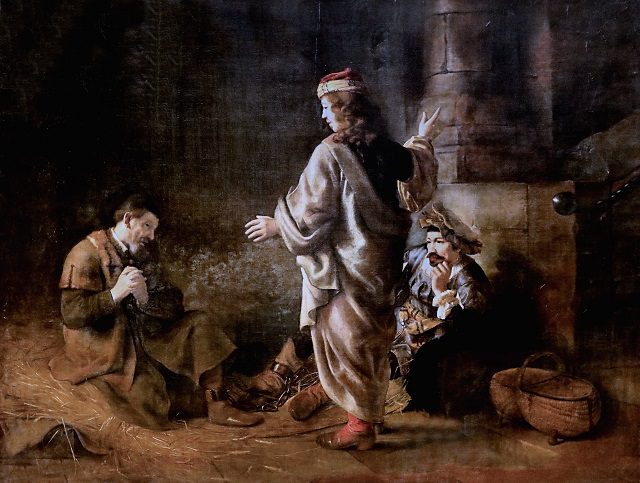
Photo credit: Joseph in prison interpreting dreams, by Ferdinand Bol (1616-1680) [Flickr / CC BY-NC-SA 2.0 license]
***
Summary: Atheist Jonathan Pearce mocks the biblical presentation of “Pharaoh Didn’t Know Joseph” based on the data of Exodus 1:8. But if one reads the context, the “problem” vanishes.
Jews & Judaism & Old Testament
Previous Post

May 25, 2021
Pearce's Potshots #27: Anachronistic "Israelites"?
Next Post

May 26, 2021 Pearce’s Potshots #29: No Pitch / Bitumen in Moses' Egypt?
Browse Our Archives
Select a Category & Last Things About Me Anti-Catholicism Atheism & Agnosticism Baptism and Sacramentalism Bible and Tradition Blessed Virgin Mary Books by Dave Armstrong C. S. Lewis Calvinism & General Protestantism Catholic Apologetics Catholic Apologists Catholic conversion Catholic converts Christmas Church (Ecclesiology) Church History Conversion and Converts Development of Doctrine Eastern Orthodoxy Ecumenism & Christian Unity Eucharist & Liturgy Fathers of the Church French Translations G. K. Chesterton Hell Hell & Satan Hell & Satan & Last Things Heresies & Comparative Religion Holistic Health Inquisition & Crusades & Scandals James White Jews & Judaism & Old Testament John Calvin John Henry Newman Liberal / Modernist Theology Life Issues Literary Resume Lutheranism Mariology Martin Luther Music Orthodoxy Papacy & Infallibility Personal Page Philosophy & Science Political & Ethical & Moral Issues Protestant Persecution & Intolerance Protestantism Purgatory Purgatory & Penance Romantic & Imaginative Theology Saints & Purgatory & Penance Salvation Salvation & Justification Satan & Last Things Sexuality and Gender Issues Spanish Translations Traditionalism vs. Radical Catholic Reactionaries Traducciones al español / tradução para português Trinitarianism & Christology Uncategorized Videos
Select a Month October 2026 September 2026 August 2026 July 2026 June 2026 May 2026 April 2026 March 2026 February 2026 January 2026 December 2025 November 2025 October 2025 September 2025 August 2025 July 2025 June 2025 May 2025 April 2025 March 2025 February 2025 January 2025 December 2024 November 2024 October 2024 September 2024 August 2024 July 2024 June 2024 May 2024 April 2024 March 2024 February 2024 January 2024 December 2023 November 2023 October 2023 September 2023 August 2023 July 2023 June 2023 May 2023 April 2023 March 2023 February 2023 January 2023 December 2022 November 2022 October 2022 September 2022 August 2022 July 2022 June 2022 May 2022 April 2022 March 2022 February 2022 January 2022 December 2021 November 2021 October 2021 September 2021 August 2021 July 2021 June 2021 May 2021 April 2021 March 2021 February 2021 January 2021 December 2020 November 2020 October 2020 September 2020 August 2020 July 2020 June 2020 May 2020 April 2020 March 2020 February 2020 January 2020 December 2019 November 2019 October 2019 September 2019 August 2019 July 2019 June 2019 May 2019 April 2019 March 2019 February 2019 January 2019 December 2018 November 2018 October 2018 September 2018 August 2018 July 2018 June 2018 May 2018 April 2018 March 2018 February 2018 January 2018 December 2017 November 2017 October 2017 September 2017 August 2017 July 2017 June 2017 May 2017 April 2017 March 2017 February 2017 January 2017 December 2016 November 2016 October 2016 September 2016 August 2016 July 2016 June 2016 May 2016 April 2016 March 2016 February 2016 January 2016 December 2015 November 2015 October 2015 September 2015 August 2015 July 2015 June 2015 May 2015 April 2015 March 2015 February 2015 January 2015 December 2014 November 2014 October 2014 September 2014 August 2014 July 2014 June 2014 April 2014 March 2014 February 2014 January 2014 December 2013 November 2013 October 2013 September 2013 August 2013 July 2013 June 2013 April 2013 March 2013 February 2013 January 2013 December 2012 November 2012 October 2012 September 2012 August 2012 July 2012 June 2012 May 2012 April 2012 March 2012 February 2012 January 2012 December 2011 November 2011 October 2011 September 2011 August 2011 July 2011 June 2011 April 2011 March 2011 February 2011 October 2010 September 2010 August 2010 July 2010 April 2010 March 2010 December 2009 October 2009 August 2009 July 2009 June 2009 May 2009 March 2009 February 2009 October 2008 September 2008 April 2008 March 2008 February 2008 January 2008 December 2007 November 2007 October 2007 May 2007 March 2007 February 2007 January 2007 November 2006 October 2006 September 2006 August 2006 July 2006 June 2006 May 2006 April 2006 March 2006 February 2006 October 2005 June 2005 April 2005 February 2005 July 2004 May 2004 April 2004
Follow Us!
TAKE THE
Religious Wisdom Quiz
Which book of the Bible contains the most direct prophecies about the Messiah?
Select your answer to see how you score.
Micah Isaiah Zechariah Psalms
Books by This Author Books by Dave Armstrong
Related posts from Biblical Evidence for Catholicism

God, Modern Physics, & Dark Energy: An Analogy
Biblical Evidence for Catholicism

God's Presence, the Ark, the Eucharist, & Death
Biblical Evidence for Catholicism
Garden of Eden’s Location Verified by Science
Biblical Evidence for Catholicism

Unregenerate Good Works in the Old Testament
Biblical Evidence for Catholicism
TRENDING AT PATHEOS Catholic

The Sermon on the Mount, Part I: Matthew...
The Sermon on the Mount, Part I (Matthew 4:12-5:12) St. Matthew moves...

What's up from Crossway: Reviewing some of their latest A few weeks...

Janie Learns the Way of the Cross: A...
Teaching children about Jesus' Passion can be challenging. Many parents and educators...

Looking For Good Catholic Writing - October 2026
He alone extends the heavens, and he walks upon the waves of...

In "Irreplaceable," our book on vocation and technology, Trevor Sutton and I...

I was strolling through the top floor of the brand new Parthenon...
view all Catholic blogs
Ad-Free & Subscriber Log-In Subscription Support
- About Us
- 2026 Calendar
- Videos
- Podcasts
- Library of World Religions
- Faith In Media Tracker
- Advertise With Us
- Write for Us
- Privacy Policy
- Terms of Service
- Do Not Sell My Data
- Contact Us
- Radiant Digital
- Manage Newsletter Subscriptions
- Unsubscribe From Notifications
- Sitemap
Copyright 2008-2026, Patheos. All rights reserved.
Subscription Support Ad-Free & Subscriber Log-In
Follow Patheos