
BuddhistCatholicContemplativeEvangelicalGeneral ChristianHinduJewishLatter-day SaintMuslimNew VisionsProgressive Christian
Beliefs
- Buddhist
- Catholic
- Contemplative
- Evangelical
- General Christian
- Hindu
- Jewish
- Latter-day Saint
- More Voices
- Muslim
- New Visions
- Pagan
- Progressive Christian
Topics
- Religion News
- Food and Religion
- Sports and Religion
- Religious Art
- Religious Music and Entertainment
- Religious Events
- History and Religion
- Style and Religion
- Politics and Religion
- Women in Religion
- Recreation Outdoors and Religion
- Business Finance and Religion
- Careers Workplace and Religion
- Education and Religion
- Family Parenting and Religion
- Health Fitness and Religion
- Home and Religion
- Relationships and Religion
- Technology and Religion
- Travel and Religion
Columnists
- Buddhist Columnists
- Business Finance and Religion Columnists
- Careers Workplace and Religion Columnists
- Catholic Columnists
- Contemplative Columnists
- Education and Religion Columnists
- Evangelists Columnists
- Family Parenting and Religion Columnists
- General Christian Columnists
- Health Fitness and Religion Columnists
- Hindu Columnists
- History and Religion Columnists
- Home and Religion Columnists
- Jewish Columnists
- More Voices Columnists
- Latter Day Columnists
- Muslim Columnists
- New Visions Columnists
- Nonreligious Columnists
- Pagan Columnists
- Politics and Religion Columnists
- Progressive Columnists
- Recreation Outdoors and Religion Columnists
- Relationships and Religion Columnists
- Religion News Columnists
- Religious Art Columnists
- Religious Events Columnists
- Religious Music and Entertainment Columnists
- Sports and Religion Columnists
- Style and Religion Columnists
- Technology and Religion Columnists
- Travel and Religion Columnists
- Women in Religion Columnists
Resource Library
- 2026 Calendar
- Library of World Religions
- The 100 Most Holy Places on Earth
- Patheos Answers
- Podcasts
- Videos
- Faith Leaders Database
- Anglican Episcopalian
- Bahai
- Baptist
- Buddhism
- Christianity
- Confucianism
- Eastern Orthodoxy
- Hinduism
- Holiness and Pentecostal
- ISKCON
- Islam
- Judaism
- Lutheran
- Methodist
- The Church of Jesus Christ of Latter-day Saints
- New Age
- Paganism
- Presbytarian and Reformed
- Protestantism
- Religion Behind the Scenes
- Roman Catholic
- Scientology
- Shia Islam
- Sikhism
- Sufism
- Sunni Islam
- Taoism
- Zen
- See all religions
Research Tools
 Ad-Free & Subscriber Log-In Subscription Support
Ad-Free & Subscriber Log-In Subscription Support
Follow Patheos 

- Trending:
- Forgiveness
- |
- Marriage
- |
- Consciousness
- |
- Death Penalty
- |
- Election
- |
- Halloween

-
About
-
Catholic Apologetics
-
Church History
-
Great Apologists
-
Christian Worldview
-
Protestantism & Misc.
- Home
- Catholic
- History and Religion
- Did Pope Innocent III Forbid the Bible in 1199?
Did Pope Innocent III Forbid the Bible in 1199?
Last updated on: June 5, 2026 at 11:59 pm by Dave Armstrong
Did Pope Innocent III Forbid the Bible in 1199? 2026-06-05T23:59:03-04:00 Dave Armstrong
Patheos Explore the world's faith through different perspectives on religion and spirituality! Patheos has the views of the prevalent religions and spiritualities of the world.
+ Does the Bible Itself Teach That it Should be Read Without Need of Any Authoritative Interpretation?
An anti-Catholic Protestant blog called Evangelical Miscellanies produced a lengthy article entitled, “Was the Bible Forbidden by the Roman Church?” (5-10-21). Presently, I shall be dealing only with the first section (I’ll address other parts in the near future). You’ll readily see why I deal with only that, as I proceed. It’s not a simple matter. Here is what the anonymous writer states (in blue):
Pope Innocent III (1199 A.D.):
Innocent III, as quoted by Pius VII:
In truth the secret mysteries of faith are not to be exposed to all everywhere, since they cannot be understood by all everywhere, but only by those who can grasp them with the intellect of faith. Therefore, to the more simple the Apostle says “I gave you milk to drink as unto little ones in Christ, not meat” [I Cor. 3:2]. For solid food is for the elders, as he said: “We speak wisdom . . . among the perfect” [I Cor. 2:6]; “for I judged not myself to know anything among you, but Jesus Christ and Him Crucified” [I Cor. 2:2]. For so great is the depth of Divine Scripture that not only the simple and the unlettered, but even the learned and the prudent are not fully able to explore the understanding of it. Therefore, Scripture says that many “searching have failed in their search” [Ps. 63:7]. “So it was rightly stated of old in the divine law, that even the beast which touched the mountain should be stoned” [Heb. 12:20; Exod. 19:12], lest, indeed, any simple and ignorant person should presume to reach the sublimity of Sacred Scripture, or to preach it to others. For it is written: Seek not the things that are too high for thee [Ecclus. 3:22]. Therefore the Apostle warns “not to be more wise than it behooveth to be wise, but to be wise unto sobriety” [Rom. 12:3].
(Denzinger, The Sources of Catholic Dogma, trans. Roy J. Deferrari, [Loreto Publications], from the Thirtieth Edition of Henry Denzinger’s Enchiridion Symbolorum, [Herder & Co., Freiburg, 1954], #1605-1606, pp. 399-400). Ecclesiastical approbation: [“Nihil Obstat,” Dominic Hughes, O.P. Censor Deputatus, “Imprimatur,” April 25, 1955, Patric A. O’Boyle, Archbishop of Washington].Here
First of all, I’d like to note that Holy Scripture itself — beyond what Pope Innocent III offered above — does indeed teach the principle of a necessity for authoritative guides with regard to reading and understanding Holy Scripture:
Exodus 18:20 (RSV) and you shall teach them the statutes and the decisions, and make them know the way in which they must walk and what they must do.
Moses was not simply to deliver and read the Law (Torah: first five books of the Bible) to the Hebrews, but also “teach them” about it. Since he was the Lawgiver and author of the Torah, it stands to reason that his interpretation and teaching would be of a highly authoritative nature.
Leviticus 10:11 and you are to teach the people of Israel all the statutes which the LORD has spoken to them by Moses.
Moses’ brother Aaron was also to teach the true meaning of the Torah. It was true at this early stage,. just as it was in Jesus’ time, that believers were not simply given Bibles (as if it were a mass “Gideon’s Bible” crusade) to read. Authoritative interpretation was stressed as necessary from the beginning.
Deuteronomy 33:10 They shall teach Jacob thy ordinances, and Israel thy law . . .
Authoritative interpretation of the Torah was also the responsibility of the Levite priests. Compare this with 2 Chronicles 15:3; Malachi 2:6-8 — the latter calls them “messenger of the LORD of hosts”.
Ezra 7:6, 10 this Ezra went up from Babylonia. He was a scribe skilled in the law of Moses which the LORD the God of Israel had given; and the king granted him all that he asked, for the hand of the LORD his God was upon him. . . . [10] For Ezra had set his heart to study the law of the LORD, and to do it, and to teach his statutes and ordinances in Israel.
Nehemiah 8:1-3, 7-8, 12 And all the people gathered as one man into the square before the Water Gate; and they told Ezra the scribe to bring the book of the law of Moses which the LORD had given to Israel. [2] And Ezra the priest brought the law before the assembly, both men and women and all who could hear with understanding, on the first day of the seventh month. [3] And he read from it . . . [7] Also Jesh’ua, Bani, Sherebi’ah, Jamin, Akkub, Shab’bethai, Hodi’ah, Ma-asei’ah, Keli’ta, Azari’ah, Jo’zabad, Hanan, Pelai’ah, the Levites, helped the people to understand the law, while the people remained in their places. [8] And they read from the book, from the law of God, clearly [footnote, “or with interpretation”]; and they gave the sense, so that the people understood the reading. . . . [12] And all the people went their way to eat and drink and to send portions and to make great rejoicing, because they had understood the words that were declared to them.
8:7 describes thirteen Levites who assisted Ezra, and “who helped the people to understand the law.” Much earlier, in King Jehoshaphat’s reign, we find Levites exercising the same function (2 Chronicles 17:8-9). There is no sola Scriptura, with its associated idea “perspicuity” (evident clearness in the main) here. The people did indeed understand the law (8:12), but not without much assistance — not merely upon hearing. Likewise, the Bible is not altogether clear in and of itself, but requires the aid of teachers who are more familiar with biblical styles and Hebrew idiom, background, context, exegesis and cross-reference, hermeneutical principles, original languages, etc.
Luke 24:25-27 And he said to them, “O foolish men, and slow of heart to believe all that the prophets have spoken! [26] Was it not necessary that the Christ should suffer these things and enter into his glory?” [27] And beginning with Moses and all the prophets, he interpreted to them in all the scriptures the things concerning himself.
Acts 8:27-31 And he rose and went. And behold, an Ethiopian, a eunuch, a minister of the Can’dace, queen of the Ethiopians, in charge of all her treasure, had come to Jerusalem to worship [28] and was returning; seated in his chariot, he was reading the prophet Isaiah. [29] And the Spirit said to Philip, “Go up and join this chariot.” [30] So Philip ran to him, and heard him reading Isaiah the prophet, and asked, “Do you understand what you are reading?” [31] And he said, “How can I, unless some one guides me?” And he invited Philip to come up and sit with him.
2 Peter 3:15-17 So also our beloved brother Paul wrote to you according to the wisdom given him, [16] speaking of this as he does in all his letters. There are some things in them hard to understand, which the ignorant and unstable twist to their own destruction, as they do the other scriptures. [17] You therefore, beloved, knowing this beforehand, beware lest you be carried away with the error of lawless men and lose your own stability.
It’s not just “the medieval Catholic Church” that came up with this concept. It’s clearly taught in inspired revelation. It’s also true that in the first five centuries of the Church, it was a deliberate and widespread practice to only gradually introduce new Christians to the “deeper” elements of Christianity. This practice was known as the Discipline of the Secret, or Disciplina Arcani in Latin.
Therefore, not only the Bible in both Testaments, but also the early Church for some 500 years, held that not everyone should simply be given a Bible to read, with no authoritative guidance to steer them from erroneous interpretations (many of which have been observed throughout history, especially among schismatic and heretical “sects” or “cults”).
With that relevant biblical and apostolic / patristic background understood, I return to the subject at hand.
It’s always good to consult the primary sources in matters such as these. The article I am critiquing cited a portion of Denzinger where Pope Pius VII (r. 1800-1823) had cited Pope Innocent III’s teaching. This was valid for his purposes, but when we are delving into the larger accusation of the Catholic Church supposedly forbidding or prohibiting the Bible altogether, we need to look at the original for more context. But even the quotation provided, if read closely, never states that the Bible was to be “forbidden” (which is why the author cited it: as supposed evidence for such a belief and practice).
Pope Innocent III had stated that a “simple and ignorant person” ought not “presume to reach the sublimity of Sacred Scripture, or to preach it to others.” This is a different concept altogether from saying that “no one who is not theologically educated can read the Bible.” Therefore, this citation from a pope does not support the accusation stated in the title of the article.
I have in my own library the hardcover edition of Denzinger’s Enchiridion symbolorum (the standard source for the dogmas of the Catholic Church): 43rd edition from 2012, edited and translated in part by my good friend, Dr. Robert Fastiggi (who in fact translated the very passage I shall produce below). To be fair to the writer of the article I critique, the letter in question from Pope Innocent III doesn’t appear to be included in the 1954 version of Denzinger that he cited, so he can’t be accused of citing out of context or ignoring relevant information.
The letter does appear in the 2012 edition on pages 251-252. It’s entitled, “Letter Cum ex iniuncto to the Inhabitants of Metz, July 12, 1199.” The earlier part makes it clear that the pope is not prohibiting Bible reading. It alludes to the people of Metz having obtained French translations of most of the New Testament (the Latin Vulgate then being the “standard” edition of the Bible). The Holy Father continues:
[E]ven though the desire to understand the divine Scriptures and the eagerness to exhort in accordance with them should not be criticized but rather commended, nevertheless, in this case, it is clear that these people are justifiably rebuked, because they conduct their own secret gatherings and they arrogate to themselves the office of preaching; they ridicule the simplicity of priests . . . [cites Matthew 10:27], [God is] indicating clearly by this that evangelical preaching is to be offered, not in secret gatherings, as is done by the heretics, but publicly in the Church, according to Catholic custom . . . (p. 252; my bolding)
The two paragraphs following were cited in the article in their 1954 translation. Dr. Fastiggi renders one portion: “[C]learly no simple or unlearned person should presume to touch the sublimity of Sacred Scripture or preach it to others.” The 2012 Denzinger has one more paragraph after that. Here is the final sentence:
Therefore, since the order of teachers is, as it were, primary in the Church, no one should indiscriminately arrogate to himself the office of preaching. (p. 252)
There is not a single word about prohibiting the Bible altogether in the entire document. What is rebuked is the presumption of a teaching office that is unwarranted. Leonard E. Boyle wrote a chapter, “Innocent III and Vernacular Versions of Scripture”, included in the book, The Bible in the Medieval World: Essays in Memory of Beryl Smalley (edited by Katherine Walsh and Diana Wood, Oxford: Blackwell, 1985, 97-107). Here are excerpts:
[A] recent historian [H. E. Mayer, The Crusades, . . . (Oxford, 1972), p. 207] . . . states baldly that the Fourth Lateran Council, under Innocent, ‘set limits to the translation of the Bible into the vernacular’, where in fact the Council has nothing whatsoever on the matter. (pp. 97-98)
Innocent never once mentions the translations. What he is really concerned about is what he sees as the usurpation by these people at Metz of the office of preaching, an office which does not belong to anyone and everyone in the Church. (p. 101)
The crucial question, of course, is whether or not Innocent eventually abolished the translation . . . We do not know. (p. 104)
There is not in fact the slightest hint that Innocent ever spoke in any way, hypothetically or not, of suppressing the translations. (p. 105)
[E]veryone admits, as the Cambridge History of the Bible does [p. 391], that ‘no universal and absolute prohibition of the translation of the Scriptures into the vernacular nor of the use of such translations by clergy or laity was ever issued by any council of the Church or any pope’ . . . (p. 107)
The Wikipedia article, “Bible translations in the Middle Ages” concurs:
While the documents are inconclusive about the fate of the specific translations in question and their users, Innocent’s general remarks suggest a rather permissive attitude toward translations and vernacular commentaries provided that they are produced and used within the scope of Christian teachings or with church oversight. . . .
As Rosemarie Potz McGerr has argued, as a general pattern, bans on translation responded to the threat of strong heretical movements; in the absence of viable heresies, a variety of translations and vernacular adaptations flourished between the twelfth and fifteenth centuries with no documented institutional opposition at all.
***
Related Reading
“Why Don’t Catholics Read the Bible?” [6-26-02]
How Do Catholics Approach & Interpret Holy Scripture? [6-17-09]
Were Vernacular Bibles Unknown Before Luther? (Luther’s Dubious Claims About the Supposed Utter Obscurity of the Bible Before His Translation) [6-15-11]
Dialogue: “Obscure” Bible Before Luther’s Translation? [7-24-14]
Catholic Church: Historic “Enemy” of the Bible? [9-11-15]
Was the Catholic Church Historically an Enemy of the Bible? [National Catholic Register, 3-27-17]
Armstrong vs. Collins & Walls #5: The Church “Gave” the Bible? [10-19-17]
Did Luther Rescue the Bible in German from Utter Obscurity? [National Catholic Register, 10-30-17]
Why Are Catholics So Deficient in Bible-Reading? [National Catholic Register, 11-22-17]
The Catholic Church Does Not Claim Superiority Over the Bible [National Catholic Register, 8-13-18]
Catholic Biblical Interpretation: Myths and Truths [National Catholic Register, 12-3-18]
***
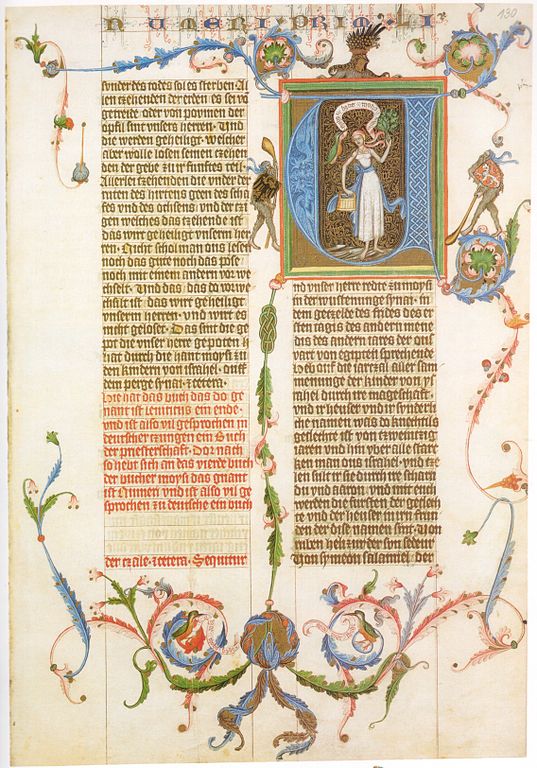
Photo credit: A page from the luxury illuminated manuscript Wenceslas Bible, a German translation of the 1390s. [public domain / Wikimedia Commons]

***
Summary: An anti-Catholic Protestant blog takes up the question of “Did Pope Innocent III forbid the Bible in 1199?” Based on primary sources, as far as we can tell he never did any such thing.
Did Pope Innocent III Forbid the Bible?
Previous Post

May 10, 2021
Pearce's Potshots #23: God's True Mercy & Grace
Next Post
May 11, 2021 Did Medieval Catholicism Forbid All Vernacular Bibles?
Browse Our Archives
Select a Category & Last Things About Me Anti-Catholicism Atheism & Agnosticism Baptism and Sacramentalism Bible and Tradition Blessed Virgin Mary Books by Dave Armstrong C. S. Lewis Calvinism & General Protestantism Catholic Apologetics Catholic Apologists Catholic conversion Catholic converts Christmas Church (Ecclesiology) Church History Conversion and Converts Development of Doctrine Eastern Orthodoxy Ecumenism & Christian Unity Eucharist & Liturgy Fathers of the Church French Translations G. K. Chesterton Hell Hell & Satan Hell & Satan & Last Things Heresies & Comparative Religion Holistic Health Inquisition & Crusades & Scandals James White Jews & Judaism & Old Testament John Calvin John Henry Newman Liberal / Modernist Theology Life Issues Literary Resume Lutheranism Mariology Martin Luther Music Orthodoxy Papacy & Infallibility Personal Page Philosophy & Science Political & Ethical & Moral Issues Protestant Persecution & Intolerance Protestantism Purgatory Purgatory & Penance Romantic & Imaginative Theology Saints & Purgatory & Penance Salvation Salvation & Justification Satan & Last Things Sexuality and Gender Issues Spanish Translations Traditionalism vs. Radical Catholic Reactionaries Traducciones al español / tradução para português Trinitarianism & Christology Uncategorized Videos
Select a Month October 2026 September 2026 August 2026 July 2026 June 2026 May 2026 April 2026 March 2026 February 2026 January 2026 December 2025 November 2025 October 2025 September 2025 August 2025 July 2025 June 2025 May 2025 April 2025 March 2025 February 2025 January 2025 December 2024 November 2024 October 2024 September 2024 August 2024 July 2024 June 2024 May 2024 April 2024 March 2024 February 2024 January 2024 December 2023 November 2023 October 2023 September 2023 August 2023 July 2023 June 2023 May 2023 April 2023 March 2023 February 2023 January 2023 December 2022 November 2022 October 2022 September 2022 August 2022 July 2022 June 2022 May 2022 April 2022 March 2022 February 2022 January 2022 December 2021 November 2021 October 2021 September 2021 August 2021 July 2021 June 2021 May 2021 April 2021 March 2021 February 2021 January 2021 December 2020 November 2020 October 2020 September 2020 August 2020 July 2020 June 2020 May 2020 April 2020 March 2020 February 2020 January 2020 December 2019 November 2019 October 2019 September 2019 August 2019 July 2019 June 2019 May 2019 April 2019 March 2019 February 2019 January 2019 December 2018 November 2018 October 2018 September 2018 August 2018 July 2018 June 2018 May 2018 April 2018 March 2018 February 2018 January 2018 December 2017 November 2017 October 2017 September 2017 August 2017 July 2017 June 2017 May 2017 April 2017 March 2017 February 2017 January 2017 December 2016 November 2016 October 2016 September 2016 August 2016 July 2016 June 2016 May 2016 April 2016 March 2016 February 2016 January 2016 December 2015 November 2015 October 2015 September 2015 August 2015 July 2015 June 2015 May 2015 April 2015 March 2015 February 2015 January 2015 December 2014 November 2014 October 2014 September 2014 August 2014 July 2014 June 2014 April 2014 March 2014 February 2014 January 2014 December 2013 November 2013 October 2013 September 2013 August 2013 July 2013 June 2013 April 2013 March 2013 February 2013 January 2013 December 2012 November 2012 October 2012 September 2012 August 2012 July 2012 June 2012 May 2012 April 2012 March 2012 February 2012 January 2012 December 2011 November 2011 October 2011 September 2011 August 2011 July 2011 June 2011 April 2011 March 2011 February 2011 October 2010 September 2010 August 2010 July 2010 April 2010 March 2010 December 2009 October 2009 August 2009 July 2009 June 2009 May 2009 March 2009 February 2009 October 2008 September 2008 April 2008 March 2008 February 2008 January 2008 December 2007 November 2007 October 2007 May 2007 March 2007 February 2007 January 2007 November 2006 October 2006 September 2006 August 2006 July 2006 June 2006 May 2006 April 2006 March 2006 February 2006 October 2005 June 2005 April 2005 February 2005 July 2004 May 2004 April 2004
Follow Us!
TAKE THE
Religious Wisdom Quiz
What type of building was Jesus born in?
Select your answer to see how you score.
A cave A tent A castle A stable
Books by This Author Books by Dave Armstrong
Related posts from Biblical Evidence for Catholicism

Three More Anti-Catholic Lies About Catholicism (#6-4)
Biblical Evidence for Catholicism

Top Ten Anti-Catholic Lies (#10-7)
Biblical Evidence for Catholicism

A Few "Worst" & "Best" Arguments vs. Protestantism
Biblical Evidence for Catholicism

"Baptism" & Romans 10 (Engwer's Silly Word Games)
Biblical Evidence for Catholicism
TRENDING AT PATHEOS Catholic

Janie Learns the Way of the Cross: A...
Teaching children about Jesus' Passion can be challenging. Many parents and educators...

Looking For Good Catholic Writing - October 2026
He alone extends the heavens, and he walks upon the waves of...

In "Irreplaceable," our book on vocation and technology, Trevor Sutton and I...

I was strolling through the top floor of the brand new Parthenon...

What Does Gêvâh Mean For Kimberley Guifoyle &...
This week, a lot of the news is focused on Kimberly Guilfoyle....

INNER CIRCLE: Profound Mystery (Of Christ In All...
Ephesians 5:31-32 “For this reason, a man will leave his father and...
view all Catholic blogs
Ad-Free & Subscriber Log-In Subscription Support
- About Us
- 2026 Calendar
- Videos
- Podcasts
- Library of World Religions
- Faith In Media Tracker
- Advertise With Us
- Write for Us
- Privacy Policy
- Terms of Service
- Do Not Sell My Data
- Contact Us
- Radiant Digital
- Manage Newsletter Subscriptions
- Unsubscribe From Notifications
- Sitemap
Copyright 2008-2026, Patheos. All rights reserved.
Subscription Support Ad-Free & Subscriber Log-In
Follow Patheos