
BuddhistCatholicContemplativeEvangelicalGeneral ChristianHinduJewishLatter-day SaintMuslimNew VisionsProgressive Christian
Beliefs
- Buddhist
- Catholic
- Contemplative
- Evangelical
- General Christian
- Hindu
- Jewish
- Latter-day Saint
- More Voices
- Muslim
- New Visions
- Pagan
- Progressive Christian
Topics
- Religion News
- Food and Religion
- Sports and Religion
- Religious Art
- Religious Music and Entertainment
- Religious Events
- History and Religion
- Style and Religion
- Politics and Religion
- Women in Religion
- Recreation Outdoors and Religion
- Business Finance and Religion
- Careers Workplace and Religion
- Education and Religion
- Family Parenting and Religion
- Health Fitness and Religion
- Home and Religion
- Relationships and Religion
- Technology and Religion
- Travel and Religion
Columnists
- Buddhist Columnists
- Business Finance and Religion Columnists
- Careers Workplace and Religion Columnists
- Catholic Columnists
- Contemplative Columnists
- Education and Religion Columnists
- Evangelists Columnists
- Family Parenting and Religion Columnists
- General Christian Columnists
- Health Fitness and Religion Columnists
- Hindu Columnists
- History and Religion Columnists
- Home and Religion Columnists
- Jewish Columnists
- More Voices Columnists
- Latter Day Columnists
- Muslim Columnists
- New Visions Columnists
- Nonreligious Columnists
- Pagan Columnists
- Politics and Religion Columnists
- Progressive Columnists
- Recreation Outdoors and Religion Columnists
- Relationships and Religion Columnists
- Religion News Columnists
- Religious Art Columnists
- Religious Events Columnists
- Religious Music and Entertainment Columnists
- Sports and Religion Columnists
- Style and Religion Columnists
- Technology and Religion Columnists
- Travel and Religion Columnists
- Women in Religion Columnists
Resource Library
- 2026 Calendar
- Library of World Religions
- The 100 Most Holy Places on Earth
- Patheos Answers
- Podcasts
- Videos
- Faith Leaders Database
- Anglican Episcopalian
- Bahai
- Baptist
- Buddhism
- Christianity
- Confucianism
- Eastern Orthodoxy
- Hinduism
- Holiness and Pentecostal
- ISKCON
- Islam
- Judaism
- Lutheran
- Methodist
- The Church of Jesus Christ of Latter-day Saints
- New Age
- Paganism
- Presbytarian and Reformed
- Protestantism
- Religion Behind the Scenes
- Roman Catholic
- Scientology
- Shia Islam
- Sikhism
- Sufism
- Sunni Islam
- Taoism
- Zen
- See all religions
Research Tools
 Ad-Free & Subscriber Log-In Subscription Support
Ad-Free & Subscriber Log-In Subscription Support
Follow Patheos 

- Trending:
- Forgiveness
- |
- Marriage
- |
- Consciousness
- |
- Death Penalty
- |
- Election
- |
- Halloween

-
About
-
Catholic Apologetics
-
Church History
-
Great Apologists
-
Christian Worldview
-
Protestantism & Misc.
- Home
- Catholic
- History and Religion
- Resurrection Debate #4: No “Leafy Branches” on Palm Sunday?
Resurrection Debate #4: No “Leafy Branches” on Palm Sunday?
Last updated on: June 5, 2026 at 11:58 pm by Dave Armstrong
Resurrection Debate #4: No “Leafy Branches” on Palm Sunday? 2026-06-05T23:58:08-04:00 Dave Armstrong
Patheos Explore the world's faith through different perspectives on religion and spirituality! Patheos has the views of the prevalent religions and spiritualities of the world.
Michael J. Alter is the author of the copiously researched, 913-page volume, The Resurrection: a Critical Inquiry (2015). I initially offered 59 “brief” replies to as many alleged New Testament contradictions (March 2021). We later engaged in amiable correspondence and decided to enter into a major ongoing dialogue about his book. He graciously sent me a PDF file of it, free of charge, for my review, and has committed himself to counter-response as well: a very rare trait these days. All of this is, I think, mightily impressive.
Mike describes himself as “of the Jewish faith” but is quick to point out that labels are often “misleading” and “divisive” (I agree to a large extent). He continues to be influenced by, for example, “Reformed, Conservative, Orthodox, and Chabad” variants of Judaism and learns “from those of other faiths, the secular, the non-theists, etc.” Fair enough. I have a great many influences, too, am very ecumenical, and am a great admirer of Judaism, as I told Michael in a combox comment on my blog.
He says his book “can be described as Jewish apologetics” and one that provides reasons for “why members of the Jewish community should not convert to Christianity.” I will be writing many critiques of the book and we’ll be engaging in ongoing discussion for likely a long time. I’m quite excited about it and eagerly enjoy the dialogue and debate. This is a rare opportunity these days and I am most grateful for Mike’s willingness to interact, minus any personal hostility.
I use RSV for all Bible verses that I cite. His words will be in blue.
*****
Alter wrote:
Another reason that it may be speculated that Jesus’s crucifixion did not take place in Nisan is because of the branches and palm trees detailed
in several of the narratives. Mark 11:8 and Matthew 21:8 reported that “branches from the trees” were cut down and used as straw on the road but omitted details about what type of tree the branches came from. Nonetheless, Mark and Matthew clearly implied two significant facts: (1) these trees were standing in Jerusalem and (2) the branches were leafy. . . .
[I]n Mark, the branches are leafy and such is the literal reading in the NSRV. (pp. 55-56)
Having asserted that both Matthew and Mark refer to “leafy” branches, he then examines the opinion of some linguistic aids and contradictorily concludes that “Matthew has either omitted or deleted any allusion or suggestion of leafy branches” (p. 56). With this confusion, it’s hard to know exactly what he is arguing. But then he adds another layer of argument by claiming:
The problem with Mark’s narrative is that there are no leafy branches in March (Nisan) during the time of Passover in Jerusalem because it is the wrong season. Therefore, either the narrative or the time sequence, the six days before the Passion and as a prelude to the Passover, is fallacious. (p. 56)
Not so fast. There is this famous hill in Jerusalem called the Mount of Olives, which was, in fact, where Jesus was (Mt 21:1; Mk 11:1) before His entry into Jerusalem (Mt 21:10; Mk 11:11; Jn 12:12). And of course, it has a lot of olive trees (at the base of it is also the Garden of Gethsemane: with many old olive trees). I was there in October 2014 and saw all this myself.
Now, would olive trees have leaves in March or April? Yes. On the Quora website is an article: “Do olive trees lose their leaves in winter?” Andy Lee, who studied Bacteriology & Cell Biology in college, commented: “Olive trees are evergreen trees and not deciduous. Olive trees lose some of their leaves in cycles throughout the year but never all at one time on purpose.” At Louisiana State University, extensive research has been done on olive trees. In a university article on the topic, it’s observed that:
They are considered evergreen tropical trees . . .
Olive trees are winter-hardy down to 10 to 15 degrees Fahrenheit . . .
Some of the characteristics that make this plant interesting for landscapes are its simple elliptic leaves that display a green-blue-silver color year-round.
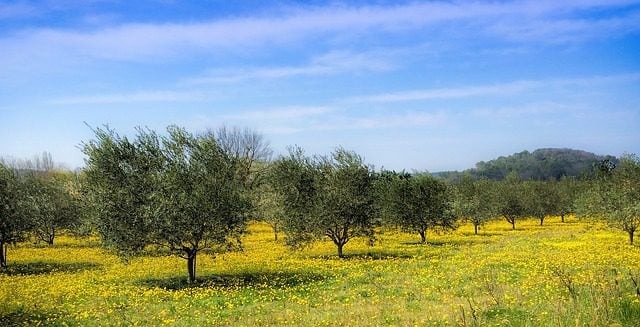
So much for Alter’s attempted refutation of Mark’s account. He claimed, “there are no leafy branches in March (Nisan) during the time of Passover in Jerusalem.” This is untrue. Leafy branches of olive trees are present year-round. See a photograph of several olive trees on the Mount of Olives during snowfall, taken on 2 March 2012. One can see that they all still have their foliage.
So this fits the bill in every respect for a tree with 1) leafy branches, 2) with foliage in early spring (March or April), 3) in Jerusalem, and 4) even in the immediate vicinity of where Jesus entered Jerusalem and was hailed with “Hosanna!” Since (as Alter agrees) Mark didn’t specify which tree he was referring to, one can reasonably opine that it is the olive tree, since everything matches up perfectly. Nehemiah 8:15 is similar: “. . . “Go out to the hills and bring branches of olive, wild olive, myrtle, palm, and other leafy trees to make booths, . . .”
Alter cites Leviticus 23:39-40 as related to “the fall harvest festival of Succoth” (p. 56). Here is the second verse in RSV: “And you shall take on the first day the fruit of goodly trees, branches of palm trees, and boughs of leafy trees, and willows of the brook; . . .” He had noted that the word for “branches” in both KJV and RSV for Matthew 21:8 is klados (Strong’s word #2798).
In the Greek Septuagint for Leviticus 23:40, it’s used for “branches” and (I believe, but not sure) also “boughs.” In Jeremiah 11:16 it’s used for “branches” of an “olive tree.” In Ezekiel 31:7 and 31:9 it is again translated “branches” in RSV, and refers to “a cedar in Lebanon” (31:3). In Daniel 4:12, 14, 21 it’s rendered as “branches” of an undisclosed type of tree of “great” height (4:10). In Hosea 14:6 it is rendered as “shoots” in RSV: of (strongly implied) an olive tree. Zechariah 4:12 again has “branches” of “olive trees.”
Moving over to the New Testament, we find that klados is used ten other times (always rendered “branch[es]” in RSV). In Matthew 13:32, Mark 4:32, and Luke 13:19 it refers to a mustard tree (see Mt 13:31 and Mk 4:31), in Matthew 24:32 and Mark 13:28, a fig tree. In Romans 11:16-19, 21 (five usages) it refers again to an olive tree (see 11:17, 24). The balance of deductive and biblical cross-reference evidence, then, points to Matthew 21:8 referring to an olive tree. But it doesn’t specify the type of tree, so we can’t know for sure.
The mustard tree is an “evergreen shrub” with green oval leaves. But the leaves of fig trees do fall in the winter.
Therefore, there is no insuperable problem of season and a complete lack of “leafy branches” in Jerusalem in the early spring. This is simply not an issue. Both Matthew and Mark (as we saw from the word study) could be referring to (much more likely) olive leaves, or also (in either case) possibly mustard leaves. Olive trees, however, were a lot more common in Israel (mentioned in the Hebrew Bible 46 times), whereas mustard trees receive zero mentions in the Hebrew Bible and only five references in the New Testament.
This leaves us with the consideration of the only mention of palm leaves connected with Palm Sunday:
John 12:13 So they took branches of palm trees and went out to meet him, crying, “Hosanna! Blessed is he who comes in the name of the Lord, even the King of Israel!”
Alter thinks this is a “controversy.” Why? He thinks the issue is “whether or not palm trees grew in Jerusalem and were readily available” (p. 57). Alter raises these issues but then helpfully resolves them himself. He cites a Bible scholar saying that palm trees and many other trees had disappeared from Jerusalem by Jesus’ time. But he cites another scholar saying that palm leaves could be obtained from the Jordan Valley. He cites a third scholar who points out that date palms are the plant or tree in question and that they require mean temperatures of 65 to flourish and become harmed if the temperature is below 20 Fahrenheit.
He then notes that date palms grew in Jericho, which is 3,280 feet lower in elevation than Jerusalem, and only 25 miles east. Jericho is called the “city of palms” in Deuteronomy 34:3 and 2 Chronicles 28:13. A thorough botanical description of the date palm states:
Depending on variety, age of a palm and environmental conditions, leaves of a date palm are 3 to 6 m long (4 m average) and have a normal life of 3 to 7 years. . . .
Unlike other fruit trees, dead or old leaves are not shed and do not drop on their own, but are removed under cultivation. An adult date palm has approximately 100 to 125 green leaves with an annual formation of 10 to 26 new leaves. The functional value of the leaf to the palm declines with age and no two leaves are the same age.
Date palms easily survive in Jericho all year-round, based on temperature data and averages. The mean minimum never dips below 43 degrees Fahrenheit in January or February or below 47 in December, while the mean maximum temperatures for those months are 53-58 degrees. The mean maximum is higher than 65 degrees for seven-and-a-half months of the year and is above 82 for three months. See a short video clip of date palms in Jericho, from March 2015.
In conclusion, none of the passages pose the slightest problem for the harmony of the Gospels. Mark and Matthew very likely refer to the leaves of olive trees, which could be obtained in Jerusalem, and the palm tree branches referred to in John 12:13 were easily obtainable at this time of year from date palms in Jericho: just 25 miles away. The most likely scenario is that the crowds hailing Jesus had both olive leaves and palm tree “branches” or leaves. The texts do not contradict each other. Luke doesn’t mention the people having leaves, but so what? It’s not required that he do so. He doesn’t deny it.
***
Photo credit: 858106 (3-26-15): olive trees with flourishing leaves in late March [Pixabay / Pixabay License]
Summary: Michael Alter asserted that during spring in Jerusalem, when Jesus entered the city on “Palm Sunday”, neither leafy branches (Mk, Mt) nor palm branches (Jn) were available. Wrong!
Tags: alleged Bible contradictions, alleged Resurrection contradictions, Bible “contradictions”, Bible “difficulties”, Bible Only, biblical inspiration, biblical prooftexts, biblical skeptics, biblical theology, exegesis, hermeneutics, Holy Bible, inerrancy, infallibility, Jewish anti-Christian polemics, Jewish apologetics, Jewish critique of Christianity, Jewish-Christian discussion, Michael J. Alter, New Testament, New Testament critics, New Testament skepticism, Resurrection “Contradictions”, Resurrection of Jesus, The Resurrection: A Critical Inquiry, palm leaves, Palm Sunday
Jews & Judaism & Old Testament
alleged Resurrection contradictions
Jewish anti-Christian polemics
Jewish critique of Christianity
The Resurrection: A Critical Inquiry
Previous Post
April 19, 2021
Resurrection Debate #3: Did Jesus Publicly Claim to Be the Messiah?
Next Post
April 20, 2021 Resurrection (?) #5: Did Jesus Claim to be Our Savior?
Browse Our Archives
Select a Category & Last Things About Me Anti-Catholicism Atheism & Agnosticism Baptism and Sacramentalism Bible and Tradition Blessed Virgin Mary Books by Dave Armstrong C. S. Lewis Calvinism & General Protestantism Catholic Apologetics Catholic Apologists Catholic conversion Catholic converts Christmas Church (Ecclesiology) Church History Conversion and Converts Development of Doctrine Eastern Orthodoxy Ecumenism & Christian Unity Eucharist & Liturgy Fathers of the Church French Translations G. K. Chesterton Hell Hell & Satan Hell & Satan & Last Things Heresies & Comparative Religion Holistic Health Inquisition & Crusades & Scandals James White Jews & Judaism & Old Testament John Calvin John Henry Newman Liberal / Modernist Theology Life Issues Literary Resume Lutheranism Mariology Martin Luther Music Orthodoxy Papacy & Infallibility Personal Page Philosophy & Science Political & Ethical & Moral Issues Protestant Persecution & Intolerance Protestantism Purgatory Purgatory & Penance Romantic & Imaginative Theology Saints & Purgatory & Penance Salvation Salvation & Justification Satan & Last Things Sexuality and Gender Issues Spanish Translations Traditionalism vs. Radical Catholic Reactionaries Traducciones al español / tradução para português Trinitarianism & Christology Uncategorized Videos
Select a Month October 2026 September 2026 August 2026 July 2026 June 2026 May 2026 April 2026 March 2026 February 2026 January 2026 December 2025 November 2025 October 2025 September 2025 August 2025 July 2025 June 2025 May 2025 April 2025 March 2025 February 2025 January 2025 December 2024 November 2024 October 2024 September 2024 August 2024 July 2024 June 2024 May 2024 April 2024 March 2024 February 2024 January 2024 December 2023 November 2023 October 2023 September 2023 August 2023 July 2023 June 2023 May 2023 April 2023 March 2023 February 2023 January 2023 December 2022 November 2022 October 2022 September 2022 August 2022 July 2022 June 2022 May 2022 April 2022 March 2022 February 2022 January 2022 December 2021 November 2021 October 2021 September 2021 August 2021 July 2021 June 2021 May 2021 April 2021 March 2021 February 2021 January 2021 December 2020 November 2020 October 2020 September 2020 August 2020 July 2020 June 2020 May 2020 April 2020 March 2020 February 2020 January 2020 December 2019 November 2019 October 2019 September 2019 August 2019 July 2019 June 2019 May 2019 April 2019 March 2019 February 2019 January 2019 December 2018 November 2018 October 2018 September 2018 August 2018 July 2018 June 2018 May 2018 April 2018 March 2018 February 2018 January 2018 December 2017 November 2017 October 2017 September 2017 August 2017 July 2017 June 2017 May 2017 April 2017 March 2017 February 2017 January 2017 December 2016 November 2016 October 2016 September 2016 August 2016 July 2016 June 2016 May 2016 April 2016 March 2016 February 2016 January 2016 December 2015 November 2015 October 2015 September 2015 August 2015 July 2015 June 2015 May 2015 April 2015 March 2015 February 2015 January 2015 December 2014 November 2014 October 2014 September 2014 August 2014 July 2014 June 2014 April 2014 March 2014 February 2014 January 2014 December 2013 November 2013 October 2013 September 2013 August 2013 July 2013 June 2013 April 2013 March 2013 February 2013 January 2013 December 2012 November 2012 October 2012 September 2012 August 2012 July 2012 June 2012 May 2012 April 2012 March 2012 February 2012 January 2012 December 2011 November 2011 October 2011 September 2011 August 2011 July 2011 June 2011 April 2011 March 2011 February 2011 October 2010 September 2010 August 2010 July 2010 April 2010 March 2010 December 2009 October 2009 August 2009 July 2009 June 2009 May 2009 March 2009 February 2009 October 2008 September 2008 April 2008 March 2008 February 2008 January 2008 December 2007 November 2007 October 2007 May 2007 March 2007 February 2007 January 2007 November 2006 October 2006 September 2006 August 2006 July 2006 June 2006 May 2006 April 2006 March 2006 February 2006 October 2005 June 2005 April 2005 February 2005 July 2004 May 2004 April 2004
Follow Us!
TAKE THE
Religious Wisdom Quiz
Who prayed for rain after a long drought and sent his servant to look seven times?
Select your answer to see how you score.
Elijah Isaiah Samuel Hosea
Books by This Author Books by Dave Armstrong
Related posts from Biblical Evidence for Catholicism

Jerusalem Council vs. James White & Sola Scriptura
Biblical Evidence for Catholicism

God, Modern Physics, & Dark Energy: An Analogy
Biblical Evidence for Catholicism

350 Bible Passages vs. Sola Scriptura
Biblical Evidence for Catholicism
Sola Scriptura: Self-Defeating, Unworkable, Unbiblical
Biblical Evidence for Catholicism
TRENDING AT PATHEOS Catholic

I was strolling through the top floor of the brand new Parthenon...

What Does Gêvâh Mean For Kimberley Guifoyle &...
This week, a lot of the news is focused on Kimberly Guilfoyle....

INNER CIRCLE: Profound Mystery (Of Christ In All...
Ephesians 5:31-32 “For this reason, a man will leave his father and...

Do Not Rejoice When Your Enemy Falls: The...
Turning an execution into a public spectacle is a disturbing expression of...

'The Chosen' S6 Trailer: The Passion Gets Very...
Not many watching 'The Chosen' worry about spoilers, but just because they...

The purpose-driven labor priest
A labor activist reads Rick Warren and it gets me wondering about...
view all Catholic blogs
Ad-Free & Subscriber Log-In Subscription Support
- About Us
- 2026 Calendar
- Videos
- Podcasts
- Library of World Religions
- Faith In Media Tracker
- Advertise With Us
- Write for Us
- Privacy Policy
- Terms of Service
- Do Not Sell My Data
- Contact Us
- Radiant Digital
- Manage Newsletter Subscriptions
- Unsubscribe From Notifications
- Sitemap
Copyright 2008-2026, Patheos. All rights reserved.
Subscription Support Ad-Free & Subscriber Log-In
Follow Patheos