
BuddhistCatholicContemplativeEvangelicalGeneral ChristianHinduJewishLatter-day SaintMuslimNew VisionsProgressive Christian
Beliefs
- Buddhist
- Catholic
- Contemplative
- Evangelical
- General Christian
- Hindu
- Jewish
- Latter-day Saint
- More Voices
- Muslim
- New Visions
- Pagan
- Progressive Christian
Topics
- Religion News
- Food and Religion
- Sports and Religion
- Religious Art
- Religious Music and Entertainment
- Religious Events
- History and Religion
- Style and Religion
- Politics and Religion
- Women in Religion
- Recreation Outdoors and Religion
- Business Finance and Religion
- Careers Workplace and Religion
- Education and Religion
- Family Parenting and Religion
- Health Fitness and Religion
- Home and Religion
- Relationships and Religion
- Technology and Religion
- Travel and Religion
Columnists
- Buddhist Columnists
- Business Finance and Religion Columnists
- Careers Workplace and Religion Columnists
- Catholic Columnists
- Contemplative Columnists
- Education and Religion Columnists
- Evangelists Columnists
- Family Parenting and Religion Columnists
- General Christian Columnists
- Health Fitness and Religion Columnists
- Hindu Columnists
- History and Religion Columnists
- Home and Religion Columnists
- Jewish Columnists
- More Voices Columnists
- Latter Day Columnists
- Muslim Columnists
- New Visions Columnists
- Nonreligious Columnists
- Pagan Columnists
- Politics and Religion Columnists
- Progressive Columnists
- Recreation Outdoors and Religion Columnists
- Relationships and Religion Columnists
- Religion News Columnists
- Religious Art Columnists
- Religious Events Columnists
- Religious Music and Entertainment Columnists
- Sports and Religion Columnists
- Style and Religion Columnists
- Technology and Religion Columnists
- Travel and Religion Columnists
- Women in Religion Columnists
Resource Library
- 2026 Calendar
- Library of World Religions
- The 100 Most Holy Places on Earth
- Patheos Answers
- Podcasts
- Videos
- Faith Leaders Database
- Anglican Episcopalian
- Bahai
- Baptist
- Buddhism
- Christianity
- Confucianism
- Eastern Orthodoxy
- Hinduism
- Holiness and Pentecostal
- ISKCON
- Islam
- Judaism
- Lutheran
- Methodist
- The Church of Jesus Christ of Latter-day Saints
- New Age
- Paganism
- Presbytarian and Reformed
- Protestantism
- Religion Behind the Scenes
- Roman Catholic
- Scientology
- Shia Islam
- Sikhism
- Sufism
- Sunni Islam
- Taoism
- Zen
- See all religions
Research Tools
 Ad-Free & Subscriber Log-In Subscription Support
Ad-Free & Subscriber Log-In Subscription Support
Follow Patheos 

- Trending:
- Forgiveness
- |
- Marriage
- |
- Consciousness
- |
- Death Penalty
- |
- Election
- |
- Halloween

-
About
-
Catholic Apologetics
-
Church History
-
Great Apologists
-
Christian Worldview
-
Protestantism & Misc.
- Home
- Catholic
- History and Religion
- Resurrection (?) #9: The Women at the Crucifixion
Resurrection (?) #9: The Women at the Crucifixion
Last updated on: June 5, 2026 at 11:58 pm by Dave Armstrong
Resurrection (?) #9: The Women at the Crucifixion 2026-06-05T23:58:26-04:00 Dave Armstrong
Patheos Explore the world's faith through different perspectives on religion and spirituality! Patheos has the views of the prevalent religions and spiritualities of the world.
Michael J. Alter is the author of the copiously researched, 913-page volume, The Resurrection: a Critical Inquiry (2015). I initially offered 59 “brief” replies to as many alleged New Testament contradictions (March 2021). We later engaged in amiable correspondence and decided to enter into a major ongoing dialogue about his book. He graciously sent me a PDF file of it, free of charge, for my review, and has committed himself to counter-response as well: a very rare trait these days. All of this is, I think, mightily impressive.
Mike describes himself as “of the Jewish faith” but is quick to point out that labels are often “misleading” and “divisive” (I agree to a large extent). He continues to be influenced by, for example, “Reformed, Conservative, Orthodox, and Chabad” variants of Judaism and learns “from those of other faiths, the secular, the non-theists, etc.” Fair enough. I have a great many influences, too, am very ecumenical, and am a great admirer of Judaism, as I told Michael in a combox comment on my blog.
He says his book “can be described as Jewish apologetics” and one that provides reasons for “why members of the Jewish community should not convert to Christianity.” I will be writing many critiques of the book and we’ll be engaging in ongoing discussion for likely a long time. I’m quite excited about it and eagerly enjoy the dialogue and debate. This is a rare opportunity these days and I am most grateful for Mike’s willingness to interact, minus any personal hostility.
I use RSV for all Bible verses that I cite. His words will be in blue.
*****
Alter wrote:
CONTRADICTION #21 The Differing Accounts of the Women at the Cross during the Crucifixion
The synoptic narratives reported differing details of those present at Jesus’s crucifixion and the actions they took. (p. 167)
That’s to be expected. Differences are not necessarily contradictions, as I have explained to atheists and biblical skeptics till I am blue in the face (to no avail).
Mark 14:50 reports that the only people present at the death of Jesus were several women. (p. 167)
Wrong. Mark 14:50 says nothing about the crucifixion. It says that the disciples “forsook him, and fled” at the time of the arrest of Jesus. This is very shoddy, reckless argumentation” not even worthy of the name.
One chapter later, Mark 15:40 tersely reports a singular action: “There were also women looking on afar off.” Mark adds that “among whom where Mary Magdalene, and Mary the mother of James the less and of Joses, and Salome.” Consequently, there were also other women present in the vicinity when Jesus died. (p. 167)
All correct. What the text does not say is that — of Jesus’ followers and disciples — only women were present at the crucifixion (however “far off” they were).
Contrary to the synoptic Gospels, John alone has Jesus’s mother present during Jesus’s crucifixion. This is the first appearance of Jesus’s mother in John. Out of nowhere she suddenly appears. (p. 167)
This is untrue. Mary had appeared in the story of the wedding of Cana, which detailed the first public miracle of Jesus” turning the water into wine (Jn 2:1-11). She was referred to as “the mother of Jesus” twice (2:1, 3) and “His mother” (2:5).
Alter then goes on to provide a list of the “few references to her physical presence in any of the gospels” (p. 167): presumably a complete list, which he presents “chronologically” (eight passages in all). But it’s not complete. He manages to somehow overlook Matthew 2:11, which is about Jesus’ Nativity, Matthew 2:14, 20-21, about the flight of Mary and Joseph to Egypt, Matthew 12:46: “his mother and his brothers stood outside, asking to speak to him”, Mark 3:31: “And his mother and his brothers came; and standing outside they sent to him and called him” (in 3:32 the crowd reiterates this), and Luke 8:19: “Then his mother and his brothers came to him, but they could not reach him for the crowd” (reiterated by the crowd in 8:20).
He found eight passages that reference the “physical presence” of Mary, and missed five (or 38% of all of them). The cause was obviously his overlooking a necessary search of “his mother” and “mother”. This brought about his erroneous statement about Mary first appearing in the Gospel of John in the 19th chapter and a list that missed five mentions of her being present.
Consequently, there is no description of the physical presence of Jesus’s mother for almost eighteen years, from the age of twelve to the age of thirty. (p. 168)
That’s right. So what?
Not only is this physical appearance highly remarkable but John also reports a terse communication Jesus had with his mother while on the cross: . . .
Jn 19:26 When Jesus therefore saw his mother, and the disciple standing by, whom he loved, he saith unto his mother, Woman,
behold thy son! (p. 168)
“Terse” is defined by Dictionary.com (2nd definition, which seems to be what Alter is implying) as “abruptly concise; curt; brusque.” Following the same source’s definition for “curt” we find: “rudely brief in speech or abrupt in manner.” And “brusque” is “abrupt in manner; blunt; rough.” Basically, then, Alter is arguing that Jesus was being “rude, short, rough, or improperly blunt” with His own mother, while He was dying: something far less than deferential or respectful. This is outrageous, even considering that Alter, of course, dies not believe in the Christian view of Jesus as God incarnate. It’s simply not what was happening in this instance.
Catholic apologist Jimmy Akin — as he always does — provides an excellent explanation of this:
The title “Woman” is not a sign of disrespect, it is the opposite — a title of dignity. It is a formal mode of speech equivalent to the English titles, “Lady” or “Madam.”
The Protestant commentator William Barclay writes:
“The word Woman (gynai) is also misleading. It sounds to us very rough and abrupt. But . . . In Homer it is the title by which Odysseus addresses Penelope, his well-loved wife [Iliad 3, 204; Odyssey 19, 221]. It is the title by which Augustus, the Roman Emperor, addressed Cleopatra, the famous Egyptian queen. So far from being a rough and discourteous way of address, it was a title of respect. We have no way of speaking in English which exactly renders it; but it is better to translate it Lady which gives at least the courtesy in it” (The Gospel of John, revised edition, vol. 1, p. 98).
Similarly, the Protestant Expositor’s Bible Commentary, published by Zondervan, states:
Jesus’ reply to Mary was not so abrupt as it seems. ‘Woman’ (gynai) was a polite form of address. . . . (vol. 9, p. 42).
Even the Fundamentalist Wycliff Bible Commentary put out by Moody Press acknowledges in its comment on this verse, “In his reply, the use of ‘Woman’ does not involve disrespect (cf. 19:26)” (p. 1076).
So there is nothing to this. It doesn’t even make any sense. Alter believes John simply makes up what Jesus said; it has little relation to either accuracy or history. So why would he make up a scene in which a dying Jesus, worried about the protection of His mother after He is dead, entrusts her to one of His best friends, but does so in a “terse” and rude manner? What sense does that make? It makes no sense, whether one regards the words as historical or pure fiction. It’s not plausible. Jesus (from all we know of Him) simply wouldn’t act like that, and if it is mere myth, John would have no possible reason (that I can imagine, anyway) to present Him as rude to His mother at such an agonizing moment, near His own death. It’s purely absurd to think so.
Yet not one of the synoptic Gospels reports the dying words of Jesus to his mother or even her presence at his death. In particular, it is extraordinary, if not incredible, that Luke did not report these events having examined “all things from the very first” (Lk 1:3) and to have deliberately omitted them. (p. 168)
So what? In God’s providence, He saw that one of the evangelists did mention it, and that is sufficient to preserve it for posterity. John reported her close presence and the words spoken because he was an eyewitness; he was there! Alter doesn’t assert it here, but the title of this sub-section implies that this omission is one of his alleged “contradictions” (using his arbitrary, modified, unscholarly definition of the word in order to suit his own agenda of NT-bashing). But, again, I reiterate: arguments from silence do not establish contradiction.
Alter further charges:
Finally, John 19:25 contradicted the synoptic Gospels by reporting that the women were positioned close to the cross when Jesus died: “Now there stood by the cross of Jesus his mother, and his mother’s sister, Mary the wife of Cleophas, and Mary Magdalene.” Yet the synoptic narrative reports that the women were positioned far away.
Mk 15:40-41 There were also women looking on afar off: among whom was Mary Magdalene, and Mary the mother of James the less and of Joses, and Salome; (Who also, when he was in Galilee, followed him, and ministered unto him;) and many other women which came up with him unto Jerusalem.
Mt 27:55-56 And many women were there beholding afar off, which followed Jesus from Galilee, ministering unto him: Among which was Mary Magdalene, and Mary the mother of James and Joses, and the mother of Zebedee’s children.
Lk 23:49, 55 And all his acquaintance, and the women that followed him from Galilee, stood afar off, beholding these things . . . And the women also, which came with him from Galilee, followed after, and beheld the sepulchre, and how his body was laid. (p. 169)
We agree that the Synoptics report onlookers being “afar off” (KJV) or at a “distance” (RSV). If tradition is correct, we know the spot where they stood, and I stood on it in the Church of the Holy Sepulchre in Jerusalem in October 2014. My rough estimate is that it was about half of a football field away (150 feet). This is consistent with the biblical “afar” or at a “distance.”
Alter himself notes (see above) that only the Gospel of John reports Jesus’ mother having been at the crucifixion. And it’s the only Gospel that alludes to one of the disciples — John Himself — being there. What Alter neglects to consider is that this could very well have been a report of a different occurrence from what the Synoptics detail. We have no time frame given. We know that Jesus’ agony and death on the cross took about six hours.
In fact, we have some possible clues about the time of each described observance. In terms of the order of things mentioned in the text, Mark refers to the female onlookers three verses (15:40) after He notes Jesus’ death (15:37). It’s not proof, but it’s a hint or indication that they were there at the time of His death. Matthew utilizes the same order of report: Jesus’ death (27:50) / description of the women (27:55-56). It’s the same again in Luke: Jesus’ death (23:46) and noting the women and other “acquaintances” present (23:49).
John, on the other hand, seems to place his scene shortly after Jesus was nailed to the cross, since he talks about the soldiers dividing up Jesus’ garments: “When the soldiers had crucified Jesus they took his garments and made four parts” (19:23) and right after mentioning that, he describes “his mother, and his mother’s sister, Mary the wife of Clopas, and Mary Mag’dalene” who were “standing by the cross” (19:25), along with John himself (19:26). Again, it’s not ironclad proof but it’s interesting and something to consider in the overall mix.
Where there is overlap of mentioned women (present near the cross and at a “distance”), it’s still not undeniably contradictory, since that would require variant assertions of a person being in two different places at a given particular time or the entire time. For example, Mary Magdalene was mentioned as being close to the cross with Mary the mother of Jesus, and further off (in Matthew and Mark). She would simply have moved (possibly being forced to move by the Roman soldiers) from one place to the other: perhaps earlier by the cross and later (up to the time of Jesus’ death) at a distance.
None of this is a big deal or a stretch at all. In my own life, I recall that I attended a Detroit Pistons game with my daughter (against the Golden State Warriors: then the world champions). It could rightly be said that “Dave and Angelina watched the two teams from the fifth row” and also that we “observed the Pistons and the Warriors from distant seats up near the rafters.” Both things are true! But more information needs to be added to explain it fully. When we were in the fifth row it was temporarily watching the teams warm up. Then we moved to our actual seats that we had tickets for. So we did both things, and it’s not contradictory at all. They were at different times. But if someone said “Dave and his daughter watched the game the entire time from row 5 and someone else said we did that — the entire time — from one of the last rows, then that would be contradictory, and either both reports would be wrong or one wrong and the other right: to be determined upon further investigation.
Likewise, what would be an actual logical contradiction regarding our topic would be if some verses describing the crucifixion stated that all of the female onlookers (whether Mary, the mother of Jesus is mentioned by name or not) were without exception, always standing at a distance, the entire time of the crucifixion, while John 19:25 taught that Mary, Jesus’ mother stood near the cross. That’s an actual contradiction. There are a number of scenarios that can be imagined that would be undeniably contradictory (according to the laws of logic: not the unbridled, irrational whims and fancies of Bible critics). But of course the Gospels don’t assert anything even remotely contradictory.
My explanation is not in the least inconsistent with all the relevant texts considered together. Nothing in those texts would preclude such a theory, which is not implausible at all. Two different things were being recorded: observance from afar, and observance much closer to the cross. And even overlap of the women mentioned is not a contradiction unless the claims contradict and are incoherent and confused with regard to the specific times and locations involved.
***
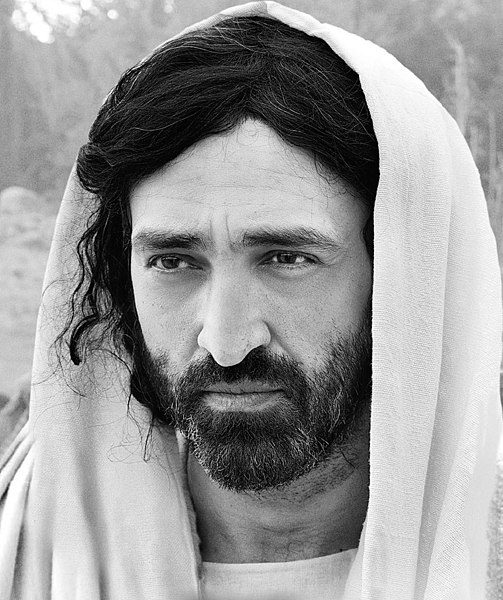
Photo credit: Selva Rasalingam as Jesus in the The Gospel of Luke (2016, Netflix USA) [Wikimedia Commons / Creative Commons CC0 1.0 Universal Public Domain Dedication]

Summary: Michael Alter argues that the New Testament presents conflicting and “contradictory” accounts as regards the women at the crucifixion. I show how these charges have no basis in either the relevant texts or logic.
Tags: alleged Bible contradictions, alleged Resurrection contradictions, Bible “contradictions”, Bible “difficulties”, Bible Only, biblical inspiration, biblical prooftexts, biblical skeptics, biblical theology, exegesis, hermeneutics, Holy Bible, inerrancy, infallibility, Jewish anti-Christian polemics, Jewish apologetics, Jewish critique of Christianity, Jewish-Christian discussion, Michael J. Alter, New Testament, New Testament critics, New Testament skepticism, Resurrection “Contradictions”, Resurrection of Jesus, The Resurrection: A Critical Inquiry, women at the crucifixion, bystanders at the crucifixion, onlookers at the crucifixion
Jews & Judaism & Old Testament
alleged Resurrection contradictions
Jewish anti-Christian polemics
Jewish critique of Christianity
The Resurrection: A Critical Inquiry
Previous Post
April 23, 2021
Resurrection (?) #8: Disciples Forsaking Jesus
Next Post
April 25, 2021 Resurrection (?) #10: "Blood & Water" & Medical Science
Browse Our Archives
Select a Category & Last Things About Me Anti-Catholicism Atheism & Agnosticism Baptism and Sacramentalism Bible and Tradition Blessed Virgin Mary Books by Dave Armstrong C. S. Lewis Calvinism & General Protestantism Catholic Apologetics Catholic Apologists Catholic conversion Catholic converts Christmas Church (Ecclesiology) Church History Conversion and Converts Development of Doctrine Eastern Orthodoxy Ecumenism & Christian Unity Eucharist & Liturgy Fathers of the Church French Translations G. K. Chesterton Hell Hell & Satan Hell & Satan & Last Things Heresies & Comparative Religion Holistic Health Inquisition & Crusades & Scandals James White Jews & Judaism & Old Testament John Calvin John Henry Newman Liberal / Modernist Theology Life Issues Literary Resume Lutheranism Mariology Martin Luther Music Orthodoxy Papacy & Infallibility Personal Page Philosophy & Science Political & Ethical & Moral Issues Protestant Persecution & Intolerance Protestantism Purgatory Purgatory & Penance Romantic & Imaginative Theology Saints & Purgatory & Penance Salvation Salvation & Justification Satan & Last Things Sexuality and Gender Issues Spanish Translations Traditionalism vs. Radical Catholic Reactionaries Traducciones al español / tradução para português Trinitarianism & Christology Uncategorized Videos
Select a Month October 2026 September 2026 August 2026 July 2026 June 2026 May 2026 April 2026 March 2026 February 2026 January 2026 December 2025 November 2025 October 2025 September 2025 August 2025 July 2025 June 2025 May 2025 April 2025 March 2025 February 2025 January 2025 December 2024 November 2024 October 2024 September 2024 August 2024 July 2024 June 2024 May 2024 April 2024 March 2024 February 2024 January 2024 December 2023 November 2023 October 2023 September 2023 August 2023 July 2023 June 2023 May 2023 April 2023 March 2023 February 2023 January 2023 December 2022 November 2022 October 2022 September 2022 August 2022 July 2022 June 2022 May 2022 April 2022 March 2022 February 2022 January 2022 December 2021 November 2021 October 2021 September 2021 August 2021 July 2021 June 2021 May 2021 April 2021 March 2021 February 2021 January 2021 December 2020 November 2020 October 2020 September 2020 August 2020 July 2020 June 2020 May 2020 April 2020 March 2020 February 2020 January 2020 December 2019 November 2019 October 2019 September 2019 August 2019 July 2019 June 2019 May 2019 April 2019 March 2019 February 2019 January 2019 December 2018 November 2018 October 2018 September 2018 August 2018 July 2018 June 2018 May 2018 April 2018 March 2018 February 2018 January 2018 December 2017 November 2017 October 2017 September 2017 August 2017 July 2017 June 2017 May 2017 April 2017 March 2017 February 2017 January 2017 December 2016 November 2016 October 2016 September 2016 August 2016 July 2016 June 2016 May 2016 April 2016 March 2016 February 2016 January 2016 December 2015 November 2015 October 2015 September 2015 August 2015 July 2015 June 2015 May 2015 April 2015 March 2015 February 2015 January 2015 December 2014 November 2014 October 2014 September 2014 August 2014 July 2014 June 2014 April 2014 March 2014 February 2014 January 2014 December 2013 November 2013 October 2013 September 2013 August 2013 July 2013 June 2013 April 2013 March 2013 February 2013 January 2013 December 2012 November 2012 October 2012 September 2012 August 2012 July 2012 June 2012 May 2012 April 2012 March 2012 February 2012 January 2012 December 2011 November 2011 October 2011 September 2011 August 2011 July 2011 June 2011 April 2011 March 2011 February 2011 October 2010 September 2010 August 2010 July 2010 April 2010 March 2010 December 2009 October 2009 August 2009 July 2009 June 2009 May 2009 March 2009 February 2009 October 2008 September 2008 April 2008 March 2008 February 2008 January 2008 December 2007 November 2007 October 2007 May 2007 March 2007 February 2007 January 2007 November 2006 October 2006 September 2006 August 2006 July 2006 June 2006 May 2006 April 2006 March 2006 February 2006 October 2005 June 2005 April 2005 February 2005 July 2004 May 2004 April 2004
Follow Us!
TAKE THE
Religious Wisdom Quiz
What was Paul’s profession before becoming an apostle?
Select your answer to see how you score.
Tentmaker Tax Collector Fisherman Carpenter
Books by This Author Books by Dave Armstrong
Related posts from Biblical Evidence for Catholicism

Jerusalem Council vs. James White & Sola Scriptura
Biblical Evidence for Catholicism

God, Modern Physics, & Dark Energy: An Analogy
Biblical Evidence for Catholicism

350 Bible Passages vs. Sola Scriptura
Biblical Evidence for Catholicism
Sola Scriptura: Self-Defeating, Unworkable, Unbiblical
Biblical Evidence for Catholicism
TRENDING AT PATHEOS Catholic

I was strolling through the top floor of the brand new Parthenon...

What Does Gêvâh Mean For Kimberley Guifoyle &...
This week, a lot of the news is focused on Kimberly Guilfoyle....

INNER CIRCLE: Profound Mystery (Of Christ In All...
Ephesians 5:31-32 “For this reason, a man will leave his father and...

Do Not Rejoice When Your Enemy Falls: The...
Turning an execution into a public spectacle is a disturbing expression of...

'The Chosen' S6 Trailer: The Passion Gets Very...
Not many watching 'The Chosen' worry about spoilers, but just because they...

The purpose-driven labor priest
A labor activist reads Rick Warren and it gets me wondering about...
view all Catholic blogs
Ad-Free & Subscriber Log-In Subscription Support
- About Us
- 2026 Calendar
- Videos
- Podcasts
- Library of World Religions
- Faith In Media Tracker
- Advertise With Us
- Write for Us
- Privacy Policy
- Terms of Service
- Do Not Sell My Data
- Contact Us
- Radiant Digital
- Manage Newsletter Subscriptions
- Unsubscribe From Notifications
- Sitemap
Copyright 2008-2026, Patheos. All rights reserved.
Subscription Support Ad-Free & Subscriber Log-In
Follow Patheos