
BuddhistCatholicContemplativeEvangelicalGeneral ChristianHinduJewishLatter-day SaintMuslimNew VisionsProgressive Christian
Beliefs
- Buddhist
- Catholic
- Contemplative
- Evangelical
- General Christian
- Hindu
- Jewish
- Latter-day Saint
- More Voices
- Muslim
- New Visions
- Pagan
- Progressive Christian
Topics
- Religion News
- Food and Religion
- Sports and Religion
- Religious Art
- Religious Music and Entertainment
- Religious Events
- History and Religion
- Style and Religion
- Politics and Religion
- Women in Religion
- Recreation Outdoors and Religion
- Business Finance and Religion
- Careers Workplace and Religion
- Education and Religion
- Family Parenting and Religion
- Health Fitness and Religion
- Home and Religion
- Relationships and Religion
- Technology and Religion
- Travel and Religion
Columnists
- Buddhist Columnists
- Business Finance and Religion Columnists
- Careers Workplace and Religion Columnists
- Catholic Columnists
- Contemplative Columnists
- Education and Religion Columnists
- Evangelists Columnists
- Family Parenting and Religion Columnists
- General Christian Columnists
- Health Fitness and Religion Columnists
- Hindu Columnists
- History and Religion Columnists
- Home and Religion Columnists
- Jewish Columnists
- More Voices Columnists
- Latter Day Columnists
- Muslim Columnists
- New Visions Columnists
- Nonreligious Columnists
- Pagan Columnists
- Politics and Religion Columnists
- Progressive Columnists
- Recreation Outdoors and Religion Columnists
- Relationships and Religion Columnists
- Religion News Columnists
- Religious Art Columnists
- Religious Events Columnists
- Religious Music and Entertainment Columnists
- Sports and Religion Columnists
- Style and Religion Columnists
- Technology and Religion Columnists
- Travel and Religion Columnists
- Women in Religion Columnists
Resource Library
- 2026 Calendar
- Library of World Religions
- The 100 Most Holy Places on Earth
- Patheos Answers
- Podcasts
- Videos
- Faith Leaders Database
- Anglican Episcopalian
- Bahai
- Baptist
- Buddhism
- Christianity
- Confucianism
- Eastern Orthodoxy
- Hinduism
- Holiness and Pentecostal
- ISKCON
- Islam
- Judaism
- Lutheran
- Methodist
- The Church of Jesus Christ of Latter-day Saints
- New Age
- Paganism
- Presbytarian and Reformed
- Protestantism
- Religion Behind the Scenes
- Roman Catholic
- Scientology
- Shia Islam
- Sikhism
- Sufism
- Sunni Islam
- Taoism
- Zen
- See all religions
Research Tools
 Ad-Free & Subscriber Log-In Subscription Support
Ad-Free & Subscriber Log-In Subscription Support
Follow Patheos 

- Trending:
- Forgiveness
- |
- Marriage
- |
- Consciousness
- |
- Death Penalty
- |
- Election
- |
- Halloween

-
About
-
Catholic Apologetics
-
Church History
-
Great Apologists
-
Christian Worldview
-
Protestantism & Misc.
- Home
- Catholic
- History and Religion
- Resurrection (?) #8: Disciples Forsaking Jesus
Resurrection (?) #8: Disciples Forsaking Jesus
Last updated on: June 5, 2026 at 11:58 pm by Dave Armstrong
Resurrection (?) #8: Disciples Forsaking Jesus 2026-06-05T23:58:27-04:00 Dave Armstrong
Patheos Explore the world's faith through different perspectives on religion and spirituality! Patheos has the views of the prevalent religions and spiritualities of the world.
Michael J. Alter is the author of the copiously researched, 913-page volume, The Resurrection: a Critical Inquiry (2015). I initially offered 59 “brief” replies to as many alleged New Testament contradictions (March 2021). We later engaged in amiable correspondence and decided to enter into a major ongoing dialogue about his book. He graciously sent me a PDF file of it, free of charge, for my review, and has committed himself to counter-response as well: a very rare trait these days. All of this is, I think, mightily impressive.
Mike describes himself as “of the Jewish faith” but is quick to point out that labels are often “misleading” and “divisive” (I agree to a large extent). He continues to be influenced by, for example, “Reformed, Conservative, Orthodox, and Chabad” variants of Judaism and learns “from those of other faiths, the secular, the non-theists, etc.” Fair enough. I have a great many influences, too, am very ecumenical, and am a great admirer of Judaism, as I told Michael in a combox comment on my blog.
He says his book “can be described as Jewish apologetics” and one that provides reasons for “why members of the Jewish community should not convert to Christianity.” I will be writing many critiques of the book and we’ll be engaging in ongoing discussion for likely a long time. I’m quite excited about it and eagerly enjoy the dialogue and debate. This is a rare opportunity these days and I am most grateful for Mike’s willingness to interact, minus any personal hostility.
I use RSV for all Bible verses that I cite. His words will be in blue.
*****
Alter wrote:
CONTRADICTION #20 The Forsaking of the Disciples
The synoptic narratives reports differing details of those present at Jesus’s crucifixion and the actions they took. In Mark 14:50, none of the apostles are described as being present during Jesus’s crucifixion: “And they all forsook him, and fled.” (p. 166)
That passage has nothing to do with the crucifixion, but rather with the arrest of Jesus (14:41-50). It refers to their forsaking of him at that particular moment. But what could they have done, anyway? They were supposed to engage in a brawl with “a crowd with swords and clubs” (14:43)? They simply didn’t want to be arrested. It was a perfectly human and understandable reaction. They couldn’t prevent Jesus from being arrested, but (whether rightly or wrongly) they could prevent it happening to themselves. But to repeat: this tells us nothing whatsoever about whether any of them were at the crucifixion. So it’s an irrelevant and wrongheaded use of a Bible passage.
Matthew 26:56 also reports that all the disciples had deserted their Master at the time of Jesus’s arrest. (p. 166)
Yes, precisely as in Mark 14:50; neither passage has anything to do with witnessing firsthand the crucifixion of Jesus.
Luke 23:48 reports: “And all the people that came together to that sight, beholding the things which were done, smote their breasts, and returned.” Then, in verse 48 [should be 49], he adds: “And all his acquaintance, and the women that followed him from Galilee, stood afar off, beholding these things.” Significantly, Luke fails to identify these acquaintances. Consequently, it is impossible to determine if any of these acquaintances were his disciples. (p. 166)
That’s correct.
A contradiction exists, given that Luke’s acquaintances include any of the disciples. (p. 166)
It does not. “All” is often not used literally in Scripture (the same happens in English; e.g., “all of Detroit came out to greet the world champion Detroit Pistons”). “All his acquaintance” in this context simply means, “lots of his acquaintances.” The non-literality is clear in verse 48 as well. Are we to believe that every single person without exception went away, beating their breasts? Of course not. Luke 23:48 is a general, proverbial statement, to the effect of saying: “the general consensus is that the witnesses who were there went away grieving.” Because “smoting one’s breast” was one Hebrew expression of grief (see, e.g., Nah 2:7), that visual depiction was used.
If someone doesn’t want to take my word (often my critics don’t!), I can provide several examples of such things in Scripture, and the authority of linguistic Bible sources. I did so, in one of my articles published at National Catholic Register:
The word for “all” . . . in Greek (pas) [the word in Lk 23:49 rendered “all”] can indeed have different meanings: as it does in English. It matters not if it means literally “every single one” in some places, if it can mean something less than “absolutely every” elsewhere in Scripture. . . .
In verse 1:29 [of Romans] the KJV has the phrase, “being filled with all unrighteousness,” whereas RSV adopts the more particular, specific meaning, “all manner of wickedness.” . . . in 15:14, Paul describes members of the Roman church as “filled with all knowledge” (cf. 1 Cor 1:5 in KJV), which clearly cannot be taken literally. Examples could be multiplied indefinitely, and are as accessible as the nearest Strong’s Concordance. . . .
Kittel’s Theological Dictionary of the New Testament (Abridged Ed.) states:
Pas can have different meanings according to its different uses . . . in many verses, pas is used in the NT simply to denote a great number, e.g., “all Jerusalem” in Mt 2:3 and “all the sick” in 4:24. (pp. 796-797)
See also Matthew 3:5; 21:10; 27:25; Mark 2:13; 9:15; etc., especially in KJV.
Likewise, Thayer’s Greek-English Lexicon of the New Testament gives “of every kind” as a possible meaning in some contexts (p. 491, Strong’s word #3956). And Vine’s Expository Dictionary of New Testament Words tells us it can mean “every kind or variety.” (vol. 1, p. 46, under “All”). . . .
We see Jewish idiom and hyperbole in passages of similar meaning. Jesus says: “No one is good but God alone” (Lk 18:19; cf. Mt 19:17). Yet He also said: “The good person brings good things out of a good treasure.” (Mt 12:35; cf. 5:45; 7:17-20; 22:10). Furthermore, in each instance in Matthew and Luke above of the English “good” the Greek word is the same: agatho.
Is this a contradiction? Of course not. Jesus is merely drawing a contrast between our righteousness and God’s, but He doesn’t deny that we can be “good” in a lesser sense. We observe the same dynamic in the Psalms:
Psalm 14:2-3 The LORD looks down from heaven upon the children of men, to see if there are any that act wisely, that seek after God. [3] They have all gone astray, they are all alike corrupt; there is none that does good, [Hebrew, tob] no not one. (cf. 53:1-3; Paul cites this in Rom 3:10-12)
Yet in the immediately preceding Psalm, David proclaims, “I have trusted in thy steadfast love” (13:5), which certainly is “seeking” after God! And in the very next he refers to “He who walk blamelessly, and does what is right” (15:2). Even two verses later (14:5) he writes that “God is with the generation of the righteous.” So obviously his lament in 14:2-3 is an indignant hyperbole and not intended as a literal utterance.
Such remarks are common to Hebrew poetic idiom. The anonymous psalmist in 112:5-6 refers to the “righteous” (Heb. tob), as does the book of Proverbs repeatedly: using the words “righteous” or “good” (11:23; 12:2; 13:22; 14:14, 19), using the same word, tob, which appears in Psalm 14:2-3. References to righteous men are innumerable (e.g., Job 17:9; 22:19; Ps 5:12; 32:11; 34:15; 37:16, 32; Mt 9:13; 13:17; 25:37, 46; Rom 5:19; Heb 11:4; Jas 5:16; 1 Pet 3:12; 4:18, etc.). . . .
The key in all this is to understand biblical language properly in context. It’s not always literal.
That is, Luke is known to have been highly dependent upon Mark and Matthew. Yet Luke seemingly rejects something reported by Mark and Matthew. Why then would Luke change such an important fact? (p. 166)
It’s a non-issue once the common non-literal use of “all” (pas in Greek in the NT) is understood. The problem with a lot of Bible critics is that they lack a basic understanding of different biblical genres (not to mention ancient Hebrew culture) and the over 200 non-literal figures of speech that are commonly used. I’ve seen this scores and scores of times among atheist biblical “exegetes” (whom I have refuted a few hundred times). They interpret the Bible in a woodenly literal manner that is very typical of relatively uneducated fundamentalist Protestants. In many cases, they actually were from that background, by their own report. So I have to get them up to speed in their biblical exegesis (a term very loosely applied in their case) and hermeneutics by informing them of the basic, elementary principles of those endeavors.
An even greater contradiction appears in John. (p. 166)
It’s not contradictory at all, as explained above. The Synoptics never claimed that no disciple was present at the cross. And the use of “all his acquaintance” was clearly non-literal in context.
Contrary to the synoptic Gospels, John had at least one disciple present during Jesus’s crucifixion, the disciple “whom he loved.”
Jn 19:25 Now there stood by the cross of Jesus his mother, and his mother’s sister, Mary the wife of Cleophas, and Mary Magdalene.
Jn 19:26 When Jesus therefore saw his mother, and the disciple standing by, whom he loved, he saith unto his mother, Woman, behold thy son!
Jn 19:27 Then saith he to the disciple, Behold thy mother! And from that hour that disciple took her unto his own home.
Not only is he the only disciple identified as being present during the Crucifixion, but Jesus also carried on a conversation with him and directed him to care for his mother! In effect, John’s narrative reads like a completely different story from the synoptic accounts. (p. 166)
As in all these alleged “contradictions,” what is happening is a consistent, non-contradictory complementarity of texts. The same occurs here. Almost all Christian commentators believe that John was the sole disciple at the cross. But there were also several “women who had followed him from Galilee” (Lk 23:49) and His mother. These included Mary Magdalene, who was His first follower (male or female) to see Him risen again. So He was not “forsaken” at the cross by all of His disciples, nor all of His larger group of “followers.” Nor does any text claim that He was. The women in His circle proved themselves more courageous than the men (which is so often the case in general life). I think that is one reason Jesus chose to first appear after His Resurrection to a woman: a little bit of pointed divine sense of humor . . .
But all the disciples save again for John, and Judas, died horrible deaths as martyrs; so in the long run they indeed proved themselves loyal, heroic, and obedient followers of Jesus, who went out and “turned the world upside down.”
In conclusion, given that Luke’s acquaintances included his disciples, Luke and John (John states that at least one disciple was at the cross during Jesus’s crucifixion) directly contradicts Mark and Matthew. However, if Luke’s “acquaintances” did not include the disciples, now there is a contradiction between John and all of the synoptic Gospels. (p. 167)
None of this is established at all, as just demonstrated.
***
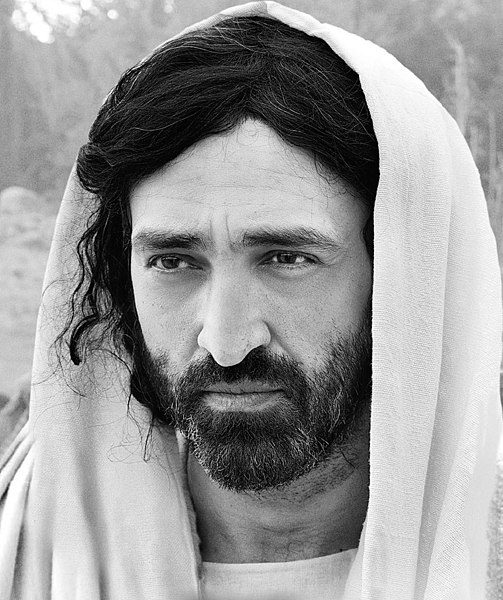
Photo credit: Selva Rasalingam as Jesus in the The Gospel of Luke (2016, Netflix USA) [Wikimedia Commons / Creative Commons CC0 1.0 Universal Public Domain Dedication]

Summary: Michael Alter argues that the NT contradicts itself regarding “disciples forsaking Jesus” & those present at the cross. I refute his arguments by logic & explanation of Hebrew non-literal idiom.
Tags: alleged Bible contradictions, alleged Resurrection contradictions, Bible “contradictions”, Bible “difficulties”, Bible Only, biblical inspiration, biblical prooftexts, biblical skeptics, biblical theology, exegesis, hermeneutics, Holy Bible, inerrancy, infallibility, Jewish anti-Christian polemics, Jewish apologetics, Jewish critique of Christianity, Jewish-Christian discussion, Michael J. Alter, New Testament, New Testament critics, New Testament skepticism, Resurrection “Contradictions”, Resurrection of Jesus, The Resurrection: A Critical Inquiry, disciples forsaking Jesus
Jews & Judaism & Old Testament
alleged Resurrection contradictions
Jewish anti-Christian polemics
Jewish critique of Christianity
The Resurrection: A Critical Inquiry
Previous Post
April 21, 2021
Resurrection (?) #7: Crucified Thieves Taunting Jesus
Next Post
April 23, 2021 Resurrection (?) #9: The Women at the Crucifixion
Browse Our Archives
Select a Category & Last Things About Me Anti-Catholicism Atheism & Agnosticism Baptism and Sacramentalism Bible and Tradition Blessed Virgin Mary Books by Dave Armstrong C. S. Lewis Calvinism & General Protestantism Catholic Apologetics Catholic Apologists Catholic conversion Catholic converts Christmas Church (Ecclesiology) Church History Conversion and Converts Development of Doctrine Eastern Orthodoxy Ecumenism & Christian Unity Eucharist & Liturgy Fathers of the Church French Translations G. K. Chesterton Hell Hell & Satan Hell & Satan & Last Things Heresies & Comparative Religion Holistic Health Inquisition & Crusades & Scandals James White Jews & Judaism & Old Testament John Calvin John Henry Newman Liberal / Modernist Theology Life Issues Literary Resume Lutheranism Mariology Martin Luther Music Orthodoxy Papacy & Infallibility Personal Page Philosophy & Science Political & Ethical & Moral Issues Protestant Persecution & Intolerance Protestantism Purgatory Purgatory & Penance Romantic & Imaginative Theology Saints & Purgatory & Penance Salvation Salvation & Justification Satan & Last Things Sexuality and Gender Issues Spanish Translations Traditionalism vs. Radical Catholic Reactionaries Traducciones al español / tradução para português Trinitarianism & Christology Uncategorized Videos
Select a Month October 2026 September 2026 August 2026 July 2026 June 2026 May 2026 April 2026 March 2026 February 2026 January 2026 December 2025 November 2025 October 2025 September 2025 August 2025 July 2025 June 2025 May 2025 April 2025 March 2025 February 2025 January 2025 December 2024 November 2024 October 2024 September 2024 August 2024 July 2024 June 2024 May 2024 April 2024 March 2024 February 2024 January 2024 December 2023 November 2023 October 2023 September 2023 August 2023 July 2023 June 2023 May 2023 April 2023 March 2023 February 2023 January 2023 December 2022 November 2022 October 2022 September 2022 August 2022 July 2022 June 2022 May 2022 April 2022 March 2022 February 2022 January 2022 December 2021 November 2021 October 2021 September 2021 August 2021 July 2021 June 2021 May 2021 April 2021 March 2021 February 2021 January 2021 December 2020 November 2020 October 2020 September 2020 August 2020 July 2020 June 2020 May 2020 April 2020 March 2020 February 2020 January 2020 December 2019 November 2019 October 2019 September 2019 August 2019 July 2019 June 2019 May 2019 April 2019 March 2019 February 2019 January 2019 December 2018 November 2018 October 2018 September 2018 August 2018 July 2018 June 2018 May 2018 April 2018 March 2018 February 2018 January 2018 December 2017 November 2017 October 2017 September 2017 August 2017 July 2017 June 2017 May 2017 April 2017 March 2017 February 2017 January 2017 December 2016 November 2016 October 2016 September 2016 August 2016 July 2016 June 2016 May 2016 April 2016 March 2016 February 2016 January 2016 December 2015 November 2015 October 2015 September 2015 August 2015 July 2015 June 2015 May 2015 April 2015 March 2015 February 2015 January 2015 December 2014 November 2014 October 2014 September 2014 August 2014 July 2014 June 2014 April 2014 March 2014 February 2014 January 2014 December 2013 November 2013 October 2013 September 2013 August 2013 July 2013 June 2013 April 2013 March 2013 February 2013 January 2013 December 2012 November 2012 October 2012 September 2012 August 2012 July 2012 June 2012 May 2012 April 2012 March 2012 February 2012 January 2012 December 2011 November 2011 October 2011 September 2011 August 2011 July 2011 June 2011 April 2011 March 2011 February 2011 October 2010 September 2010 August 2010 July 2010 April 2010 March 2010 December 2009 October 2009 August 2009 July 2009 June 2009 May 2009 March 2009 February 2009 October 2008 September 2008 April 2008 March 2008 February 2008 January 2008 December 2007 November 2007 October 2007 May 2007 March 2007 February 2007 January 2007 November 2006 October 2006 September 2006 August 2006 July 2006 June 2006 May 2006 April 2006 March 2006 February 2006 October 2005 June 2005 April 2005 February 2005 July 2004 May 2004 April 2004
Follow Us!
TAKE THE
Religious Wisdom Quiz
I am twelve stones taken from a riverbed and set up as a memorial to a miraculous crossing. What am I?
Select your answer to see how you score.
Altar stones The memorial stones The Stones of remembrance Bethel
Books by This Author Books by Dave Armstrong
Related posts from Biblical Evidence for Catholicism

Jerusalem Council vs. James White & Sola Scriptura
Biblical Evidence for Catholicism

God, Modern Physics, & Dark Energy: An Analogy
Biblical Evidence for Catholicism

350 Bible Passages vs. Sola Scriptura
Biblical Evidence for Catholicism
Sola Scriptura: Self-Defeating, Unworkable, Unbiblical
Biblical Evidence for Catholicism
TRENDING AT PATHEOS Catholic

The Sermon on the Mount, Part I: Matthew...
The Sermon on the Mount, Part I (Matthew 4:12-5:12) St. Matthew moves...

What's up from Crossway: Reviewing some of their latest A few weeks...

Janie Learns the Way of the Cross: A...
Teaching children about Jesus' Passion can be challenging. Many parents and educators...

Looking For Good Catholic Writing - October 2026
He alone extends the heavens, and he walks upon the waves of...

In "Irreplaceable," our book on vocation and technology, Trevor Sutton and I...

I was strolling through the top floor of the brand new Parthenon...
view all Catholic blogs
Ad-Free & Subscriber Log-In Subscription Support
- About Us
- 2026 Calendar
- Videos
- Podcasts
- Library of World Religions
- Faith In Media Tracker
- Advertise With Us
- Write for Us
- Privacy Policy
- Terms of Service
- Do Not Sell My Data
- Contact Us
- Radiant Digital
- Manage Newsletter Subscriptions
- Unsubscribe From Notifications
- Sitemap
Copyright 2008-2026, Patheos. All rights reserved.
Subscription Support Ad-Free & Subscriber Log-In
Follow Patheos