
BuddhistCatholicContemplativeEvangelicalGeneral ChristianHinduJewishLatter-day SaintMuslimNew VisionsProgressive Christian
Beliefs
- Buddhist
- Catholic
- Contemplative
- Evangelical
- General Christian
- Hindu
- Jewish
- Latter-day Saint
- More Voices
- Muslim
- New Visions
- Pagan
- Progressive Christian
Topics
- Religion News
- Food and Religion
- Sports and Religion
- Religious Art
- Religious Music and Entertainment
- Religious Events
- History and Religion
- Style and Religion
- Politics and Religion
- Women in Religion
- Recreation Outdoors and Religion
- Business Finance and Religion
- Careers Workplace and Religion
- Education and Religion
- Family Parenting and Religion
- Health Fitness and Religion
- Home and Religion
- Relationships and Religion
- Technology and Religion
- Travel and Religion
Columnists
- Buddhist Columnists
- Business Finance and Religion Columnists
- Careers Workplace and Religion Columnists
- Catholic Columnists
- Contemplative Columnists
- Education and Religion Columnists
- Evangelists Columnists
- Family Parenting and Religion Columnists
- General Christian Columnists
- Health Fitness and Religion Columnists
- Hindu Columnists
- History and Religion Columnists
- Home and Religion Columnists
- Jewish Columnists
- More Voices Columnists
- Latter Day Columnists
- Muslim Columnists
- New Visions Columnists
- Nonreligious Columnists
- Pagan Columnists
- Politics and Religion Columnists
- Progressive Columnists
- Recreation Outdoors and Religion Columnists
- Relationships and Religion Columnists
- Religion News Columnists
- Religious Art Columnists
- Religious Events Columnists
- Religious Music and Entertainment Columnists
- Sports and Religion Columnists
- Style and Religion Columnists
- Technology and Religion Columnists
- Travel and Religion Columnists
- Women in Religion Columnists
Resource Library
- 2026 Calendar
- Library of World Religions
- The 100 Most Holy Places on Earth
- Patheos Answers
- Podcasts
- Videos
- Faith Leaders Database
- Anglican Episcopalian
- Bahai
- Baptist
- Buddhism
- Christianity
- Confucianism
- Eastern Orthodoxy
- Hinduism
- Holiness and Pentecostal
- ISKCON
- Islam
- Judaism
- Lutheran
- Methodist
- The Church of Jesus Christ of Latter-day Saints
- New Age
- Paganism
- Presbytarian and Reformed
- Protestantism
- Religion Behind the Scenes
- Roman Catholic
- Scientology
- Shia Islam
- Sikhism
- Sufism
- Sunni Islam
- Taoism
- Zen
- See all religions
Research Tools
 Ad-Free & Subscriber Log-In Subscription Support
Ad-Free & Subscriber Log-In Subscription Support
Follow Patheos 

- Trending:
- Forgiveness
- |
- Marriage
- |
- Consciousness
- |
- Death Penalty
- |
- Election
- |
- Halloween

-
About
-
Catholic Apologetics
-
Church History
-
Great Apologists
-
Christian Worldview
-
Protestantism & Misc.
- Home
- Catholic
- History and Religion
- Resurrection (?) #7: Crucified Thieves Taunting Jesus
Resurrection (?) #7: Crucified Thieves Taunting Jesus
Last updated on: June 5, 2026 at 11:58 pm by Dave Armstrong
Resurrection (?) #7: Crucified Thieves Taunting Jesus 2026-06-05T23:58:26-04:00 Dave Armstrong
Patheos Explore the world's faith through different perspectives on religion and spirituality! Patheos has the views of the prevalent religions and spiritualities of the world.
Michael J. Alter is the author of the copiously researched, 913-page volume, The Resurrection: a Critical Inquiry (2015). I initially offered 59 “brief” replies to as many alleged New Testament contradictions (March 2021). We later engaged in amiable correspondence and decided to enter into a major ongoing dialogue about his book. He graciously sent me a PDF file of it, free of charge, for my review, and has committed himself to counter-response as well: a very rare trait these days. All of this is, I think, mightily impressive.
Mike describes himself as “of the Jewish faith” but is quick to point out that labels are often “misleading” and “divisive” (I agree to a large extent). He continues to be influenced by, for example, “Reformed, Conservative, Orthodox, and Chabad” variants of Judaism and learns “from those of other faiths, the secular, the non-theists, etc.” Fair enough. I have a great many influences, too, am very ecumenical, and am a great admirer of Judaism, as I told Michael in a combox comment on my blog.
He says his book “can be described as Jewish apologetics” and one that provides reasons for “why members of the Jewish community should not convert to Christianity.” I will be writing many critiques of the book and we’ll be engaging in ongoing discussion for likely a long time. I’m quite excited about it and eagerly enjoy the dialogue and debate. This is a rare opportunity these days and I am most grateful for Mike’s willingness to interact, minus any personal hostility.
I use RSV for all Bible verses that I cite. His words will be in blue.
*****
Alter wrote:
CONTRADICTION #10 Significant Omissions of Luke’s Narrative in Three Gospels
The gospel narratives present significantly differing details about the thieves on the cross. At first appearance, the details in Mark, Luke, and John read virtually the same: there are two thieves being crucified along with Jesus. However, in Matthew an additional and significant fact is provided that both thieves also taunted Jesus.
Mt 27:44 In the same way the robbers who were crucified with him also heaped insults on him. (NIV)
Mt 27:44 The bandits who were crucified with him also taunted him in the same way. (NRSV)
Mt 27:44 The robbers who had been crucified with Him were also insulting Him with the same words. (NASB)
Luke’s narrative reads like a completely different story: “And one of the malefactors which were hanged railed on him, saying, If thou be Christ, save thyself and us. But the other answering rebuked him, saying, Dost not thou fear God, seeing thou art in the same condemnation?” . . .
Matthew stated categorically that both thieves taunted Jesus, whereas Luke reported that just one thief did. (p. 120)
Both things can be true. It could simply (and not implausibly) have been that both thieves reviled Jesus at first, then when one of them “upped the ante” and said to Jesus, “Save yourself and us!” (Lk 23:39), the other had a change of mind, repented, and rebuked him:
Luke 23:40-41 “Do you not fear God, since you are under the same sentence of condemnation? [41] And we indeed justly; for we are receiving the due reward of our deeds; but this man has done nothing wrong.”
For all we know, there could have also been further conversation not recorded. Jesus might have briefly preached the gospel to both men, with one accepting it. Once again (for the umpteenth time) this is not a contradiction. One tires of the quick recourse among biblical skeptics and atheists to the accusation of “contradiction” when the example given is far from the case. Here is what a contradiction actually is:
A contradiction is a logical incompatibility between two or more statements or propositions. It occurs when those statements or propositions, taken together, yield a falsehood. By extension, outside of logic, contradictions are also said to occur between actions for which the motives are held to be contradictory, or between beliefs or principles when their content is contradictory.
Pointing to this principle in applied logic, Aristotle’s law of noncontradiction states that “One cannot say of something that it is and that it is not in the same respect and at the same time.”
The simplest or classic form of contradiction is the assertion both of some statement or proposition and its negation. So, for example, the statement-pair: “All fire engines are red,” and “It is not true that all fire engines are red” is contradictory. This means that one of those statements must be false; they cannot both be true at the same time and in the same manner.
The logical form of a simple contradiction is “Statement + negation of that statement.” (New World Encyclopedia, “Contradiction”)
Alter played around with the definition of “contradiction” early in his book:
[O]missions can at times be considered contradictions when the missing material is highly relevant and significant. Thus skeptics argue that the
absence of proof can be proof, but it is acknowledged not always.
Numerous times this text will present contradictions which fall under the Christian apologists’ rubric of omission. When these contradictions are
encountered, it must be remembered that the omissions here are extremely significant and something a normal person would not expect to see. (p. 26)
This is simply not what a logical contradiction is. Omissions are not contradictions, and arguments constructed from them are fallacious arguments from silence (argumentum ex silentio). He is trying to argue that if an omission is “significant” or “relevant” enough, then it can qualify as a “contradiction.” This make the entire determination one of subjective mush. Who is to decide what is “significant” or “relevant”? That’s not how logic works (and I did take a course in it in college, just for the record, as well as several other philosophy courses).
Logic is not about relative significance of two ideas or proposition or statements of fact. It’s about the relationship between two things: whether the relation is in harmony with the laws of non-contradiction and logic or not. There are several hypothetical ways that the story of the two thieves might be considered contradictory, if only they were in the texts and not bald speculation.
Mere difference is not contradiction. For example, if Matthew had stated that “both thieves insulted Jesus the entire time and never stopped till they [or He] died”, then that would be an undeniable contradiction compared with Luke. That is what a real contradiction looks like. But of course Matthew doesn’t say such a thing.
As it is, all we have to do is speculate about is a change of mind and heart of one of the thieves. Is that a plausible possibility? Have human beings never changed their minds? How absurd will we become in our skepticism? Alter would have to maintain that the one thief who is said to have rebuked the other in Luke couldn’t possibly have changed his mind — in about six hours of unspeakable agony, nailed to a cross — from his earlier stance of mocking Jesus. That could never have happened in any possible universe?!
This is absurd. Of course it is a possibility. We also know that being on the verge of death remarkably focuses a mind and a soul on the most serious aspects of life. This would be a time for a “deathbed repentance / conversion” from a life of crime if there ever was one.
Therefore, by reductio ad absurdum, the claim of “contradiction” vanishes. It’s not established by what we know about the nature of a contradiction, and by simple deduction, we can posit a plausible scenario that explains what Alter thinks is a contradiction (but what really isn’t, by definition). One merely has to be objective and fair-minded about it, and not question the text at every turn.
That’s the thing: fairness. In a Christian discussion on this issue, one person commented:
The so-called “difficulties” with this passage are no different, in kind, from many other differences that exist in parallel accounts among the four (and, especially, the three synoptic) Gospels. They are not difficulties to those who take the gospel accounts at face value. They only create problems when we bring an a priori suspicion to the reading of them, as if we suspect that someone is trying to “put something over” on us, and we are determined to find every possible evidence that they are doing so.
Obviously, if we were listening to friends, on different occasions, relating a story that was known to all of them (rather than reading the Gospels in the Bible), we would bring no such suspicion to our listening. Nor would certain differences in detail of various reports disturb us or raise our eyebrows (unless they involved ostensible contradictions, which our present case does not). . . .
I know that Luke was not an eye-witness, but I have never disqualified a historian’s reports simply on the grounds that he was not there when the events occurred. Luke has been demonstrated to be one of the most careful historians of ancient history. The people who doubt him without a cause must approach him differently than I do.
Beyond that, Luke reported that part of verses 39 through 43 were found in neither Mark nor Matthew. Where then did Luke obtain his material? (p. 120)
It could have been from any number of sources: from Jesus’ mother, who was present at the crucifixion, Mary, mother of James and Joseph, Mary, mother of the sons of Zebedee, Salome, or Mary Clopas. All these women were present at the cross. Or he could have gotten the information from, say, a Roman centurion eyewitness and earwitness who later became a Christian, or from any number of onlookers, who were willing to talk about what they saw and heard (not necessarily all Christians).
Or he got it from an oral tradition passed down. There could even be a tradition based on things Jesus taught during His post-Resurrection appearances. His appearance to the two disciples on the road to Emmaus alone appears to have lasted several hours: all likely in theological / spiritual conversation (Lk 24:13-31). Luke in Acts (1:3) says that these appearances of the risen Jesus lasted “forty days” and Paul says Jesus “appeared to more than five hundred brethren at one time” (1 Cor 15:6). All of these things are possible. On what grounds must we be excessively skeptical? Well, it seems to often stem from groundless pre-existing hostilities.
We must also understand that oral traditions were highly (quite often, remarkably) reliable in ancient cultures where relatively few people could read or write. See, for example: “How Reliable were the Early Church’s Oral Traditions?”
On the other hand, given that the event is historical, would it have been possible for Mark, Matthew, and John to be unaware of this tradition? (p. 120).
Yes; why not?
Furthermore, it is not reasonable to expect that three authors would agree to omit such important details from their narratives assuming they knew the tradition. (p. 120)
It’s the nature of all stories about roughly the same events. Each account will omit something one or more of the others include; they might differ on, say, chronology or relative emphasis. None of this is unusual or unexpected at all. And these factors ought not be seized upon in cynical attempts to “see a contradiction under every rock” (in the New Testament).
***
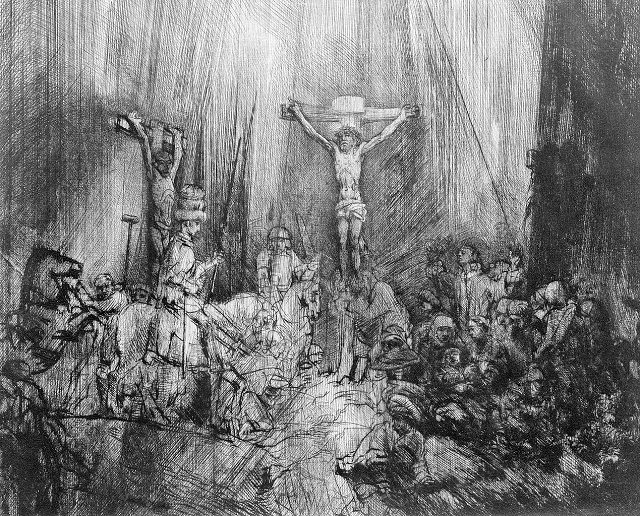
Photo credit: Christ Crucified between the Two Thieves: The Three Crosses (c. 1660), by Rembrandt (1606-1669) [public domain / Wikimedia Commons]

Summary: Michael Alter claims that Luke contradicted the other Gospels with regard to the crucified thieves. His account showed one rebuking the other, rather than both taunting. Is this contradictory?
Tags: alleged Bible contradictions, alleged Resurrection contradictions, Bible “contradictions”, Bible “difficulties”, Bible Only, biblical inspiration, biblical prooftexts, biblical skeptics, biblical theology, exegesis, hermeneutics, Holy Bible, inerrancy, infallibility, Jewish anti-Christian polemics, Jewish apologetics, Jewish critique of Christianity, Jewish-Christian discussion, Michael J. Alter, New Testament, New Testament critics, New Testament skepticism, Resurrection “Contradictions”, Resurrection of Jesus, The Resurrection: A Critical Inquiry, crucified thieves, thief on the cross
***
Jews & Judaism & Old Testament
alleged Resurrection contradictions
Jewish anti-Christian polemics
Jewish critique of Christianity
The Resurrection: A Critical Inquiry
Previous Post
April 21, 2021
Resurrection (?) #6: "Three Days and Three Nights"
Next Post
April 23, 2021 Resurrection (?) #8: Disciples Forsaking Jesus
Browse Our Archives
Select a Category & Last Things About Me Anti-Catholicism Atheism & Agnosticism Baptism and Sacramentalism Bible and Tradition Blessed Virgin Mary Books by Dave Armstrong C. S. Lewis Calvinism & General Protestantism Catholic Apologetics Catholic Apologists Catholic conversion Catholic converts Christmas Church (Ecclesiology) Church History Conversion and Converts Development of Doctrine Eastern Orthodoxy Ecumenism & Christian Unity Eucharist & Liturgy Fathers of the Church French Translations G. K. Chesterton Hell Hell & Satan Hell & Satan & Last Things Heresies & Comparative Religion Holistic Health Inquisition & Crusades & Scandals James White Jews & Judaism & Old Testament John Calvin John Henry Newman Liberal / Modernist Theology Life Issues Literary Resume Lutheranism Mariology Martin Luther Music Orthodoxy Papacy & Infallibility Personal Page Philosophy & Science Political & Ethical & Moral Issues Protestant Persecution & Intolerance Protestantism Purgatory Purgatory & Penance Romantic & Imaginative Theology Saints & Purgatory & Penance Salvation Salvation & Justification Satan & Last Things Sexuality and Gender Issues Spanish Translations Traditionalism vs. Radical Catholic Reactionaries Traducciones al español / tradução para português Trinitarianism & Christology Uncategorized Videos
Select a Month October 2026 September 2026 August 2026 July 2026 June 2026 May 2026 April 2026 March 2026 February 2026 January 2026 December 2025 November 2025 October 2025 September 2025 August 2025 July 2025 June 2025 May 2025 April 2025 March 2025 February 2025 January 2025 December 2024 November 2024 October 2024 September 2024 August 2024 July 2024 June 2024 May 2024 April 2024 March 2024 February 2024 January 2024 December 2023 November 2023 October 2023 September 2023 August 2023 July 2023 June 2023 May 2023 April 2023 March 2023 February 2023 January 2023 December 2022 November 2022 October 2022 September 2022 August 2022 July 2022 June 2022 May 2022 April 2022 March 2022 February 2022 January 2022 December 2021 November 2021 October 2021 September 2021 August 2021 July 2021 June 2021 May 2021 April 2021 March 2021 February 2021 January 2021 December 2020 November 2020 October 2020 September 2020 August 2020 July 2020 June 2020 May 2020 April 2020 March 2020 February 2020 January 2020 December 2019 November 2019 October 2019 September 2019 August 2019 July 2019 June 2019 May 2019 April 2019 March 2019 February 2019 January 2019 December 2018 November 2018 October 2018 September 2018 August 2018 July 2018 June 2018 May 2018 April 2018 March 2018 February 2018 January 2018 December 2017 November 2017 October 2017 September 2017 August 2017 July 2017 June 2017 May 2017 April 2017 March 2017 February 2017 January 2017 December 2016 November 2016 October 2016 September 2016 August 2016 July 2016 June 2016 May 2016 April 2016 March 2016 February 2016 January 2016 December 2015 November 2015 October 2015 September 2015 August 2015 July 2015 June 2015 May 2015 April 2015 March 2015 February 2015 January 2015 December 2014 November 2014 October 2014 September 2014 August 2014 July 2014 June 2014 April 2014 March 2014 February 2014 January 2014 December 2013 November 2013 October 2013 September 2013 August 2013 July 2013 June 2013 April 2013 March 2013 February 2013 January 2013 December 2012 November 2012 October 2012 September 2012 August 2012 July 2012 June 2012 May 2012 April 2012 March 2012 February 2012 January 2012 December 2011 November 2011 October 2011 September 2011 August 2011 July 2011 June 2011 April 2011 March 2011 February 2011 October 2010 September 2010 August 2010 July 2010 April 2010 March 2010 December 2009 October 2009 August 2009 July 2009 June 2009 May 2009 March 2009 February 2009 October 2008 September 2008 April 2008 March 2008 February 2008 January 2008 December 2007 November 2007 October 2007 May 2007 March 2007 February 2007 January 2007 November 2006 October 2006 September 2006 August 2006 July 2006 June 2006 May 2006 April 2006 March 2006 February 2006 October 2005 June 2005 April 2005 February 2005 July 2004 May 2004 April 2004
Follow Us!
TAKE THE
Religious Wisdom Quiz
Who prayed for rain after a long drought and sent his servant to look seven times?
Select your answer to see how you score.
Elijah Isaiah Samuel Hosea
Books by This Author Books by Dave Armstrong
Related posts from Biblical Evidence for Catholicism

Jerusalem Council vs. James White & Sola Scriptura
Biblical Evidence for Catholicism

God, Modern Physics, & Dark Energy: An Analogy
Biblical Evidence for Catholicism

350 Bible Passages vs. Sola Scriptura
Biblical Evidence for Catholicism
Sola Scriptura: Self-Defeating, Unworkable, Unbiblical
Biblical Evidence for Catholicism
TRENDING AT PATHEOS Catholic

I was strolling through the top floor of the brand new Parthenon...

What Does Gêvâh Mean For Kimberley Guifoyle &...
This week, a lot of the news is focused on Kimberly Guilfoyle....

INNER CIRCLE: Profound Mystery (Of Christ In All...
Ephesians 5:31-32 “For this reason, a man will leave his father and...

Do Not Rejoice When Your Enemy Falls: The...
Turning an execution into a public spectacle is a disturbing expression of...

'The Chosen' S6 Trailer: The Passion Gets Very...
Not many watching 'The Chosen' worry about spoilers, but just because they...

The purpose-driven labor priest
A labor activist reads Rick Warren and it gets me wondering about...
view all Catholic blogs
Ad-Free & Subscriber Log-In Subscription Support
- About Us
- 2026 Calendar
- Videos
- Podcasts
- Library of World Religions
- Faith In Media Tracker
- Advertise With Us
- Write for Us
- Privacy Policy
- Terms of Service
- Do Not Sell My Data
- Contact Us
- Radiant Digital
- Manage Newsletter Subscriptions
- Unsubscribe From Notifications
- Sitemap
Copyright 2008-2026, Patheos. All rights reserved.
Subscription Support Ad-Free & Subscriber Log-In
Follow Patheos