
BuddhistCatholicContemplativeEvangelicalGeneral ChristianHinduJewishLatter-day SaintMuslimNew VisionsProgressive Christian
Beliefs
- Buddhist
- Catholic
- Contemplative
- Evangelical
- General Christian
- Hindu
- Jewish
- Latter-day Saint
- More Voices
- Muslim
- New Visions
- Pagan
- Progressive Christian
Topics
- Religion News
- Food and Religion
- Sports and Religion
- Religious Art
- Religious Music and Entertainment
- Religious Events
- History and Religion
- Style and Religion
- Politics and Religion
- Women in Religion
- Recreation Outdoors and Religion
- Business Finance and Religion
- Careers Workplace and Religion
- Education and Religion
- Family Parenting and Religion
- Health Fitness and Religion
- Home and Religion
- Relationships and Religion
- Technology and Religion
- Travel and Religion
Columnists
- Buddhist Columnists
- Business Finance and Religion Columnists
- Careers Workplace and Religion Columnists
- Catholic Columnists
- Contemplative Columnists
- Education and Religion Columnists
- Evangelists Columnists
- Family Parenting and Religion Columnists
- General Christian Columnists
- Health Fitness and Religion Columnists
- Hindu Columnists
- History and Religion Columnists
- Home and Religion Columnists
- Jewish Columnists
- More Voices Columnists
- Latter Day Columnists
- Muslim Columnists
- New Visions Columnists
- Nonreligious Columnists
- Pagan Columnists
- Politics and Religion Columnists
- Progressive Columnists
- Recreation Outdoors and Religion Columnists
- Relationships and Religion Columnists
- Religion News Columnists
- Religious Art Columnists
- Religious Events Columnists
- Religious Music and Entertainment Columnists
- Sports and Religion Columnists
- Style and Religion Columnists
- Technology and Religion Columnists
- Travel and Religion Columnists
- Women in Religion Columnists
Resource Library
- 2026 Calendar
- Library of World Religions
- The 100 Most Holy Places on Earth
- Patheos Answers
- Podcasts
- Videos
- Faith Leaders Database
- Anglican Episcopalian
- Bahai
- Baptist
- Buddhism
- Christianity
- Confucianism
- Eastern Orthodoxy
- Hinduism
- Holiness and Pentecostal
- ISKCON
- Islam
- Judaism
- Lutheran
- Methodist
- The Church of Jesus Christ of Latter-day Saints
- New Age
- Paganism
- Presbytarian and Reformed
- Protestantism
- Religion Behind the Scenes
- Roman Catholic
- Scientology
- Shia Islam
- Sikhism
- Sufism
- Sunni Islam
- Taoism
- Zen
- See all religions
Research Tools
 Ad-Free & Subscriber Log-In Subscription Support
Ad-Free & Subscriber Log-In Subscription Support
Follow Patheos 

- Trending:
- Forgiveness
- |
- Marriage
- |
- Consciousness
- |
- Death Penalty
- |
- Election
- |
- Halloween

-
About
-
Catholic Apologetics
-
Church History
-
Great Apologists
-
Christian Worldview
-
Protestantism & Misc.
- Home
- Catholic
- History and Religion
- Resurrection #19: When Was Judas Paid?
Resurrection #19: When Was Judas Paid?
Last updated on: June 5, 2026 at 11:58 pm by Dave Armstrong
Resurrection #19: When Was Judas Paid? 2026-06-05T23:58:46-04:00 Dave Armstrong
Patheos Explore the world's faith through different perspectives on religion and spirituality! Patheos has the views of the prevalent religions and spiritualities of the world.
Michael J. Alter is the author of the copiously researched, 913-page volume, The Resurrection: a Critical Inquiry (2015). I initially offered 59 “brief” replies to as many alleged New Testament contradictions (March 2021). We later engaged in amiable correspondence and decided to enter into a major ongoing dialogue about his book. He graciously (and impressively!) sent me a PDF file of it, free of charge, for my review.
Mike describes himself as “of the Jewish faith” but is quick to point out that labels are often “misleading” and “divisive” (I agree to a large extent). He continues to be influenced by, for example, “Reformed, Conservative, Orthodox, and Chabad” variants of Judaism and learns “from those of other faiths, the secular, the non-theists, etc.” Fair enough. I have a great many influences, too, am very ecumenical, and am a great admirer of Judaism, as I told Michael in a combox comment on my blog.
He says his book “can be described as Jewish apologetics” and one that provides reasons for “why members of the Jewish community should not convert to Christianity.” I will be writing many critiques of the book and we’ll be engaging in ongoing discussion for likely a long time. I’m quite excited about it and am most grateful for Mike’s willingness to interact, minus any personal hostility.
To see all the other installments, search “Michael J. Alter” on either my Jews and Judaism or Trinitarianism & Christology web pages. That will take you to the subsection with the series.
I use RSV for all Bible verses that I cite. His words will be in blue.
*****
Alter wrote:
CONTRADICTION #79 Matthew Contradicting Mark-Luke When Judas Was Paid
Matthew directly contradicts Mark (and also Luke) by reporting the time when Judas was paid by the chief priests. Mark narrates that Judas specifically went to the chief priests to betray Jesus. When the Jewish leadership heard from Judas, they were pleased and promised to give him an undisclosed amount of money. Therefore, no money was received in advance.
Mk 14:10 and Judas Iscariot, one of the twelve, went unto the chief priests, to betray him unto them.
Mk 14:11 And when they heard it, they were glad, and promised to give him money. And he sought how he might conveniently betray him.
Similar to Mark, Luke’s Judas did not receive any money up front:
Lk 22:4 And he went his way, and communed with the chief priests and captains, how he might betray him unto them.
Lk 22:5 And they were glad, and covenanted to give him money.
In contradiction, Matthew reports that Judas received his money up front:
Mt 26:14 Then one of the twelve, called Judas Iscariot, went unto the chief priests,
Mt 26:15 And said unto them, “What will you give me, and I will deliver him unto you?” . . .
In conclusion, in Mark and Luke, Judas did not receive any money up front; the chief priests only agreed to enter into an agreement and give him money. In contradiction, Matthew’s Judas was paid in advance. Matthew incontrovertibly and indisputably contradicted Mark and Luke. (pp. 444-445)
Matthew 26:14-15 Then one of the twelve, who was called Judas Iscariot, went to the chief priests [15] and said, “What will you give me if I deliver him to you?” And they paid him thirty pieces of silver.
Matthew appears to be applying what is called in Hebrew literature “telescoping” or “compression” of time (a literary technique that I also wrote about at some length in my reply #15: including Matthew‘s use of it in particular). In his book, Hebrew for Theologians: A Textbook for the Study of Biblical Hebrew in Relation to Hebrew Thinking (University Press of America, 1993) Jacques Doukhan notes that in the Hebrew mind, “the content of time prevails over chronology. Events which are distant in time can, if their content is similar, be regarded as simultaneous.” (p. 206).
Matthew 28:2-4 is arguably another example of the same technique. Former atheist Steve Diseb elaborates on a further instance of this in Matthew:
The Cursing of the Fig Tree . . .
Matthew 21:17-22; Mark 11:11-15, 19-25.
Matthew — Jesus curses the fig tree. The withering of the tree appears to happen immediately after the curing.
Mark — Jesus curses the fig tree, but the withering happens much later after Jesus and the disciples have moved on; they don’t notice it until after the cleansing of the Temple.
As we have seen throughout the examples provided in this series, Matthew regularly shortens his telling of the events. Matthew decided to tell the two parts of the story side-by-side, instead of separating the curing and withering of the fig tree with the cleansing of the Temple between them. As we have seen throughout this series, Matthew tends to group things according to thematic reasons.
Matthew’s not the only one who does this. Sometimes Mark and Luke use the same literary technique as well:
Matthew mentions two demoniacs, while Mark and Luke only mention one. This occurs throughout Matthew’s gospel: two demoniacs (Mt. 8:28ff), two blind men (Mt. 9:27ff), and two more blind men (Mt. 20:30ff). In each case, Matthew has two, rather than one. This doesn’t give us great difficulty, because Mark and Luke do not write that there was only one demoniac or blind man. Instead, they use a literary device called “telescoping,” where they choose to focus on one figure, rather than two. (“Introduction to Matthew”, James M. Rochford, Evidence Unseen)
There is a right way and a wrong way to understand the use of compression in the New Testament. The Gospel writers do not “make things up out of whole cloth” or deliberately take liberties with known facts for the sake of an agenda that trumps truthfulness and honesty (i.e., Alter’s view of how they go about writing their accounts). Dr. Lydia McGrew, a friendly acquaintance of mine, makes several very important observations in this regard:
Two senses of “compression” or “telescoping.” These are phrases that you’ll hear, terms that you’ll hear. Now sometimes, what you’ll hear is that an author like a Gospel author, will tell things in a briefer way: he’ll leave things out. He’ll just not mention everything, not mention every detail. An illustration I’ve heard used is that it’s like the “guy version” and the “girl version” of a story, wherein women like to hear all the details whereas men just like to hit the bullet points, and so on. That’s fine for one sense of compression, that describes one sense of compression or telescoping. . . .
If you just leave stuff out, you’re just being indefinite. You’re not specifically trying to give the impression that these things happened all in one day or all in a much shorter time, or that certain people didn’t say certain things, or anything like that. You’re not trying to make your reader read your document in such a fashion that it gives the impression that this took a shorter time. . . .
Next: Two senses of “non-chronological order.” This is very similar to the two senses of “telescoping” or “compression.” Now what you often will find – and I’d say that ancient authors have somewhat more of a tendency to do this than we do, but we do it sometimes too – is just what I call “and-and chronology” or “and-but chronology”: “He did this and this, but he did this, but this happened.” OK. This is not implying a chronology. All right. This is not giving a specific chronology at all! This is just saying, “These things happened.” They might not have happened in that precise way. . . .
That fact, that ancient people – and we sometimes, too – are inexplicit about our chronology, is not something that was discovered as a special compositional device used by the Greeks and Romans, or something, just last year. That’s actually something that traditional harmonizers have been saying for many, many decades, and actually [for] hundreds of years. OK? Sometimes you get a non-chronological narration, but it’s not actually giving a chronological order. . . .
Narrating in an order where you do not imply a chronology is incompatible with narrating in an order where you do imply a chronology, and you change the chronology from someone else’s – maybe even changed it from what you had reason to believe was true. OK?
So one might [not] – and shouldn’t – have any objection to narrating in an inexplicit fashion about chronology, narrating things in a topic-oriented order or something like that, without even mentioning a chronology – versus laying out a chronology – “This happened, then this happened, then this happened” – when you know it’s the wrong chronology! You know it’s not how it happened! “Dr. Lydia McGrew on Six Bad Habits of New Testament Scholars (and how to avoid them)”, The Skeptical Zone, 1-12-18)
In the introductory section of this article (written by someone else), Dr. McGrew’s concern (with which I totally agree) is described as follows:
In his book, Dr. [Michael] Licona defended the historicity of the Gospels but endorsed the view, common among New Testament scholars, that the authors of the Gospels would have considered it perfectly legitimate to deliberately alter historical details of events, relating non-factual claims as if they were factual, because back in those days, writers of biographies were more concerned with Truth than with mere facts. Dr. McGrew is a conservative Christian writer, but not a Biblical inerrantist. Nevertheless, she felt that by acknowledging the existence of what she terms “fictionalizing compositional devices” in the Gospels, Dr. Licona had conceded too much to skeptics such as Bart Ehrman (whom Licona debated on the reliability of the New Testament back in 2016), and that such a concession undermined his whole case for the historicity of the Resurrection.
Matthew was simply thinking “non-chronologically” in 26:15 and applying a perspective that Jacques Doukhan noted (cited above): the Hebrew outlook, where “the content of time prevails over chronology.” Per Dr. McGrew’s analysis, Matthew isn’t “messing” with known chronology (like, e.g., John the Baptist being born before Jesus) in a way that is non-factual or fictional. He is simply (as she put it) “Narrating in an order where you do not imply a chronology” — with use of the “right” sort of compression. This is a crucial distinction.
Judas was paid for his betrayal. The Gospels agree on that. Matthew simply ignores the element of when he was paid. It wasn’t his concern. And that’s okay. Chronology is not of the essence of what is described. People like Alter and other biblical skeptics (and sadly too often, even conservative Christian scholars) superimpose onto his account the element of chronology and therefore (starting with that false premise) wrongly believe it contradicts Mark and Luke.
We observe for the millionth time, then, that the Gospel writers and ancient Hebrews were not primitive simpletons. The entire Bible is very rich in literary techniques and figures of speech. As I have noted before (but it bears repeating): Bible scholar E. W. Bullinger catalogued “over 200 distinct figures [in the Bible], several of them with from 30 to 40 varieties.” That is a statement from the Introduction to his 1104-page tome, Figures of Speech Used in the Bible (London: 1898).
But Alter’s entire 913-page book, with its hundreds of references to and citations of scholars, and a claim to often present both sides of issues (“The references include opinions and sources from a wide range of perspectives”: p. xliv) never takes note of either “compression” or “telescoping” (at least not by those terms, if so). On the other hand — typical of a “Greek hyper-rationalist” approach rather than the very different, more holistic ancient Hebrew mindset — he mentions “chronology” 117 times and “chronological” 43 times: never realizing that chronology is often, if not usually a matter of indifference to the Gospel writers (who are far more interested in “what” happened rather than “when” it did). Alas, he has failed to do sufficient research, in his never-ending (shall we say?) “fascination” with the New Testament texts.
***
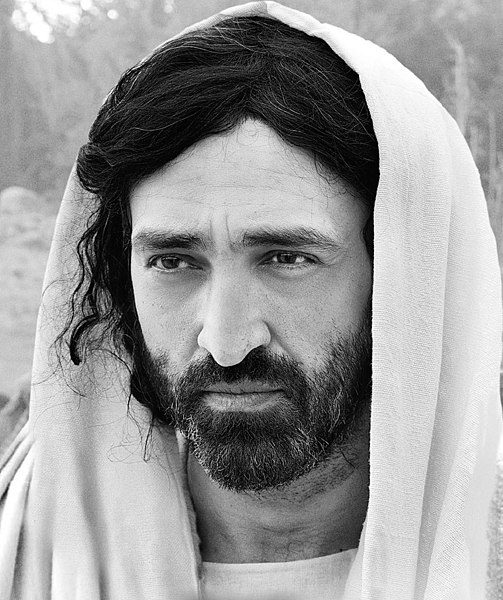
Photo credit: Selva Rasalingam as Jesus in the The Gospel of Luke (2016, Netflix USA) [Wikimedia Commons / Creative Commons CC0 1.0 Universal Public Domain Dedication]

Summary: The question of “when was Judas paid?” & chronology was simply ignored as a non-issue by Matthew, who utilized the literary technique of compression; also known as “telescoping.”
Tags: alleged Bible contradictions, alleged Resurrection contradictions, Bible “contradictions”, Bible “difficulties”, Bible Only, biblical inspiration, biblical prooftexts, biblical skeptics, biblical theology, exegesis, hermeneutics, Holy Bible, inerrancy, infallibility, Jewish anti-Christian polemics, Jewish apologetics, Jewish critique of Christianity, Jewish-Christian discussion, Michael J. Alter, New Testament, New Testament critics, New Testament skepticism, Resurrection “Contradictions”, Resurrection of Jesus, The Resurrection: A Critical Inquiry, when was Judas paid?, Judas’ payment, thirty coins, Judas
Jews & Judaism & Old Testament
alleged Resurrection contradictions
Jewish anti-Christian polemics
Jewish critique of Christianity
The Resurrection: A Critical Inquiry
Previous Post
April 29, 2021
Resurrection #18: "Touch Me Not" & Mary Magdalene
Next Post

April 30, 2021 Resurrection #20: Motivation of Judas' Betrayal
Browse Our Archives
Select a Category & Last Things About Me Anti-Catholicism Atheism & Agnosticism Baptism and Sacramentalism Bible and Tradition Blessed Virgin Mary Books by Dave Armstrong C. S. Lewis Calvinism & General Protestantism Catholic Apologetics Catholic Apologists Catholic conversion Catholic converts Christmas Church (Ecclesiology) Church History Conversion and Converts Development of Doctrine Eastern Orthodoxy Ecumenism & Christian Unity Eucharist & Liturgy Fathers of the Church French Translations G. K. Chesterton Hell Hell & Satan Hell & Satan & Last Things Heresies & Comparative Religion Holistic Health Inquisition & Crusades & Scandals James White Jews & Judaism & Old Testament John Calvin John Henry Newman Liberal / Modernist Theology Life Issues Literary Resume Lutheranism Mariology Martin Luther Music Orthodoxy Papacy & Infallibility Personal Page Philosophy & Science Political & Ethical & Moral Issues Protestant Persecution & Intolerance Protestantism Purgatory Purgatory & Penance Romantic & Imaginative Theology Saints & Purgatory & Penance Salvation Salvation & Justification Satan & Last Things Sexuality and Gender Issues Spanish Translations Traditionalism vs. Radical Catholic Reactionaries Traducciones al español / tradução para português Trinitarianism & Christology Uncategorized Videos
Select a Month October 2026 September 2026 August 2026 July 2026 June 2026 May 2026 April 2026 March 2026 February 2026 January 2026 December 2025 November 2025 October 2025 September 2025 August 2025 July 2025 June 2025 May 2025 April 2025 March 2025 February 2025 January 2025 December 2024 November 2024 October 2024 September 2024 August 2024 July 2024 June 2024 May 2024 April 2024 March 2024 February 2024 January 2024 December 2023 November 2023 October 2023 September 2023 August 2023 July 2023 June 2023 May 2023 April 2023 March 2023 February 2023 January 2023 December 2022 November 2022 October 2022 September 2022 August 2022 July 2022 June 2022 May 2022 April 2022 March 2022 February 2022 January 2022 December 2021 November 2021 October 2021 September 2021 August 2021 July 2021 June 2021 May 2021 April 2021 March 2021 February 2021 January 2021 December 2020 November 2020 October 2020 September 2020 August 2020 July 2020 June 2020 May 2020 April 2020 March 2020 February 2020 January 2020 December 2019 November 2019 October 2019 September 2019 August 2019 July 2019 June 2019 May 2019 April 2019 March 2019 February 2019 January 2019 December 2018 November 2018 October 2018 September 2018 August 2018 July 2018 June 2018 May 2018 April 2018 March 2018 February 2018 January 2018 December 2017 November 2017 October 2017 September 2017 August 2017 July 2017 June 2017 May 2017 April 2017 March 2017 February 2017 January 2017 December 2016 November 2016 October 2016 September 2016 August 2016 July 2016 June 2016 May 2016 April 2016 March 2016 February 2016 January 2016 December 2015 November 2015 October 2015 September 2015 August 2015 July 2015 June 2015 May 2015 April 2015 March 2015 February 2015 January 2015 December 2014 November 2014 October 2014 September 2014 August 2014 July 2014 June 2014 April 2014 March 2014 February 2014 January 2014 December 2013 November 2013 October 2013 September 2013 August 2013 July 2013 June 2013 April 2013 March 2013 February 2013 January 2013 December 2012 November 2012 October 2012 September 2012 August 2012 July 2012 June 2012 May 2012 April 2012 March 2012 February 2012 January 2012 December 2011 November 2011 October 2011 September 2011 August 2011 July 2011 June 2011 April 2011 March 2011 February 2011 October 2010 September 2010 August 2010 July 2010 April 2010 March 2010 December 2009 October 2009 August 2009 July 2009 June 2009 May 2009 March 2009 February 2009 October 2008 September 2008 April 2008 March 2008 February 2008 January 2008 December 2007 November 2007 October 2007 May 2007 March 2007 February 2007 January 2007 November 2006 October 2006 September 2006 August 2006 July 2006 June 2006 May 2006 April 2006 March 2006 February 2006 October 2005 June 2005 April 2005 February 2005 July 2004 May 2004 April 2004
Follow Us!
TAKE THE
Religious Wisdom Quiz
Who asked Jesus, "What is truth?"
Select your answer to see how you score.
Caiaphas Pilate Nicodemus Herod
Books by This Author Books by Dave Armstrong
Related posts from Biblical Evidence for Catholicism

Jerusalem Council vs. James White & Sola Scriptura
Biblical Evidence for Catholicism

God, Modern Physics, & Dark Energy: An Analogy
Biblical Evidence for Catholicism

350 Bible Passages vs. Sola Scriptura
Biblical Evidence for Catholicism
Sola Scriptura: Self-Defeating, Unworkable, Unbiblical
Biblical Evidence for Catholicism
TRENDING AT PATHEOS Catholic

I was strolling through the top floor of the brand new Parthenon...

What Does Gêvâh Mean For Kimberley Guifoyle &...
This week, a lot of the news is focused on Kimberly Guilfoyle....

INNER CIRCLE: Profound Mystery (Of Christ In All...
Ephesians 5:31-32 “For this reason, a man will leave his father and...

Do Not Rejoice When Your Enemy Falls: The...
Turning an execution into a public spectacle is a disturbing expression of...

'The Chosen' S6 Trailer: The Passion Gets Very...
Not many watching 'The Chosen' worry about spoilers, but just because they...

The purpose-driven labor priest
A labor activist reads Rick Warren and it gets me wondering about...
view all Catholic blogs
Ad-Free & Subscriber Log-In Subscription Support
- About Us
- 2026 Calendar
- Videos
- Podcasts
- Library of World Religions
- Faith In Media Tracker
- Advertise With Us
- Write for Us
- Privacy Policy
- Terms of Service
- Do Not Sell My Data
- Contact Us
- Radiant Digital
- Manage Newsletter Subscriptions
- Unsubscribe From Notifications
- Sitemap
Copyright 2008-2026, Patheos. All rights reserved.
Subscription Support Ad-Free & Subscriber Log-In
Follow Patheos