
BuddhistCatholicContemplativeEvangelicalGeneral ChristianHinduJewishLatter-day SaintMuslimNew VisionsProgressive Christian
Beliefs
- Buddhist
- Catholic
- Contemplative
- Evangelical
- General Christian
- Hindu
- Jewish
- Latter-day Saint
- More Voices
- Muslim
- New Visions
- Pagan
- Progressive Christian
Topics
- Religion News
- Food and Religion
- Sports and Religion
- Religious Art
- Religious Music and Entertainment
- Religious Events
- History and Religion
- Style and Religion
- Politics and Religion
- Women in Religion
- Recreation Outdoors and Religion
- Business Finance and Religion
- Careers Workplace and Religion
- Education and Religion
- Family Parenting and Religion
- Health Fitness and Religion
- Home and Religion
- Relationships and Religion
- Technology and Religion
- Travel and Religion
Columnists
- Buddhist Columnists
- Business Finance and Religion Columnists
- Careers Workplace and Religion Columnists
- Catholic Columnists
- Contemplative Columnists
- Education and Religion Columnists
- Evangelists Columnists
- Family Parenting and Religion Columnists
- General Christian Columnists
- Health Fitness and Religion Columnists
- Hindu Columnists
- History and Religion Columnists
- Home and Religion Columnists
- Jewish Columnists
- More Voices Columnists
- Latter Day Columnists
- Muslim Columnists
- New Visions Columnists
- Nonreligious Columnists
- Pagan Columnists
- Politics and Religion Columnists
- Progressive Columnists
- Recreation Outdoors and Religion Columnists
- Relationships and Religion Columnists
- Religion News Columnists
- Religious Art Columnists
- Religious Events Columnists
- Religious Music and Entertainment Columnists
- Sports and Religion Columnists
- Style and Religion Columnists
- Technology and Religion Columnists
- Travel and Religion Columnists
- Women in Religion Columnists
Resource Library
- 2026 Calendar
- Library of World Religions
- The 100 Most Holy Places on Earth
- Patheos Answers
- Podcasts
- Videos
- Faith Leaders Database
- Anglican Episcopalian
- Bahai
- Baptist
- Buddhism
- Christianity
- Confucianism
- Eastern Orthodoxy
- Hinduism
- Holiness and Pentecostal
- ISKCON
- Islam
- Judaism
- Lutheran
- Methodist
- The Church of Jesus Christ of Latter-day Saints
- New Age
- Paganism
- Presbytarian and Reformed
- Protestantism
- Religion Behind the Scenes
- Roman Catholic
- Scientology
- Shia Islam
- Sikhism
- Sufism
- Sunni Islam
- Taoism
- Zen
- See all religions
Research Tools
 Ad-Free & Subscriber Log-In Subscription Support
Ad-Free & Subscriber Log-In Subscription Support
Follow Patheos 

- Trending:
- Forgiveness
- |
- Marriage
- |
- Consciousness
- |
- Death Penalty
- |
- Election
- |
- Halloween

-
About
-
Catholic Apologetics
-
Church History
-
Great Apologists
-
Christian Worldview
-
Protestantism & Misc.
- Home
- Catholic
- History and Religion
- Resurrection #12: Who Buried Jesus?
Resurrection #12: Who Buried Jesus?
Last updated on: June 5, 2026 at 11:58 pm by Dave Armstrong
Resurrection #12: Who Buried Jesus? 2026-06-05T23:58:26-04:00 Dave Armstrong
Patheos Explore the world's faith through different perspectives on religion and spirituality! Patheos has the views of the prevalent religions and spiritualities of the world.
Michael J. Alter is the author of the copiously researched, 913-page volume, The Resurrection: a Critical Inquiry (2015). I initially offered 59 “brief” replies to as many alleged New Testament contradictions (March 2021). We later engaged in amiable correspondence and decided to enter into a major ongoing dialogue about his book. He graciously sent me a PDF file of it, free of charge, for my review, and has committed himself to counter-response as well: a very rare trait these days. All of this is, I think, mightily impressive.
Mike describes himself as “of the Jewish faith” but is quick to point out that labels are often “misleading” and “divisive” (I agree to a large extent). He continues to be influenced by, for example, “Reformed, Conservative, Orthodox, and Chabad” variants of Judaism and learns “from those of other faiths, the secular, the non-theists, etc.” Fair enough. I have a great many influences, too, am very ecumenical, and am a great admirer of Judaism, as I told Michael in a combox comment on my blog.
He says his book “can be described as Jewish apologetics” and one that provides reasons for “why members of the Jewish community should not convert to Christianity.” I will be writing many critiques of the book and we’ll be engaging in ongoing discussion for likely a long time. I’m quite excited about it and eagerly enjoy the dialogue and debate. This is a rare opportunity these days and I am most grateful for Mike’s willingness to interact, minus any personal hostility.
I use RSV for all Bible verses that I cite. His words will be in blue.
*****
Alter wrote:
CONTRADICTION #37 Who Took Jesus’s Body Down from the Cross?
There is a definite contradiction concerning the removal of Jesus’s body from the cross as recorded in Acts. Acts 13:27-29 states that Paul was informed that Jesus was taken down from the cross by the Romans, the same people who crucified him.
Acts 13:27 For they that dwell at Jerusalem, and their rulers, because they knew him not, nor yet the voices of the prophets
which are read every sabbath day, they have fulfilled them in condemning him.Acts 13:28 And though they found no cause of death in him, yet desired they Pilate that he should be slain.
Acts 13:29 And when they had fulfilled all that was written of him, they took him down from the tree, and laid him in a sepulchre.
The passage in Acts, attributed to Paul but written by Luke, declares that those who took part in the recovery of Jesus’s body were responsible for his execution. Consequently, Paul emphasizes that Jesus was taken down from the cross, not by his followers but by his enemies, the very group who Paul accuses of arranging for his death. (p. 229)
Note that Matthew 27:57-60, Mark 15:43-46 and Luke 23:50-53 all assert that Joseph of Arimathea buried Jesus, whereas here it appears that the hostile Jewish rulers who sought His execution did it (which appears prima facie to be a contradiction). Moreover, John 19:38-42 informs us that both Joseph and Nicodemus buried Jesus. Hence, Alter contends:
In direct contradiction, the synoptic narratives claim that the action of taking down Jesus’s body is carried out by Joseph alone. This contradiction seems particularly odd since the author of Acts is also believed to be the writer of Luke, yet he records conflicting accounts. How then is it possible that the Gospel of Luke and the Acts of the Apostles conflict?
Adding to the confusion, John 19:39 states that it was Joseph and Nicodemus who take the body, prepare the body, and bury the body: . . . (p. 229)
Alter also revisits this entire discussion later on in his book:
CONTRADICTION #41 John and Acts versus the Synoptics
John and Acts directly contradict the synoptic Gospels regarding who buried Jesus. The synoptic Gospels report that Joseph alone buried Jesus. . . .
To the contrary, John and Acts report that a plurality of people buried Jesus. John 19:42 claims that Joseph and Nicodemus buried Jesus: “There laid they Jesus therefore because of the Jews’ preparation day; for the sepulchre was nigh at hand.” In addition, Acts 13:29 reports that a plurality of people buried Jesus: “And when they had fulfilled all that was written of him, they took him down from the tree, and laid him in a sepulchre.” Thus, there is a glaring and incontrovertible contradiction. (p. 274; essentially the same argument is reiterated in “CONTRADICTION #42 Acts versus the Synoptics and John” on p. 275)
The question of Joseph or Joseph + Nicodemus as the person(s) who buried Jesus is not a logical contradiction because the Synoptics (directly contrary to Alter’s false claim) do not use the terminology of “alone” or “only” with regard to this action of Joseph, nor do they make the other claim that would establish a contradiction beyond all doubt: that Nicodemus was not involved at all. Hence, no contradiction on this score is present. I didn’t create the rules of logic; I only abide by them and point it out in the course of dialogue or non-dialogical apologetics when others don’t.
The question of whether one or two of those men or the Jewish rulers buried Jesus, is a much more difficult one, but it does have a plausible explanation, and it is again based on the common biblical phenomenon of a non-literal usage of words. If a word or sentence was not intended to be literal in the first place, then applying logic to it involves additional considerations of interpretation. The idiomatic usage has to be taken into account as well.
I again appeal to E. W. Bullinger’s wonderful book, Figures of Speech Used in the Bible (London: 1898; reprinted by Baker book House, Grand Rapids, Michigan, 1968). It’s available online on several different sites (here’s one). Bullinger classifies Acts 13:29 as an instance of actually two sorts of non-literal figurative use of language: ellipsis and idiom. Bullinger defines the first:
El-lip´-sis. This is the Greek word ἔλλειψις, a leaving in, from ἐν (en) in, and λείπειν (leipein) to leave.
‘The figure is so called, because some gap is left in the sentence, which means that a word or words are left out or omitted. The English name of the figure would therefore be Omission.
The figure is a peculiar form given to a passage when a word or words are omitted; words which are necessary for the grammar, but are not necessary for the sense.
The laws of geometry declare that there must be at least three straight lines to enclose a space. So the laws of syntax declare that there must be at least three words to make complete sense, or the simplest complete sentence. These three words are variously named by grammarians. In the sentence “Thy word is truth,” “Thy word” is the subject spoken of, “truth” is what is said of it (the predicate), and the verb “is” (the copula) connects it.
But any of these three may be dispensed with; and this law of syntax may be legitimately broken by Ellipsis.
The omission arises not from want of thought, or lack of care, or from accident, but from design, in order that we may not stop to think of, or lay stress on, the word omitted, but may dwell on the other words which are thus emphasised by the omission. For instance, in Matthew 14:19, we read that the Lord Jesus “gave the loaves to His disciples, and the disciples to the multitude.”
There is no sense in the latter sentence, which is incomplete, “the disciples to the multitude,” because there is no verb. The verb “gave” is omitted by the figure of Ellipsis for some purpose. If we read the last sentence as it stands, it reads as though Jesus gave the disciples to the multitude! (p. 1)
He goes on to explain how ellipsis can be found in three kinds in Scripture: absolute, relative, and the ellipsis of repetition. Acts 13:29 involves absolute ellipsis, which in turn has four sub-varieties and further categories. So this instance is “the omission of nouns and pronouns” and (as a further sub-category), “the omission of the nominative.” Bullinger provides many examples of this from both testaments. I will cite all of them, save one lengthy examination (for the sake of brevity). They are found on pages 4-8:
I. The Omission of Nouns and Pronouns
- The Omission of the Nominative
Genesis 14:19-20.-Melchizedek said to Abram, “Blessed be the most high God, which hath delivered thine enemies into thine hand. And he [i.e., Abram] gave him tithes of all.”
From the context, as well as from Hebrews 7:4, it is clear that it was Abram who gave the tithes to Melchizedek, and not Melchizedek to Abram.
Genesis 39:6.-“And he left all that he had in Joseph’s hand; and he knew not ought he had, save the bread Which he did eat. And Joseph was a goodly person, and well-favoured.”
Here it is not at all clear which it was of the two who “knew not ought he had.” If we understand Potiphar, it is difficult to see how he only knew the bread he ate: or if Joseph, it is difficult to understand how he knew not ought he had.
If the Ellipsis, however, is rightly supplied, it makes it all clear.
The verse may be rendered, and the Ellipsis supplied as follows:- “And he [Potiphar] left all that he had in Joseph’s hand: and he [Potiphar] knew not anything save the bread which he was eating. And Joseph was beautiful of figure, and beautiful of appearance.”
All difficulty is removed when we remember that “the Egyptians might not eat bread with the Hebrews, for that is an abomination unto the Egyptians” (43:32). Everything, therefore, was committed by Potiphar to Joseph’s care, except that which pertained to the matter of food.
2 Samuel 3:7.-“And Saul had a concubine, whose name was Rizpah, the daughter of Aiah, and … said to Abner, Wherefore, etc.”
Here it is clear from the Sense of the next verse and 2 Samuel 21:8 that “Ishbosheth” is the word to be supplied, as is done in italics.
2 Samuel 23:20.-“He slew two lionlike men of Moab.”
The Massorah points out [Note: Ginsburg’s Edition, Vol. i., p. 106.] that the word Ariel occurs three times, in this passage and Isaiah 29:1. In Isa. the word is twice transliterated as a proper name, while in 2 Samuel 23:20, margin, it is translated lions of God: the first part of the word אֲרִי (aree) a lion, and the second part אֵל (el) God. But if we keep it uniformly and consistently as a proper name we have with the Ellipsis of the accusative (sons) the following sense: “He slew the two sons of Ariel of Moab.”
2 Samuel 24:1.-“And again the anger of the Lord was kindled against Israel, and he moved David against them to say, Go, number Israel and Judah.”
Here the nominative to the verb “moved” is wanting. Someone moved, and who that was we learn from 1 Chronicles 21:1, from which it is clear that the word Satan or the Adversary is to be supplied, as is done in the margin:-“And again the anger of the Lord was kindled against Israel, and [the Adversary] moved David against them to say, Go, number Israel and Judah.”
1 Chronicles 6:28 (12).-“And the sons of Samuel; the firstborn Vashni (marg., called also Joel, ver. 33 and 1 Samuel 8:2) and Abiah.”
Here there is an Ellipsis of the name of the firstborn: while the word וַשְׁנִי, Vashni, when otherwise pointed (וְשֵׁנִי) means “and the second“! so that the verse reads,
“And the sons of Samuel; the firstborn [Joel] and the second Abiah.” This agrees with the Syriac Version. The R.V. [Note: The Revised Version, 1881.] correctly supplies the Ellipsis, and translates vashni “and the second.”
“Joel” is supplied from ver. 33 (see also 1 Samuel 8:2, and the note in Ginsburg’s edition of the Hebrew Bible).
Psalms 34:17.-“[They] cry, and the Lord heareth, and delivereth them out of all their troubles.”
The immediate subject in ver. 16 is evildoers. But it is not these who cry. It is the righteous. Hence the A.V. and the R.V. supply the words “the righteous” in italics. The nominative is omitted, in order that our attention may be fixed not on their persons or their characters, but upon their cry, and the Lord’s gracious answer.
The same design is seen in all similar cases.
Psalms 105:40.-“[They] asked, and he brought quails,” i.e., the People asked. The nominative is supplied in the A.V. But the R.V. translates it literally “They asked.”
Proverbs 22:27.-“If thou hast nothing to pay, why should one [i.e., the creditor] take away thy bed from under thee?”
Isaiah 26:1.-“In that day shall this song be sung in the land of Judah; we have a strong city; salvation will one [i.e. God] appoint for walls and bulwarks.”
The A.V. interprets by supplying the nominative. The R.V. translates it literally.
Jeremiah 51:19.-“He is the former of all things, and Israel is the rod of his inheritance.”
Here both the A.V. and R.V. supply the Ellipsis from 10:16. Had it been supplied from the immediate context, it would have come under the head of Relative Ellipsis, or that of Repetition.
Ezekiel 46:12.-“Now when the Prince shall prepare a voluntary offering or peace offerings voluntarily unto the Lord, one shall then open him the gate that looketh toward the East, &c.,” i.e., הַשּׁעֵר the gate-keeper (supplied from the noun הַשַּׁעַר, the gate), which follows, shall open the gate.
Zechariah 7:2.-“When they (Heb. he) had sent unto the house of God, Sherezer and Regem-melech and their men, to pray before the Lord” [i.e., when the people who had returned to Judea had sent].
Matthew 16:22.-“Be it far from Thee, Lord.”
Here the Ellipsis in the Greek is destroyed by the translation. The Greek reads, “Ἵλεώς σοι, κύριε” (hileôs soi, kyrie), which is untranslatable literally, unless we supply the Ellipsis of the Nominative, thus: “[God be] merciful to Thee, Lord!” Thus it is in the Septuagint 1 Chronicles 11:19, where it is rendered “God forbid that I should do this thing,” but it ought to be, “[God] be merciful to me [to keep me from doing] this thing.”
Acts 13:29.-“And when they had fulfilled all that was written, of him, they took him down from the tree, and laid him in a sepulchre,” i.e., Joseph of Arimathea and Nicodemus took him down. But it is the act which we are to think of here rather than the persons who did it. Hence the Ellipsis. . . .
1 Corinthians 15:53.-“For this corruptible [body] must put on incorruption, and this mortal [body] must put on immortality.”
The noun “body” must also be supplied in the next verse.
Ephesians 1:8.-“Wherein he hath abounded towards us in all wisdom and prudence.”
It is not “wherein,” but ἧς (hees) which, i.e., “[the knowledge] or grace, which he hath made to abound in us in all wisdom and prudence.”
Titus 1:15.-“Unto the pure all things are pure.”
The noun “meats” (i.e., foods) must be supplied as in 1 Corinthians 6:12. “All [meats] indeed are clean to the clean.” The word “clean” being used in its ceremonial or Levitical sense, for none can be otherwise either “pure” or “clean.”
Hebrews 9:1.-“Then verily the first covenant had also ordinances of divine service.” Here the word covenant is properly supplied in italics.
2 Peter 3:1.-“This second epistle, beloved, I now write unto you; in both which I stir up your pure minds by way of remembrance,” i.e., “In both which [epistles] I stir up,” etc.
1 John 5:16.-“If any man see his brother sin a sin which is not unto death, he shall ask, and he shall give him life, etc.,” i.e., “[God] shall give him life.” See also Matthew 5:11; Matthew 5:15; Luke 6:38, where men must be the word supplied.
The second non-literal figurative aspect of Acts 13:29 is idiom. Again, for the sake of brevity (utilizing the wonderful and ultra-convenient tool of a link), readers may peruse Bullinger’s multi-faceted definitions. He lists eleven sub-categories for idiom: one of which is “Idiomatic usage of verbs.” Acts 13:29 falls under the further sub-category: “4. Active verbs were used by the Hebrews to express, not the doing of the thing, but the permission of the thing which the agent is said to do.” (p. 823). He then provides examples, on pages 823-824. I include all of them:
Genesis 31:7.-Jacob says to Laban: “God did not give him to do me evil”: i.e., as in A.V., God suffered him not, etc.
Exodus 4:21.-“I will harden his heart (i.e., I will permit or suffer his heart to be hardened), that he shall not let the people go.” So in all the passages which speak of the hardening of Pharaoh’s heart. As is clear from the common use of the same Idiom in the following passages.
Exodus 5:22.-“Lord, wherefore hast thou so evil entreated this people?” i.e., suffered them to be so evil entreated.
Psalms 16:10.-“Thou wilt not give thine Holy One (i.e., suffer Him) to see corruption.” So the A.V.
Jeremiah 4:10.-“Lord God, surely thou hast greatly deceived this people”: i.e., thou hast suffered this People to be greatly deceived, by the false prophets, saying: Ye shall have peace, etc.
Ezekiel 14:9.-“If the prophet be deceived when he hath spoken a thing, I the Lord have deceived that prophet”: i.e., I have permitted him to deceive himself.
Matthew 6:13.-“Lead us not (i.e., suffer us not to be led) into temptation.”
Matthew 11:25.-“I thank thee, O Father … because thou hast hid (i.e., not revealed) these things,” etc.
Matthew 13:11.-“It is given to know unto you,” etc. (i.e., ye are permitted to know … but they are not permitted to know them.
Acts 13:29.-“When they (i.e., the rulers, verse 27) had fulfilled all that was written of him, they took him down from the tree, and laid him in a sepulchre”: i.e., they permitted Joseph of Arimathea and Nicodemus to do so.
Romans 9:18.-“Whom he will he hardeneth”: i.e., he suffereth to be hardened. Not that this in any way weakens the absolute sovereignty of God.
Romans 11:7.-“The rest were hardened”: i.e., were suffered to become blind (as in A.V. marg.).
Romans 11:8.-“God hath given them the spirit of slumber”: i.e., hath suffered them to fall asleep.
2 Thessalonians 2:11.-“For this cause God shall send them strong delusion, that they should believe a lie”: i.e., God will leave them and suffer them to be deceived by the great Lie which will come on all the world.
The Bible is not always easy to understand: especially for those of us who are not ancient Hebrews, and who are unfamiliar with their customs and ways of writing and thinking. It requires a degree of perseverance and study (I’ve been intensely studying it for 44 years — 40 of those as an apologist — : if anyone is wondering). It was always intended to be authoritatively interpreted even for those raised in the culture that it derived from.
Moses was to teach the ancient Hebrews the Law; not just read it to them (Ex 18:20). His brother Aaron was also to teach (Lev 10:11). Moreover, Levite priests were to authoritatively teach (Dt 33:10; 2 Chr 15:3; Mal 2:6-8). Ezra was a teacher of the Law (Ezra 7:6, 10, 25-26). When he read the Law of Moses to the people in Jerusalem (Neh 8:3), he had thirteen Levites assisting him “who helped the people to understand the law” (Neh 8:7; cf. 2 Chr 17:8-9). These Levites “gave the sense, so that the people understood the reading” (Neh 8:8). The same scenario applied in the New Testament as well:
Acts 8:30-31 So Philip ran to him, and heard him reading Isaiah the prophet, and asked, “Do you understand what you are reading?” [31] And he said, “How can I, unless some one guides me?” And he invited Philip to come up and sit with him.
2 Peter 3:15-16 . . . So also our beloved brother Paul wrote to you according to the wisdom given him, [16] speaking of this as he does in all his letters. There are some things in them hard to understand, which the ignorant and unstable twist to their own destruction, as they do the other scriptures.
I have provided the proper sense of Acts 13:29, by utilizing Bullinger’s fabulous and comprehensive biblical scholarship; thus showing that the ubiquitous charge of “contradiction” from biblical skeptics is again a false and unsubstantiated one in this instance. Once the failures of the skeptics are demonstrated enough times, the onlooker starts to get a distinct sense that maybe they are the ones (given their abysmal track record) who should be doubted and challenged, rather than Holy Scripture.
Some inquisitive readers may be interested in a collection of scores of my articles, where I solve these alleged biblical contradictions.
***
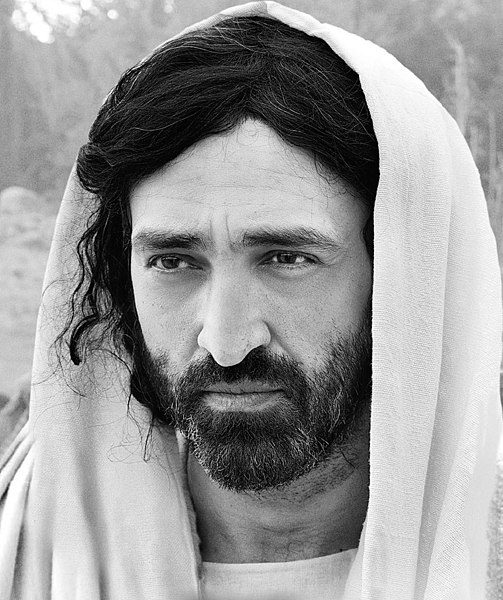
Photo credit: Selva Rasalingam as Jesus in the The Gospel of Luke (2016, Netflix USA) [Wikimedia Commons / Creative Commons CC0 1.0 Universal Public Domain Dedication]

Summary: Michael Alter attempted to assert two different contradictions regarding “who buried Jesus?” The first is solved by classical logic, the second through understanding Hebrew idiom.
Tags: alleged Bible contradictions, alleged Resurrection contradictions, Bible “contradictions”, Bible “difficulties”, Bible Only, biblical inspiration, biblical prooftexts, biblical skeptics, biblical theology, exegesis, hermeneutics, Holy Bible, inerrancy, infallibility, Jewish anti-Christian polemics, Jewish apologetics, Jewish critique of Christianity, Jewish-Christian discussion, Michael J. Alter, New Testament, New Testament critics, New Testament skepticism, Resurrection “Contradictions”, Resurrection of Jesus, The Resurrection: A Critical Inquiry, who buried Jesus?, burial of Jesus, Joseph of Arimathea, Nicodemus
***
Jews & Judaism & Old Testament
alleged Resurrection contradictions
Jewish anti-Christian polemics
Jewish critique of Christianity
The Resurrection: A Critical Inquiry
Previous Post
April 25, 2021
Resurrection #11: "All the Council" / Joseph of Arimathea?
Next Post
April 27, 2021 Resurrection #13: Guards at the Tomb & Historiography
Browse Our Archives
Select a Category & Last Things About Me Anti-Catholicism Atheism & Agnosticism Baptism and Sacramentalism Bible and Tradition Blessed Virgin Mary Books by Dave Armstrong C. S. Lewis Calvinism & General Protestantism Catholic Apologetics Catholic Apologists Catholic conversion Catholic converts Christmas Church (Ecclesiology) Church History Conversion and Converts Development of Doctrine Eastern Orthodoxy Ecumenism & Christian Unity Eucharist & Liturgy Fathers of the Church French Translations G. K. Chesterton Hell Hell & Satan Hell & Satan & Last Things Heresies & Comparative Religion Holistic Health Inquisition & Crusades & Scandals James White Jews & Judaism & Old Testament John Calvin John Henry Newman Liberal / Modernist Theology Life Issues Literary Resume Lutheranism Mariology Martin Luther Music Orthodoxy Papacy & Infallibility Personal Page Philosophy & Science Political & Ethical & Moral Issues Protestant Persecution & Intolerance Protestantism Purgatory Purgatory & Penance Romantic & Imaginative Theology Saints & Purgatory & Penance Salvation Salvation & Justification Satan & Last Things Sexuality and Gender Issues Spanish Translations Traditionalism vs. Radical Catholic Reactionaries Traducciones al español / tradução para português Trinitarianism & Christology Uncategorized Videos
Select a Month October 2026 September 2026 August 2026 July 2026 June 2026 May 2026 April 2026 March 2026 February 2026 January 2026 December 2025 November 2025 October 2025 September 2025 August 2025 July 2025 June 2025 May 2025 April 2025 March 2025 February 2025 January 2025 December 2024 November 2024 October 2024 September 2024 August 2024 July 2024 June 2024 May 2024 April 2024 March 2024 February 2024 January 2024 December 2023 November 2023 October 2023 September 2023 August 2023 July 2023 June 2023 May 2023 April 2023 March 2023 February 2023 January 2023 December 2022 November 2022 October 2022 September 2022 August 2022 July 2022 June 2022 May 2022 April 2022 March 2022 February 2022 January 2022 December 2021 November 2021 October 2021 September 2021 August 2021 July 2021 June 2021 May 2021 April 2021 March 2021 February 2021 January 2021 December 2020 November 2020 October 2020 September 2020 August 2020 July 2020 June 2020 May 2020 April 2020 March 2020 February 2020 January 2020 December 2019 November 2019 October 2019 September 2019 August 2019 July 2019 June 2019 May 2019 April 2019 March 2019 February 2019 January 2019 December 2018 November 2018 October 2018 September 2018 August 2018 July 2018 June 2018 May 2018 April 2018 March 2018 February 2018 January 2018 December 2017 November 2017 October 2017 September 2017 August 2017 July 2017 June 2017 May 2017 April 2017 March 2017 February 2017 January 2017 December 2016 November 2016 October 2016 September 2016 August 2016 July 2016 June 2016 May 2016 April 2016 March 2016 February 2016 January 2016 December 2015 November 2015 October 2015 September 2015 August 2015 July 2015 June 2015 May 2015 April 2015 March 2015 February 2015 January 2015 December 2014 November 2014 October 2014 September 2014 August 2014 July 2014 June 2014 April 2014 March 2014 February 2014 January 2014 December 2013 November 2013 October 2013 September 2013 August 2013 July 2013 June 2013 April 2013 March 2013 February 2013 January 2013 December 2012 November 2012 October 2012 September 2012 August 2012 July 2012 June 2012 May 2012 April 2012 March 2012 February 2012 January 2012 December 2011 November 2011 October 2011 September 2011 August 2011 July 2011 June 2011 April 2011 March 2011 February 2011 October 2010 September 2010 August 2010 July 2010 April 2010 March 2010 December 2009 October 2009 August 2009 July 2009 June 2009 May 2009 March 2009 February 2009 October 2008 September 2008 April 2008 March 2008 February 2008 January 2008 December 2007 November 2007 October 2007 May 2007 March 2007 February 2007 January 2007 November 2006 October 2006 September 2006 August 2006 July 2006 June 2006 May 2006 April 2006 March 2006 February 2006 October 2005 June 2005 April 2005 February 2005 July 2004 May 2004 April 2004
Follow Us!
TAKE THE
Religious Wisdom Quiz
Who prayed for rain after a long drought and sent his servant to look seven times?
Select your answer to see how you score.
Elijah Isaiah Samuel Hosea
Books by This Author Books by Dave Armstrong
Related posts from Biblical Evidence for Catholicism

Jerusalem Council vs. James White & Sola Scriptura
Biblical Evidence for Catholicism

God, Modern Physics, & Dark Energy: An Analogy
Biblical Evidence for Catholicism

350 Bible Passages vs. Sola Scriptura
Biblical Evidence for Catholicism
Sola Scriptura: Self-Defeating, Unworkable, Unbiblical
Biblical Evidence for Catholicism
TRENDING AT PATHEOS Catholic

I was strolling through the top floor of the brand new Parthenon...

What Does Gêvâh Mean For Kimberley Guifoyle &...
This week, a lot of the news is focused on Kimberly Guilfoyle....

INNER CIRCLE: Profound Mystery (Of Christ In All...
Ephesians 5:31-32 “For this reason, a man will leave his father and...

Do Not Rejoice When Your Enemy Falls: The...
Turning an execution into a public spectacle is a disturbing expression of...

'The Chosen' S6 Trailer: The Passion Gets Very...
Not many watching 'The Chosen' worry about spoilers, but just because they...

The purpose-driven labor priest
A labor activist reads Rick Warren and it gets me wondering about...
view all Catholic blogs
Ad-Free & Subscriber Log-In Subscription Support
- About Us
- 2026 Calendar
- Videos
- Podcasts
- Library of World Religions
- Faith In Media Tracker
- Advertise With Us
- Write for Us
- Privacy Policy
- Terms of Service
- Do Not Sell My Data
- Contact Us
- Radiant Digital
- Manage Newsletter Subscriptions
- Unsubscribe From Notifications
- Sitemap
Copyright 2008-2026, Patheos. All rights reserved.
Subscription Support Ad-Free & Subscriber Log-In
Follow Patheos