
BuddhistCatholicContemplativeEvangelicalGeneral ChristianHinduJewishLatter-day SaintMuslimNew VisionsProgressive Christian
Beliefs
- Buddhist
- Catholic
- Contemplative
- Evangelical
- General Christian
- Hindu
- Jewish
- Latter-day Saint
- More Voices
- Muslim
- New Visions
- Pagan
- Progressive Christian
Topics
- Religion News
- Food and Religion
- Sports and Religion
- Religious Art
- Religious Music and Entertainment
- Religious Events
- History and Religion
- Style and Religion
- Politics and Religion
- Women in Religion
- Recreation Outdoors and Religion
- Business Finance and Religion
- Careers Workplace and Religion
- Education and Religion
- Family Parenting and Religion
- Health Fitness and Religion
- Home and Religion
- Relationships and Religion
- Technology and Religion
- Travel and Religion
Columnists
- Buddhist Columnists
- Business Finance and Religion Columnists
- Careers Workplace and Religion Columnists
- Catholic Columnists
- Contemplative Columnists
- Education and Religion Columnists
- Evangelists Columnists
- Family Parenting and Religion Columnists
- General Christian Columnists
- Health Fitness and Religion Columnists
- Hindu Columnists
- History and Religion Columnists
- Home and Religion Columnists
- Jewish Columnists
- More Voices Columnists
- Latter Day Columnists
- Muslim Columnists
- New Visions Columnists
- Nonreligious Columnists
- Pagan Columnists
- Politics and Religion Columnists
- Progressive Columnists
- Recreation Outdoors and Religion Columnists
- Relationships and Religion Columnists
- Religion News Columnists
- Religious Art Columnists
- Religious Events Columnists
- Religious Music and Entertainment Columnists
- Sports and Religion Columnists
- Style and Religion Columnists
- Technology and Religion Columnists
- Travel and Religion Columnists
- Women in Religion Columnists
Resource Library
- 2026 Calendar
- Library of World Religions
- The 100 Most Holy Places on Earth
- Patheos Answers
- Podcasts
- Videos
- Faith Leaders Database
- Anglican Episcopalian
- Bahai
- Baptist
- Buddhism
- Christianity
- Confucianism
- Eastern Orthodoxy
- Hinduism
- Holiness and Pentecostal
- ISKCON
- Islam
- Judaism
- Lutheran
- Methodist
- The Church of Jesus Christ of Latter-day Saints
- New Age
- Paganism
- Presbytarian and Reformed
- Protestantism
- Religion Behind the Scenes
- Roman Catholic
- Scientology
- Shia Islam
- Sikhism
- Sufism
- Sunni Islam
- Taoism
- Zen
- See all religions
Research Tools
 Ad-Free & Subscriber Log-In Subscription Support
Ad-Free & Subscriber Log-In Subscription Support
Follow Patheos 

- Trending:
- Forgiveness
- |
- Marriage
- |
- Consciousness
- |
- Death Penalty
- |
- Election
- |
- Halloween

-
About
-
Catholic Apologetics
-
Church History
-
Great Apologists
-
Christian Worldview
-
Protestantism & Misc.
- Home
- Catholic
- History and Religion
- The Papacy & Infallibility: “Keys of the Kingdom”
The Papacy & Infallibility: “Keys of the Kingdom”
Last updated on: June 6, 2026 at 12:44 am by Dave Armstrong
The Papacy & Infallibility: “Keys of the Kingdom” 2026-06-06T00:44:18-04:00 Dave Armstrong
Patheos Explore the world's faith through different perspectives on religion and spirituality! Patheos has the views of the prevalent religions and spiritualities of the world.
Chapter Ten of My Bestselling (and Probably Most Well-Known) Book, A Biblical Defense of Catholicism
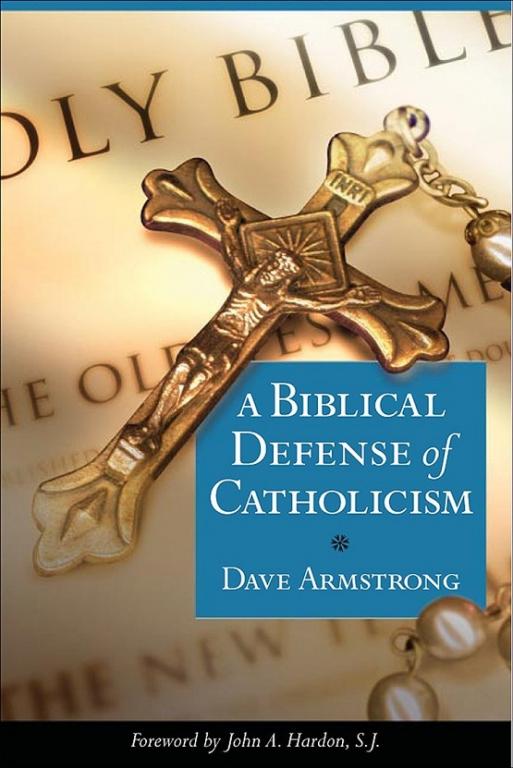
A Biblical Defense of Catholicism (my first book) was completed in May 1996 and “officially” published in June 2003 by Sophia Institute Press. The following is from pages 211-233, 238, minus the final section, Petrine panoply: fifty New Testament proofs for the pre-eminence of St. Peter: which I have long since linked as its own self-contained article. It was published in The Catholic Answer (Jan/Feb. 1997 issue).
I present below my slightly different original (i.e., pre-edited) 1996 manuscript version (all Bible passages: RSV). Readers may also be interested in additional related sections from the much longer initial 1994 version of this book: Primacy of St. Peter Verified by Protestant Scholars and Papacy & Papal Infallibility: Classic Catholic Reflections.
*****
Introduction, Definitions, and Explanation*The ecumenical First Vatican Council, in 1870, defined once and for all the dogma of papal infallibility as follows:
We teach and define that it is a dogma divinely revealed: that the Roman Pontiff, when he speaks ex cathedra, that is, when, in discharge of the office of pastor and teacher of all Christians, by virtue of his supreme Apostolic authority, he defines a doctrine regarding faith or morals to be held by the universal Church, is, by the divine assistance promised to him in Blessed Peter, possessed of that infallibility with which the divine Redeemer willed that His Church should be endowed in defining doctrine regarding faith or morals; and that, therefore, such definitions of the Roman Pontiff are of themselves, and not from the consent of the Church, irreformable. (1)
The charge is often made that the Catholic Church “invents” dogmas late in the game, which were not present in earlier centuries. The papacy, and papal infallibility, have indeed been in existence from the very earliest days of the Church, starting with the Apostle Peter, and what he and other Christians believed about his leadership and jurisdiction. (2) As is to be expected, however, both the office of the pope, and the notion of papal infallibility did undergo much development through the centuries.
In order to illustrate how the definition of 1870 drew on centuries of reflection and practice, we will cite St. Francis de Sales’ teaching from around 1596:
When he teaches the whole Church as shepherd, in general matters of faith and morals, then there is nothing but doctrine and truth. And in fact everything a king says is not a law or an edict, but that only which a king says as king and as a legislator. So everything the Pope says is not canon law or of legal obligation; he must mean to define and to lay down the law for the sheep, and he must keep the due order and form .
We must not think that in everything and everywhere his judgment is infallible, but then only when he gives judgment on a matter of faith in questions necessary to the whole Church; for in particular cases which depend on human fact he can err, there is no doubt, though it is not for us to control him in these cases save with all reverence, submission, and discretion. Theologians have said, in a word, that he can err in questions of fact, not in questions of right; that he can err extra cathedram, outside the chair of Peter. that is, as a private individual, by writings and bad example.
But he cannot err when he is in cathedra, that is, when he intends to make an instruction and decree for the guidance of the whole Church, when he means to confirm his brethren as supreme pastor, and to conduct them into the pastures of the faith. For then it is not so much man who determines, resolves, and defines as it is the Blessed Holy Spirit by man, which Spirit, according to the promise made by Our Lord to the Apostles, teaches all truth to the Church. (3)
Robert Hugh Benson (1871-1914), a convert to Catholicism, whose father, Edward W. Benson (1829-1896), had been the Archbishop of Canterbury, the highest office in Anglicanism, wrote concerning the development of the papacy:
It was not, then, until the head had been fully established as supreme over the body that men had eyes to see how it had been so ordained and indicated from the beginning. After it had come to pass it was seen to have been inevitable. All this is paralleled, of course, by the ordinary course of affairs. Laws of nature, as well as laws of grace, act quite apart from man’s perception or appreciation of them; and it is not until the law is recognized that its significance and inevitability, its illustrations and effects, are intelligibly recognized either. (4)
Likewise, [St.] John Henry Cardinal Newman, in his masterpiece Essay on the Development of Christian Doctrine (1845), offers similar analysis:
Whether communion with the Pope was necessary for Catholicity would not and could not be debated till a suspension of that communion had actually occurred. It is not a greater difficulty that St. Ignatius does not write to the Asian Greeks about Popes, than that St. Paul does not write to the Corinthians about Bishops. And it is a less difficulty that the Papal supremacy was not formally acknowledged in the second century, than that there was no formal acknowledgment on the part of the Church of the doctrine of the Holy Trinity till the fourth. No doctrine is defined till it is violated . . . .
Moreover, an international bond and a common authority could not be consolidated . . . while persecutions lasted. If the Imperial Power checked the development of Councils, it availed also for keeping back the power of the Papacy. The Creed, the Canon, in like manner, both remained undefined . . . All began to form, as soon as the Empire relaxed its tyrannous oppression of the Church . . .
Supposing there be otherwise good reason for saying that the Papal Supremacy is part of Christianity, there is nothing in the early history of the Church to contradict it. . .
Doctrine cannot but develop as time proceeds and need arises, and . . . therefore it is lawful, or rather necessary, to interpret the words and deeds of the earlier Church by the determinate teaching of the later. (5)
James Cardinal Gibbons, in his best-selling book of Catholic apologetics, The Faith of Our Fathers (1917), eloquently defended papal infallibility against many of the common objections of Protestants and other non-Catholics:
You will tell me that infallibility is too great a prerogative to be conferred on man. I answer: Has not God, in former times, clothed His Apostles with powers far more exalted? They were endowed with the gifts of working miracles, of prophecy and inspiration; they were the mouthpiece communicating God’s revelation, of which the Popes are merely the custodians. If God could make man the organ of His revealed Word, is it impossible for Him to make man its infallible guardian and interpreter? For, surely, greater is the Apostle who gives us the inspired Word than the Pope who preserves it from error . . .
Let us see, sir, whether an infallible Bible is sufficient for you. Either you are infallibly certain that your interpretation of the Bible is correct or you are not.
If you are infallibly certain, then you assert for yourself, and of course for every reader of the Scripture, a personal infallibility which you deny to the Pope, and which we claim only for him. You make every man his own Pope.
If you are not infallibly certain that you understand the true meaning of the whole Bible . . . then, I ask, of what use to you is the objective infallibility of the Bible without an infallible interpreter? (6)
Although the pope is supreme Head of the Church and preeminent in authority, nevertheless, he acts in concert with both the college of bishops (especially when meeting in an ecumenical Council, such as Trent or Vatican II), (7) and the “sense of the faithful” (or, sensus fidelium). (8) It is this united jurisdiction of bishops and pope (distantly analogous to the U.S. Congress and President, with the Supreme Court similar to Catholic Canon Law), which is the distinctive mark of Catholic ecclesiology, (9) as opposed to Eastern Orthodoxy, which accepts bishops but acknowledges no pope, and Protestantism, which does not formally recognize the papacy, and many denominations of which (perhaps the majority) lack bishops. Catholics claim that this arrangement is mirrored in the biblical relationship of St. Peter and the other original disciples, and that it is required by the demands of apostolic succession, which is itself suggested in the Bible. (10)
Bishop Vincent Gasser, in his famous defense of papal infallibility (the Relatio) at the First Vatican Council, discussed the aspects of collegiality and community:
We do defend the infallibility of the person of the Roman Pontiff, not as an individual person but as the person of the Roman Pontiff or a public person, that is, as head of the Church in his relation to the Church Universal . . .
We do not exclude the cooperation of the Church because the infallibility of the Roman Pontiff does not come to him in the manner of inspiration or of revelation but through a divine assistance. Therefore, the Pope, by reason of his office and the gravity of the matter, is held to use the means suitable for properly discerning and aptly enunciating the truth. These means are councils, or the advice of the bishops, cardinals, theologians, etc. Indeed the means are diverse according to the diversity of situations, and we should piously believe that, in the divine assistance promised to Peter and his successors by Christ, there is simultaneously contained a promise about the means which are necessary and suitable to make an infallible pontifical judgment.
Finally we do not separate the Pope, even minimally, from the consent of the Church, as long as that consent is not laid down as a condition which is either antecedent or consequent. We are not able to separate the Pope from the consent of the Church because this consent is never able to be lacking to him. Indeed, since we believe that the Pope is infallible through the divine assistance, by that very fact we also believe that the assent of the Church will not be lacking to his definitions since it is not able to happen that the body of bishops be separated from its head, and since the Church universal is not able to fail. (11)
Nevertheless, the pope is ultimately supreme, even over ecumenical Councils, which he ratifies in all particulars (a power which might be compared in part to the veto of the American President). The famous English convert and apologist Ronald Knox (1888-1957) explains:
[It is a] quite unworkable idea that the authority of the Pope depends on the authority of the Council. There is no way of deciding which councils were ecumenical councils except by saying that those councils were ecumenical which had their decisions ratified by the Pope. Now, either that ratification is infallible of itself, or else you will immediately have to summon a fresh ecumenical council to find out whether the Pope’s ratification was infallible or not, and so on ad infinitum. You can’t keep on going round and round in a vicious circle; in the long run the last word of decision must lie with one man, and that man is obviously the Pope. In the last resort the Pope must be the umpire, must have the casting vote. If therefore there is to be any infallibility in the Church, that infallibility must reside in the Pope, even when he speaks in his own name, without summoning a council to fortify his decision. (12)
Contrary to common assumptions, the doctrine of the papacy is well-grounded in Scripture, and the institution is present in increasingly-developing stages throughout the history of the Church. Moreover, the constant, remarkable primacy of Rome in the history of Christianity is equally undeniable. Because the very existence of this historical institution (in the early Church) is so often denied (for example, many arbitrarily maintain that Pope Leo the Great in the fifth century was the first pope, and others claim the same for Gregory the Great in the sixth), more attention than usual will be paid to the actual history of the papacy and the theological justifications historically put forth in defense of it.
Scriptural Evidence for the Papacy and the Apostolic Primacy of St. Peter*St. Peter as the Rock (Matthew 16:18)
Matthew 16:18 And I tell you, you are Peter, and on this rock I will build my church, and the powers of death shall not prevail against it.
Catholics contend that the “rock” is Peter himself, not his faith, or Jesus (although arguably his faith is assumed by Christ in naming Peter “rock” in the first place). This interpretation is found in the Church Fathers at least as early as Tertullian (d.c.230). The next verse (16:19) is in the singular, which supports this view, which is in fact the consensus of the majority of biblical commentators today, according to the article on Peter in the Encyclopedia Britannica (1985 edition). (13)
It has often been argued to the contrary that Jesus called Peter petros (literally, “stone”), not petra (the word for “rock” in the passage), so that the “rock” wasn’t Peter, but this is simply explained by the necessity for a proper male name in Greek to be in the masculine gender. In Aramaic, however (the language Jesus spoke), the name kepha would have been used for both “rock” and “Peter.” Matthew could just as easily have used another Greek word for “stone,” lithos, in contrast to “rock,” but this would have distorted the unmistakable word-play of the passage, which is the whole point!
Many prominent Protestant scholars and exegetes have agreed that Peter is the “rock” in Matthew 16:18, including Alford, Broadus, Keil, Kittel, Cullmann (14), Albright (15), Robert McAfee Brown (16), and more recently, respected evangelical commentators R.T. France (17) and D.A. Carson. (18) Also, popular one-volume Protestant Bible commentaries such as Peake’s Commentary (19), New Bible Commentary (20) and numerous others concur. (21) Both Carson and France surprisingly assert that only Protestant overreaction to Catholic Petrine and papal claims have brought about the denial that Peter himself is the “rock.”
The great Protestant Greek scholar Marvin Vincent was among those who took the traditional view, in his standard reference work Word Studies in the New Testament (1887):
The word refers neither to Christ as a rock, distinguished from Simon, a stone, nor to Peter’s confession, but to Peter himself, . . . The reference of petra to Christ is forced and unnatural. The obvious reference of the word is to Peter. The emphatic this naturally refers to the nearest antecedent; and besides, the metaphor is thus weakened, since Christ appears here, not as the foundation, but as the architect: “On this rock will I build.” Again, Christ is the great foundation, the chief cornerstone, but the New Testament writers recognize no impropriety in applying to the members of Christ’s church certain terms which are applied to him. For instance, Peter himself (1 Peter 2:4), calls Christ a living stone, and in ver. 5, addresses the church as living stones . . .
Equally untenable is the explanation which refers petra to Simon’s confession. Both the play upon the words and the natural reading of the passage are against it, and besides, it does not conform to the fact, since the church is built, not on confessions, but on confessors – living men . . . . . .
The reference to Simon himself is confirmed by the actual relation of Peter to the early church . . . See Acts 1:15; 2:14,37; 3:2; 4:8; 5:15,29; 9:34,40; 10:25-6; Galatians 1:18. (22)
St. Francis de Sales (1567-1622), a leader of the Catholic Reformation, draws out the implications of this passage for the papacy:
Our Lord then, who is comparing his Church to a building, when he says that he will build it on St. Peter, shows that St. Peter will be its foundation-stone . . . When he makes St. Peter its foundation, he makes him head and superior of this family.
By these words Our Lord shows the perpetuity and immovableness of this foundation. The stone on which one raises the building is the first, the others rest on it. Other stones may be removed without overthrowing the edifice, but he who takes away the foundation, knocks down the house. If then the gates of hell can in no wise prevail against the Church, they can in no wise prevail against its foundation and head, which they cannot take away and overturn without entirely overturning the whole edifice . . .
The supreme charge which St. Peter had . . . as chief and governor, is not beside the authority of his Master, but is only a participation in this, so that he is not the foundation of this hierarchy besides Our Lord but rather in Our Lord: as we call him most holy Father in Our Lord, outside whom he would be nothing . . St. Peter is foundation, not founder, of the whole Church; foundation but founded on another foundation, which is Our Lord . . . in fine, administrator and not lord, and in no way the foundation of our faith, hope and charity, nor of the efficacy of the Sacraments . . . So, although he is the Good Shepherd, he gives us shepherds (Ephesians 4:11) under himself, between whom and his Majesty there is so great a difference that he declares himself to be the only shepherd (John 10:11; Ezekiel 34:23). (23)
G.K. Chesterton (1874-1936), the English literary giant, made a marvelously insightful comment concerning Christ’s selection of Peter as the “rock”:
When Christ at a symbolic moment was establishing His great society, he chose for its cornerstone neither the brilliant Paul nor the mystic John, but a shuffler, a snob, a coward – in a word, a man. And upon this rock he has built His Church, and the gates of Hell have not prevailed against it. All the empires and the kingdoms have failed, because of this inherent and continual weakness, that they were founded by strong men and upon strong men. But this one thing, the historic Christian Church, was founded on a weak man, and for that reason it is indestructible. For no chain is stronger than its weakest link. (24)
The Keys of the Kingdom (Matthew 16:19)
Matthew 16:19 I will give you the keys of the kingdom of heaven . . .
Isaiah 22:20-22 In that day I will call my servant Eliakim the son of Hilkiah, . . . and he shall be a father to the inhabitants of Jerusalem and to the house of Judah. And I will place on his shoulder the key of the house of David; he shall open, and none shall shut; and he shall shut, and none shall open.
Revelation 3:7 [Christ describing Himself]:. . . the holy one, the true one, who has the key of David, who opens and no one shall shut, who shuts and no one opens.
The power of the “keys,” in the Hebrew mind, had to do with administrative authority and ecclesiastical discipline, and, in a broad sense, might be thought to encompass the use of excommunication, penitential decrees, a barring from the sacraments and lesser censures, and legislative and executive functions. Like the name “rock,” this privilege was bestowed only upon St. Peter and no other disciple or Apostle. He was to become God’s “vice-regent,” so to speak. (25) In the Old Testament, a steward was a man over a house (Genesis 43:19, 44:4, 1 Kings 4:6, 16:9, 18:3, 2 Kings 10:5 15:5 18:18, Isaiah 22:15). The steward was also called a “governor” in the Old Testament and has been described by commentators as a type of “prime minister.”
In the New Testament, the two words often translated as “steward” are oikonomos (Luke 16:2-3, 1 Corinthians 4:1-2, Titus 1:7, 1 Peter 4:10), and epitropos (Matthew 20:8, Galatians 4:2). Several Protestant commentaries and dictionaries take the position that Christ is clearly hearkening back to Isaiah 22:15-22 when He makes this pronouncement, and that it has something to do with delegated authority in the Church He is establishing (in the same context). (26) He applies the same language to Himself in Revelation 3:7 (cf. Job 12:14), so that his commission to Peter may be interpreted as an assignment of powers to the recipient in His stead, as a sort of authoritative representative or ambassador.
The “opening” and “shutting” (in Isaiah 22:2) appear to refer to a jurisdictional power which no one but the king (in the ancient kingdom of Judah) could override. Literally, it refers to the prime minister’s prerogative to deny or allow entry to the palace, and access to the king. In Isaiah’s time, this office was over three hundred years old, and is thought to have been derived by Solomon from the Egyptian model of palace functionary, or the Pharaoh’s “vizier,” who was second in command after the Pharaoh. This was exactly the office granted to Joseph in Egypt (Genesis 41:40-44, 45:8). (27)
The symbol of keys always represented authority in the Middle East. This standpoint comes down to us in our own culture when we observe mayors giving an honored visitor the “key to the city.” The reputable Commentary on the Whole Bible (1864), by Jamieson, Fausset and Brown, a Protestant work, expounds Isaiah 22:15,22 as follows:
[The steward is] the king’s friend, or principal officer of the court (1 Kings 4:5; 18:3; 1 Chronicles27:33, the king’s counsellor) . . .
Keys are carried sometimes in the East hanging from the kerchief on the shoulder. But the phrase is rather figurative for sustaining the government on one’s shoulders. Eliakim, as his name implies, is here plainly a type of the God-man Christ, the son of “David,” of whom Isaiah (ch. 9:6) uses the same language as the former clause of this verse [and the government will be upon his shoulder]. (28)
One can confidently conclude, therefore, that when Old Testament usage and the culture of the hearers is closely examined, the phrase keys of the kingdom of heaven must have great significance (for Peter and for the papacy) indeed, all the more so since Christ granted this honor only to St. Peter.
The Power to Bind and Loose (Matthew 16:19)
Matthew 16:19 . . . Whatever you bind on earth shall be bound in heaven, and whatever you loose on earth shall be loosed in heaven.
Binding and loosing were technical rabbinical terms meaning, respectively, to forbid and permit, with regard to interpretations of Jewish Law. In secondary usage, they also could mean condemn and acquit. This power is also given to the Apostles in Matthew 18:17-18, where it apparently refers particularly to discipline and excommunication in local jurisdictions (whereas Peter’s commission seems to apply to the universal Church). In John 20:23 it is also granted to the Apostles (in a different terminology, which suggests the power to impose penance and grant indulgences and absolution). Generally speaking, binding and loosing usually meant the prerogative to formulate Christian doctrine and to require allegiance to it, as well as to condemn heresies which were opposed to the true doctrine (Jude 3). (29) Marvin Vincent writes:
No other terms were in more constant use in Rabbinic canon-law than those of binding and loosing. They represented the legislative and judicial powers of the Rabbinic office. These powers Christ now transferred, . . . in their reality, to his apostles; the first, here, to Peter, as their representative, the second, after his resurrection, to the church (John 20:23) . . . (30)
St. Peter Commanded to “Feed My Sheep” (John 21:15-17)
John 21:15-17 . . . Jesus said to Simon Peter, “Simon, son of John, do you love me more than these?” He said to him, “Yes, Lord; you know that I love you.” He said to him, “Feed my lambs.” A second time he said to him, “Simon, son of John, do you love me?” He said to him, “Yes, Lord; you know that I love you.” He said to him, “Tend my sheep.” He said to him the third time, “Simon, son of John, do you love me?” Peter was grieved because he said to him the third time, “Do you love me?” And he said to him, “Lord, you know everything; you know that I love you.” Jesus said to him, “Feed my sheep.”
Revelation 7:17 For the Lamb in the midst of the throne will be their shepherd, and he will guide them to springs of living water.
The Greek word for “tend” in 21:16 is poimaino, which is applied to Jesus Christ in Revelation 7:17 above, and also in Matthew 2:6, and Revelation 2:27, 12:5, and 19:15. It is used of bishops in Acts 20:28 and 1 Peter 5:2 (which seems to be a passage perhaps reminiscent in St. Peter’s mind of the Lord’s charge to him). Clearly, an awesome amount of spiritual authority is being given to Peter, which includes, according to the Protestant Greek scholar W.E. Vine, “discipline, authority, restoration, material assistance of individuals.” (31)
The commission of Christ to Peter, then, to tend my sheep, while not exclusive to Peter in the sense that no one else (besides Christ) exercises this function (St. Peter himself says as much in 1 Peter 5:2), nevertheless is supremely unique and important insofar as no other individual disciple is likewise instructed by our Lord – and in such momentous terms (considering all of the biblical data).
Peter’s ministry to the Church is always universal; his jurisdiction knows no bounds, and the language that Christ Himself applies to him is strikingly sublime and profound. For to no one else was it granted the keys of the kingdom of heaven. No one else was renamed “Rock,” and proclaimed by Jesus to be the foundation upon which He would build His Church. And although the power to bind and loose was given to the disciples as a whole in Matthew 18:18, nevertheless, Peter is the only individual to be given this power by Christ. In other words, St. Peter has extraordinary privileges unique to himself, and in cases where they are not exclusive they are obviously applied to him in a preeminent sense.
We find then, that the scriptural relation between Christ, Peter, and the disciples (by extension, bishops and priests), is precisely that found in the teaching and practice of the Catholic Church, where the pope, more than just the “foremost among equals,” as the Orthodox and some Lutherans and Anglicans hold, is the supreme shepherd and leader of the Church, yet not in such a fashion as to exclude Christ as the Head or the Cardinals and bishops (and even laymen) as fellow members of the Body in Christ acting in organic harmony. Always, it is the pope and the Cardinals, the pope and the Council, the pope acting with due consideration of the faithful lay members of the Church, but the pope is supreme.
It is simply not necessary to dichotomize the relationship between the pope and lesser clergy. With regard to the papacy, only Catholicism does justice to both the scriptural data and the course of the early Church in the formative years of its development. One need not fall into the trap of denying the pope’s existence (and thereby doing violence to the Petrine texts as well), nor of caricaturing the Catholic Church’s doctrine of the papacy as strictly a “top-down,” “autocratic,” “monarchical” conception of Church government. In any event, the abundant Petrine evidence in the Bible must be dealt with in an open and consistent manner, whatever position one holds.
St. Peter Charged to Strengthen His Brethren (Luke 22:31-32)
Luke 22:31-32 Simon, Simon, behold, Satan demanded to have you, that he might sift you like wheat, but I have prayed for you that your faith may not fail; and when you have turned again, strengthen your brethren.
The Jesuit apologist Nicholas Russo and St. Francis de Sales explain how this charge to St. Peter suggests the need for an ongoing, infallible papacy:
In this passage there is question of infallibility. For infallibility is nothing else but a supernatural gift by which the recipient is shielded from all error against faith. But – a) this is clearly expressed in the words, that thy faith fail not; b) it is implied in the command to confirm his brethren; c) it is supposed in the very failure of Satan’s attempts to destroy the Church, which is personified in the Apostles, and which depends essentially upon faith . . .
The temptation is common, but the prayer was offered for Peter alone; not because Our Lord was less solicitous for the rest of the Apostles, says Bossuet, but because by strengthening the head He wished to prevent the rest from staggering. Now this duty of confirming his brethren was to last as long as the Church; and Peter, accordingly, abides always in his successors . . . Strange, indeed, would it be to suppose that the doctrinal infallibility of the Head of the Church should cease just when the need becomes greater and more urgent. Christ would in this supposition have rendered His first vicar infallible . . . and denied this divine assistance to all the rest of His vicars on earth, when in their times the dangers were to be greater . . . If this consequence be absurd, our position is unassailable. (32)
He prays for St. Peter as for the confirmer and support of the others; and what is this but to declare him head of the others? Truly one could not give St. Peter the command to confirm the Apostles without charging him to have care of them . . . Is this not to again call him foundation of the Church? If he supports, secures, strengthens the very foundation-stones, how shall he not confirm all the rest? If he has the charge of supporting the columns of the Church, how shall he not support all the rest of the building? If he has the charge of feeding the pastors, must he not be sovereign pastor himself? . . . Our Lord . . ., having planted this holy assembly of the disciples, prayed for the head and the root, in order that the water of faith might not fail to him who was therewith to supply all the rest, and in order that through the head the faith might always be preserved in the Church. (33)
St. Paul’s Rebuke of St. Peter (Galatians 2:9,11-14)
Galatians 2:9, 11-14 And when they perceived the grace that was given to me, James and Cephas [Peter] and John, who were reputed to be pillars, gave to me and Barnabas the right hand of fellowship . . . But when Cephas came to Antioch I opposed him to his face, because he stood condemned. For before certain men came from James, he ate with the Gentiles; but when they came he drew back and separated himself, fearing the circumcision party. And with him the rest of the Jews acted insincerely, so that even Barnabas was carried away by their insincerity. But when I saw that they were not straightforward about the truth of the gospel, I said to Cephas before them all, “If you, though a Jew, live like a Gentile and not like a Jew, how can you compel the Gentiles to live like Jews?”
Bertrand Conway, author of the enormously popular The Question Box (second edition, 1929), a classic of Catholic apologetics, puts this incident in the proper perspective:
St. Paul’s rebuke of St. Peter, instead of implying a denial of his supremacy, implies just the opposite. He tells us that the example of St. Peter compelled the Gentiles to live as the Jews. St. Paul’s example had not the same compelling power.
The duty of fraternal correction (Matthew 18:15) may often require an inferior to rebuke a superior in defence of justice and truth. St. Bernard, St. Thomas of Canterbury and St. Catherine of Siena have rebuked Popes, while fully acknowledging their supreme authority . . .
The rebuke, however, did not refer to the doctrine, but to the conduct of St. Peter . . . St. Peter had not changed the views he had himself set forth at the Council of Jerusalem (Acts 15:10). But at Antioch he withdrew from the table of the Gentiles, because he feared giving offence to the Jewish converts. They at once mistook his kindliness for an approval of the false teaching of certain Judaizers, who wished to make the Mosaic law obligatory upon all Christians. His action was most imprudent, and calculated to do harm because of his great influence and authority. St. Paul, therefore, had a perfect right to uphold the Gospel liberty by a direct appeal to St. Peter’s own example and teaching. (34)
Leslie Rumble and Charles Carty, who co-wrote the three-volume Radio Replies (1940), another popular and bestselling defense of Catholicism, agree:
No doctrinal error was involved in this particular case . . . To cease from doing a lawful thing for fear lest others be scandalized is not a matter of doctrine. It is a question of prudence or imprudence. St. Paul did not act as if he were St. Peter’s superior. Nor did he boast. To show the urgency of the matter, he practically said, “I had to resist even Peter – to whom chief authority belongs.” And his words derive their full significance only from the fact that St. Peter was head of the Apostles. (35)
If St. Peter were guilty in this instance of hypocrisy (which appears to be the case), this is no disproof whatsoever of the Catholic dogma of papal infallibility, since that teaching does not extend to behavior and applies only to decrees on faith and morals which are intended to bind all the faithful to a certain doctrinal standpoint. Granted, hypocrisy and bad example are not conducive to the successful propagation of a viewpoint, yet one must critique an idea according to its actual content. Thus, the attempt to undermine papal infallibility by means of this scriptural passage fails due to misunderstanding of the Catholic claims for the pope’s divinely-appointed charism (in other words, it is a “straw man” argument). The New Bible Dictionary, an authoritative evangelical reference work, states that the disagreement here had nothing to do with any theological dispute between Paul and Peter, but rather, with the unfortunate inconsistency of belief and behavior on Peter’s part, and denies the “old theory” that there was some sort of “rivalry” between these two pillars of the early Church. (36)
St. Peter at the Jerusalem Council (Acts 15)*The apostolic supremacy of St. Peter is also often disputed by the counter-assertion that he did not preside over the Council of Jerusalem, the first record we have of a corporate Christian assembly, convened in order to settle doctrinal and practical matters. Conway and Rumble and Carty show how this, too, is an untenable position:
St. Peter, not St. James, presided at the Council of Jerusalem. The question at issue was whether the Gentiles were bound to obey the Mosaic law. Paul, Barnabas, James and the rest were present as teachers and judges, . . . but Peter was their head, and the supreme arbiter of the controversy . . .
St. Peter spoke first and decided the matter unhesitatingly [Acts 15:7-11], declaring that the Gentile converts were not bound by the Mosaic law. He claimed to exercise authority in the name of his special election by God to receive the Gentiles (Acts 15:7), and he severely rebuked those who held the opposite view (Acts 15:10). After he had spoken all the multitude held their peace (Acts 15:12) [immediately before Peter spoke, there had been much debate – 15:7]. Those who spoke after him merely confirmed his decision . . . James gave no special decision on the question . . . Moreover the decree is attributed to the Council of Apostles and Presbyters . . . (Acts 16:4), and not to James personally. (37)
St. James, as local Bishop of Jerusalem, would naturally have a prominent position at the meeting, since it took place in Jerusalem. But there can be no doubt about his deference to the ecumenical position of St. Peter as chief of the Apostles [for example, he starts by saying Symeon {Peter} has related. . .]. (38)
[ . . . ]
In conclusion, it strains credulity to hold that God would present St. Peter with such prominence in the Bible, without some meaning and import for later Church government. The papacy is the most plausible interpretation and actual institutional fulfillment of this biblical evidence. For why would God foreordain such a leadership function, only to cease after Peter’s death? Clearly, the office of the papacy is paramount, not individual popes, and this was to be perpetual (apostolic succession), just as are the offices of bishop, deacon, teacher, and evangelist.
FOOTNOTES
- 1. In Dogmatic Canons and Decrees, Rockford, Illinois: TAN Books, 1977 (originally New York: 1912), p. 256. [Documents of Councils of Trent and Vatican I, plus Decree on the Immaculate Conception and the Syllabus of Errors of Pope Pius IX]. See also Catechism of the Catholic Church (CCC), Liguori, Missouri: Liguori Publications, 1994, #891, 2035; John A. Hardon, The Catholic Catechism (CC), Garden City, New York: Doubleday & Co., 1975, pp. 224-233; John A. Hardon, Pocket Catholic Dictionary (PCD), New York: Doubleday Image, 1980, pp. 194-195. For conciliar infallibility, see CCC, #891-892, 2035.
- 2. CCC, #552-553, 765, 862, 880-882, 936-937, 1444.
- 3. St. Francis de Sales, The Catholic Controversy, translated by Henry B. Mackey, Rockford, Illinois: TAN Books, 1989 (originally 1596), pp. 306-307.
- 4. Robert Hugh Benson, The Religion of the Plain Man, Long Prairie, Minnesota: Neumann Press, 1906, p. 109.
- 5. St. John Henry Newman, An Essay on the Development of Christian Doctrine (1845), Part I, chapter 4, section 3, nos. 4-5, 7-8. Newman was received into the Catholic Church the same year this book was completed (essentially arguing himself into the Church).
- 6. James Cardinal Gibbons, The Faith of Our Fathers, New York: P. J. Kenedy & Sons, revised edition, 1917, pp. 108-109.
- 7. CCC, #877, 879, 887.
- 8. CCC, #889.
- 9. CCC, #765, 816, 880-881, 883-885, 895, 1444, 2034.
- 10. CCC, #77, 551, 833, 860-862, 869, 875, 886, 888, 890, 892, 894-896, 935, 938.
- 11. In Vincent Gasser, The Gift of Infallibility, translated with commentary, James T. O’Connor, Boston: Daughters of St. Paul, 1986 (Gasser’s Relatio from First Vatican Council, 1870), pp. 41-44.
- 12. Ronald Knox, In Soft Garments, Garden City, New York: Doubleday Image, 1941, p. 130.
- 13. Micropedia, pp. 330-333. D. W. O’Connor, the author of the article, is himself Protestant and author of Peter in Rome: The Literary, Liturgical & Archaeological Evidence (1969).
- 14. Oscar Cullmann, Peter: Disciple, Apostle, Martyr, 2nd revised edition, 1962.
- 15. Anchor Bible, Garden City, New York: Doubleday, 1971, vol. 26, pp. 195, 197-198.
- 16. In Peter J. McCord, editor, A Pope For All Christians?, New York: Paulist Press, 1976, Introduction, p. 7. This book is an ecumenical project offering views on the papacy from many perspectives. Brown is a Presbyterian and very prominent ecumenist.
- 17. Leon Morris, general editor, Tyndale New Testament Commentaries, Leicester, England: Inter-Varsity Press / Grand Rapids, Michigan: Eerdmans Pub. Co., 1985, vol. 1: Matthew, R. T. France, pp. 254, 256.
- 18. Frank E. Gaebelein, general editor, Expositor’s Bible Commentary, Grand Rapids, Michigan: Zondervan, 1984, vol. 8: Matthew, Mark, Luke (Matthew: D. A. Carson), p. 368.
- 19. 2nd revised edition, London: Nelson, 1962, p. 787.
- 20. D. Guthrie, and J. A. Motyer, editors, The New Bible Commentary (NBC), Grand Rapids, Michigan: Eerdmans, 3rd edition, 1970 [Reprinted, 1987, as The Eerdmans Bible Commentary], p. 837.
- 21. According to Raymond E. Brown, Karl P. Donfried and John Reumann, editors, Peter in the New Testament, Minneapolis: Augsburg Pub. House / New York: Paulist Press, 1973, pp. 92-93, which also takes the same view. This is probably the most important ecumenical work on Peter, and is thus cited first in a long bibliography in the Encyclopedia Britannica. It is a common statement by a panel of eleven Catholic and Lutheran scholars.
- 22. Marvin R. Vincent, Word Studies in the New Testament, Grand Rapids, Michigan: Eerdmans, 1946 (originally 1887), 4 volumes, vol. 1, pp. 91-92; emphasis in original.
- 23. St. Francis de Sales, ibid., pp. 242-243, 245-247.
- 24. G. K. Chesterton, Heretics, London: The Bodley Head, 1950 (originally 1905), pp. 60-61. Chesterton was not yet formally Catholic at the time of this quote (1905). He would be received into the Catholic Church 17 years later, in 1922.
- 25. J. D. Douglas, editor, The New Bible Dictionary (NBD), Grand Rapids, Michigan: Eerdmans, 1962, p. 1018.
- 26. Ibid., pp. 1018, 1216; Guthrie, NBC, pp. 603, 837; France, ibid., p. 256; Cullmann, ibid. (pp. 183-184 in 1952 French edition). Cullmann describes Peter as Jesus’ “superintendent.” The ecumenical work Peter in the New Testament (edited by Brown), also espouses the same view (pp. 96-97).
- 27. See Stanley Jaki, The Keys of the Kingdom, Chicago: Franciscan Herald Press, 1986, pp. 27-28.
- 28. Robert Jamieson, Andrew R. Fausset and David Brown, Commentary on the Whole Bible, Grand Rapids, Michigan: Zondervan, 1961 (originally 1864) [Fausset and Brown were Anglicans, Brown Presbyterian], p. 536.
- 29. See, for example, Protestant works: Allen C. Myers, editor, Eerdmans Bible Dictionary, Grand Rapids, Michigan: Eerdmans, 1987 [English revision of Bijbelse Encyclopedie, edited by W. H. Gispen, Kampen, Netherlands: J. H. Kok, revised edition, 1975], translated by Raymond C. Togtman and Ralph W. Vunderink, p. 158; Guthrie, NBC, p. 837; France, ibid., p. 256.
- 30. Vincent, ibid., vol. 1, p. 96.
- 31. W. E. Vine, An Expository Dictionary of New Testament Words, Old Tappan, New Jersey: Fleming H. Revell, 1940, four-volumes-in-one edition, vol. 2, p. 88.
- 32. Nicholas Russo, The True Religion, New York: P.J. Kenedy & Sons, 1886, pp. 124-126.
- 33. St. Francis de Sales, ibid., pp. 258-259.
- 34. Bertrand L. Conway, The Question Box, New York: Paulist Press, 1929, pp. 152-153; emphasis added.
- 35. Leslie Rumble and Charles M. Carty, Radio Replies, three volumes, St. Paul, Minnesota: Radio Replies Press, 1940, [4374 questions about Catholicism answered], vol. 1, pp. 82-83, question #357.
- 36. Douglas, NBD, p. 973.
- 37. Conway, ibid., p. 152.
- 38. Rumble and Carty, ibid., vol. 2, p. 91, question #344.
***
Summary: Chapter ten of my book, A Biblical Defense of Catholicism: presenting a wide array of biblical and linguistic arguments in defense of the Catholic viewpoint on St. Peter and the papacy.
***
A Biblical Defense of Catholicism
Previous Post
March 27, 2021
Catholic Mass as "Idolatry" Reductio ad Absurdum
Next Post

March 28, 2021 The Weavers (1949-1963) & the New Leftist McCarthyism
Browse Our Archives
Select a Category & Last Things About Me Anti-Catholicism Atheism & Agnosticism Baptism and Sacramentalism Bible and Tradition Blessed Virgin Mary Books by Dave Armstrong C. S. Lewis Calvinism & General Protestantism Catholic Apologetics Catholic Apologists Catholic conversion Catholic converts Christmas Church (Ecclesiology) Church History Conversion and Converts Development of Doctrine Eastern Orthodoxy Ecumenism & Christian Unity Eucharist & Liturgy Fathers of the Church French Translations G. K. Chesterton Hell Hell & Satan Hell & Satan & Last Things Heresies & Comparative Religion Holistic Health Inquisition & Crusades & Scandals James White Jews & Judaism & Old Testament John Calvin John Henry Newman Liberal / Modernist Theology Life Issues Literary Resume Lutheranism Mariology Martin Luther Music Orthodoxy Papacy & Infallibility Personal Page Philosophy & Science Political & Ethical & Moral Issues Protestant Persecution & Intolerance Protestantism Purgatory Purgatory & Penance Romantic & Imaginative Theology Saints & Purgatory & Penance Salvation Salvation & Justification Satan & Last Things Sexuality and Gender Issues Spanish Translations Traditionalism vs. Radical Catholic Reactionaries Traducciones al español / tradução para português Trinitarianism & Christology Uncategorized Videos
Select a Month October 2026 September 2026 August 2026 July 2026 June 2026 May 2026 April 2026 March 2026 February 2026 January 2026 December 2025 November 2025 October 2025 September 2025 August 2025 July 2025 June 2025 May 2025 April 2025 March 2025 February 2025 January 2025 December 2024 November 2024 October 2024 September 2024 August 2024 July 2024 June 2024 May 2024 April 2024 March 2024 February 2024 January 2024 December 2023 November 2023 October 2023 September 2023 August 2023 July 2023 June 2023 May 2023 April 2023 March 2023 February 2023 January 2023 December 2022 November 2022 October 2022 September 2022 August 2022 July 2022 June 2022 May 2022 April 2022 March 2022 February 2022 January 2022 December 2021 November 2021 October 2021 September 2021 August 2021 July 2021 June 2021 May 2021 April 2021 March 2021 February 2021 January 2021 December 2020 November 2020 October 2020 September 2020 August 2020 July 2020 June 2020 May 2020 April 2020 March 2020 February 2020 January 2020 December 2019 November 2019 October 2019 September 2019 August 2019 July 2019 June 2019 May 2019 April 2019 March 2019 February 2019 January 2019 December 2018 November 2018 October 2018 September 2018 August 2018 July 2018 June 2018 May 2018 April 2018 March 2018 February 2018 January 2018 December 2017 November 2017 October 2017 September 2017 August 2017 July 2017 June 2017 May 2017 April 2017 March 2017 February 2017 January 2017 December 2016 November 2016 October 2016 September 2016 August 2016 July 2016 June 2016 May 2016 April 2016 March 2016 February 2016 January 2016 December 2015 November 2015 October 2015 September 2015 August 2015 July 2015 June 2015 May 2015 April 2015 March 2015 February 2015 January 2015 December 2014 November 2014 October 2014 September 2014 August 2014 July 2014 June 2014 April 2014 March 2014 February 2014 January 2014 December 2013 November 2013 October 2013 September 2013 August 2013 July 2013 June 2013 April 2013 March 2013 February 2013 January 2013 December 2012 November 2012 October 2012 September 2012 August 2012 July 2012 June 2012 May 2012 April 2012 March 2012 February 2012 January 2012 December 2011 November 2011 October 2011 September 2011 August 2011 July 2011 June 2011 April 2011 March 2011 February 2011 October 2010 September 2010 August 2010 July 2010 April 2010 March 2010 December 2009 October 2009 August 2009 July 2009 June 2009 May 2009 March 2009 February 2009 October 2008 September 2008 April 2008 March 2008 February 2008 January 2008 December 2007 November 2007 October 2007 May 2007 March 2007 February 2007 January 2007 November 2006 October 2006 September 2006 August 2006 July 2006 June 2006 May 2006 April 2006 March 2006 February 2006 October 2005 June 2005 April 2005 February 2005 July 2004 May 2004 April 2004
Follow Us!
TAKE THE
Religious Wisdom Quiz
Who fell out of a window and was restored to life by Paul?
Select your answer to see how you score.
Silas Barnabas Eutychus Timothy
Books by This Author Books by Dave Armstrong
Related posts from Biblical Evidence for Catholicism

Was Peter "Any Old" Apostle? 10 Anti-Papal Arguments
Biblical Evidence for Catholicism

Jesus Founded the [Catholic] Church. If Not Him,...
Biblical Evidence for Catholicism

11 Protestant Objections to Papal Authority Debunked
Biblical Evidence for Catholicism

Matthew 16 & the Papacy (vs. Patrick O'Brien)
Biblical Evidence for Catholicism
TRENDING AT PATHEOS Catholic

In "Irreplaceable," our book on vocation and technology, Trevor Sutton and I...

I was strolling through the top floor of the brand new Parthenon...

What Does Gêvâh Mean For Kimberley Guifoyle &...
This week, a lot of the news is focused on Kimberly Guilfoyle....

INNER CIRCLE: Profound Mystery (Of Christ In All...
Ephesians 5:31-32 “For this reason, a man will leave his father and...

Do Not Rejoice When Your Enemy Falls: The...
Turning an execution into a public spectacle is a disturbing expression of...

'The Chosen' S6 Trailer: The Passion Gets Very...
Not many watching 'The Chosen' worry about spoilers, but just because they...
view all Catholic blogs
Ad-Free & Subscriber Log-In Subscription Support
- About Us
- 2026 Calendar
- Videos
- Podcasts
- Library of World Religions
- Faith In Media Tracker
- Advertise With Us
- Write for Us
- Privacy Policy
- Terms of Service
- Do Not Sell My Data
- Contact Us
- Radiant Digital
- Manage Newsletter Subscriptions
- Unsubscribe From Notifications
- Sitemap
Copyright 2008-2026, Patheos. All rights reserved.
Subscription Support Ad-Free & Subscriber Log-In
Follow Patheos