
BuddhistCatholicContemplativeEvangelicalGeneral ChristianHinduJewishLatter-day SaintMuslimNew VisionsProgressive Christian
Beliefs
- Buddhist
- Catholic
- Contemplative
- Evangelical
- General Christian
- Hindu
- Jewish
- Latter-day Saint
- More Voices
- Muslim
- New Visions
- Pagan
- Progressive Christian
Topics
- Religion News
- Food and Religion
- Sports and Religion
- Religious Art
- Religious Music and Entertainment
- Religious Events
- History and Religion
- Style and Religion
- Politics and Religion
- Women in Religion
- Recreation Outdoors and Religion
- Business Finance and Religion
- Careers Workplace and Religion
- Education and Religion
- Family Parenting and Religion
- Health Fitness and Religion
- Home and Religion
- Relationships and Religion
- Technology and Religion
- Travel and Religion
Columnists
- Buddhist Columnists
- Business Finance and Religion Columnists
- Careers Workplace and Religion Columnists
- Catholic Columnists
- Contemplative Columnists
- Education and Religion Columnists
- Evangelists Columnists
- Family Parenting and Religion Columnists
- General Christian Columnists
- Health Fitness and Religion Columnists
- Hindu Columnists
- History and Religion Columnists
- Home and Religion Columnists
- Jewish Columnists
- More Voices Columnists
- Latter Day Columnists
- Muslim Columnists
- New Visions Columnists
- Nonreligious Columnists
- Pagan Columnists
- Politics and Religion Columnists
- Progressive Columnists
- Recreation Outdoors and Religion Columnists
- Relationships and Religion Columnists
- Religion News Columnists
- Religious Art Columnists
- Religious Events Columnists
- Religious Music and Entertainment Columnists
- Sports and Religion Columnists
- Style and Religion Columnists
- Technology and Religion Columnists
- Travel and Religion Columnists
- Women in Religion Columnists
Resource Library
- 2026 Calendar
- Library of World Religions
- The 100 Most Holy Places on Earth
- Patheos Answers
- Podcasts
- Videos
- Faith Leaders Database
- Anglican Episcopalian
- Bahai
- Baptist
- Buddhism
- Christianity
- Confucianism
- Eastern Orthodoxy
- Hinduism
- Holiness and Pentecostal
- ISKCON
- Islam
- Judaism
- Lutheran
- Methodist
- The Church of Jesus Christ of Latter-day Saints
- New Age
- Paganism
- Presbytarian and Reformed
- Protestantism
- Religion Behind the Scenes
- Roman Catholic
- Scientology
- Shia Islam
- Sikhism
- Sufism
- Sunni Islam
- Taoism
- Zen
- See all religions
Research Tools
 Ad-Free & Subscriber Log-In Subscription Support
Ad-Free & Subscriber Log-In Subscription Support
Follow Patheos 

- Trending:
- Forgiveness
- |
- Marriage
- |
- Consciousness
- |
- Death Penalty
- |
- Election
- |
- Halloween

-
About
-
Catholic Apologetics
-
Church History
-
Great Apologists
-
Christian Worldview
-
Protestantism & Misc.
- Home
- Catholic
- History and Religion
- Did Pope Gelasius (r. 492-496) Deny Transubstantiation?
Did Pope Gelasius (r. 492-496) Deny Transubstantiation?
Last updated on: March 24, 2021 at 2:28 pm by Dave Armstrong
Did Pope Gelasius (r. 492-496) Deny Transubstantiation? 2021-03-24T14:28:47-04:00 Dave Armstrong
Patheos Explore the world's faith through different perspectives on religion and spirituality! Patheos has the views of the prevalent religions and spiritualities of the world.
Reformed Protestant apologist Matt Hedges wrote an article entitled, “Documentation for Pope Gelasius’ Denial of Transubstantiation” (3-23-21). In it, he claimed:
Here is an interesting quote from Pope Gelasius concerning the nature of the elements of the bread and wine in the Eucharist:
“The sacrament of the body and blood of Christ, which we receive, is a divine thing, because by it we are made partakers of the divine-nature. Yet the substance or nature of the bread and wine does not cease. And assuredly the image and the similitude of the body and blood of Christ are celebrated in the performance of the mysteries.” (De duabus naturis in Christo Adv. Eutychen et Nestorium, this quote from Gelasius is attested in a few different sources: [1] [2] [3] [4]) . . .
This contradicts the definition of transubstantiation given by Rome:
“But in the Eucharist-a supernatural transformation-substantial change occurs without accidental alteration. Thus, the properties of bread and wine continue after consecration, but their essence and substance cease to exist, replaced by the substance of the true and actual Body and Blood of Christ.” (Dave Armstrong, A Biblical Defense of Catholicism [Sophia Institute Press; Manchester, NH, 2003], pg. 81)
“If anyone says that in the sacred and holy sacrament of the Eucharist the substance of the bread and wine remains conjointly with the body and blood of our Lord Jesus Christ, and denies that wonderful and singular change of the whole substance of the bread into the body and the whole substance of the wine into the blood, the appearances only of bread and wine remaining, which change the Catholic Church most aptly calls transubstantiation, let him be anathema.” (Council of Trent, Session 13, Canon 2).”
Some Roman Catholic apologists have responded to this clear quote from Pope Gelasius by insisting that he is speaking only of the accidents, or outward appearance of the bread and wine. Yet the clear reading of Gelasius is his plain assertion that the substance does not change, which is explicitly contradictory to what the Roman Catholic church teaches today concerning the doctrine of transubstantiation.
He provides further analysis from scholars which can be read there. Now here is the Catholic reply:
[I]t is assumed wrongly that by the words “nature” and “substance” the Fathers cited, writing centuries before heresies had made accurate definition and precise terminology necessary, intended to mean what the Tridentine Fathers meant by them. This is demonstrably untrue. The words ‘substance’ and ‘nature’ are synonymous with what at Trent were called the ‘species’ or ‘accidents.’ This is surely evident (a) from the context of the various passages, where a conversion (metabolen), to use Theodoret’s word, of the bread and wine into the Body and Blood of Christ, is mentioned; (b) from the fact that they constantly and uniformly speak of such ‘nature’ and ‘substance’ as symbols; (c) from Leibnitz’ (a Protestant authority) well-known observation that the Fathers do not use these terms to express metaphysical notions. (W. R. Carson, “The Antiquity of the Doctrine of Transubstantiation”, in American Ecclesiastical Review, Dec. 1903, pp. 421-439)
Pope Gelasius categorically affirms the Real Presence of Christ in the Eucharist. . . . Second, Pope Gelasius was concerned in defending the nature of Christ not the Eucharist. So he was not so concerned in giving his understanding of the Eucharist as he was in explaining the mystery of the Incarnation. Remember, the Church was concerned with various Christological heresies at this time which denied the two natures, the two wills, and the one [divine] personhood of Christ. At this point in time, the mystery of the Eucharist had not so developed in the mind of the Church to force upon the mind of Pope Gelasius an expression of the Eucharist in the terms of transubstantiation. The Church had to develop a theological language to express the mind of the Church on various matters of faith. The Church was just beginning to express its thoughts to describe the change of the bread and wine into the body and blood of Christ. There was no question regarding a Real Presence in the Eucharist; however, it is another matter regarding the type of change (consubstantiation, transubstantiation etc.). At best, Pope Gelasius was simply saying that the appearance [accidents] of bread/wine remain alongside the Real Presence in an attempt to explain the mystery of the Incarnation, since Christ humanity remains alongside His divinity. . . . his theological vocabulary did not allow him to express the mystery of the Eucharist with any more precision. (Joe Gallegos, Cor Unum Apologetic Website, “Church Fathers FAQ” / “Did Pope Gelasius deny the doctrine of transubstantiation?”)
Gelasius notes that the Eucharist is “a divine thing” (divina res) and by consuming the divine thing we become partakers of the divine nature. Gelasius also says, “Yet the substance or nature of the bread and wine does not cease to be.” Does this mean that he believed that the bread and wine remain after consecration? I have two reasons to doubt this to be the case.
First, the preceding line identifies the Eucharist as a “divine thing.” Surely, if the Eucharist was Christ’s body and blood plus the substance of bread and wine, he could not say that. It would only be partly divine.
Second, Gelasius himself later says, “Thus, as the elements pass into this, that is the divine substance by the operation of the Holy Ghost and none the less remain in their own proper nature…” Although his language is imprecise, he does, nevertheless, state that the elements (bread and wine) “pass into” the divine substance. Is this not transubstantiation? If not, it sure does sound like it. He also says “…and nonetheless remain in their own proper nature.” What does he mean by nature? Since the “divine thing” isn’t manifested after consecration, it seems to me that what he means by “nature” must be the accidents or appearances of bread and wine. In other words, the elements (of bread and wine) become (pass into this, that is the divine substance), yet they retain their nature (i.e., physical appearances or accidents). If this is so, it mirrors the definition given at Trent. (Steve Ray, “A Critique of William Webster’s article: ‘The Eucharist’ “)
Matt claims: “the clear reading of Gelasius is his plain assertion that the substance does not change”. This is shown to be a falsehood, once the larger context is consulted, as Steve Ray alluded to. Here is the passage shortly after what Matt cites:
[B]y the work of the Holy Spirit they pass over into the divine substance while nevertheless remaining in their own nature [Lat. in hanc, scilicet divinam, transeant sancto Spiritu perficiente substantiam, permanentes tamen in suae proprietate naturae] (Patrologia Latina [PL], 224 [Supplementum 3], 773-74; Latin translation provided [I believe] by James T. O’Connor, The Hidden Manna: A Theology of the Eucharist, San Francisco, Ignatius Press: 1988, p. 72)
O’Connor further comments:
As is obvious, the letter is not directly concerned with the Eucharist but rather with the Christological Mystery of the two natures in the One Person of the Lord. This Mystery was attacked by both Nestorians and Monophysites and was the subject for two Church councils, Ephesus and Chalcedon. The letter seeks to use the eucharistic Mystery as an illustration for the Christological truths. It works from the implicit assumption, accepted by all parties, that the eucharist is Christ. But, says the author, it is also bread and wine, thereby illustrating how Christ’s Person is one, his natures two. It is easy to see how the comparison could be made, and it indicates that the notion of a total change in the elements was not yet so fixed in Christian thought that alternative solutions did not present themselves. (Ibid., pp. 72-73)
St. John Henry Cardinal Newman drew the same distinction between nature and substance that Pope Gelasius did in the second excerpt I have cited:
I consider the ‘natura’ of bread and wine remains – though the substance does not. The substance is that which we neither see nor touch – the natura is that which presents itself to the senses. The substance is the foundation or resting place of the natura.
When our Lord appeared as a gardener to St. Mary M. – and ‘under another form’ to the two disciples, He took upon His personal substance a new nature, a foreign nature, as He now takes the sensible qualities of bread or wine. . . . The Church uses the best words, and she speaks of Transubstantiation. (Letters and Diaries, vol. xxvii, 115; Letter to Miss Rowe, 3 Sep. 1874)
He commented further on the distinction between substance and accidents in the Eucharist:
As to the word ’accidents’ it has high authority, but is a scholastic, not a dogmatic word – ’Substance’ however is dogmatic, and the simple question is, what it means. The Church gives her own sense to words; and this very word ’substance’ which occurs in the Nicene Creed, did not take its place there without fearful controversies and divisions, from the unwillingness of numbers to give up their own sense of the word and to accept the ecclesiastical. Now as to the Holy Eucharist, the word ’substance’ denotes nothing which enters into the idea of effect, nothing which appeals to the senses. Intoxication is an effect – poisoning is an effect – they are the effect of a force – but force is distinct from substance. What we see, taste, hear etc etc. is no part of the substance of a thing. . . . Catholics hold, that, though the bread, that is, the substance of bread is not present, yet all those effects upon our senses and upon our bodies, which would follow, were it present, do follow though it is not present – viz colour, size, taste, solidity, power of nourishing (for Saints have lived upon the Sacred Host) power of poisoning etc etc. – The change which takes place in Transubstantiation has nothing to do with these effects, – it relates to that which we know nothing about, and can know nothing about – that substance which is something altogether hidden from us. It is nothing to the purpose then, that, as you say, the species of wine after consecration can intoxicate. (Letters and Diaries, vol. xxii, Letter to J. O. Wood, 24 Oct. 1865)
The doctrine of transubstantiation, of course, developed just as all other doctrines develop. It is a particularly mysterious mystery: up there with other exceedingly complex doctrines like predestination, the two Natures of Christ, and trinitarianism (all quite difficult to express in any language whatever). Therefore, we would especially expect in this instance some imprecision and more primitive forms of language and expressions and descriptions (i.e., more than usual) in the Church fathers, and we see some of that (even perhaps self-contradiction, unless he was using different senses of single words, which is possible) in Pope Gelasius. Catholic writer Tim A. Troutman elaborates:
The claim that the Church fathers believed in Transubstantiation is not a claim that any particular father commanded a precise understanding of the doctrine as formulated by Trent. Any given Church father could no sooner express this doctrine precisely in its developed form than could any given ante-Nicene father express the Niceno-Constantinoplitan doctrine of the Trinity. Yet this does not mean either that they did not believe it, or even that it existed in mere “seed form.” The Nicene doctrine of the Trinity can be detected not only in the early Christian writings and in the New Testament, it is an unavoidable development. That is, anything other than the Niceno-Constantinopolitan doctrine of the Trinity would be contrary to the Tradition of the Church. Likewise, the affirmations that the fathers made about the Eucharist were not only compatible with Transubstantiation, they were incompatible with anything less. (“The Church Fathers on Transubstantiation”, Called to Communion, 12-13-10)
Andrew Preslar makes helpful comments about fluidity of language in the combox of this article (#203, 7-12-14):
[A]s a general matter, relative to Eucharistic doctrine (but especially to Christology), we know that fluidity of terminology over time and from place to place makes it possible to affirm the same thing (e.g., the realities of the appearances continue to exist, they do not change as appearances) in different ways (e.g., no change took place in the natural substances [appearances] of bread and wine). As warranted by circumstances, the Church can and does further define doctrine, and in so doing it must use particular words which, in the process and in that context, become more definite in meaning (e.g., “substance”).
Catholic apologist Joe Heschmeyer adds:
The first time we see the word “Trinity” used to describe God is in 181 A.D. The reality is there, but crafting a precise philosophical language to capture these realities takes time. In contrast to the kinks that the early Church was hammering out on everything from the Trinity to the Bible, their grasp of Eucharistic theology is almost shockingly clear. Even though philosophical terms like transubstantiation are far in the future, we’re already seeing, by 200, terms like transmutation being used to describe what the words of consecration does to the bread and wine, and what the Eucharist does to our soul. (“Very Early Church Fathers on the Eucharist”, Shameless Popery, 11-17-10)
***
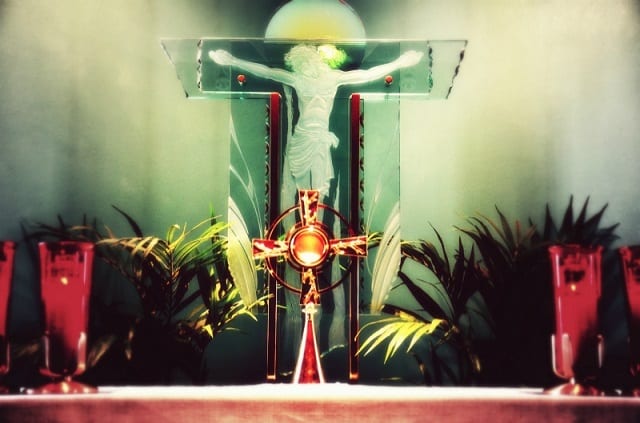
Photo credit: Sharon Tate Soberon (1-23-13) [Flickr / CC BY-ND 2.0 license]
***
Summary: Many folks critical of Catholicism and especially its doctrine of transubstantiation bring up Pope Gelasius (r. 492-496) as a supposed denier of the doctrine. I show that this is not the case.
***
Church fathers & transubstantiation
development of eucharistic doctrine
Fathers & eucharistic sacrifice
patristic eucharistic theology
Pope Gelasius & transubstantiation
Previous Post

March 23, 2021
Catholic Obsession with James White or Vice Versa?
Next Post

March 25, 2021 Pope Francis vs. Same-Sex "Marriage": The Record
Browse Our Archives
Select a Category & Last Things About Me Anti-Catholicism Atheism & Agnosticism Baptism and Sacramentalism Bible and Tradition Blessed Virgin Mary Books by Dave Armstrong C. S. Lewis Calvinism & General Protestantism Catholic Apologetics Catholic Apologists Catholic conversion Catholic converts Christmas Church (Ecclesiology) Church History Conversion and Converts Development of Doctrine Eastern Orthodoxy Ecumenism & Christian Unity Eucharist & Liturgy Fathers of the Church French Translations G. K. Chesterton Hell Hell & Satan Hell & Satan & Last Things Heresies & Comparative Religion Holistic Health Inquisition & Crusades & Scandals James White Jews & Judaism & Old Testament John Calvin John Henry Newman Liberal / Modernist Theology Life Issues Literary Resume Lutheranism Mariology Martin Luther Music Orthodoxy Papacy & Infallibility Personal Page Philosophy & Science Political & Ethical & Moral Issues Protestant Persecution & Intolerance Protestantism Purgatory Purgatory & Penance Romantic & Imaginative Theology Saints & Purgatory & Penance Salvation Salvation & Justification Satan & Last Things Sexuality and Gender Issues Spanish Translations Traditionalism vs. Radical Catholic Reactionaries Traducciones al español / tradução para português Trinitarianism & Christology Uncategorized Videos
Select a Month October 2026 September 2026 August 2026 July 2026 June 2026 May 2026 April 2026 March 2026 February 2026 January 2026 December 2025 November 2025 October 2025 September 2025 August 2025 July 2025 June 2025 May 2025 April 2025 March 2025 February 2025 January 2025 December 2024 November 2024 October 2024 September 2024 August 2024 July 2024 June 2024 May 2024 April 2024 March 2024 February 2024 January 2024 December 2023 November 2023 October 2023 September 2023 August 2023 July 2023 June 2023 May 2023 April 2023 March 2023 February 2023 January 2023 December 2022 November 2022 October 2022 September 2022 August 2022 July 2022 June 2022 May 2022 April 2022 March 2022 February 2022 January 2022 December 2021 November 2021 October 2021 September 2021 August 2021 July 2021 June 2021 May 2021 April 2021 March 2021 February 2021 January 2021 December 2020 November 2020 October 2020 September 2020 August 2020 July 2020 June 2020 May 2020 April 2020 March 2020 February 2020 January 2020 December 2019 November 2019 October 2019 September 2019 August 2019 July 2019 June 2019 May 2019 April 2019 March 2019 February 2019 January 2019 December 2018 November 2018 October 2018 September 2018 August 2018 July 2018 June 2018 May 2018 April 2018 March 2018 February 2018 January 2018 December 2017 November 2017 October 2017 September 2017 August 2017 July 2017 June 2017 May 2017 April 2017 March 2017 February 2017 January 2017 December 2016 November 2016 October 2016 September 2016 August 2016 July 2016 June 2016 May 2016 April 2016 March 2016 February 2016 January 2016 December 2015 November 2015 October 2015 September 2015 August 2015 July 2015 June 2015 May 2015 April 2015 March 2015 February 2015 January 2015 December 2014 November 2014 October 2014 September 2014 August 2014 July 2014 June 2014 April 2014 March 2014 February 2014 January 2014 December 2013 November 2013 October 2013 September 2013 August 2013 July 2013 June 2013 April 2013 March 2013 February 2013 January 2013 December 2012 November 2012 October 2012 September 2012 August 2012 July 2012 June 2012 May 2012 April 2012 March 2012 February 2012 January 2012 December 2011 November 2011 October 2011 September 2011 August 2011 July 2011 June 2011 April 2011 March 2011 February 2011 October 2010 September 2010 August 2010 July 2010 April 2010 March 2010 December 2009 October 2009 August 2009 July 2009 June 2009 May 2009 March 2009 February 2009 October 2008 September 2008 April 2008 March 2008 February 2008 January 2008 December 2007 November 2007 October 2007 May 2007 March 2007 February 2007 January 2007 November 2006 October 2006 September 2006 August 2006 July 2006 June 2006 May 2006 April 2006 March 2006 February 2006 October 2005 June 2005 April 2005 February 2005 July 2004 May 2004 April 2004
Follow Us!
TAKE THE
Religious Wisdom Quiz
What was forbidden after the conquest of Jericho?
Select your answer to see how you score.
Celebrating with a feast Rebuilding the city Taking plunder Offering sacrifices
Books by This Author Books by Dave Armstrong
Related posts from Biblical Evidence for Catholicism

Top Ten Anti-Catholic Lies (#10-7)
Biblical Evidence for Catholicism

Was Peter "Any Old" Apostle? 10 Anti-Papal Arguments
Biblical Evidence for Catholicism

17 Church Fathers on Purgatory (Esp. 1 Cor...
Biblical Evidence for Catholicism

Deuterocanon & Javier Perdomo's Straw Men
Biblical Evidence for Catholicism
TRENDING AT PATHEOS Catholic

Letters on Living the Faith by C.S. Lewis
Most of us met C.S. Lewis as a public intellectual. Mere Christianity....

When Halloween Unmasks Married Hearts
Written by Dr. David K. Ewen from Eternal Truth Bible College Behind...

Aristotle. He’s been called the father of logic, the father of the...

Methodist Central Hall and Westminster Abbey
Situated on the same square is Methodist Central Hall and Westminster Abbey. ...

57th Dove Awards Honor Dolly Parton, Crown New...
On gospel music’s biggest night, the 57th annual GMA Dove Awards honored...

The First Eucharistic Controversy: Christ’s Real Presence
For Catholics, the Eucharist is the source and summit of the Christian...
view all Catholic blogs
Ad-Free & Subscriber Log-In Subscription Support
- About Us
- 2026 Calendar
- Videos
- Podcasts
- Library of World Religions
- Faith In Media Tracker
- Advertise With Us
- Write for Us
- Privacy Policy
- Terms of Service
- Do Not Sell My Data
- Contact Us
- Radiant Digital
- Manage Newsletter Subscriptions
- Unsubscribe From Notifications
- Sitemap
Copyright 2008-2026, Patheos. All rights reserved.
Subscription Support Ad-Free & Subscriber Log-In
Follow Patheos