
BuddhistCatholicContemplativeEvangelicalGeneral ChristianHinduJewishLatter-day SaintMuslimNew VisionsProgressive Christian
Beliefs
- Buddhist
- Catholic
- Contemplative
- Evangelical
- General Christian
- Hindu
- Jewish
- Latter-day Saint
- More Voices
- Muslim
- New Visions
- Pagan
- Progressive Christian
Topics
- Religion News
- Food and Religion
- Sports and Religion
- Religious Art
- Religious Music and Entertainment
- Religious Events
- History and Religion
- Style and Religion
- Politics and Religion
- Women in Religion
- Recreation Outdoors and Religion
- Business Finance and Religion
- Careers Workplace and Religion
- Education and Religion
- Family Parenting and Religion
- Health Fitness and Religion
- Home and Religion
- Relationships and Religion
- Technology and Religion
- Travel and Religion
Columnists
- Buddhist Columnists
- Business Finance and Religion Columnists
- Careers Workplace and Religion Columnists
- Catholic Columnists
- Contemplative Columnists
- Education and Religion Columnists
- Evangelists Columnists
- Family Parenting and Religion Columnists
- General Christian Columnists
- Health Fitness and Religion Columnists
- Hindu Columnists
- History and Religion Columnists
- Home and Religion Columnists
- Jewish Columnists
- More Voices Columnists
- Latter Day Columnists
- Muslim Columnists
- New Visions Columnists
- Nonreligious Columnists
- Pagan Columnists
- Politics and Religion Columnists
- Progressive Columnists
- Recreation Outdoors and Religion Columnists
- Relationships and Religion Columnists
- Religion News Columnists
- Religious Art Columnists
- Religious Events Columnists
- Religious Music and Entertainment Columnists
- Sports and Religion Columnists
- Style and Religion Columnists
- Technology and Religion Columnists
- Travel and Religion Columnists
- Women in Religion Columnists
Resource Library
- 2026 Calendar
- Library of World Religions
- The 100 Most Holy Places on Earth
- Patheos Answers
- Podcasts
- Videos
- Faith Leaders Database
- Anglican Episcopalian
- Bahai
- Baptist
- Buddhism
- Christianity
- Confucianism
- Eastern Orthodoxy
- Hinduism
- Holiness and Pentecostal
- ISKCON
- Islam
- Judaism
- Lutheran
- Methodist
- The Church of Jesus Christ of Latter-day Saints
- New Age
- Paganism
- Presbytarian and Reformed
- Protestantism
- Religion Behind the Scenes
- Roman Catholic
- Scientology
- Shia Islam
- Sikhism
- Sufism
- Sunni Islam
- Taoism
- Zen
- See all religions
Research Tools
 Ad-Free & Subscriber Log-In Subscription Support
Ad-Free & Subscriber Log-In Subscription Support
Follow Patheos 

- Trending:
- Forgiveness
- |
- Marriage
- |
- Consciousness
- |
- Death Penalty
- |
- Election
- |
- Halloween

-
About
-
Catholic Apologetics
-
Church History
-
Great Apologists
-
Christian Worldview
-
Protestantism & Misc.
- Home
- Catholic
- History and Religion
- Development of Doctrine: an Exclusively Catholic Concept?
Development of Doctrine: an Exclusively Catholic Concept?
Last updated on: June 6, 2026 at 12:44 am by Dave Armstrong
Development of Doctrine: an Exclusively Catholic Concept? 2026-06-06T00:44:02-04:00 Dave Armstrong
Patheos Explore the world's faith through different perspectives on religion and spirituality! Patheos has the views of the prevalent religions and spiritualities of the world.
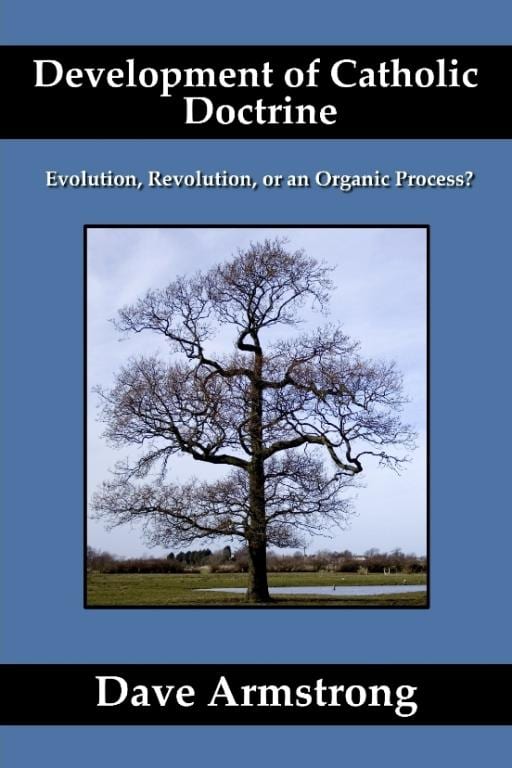
[book and purchase information]
Reply to a Protestant apologist’s comments (in blue) on a public discussion board:
*****
Do you even comprehend that whether Newman’s theory is seen as “development” or “evolution” largely depends on one’s philosophical presuppositions . . . ?
No, because that is a non sequitur. You seem to believe that one’s philosophy almost entirely colors their perceptions of theology, ecclesiology, and Church history. I don’t buy that (not nearly to the extent that you do). I continue to maintain that Christianity is not a philosophy. Faith is not philosophy. And all Christians have faith. To the extent that they do, they are not acting or believing on solely philosophical grounds. Development can be understood as a way to view Church history, without recourse to complicated philosophical discussions.
Consider that for someone who doesn’t believe in “essences” and doesn’t invest “Church history” with the power to legislate belief and practice, a theory that approaches history with such a priorism cannot help but look like a theory that justifies mutation and evolution,
With evolution (at least macroevolution, at any rate), something changes into something else entirely different. Development is like an acorn changing into an oak tree, or a human embryo growing into an adult person: an organic continuity where the essence stays the same even though outward appearances differ. This is not even a Catholic-Protestant issue. Christians of all stripes (i.e., those who think about and respect Church history at all) have always accepted development in some form or other.
The argument between Catholics and Protestants on this is not over whether development occurs at all, but over which doctrines are developments and which are corruptions. Even [anti-Catholic apologist] James White believes that. He (and most Protestants) think distinctive Catholic doctrines are unbiblical, nonbiblical, extra-biblical, and therefore corruptions, and no developments. Catholics think Protestant distinctives are late-arising novelties (as well as unbiblical) and therefore clearly not developments of what came before, as there was no “before.”
This is a standard concept amongst Church historians of whatever stripe. Lutheran (now Orthodox) Jaroslav Pelikan’s views (and admiration of Cardinal Newman) are well-known. Any Church historian you could find accepts the notion of development and understands that it is not evolution. Protestant historian J. N. D. Kelly, for example, starts out his widely-used work, Early Christian Doctrines (San Francisco: Harper, revised edition, 1978) with these words:
The object of this book is to sketch the development of the principal Christian doctrines . . . (p. 3)
He goes on to state that the student of the “patristic age”:
. . . must not expect to find it characterized by that doctrinal homogeneity which he may have come across at other epochs. Being still at the formative stage, the theology of the early centuries exhibits the extremes of immaturity and sophistication . . . it is a commonplace that certain fathers (Origen is the classic example) who were later adjudged heretics counted for orthodox in their lifetimes. The explanation is not that the early Church was indifferent to the distinction between orthodoxy and heresy. Rather, it is that, while from the beginning the broad outline of revealed truth was respected as a sacrosanct inheritance from the apostles, its theological explication was to a large extent left unfettered. Only gradually, and even then in regard to comparatively few doctrines which became subjects of debate, did the tendency to insist upon precise definition and rigid uniformity assert itself. (pp. 3-4)
Likewise, widely respected Protestant historian Philip Schaff. In his General Introduction to his multi-volume History of the Christian Church (Grand Rapids, Michigan: Eerdmans, 1975, reprint of 1910 edition from Scribner’s, New York, p. 10), he writes:
[T]he mind of the Church has gradually apprehended and unfolded the divine truths of revelation, . . . the teachings of scripture have been formulated and shaped into dogmas, and grown into creeds and confessions of faith, or systems of doctrine stamped with public authority. This growth of the church in the knowledge off the infallible word of God is a constant struggle against error, misbelief, and unbelief; and the history of heresies is an essential part of the history of doctrines.Every important dogma now professed by the Christian church is the result of a severe conflict with error. The doctrine of the holy Trinity, for instance, was believed from the beginning, but it required, in addition to the preparatory labors of the ante-Nicene age, fifty years of controversy, in which the strongest intellects were absorbed, until it was brought to the clear expression of the Nicene-Constantinopolitan Creed. The Christological conflict was equally long and intense, until it was brought to a settlement by the council of Chalcedon.
Most Protestant apologists or students of history are well-acquainted with the outlines of Church history and the early theological struggles to define orthodoxy. To reiterate, then: the existence of doctrinal development itself it is not a Protestant-Catholic argument; the real dispute is over which particular doctrines are the legitimate developments.
***
Related Reading
Development of Doctrine: A Corruption of Biblical Teaching? [1995]
Development of Doctrine: He Will Teach You . . . [2-17-91; rev. May 1996]
Overview of Development of Doctrine (TV Interview) [5-1-99]
William Webster’s Misunderstanding of Development of Doctrine [2000]
Catholic Synthesis of Development & “Believed Always by All” [3-19-02]
A Brief Introduction to the Development of Doctrine [8-30-06]
Development of Catholic Doctrine: A Primer [National Catholic Register, 1-5-18]
C. S. Lewis on Inevitable Development of Doctrine [2-17-19]
***
(originally posted on my website on 17 October 2002)
***
Summary: All Christians have always accepted development of doctrine. Catholics and Protestants dispute which doctrines are developments and which are (actually or supposedly) corruptions.
***
Previous Post

March 25, 2021
Pope Francis vs. Same-Sex "Marriage": The Record
Next Post
March 26, 2021 Loftus Lies #24: David Madison & Atheist Cowardice
Browse Our Archives
Select a Category & Last Things About Me Anti-Catholicism Atheism & Agnosticism Baptism and Sacramentalism Bible and Tradition Blessed Virgin Mary Books by Dave Armstrong C. S. Lewis Calvinism & General Protestantism Catholic Apologetics Catholic Apologists Catholic conversion Catholic converts Christmas Church (Ecclesiology) Church History Conversion and Converts Development of Doctrine Eastern Orthodoxy Ecumenism & Christian Unity Eucharist & Liturgy Fathers of the Church French Translations G. K. Chesterton Hell Hell & Satan Hell & Satan & Last Things Heresies & Comparative Religion Holistic Health Inquisition & Crusades & Scandals James White Jews & Judaism & Old Testament John Calvin John Henry Newman Liberal / Modernist Theology Life Issues Literary Resume Lutheranism Mariology Martin Luther Music Orthodoxy Papacy & Infallibility Personal Page Philosophy & Science Political & Ethical & Moral Issues Protestant Persecution & Intolerance Protestantism Purgatory Purgatory & Penance Romantic & Imaginative Theology Saints & Purgatory & Penance Salvation Salvation & Justification Satan & Last Things Sexuality and Gender Issues Spanish Translations Traditionalism vs. Radical Catholic Reactionaries Traducciones al español / tradução para português Trinitarianism & Christology Uncategorized Videos
Select a Month October 2026 September 2026 August 2026 July 2026 June 2026 May 2026 April 2026 March 2026 February 2026 January 2026 December 2025 November 2025 October 2025 September 2025 August 2025 July 2025 June 2025 May 2025 April 2025 March 2025 February 2025 January 2025 December 2024 November 2024 October 2024 September 2024 August 2024 July 2024 June 2024 May 2024 April 2024 March 2024 February 2024 January 2024 December 2023 November 2023 October 2023 September 2023 August 2023 July 2023 June 2023 May 2023 April 2023 March 2023 February 2023 January 2023 December 2022 November 2022 October 2022 September 2022 August 2022 July 2022 June 2022 May 2022 April 2022 March 2022 February 2022 January 2022 December 2021 November 2021 October 2021 September 2021 August 2021 July 2021 June 2021 May 2021 April 2021 March 2021 February 2021 January 2021 December 2020 November 2020 October 2020 September 2020 August 2020 July 2020 June 2020 May 2020 April 2020 March 2020 February 2020 January 2020 December 2019 November 2019 October 2019 September 2019 August 2019 July 2019 June 2019 May 2019 April 2019 March 2019 February 2019 January 2019 December 2018 November 2018 October 2018 September 2018 August 2018 July 2018 June 2018 May 2018 April 2018 March 2018 February 2018 January 2018 December 2017 November 2017 October 2017 September 2017 August 2017 July 2017 June 2017 May 2017 April 2017 March 2017 February 2017 January 2017 December 2016 November 2016 October 2016 September 2016 August 2016 July 2016 June 2016 May 2016 April 2016 March 2016 February 2016 January 2016 December 2015 November 2015 October 2015 September 2015 August 2015 July 2015 June 2015 May 2015 April 2015 March 2015 February 2015 January 2015 December 2014 November 2014 October 2014 September 2014 August 2014 July 2014 June 2014 April 2014 March 2014 February 2014 January 2014 December 2013 November 2013 October 2013 September 2013 August 2013 July 2013 June 2013 April 2013 March 2013 February 2013 January 2013 December 2012 November 2012 October 2012 September 2012 August 2012 July 2012 June 2012 May 2012 April 2012 March 2012 February 2012 January 2012 December 2011 November 2011 October 2011 September 2011 August 2011 July 2011 June 2011 April 2011 March 2011 February 2011 October 2010 September 2010 August 2010 July 2010 April 2010 March 2010 December 2009 October 2009 August 2009 July 2009 June 2009 May 2009 March 2009 February 2009 October 2008 September 2008 April 2008 March 2008 February 2008 January 2008 December 2007 November 2007 October 2007 May 2007 March 2007 February 2007 January 2007 November 2006 October 2006 September 2006 August 2006 July 2006 June 2006 May 2006 April 2006 March 2006 February 2006 October 2005 June 2005 April 2005 February 2005 July 2004 May 2004 April 2004
Follow Us!
TAKE THE
Religious Wisdom Quiz
What does "Bartholomew" mean in Aramaic?
Select your answer to see how you score.
Servant of God The Lord is my Shepherd Fisher of Men Son of Talmai
Books by This Author Books by Dave Armstrong
Related posts from Biblical Evidence for Catholicism

The Mass & Development of Doctrine (vs. Wes...
Biblical Evidence for Catholicism

Accurately Transmitted Oral Tradition: Introduction
Biblical Evidence for Catholicism

Binding Oral Tradition (Video Transcript)
Biblical Evidence for Catholicism
Vs. Gavin Ortlund: St. Augustine Rejected Sola Scriptura
Biblical Evidence for Catholicism
TRENDING AT PATHEOS Catholic

Pope Leo Celebrates Mass for Nurses & Docs...
I don't have any idea how he did it, but Pope Leo...

The Sermon on the Mount, Part I: Matthew...
The Sermon on the Mount, Part I (Matthew 4:12-5:12) St. Matthew moves...

What's up from Crossway: Reviewing some of their latest A few weeks...

Janie Learns the Way of the Cross: A...
Teaching children about Jesus' Passion can be challenging. Many parents and educators...

Looking For Good Catholic Writing - October 2026
He alone extends the heavens, and he walks upon the waves of...

In "Irreplaceable," our book on vocation and technology, Trevor Sutton and I...
view all Catholic blogs
Ad-Free & Subscriber Log-In Subscription Support
- About Us
- 2026 Calendar
- Videos
- Podcasts
- Library of World Religions
- Faith In Media Tracker
- Advertise With Us
- Write for Us
- Privacy Policy
- Terms of Service
- Do Not Sell My Data
- Contact Us
- Radiant Digital
- Manage Newsletter Subscriptions
- Unsubscribe From Notifications
- Sitemap
Copyright 2008-2026, Patheos. All rights reserved.
Subscription Support Ad-Free & Subscriber Log-In
Follow Patheos