
BuddhistCatholicContemplativeEvangelicalGeneral ChristianHinduJewishLatter-day SaintMuslimNew VisionsProgressive Christian
Beliefs
- Buddhist
- Catholic
- Contemplative
- Evangelical
- General Christian
- Hindu
- Jewish
- Latter-day Saint
- More Voices
- Muslim
- New Visions
- Pagan
- Progressive Christian
Topics
- Religion News
- Food and Religion
- Sports and Religion
- Religious Art
- Religious Music and Entertainment
- Religious Events
- History and Religion
- Style and Religion
- Politics and Religion
- Women in Religion
- Recreation Outdoors and Religion
- Business Finance and Religion
- Careers Workplace and Religion
- Education and Religion
- Family Parenting and Religion
- Health Fitness and Religion
- Home and Religion
- Relationships and Religion
- Technology and Religion
- Travel and Religion
Columnists
- Buddhist Columnists
- Business Finance and Religion Columnists
- Careers Workplace and Religion Columnists
- Catholic Columnists
- Contemplative Columnists
- Education and Religion Columnists
- Evangelists Columnists
- Family Parenting and Religion Columnists
- General Christian Columnists
- Health Fitness and Religion Columnists
- Hindu Columnists
- History and Religion Columnists
- Home and Religion Columnists
- Jewish Columnists
- More Voices Columnists
- Latter Day Columnists
- Muslim Columnists
- New Visions Columnists
- Nonreligious Columnists
- Pagan Columnists
- Politics and Religion Columnists
- Progressive Columnists
- Recreation Outdoors and Religion Columnists
- Relationships and Religion Columnists
- Religion News Columnists
- Religious Art Columnists
- Religious Events Columnists
- Religious Music and Entertainment Columnists
- Sports and Religion Columnists
- Style and Religion Columnists
- Technology and Religion Columnists
- Travel and Religion Columnists
- Women in Religion Columnists
Resource Library
- 2026 Calendar
- Library of World Religions
- The 100 Most Holy Places on Earth
- Patheos Answers
- Podcasts
- Videos
- Faith Leaders Database
- Anglican Episcopalian
- Bahai
- Baptist
- Buddhism
- Christianity
- Confucianism
- Eastern Orthodoxy
- Hinduism
- Holiness and Pentecostal
- ISKCON
- Islam
- Judaism
- Lutheran
- Methodist
- The Church of Jesus Christ of Latter-day Saints
- New Age
- Paganism
- Presbytarian and Reformed
- Protestantism
- Religion Behind the Scenes
- Roman Catholic
- Scientology
- Shia Islam
- Sikhism
- Sufism
- Sunni Islam
- Taoism
- Zen
- See all religions
Research Tools
 Ad-Free & Subscriber Log-In Subscription Support
Ad-Free & Subscriber Log-In Subscription Support
Follow Patheos 

- Trending:
- Forgiveness
- |
- Marriage
- |
- Consciousness
- |
- Death Penalty
- |
- Election
- |
- Halloween

-
About
-
Catholic Apologetics
-
Church History
-
Great Apologists
-
Christian Worldview
-
Protestantism & Misc.
- Home
- Catholic
- History and Religion
- Cyril of Alexandria (d. 444) vs. Sola Scriptura as the Rule of Faith
Cyril of Alexandria (d. 444) vs. Sola Scriptura as the Rule of Faith
Last updated on: June 6, 2026 at 12:44 am by Dave Armstrong
Cyril of Alexandria (d. 444) vs. Sola Scriptura as the Rule of Faith 2026-06-06T00:44:02-04:00 Dave Armstrong
Patheos Explore the world's faith through different perspectives on religion and spirituality! Patheos has the views of the prevalent religions and spiritualities of the world.
Protestant anti-Catholic polemicists David T. King and William Webster are the editors of a three-volume series, entitled, Holy Scripture: The Ground and Pillar of Our Faith (self-published by Webster’s outfit, Christian Resources Inc. [Battle Ground, Washington] in 2001). I’m most interested in Volume III: subtitled, “The Writings of the Church Fathers Affirming the Reformation Principle of Sola Scriptura” (edited by both Webster and King). In the Introduction to Vol. III (p. 9) they make the fantastically absurd, demonstrably false assertion:
[T]he Church fathers . . . universally taught sola Scriptura in the fullest sense of the term embracing both the material and formal sufficiency of Scripture.
The definition of sola Scriptura, according to three of the most able and articulate Protestant defenders of it in our time, is the following:
[T]he Bible alone is the infallible written authority for faith and morals (Norman Geisler)
Scripture . . . is the only inspired and inherently infallible norm, and therefore Scripture is the only final authoritative norm. (Keith A. Mathison)
The doctrine of sola scriptura . . . is that the Scriptures alone are sufficient to function as the regula fidei, the infallible rule of faith for the Church. (James R. White) [my bolding; see the sources for these quotations and also a fuller explication by each man]
Such a definition entails also understanding what sola Scriptura is not. It logically rules out tradition, the Church, ecumenical councils, bishops, popes, or appeal to apostolic succession as infallibly and finally authoritative. Only the Bible is that. Therefore, if any Church father believes that any of these are infallible or a final authority, then he (by the same token) does not and indeed cannot believe in sola Scriptura. I didn’t “set the rules”. Protestants have by defining sola Scriptura as they do. Thus, they have to live with their own definition and unbiblical rule of faith.
I shall be examining (in this series of papers) several Church fathers that Webster and King bring up, and documenting that they rejected sola Scriptura. I’ve already done this documentation with regard to Augustine, Athanasius, John Chrysostom, Jerome, Ambrose, Irenaeus, Justin Martyr, Clement of Alexandria, Hippolytus, Dionysius, Basil the Great, Cyril of Jerusalem, Theodoret, Gregory of Nyssa, Tertullian, Origen, Gregory Nazianzen, Epiphanius, Lactantius, Cyprian, Papias, Hilary of Poitiers, Pope St. Gregory the Great, and John Damascene.
All citations are from Volume III unless otherwise indicated.
*****
Sufficient, sufficient for this [obtaining a knowledge of the faith] are the Scriptures of the holy Fathers . . . (De SS. Trinitate Dialogus I. Translation by William Goode, Vol. 2, pp. 281-282) [p. 125]
That which the divine Scripture has not spoken, how shall we receive it, and reckon it among verities? (Glaphyrorum In Genesim, Lib. II. Translation by William Goode, Vol. 3, p. 181) [p. 124]
[Y]ou, O my friend, will adduce vain words to us, and heap up a cold and useless mass of notions, unless you should prove to us, that the volumes of the sacred writers agree with what you have spoken? (De SS. Trinitate Dialogus III. Translation by William Goode, Vol. 3, p. 182) [p. 125]
It is best . . . to make the words of the inspired writers the correct and exact rule of faith. (De SS. Trinitate Dialogus IV. Translation by William Goode, Vol. 3, p. 183) [p. 126]
[H]old firmly to the sacred Scriptures, and following the right path of the sacred writers, go straight to the truth itself. (De Recta Fide, Ad Theodosium Imperatorem. Translation by William Goode, Vol. 3, pp. 183-184) [p. 126]
[I]t is necessary that we should follow the sacred Scriptures, in nothing going beyond what they sanction. (Ad Reginas De Recta Fide Oratio Altera. Translation by William Goode, Vol. 3, p. 184) [p. 127]
[I]t is impossible for us to say, or at all think anything concerning God, beyond what has been divinely declared by the divine oracles of the Old and New Testament (De Sacrosancta Trinitate, Cap. 1. Translation by William Goode, Vol. 3, p. 185) [p. 128]
[A]n exact and scrupulous knowledge of each particular matter we can obtain from no other source than from divinely-inspired Scripture. (Commentary on the Gospel of Saint Luke, Homily 55, trans. R. Payne Smith; Studion Publishers, Inc., 1983, p. 240) [p. 128]
Note (for what it’s worth), that Webster and King rely in all but the last citation above on translations of William Goode, who was an anti-Catholic, strong Protestant partisan (against whom I’ve partially devoted a book refuting sola Scriptura). Biases have been known to affect translation (even Bible translation: see example one / example two). I’m not saying we can question any or every rendering above, but rather, simply to keep in mind the likely bias of the translator. In any event, material sufficiency of Scripture is wholly consistent with Catholicism, and neither identical to, nor exclusive to, sola Scriptura. So all the examples above that Webster and King classify under “material sufficiency” prove exactly nothing as to St. Cyril’s alleged espousal of sola Scriptura.
***
It remains the case, as always, that one must examine what Church fathers stated regarding other means of binding, infallible authority within Christianity (besides Holy Scripture), to determine whether they hold to sola Scriptura.
St. Cyril of Alexandria believed in the authoritative, binding, infallible nature of the decisions of ecumenical councils:
And in no wise do we suffer to be shaken by any one, the faith defined, or the symbol of faith settled, by our fathers, who assembled, in their day, at Nicaea. Neither do we allow ourselves, or any other to alter a word there set down, or even to omit a single syllable, mindful of that saying: ‘Remove not the ancient land-marks which thy fathers have set.’ (Letter to John of Antioch, 5)
[H]e opposes the truth and the very symbol of the Church’s Faith, which the fathers once gathered together at Nicea through the illumination of the Spirit defined; he, fearing lest any should keep whole the Faith, instructed unto the Truth by their words, endeavours to calumniate it and alters the significance of the words, . . . against the holy fathers who have decreed for us the pious definition of the Faith which we have as an anchor of the soul both sure and steadfast, as it is written. (Tomes Against Nestorius: I, 5)
. . . the holy Churches in every region under Heaven, and the venerable Fathers themselves who put forth unto us the definition of the right and undefiled Faith, viz. (the Holy Ghost speaking in them) that the Word of God was made flesh and became Man, . . . (Tomes Against Nestorius: IV, 2)
St. Cyril held to the binding authority of apostolic tradition and Church teaching:
[H]old fast the faith in simplicity of mind; establishing the tradition of the church as a foundation, in the inmost recesses of thy heart, hold the doctrines which are well-pleasing unto God. (Festal Letters, Homily 8)
[T]he word of the truth contends on our side and the tradition of the undefiled Faith. (Tomes Against Nestorius: III, 3)
And he espoused the indefectibility and infallibility of the one true Church, with Peter (and popes) as the head:
He promises to found the church, assigning immovableness to it, as He is the Lord of strength, and over this he sets Peter as shepherd. (Commentary on Matthew)
‘I have raised him up a king with justice, and all his ways are right.’ The ways of Christ are right, and he has built the holy city, that is, the church, wherein also he dwelleth. For he abideth in the saints, and we have become temples of the living God, having Christ within us through the participation of the Holy Spirit. He, therefore, founded a church, himself being the foundation, in which we also, as rich and precious stones, are built into a holy temple, as a dwelling-place for God in the spirit; the church, having Christ for a foundation, and an immovable support, is perfectly immoveable. (Commentary on Isaiah, 4)
[T]he Catholic Church, which Christ Himself presented to Himself, has not the wrinkles of him who has compiled such things, but rather as unblemished, she keeps wholly without rebuke her knowledge of Him, and hath made full well her tradition of the Faith. . . . following the confessions annexed hereto of the holy Fathers, . . . (Tomes Against Nestorius: II, Introduction)
Therefore, by inexorable logical deduction and many expressly contradictory statements, St. Cyril of Alexandria did not believe in sola Scriptura. Webster and King have inexcusably misled their readers yet again. Bearing false witness violates the Ten Commandments and is, therefore, a grave sin. According to Revelation 21:8, habitual, unrepentant “liars” are among those who will receive the sentence of hell. So this is a serious business indeed. Christian teachers must — by God’s grace — teach the truth and make every effort to ensure that they are doing so. James 3:1 (RSV) warns: “Let not many of you become teachers, my brethren, for you know that we who teach shall be judged with greater strictness.”
***
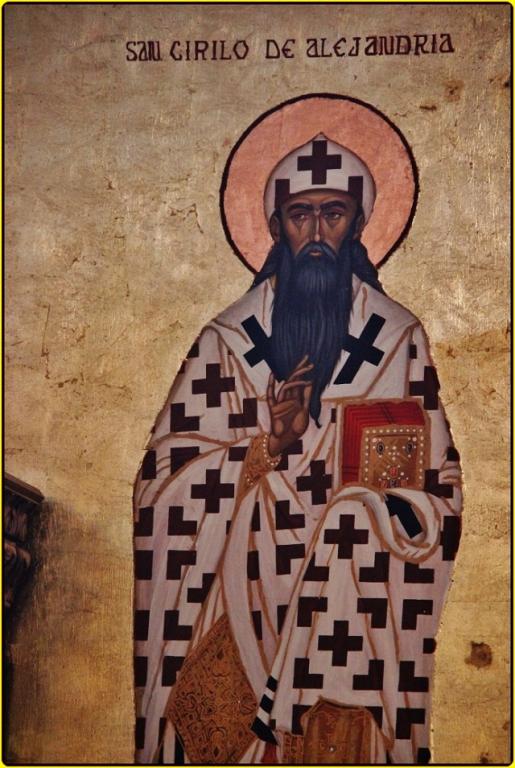
Photo credit: St. Cyril of Alexandria: icon in St. George Orthodox Cathedral (Cuauhtémoc, Mexico). Catedrales e Iglesias/Cathedrals and Churches; uploaded to Flickr on 10-20-13 [Wikimedia Commons / Creative Commons Attribution 2.0 Generic license]

***
Summary: St. Cyril of Alexandria did not believe in sola Scriptura, since he held to infallible ecumenical councils, an indefectible and infallible Church, and the binding authority of tradition.
***
Cyril of Alexandria & sola Scriptura
Cyril of Alexandria & the rule of faith
Previous Post

March 1, 2021
Gregory the Great vs. Sola Scriptura as the Rule of Faith
Next Post
March 2, 2021 Rufinus (d. 411) vs. Sola Scriptura as the Rule of Faith
Browse Our Archives
Select a Category & Last Things About Me Anti-Catholicism Atheism & Agnosticism Baptism and Sacramentalism Bible and Tradition Blessed Virgin Mary Books by Dave Armstrong C. S. Lewis Calvinism & General Protestantism Catholic Apologetics Catholic Apologists Catholic conversion Catholic converts Christmas Church (Ecclesiology) Church History Conversion and Converts Development of Doctrine Eastern Orthodoxy Ecumenism & Christian Unity Eucharist & Liturgy Fathers of the Church French Translations G. K. Chesterton Hell Hell & Satan Hell & Satan & Last Things Heresies & Comparative Religion Holistic Health Inquisition & Crusades & Scandals James White Jews & Judaism & Old Testament John Calvin John Henry Newman Liberal / Modernist Theology Life Issues Literary Resume Lutheranism Mariology Martin Luther Music Orthodoxy Papacy & Infallibility Personal Page Philosophy & Science Political & Ethical & Moral Issues Protestant Persecution & Intolerance Protestantism Purgatory Purgatory & Penance Romantic & Imaginative Theology Saints & Purgatory & Penance Salvation Salvation & Justification Satan & Last Things Sexuality and Gender Issues Spanish Translations Traditionalism vs. Radical Catholic Reactionaries Traducciones al español / tradução para português Trinitarianism & Christology Uncategorized Videos
Select a Month October 2026 September 2026 August 2026 July 2026 June 2026 May 2026 April 2026 March 2026 February 2026 January 2026 December 2025 November 2025 October 2025 September 2025 August 2025 July 2025 June 2025 May 2025 April 2025 March 2025 February 2025 January 2025 December 2024 November 2024 October 2024 September 2024 August 2024 July 2024 June 2024 May 2024 April 2024 March 2024 February 2024 January 2024 December 2023 November 2023 October 2023 September 2023 August 2023 July 2023 June 2023 May 2023 April 2023 March 2023 February 2023 January 2023 December 2022 November 2022 October 2022 September 2022 August 2022 July 2022 June 2022 May 2022 April 2022 March 2022 February 2022 January 2022 December 2021 November 2021 October 2021 September 2021 August 2021 July 2021 June 2021 May 2021 April 2021 March 2021 February 2021 January 2021 December 2020 November 2020 October 2020 September 2020 August 2020 July 2020 June 2020 May 2020 April 2020 March 2020 February 2020 January 2020 December 2019 November 2019 October 2019 September 2019 August 2019 July 2019 June 2019 May 2019 April 2019 March 2019 February 2019 January 2019 December 2018 November 2018 October 2018 September 2018 August 2018 July 2018 June 2018 May 2018 April 2018 March 2018 February 2018 January 2018 December 2017 November 2017 October 2017 September 2017 August 2017 July 2017 June 2017 May 2017 April 2017 March 2017 February 2017 January 2017 December 2016 November 2016 October 2016 September 2016 August 2016 July 2016 June 2016 May 2016 April 2016 March 2016 February 2016 January 2016 December 2015 November 2015 October 2015 September 2015 August 2015 July 2015 June 2015 May 2015 April 2015 March 2015 February 2015 January 2015 December 2014 November 2014 October 2014 September 2014 August 2014 July 2014 June 2014 April 2014 March 2014 February 2014 January 2014 December 2013 November 2013 October 2013 September 2013 August 2013 July 2013 June 2013 April 2013 March 2013 February 2013 January 2013 December 2012 November 2012 October 2012 September 2012 August 2012 July 2012 June 2012 May 2012 April 2012 March 2012 February 2012 January 2012 December 2011 November 2011 October 2011 September 2011 August 2011 July 2011 June 2011 April 2011 March 2011 February 2011 October 2010 September 2010 August 2010 July 2010 April 2010 March 2010 December 2009 October 2009 August 2009 July 2009 June 2009 May 2009 March 2009 February 2009 October 2008 September 2008 April 2008 March 2008 February 2008 January 2008 December 2007 November 2007 October 2007 May 2007 March 2007 February 2007 January 2007 November 2006 October 2006 September 2006 August 2006 July 2006 June 2006 May 2006 April 2006 March 2006 February 2006 October 2005 June 2005 April 2005 February 2005 July 2004 May 2004 April 2004
Follow Us!
TAKE THE
Religious Wisdom Quiz
How many disciples did Jesus have?
Select your answer to see how you score.
Thirty Seven One hundred Twelve
Books by This Author Books by Dave Armstrong
Related posts from Biblical Evidence for Catholicism

17 Church Fathers on Purgatory (Esp. 1 Cor...
Biblical Evidence for Catholicism

Deuterocanon & Javier Perdomo's Straw Men
Biblical Evidence for Catholicism

St. Athanasius & the Deuterocanon (vs. Javier Perdomo)
Biblical Evidence for Catholicism

Jerusalem Council vs. James White & Sola Scriptura
Biblical Evidence for Catholicism
TRENDING AT PATHEOS Catholic

In "Irreplaceable," our book on vocation and technology, Trevor Sutton and I...

I was strolling through the top floor of the brand new Parthenon...

What Does Gêvâh Mean For Kimberley Guifoyle &...
This week, a lot of the news is focused on Kimberly Guilfoyle....

INNER CIRCLE: Profound Mystery (Of Christ In All...
Ephesians 5:31-32 “For this reason, a man will leave his father and...

Do Not Rejoice When Your Enemy Falls: The...
Turning an execution into a public spectacle is a disturbing expression of...

'The Chosen' S6 Trailer: The Passion Gets Very...
Not many watching 'The Chosen' worry about spoilers, but just because they...
view all Catholic blogs
Ad-Free & Subscriber Log-In Subscription Support
- About Us
- 2026 Calendar
- Videos
- Podcasts
- Library of World Religions
- Faith In Media Tracker
- Advertise With Us
- Write for Us
- Privacy Policy
- Terms of Service
- Do Not Sell My Data
- Contact Us
- Radiant Digital
- Manage Newsletter Subscriptions
- Unsubscribe From Notifications
- Sitemap
Copyright 2008-2026, Patheos. All rights reserved.
Subscription Support Ad-Free & Subscriber Log-In
Follow Patheos