
BuddhistCatholicContemplativeEvangelicalGeneral ChristianHinduJewishLatter-day SaintMuslimNew VisionsProgressive Christian
Beliefs
- Buddhist
- Catholic
- Contemplative
- Evangelical
- General Christian
- Hindu
- Jewish
- Latter-day Saint
- More Voices
- Muslim
- New Visions
- Pagan
- Progressive Christian
Topics
- Religion News
- Food and Religion
- Sports and Religion
- Religious Art
- Religious Music and Entertainment
- Religious Events
- History and Religion
- Style and Religion
- Politics and Religion
- Women in Religion
- Recreation Outdoors and Religion
- Business Finance and Religion
- Careers Workplace and Religion
- Education and Religion
- Family Parenting and Religion
- Health Fitness and Religion
- Home and Religion
- Relationships and Religion
- Technology and Religion
- Travel and Religion
Columnists
- Buddhist Columnists
- Business Finance and Religion Columnists
- Careers Workplace and Religion Columnists
- Catholic Columnists
- Contemplative Columnists
- Education and Religion Columnists
- Evangelists Columnists
- Family Parenting and Religion Columnists
- General Christian Columnists
- Health Fitness and Religion Columnists
- Hindu Columnists
- History and Religion Columnists
- Home and Religion Columnists
- Jewish Columnists
- More Voices Columnists
- Latter Day Columnists
- Muslim Columnists
- New Visions Columnists
- Nonreligious Columnists
- Pagan Columnists
- Politics and Religion Columnists
- Progressive Columnists
- Recreation Outdoors and Religion Columnists
- Relationships and Religion Columnists
- Religion News Columnists
- Religious Art Columnists
- Religious Events Columnists
- Religious Music and Entertainment Columnists
- Sports and Religion Columnists
- Style and Religion Columnists
- Technology and Religion Columnists
- Travel and Religion Columnists
- Women in Religion Columnists
Resource Library
- 2026 Calendar
- Library of World Religions
- The 100 Most Holy Places on Earth
- Patheos Answers
- Podcasts
- Videos
- Faith Leaders Database
- Anglican Episcopalian
- Bahai
- Baptist
- Buddhism
- Christianity
- Confucianism
- Eastern Orthodoxy
- Hinduism
- Holiness and Pentecostal
- ISKCON
- Islam
- Judaism
- Lutheran
- Methodist
- The Church of Jesus Christ of Latter-day Saints
- New Age
- Paganism
- Presbytarian and Reformed
- Protestantism
- Religion Behind the Scenes
- Roman Catholic
- Scientology
- Shia Islam
- Sikhism
- Sufism
- Sunni Islam
- Taoism
- Zen
- See all religions
Research Tools
 Ad-Free & Subscriber Log-In Subscription Support
Ad-Free & Subscriber Log-In Subscription Support
Follow Patheos 

- Trending:
- Forgiveness
- |
- Marriage
- |
- Consciousness
- |
- Death Penalty
- |
- Election
- |
- Halloween

-
About
-
Catholic Apologetics
-
Church History
-
Great Apologists
-
Christian Worldview
-
Protestantism & Misc.
- Home
- Catholic
- History and Religion
- Pearce’s Potshots #16: Does St. Paul Justify Lying?
Pearce’s Potshots #16: Does St. Paul Justify Lying?
Last updated on: June 5, 2026 at 11:57 pm by Dave Armstrong
Pearce’s Potshots #16: Does St. Paul Justify Lying? 2026-06-05T23:57:49-04:00 Dave Armstrong
Patheos Explore the world's faith through different perspectives on religion and spirituality! Patheos has the views of the prevalent religions and spiritualities of the world.
Atheist anti-theist Jonathan M. S. Pearce is the main writer on the blog, A Tippling Philosopher. His “About” page states: “Pearce is a philosopher, author, blogger, public speaker and teacher from Hampshire in the UK. He specialises in philosophy of religion, but likes to turn his hand to science, psychology, politics and anything involved in investigating reality.”
*****
I am replying to Jonathan’s paper, “Paul Justifies Lying” (2-11-21). His words will be in blue.
In writing my forthcoming book on the Resurrection of Jesus, it has been important to look at Jesus’ earliest source, Paul. Paul is famous for not actually telling us much about Jesus at all. [repetitive typo corrected]
Right. Paul basically engages in systematic Christian theology (which is, of course, in the end, all about Jesus: He being God). In doing that, several things are presupposed. We have four Gospels that tell us plenty about Jesus, in terms of His life. They don’t do systematic theology. Paul does.
Apparently, Jonathan thinks that Paul should in effect be a fifth Gospel writer. Four’s not enough. In my edition of RSV, the Gospels take up 145 pages. Paul’s epistles take up about 87 pages. But Jonathan: the Great Bible Judge, opines that Paul needs to write in the same style or format as the Gospels and can’t do anything different, on pain of being accused of not knowing anything about / not teaching enough about Jesus. Makes total sense, doesn’t it?
There are some genuinely quite problematic Pauline verses that should raise some eyebrows concerning his agenda and methodology for converting others and evangelising:
I’m trembling in my boots. Jonathan is gonna expose Paul as a moral relativist who thinks lying is fine and dandy! What will I do now??!! I’ve put all my eggs in the basket of defending Christianity and the Bible, including this scumbag, Paul. Now I will have no career and at least 2,500 of my 3,200 articles will be null and void: fit only for the trash heap! Well, I can always be a Bible-bashing anti-theist atheist like Jonathan! Or I can simply take scissors to my Bible and cut out Paul (just as Thomas Jefferson — knowing better than God and 1800 years of Christianity — removed all of Jesus’ miracles). So hope springs eternal . . .
[ . . . ] There seem to be various instances of Paul justifying any means to get across the “truth” of Jesus, that he could be justifying lying for Jesus. There is a divergence of historical, veridical truth of events, and theological truth.
Well, we shall see about that. Atheist “exegesis” always has the depth of a half-evaporated, one millimeter thick puddle of water on the sidewalk. Jonathan does none here (perhaps he does in his book). He just throws out three Pauline passages, as if they self-evidently justify lying.
But as I mention in this and my Nativity book, with reference to the Nativity of Jesus and the work of Catholic exegete Raymond Brown, if there are no historical foundations, then what is the Christian hanging their theological truth on? We agree! So not only is there a silence from Paul, as I discuss in the book, but what there is could be, by his own admission, “fake news” to serve a religious purpose.
I see. Paul admits to serving up “fake news.” He was the CNN and MSDNC of his day. Gotcha, Jonathan. Now let’s examine the actual “incriminating” passages in St. Paul:
Romans 3:7-8
7 But if through my lie the truth of God abounded to His glory, why am I also still being judged as a sinner? 8 And why not say (as we are slanderously reported and as some claim that we say), “Let us do evil that good may come”? Their condemnation is just.
Jonathan doesn’t say which translation he is using. It is NASB (1995 edition). I use RSV:
But if through my falsehood God’s truthfulness abounds to his glory, why am I still being condemned as a sinner? [8] And why not do evil that good may come? — as some people slanderously charge us with saying. Their condemnation is just.
In context, this is obviously a rhetorical section (not uncommon in Paul): not to be taken literally as all his own opinion. As such, it is (so it seems) far too subtle for the average anti-theist atheist to correctly comprehend (such atheists are rendered unable to do so by extreme bias and hostility). Many atheists, having formerly been fundamentalists, interpret the Bible hyper-literally and have no inkling of the rich diversity of literary and even philosophical styles and senses of Scripture (which reach their apogee in Paul).
They simply repeat their old tired, silly errors: now as atheists. And this is precisely what Jonathan (whether he used to be a fundamentalist or not) does. He interprets it as Paul justifying lying, in an “anything goes” / “any immoral means for the sake of a good end” sense. This is absurd. Context is crucially important to understand what Paul is driving at, and to grasp that he is employing non-literal rhetoric:
Romans 3:1-6 Then what advantage has the Jew? Or what is the value of circumcision? [2] Much in every way. To begin with, the Jews are entrusted with the oracles of God. [3] What if some were unfaithful? Does their faithlessness nullify the faithfulness of God? [4] By no means! Let God be true though every man be false, as it is written, “That thou mayest be justified in thy words, and prevail when thou art judged.” [5] But if our wickedness serves to show the justice of God, what shall we say? That God is unjust to inflict wrath on us? (I speak in a human way.) [6] By no means! For then how could God judge the world?
So what is Paul arguing? Admittedly, there is much nuance and subtlety, as always in Paul (the big “intellectual” of the New Testament). No one is saying he is always easy to understand. There is “deep theology” here that many Christians don’t grasp; let alone a hostile, theologically grossly unequipped atheist). On the other hand, there is no basis for a hostile atheist to immediately come to the conclusion that Paul is flat-out justifying lying. Joel Watts explains the particular rhetorical device that Paul is employing:
Previously, I posted Quintilian’s boundaries for the use of prosopopoeia, a literary device that allows a speaker to create a fictional dialogue partner. It has been long recognized that Paul employs such a method in Romans 2-4 in dealing with Jewish resentment to Gentile salvation. . . .
I note that Paul was writing to the Church in Rome, which would have had accesses to the numerous philosophical, rhetorical, and oratory schools which abounded in the city. As Christians left these places for the Church, they would have brought their knowledge of these highly refined skills for use in the local congregation. With Paul being a supremely educated Roman citizen, he too would have known of these skills, at least in part. Paul could have used prosopopoeia as a rhetorical device to communicate a lot of information to his audience and use a relatively short space in doing so. (“Paul’s Use of Prosopopoeia in his Epistle to the Romans”, Unsettled Christianity, 1-21-10)
Thomas H. Tobin SJ wrote an entire 469-page book about these aspects of Paul’s writing (Paul’s Rhetoric in Its Contexts: The Argument of Romans; Peabody, Massachusetts: Hendrickson Publishers, 2004). He explains, regarding another passage in Romans where Paul uses the same technique:
It is another example of the rhetorical technique speech-in-character (prosopopoeia) which was seen earlier in 7:7-25. . . . This use . . . in connection with virtues and vices is a rhetorical technique again found in popular philosophical discourse of the period and one that Paul now employs in 10:6-8 [Hermogenes, Prog. 9.4-6; Rhet. Her. 4-6; Cicero, Inv. 1.99-100; Quintilian, Inst., 9.2.31]. It is part of the diatribe style Paul’s Roman Christian audience would have been familiar with, and so they would have understood his use of it here. (p. 343)
Wikipedia describes this literary device:
A prosopopoeia (Greek: προσωποποιία, /prɒsoʊpoʊˈpiːə/) is a rhetorical device in which a speaker or writer communicates to the audience by speaking as another person or object. . . . Prosopopoeiae are used mostly to give another perspective on the action being described. For example, in Cicero’s Pro Caelio, Cicero speaks as Appius Claudius Caecus, a stern old man. This serves to give the “ancient” perspective on the actions of the plaintiff.
Prosopopoeiae can also be used to take some of the load off the communicator by placing an unfavorable point of view on the shoulders of an imaginary stereotype. The audience’s reactions are predisposed to go towards this figment rather than the communicator himself.
Fernand Prat SJ, in his two-volume set, The Theology of St. Paul (Westminster, Maryland, The Newman Bookshop, 1952), comments on Romans 3:
[T]he argument formed by this series of texts, which recalls the rabbinical method of the haraz, is sufficient for the Apostle’s present design. . . . Paul here [Rom 3:1-9] confronts an objector, whose five objections he demolishes one by one; or rather he talks to himself and replies to himself in order to instruct the reader. (vol. I, pp. 203-204)
Philippians 1:18
18 What then? Only that in every way, whether in pretense or in truth, Christ is proclaimed; and in this I rejoice. Yes, and I will rejoice…
Philippians 1:18 What then? Only that in every way, whether in pretense or in truth, Christ is proclaimed; and in that I rejoice.
The meaning here is made abundantly clear in context (that evil wicked word in the ears of atheist eisegetes):
Philippians 1:15-17 Some indeed preach Christ from envy and rivalry, but others from good will. [16] The latter do it out of love, knowing that I am put here for the defense of the gospel; [17] the former proclaim Christ out of partisanship, not sincerely but thinking to afflict me in my imprisonment.
The meaning is pretty clear and straightforward. This is not rhetoric. Paul is writing literally and engaging in “straight talk” in this instance, noting that there are preachers of the gospel who don’t have entirely pure motives in preaching. They fall into envy and rivalry and partisanship and insincerity. Others have the proper motivations: good will and love. So Paul expresses the notion that he is happy that the gospel is proclaimed, even if often imperfectly, through less than stellar vessels. He’s not endorsing the “pretense”; only the fact that “Christ is proclaimed”: which, in and of itself, is always a good thing or a “net gain” so to speak. We do the same thing all the time in everyday life:
“I don’t like the way that Susie goes about sharing the pro-life message, but at least she is getting that message out.”
“Joe has a rather off-putting and abrasive manner, but I do appreciate the fact that he is out there every weekend feeding the hungry.”
“My wife nags me all the time, but despite that, she also says she loves me constantly, and shows it in acts of love.”
A score of similar examples are easily imagined. It’s the imperfect person (as we all are, in the final analysis) doing the right thing, in the midst of wrong things also present. And that’s all Paul is doing here (and I dare say, rather obviously so).
1 Corinthians 9:21-23
21 to those who are without the Law, I became as one without the Law, though not being without the law of God but under the law of Christ, so that I might gain those who are without the Law. 22 To the weak I became weak, that I might gain the weak; I have become all things to all people, so that I may by all means save some. 23 I do all things for the sake of the gospel, so that I may become a fellow partaker of it.
1 Corinthians 9:19-23 For though I am free from all men, I have made myself a slave to all, that I might win the more. [20] To the Jews I became as a Jew, in order to win Jews; to those under the law I became as one under the law — though not being myself under the law — that I might win those under the law. [21] To those outside the law I became as one outside the law — not being without law toward God but under the law of Christ — that I might win those outside the law. [22] To the weak I became weak, that I might win the weak. I have become all things to all men, that I might by all means save some. [23] I do it all for the sake of the gospel, that I may share in its blessings.
This (one of my favorite passages in Paul and a model for me in my own apostolate of apologetics and evangelism) is simply Paul meeting his hearers where they are at (as we say today). In any successful persuasion, it’s supremely important to enter into the mindset of the other and to do one’s best to relate truths to them in ways that they can understand. That’s what Paul does. If he is talking to an observant Jew; an adherent of Judaism, he argues within that paradigm, in ways that they can understand. After all, he used to be a Pharisee (in fact, still called himself that twice in the book of Acts), so it was not difficult for him to do.
I do the same thing all the time, in trying to persuade Protestants to become Catholics. I know how they think and go about things; what their premises are (having held them myself from 1977-1990), so I argue in modes that they will understand and accept. So, for example, I never cite popes, as if their authority means anything to a Protestant. I cite biblical passages, since that is what we hold in common as God’s inspired revelation. I wrote several entire books along those lines: “biblical evidence” etc.
This involves no duplicity or equivocation or deception. It’s simply techniques and methods of arguing. That’s what Paul refers to. Jonathan italicizes “became” as if to imply that Paul is saying that he is pretending to be these things. He completely misses the point. In the context, two verses before, which he chose to omit, Paul says “I have made myself a slave to all.”
He didn’t say, “I became all”: as if he was saying, “I deceptively pretended to be all”. What he “became” is “as a Jew” or “as one outside the law”; in other words, he argues like people in those groups, in terms they can understand, and uses methodologies that make sense to them. It’s simply the practical and clever use of a technique that every junior high debating team is taught before anything else: know your opponent’s views as well as they do, or even better. Cicero stated:
The man who can hold forth on every matter under debate in two contradictory ways of pleading, or can argue for and against every proposition that can be laid down – such a man is the true, the complete, and the only orator.
And John Stuart Mill opined:
He who knows only his own side of the case knows little of that.
MacLaren’s Expositions provides an excellent commentary on this passage:
The great principle incumbent on all Christians, with a view to the salvation of others, is to go as far as one can without untruthfulness in the direction of finding points of resemblance and contact with those to whom we would commend the Gospel. There is a base counterfeit of this apostolic example, which slurs over distinctive beliefs, and weakly tries to please everybody by differing from nobody. That trimming to catch all winds never gains any. Mr. Facing-both-ways is not a powerful evangelist. The motive of becoming all things to all men must be plainly disinterested, and the assimilation must have love for the souls concerned and eagerness to bring the truth to them, and them to the truth, legibly stamped upon it, or it will be regarded, and rightly so, as mere cowardice or dishonesty. And there must be no stretching the assimilation to the length of either concealing truth or fraternising in evil. Love to my neighbour can never lead to my joining him in wrongdoing.
But, while the limits of this assumption of the colour of our surroundings are plainly marked, there is ample space within these for the exercise of this eminently Christian grace. We must get near people if we would help them. Especially must we identify ourselves with them in sympathy, and seek to multiply points of assimilation, if we would draw them to Jesus Christ. He Himself had to become man that He might gain men, and His servants have to do likewise, in their degree. The old story of the Christian teacher who voluntarily became a slave, that he might tell of Christ to slaves, has in spirit to be repeated by us all.
We can do no good by standing aloof on a height and flinging down the Gospel to the people below. They must feel that we enter into their circumstances, prejudices, ways of thinking, and the like, if our words are to have power. That is true about all Christian teachers, whether of old or young. You must be a boy among boys, and try to show that you enter into the boy’s nature, or you may lecture till doomsday and do no good.
Conclusion: none of these passage remotely establishes a scenario whereby St. Paul endorses lying or “any means to an end.” But it shows that Jonathan MS Pearce is lying: since he is spreading falsehood about the Apostle Paul. People think the word “lie” must include within it deliberate intent. But that’s not what dictionaries inform us. Merriam-Webster defines “lying” as “marked by or containing untrue statements : FALSE.”
***
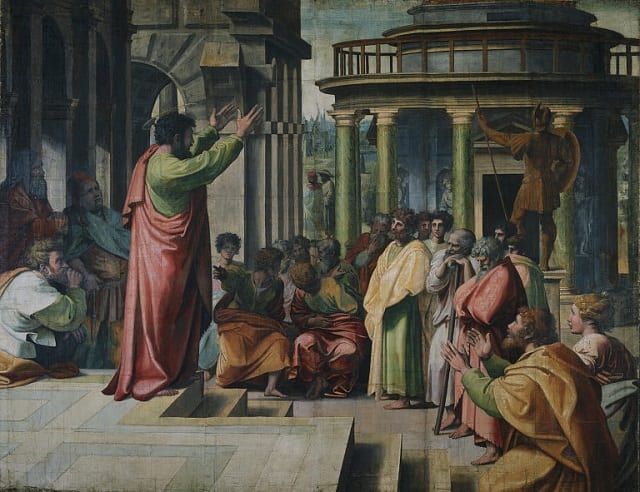
Photo credit: St. Paul Preaching in Athens (1515), by Raphael (1483-1520) [public domain / Wikimedia Commons]

***
Previous Post

February 12, 2021
Gospel of Luke Bashing Examined & Found Wanting
Next Post

February 13, 2021 Reply to the Nonsense of "Atheists Have No Worldview"
Browse Our Archives
Select a Category & Last Things About Me Anti-Catholicism Atheism & Agnosticism Baptism and Sacramentalism Bible and Tradition Blessed Virgin Mary Books by Dave Armstrong C. S. Lewis Calvinism & General Protestantism Catholic Apologetics Catholic Apologists Catholic conversion Catholic converts Christmas Church (Ecclesiology) Church History Conversion and Converts Development of Doctrine Eastern Orthodoxy Ecumenism & Christian Unity Eucharist & Liturgy Fathers of the Church French Translations G. K. Chesterton Hell Hell & Satan Hell & Satan & Last Things Heresies & Comparative Religion Holistic Health Inquisition & Crusades & Scandals James White Jews & Judaism & Old Testament John Calvin John Henry Newman Liberal / Modernist Theology Life Issues Literary Resume Lutheranism Mariology Martin Luther Music Orthodoxy Papacy & Infallibility Personal Page Philosophy & Science Political & Ethical & Moral Issues Protestant Persecution & Intolerance Protestantism Purgatory Purgatory & Penance Romantic & Imaginative Theology Saints & Purgatory & Penance Salvation Salvation & Justification Satan & Last Things Sexuality and Gender Issues Spanish Translations Traditionalism vs. Radical Catholic Reactionaries Traducciones al español / tradução para português Trinitarianism & Christology Uncategorized Videos
Select a Month October 2026 September 2026 August 2026 July 2026 June 2026 May 2026 April 2026 March 2026 February 2026 January 2026 December 2025 November 2025 October 2025 September 2025 August 2025 July 2025 June 2025 May 2025 April 2025 March 2025 February 2025 January 2025 December 2024 November 2024 October 2024 September 2024 August 2024 July 2024 June 2024 May 2024 April 2024 March 2024 February 2024 January 2024 December 2023 November 2023 October 2023 September 2023 August 2023 July 2023 June 2023 May 2023 April 2023 March 2023 February 2023 January 2023 December 2022 November 2022 October 2022 September 2022 August 2022 July 2022 June 2022 May 2022 April 2022 March 2022 February 2022 January 2022 December 2021 November 2021 October 2021 September 2021 August 2021 July 2021 June 2021 May 2021 April 2021 March 2021 February 2021 January 2021 December 2020 November 2020 October 2020 September 2020 August 2020 July 2020 June 2020 May 2020 April 2020 March 2020 February 2020 January 2020 December 2019 November 2019 October 2019 September 2019 August 2019 July 2019 June 2019 May 2019 April 2019 March 2019 February 2019 January 2019 December 2018 November 2018 October 2018 September 2018 August 2018 July 2018 June 2018 May 2018 April 2018 March 2018 February 2018 January 2018 December 2017 November 2017 October 2017 September 2017 August 2017 July 2017 June 2017 May 2017 April 2017 March 2017 February 2017 January 2017 December 2016 November 2016 October 2016 September 2016 August 2016 July 2016 June 2016 May 2016 April 2016 March 2016 February 2016 January 2016 December 2015 November 2015 October 2015 September 2015 August 2015 July 2015 June 2015 May 2015 April 2015 March 2015 February 2015 January 2015 December 2014 November 2014 October 2014 September 2014 August 2014 July 2014 June 2014 April 2014 March 2014 February 2014 January 2014 December 2013 November 2013 October 2013 September 2013 August 2013 July 2013 June 2013 April 2013 March 2013 February 2013 January 2013 December 2012 November 2012 October 2012 September 2012 August 2012 July 2012 June 2012 May 2012 April 2012 March 2012 February 2012 January 2012 December 2011 November 2011 October 2011 September 2011 August 2011 July 2011 June 2011 April 2011 March 2011 February 2011 October 2010 September 2010 August 2010 July 2010 April 2010 March 2010 December 2009 October 2009 August 2009 July 2009 June 2009 May 2009 March 2009 February 2009 October 2008 September 2008 April 2008 March 2008 February 2008 January 2008 December 2007 November 2007 October 2007 May 2007 March 2007 February 2007 January 2007 November 2006 October 2006 September 2006 August 2006 July 2006 June 2006 May 2006 April 2006 March 2006 February 2006 October 2005 June 2005 April 2005 February 2005 July 2004 May 2004 April 2004
Follow Us!
TAKE THE
Religious Wisdom Quiz
What Christian tradition requires confession to a priest for forgiveness of sins?
Select your answer to see how you score.
Baptist Roman Catholic Methodist Quaker
Books by This Author Books by Dave Armstrong
Related posts from Biblical Evidence for Catholicism

God, Modern Physics, & Dark Energy: An Analogy
Biblical Evidence for Catholicism

My “Number Articles”: Alphabetized by Topic
Biblical Evidence for Catholicism

General Debate on Christianity with an Atheist
Biblical Evidence for Catholicism

Can Atheists Be Saved? Surprising Biblical Data
Biblical Evidence for Catholicism
TRENDING AT PATHEOS Catholic

I was strolling through the top floor of the brand new Parthenon...

What Does Gêvâh Mean For Kimberley Guifoyle &...
This week, a lot of the news is focused on Kimberly Guilfoyle....

INNER CIRCLE: Profound Mystery (Of Christ In All...
Ephesians 5:31-32 “For this reason, a man will leave his father and...

Do Not Rejoice When Your Enemy Falls: The...
Turning an execution into a public spectacle is a disturbing expression of...

'The Chosen' S6 Trailer: The Passion Gets Very...
Not many watching 'The Chosen' worry about spoilers, but just because they...

The purpose-driven labor priest
A labor activist reads Rick Warren and it gets me wondering about...
view all Catholic blogs
Ad-Free & Subscriber Log-In Subscription Support
- About Us
- 2026 Calendar
- Videos
- Podcasts
- Library of World Religions
- Faith In Media Tracker
- Advertise With Us
- Write for Us
- Privacy Policy
- Terms of Service
- Do Not Sell My Data
- Contact Us
- Radiant Digital
- Manage Newsletter Subscriptions
- Unsubscribe From Notifications
- Sitemap
Copyright 2008-2026, Patheos. All rights reserved.
Subscription Support Ad-Free & Subscriber Log-In
Follow Patheos