
BuddhistCatholicContemplativeEvangelicalGeneral ChristianHinduJewishLatter-day SaintMuslimNew VisionsProgressive Christian
Beliefs
- Buddhist
- Catholic
- Contemplative
- Evangelical
- General Christian
- Hindu
- Jewish
- Latter-day Saint
- More Voices
- Muslim
- New Visions
- Pagan
- Progressive Christian
Topics
- Religion News
- Food and Religion
- Sports and Religion
- Religious Art
- Religious Music and Entertainment
- Religious Events
- History and Religion
- Style and Religion
- Politics and Religion
- Women in Religion
- Recreation Outdoors and Religion
- Business Finance and Religion
- Careers Workplace and Religion
- Education and Religion
- Family Parenting and Religion
- Health Fitness and Religion
- Home and Religion
- Relationships and Religion
- Technology and Religion
- Travel and Religion
Columnists
- Buddhist Columnists
- Business Finance and Religion Columnists
- Careers Workplace and Religion Columnists
- Catholic Columnists
- Contemplative Columnists
- Education and Religion Columnists
- Evangelists Columnists
- Family Parenting and Religion Columnists
- General Christian Columnists
- Health Fitness and Religion Columnists
- Hindu Columnists
- History and Religion Columnists
- Home and Religion Columnists
- Jewish Columnists
- More Voices Columnists
- Latter Day Columnists
- Muslim Columnists
- New Visions Columnists
- Nonreligious Columnists
- Pagan Columnists
- Politics and Religion Columnists
- Progressive Columnists
- Recreation Outdoors and Religion Columnists
- Relationships and Religion Columnists
- Religion News Columnists
- Religious Art Columnists
- Religious Events Columnists
- Religious Music and Entertainment Columnists
- Sports and Religion Columnists
- Style and Religion Columnists
- Technology and Religion Columnists
- Travel and Religion Columnists
- Women in Religion Columnists
Resource Library
- 2026 Calendar
- Library of World Religions
- The 100 Most Holy Places on Earth
- Patheos Answers
- Podcasts
- Videos
- Faith Leaders Database
- Anglican Episcopalian
- Bahai
- Baptist
- Buddhism
- Christianity
- Confucianism
- Eastern Orthodoxy
- Hinduism
- Holiness and Pentecostal
- ISKCON
- Islam
- Judaism
- Lutheran
- Methodist
- The Church of Jesus Christ of Latter-day Saints
- New Age
- Paganism
- Presbytarian and Reformed
- Protestantism
- Religion Behind the Scenes
- Roman Catholic
- Scientology
- Shia Islam
- Sikhism
- Sufism
- Sunni Islam
- Taoism
- Zen
- See all religions
Research Tools
 Ad-Free & Subscriber Log-In Subscription Support
Ad-Free & Subscriber Log-In Subscription Support
Follow Patheos 

- Trending:
- Forgiveness
- |
- Marriage
- |
- Consciousness
- |
- Death Penalty
- |
- Election
- |
- Halloween

-
About
-
Catholic Apologetics
-
Church History
-
Great Apologists
-
Christian Worldview
-
Protestantism & Misc.
- Home
- Catholic
- History and Religion
- My Chesterton Quotations Book: Two Interviews
My Chesterton Quotations Book: Two Interviews
Last updated on: June 6, 2026 at 12:43 am by Dave Armstrong
My Chesterton Quotations Book: Two Interviews 2026-06-06T00:43:42-04:00 Dave Armstrong
Patheos Explore the world's faith through different perspectives on religion and spirituality! Patheos has the views of the prevalent religions and spiritualities of the world.
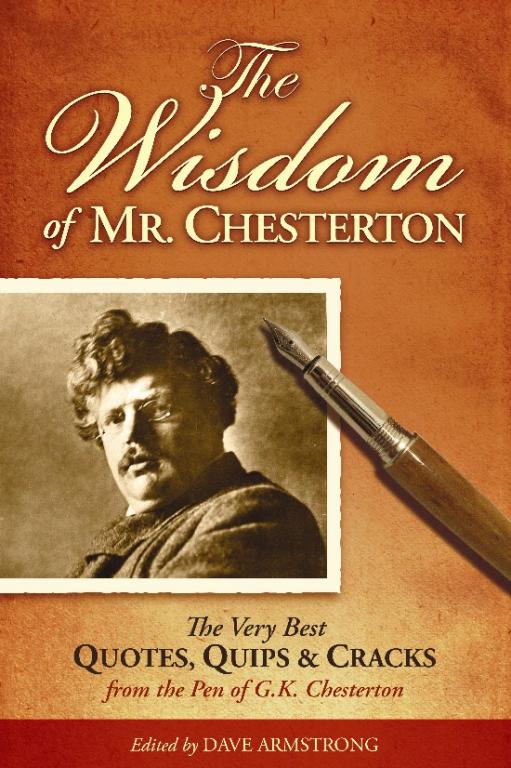
[link for more information on the book, including purchase options]
***
My book is entitled The Wisdom of Mr. Chesterton: The Very Best Quotes, Quips & Cracks from the Pen of G. K. Chesterton (Dec. 2009): a collection of quotations. I was interviewed on 3 March 2010 for the show The Catholics Next Door, hosted by Greg and Jennifer Willits, which aired on The Catholic Channel (Sirius Satellite Channel 159), from 2008-2012. I tried to find my interview in their archive of the radio show, with no success. They still have a podcast today, called Imperfect Living.
They sent me written interview questions prior to the show. Here they are, with my replies:
The Wisdom of Mr. Chesterton: The Very Best Quotes, Quips, and Cracks from the Pen of G. K. Chesterton
Publisher: Saint Benedict Press: recently merged with TAN Books; specializes in classic Catholic literature.
Basic Book Information
2100+ quotations. All single sentences, or aphorisms. From 34 non-fiction books and 229 articles written for The Illustrated London News. Organized under 281 topics, with extensive cross-referencing, indexed by source and by topic. 378 pages. GKC dates: 1874-1936.
Aphorism: a pithy, astute, proverb-like saying or maxim on a general truth. Biographer Maisie Ward: “all his paradoxes were either the startling expression of an entirely neglected truth, or the startling re-emphasis of the neglected side of a truth.”
Examples: A man’s friend likes him but leaves him as he is: his wife loves him and is always trying to turn him into somebody else.
But the new sceptic is so humble that he doubts if he can even learn.
No Catholic thinks he is a good Catholic; or he would by that thought become a bad Catholic.
Subjects Covered by Chesterton: Theology, morality, childhood, the arts, literature, science, philosophy, economic and social topics, agnosticism, education, history, politicians, everyday life, the family, and gender differences.
“How did you first get interested in GK Chesterton?”
I first heard of him as a result of my interest in C. S. Lewis, who has been my favorite writer for over thirty years (perhaps Chesterton is now!). He is often associated with Lewis, and is widely regarded as the greatest Christian apologist in the first third of the 20th century, with Lewis taking his place (in a way) in the second third of the century. An evangelical Protestant teacher at the non-denominational church I used to attend in the early 80s kept mentioning Orthodoxy as a wonderful book. I obtained a library copy around 1983 or so, and enjoyed it quite a bit. Lewis mentioned in his autobiography that The Everlasting Man was the book that influenced him the most. I had read portions of that book in the mid-80s, but didn’t read the whole thing (strangely enough) until just a few years ago. That was good, though, because the elaborate analogical reasoning he uses in the book probably would have been partially inexplicable to me earlier on.
“What books would you recommend for a new reader of GK Chesterton or for someone who wants to check out the author for the first time?”
I think Orthodoxy is the best introductory book because it is very straightforward and basic: almost the near-Catholic equivalent (in a way) of Lewis’ Mere Christianity, but with the object of explaining the necessity of tradition and orthodoxy. After that I would highly recommend What’s Wrong With the World (his social thought), St. Thomas Aquinas, and St. Francis. I’m not much of a fiction reader at all but I know that The Napoleon of Notting Hill, The Man Who Was Thursday, and the many Father Brown stories are very highly regarded.
“What compelled you to put together this book?”
I love to organize and categorize, so it was easy to collect these since all his books are online. I just cut-and-paste from the Internet versions (a lot less typing!). I wanted to share one of my favorite writers with everyone. If we love a writer, we want others to be aware of them, too, so we can share the pleasure. My favorite writers are Chesterton, C. S. Lewis, and Cardinal Newman. I have web pages about all three.
“Can you share a few favorite Chesterton quotes?”
The Christian ideal has not been tried and found wanting. It has been found difficult; and left untried.
Men have not got tired of Christianity; they have never found enough Christianity to get tired of.
(What’s Wrong With the World, 1910)
It is an almost invariable rule that the man with whom I don’t agree thinks I am making a fool of myself, and the man with whom I do agree thinks I am making a fool of him.
“What do you hope people will gain from this book?”
An appreciation for great writing, style, disagreement without hostility, the rationale for the Christian worldview, and the reasonable objections to non-Christian belief-systems.
“What do you think makes Chesterton special or unique among Catholic writers? Why is there so much interest in him by so many Catholics?”
He has extraordinary wisdom and insight combined with a certain innocence, playful wit, and joviality. He had common sense, and a very deep faith. But he wasn’t a cynic. In dashing the pretentiousness of the cynical and the prideful, he was being an idealistic and optimistic Christian. He was realistic while remaining joyful: always a very rare combination.
Chesterton’s time and place (England: early 20th century) was a lot like our own: moral relativism, agnosticism and atheism, over-emphasis on science and naturalism and the separation of faith and reason, occult and spiritualism, contraception, euthanasia, divorce, and laxity in sexual morals.
Everyone liked him, even his debate opponents. His writing is timeless. What Chesterton wrote in 1905 or 1925 is every bit as relevant today (if not more so) as anything written in the last month. Truth is truth, and doesn’t change according to fashion or the spirit of the age (zeitgeist).
Career as a Journalist He was a journalist by profession, and was not trained in theology. This is the case with almost all of the most influential apologists. C. S. Lewis and Thomas Howard were English professors. Malcolm Muggeridge was a journalist. Peter Kreeft is a philosophy professor. It enables them to write to the common man, rather than to other academics. Apologetics is about helping everyone to understand and defend Christianity, in order to live it out.
Education He attended the Slade School of Art, a department of University College, London, but never obtained a degree. He had studied English, French, History, and Political Economy, and lasted only a year in the Latin course before dropping it.
Wisdom When he wrote his book St. Thomas Aquinas in 1933 the academic Thomists (Jacques Maritain, Etienne Gilson and others) ecstatically praised it, and more than one of them said that Chesterton understood Aquinas better than they had, after 40-50 years of study. That is because Chesterton gets right down to heart of the matter or essence of any given topic: the first principles or premises.
Better-Known Books
Non-Fiction
1905 Heretics
1908 All Things Considered
1908 Orthodoxy
1910 What’s Wrong With the World
1920 The Superstition of Divorce
1924 St. Francis of Assisi
1925 The Everlasting Man
1926 The Catholic Church and Conversion
1926 The Outline of Sanity
1929 The Thing: Why I am a Catholic
1933 St. Thomas Aquinas
1935 The Well and the Shallows
1936 Autobiography
Fiction
1904 The Napoleon of Notting Hill
1905 The Club of Queer Trades
1908 The Man Who Was Thursday
1911 The Innocence of Father Brown
1914 The Wisdom of Father Brown

Representative Quotations
Abstinence
Everybody has always known about birth-control, even if it took the wild and unthinkable form of self-control.
The Bible
But it is unfair to turn round and blame the Bible because of all these legends and jokes and journalistic allusions, which are read into the Bible by people who have not read the Bible.
Children
If anybody chooses to say that I have founded all my social philosophy on the antics of a baby, I am quite satisfied to bow and smile.
Dialogue and Discussion
People generally quarrel because they cannot argue.
People do not seem to understand even the first principle of all argument: that people must agree in order to disagree.
Divorce
But the truth is that the innovators have as much sham optimism about divorce as any romanticist can have had about marriage.
The obvious effect of frivolous divorce will be frivolous marriage.
If people can be separated for no reason they will feel it all the easier to be united for no reason.
Dogmatism
The modern world is filled with men who hold dogmas so strongly that they do not even know that they are dogmas.
For the modern world will accept no dogmas upon any authority; but it will accept any dogmas on no authority.
Fashions and Fads
Anything that is fashionable is on the brink of being old-fashioned.
And the moral of it is that nothing grows old so quickly as what is new.
(Humor)
Shakespeare is quite himself; it is only some of his critics who have discovered that he was somebody else.
The very notion of always talking in terms of tomorrow is a passing taste that will soon be a thing of yesterday.
A man may be said loosely to love himself, but he can hardly fall in love with himself, or, if he does, it must be a monotonous courtship.
Incarnation
Since that day it has never been quite enough to say that God is in his heaven and all is right with the world, since the rumour that God had left his heavens to set it right.
Intelligentsia
Why is it that for the last two or three centuries the educated have been generally wrong and the uneducated relatively right?
What we call the intellectual world is divided into two types of people — those who worship the intellect and those who use it.
Reason and Logic
The difficulty is not so much to get people to follow a commandment as to get them even to follow an argument.
What is new in this matter is not so much unreason as the fact of unreason not being recognised as unreasonable.
Writers
For instance, I am staring blankly at this sheet of paper and I firmly believe that something more or less intelligible will happen soon.
Whereas, as I have only too good reason to know, if you are writing an article you can say anything that comes into your head.
+++++++++++++++++++++++++++++++++++++++++++++++++++++++++++++++++++++++++++++
Interview with Mike Davis from Aquinas and More Catholic Goods (3-12-10)
[This is a slightly edited version of the interview, published on the Musings From a Catholic Bookstore blog; entitled, “Find Out For Yourself Why There’s Such Renewed Interest in G. K. Chesterton.” Be sure to check out the books and other items from my friends at this well-known online Catholic site: Aquinas and More Catholic Gifts for Good. They have been gracious enough to strongly support my work through the years.]
We recently had the opportunity to interview Dave Armstrong, noted Catholic apologist and prolific author, about his new book The Wisdom of Mr. Chesterton. If you’re not familiar with Dave’s work, you need to get up to speed. He’s simply one of the best Catholic apologists writing today. Do yourself and your faith a big favor by reading one of his books during this Lenten season.
*
This new book is a bit different from your previous books, tell us about your motivation to write this one.
*
I wanted to put together a collection that would show the depth and breadth of Chesterton’s writings, and introduce new readers to him. He’s been one of my favorite writers for years. It’s like finding a huge cave filled with gold, diamonds and silver: you don’t know where to look first. But anywhere and everywhere you look it is glorious. Human beings like to share with others the things they love. That was largely my motivation with this book: if we love a writer, we want others to be more aware of them, too.
*
What will readers take away from your new book?
*
Besides lots of pithy quotations for use in many ways, hopefully, an appreciation for great writing, style, disagreement without hostility, the rationale for the Christian worldview, and the reasonable objections to non-Christian belief-systems. The reader will learn to think more Christianly.
*
Can you tell us about the process you went through to write your new book?
*
I love to organize and categorize, so it was easy to collect these since virtually all of his books are online. I just cut-and-paste from the Internet versions (a lot less typing!). Basically I heavily skimmed about 50 of his books, and kept an eye out for catchy sentences and thoughts. Every citation in the book is one-sentence long. That’s how I decided to do it. It’s amazing how easy it is to “find quotations” (with a great writer like Chesterton, anyway) if you put your mind to it. I’m actually a fairly slow reader, but when looking for something in this manner, I seem to be able to read much faster (probably sort of like speed reading).
*
How was it different than your previous efforts?
*
The unique process of combing through an author’s many books in order to glean the most quotable material out of them. It’s all editing. That’s how it was different. I did a book on the Church fathers, where I cited a lot of their statements (which is most similar to this one), but in that book I also had a lot of my own argumentation, whereas in this one I have nothing of my own except the categories and introduction.
*
Chesterton was such a prolific writer. What was it like combing through such a vast array of writings to put together your new book?
*
It was like being a kid in a candy store with a $100 gift certificate! Riches everywhere, and what a joy to find them! It was a wonderful time for me.
*
Many people might think that Chesterton is too intellectual, or even inaccessible, for them. Can you speak to that issue, in general, and also as it relates to your new book?
*
That seems to be an impression that a lot of folks have. I don’t feel that way about Chesterton, myself. I think he had a gift of expressing profound truth and wisdom, yet in a manner that can be grasped by the average person. He wrote for the masses, which is what I try to do myself, as an apologist, and non-academic. He tends to write in short, concise, catchy sentences (which is why it was easy to collect a lot of fabulous quotations). It’s not like reading “heavy theology” from one like, say, St. Thomas Aquinas, or St. John Henry Cardinal Newman.
*
In doing all your research for the book, did you learn anything new about Chesterton that you can share with us? Do you have a different opinion of him and his work now?
*
I think the main thing I came away with from the project was a deeper appreciation of just how flat-out, exceedingly wise the man was. I think he is one of the wisest men who ever lived: on the level of a Socrates or a Confucius or Solomon or Blaise Pascal. It’s extraordinary. That is what struck me the most, as opposed to some specific subject matter or facts. It’s quite striking, the more of his work one reads.
*
How do you think knowledge of Chesterton’s work can impact one’s Catholic faith?
*
It can bring a confidence that we are right square in the middle of truth, and that we have insights as Christians, and Catholic Christians, that are not able to be attained in their fullness anywhere else. And he fosters a happy, joyous, optimistic faith and walk with God. You see that the most, perhaps, when he writes about children. He never lost his wonder at creation and life and God and His universe. He was literally like an overgrown child: but a very thoughtful one. May we all be struck with such a “limitation”!
*
If someone wants to read a specific work by Chesterton, what would you recommend and why?
*
For a first book, I always suggest Orthodoxy, because it is one of the “quintessential” Chesterton books. It presents his outlook in a concise, more-or-less introductory way, and is about the topic of tradition, and why it is important and crucial. Chesterton was Anglican when he wrote it (around 1908), not yet Catholic (he was received in 1922), so that may help to give it a very wide appeal. Yet nothing in it (that I am aware of) could be said to be contrary to the Catholic faith.
*
What new books can we look forward to from you in the future?
*
I’m just about to finish (perhaps this very day) a book about John Calvin (in honor of his 500th birthday in 2009), entitled, Biblical Catholic Answers for John Calvin. It is mostly a set of replies to Book IV of his Institutes of the Christian Religion. It has a lot about the doctrine of the Church, the papacy, and the sacraments. I feel that Calvin has had considerably more influence on the historical course of Protestantism than Martin Luther did, and so his arguments (and errors) need to be directly dealt with.
*
But there is also a lengthy section at the end of the book (as in my book about Luther) that details exactly what Catholics and Calvinists can agree on. There is quite a bit, when it is all collected in one place. So one can see my usual combination of apologetics and ecumenism there. I am always happy to find as much agreement with our non-Catholic Christian brethren as possible. We need to rejoice about that, too, and not just fret about the differences and divisions (as recent popes have been stressing). There is good news as well as bad news along those lines.
*
In the near future, I hope to put together two books about the Blessed Virgin Mary, and salvation and justification, from existing writings.
*
I’d like to take this opportunity to express my heartfelt gratitude to Mike Davis, the good folks at Aquinas and More bookstore and all my readers. I appreciate all of you very much, and encourage you to keep living and sharing the gospel and the fullness of faith. God bless.
*
A big thank you from all of us here at Aquinas and More – you do great work for the Church, Dave, and we love your books.
*
Related Reading
G. K. Chesterton: The “Colossal Genius” (Links Page; now discontinued; see old archived versions)
Interview With Dale Ahlquist for Gilbert Magazine, Regarding My Book, The Wisdom of Mr. Chesterton [March 2010]
TV Interview: On Catholicism, Over Against Protestantism [5-1-99]
Dave Armstrong: Catholic Apologetics’ “Socratic Evangelist” (by Tim Drake; Envoy Magazine, Spring 2002)
Interview for Catholic Books and Gifts / Catholic Free Shipping [4-23-10]
My Two Conversions: Interview with Spanish Journalist Itxu Díaz [3-31-11]
* * * * *
Previous Post

February 14, 2021
Orange Beast Gone. Who Will Dems Hate Now?
Next Post

February 15, 2021 Top Ten All-Time Favorite Insults Sent My Way
Browse Our Archives
Select a Category & Last Things About Me Anti-Catholicism Atheism & Agnosticism Baptism and Sacramentalism Bible and Tradition Blessed Virgin Mary Books by Dave Armstrong C. S. Lewis Calvinism & General Protestantism Catholic Apologetics Catholic Apologists Catholic conversion Catholic converts Christmas Church (Ecclesiology) Church History Conversion and Converts Development of Doctrine Eastern Orthodoxy Ecumenism & Christian Unity Eucharist & Liturgy Fathers of the Church French Translations G. K. Chesterton Hell Hell & Satan Hell & Satan & Last Things Heresies & Comparative Religion Holistic Health Inquisition & Crusades & Scandals James White Jews & Judaism & Old Testament John Calvin John Henry Newman Liberal / Modernist Theology Life Issues Literary Resume Lutheranism Mariology Martin Luther Music Orthodoxy Papacy & Infallibility Personal Page Philosophy & Science Political & Ethical & Moral Issues Protestant Persecution & Intolerance Protestantism Purgatory Purgatory & Penance Romantic & Imaginative Theology Saints & Purgatory & Penance Salvation Salvation & Justification Satan & Last Things Sexuality and Gender Issues Spanish Translations Traditionalism vs. Radical Catholic Reactionaries Traducciones al español / tradução para português Trinitarianism & Christology Uncategorized Videos
Select a Month October 2026 September 2026 August 2026 July 2026 June 2026 May 2026 April 2026 March 2026 February 2026 January 2026 December 2025 November 2025 October 2025 September 2025 August 2025 July 2025 June 2025 May 2025 April 2025 March 2025 February 2025 January 2025 December 2024 November 2024 October 2024 September 2024 August 2024 July 2024 June 2024 May 2024 April 2024 March 2024 February 2024 January 2024 December 2023 November 2023 October 2023 September 2023 August 2023 July 2023 June 2023 May 2023 April 2023 March 2023 February 2023 January 2023 December 2022 November 2022 October 2022 September 2022 August 2022 July 2022 June 2022 May 2022 April 2022 March 2022 February 2022 January 2022 December 2021 November 2021 October 2021 September 2021 August 2021 July 2021 June 2021 May 2021 April 2021 March 2021 February 2021 January 2021 December 2020 November 2020 October 2020 September 2020 August 2020 July 2020 June 2020 May 2020 April 2020 March 2020 February 2020 January 2020 December 2019 November 2019 October 2019 September 2019 August 2019 July 2019 June 2019 May 2019 April 2019 March 2019 February 2019 January 2019 December 2018 November 2018 October 2018 September 2018 August 2018 July 2018 June 2018 May 2018 April 2018 March 2018 February 2018 January 2018 December 2017 November 2017 October 2017 September 2017 August 2017 July 2017 June 2017 May 2017 April 2017 March 2017 February 2017 January 2017 December 2016 November 2016 October 2016 September 2016 August 2016 July 2016 June 2016 May 2016 April 2016 March 2016 February 2016 January 2016 December 2015 November 2015 October 2015 September 2015 August 2015 July 2015 June 2015 May 2015 April 2015 March 2015 February 2015 January 2015 December 2014 November 2014 October 2014 September 2014 August 2014 July 2014 June 2014 April 2014 March 2014 February 2014 January 2014 December 2013 November 2013 October 2013 September 2013 August 2013 July 2013 June 2013 April 2013 March 2013 February 2013 January 2013 December 2012 November 2012 October 2012 September 2012 August 2012 July 2012 June 2012 May 2012 April 2012 March 2012 February 2012 January 2012 December 2011 November 2011 October 2011 September 2011 August 2011 July 2011 June 2011 April 2011 March 2011 February 2011 October 2010 September 2010 August 2010 July 2010 April 2010 March 2010 December 2009 October 2009 August 2009 July 2009 June 2009 May 2009 March 2009 February 2009 October 2008 September 2008 April 2008 March 2008 February 2008 January 2008 December 2007 November 2007 October 2007 May 2007 March 2007 February 2007 January 2007 November 2006 October 2006 September 2006 August 2006 July 2006 June 2006 May 2006 April 2006 March 2006 February 2006 October 2005 June 2005 April 2005 February 2005 July 2004 May 2004 April 2004
Follow Us!
TAKE THE
Religious Wisdom Quiz
What did Isaiah say about Egypt's future in his oracles?
Select your answer to see how you score.
It would conquer Israel It would be conquered It would prosper It would rule Persia
Books by This Author Books by Dave Armstrong
Related posts from Biblical Evidence for Catholicism

Why Wes Huff (and Everyone) Should Be Catholic
Biblical Evidence for Catholicism

100 Motown Stars: Info. & Links / My...
Biblical Evidence for Catholicism

Invocation of Saints: Catholic Scholars vs. Me? Nope!
Biblical Evidence for Catholicism

My 19 Imprimaturs vs. James Swan's Slanders
Biblical Evidence for Catholicism
TRENDING AT PATHEOS Catholic

In "Irreplaceable," our book on vocation and technology, Trevor Sutton and I...

I was strolling through the top floor of the brand new Parthenon...

What Does Gêvâh Mean For Kimberley Guifoyle &...
This week, a lot of the news is focused on Kimberly Guilfoyle....

INNER CIRCLE: Profound Mystery (Of Christ In All...
Ephesians 5:31-32 “For this reason, a man will leave his father and...

Do Not Rejoice When Your Enemy Falls: The...
Turning an execution into a public spectacle is a disturbing expression of...

'The Chosen' S6 Trailer: The Passion Gets Very...
Not many watching 'The Chosen' worry about spoilers, but just because they...
view all Catholic blogs
Ad-Free & Subscriber Log-In Subscription Support
- About Us
- 2026 Calendar
- Videos
- Podcasts
- Library of World Religions
- Faith In Media Tracker
- Advertise With Us
- Write for Us
- Privacy Policy
- Terms of Service
- Do Not Sell My Data
- Contact Us
- Radiant Digital
- Manage Newsletter Subscriptions
- Unsubscribe From Notifications
- Sitemap
Copyright 2008-2026, Patheos. All rights reserved.
Subscription Support Ad-Free & Subscriber Log-In
Follow Patheos