
BuddhistCatholicContemplativeEvangelicalGeneral ChristianHinduJewishLatter-day SaintMuslimNew VisionsProgressive Christian
Beliefs
- Buddhist
- Catholic
- Contemplative
- Evangelical
- General Christian
- Hindu
- Jewish
- Latter-day Saint
- More Voices
- Muslim
- New Visions
- Pagan
- Progressive Christian
Topics
- Religion News
- Food and Religion
- Sports and Religion
- Religious Art
- Religious Music and Entertainment
- Religious Events
- History and Religion
- Style and Religion
- Politics and Religion
- Women in Religion
- Recreation Outdoors and Religion
- Business Finance and Religion
- Careers Workplace and Religion
- Education and Religion
- Family Parenting and Religion
- Health Fitness and Religion
- Home and Religion
- Relationships and Religion
- Technology and Religion
- Travel and Religion
Columnists
- Buddhist Columnists
- Business Finance and Religion Columnists
- Careers Workplace and Religion Columnists
- Catholic Columnists
- Contemplative Columnists
- Education and Religion Columnists
- Evangelists Columnists
- Family Parenting and Religion Columnists
- General Christian Columnists
- Health Fitness and Religion Columnists
- Hindu Columnists
- History and Religion Columnists
- Home and Religion Columnists
- Jewish Columnists
- More Voices Columnists
- Latter Day Columnists
- Muslim Columnists
- New Visions Columnists
- Nonreligious Columnists
- Pagan Columnists
- Politics and Religion Columnists
- Progressive Columnists
- Recreation Outdoors and Religion Columnists
- Relationships and Religion Columnists
- Religion News Columnists
- Religious Art Columnists
- Religious Events Columnists
- Religious Music and Entertainment Columnists
- Sports and Religion Columnists
- Style and Religion Columnists
- Technology and Religion Columnists
- Travel and Religion Columnists
- Women in Religion Columnists
Resource Library
- 2026 Calendar
- Library of World Religions
- The 100 Most Holy Places on Earth
- Patheos Answers
- Podcasts
- Videos
- Faith Leaders Database
- Anglican Episcopalian
- Bahai
- Baptist
- Buddhism
- Christianity
- Confucianism
- Eastern Orthodoxy
- Hinduism
- Holiness and Pentecostal
- ISKCON
- Islam
- Judaism
- Lutheran
- Methodist
- The Church of Jesus Christ of Latter-day Saints
- New Age
- Paganism
- Presbytarian and Reformed
- Protestantism
- Religion Behind the Scenes
- Roman Catholic
- Scientology
- Shia Islam
- Sikhism
- Sufism
- Sunni Islam
- Taoism
- Zen
- See all religions
Research Tools
 Ad-Free & Subscriber Log-In Subscription Support
Ad-Free & Subscriber Log-In Subscription Support
Follow Patheos 

- Trending:
- Forgiveness
- |
- Marriage
- |
- Consciousness
- |
- Death Penalty
- |
- Election
- |
- Halloween

-
About
-
Catholic Apologetics
-
Church History
-
Great Apologists
-
Christian Worldview
-
Protestantism & Misc.
- Home
- Catholic
- History and Religion
- Groundless Gospel of Mark Bashing Systematically Refuted
Groundless Gospel of Mark Bashing Systematically Refuted
Last updated on: June 5, 2026 at 11:57 pm by Dave Armstrong
Groundless Gospel of Mark Bashing Systematically Refuted 2026-06-05T23:57:49-04:00 Dave Armstrong
Patheos Explore the world's faith through different perspectives on religion and spirituality! Patheos has the views of the prevalent religions and spiritualities of the world.
I just finished yesterday an exhaustive (over 8,000-word) point-by-point refutation of a wholesale attack on the Gospel of Mark, written by atheist Steven Carr: Pearce’s Potshots #15: Gospel of Matthew vs. Gospel of Mark?. That piece was actually part of a longer diatribe, entitled The Gospel According to Saint Mark: written by another atheist: Vexen Crabtree in 2006. Now I will examine his piece, too, to see if it is any more worthy of belief than Carr’s relentlessly erroneous analysis. Vexen’s words will be in blue.
*****
This anonymous gospel was the first to be written, around 80 CE, by an unknown Roman convert to Christianity.
Many early Christian writers state that Mark (or John Mark) is the author. The most important “witness” is Papias, a bishop of Hierapolis in Asia Minor (Turkey) until about 130 AD. His statement is recorded in in Eusebius’ History of the Church, written in 325:
Papias gives also in his own work other accounts of the words of the Lord on the authority of Aristion who was mentioned above, and traditions as handed down by the presbyter John; to which we refer those who are fond of learning. But now we must add to the words of his which we have already quoted the tradition which he gives in regard to Mark, the author of the Gospel.
“This also the presbyter 960 said: Mark, having become the interpreter of Peter, wrote down accurately, though not in order, whatsoever he remembered of the things said or done by Christ. 961 For he neither heard the Lord nor followed him, but afterward, as I said, he followed Peter, who adapted his teaching to the needs of his hearers, but with no intention of giving a connected account of the Lord’s discourses, 962 so that Mark committed no error while he thus wrote some things as he remembered them. For he was careful of one thing, not to omit any of the things which he had heard, and not to state any of them falsely.” These things are related by Papias concerning Mark. (Book III, 39:15)
The “presbyter John” referred to may be the apostle John himself. If so, the identification of Mark as the author goes back (via oral transmission) to the first Christians. Other early witnesses to Mark’s authorship include Irenaeus (c. 130-c. 202), Clement of Alexandria (150-c. 215), Tertullian (c. 155-c. 240), and Origen (c. 184-c. 253). No one can be found in the early Church who dissents from this opinion of authorship.
That this Mark referred to by these early Christians is also the same as “(John) Mark” (mentioned in Acts 12:12, 25; 13:5, 13; 15:37; Col 4:10; Philem 24; 2 Tim 4:11; 1 Pet 5:13) is almost certain.
The author of Mark was not an eyewitnesses of Jesus, and wasn’t friends with any of the disciples nor any other witnesses who could have easily corrected many of his mistakes.
Papias states otherwise: that he drew from Peter, and we have no compelling reason to doubt his report.
The evidence is that (1) the author uses a lot of existing stories (both Hebrew and Greek) and wrote them into the text with Jesus as the centre of the story, instead of the original characters.
A common theme in atheist biblical skepticism is to simply assert these sorts of wild claims, while not presenting any evidence why anyone should accept them. Joe Blow atheist asserting x, y, z skeptical claims about supposed Gospel “fictions and fairy tales” — provided by no evidence whatsoever — has exactly no plausibility or ability to persuade any fair-minded, objective thinking person. Why should we believe them (even before getting into the question of the unreliability of “hostile witnesses”)? But the early Christian tradition is agreed that the author was Mark and that he drew from an eyewitness, Peter.
(2) He didn’t speak Aramaic (Jesus’ language)
How does he know this? The Gospel of Mark came down to us in Greek, but there is no proof that Mark didn’t speak Aramaic. Professor of New Testament Language Larry Hurtado wrote that “Mark has more Semitic words/expressions (mainly Aramaic) than any of the other Gospels.” As to whether Mark spoke Aramaic, see “Aramaic in Mark” by Dr. Benjamin Shaw (who earned a Th.M. from Princeton Theological Seminary, with an emphasis in biblical languages: Greek, Hebrew, Old Testament and Targumic Aramaic, as well as Ugaritic), 2021.
Ben Witherington in The Gospel of Mark: A Socio-Rhetorical Commentary (pp. 18-9) documents a number of stylistic traits of Mark’s Gospel:
- Historical present tense verbs
- Repetition of phrases
- Impersonal plural verb followed by a singular verb
- First-person plural narrative
- Parenthetical clarifications
- γάρ–clauses
- Anacoluthon
- Paratacticκαί
- Aramaic phrases
- Unusual words or constructions
- Chreia
In sum, these traits point to an author who struggles to express himself in the language he is writing. . . . So the text itself suggests the author of Mark was, in fact, an Aramaic speaker. [source]
Kenneth Kuziej, in his article, “The Aramaic Logic of Jesus in Mark and Matthew,” Consensus: Vol. 2 : Iss. 3 , Article 5 (1976) provides very helpful information:
Mark’s Greek is rough, strongly Aramaic, and not surprisingly, full of grammatical errors. At the same time, however, it is language which is lively and appealing, like that of an enthusiastic young immigrant. . . . Luke’s Gospel preserves no Aramaic words of Jesus. Neither does the Gospel of John, which, though accented with Aramaic, has such a simple vocabulary it almost seems as if this evangelist chooses not to make his work hard to understand for readers who understood no Aramaic.
The question is why did Matthew’s and Mark’s Gospels preserve those Aramaic words and phrases of Jesus? It’s only a guess, but perhaps, like many people who are new to a language, when stumped, fall back on their native words. This almost could be the explanation for the word Mammon (loosely translated “money” but meaning all material things) and Raka (which is an obscure term of abuse loosely translated “you fool”).
and wrote in Greek, not Hebrew,
The manuscript came down to us in Greek. No one disagrees with that. So why mention it? But the evidence presented above strongly suggests that Greek was not his first language; Aramaic very likely was.
even having Jesus quote a Greek mistranslation of the Old Testament. . . .
All of his quotes from the Old Testament are from the faulty Septuagint translation, in Greek.
Catholic apologist Jason Evert explains the New Testament use of the Septuagint: Greek translation of the Old Testament:
Of the places where the New Testament quotes the Old, the great majority is from the Septuagint version. Protestant authors Archer and Chirichigno list 340 places where the New Testament cites the Septuagint but only 33 places where it cites from the Masoretic Text rather than the Septuagint (G. Archer and G. C. Chirichigno, Old Testament Quotations in the New Testament: A Complete Survey, 25-32).
For those who may not know, the Septuagint was the Greek translation of the Hebrew Old Testament. The common abbreviation for it—LXX, or the Roman numerals for 70—come from a legend that the first part of the Septuagint was done by 70 translators.
By the first century, the LXX was the Bible of Greek-speaking Jews and so was the most frequently used version of the Old Testament in the early Church. For this reason, it was natural for the authors of the New Testament to lift quotes from it while writing in Greek to the Church.
But, while the New Testament authors quoted the LXX frequently, it does not necessarily follow that Christ did. We know for certain that Jesus quoted the Hebrew Old Testament at times, since he read from the scrolls in the synagogue. But Jesus could have only quoted from the Hebrew, and the New Testament authors later used the Greek translation to record the fact.
Some details such as what Jesus said in his personal prayers is made-up. . . .
How did Mark know what Jesus said in his private prayer in Mark 14:32-36? Jesus specifically goes out of his way to leave the disciples behind, taking only James, John and Peter with him. Then, he departs from them for such a distance that they are asleep by the time he returns – and this happens twice. The occasional academic is not afraid to voice the obvious truth: “So how did Mark know? He ‘knew’ because he made it up” – Price.
On what basis is this to be believed? It’s simply the usual irrational, hostile atheist skepticism. Jesus could have simply communicated what He was praying to Peter, who passed it on to Mark. The Bible doesn’t claim to be absolutely exhaustive, as to what Jesus taught His followers. Indeed, one long conversation in one evening by Jesus would contain far more words, by far, than all of His words recorded in Scripture. And that’s just one night. He was constantly with the disciples for three years, day and night. Mark 6:34 notes in one instance, even with the crowds, not just the disciples: “he began to teach them many things” (RSV, as throughout my reply) None of them are recorded. Mark 4:34 adds: “privately to his own disciples he explained everything.”
So some of this “everything” could have easily been what Jesus prayed. All Jesus had to do was tell Peter, “last night I prayed [so-and-so]” (maybe in response to the ever-zealous Peter asking Him) just as we have cases where He revealed what He prayed in Scripture: “I have prayed for you that your faith may not fail” (Lk 22:32; spoken to Peter). Then Peter could tell Mark about one of these prayers, and that’s how Mark could have “known” about Jesus’ private prayers. It’s not rocket science to envision such a scenario. It’s absolutely not impossible.
He included multiple copies of the same story (but often with different details – evidence that he was using passed-on stories that had diverged over time). This often results in internal contradictions and inconsistencies.
Another bald claim. Mr. Crabtree has to provide more specifics, then the Christian can respond to the accusation (just as I did with Steven Carr’s hit-piece: systematically refuting every “anti-Mark” argument that he made). Christian apologists don’t have time to chase vague phantoms of anti-theist atheists’ unbridled imaginations.
The unfamiliarity with Jewish ways of life. There was no-one to correct his blunders such as misquoting the 10 commandments, attributing God’s words to Moses, and having Jews buy things on the Sabbath.
I thoroughly refuted all of these bogus charges last time, along with many others. They are born of rank ignorance, and it’s embarrassing to see how woefully inadequate and downright silly they are, once scrutinized.
Many of the Gospel of Mark’s mistakes were edited and corrections were attempted by Matthew and Luke when they made their own copies of Mark (together there are only about 30 verses that they didn’t copy).
Once again, specifics would have to be given, for me to reply. When such alleged “corrections” of Matthew were posited by Mr. Carr, I showed in every instance that they were groundless.
Because of its influence, some historians have argued that Mark’s text it the primary material that created the legend of Jesus: “Bruno Bauer believed Mark had invented Jesus, just as Mark Twain created Huck Finn”.
Saying that a real Jesus didn’t exist at all, or if He did, it was nothing like the Gospel portrayal, is intellectual suicide (hence, I spend little time with it, just as I rarely waste my time wrangling about a flat earth or a 10,000-year-old earth. See: Seidensticker Folly #4: Jesus Never Existed, Huh? [8-14-18]
Mr. Crabtree cites Robert M. Price stating about the time of Jesus: “there is no evidence for synagogues in Galilee.” Nonsense. The text Price was dealing with (Mark 3:1-5) was about an incident in Capernaum (see Mk 2:1 for the context regarding place). Capernaum had a synagogue. It’s located in Galilee on the shores of the Sea of Galilee. I visited it myself in 2014, and it was noted that the present one was built on top of an older one, whose foundation could still be seen at the bottom of the structure (much darker basalt rocks). Where do people like Price get off saying stupid things like this? A UNESCO page: “Early Synagogues in the Galilee” gives the real story:
The remains of as many as 50 different synagogues were identified in the Galilee, one of the most concentrated sites for synagogues in the world at that time. These early synagogues included Meron, Gush Halav, Navorin, Bar Am and Bet Alfa and Korazim, and Capernaum by the Sea of Galilee. The earliest synagogue remains in Palestine date to the late first century BCE, or by the early first century CE. By this time the synagogue was a developed central institution throughout the Jewish world.
Len Ritmeyer noted in his article, “The Synagogue of Capernaum in which Jesus taught” (3-15-18):
Digging deeper down in 1981, walls made of basalt stones and a basalt floor turned up 4 feet below the surface. These walls were located underneath the walls of the white synagogue and also under the stylobates (low walls that support a row of columns). It was initially thought that these walls were foundation walls, but when 1st century material was found on and below the basalt floor, it became evident that these basalt walls belonged to a synagogue of the 1st century, i.e, the synagogue in which Jesus taught.
Some of the trenches have been left open and the remains of this early synagogue can be seen today. [the article has a photo of that]
The Times of Israel reported on 8-19-16 about another synagogue in Galilee from Jesus’ time, that He very well may have visited:
Israeli archaeologists in northern Israel have uncovered the ruins of a rural synagogue that dates back some 2,000 years.
The remains of the synagogue were found during an archaeological dig at Tel Rekhesh, near Mount Tabor in the lower Galilee, in what was an ancient Jewish village.
The find could lend weight to the New Testament narrative that Jesus visited villages in the area to preach.
Mordechai Aviam, an archaeologist at Kinneret College on the Sea of Galilee who led the dig, estimated the synagogue was built between 20-40 AD and was used for a hundred years. . . .
“The site is 17 km (10 miles) as crow flies east of Nazareth, and 12 km from Nin (Naim), and although we don’t have its name in the New Testament, it is in the area in which Jesus acted,” said Aviam.
Mark 1:30 And he went throughout all Galilee, preaching in their synagogues . . .
Mark 6:6 And he went about among the villages teaching. [i.e., “villages” near Nazareth: see 6:1]
I could easily find more about this, but these counter-examples suffice. So goes “bust” another atheist myth: disproven by archaeology and historiography . . .
We have seen already that Mark was not known as a Gospel of ‘Mark’ for over a hundred years.
That’s of no relevance. All that matters is whether there were reliable oral traditions, based ultimately on eyewitness testimony. These eventually made their way into the written accounts.
When Christians came to name the Gospels, they picked ‘Mark’, who they thought should be a disciple of Peter, who in Greek mythology was associated with the Egyptian god Petra, the gate guardian of Heaven. Nowadays, Christians nowadays consider ‘Peter’ to be a genuine historical person, but it seems that even if he was real, Mark didn’t know him.
This is simply groundless, arbitrary, downright stupid speculation from atheists: as usual backed up with nothing substantial at all, let alone scholarly. Readers can see, on the other hand, how my replies consistently have scholarly backing. Mr. Crabtree is ridiculous enough to start doubting the historicity of Peter as well.
Peter certainly could have corrected any of Mark’s errors in Jewish knowledge, and it is ludicrous to assume that Mark wrote this text without showing Peter (or any other Jew).
Again, I think I disposed of many of the supposed examples of Mark’s “lack of Jewishness” in my previous reply along these lines. I flatly deny the premise.
It is clear that Mark didn’t know any Jews.
This is an extraordinary claim. What’s the evidence for it?
All three other gospels refer to Peter (Matthew 16:17-20, Luke 22:28-32 and John 21:15-17) and give him authority, whereas Mark doesn’t.
Mark mentions “Peter” 19 times. Matthew mentions him 23 times, with 12 more chapters to do so. So, proportionately, Mark has more emphasis on Peter. Luke mentions him 18 times, with eight more chapters than Mark. But then we have to add the use also of “Simon”: his earlier name. That’s ten more times in Mark for a total of references to Peter of 29 times. Matthew adds five more references with “Simon” for 28 total. Luke adds 14, for a total of 32. So the grand totals are:
Mark: 29 in 15 chapters (average of 1.9 times per chapter).
Matthew: 28 in 28 chapters (average of one time per chapter).
Luke: 32 in 24 chapters (average of 1.3 times per chapter).
So Mark mentions Peter (“Peter” or “Simon”) almost twice as much per chapter as Matthew does and almost three times to every two times that Luke does. That’s hardly an underemphasis on Peter.
Moreover, Mark shows him as preeminent, just as the others do, by showing that he is the most mentioned of the disciples and their leader. Peter’s name invariably occurs first in all lists of apostles, including in Mark (3:16). Mark implies that he is the leader, in citing an angel stating, “tell his disciples and Peter that he is going before you to Galilee” (16:7). Singling him out in such a way, over against the rest of the disciples, is clearly expressing his leadership. This occurs again in Mark 1:36 (“And Simon and those who were with him pursued him,”). He’s a spokesman for the other disciples (Mk 8:29). He’s listed first of the “inner circle” of disciples: Peter, James, and John (Mk 5:37; 14:37). He’s the central figure in dramatic stories: for instance, Jesus walking on the water (Mk 10:28).
I think Mark knew Peter was not real; but merely a piece of Roman mythology used symbolically in a way all Romans would have understood. Later authors (such as the Jewish author of the Gospel of Matthew), who copied Mark’s text, did not know this, therefore they elevated him.
This is just manifestly ridiculous, and not worthy of any attention. It’s self-refuting.
Sandals and Staff: Jesus sends his disciples out to preach, but in Mark [6:8-9] they are told to wear sandals (contradicting Matthew [10:9-10] ), and are told to take a staff (contradicting Luke [9:3]). Only one of these three authors could have really been there (if any).
At least this appears at first glance to be a real contradiction (unlike virtually all atheist proposed ones I’ve ever seen: and I’ve dealt with several hundred). So it deserves a serious treatment. Protestant apologists Eric Lyons and Brad Harrub (on a site that specializes in alleged biblical contradictions) grant the difficulty of interpreting these passages harmoniously in writing that they were “Perhaps the most difficult alleged Bible contradiction that we have been asked to ‘tackle’ . . . A cursory reading of the above passages admittedly is somewhat confusing.” Then they proceed to explain the apparent discrepancies:
The differences between Matthew and Mark are explained easily when one acknowledges that the writers used different Greek verbs to express different meanings. In Matthew, the word “provide” (NKJV) is an English translation of the Greek word ktesthe. According to Bauer’s Greek-English Lexicon, the root word comes from ktaomai, which means to “procure for oneself, acquire, get” (1979, p. 455). Based upon these definitions, the New American Standard Version used the English verb “acquire” in Matthew 10:9 (“Do not acquire….”), instead of “provide” or “take.” In Matthew, Jesus is saying: “Do not acquire anything in addition to what you already have that may tempt you or stand in your way. Just go as you are.” As Mark indicated, the apostles were to “take” (airo) what they had, and go. The apostles were not to waste precious time gathering supplies (extra apparel, staffs, shoes, etc.) or making preparations for their trip, but instead were instructed to trust in God’s providence for additional needs. Jesus did not mean for the apostles to discard the staffs and sandals they already had; rather, they were not to go and acquire more.
They continue by tackling the additional information from Luke:
As is obvious from a comparison of the verses in Matthew and Luke, they are recording the same truth—that the apostles were not to spend valuable time gathering extra staffs—only they are using different words to do so.
“Provide (Greek ktaomi) neither gold nor silver…nor staffs” (Matthew 10:9-10, emp. added).
“Take (Greek airo) nothing for the journey, neither staffs” (Luke 9:3, emp. added).
Luke did not use ktaomi in his account because he nearly always used ktaomi in a different sense than Matthew did. In Matthew’s account, the word ktaomai is used to mean “provide” or “acquire,” whereas in the books of Luke and Acts, Luke used this word to mean “purchase, buy, or earn.” Notice the following examples of how Luke used this word.
“I fast twice a week; I pay tithes of all that I get” (ktaomai) [Luke 18:12, emp. added, NAS]
“Now this man purchased (ktaomai) a field with the wages of iniquity (Acts 1:18, emp. added).
“Your money perish with you, because you thought that the gift of God could be purchased (ktaomai) with money!” (Acts 8:20, emp. added).
The commander answered, “With a large sum I obtained (ktaomai) this citizenship” (Acts 22:28, emp. added).
[Luke 21:19 is the only place one could argue where Luke may have used ktaomai to mean something other than “purchase, buy, or earn,” but even here there is a transactional notion in it (Miller, 1997)].When Luke, the beloved physician (Colossians 4:14), used the word ktaomai, he meant something different than when Matthew, the tax collector, used the same word. Whereas Luke used ktaomai to refer to purchasing or buying something, Matthew used the Greek verb agorazo (cf. Matthew 14:15; 25:9-10; 27:6-7). Matthew used ktaomai only in the sense of acquiring something (not purchasing something). As such, it would make absolutely no sense for Luke to use ktaomai in his account of Jesus sending out the apostles (9:3). If he did, then he would have Jesus forbidding the apostles to “purchase” or “buy” money [“Buy nothing for the journey, neither staffs nor bag nor bread nor money….”]. Thus, Luke used the more general Greek verb (airo) in order to convey the same idea that Matthew did when using the Greek verb ktaomai.
Just as ktaomai did not mean the same for Luke and Matthew, the Greek word airo (translated “take” in both Mark 6:8 and Luke 9:3) often did not mean the same for Luke and Mark (see Miller, 1997). [Understanding this simple fact eliminates the “contradiction” completely, for unless the skeptic can be certain that Mark and Luke were using the word in the same sense, he cannot prove that the accounts contradict each other.] Mark consistently used airo in other passages throughout his gospel to mean simply “take” or “pick up and carry” (2:9; 6:29; 11:23; 13:16). That Luke (in 9:3) did not mean the same sense of airo as Mark did (in 6:8) is suggested by the fact that in Luke 19:21-22 he used this same verb to mean “acquire.” [see also the visual chart in the article that is very helpful]
Now, the anti-theist atheists (who love bringing up things like this) typically respond that “well, see how hard you had to work to solve the contradiction?! It shouldn’t have to be that hard!” We agree that it shouldn’t be so hard, if one understood Greek in the first place. But for those of us who don’t know Greek, it appears contradictory, because the difference hinges upon different Greek words and even different meanings of the same Greek words (in context): just as English words usually have several definitions.
Therefore, it takes a considerable bit of explaining to clarify for the non-Greek speaker. Once that key difference is understood, the so-called “contradiction” is shown to not be one at all, because the writers are using different Greek words and meaning different things. And there are many alleged “biblical contradictions” that are resolved in this same fashion.
Making Up Details on How Many Were Fed: The scribes who put together the Gospel of Mark included two versions of the same story of Jesus feeding crowds of people with only a small number of loaves of bread and fish. The two copies are at Mark 6:32-44 and Mark 8:1-10. “They are essentially the same in every detail except the precise numbers of people present and food left over. Such figures are, of course, the easiest details to lose and confuse” as the stories were passed on from person to person. This is more proof that Mark wasn’t an eye-witness (or even close to one).
This is untrue, and easily shown to be so. The two events took place in two entirely different locations, as the text states. The feeding of the 5,000 was near Bethsaida, which was on the north side of the Sea of Galilee (Mk 6:45; cf. Lk 9:10-17). The feeding of the 4,000, however, was a completely different story that occurred in a different place, as opposed to the fairy-tale of “essentially the same in every detail except the precise numbers of people present and food left over*“* that the foolish skeptic Robert Price invented, and Mr. Crabtree accepts uncritically.
It occurred in “the region of the Decapolis” (Mk 7:31), which was east of the Sea of Galilee, and included the town of Hippos, which was literally on a hill overlooking it. Immediately after the miracle, Jesus “immediately . . . got into the boat with his disciples, and went to the district of Dalmanu’tha” (Mk 8:10). Matthew 15:39, the parallel verse, states: “he got into the boat and went to the region of Mag’adan.” That would have been directly across the Sea of Galilee, and some archaeologists believe that Dalmanutha has been found, very close to Magadan, or Magdala, as I recently wrote about at length. There is evidence that the place where the feeding of the 4,000 occurred was near the archaeological site of Kursi. In any event, it’s clearly an entirely different place being described in the two feedings.
The two copies certainly do not represent two different events, as the disciples are surprised all-over-again in the second copy.
The disciples were continually surprised by any miracle Jesus did. This is a more-or-less common theme in every Gospel story of a miracle. They lacked faith and thought “carnally’ as Christians say, because they didn’t yet have the grace of the Holy Spirit dwelling with them (that came after Jesus’ death on the Day of Pentecost (Acts 2).
It seems that the story didn’t start out as a story about Jesus anyway, as it looks like a Greek rewrite of 2 Kings 4:42-44, where Elisha also multiplies food.
Similarity to something else doesn’t prove that the second event is merely fictitious.
Mark 7’s Long Story About Unclean Food Practices Contradicts Book of Acts. Mark 7 has Jesus teach the disciples at length that the Jewish laws on food go too far. The obsession with washing hands before eating, and many other precise rules and regulations about cleanliness and uncleanliness, are not actually important. And yet, in Acts 10:14, the Disciples have forgotten the entire thing. Mark might have made-up these stories or (more likely) copied them from stories about other prophets, and rewritten them as with Jesus at their centre instead.
I dealt with this last time too:
Jesus indeed declared the principle that Peter would later publicly declare (after receiving a revelation) that all foods were clean (Acts 10:9-16): a thing shortly afterwards codified at the Jerusalem Council as applicable to all Gentile Christians (Acts 15:19-20). The difference is that Jesus did it only with His disciples (Mark 7:17-23). He wasn’t Himself proclaiming “all foods clean” in so many words (let alone publicly). He simply taught the principle underlying that thought, and Mark made his “theological” comment about it.
I would add now that the disciples didn’t (as far as the text informs us) hear Jesus specifically say in this incident recorded by Mark: “all foods are clean.” It was simply the narrator (Mark) making note of the broader point Jesus had made, summarizing it as “Thus he declared all foods clean.” This would explain why Peter was surprised to hear it more explicitly taught, in Acts 10:14. He was probably unaware that what Jesus had said in the earlier incident had the implication of changing Jewish food laws. So there is no contradiction here.
Galilee or Judea? The gospels describe where Jesus taught. Mark contradicts both Luke’s and John’s accounts:
The different Gospels simply emphasize different things and omit some things others include. There is no inexorable contradictions here. Harmonies of the Gospels (here’s an online version by A. T. Robertson) show how a non-contradictory scenario can be constructed of all of Jesus’ journeys.
Mark contradicts Luke and John on the issue of how Jesus was sentenced:
“According to Matthew and Mark, Jesus was both tried and sentenced by the Jewish priests of the Sanhedrin. Luke has it that Jesus was [not] sentenced by them. Yet according to John, Jesus does not appear before the Sanhedrin at all.” [“The Jesus Mysteries” by Timothy Freke & Peter Gandy (1999) ]
The ultimate sentence of crucifixion could not have been made by the Jews in any event. Only the Romans could put a man to death in that place at that time (see Jn 18:31). So Matthew records that the Sanhedrin concluded that Jesus “deserves death” (26:66), but they couldn’t sentence him. That’s why they had to send him to the Roman governor Pontius Pilate (Mt 27:1-2), who “delivered him to be crucified” (27:26). So Freke and Gandy are dead wrong in their assessment of what Matthew taught in this regard. The story in Mark is precisely the same. The Sanhedrin unanimously “condemned him as deserving death” (14:64), sent him to Pilate (15:1), who alone could sentence Him, and Pilate “delivered him to be crucified” (15:15). So the “interpretation” (to be charitable) above is dead wrong again.
Luke is no different. The Sanhedrin judged Him (as supposedly a blasphemer) in effect by saying, “What further testimony do we need? We have heard it ourselves from his own lips” (22:71). They “brought him before Pilate” (23:1), and we see them still trying to get Him killed (23:2, 5, 10, 14, 18, 21, 23). But Pilate decided (23:24-25). No essential difference whatsoever, and no contradiction. So the atheists, undaunted, and unconcerned with mere reason and never dissuaded from their aim of tearing down the Bible, simply move on to the Gospel of John, in their never-ending mocking crusade to find yet another biblical “contradiction.” What do we find there?
John reports that Jesus was first questioned by Annas: “the father-in-law of Ca’iaphas, who was high priest that year” (Jn 18:13), who “questioned Jesus about his disciples and his teaching ” (Jn 18:19). Annas “Annas then sent him bound to Ca’iaphas the high priest” (18:24). Then “they [implied: the Sanhedrin] led Jesus from the house of Ca’iaphas to the praetorium [where Pilate was]” (18:28). And “They answered him, “If this man were not an evildoer, we would not have handed him over” (18:30). Note that Caiaphas was present at the judgment and “monkey trial” of the Sanhedrin, as indicated by Matthew 26:57, 62, Mark (not named, but mentioned as the “high priest”: 14:53-54, 60, 63, 66), and Luke (“high priest”: 22:54).
So it’s all the same overall story, told by four storytellers, with the expected differences in detail and emphases that we would expect in any four different accounts of the same incident. Matthew and John refer directly to Caiphas the high priest as being involved (Matthew mentions also the assembly, whereas John doesn’t (directly), but still indicates their presence by the two uses of “they” in describing the Jewish leaders leading Jesus to Pilate. Mark and Luke don’t name him, but note that the “high priest” was involved, which is no contradiction.
So we see that Freke and Gandy have misrepresented the nature of all four Gospels in this regard. It’s nothing new, folks. It happens all the time, and I am demonstrating it over and over in this paper. Atheists don’t care what the biblical accounts state, because they think they are a pack of lies written by liars and propagandists, and they approach the Bible like a butcher approaches a hog. There’s no rhyme or reason in any of it; only irrational hostility: which alone can explain how they can consistently be factually and logically wrong, every time.
This is my fourth lengthy paper in the last seven days (links: one, two, three), exhaustively demonstrating that they get everything wrong when they attempt to do biblical exegesis and hermeneutics. Their efforts may look mighty impressive and convincing at first: until a biblical scholar or apologist like myself (who specializes in dealing with anti-theist / anti-biblical polemics) examines what they write and provides another side.
The gospel of Mark does not describe the history of Jesus or his virgin birth.
It doesn’t have to. Mark simply decided to start the story with John the Baptist, whom the Old Testament predicted (as a prototype of Elijah) as the forerunner of the Messiah. In other words, Mark presents the story as most people at that place and time would have witnessed or experienced it: Jesus suddenly appearing out of nowhere at His baptism and commencing His three-year ministry.
These parts of the New Testament’s stories were added by Matthew, 30 years later, who assimilated other myths into the legends.
It’s simply an atheist fairy-tale, with no basis. If they want to make ludicrous claims like this, the burden of proof is on them. But they have nothing. It’s just wild skeptical speculation.
“The accounts of Matthew, Mark and Luke contradict each other, even on the parts of Christian mythology which Christians consider to be the most important: The crucifixion and resurrection. They give different sets of final words, confusingly different accounts of the empty tomb (one of them including an earthquake), and wildly different accounts of the resurrection. They’re all making it up!” [“The Crucifixion Facade” by Vexen Crabtree (2002) ]
The final words of Jesus on the cross are completely harmonious and non-contradictory, as A. T. Robertson shows in his Harmony and as many others have demonstrated. It’s not difficult to synthesize them. It just take s a little work on the chronology.
I just demonstrated in two lengthy papers that all the accusations about contradictory accounts of the empty tomb and Jesus’ resurrection are bogus and a bunch of hot air.
Mr. Crabtree then tries to establish a contradiction between Matthew 20:29-34, where it is said that Jesus healed two blind men, and Mark 10:46-52, where He is said to heal one. Gleason Archer in his Encyclopedia of Bible Difficulties (Grand Rapids, Michigan: Zondervan, 1982, p. 333) wrote:
Matthew was concerned to mention all who were involved in this episode . . . Matthew is content to record that actual scene of healing, whereas Luke gives particular attention to the entire proceedings, from the moment that Bartimaeus first heard about Jesus’ arrival — a feature only cursorily suggested by Mark 10:46 — because he is interested in the beggar’s persistence in request before the cure was actually performed on him. As for the second blind beggar, neither Mark nor Luke find him significant enough to mention; presumably he was the more colorless personality of the two.
No contradiction; no problem at all. Mark and Luke decide to focus on one blind man, whereas Matthew mentions a second as well. So what?
Mr. Crabtree produced a few more challenges, but I replied to 95% of his paper, and I am out of both energy and patience with tomfoolery at this point, having worked on this all day, so I will leave it here.
***
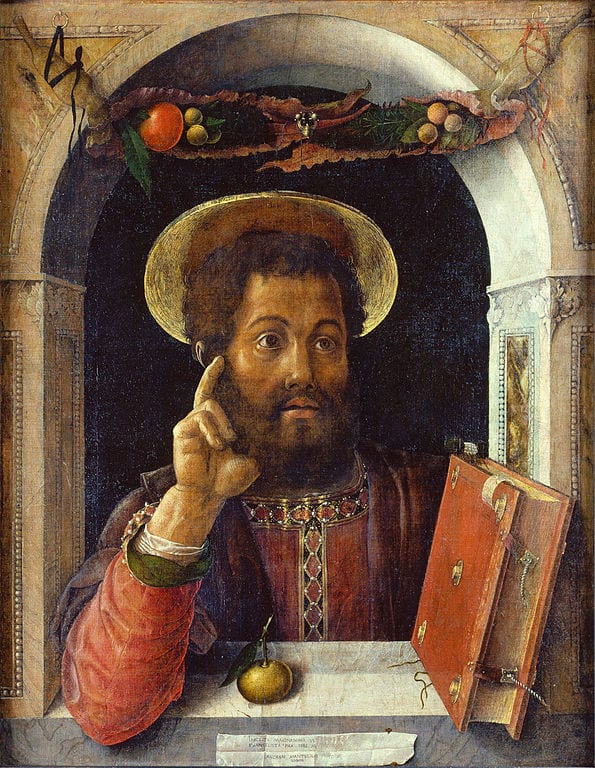
Photo credit: Saint Mark (1450), by Andrea Mantegna (1431-1506) [public domain / Wikimedia Commons]

***
Jews & Judaism & Old Testament
Previous Post

February 7, 2021
Pearce’s Potshots #15: Gospel of Matthew vs. Gospel of Mark?
Next Post

February 9, 2021 Mandatory COVID Vaccines & Facebook Fascist Censorship
Browse Our Archives
Select a Category & Last Things About Me Anti-Catholicism Atheism & Agnosticism Baptism and Sacramentalism Bible and Tradition Blessed Virgin Mary Books by Dave Armstrong C. S. Lewis Calvinism & General Protestantism Catholic Apologetics Catholic Apologists Catholic conversion Catholic converts Christmas Church (Ecclesiology) Church History Conversion and Converts Development of Doctrine Eastern Orthodoxy Ecumenism & Christian Unity Eucharist & Liturgy Fathers of the Church French Translations G. K. Chesterton Hell Hell & Satan Hell & Satan & Last Things Heresies & Comparative Religion Holistic Health Inquisition & Crusades & Scandals James White Jews & Judaism & Old Testament John Calvin John Henry Newman Liberal / Modernist Theology Life Issues Literary Resume Lutheranism Mariology Martin Luther Music Orthodoxy Papacy & Infallibility Personal Page Philosophy & Science Political & Ethical & Moral Issues Protestant Persecution & Intolerance Protestantism Purgatory Purgatory & Penance Romantic & Imaginative Theology Saints & Purgatory & Penance Salvation Salvation & Justification Satan & Last Things Sexuality and Gender Issues Spanish Translations Traditionalism vs. Radical Catholic Reactionaries Traducciones al español / tradução para português Trinitarianism & Christology Uncategorized Videos
Select a Month October 2026 September 2026 August 2026 July 2026 June 2026 May 2026 April 2026 March 2026 February 2026 January 2026 December 2025 November 2025 October 2025 September 2025 August 2025 July 2025 June 2025 May 2025 April 2025 March 2025 February 2025 January 2025 December 2024 November 2024 October 2024 September 2024 August 2024 July 2024 June 2024 May 2024 April 2024 March 2024 February 2024 January 2024 December 2023 November 2023 October 2023 September 2023 August 2023 July 2023 June 2023 May 2023 April 2023 March 2023 February 2023 January 2023 December 2022 November 2022 October 2022 September 2022 August 2022 July 2022 June 2022 May 2022 April 2022 March 2022 February 2022 January 2022 December 2021 November 2021 October 2021 September 2021 August 2021 July 2021 June 2021 May 2021 April 2021 March 2021 February 2021 January 2021 December 2020 November 2020 October 2020 September 2020 August 2020 July 2020 June 2020 May 2020 April 2020 March 2020 February 2020 January 2020 December 2019 November 2019 October 2019 September 2019 August 2019 July 2019 June 2019 May 2019 April 2019 March 2019 February 2019 January 2019 December 2018 November 2018 October 2018 September 2018 August 2018 July 2018 June 2018 May 2018 April 2018 March 2018 February 2018 January 2018 December 2017 November 2017 October 2017 September 2017 August 2017 July 2017 June 2017 May 2017 April 2017 March 2017 February 2017 January 2017 December 2016 November 2016 October 2016 September 2016 August 2016 July 2016 June 2016 May 2016 April 2016 March 2016 February 2016 January 2016 December 2015 November 2015 October 2015 September 2015 August 2015 July 2015 June 2015 May 2015 April 2015 March 2015 February 2015 January 2015 December 2014 November 2014 October 2014 September 2014 August 2014 July 2014 June 2014 April 2014 March 2014 February 2014 January 2014 December 2013 November 2013 October 2013 September 2013 August 2013 July 2013 June 2013 April 2013 March 2013 February 2013 January 2013 December 2012 November 2012 October 2012 September 2012 August 2012 July 2012 June 2012 May 2012 April 2012 March 2012 February 2012 January 2012 December 2011 November 2011 October 2011 September 2011 August 2011 July 2011 June 2011 April 2011 March 2011 February 2011 October 2010 September 2010 August 2010 July 2010 April 2010 March 2010 December 2009 October 2009 August 2009 July 2009 June 2009 May 2009 March 2009 February 2009 October 2008 September 2008 April 2008 March 2008 February 2008 January 2008 December 2007 November 2007 October 2007 May 2007 March 2007 February 2007 January 2007 November 2006 October 2006 September 2006 August 2006 July 2006 June 2006 May 2006 April 2006 March 2006 February 2006 October 2005 June 2005 April 2005 February 2005 July 2004 May 2004 April 2004
Follow Us!
TAKE THE
Religious Wisdom Quiz
Proverbs warns against what kind of woman as a symbol of temptation?
Select your answer to see how you score.
Widow Mother-in-law Queen Adulterous woman
Books by This Author Books by Dave Armstrong
Related posts from Biblical Evidence for Catholicism

A Few "Worst" & "Best" Arguments vs. Protestantism
Biblical Evidence for Catholicism

Jerusalem Council vs. James White & Sola Scriptura
Biblical Evidence for Catholicism

Biblical Perspicuity: Absurd Anti-Catholic "Defense"
Biblical Evidence for Catholicism

50 Biblical Disproofs of "Evident Clearness" of the...
Biblical Evidence for Catholicism
TRENDING AT PATHEOS Catholic

The Sermon on the Mount, Part I: Matthew...
The Sermon on the Mount, Part I (Matthew 4:12-5:12) St. Matthew moves...

What's up from Crossway: Reviewing some of their latest A few weeks...

Janie Learns the Way of the Cross: A...
Teaching children about Jesus' Passion can be challenging. Many parents and educators...

Looking For Good Catholic Writing - October 2026
He alone extends the heavens, and he walks upon the waves of...

In "Irreplaceable," our book on vocation and technology, Trevor Sutton and I...

I was strolling through the top floor of the brand new Parthenon...
view all Catholic blogs
Ad-Free & Subscriber Log-In Subscription Support
- About Us
- 2026 Calendar
- Videos
- Podcasts
- Library of World Religions
- Faith In Media Tracker
- Advertise With Us
- Write for Us
- Privacy Policy
- Terms of Service
- Do Not Sell My Data
- Contact Us
- Radiant Digital
- Manage Newsletter Subscriptions
- Unsubscribe From Notifications
- Sitemap
Copyright 2008-2026, Patheos. All rights reserved.
Subscription Support Ad-Free & Subscriber Log-In
Follow Patheos