
BuddhistCatholicContemplativeEvangelicalGeneral ChristianHinduJewishLatter-day SaintMuslimNew VisionsProgressive Christian
Beliefs
- Buddhist
- Catholic
- Contemplative
- Evangelical
- General Christian
- Hindu
- Jewish
- Latter-day Saint
- More Voices
- Muslim
- New Visions
- Pagan
- Progressive Christian
Topics
- Religion News
- Food and Religion
- Sports and Religion
- Religious Art
- Religious Music and Entertainment
- Religious Events
- History and Religion
- Style and Religion
- Politics and Religion
- Women in Religion
- Recreation Outdoors and Religion
- Business Finance and Religion
- Careers Workplace and Religion
- Education and Religion
- Family Parenting and Religion
- Health Fitness and Religion
- Home and Religion
- Relationships and Religion
- Technology and Religion
- Travel and Religion
Columnists
- Buddhist Columnists
- Business Finance and Religion Columnists
- Careers Workplace and Religion Columnists
- Catholic Columnists
- Contemplative Columnists
- Education and Religion Columnists
- Evangelists Columnists
- Family Parenting and Religion Columnists
- General Christian Columnists
- Health Fitness and Religion Columnists
- Hindu Columnists
- History and Religion Columnists
- Home and Religion Columnists
- Jewish Columnists
- More Voices Columnists
- Latter Day Columnists
- Muslim Columnists
- New Visions Columnists
- Nonreligious Columnists
- Pagan Columnists
- Politics and Religion Columnists
- Progressive Columnists
- Recreation Outdoors and Religion Columnists
- Relationships and Religion Columnists
- Religion News Columnists
- Religious Art Columnists
- Religious Events Columnists
- Religious Music and Entertainment Columnists
- Sports and Religion Columnists
- Style and Religion Columnists
- Technology and Religion Columnists
- Travel and Religion Columnists
- Women in Religion Columnists
Resource Library
- 2026 Calendar
- Library of World Religions
- The 100 Most Holy Places on Earth
- Patheos Answers
- Podcasts
- Videos
- Faith Leaders Database
- Anglican Episcopalian
- Bahai
- Baptist
- Buddhism
- Christianity
- Confucianism
- Eastern Orthodoxy
- Hinduism
- Holiness and Pentecostal
- ISKCON
- Islam
- Judaism
- Lutheran
- Methodist
- The Church of Jesus Christ of Latter-day Saints
- New Age
- Paganism
- Presbytarian and Reformed
- Protestantism
- Religion Behind the Scenes
- Roman Catholic
- Scientology
- Shia Islam
- Sikhism
- Sufism
- Sunni Islam
- Taoism
- Zen
- See all religions
Research Tools
 Ad-Free & Subscriber Log-In Subscription Support
Ad-Free & Subscriber Log-In Subscription Support
Follow Patheos 

- Trending:
- Forgiveness
- |
- Marriage
- |
- Consciousness
- |
- Death Penalty
- |
- Election
- |
- Halloween

-
About
-
Catholic Apologetics
-
Church History
-
Great Apologists
-
Christian Worldview
-
Protestantism & Misc.
- Home
- Catholic
- History and Religion
- Gospel of Matthew Bashing Refuted Point-by-Point
Gospel of Matthew Bashing Refuted Point-by-Point
Last updated on: June 5, 2026 at 11:57 pm by Dave Armstrong
Gospel of Matthew Bashing Refuted Point-by-Point 2026-06-05T23:57:49-04:00 Dave Armstrong
Patheos Explore the world's faith through different perspectives on religion and spirituality! Patheos has the views of the prevalent religions and spiritualities of the world.
“The Gospel According to Saint Matthew” was written by atheist Vexen Crabtree in 2016. I will examine his “anti-biblical” arguments to see if they can withstand criticism. Vexen’s words will be in blue.
*****
The Gospel of Matthew is a later copy of the Gospel of Mark, using 92% of its text.
It’s grossly inaccurate to call Matthew simply a “copy” of Mark. Sure, it draws heavily from Mark, as almost all Christians would agree (though likely not it only), but it’s a different book. Probably the majority of biblical scholars today hold to the “two source hypothesis”: that is, the view that both Matthew and Luke independently drew from both Mark and “Q”: a lost collection of Jesus’ sayings. Mr. Crabtree recognizes this in writing, later: “historians are sure that a common source document was used for all of them. They call it ‘Q’ after the German word for ‘source’ “.
One Introduction to the New Testament summarizes the Synoptic situation:
[W]hat makes the synoptic problem particularly knotty is the fact that, alongside such exact agreements, there are so many puzzling differences. . . .
Each evangelist . . . omits material found in the other two, each contains unique incidents, and some of the events that are found in one or both of the others are put in a different order. (by D. A. Carson, Douglas J. Moo, and Leon Morris, Grand Rapids, Michigan: Zondervan, 1992, pp. 26-27)
Nor are the three Synoptic Gospels to be seen as merely redundant testimony. Each provides its own slant, together providing a kind of stereoscopic depth that would otherwise be almost entirely missing. (Ibid., p. 84)
The same source refers to the “combination of exact agreement and wide divergence that characterizes the first three gospels” (p. 27). In any event, this reference book explains that the “wholesale takeover, without acknowledgment, of someone else’s literary work, with or without changes, was a common practice in the ancient world, and no opprobrium was connected with it” (p. 73).
Of course, anti-theist atheists routinely throw out the accusation of “dishonesty” and “lying” and fiction-creation by the biblical writers, but they show no real basis for such hostile conclusions, and almost invariably don’t understand key aspects of the culture of the time (such as this one about the practices of ancient writers utilizing existing materials).
It is anonymous and it wasn’t until about 150 CE that the author “Matthew” was assigned.
Carson et al stated that “we have no evidence that these gospels ever circulated without an appropriate designation . . .” (p. 66). And they add:
[T]he argument that Matthew was understood to be the author of the first gospel long before Papias wrote his difficult words affirming such a connection seems very strong, even if not unassailable. (Ibid., p. 67)
Atheists simply throw out these dates because by then the books were widely known by certain titles. It doesn’t follow, however, that they were not before. They may have been, and more recent scholarship has trended in the direction of earlier use of titles than was previously supposed by the beloved omniscient “higher critics”.
Matthew [was] not written by an eye-witness of Jesus. We know this because it is a copy of Mark. No eye witness of such an important person would have needed, or wanted, to simply copy someone-else’s memories about him.
Well, we deny the premise that Matthew was only “plagiarism of Mark with a few details added.” That just doesn’t fly, upon close analysis. As to eye-witness testimony, J. Warner Wallace observed:
I’m sometimes surprised skeptics resist the claim (at least) that the gospels are written as eyewitness accounts. We can argue about whether or not the gospels are pure fiction, or whether or not they are accurate. But the idea that the gospels can be read as eyewitness accounts is rather unremarkable to me. The gospels record events from the perspective of writers who either saw the events themselves or had access to those who did. The author of John’s gospel describes a meeting between Jesus and his disciples. This meeting appears to include the author and he makes the following claim:
“This is the disciple who is testifying to these things and wrote these things, and we know that his testimony is true.” (John 21:24)
It certainly appears that the author considers himself to be both a participant in the narrative and a reporter (eyewitness) of the event. That seems rather unremarkable to me. Even if the author is someone other than John, the claim (at the very least) that the author is an eyewitness seems plain. In addition, the author of Luke’s gospel describes himself as a historian who had access to the eyewitnesses:
“Inasmuch as many have undertaken to compile an account of the things accomplished among us, just as they were handed down to us by those who from the beginning were eyewitnesses and servants of the word…” [Lk 1:1-2]
Even if the author of Luke was not himself an eyewitness, it does appear that he believed he was recording true history as delivered to him from eyewitnesses. Once again, this seems unremarkable. (“Can the Gospels be Defended as Eyewitness Accounts?”, Cold-Case Christianity, 1-26-15)
It is written in Greek and not in the native tongues of anyone who met and followed Jesus,
What difference does it make what language it was written in? As a Jew in Palestine in the first century, Matthew would have spoken Aramaic. As a tax collector, he would also have known Greek and Hebrew. It’s said that his style of Greek (less elegant than the Gentile Luke’s) is as if it has a strong Aramaic “accent.”
and it was written too late to reasonably be the memóires of an eye-witness.
It’s not too late at all insofar as it is a personal account, and/or well within range to consult many who were eyewitnesses or earwitnesses to the events. Oral traditions were much stronger in those times and information was routinely preserved in this manner with remarkable accuracy. Encyclopaedia Britannica (“Oral tradition”) explains this notion (very foreign to modern persons in developed and highly literate societies):
In the 1930s, for example, two American scholars, Milman Parry and Albert Lord, conducted extensive fieldwork on oral tradition in the former Yugoslavia. They recorded more than 1,500 orally performed epic poems in an effort to determine how stories that often reached thousands of lines in length could be recalled and performed by individuals who could neither read nor write. What they found was that these poets employed a highly systematic form of expression, a special oral language of formulaic phrases, typical scenes, and story patterns that enabled their mnemonic and artistic activities. With this information in hand, Parry and Lord were able to draw a meaningful analogy to the ancient Greek Iliad and Odyssey, which derived from oral tradition and obey many of the same rules of composition. The mystery of the archaic Homeric poems—simply put, “Who was Homer and what relation did he have to the surviving texts?”—was solved by modern comparative investigation. Whoever Homer was, whether a legend or an actual individual, the poems attributed to him ultimately derive from an ancient and long-standing oral tradition.
Other familiar works with deep roots in oral tradition include the Judeo-Christian Bible, the Mesopotamian Epic of Gilgamesh, and the medieval English Beowulf. The famous “begats” genealogy of the Bible’s book of Genesis and corresponding elements found in the four Gospels of the New Testament provide examples of how flexible oral-traditional systems can produce different but related products over many generations. Similarly, what survives in the fragmentary record of Gilgamesh is evidence of a broadly distributed tale in the ancient Middle East, one that passed easily from culture to culture and language to language before being inscribed on tablets. Beowulf, whose unique manuscript dates to the 10th century CE, circulated in oral tradition for centuries before Irish missionaries introduced the new technology of inked letters on parchment.
Bottom line? Even Mr. Crabtree holds that Matthew was written between 70-100 AD. That’s “nothing” in terms of an oral tradition being preserved with minute accuracy. No problem at all. And it’s early enough to be either from a direct witness (Matthew) or reported by same.
Matthew specifically set out to correct many mistakes in Mark’s gospel, especially regarding comments on Jewish customs and practices.
Well, that was Mr. Crabtree’s goal: to show this. I think I systematically dismantled his case in my previous two papers along these lines:
Pearce’s Potshots #15: Gospel of Matthew vs. Gospel of Mark? [2-7-21]
Groundless Gospel of Mark Bashing Systematically Refuted (vs. Vexen Crabtree) [2-9-21]
In many cases he found a text, and because he did not know Jesus, felt free to invent details in order to make the Old Testament text he was reading appear as a prophecy.
Mr. Crabtree acts as if what Matthew did (i.e., what he actually did; not atheist caricatures of it) is unethical or dishonest. It wasn’t. On this question, see:
“Matthew’s Use of the Old Testament: A Preliminary Analysis” (Lee Campbell Ph.D., Xenos Christian Fellowship)
“New Testament use of the Old Testament” (Theopedia)
2.1. There Was No Virgin Birth
The Prophecy of the Virgin Birth appears in Matthew 1:22-23. Matthew wrote this seventy years after Jesus Christ was born (35-40 years after he died). Up until that point no other text mentions Jesus’ virgin birth. He quotes Isaiah 7:14 which was written 700 years before Jesus was born – thus claiming it was a sign, a prediction of the messiah’s virgin birth.
Yes, it was.
But there is a serious problem. Matthew states that, due to prophecy, it is true that Jesus was a male line descendant of King David, and presents a genealogy at the beginning of his gospel tracing Jesus’ lineage through Joseph. Matthew, apparently, like Luke and Paul and the rest of the early Christians, did not believe in a virgin birth. There are two theories that explain how this contradiction occurred. (1) A Septuagint mistranslation of the word “virgin” instead of “young woman” caused the discrepancy. The original prophecy is not that someone called Immanuel will be born of a virgin, but merely that someone called Immanuel will be born. In the original context of the story, this makes a lot of sense. (2) Matthew, writing for a Roman gentile audience in Greek, included popular myths surrounding sons of gods, who in Roman mythology were frequently said to be born of virgins. In either case, it is clear that Matthew’s prophecy of a virgin birth was a mistake, and modern Bible’s actually include a footnote in Matthew pointing out that the virgin birth is a Septuagint mistranslation. . . .
It is only a later Greek mistranslation that makes Matthew say “called Immanuel, born of a virgin”, rather than “of a young woman”.
I’ve addressed these matters at great length:
Reply to Atheist Jonathan MS Pearce: “Mistranslation” of “Virgin”? (Isaiah 7:14) (with Glenn Miller) [7-26-17]
Dual Fulfillment of Prophecy & the Virgin Birth (vs. JMS Pearce) [12-18-20]
Other Christians and Previous Christians Did Not Believe in the Virgin Birth
- 50ce : The writer(s) of the gospel of Q were unaware of the virgin birth.
- 64ce : Paul died without writing of the virgin birth.
- 70ce : The writer of the Gospel of Mark does not mention it.
Not mentioning something is not the same as a denial. This should be self-evident to anyone. It’s a simple matter of logic. The Gospel of John and all of Paul’s epistles in the Bible never mention camels, either. Does it follow that both men denied their existence?
But a case can be made that Paul did allude to it. J. Warner Wallace contended:
Galatians 4:4-5 But when the fullness of the time came, God sent forth His Son, born of a woman, born under the Law, so that He might redeem those who were under the Law, that we might receive the adoption as sons.
Paul says that Jesus was “born of a woman” and not “born of a virgin”. Critics have argued that this is proof that Paul was unaware of the virgin conception. But this is not necessarily the case. Many scholars have observed that the expression, “born of a woman, born under the Law” implies that Jesus had no earthly father because Paul curiously chose to omit any mention of Joseph in this passage. It was part of the Hebrew culture and tradition to cite the father alone when describing any genealogy, yet Paul ignored Joseph and cited Mary alone, as if to indicate that Joseph was not Jesus’ father. (“Why Didn’t Paul Mention the Virgin Conception?”, Cold-Case Christianity, 12-14-18)
2.2. The Guiding Star
One of Matthew’s plotlines is the three visitors from the East who visit the newborn Jesus. They say that a star came up in the East, however no other people in the story appear to notice this. It must have been a relatively unnoticeable event, a fairly faint star, only noticed by people who study the stars. The three visitors are called “Star Readers” in Matthew 2:1. However no other astrologers across the world at that time document this phenomenon. It appears Matthew made it up.
It so happens that I did a great deal of study on the star of Bethlehem last December:
Star of Bethlehem, Astronomy, Wise Men, & Josephus (Amazing Astronomically Verified Data in Relation to the Journey of the Wise Men & Jesus’ Birth & Infancy) [12-14-20]
Star of Bethlehem: Refuting Silly Atheist Objections [12-26-20]
Star of Bethlehem: More Silly Atheist “Objections” [12-29-20]
2.3. Matthew 21:1-7 – The Prophecy of the 2 Donkeys
Mark wrote that Jesus rode triumphantly into Jerusalem on a donkey. Luke and John both stuck to this. Matthew was in the habit of “correcting” Mark’s errors and on this point of Jesus’ riding into Jerusalem, Matthew felt he should have been riding on two donkeys at the same time.
On all three times Matthew mentions this part (Matthew 21:1-7) he says the same thing, so it was not a transcription error. Why does Matthew alter the text in such a bizarre way? It seems he misread Zechariah 9:9: “mounted on a donkey, and on a colt, the foal of a donkey”. We have already seen from Matthew’s misinterpretation of the difference between the Hebrew word “Almah” and “Betulah” that he has a poor understanding of Hebrew. This passage also was misunderstood by Matthew.
“In Hebrew an emphasis is expressed by the doubling of a word or a phrase, like “and David’s enemies were dead, and yes, very dead,” so the original phrase does not mean two animals at all (as is also clearly shown by Jewish comments on the passage).”
Once again Matthew changed the meaning of the text to reflect what he thought it should say in order to make a prophecy come true, a conscious act of fraud in order to make the text fits his own personal opinion of the facts.
This is hogwash, I have dealt with this charge already:
David Madison vs. the Gospel of Mark #10: Chapter 11 (Two Donkeys? / Fig Tree / Moneychangers) [8-20-19]
2.4. Matthew 2:16-18 – King Herod: The Killing of Every Male Baby
Chapter two of Matthew tells us of King Herod’s anger at the three wise men and then of the killing of every child. Surely, the slaughter of every male child (Matthew 2:16-18) in Bethlehem, Ramah, and the surrounding area would have got mentioned in many places, such as Josephus’ detailed accounts of the times, in fact it would likely cause the downfall of such an immoral, monstrous leader who issued such orders!
Catholic apologist Trent Horn offers a superb rebuttal of this standard playbook accusation from atheists:
Such an act of cruelty perfectly corresponds with Herod’s paranoid and merciless character, which bolsters the argument for its historicity. Josephus records that Herod was quick to execute anyone he perceived to threaten his rule, including his wife and children (Antiquities 15.7.5–6 and 16.11.7). Two Jewish scholars have made the case that Herod suffered from “Paranoid Personality Disorder,” and Caesar Augustus even said that it was safer to be Herod’s pig than his son.
In addition, first-century Bethlehem was a small village that would have included, at most, a dozen males under the age of two. Josephus, if he even knew about the massacre, probably did not think an isolated event like the killings at Bethlehem needed to be recorded, especially since infanticide in the Roman Empire was not a moral abomination as it is in our modern Western world.
[prominent archaeologist William F. Albright estimated the population of Bethlehem at the time of Jesus’ birth to be about 300 people]
Herod’s massacre would also not have been the first historical event Josephus failed to record.
We know from Suetonius and from the book of Acts that the Emperor Claudius expelled the Jews from Rome in A.D. 49, but neither Josephus nor the second century Roman historian Tacitus record this event (Acts 18). Josephus also failed to record Pontius Pilate’s decision to install blasphemous golden shields in Jerusalem, which drove the Jews to petition the emperor for their removal. The Alexandrian philosopher Philo was the only person to record this event.
Sometimes historians choose not to record an event, and their reasons cannot always be determined. In the nineteenth century Pope Leo XIII noted the double standard in critics for whom “a profane book or ancient document is accepted without hesitation, whilst the Scripture, if they only find in it a suspicion of error, is set down with the slightest possible discussion as quite untrustworthy” (Providentissimus Deus, 20).
We should call out this double standard when critics demand that every event recorded in Scripture, including the massacre of the Holy Innocents, be corroborated in other non-biblical accounts before they can be considered to be historical. (“Is the Massacre of the Holy Innocents Historical?”, Catholic Answers, 12-26-19)
Many other myths, including more ancient Roman ones, had an event where all the male children were killed, and the famous Romulus and Remus story is (once again) a good, famous example. The story of Moses also contains a period of time when all Jewish male children are being killed by the King of the time, when Moses escapes in a basket pushed down a river by his mother. The princess who picked him out of the water called him Moses, which means “picked out”. . . .
Matthew appears to have included, as part of Jesus’ history, the same story that accompanies many other myths in history. That of the darkening of the sun when an important person dies. . . .
Graves continues to partially list major myths of the time that included such a darkening of the sun: The ancient pagan demigod Senerus, the Indian God Chrishna, the Egyptian Osiris, Prometheus, Romulus, even Caesar and Alexander the Great.
If we removed from Matthew all the stories about Jesus that were to be found to be part of Roman popular culture about sons-of-gods, then, we find that there is very little left! Some people theorize that all stories about Jesus are copies of other stories because Jesus himself never existed!
So what! How would this “logic” work? Let’s see: “if ever in history an event, x, occurred [Christians and Jews think the story of Moses is historical], which included in it sub-event y, then it follows that y can never ever happen again, since it already happened!” Huh? This would be scornfully laughed out of any course on logic anytime, anywhere.
By this logic, because President Lincoln was shot and killed by a pistol, it follows that Presidents Garfield and McKinley could not have been. Makes sense, huh? But Mr. Crabtree is actually being even more ridiculous than that. He is also arguing, “if in non-historical mythology, an event, x is described, which included in it sub-event y, then it follows that y can never ever happen in real life.”
Therefore, by his “reasoning” because the wicked witch was burned to death in her own oven, in the German fairy tale Hansel and Gretel, no one could ever actually be burned to death in an oven. The existence of the fairy tale / myth precludes the possibility of it ever occurring in real life.
Anti-theist atheists engage in this sort of logical ludicrosity time and again: apparently never stopping to think that it is perfectly absurd. Or if they know it’s logically absurd, they use it anyway if they perceive that it “works” in order to further their goal of painting Christianity and the Bible as worthy only of loathing and mockery.
2.5. The End of the World is Imminent
Jesus in the Christian Bible proclaimed many times that the world was about to end: judgement was about to come and he specifically said that this would happen in the same generation that he first appeared in. Obviously, there has been a delay. St Paul taught the same message, preaching the urgent admission of sins, because of the imminent end. The rest of the New Testament, especially the Book of Revelations, provides many more cryptic clues about when this will occur. This is what has spurred the endless stream of historical proclamations by studious Christians that the end is near. Matthew 24:27-44 is a lengthy commentary on when the Son of Man comes to end the world, but various hints and comments are scattered throughout the rest of New Testament. Some of the relevant comments in Matthew are:
- The imminent end of the world will be obvious to all (Matthew 24:27). Jesus quotes Isaiah 13:10, 34:4, saying that the sun will go out and the stars will fall from the sky (Matthew 24:29, copied from Mark 13:20-26). The Son of Man will arrive in the clouds with great power and trumpets (24:30-31 copied from Mark 13:27). There will be signs just before the end although no-one knows in advance at what hour the end-times will come (Matthew 24:32-39, copied from Mark 13:28-33). The end of the world starts with the rapture, when approximately one in two men and one in two women will be raptured and taken into heaven, suddenly, by God (Matthew 24:40-41).
- It is imminent: Jesus warns clearly that “this generation will certainly not pass away until all these things have happened. This world will pass away…” (Matthew 16:28, 24:34-35, Mark 9:1, 13:30 and Luke 9:26-27). In Matthew 10:23 Jesus warns his disciples to preach very rapidly in town after town, fleeing at the first sign of persecution, because they will not have enough time to go through all the towns of Israel before the end of the world occurs. In 1 Corinthians 7:27-31 St Paul says that time is so short, people should no longer bother getting married, mourn or bother with possessions: “Those who have wives should live as if they had none; … those who buy something, as if it were not theirs to keep; those who use the things of the world, as if not engrossed in them. For this world in its present form is passing away”. Matthew 8:22 dismisses niceties of funeral arrangements “let the dead bury their own dead” because followers must join Jesus immediately, before it is too late!
I had dealt with this issue three times:
“The Last Days”: Meaning in Hebrew, Biblical Thought [12-5-08]
Dr. David Madison vs. Jesus #3: Nature & Time of 2nd Coming [8-3-19]
Then I was made aware of an online copy of a master’s thesis on this topic by a friend of mine, David Palm, entitled “The Signs of His Coming”: for Trinity Evangelical Divinity School, Deerfield, Illinois (1993). He wrote it as an evangelical Protestant, later became a Catholic, and recently noted that he would change nothing in it. I summarized his arguments in this paper:
Seidensticker Folly #58: Jesus Erred on Time of 2nd Coming? (with David Palm) [10-7-20]
Matthew contributed some very unlikely events to the Biblical account of the crucifixion and resurrection.
Whether an event is “unlikely” or not is irrelevant to whether it actually happened. Lots of “strange” things have happened throughout history.
For example, the Guards on the Tomb,
How is that “very unlikely”? Atheists have bandied about the story of the supposed stolen body of Jesus, in order to explain away the resurrection, for centuries. If they can “reason” like that, then it follows that the people of the time could have as well. The very prevalence of this skeptical motif renders it likely and plausible.
the empty Tomb,
Yeah, it’s very unlikely. But it didn’t mean it didn’t happen.
the Angel,
In the Bible there are such things as angels! We understand that atheists disbelieve in them. Again, mere disbelief is not proof of the non-existence of angels, anymore than it is for God’s existence.
the Earthquake
Now there is scientific evidence that an earthquake did indeed occur around the time of the crucifixion of Jesus. See:
The Christ Quake (documentary)
Crucifixion Quake (documentary)
and the 3 hours darkness at Jesus’ death
If this wasn’t a natural event (a lunar eclipse or a storm with very dark cloud cover, which can happen), then it could have been a supernatural darkness. If God exists and if indeed He is omnipotent, then this is entirely possible.
are all very likely to be wrong.
On what basis? Bald assertion is neither argument nor evidence.
Matthew exaggerates elements when copying Mark to the point of making it up, for example the young-boy who at Jesus’ tomb becomes a radiant angel who scares off the guards (Matthew 28).
Angels are often called men in Scripture. But there could easily have been more than one angel involved. The Gospels taken together, show that this is the case. Deliberate lying or deception is not a plausible or provable hypothesis.
These side-stories, although not essential to the idea of the resurrection, reinforce the feeling that Matthew was writing anything he could to make Jesus out to have existed, whether such things were true or not.
Mr. Crabtree has not cast serious doubt on these things; not by these arguments. That Jesus exists is the consensus of virtually all serious scholars. See: Seidensticker Folly #4: Jesus Never Existed, Huh? [8-14-18].
Mr. Crabtree then cites atheist Richard Carrier at length. His words will be in green:
Doesn’t the fact that the tomb was guarded make escape unlikely, even if Jesus survived?
Not if Jesus was resurrected, and if He was God (as Christians believe). A mere stone would then be irrelevant as to His “escape.”
Although one gospel accuses the Jews of making up the theft story, it is only that same gospel, after all, which mentions a guard on the tomb, and the authors have the same motive to make that up as the Jews would have had to make up the theft story: by inventing guards on the tomb the authors create a rhetorical means of putting the theft story into question, especially for the majority of converts who did not live in Palestine.
I already answered this above:
Atheists have bandied about the story of the supposed stolen body of Jesus, in order to explain away the resurrection, for centuries. If they can “reason” like that, then it follows that the people of the time could have as well. The very prevalence of this skeptical motif renders it likely and plausible.
I think atheists and the Jewish opponents of Jesus making such a story up is at least as plausible as the Gospel writers doing so.
An additional reason to reject Matthew’s story is that it contradicts all other accounts and is illogical: if the tomb was sealed until the angel came and moved the stone before the women and the guards, how did Jesus leave the tomb undetected? Did he teleport? For he wasn’t in the tomb: it was already empty. Even if he want to imagine that he did teleport, all the other Gospels record that the stone had already been moved when the women arrived (Mark 16:4, Luke 24:2, John 20:1). Thus, Matthew’s account is contradicted three times, even by an earlier source (Mark), and does not make a lot of sense. That is further ground for rejecting it: for Matthew alone must have the angel open the tomb when the women are present in order to silence the guards that he alone has put there.
I just got through writing an exhaustive two-part refutation of numerous anti-resurrection claims:
Pearce’s Potshots #13: Resurrection “Contradictions” (?) [2-2-21]
Pearce’s Potshots #14: Resurrection “Contradictions” #2 [2-4-21]
And I had done some before, too:
Silly Atheist Arguments vs. the Resurrection & Miracles [2002]
Dialogue w Atheist on Post-Resurrection “Contradictions” [1-26-11]
Seidensticker Folly #18: Resurrection “Contradictions”? [9-17-18]
Jesus’ Resurrection: Scholarly Defenses of its Historicity [4-12-20]
***
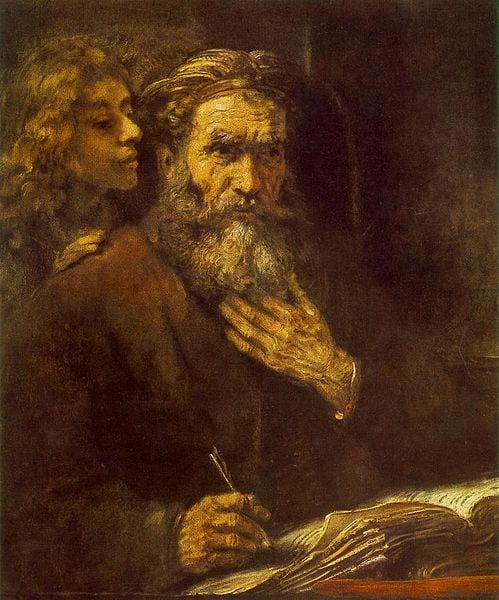
Photo credit: The evangelist Matthew and the angel (1661), by Rembrandt (1606-1669) [public domain / Wikimedia Commons]

***
Previous Post

February 10, 2021
Why Do I Defend the Bible Against Atheist Attacks?
Next Post

February 11, 2021 Debate on Fascist Facebook Censorship & Cancel Culture
Browse Our Archives
Select a Category & Last Things About Me Anti-Catholicism Atheism & Agnosticism Baptism and Sacramentalism Bible and Tradition Blessed Virgin Mary Books by Dave Armstrong C. S. Lewis Calvinism & General Protestantism Catholic Apologetics Catholic Apologists Catholic conversion Catholic converts Christmas Church (Ecclesiology) Church History Conversion and Converts Development of Doctrine Eastern Orthodoxy Ecumenism & Christian Unity Eucharist & Liturgy Fathers of the Church French Translations G. K. Chesterton Hell Hell & Satan Hell & Satan & Last Things Heresies & Comparative Religion Holistic Health Inquisition & Crusades & Scandals James White Jews & Judaism & Old Testament John Calvin John Henry Newman Liberal / Modernist Theology Life Issues Literary Resume Lutheranism Mariology Martin Luther Music Orthodoxy Papacy & Infallibility Personal Page Philosophy & Science Political & Ethical & Moral Issues Protestant Persecution & Intolerance Protestantism Purgatory Purgatory & Penance Romantic & Imaginative Theology Saints & Purgatory & Penance Salvation Salvation & Justification Satan & Last Things Sexuality and Gender Issues Spanish Translations Traditionalism vs. Radical Catholic Reactionaries Traducciones al español / tradução para português Trinitarianism & Christology Uncategorized Videos
Select a Month October 2026 September 2026 August 2026 July 2026 June 2026 May 2026 April 2026 March 2026 February 2026 January 2026 December 2025 November 2025 October 2025 September 2025 August 2025 July 2025 June 2025 May 2025 April 2025 March 2025 February 2025 January 2025 December 2024 November 2024 October 2024 September 2024 August 2024 July 2024 June 2024 May 2024 April 2024 March 2024 February 2024 January 2024 December 2023 November 2023 October 2023 September 2023 August 2023 July 2023 June 2023 May 2023 April 2023 March 2023 February 2023 January 2023 December 2022 November 2022 October 2022 September 2022 August 2022 July 2022 June 2022 May 2022 April 2022 March 2022 February 2022 January 2022 December 2021 November 2021 October 2021 September 2021 August 2021 July 2021 June 2021 May 2021 April 2021 March 2021 February 2021 January 2021 December 2020 November 2020 October 2020 September 2020 August 2020 July 2020 June 2020 May 2020 April 2020 March 2020 February 2020 January 2020 December 2019 November 2019 October 2019 September 2019 August 2019 July 2019 June 2019 May 2019 April 2019 March 2019 February 2019 January 2019 December 2018 November 2018 October 2018 September 2018 August 2018 July 2018 June 2018 May 2018 April 2018 March 2018 February 2018 January 2018 December 2017 November 2017 October 2017 September 2017 August 2017 July 2017 June 2017 May 2017 April 2017 March 2017 February 2017 January 2017 December 2016 November 2016 October 2016 September 2016 August 2016 July 2016 June 2016 May 2016 April 2016 March 2016 February 2016 January 2016 December 2015 November 2015 October 2015 September 2015 August 2015 July 2015 June 2015 May 2015 April 2015 March 2015 February 2015 January 2015 December 2014 November 2014 October 2014 September 2014 August 2014 July 2014 June 2014 April 2014 March 2014 February 2014 January 2014 December 2013 November 2013 October 2013 September 2013 August 2013 July 2013 June 2013 April 2013 March 2013 February 2013 January 2013 December 2012 November 2012 October 2012 September 2012 August 2012 July 2012 June 2012 May 2012 April 2012 March 2012 February 2012 January 2012 December 2011 November 2011 October 2011 September 2011 August 2011 July 2011 June 2011 April 2011 March 2011 February 2011 October 2010 September 2010 August 2010 July 2010 April 2010 March 2010 December 2009 October 2009 August 2009 July 2009 June 2009 May 2009 March 2009 February 2009 October 2008 September 2008 April 2008 March 2008 February 2008 January 2008 December 2007 November 2007 October 2007 May 2007 March 2007 February 2007 January 2007 November 2006 October 2006 September 2006 August 2006 July 2006 June 2006 May 2006 April 2006 March 2006 February 2006 October 2005 June 2005 April 2005 February 2005 July 2004 May 2004 April 2004
Follow Us!
TAKE THE
Religious Wisdom Quiz
Who led the Israelites into the Promised Land?
Select your answer to see how you score.
Aaron Caleb Joshua Moses
Books by This Author Books by Dave Armstrong
Related posts from Biblical Evidence for Catholicism

A Few "Worst" & "Best" Arguments vs. Protestantism
Biblical Evidence for Catholicism

Jerusalem Council vs. James White & Sola Scriptura
Biblical Evidence for Catholicism

Biblical Perspicuity: Absurd Anti-Catholic "Defense"
Biblical Evidence for Catholicism

50 Biblical Disproofs of "Evident Clearness" of the...
Biblical Evidence for Catholicism
TRENDING AT PATHEOS Catholic

I was strolling through the top floor of the brand new Parthenon...

What Does Gêvâh Mean For Kimberley Guifoyle &...
This week, a lot of the news is focused on Kimberly Guilfoyle....

INNER CIRCLE: Profound Mystery (Of Christ In All...
Ephesians 5:31-32 “For this reason, a man will leave his father and...

Do Not Rejoice When Your Enemy Falls: The...
Turning an execution into a public spectacle is a disturbing expression of...

'The Chosen' S6 Trailer: The Passion Gets Very...
Not many watching 'The Chosen' worry about spoilers, but just because they...

The purpose-driven labor priest
A labor activist reads Rick Warren and it gets me wondering about...
view all Catholic blogs
Ad-Free & Subscriber Log-In Subscription Support
- About Us
- 2026 Calendar
- Videos
- Podcasts
- Library of World Religions
- Faith In Media Tracker
- Advertise With Us
- Write for Us
- Privacy Policy
- Terms of Service
- Do Not Sell My Data
- Contact Us
- Radiant Digital
- Manage Newsletter Subscriptions
- Unsubscribe From Notifications
- Sitemap
Copyright 2008-2026, Patheos. All rights reserved.
Subscription Support Ad-Free & Subscriber Log-In
Follow Patheos