
BuddhistCatholicContemplativeEvangelicalGeneral ChristianHinduJewishLatter-day SaintMuslimNew VisionsProgressive Christian
Beliefs
- Buddhist
- Catholic
- Contemplative
- Evangelical
- General Christian
- Hindu
- Jewish
- Latter-day Saint
- More Voices
- Muslim
- New Visions
- Pagan
- Progressive Christian
Topics
- Religion News
- Food and Religion
- Sports and Religion
- Religious Art
- Religious Music and Entertainment
- Religious Events
- History and Religion
- Style and Religion
- Politics and Religion
- Women in Religion
- Recreation Outdoors and Religion
- Business Finance and Religion
- Careers Workplace and Religion
- Education and Religion
- Family Parenting and Religion
- Health Fitness and Religion
- Home and Religion
- Relationships and Religion
- Technology and Religion
- Travel and Religion
Columnists
- Buddhist Columnists
- Business Finance and Religion Columnists
- Careers Workplace and Religion Columnists
- Catholic Columnists
- Contemplative Columnists
- Education and Religion Columnists
- Evangelists Columnists
- Family Parenting and Religion Columnists
- General Christian Columnists
- Health Fitness and Religion Columnists
- Hindu Columnists
- History and Religion Columnists
- Home and Religion Columnists
- Jewish Columnists
- More Voices Columnists
- Latter Day Columnists
- Muslim Columnists
- New Visions Columnists
- Nonreligious Columnists
- Pagan Columnists
- Politics and Religion Columnists
- Progressive Columnists
- Recreation Outdoors and Religion Columnists
- Relationships and Religion Columnists
- Religion News Columnists
- Religious Art Columnists
- Religious Events Columnists
- Religious Music and Entertainment Columnists
- Sports and Religion Columnists
- Style and Religion Columnists
- Technology and Religion Columnists
- Travel and Religion Columnists
- Women in Religion Columnists
Resource Library
- 2026 Calendar
- Library of World Religions
- The 100 Most Holy Places on Earth
- Patheos Answers
- Podcasts
- Videos
- Faith Leaders Database
- Anglican Episcopalian
- Bahai
- Baptist
- Buddhism
- Christianity
- Confucianism
- Eastern Orthodoxy
- Hinduism
- Holiness and Pentecostal
- ISKCON
- Islam
- Judaism
- Lutheran
- Methodist
- The Church of Jesus Christ of Latter-day Saints
- New Age
- Paganism
- Presbytarian and Reformed
- Protestantism
- Religion Behind the Scenes
- Roman Catholic
- Scientology
- Shia Islam
- Sikhism
- Sufism
- Sunni Islam
- Taoism
- Zen
- See all religions
Research Tools
 Ad-Free & Subscriber Log-In Subscription Support
Ad-Free & Subscriber Log-In Subscription Support
Follow Patheos 

- Trending:
- Forgiveness
- |
- Marriage
- |
- Consciousness
- |
- Death Penalty
- |
- Election
- |
- Halloween

-
About
-
Catholic Apologetics
-
Church History
-
Great Apologists
-
Christian Worldview
-
Protestantism & Misc.
- Home
- Catholic
- History and Religion
- Gospel of Luke Bashing Examined & Found Wanting
Gospel of Luke Bashing Examined & Found Wanting
Last updated on: February 12, 2021 at 11:10 am by Dave Armstrong
Gospel of Luke Bashing Examined & Found Wanting 2021-02-12T11:10:38-04:00 Dave Armstrong
Patheos Explore the world's faith through different perspectives on religion and spirituality! Patheos has the views of the prevalent religions and spiritualities of the world.
“The Gospel According to Saint Luke” was written by atheist Vexen Crabtree in 2016. I will examine his “anti-biblical” arguments to see if they can withstand criticism. Vexen’s words will be in blue.
*****
It might be that the character of Luke was based on an old Roman pagan story about the healing God, Lykos, from Greek culture, and hence why the text was given the name Luke.
Right-o! I can relate to this, I guess. My name is David, which is based on a King (David), from Hebrew culture. Therefore, I’m not who I am, since I am merely given a title from a mythical Hercules- or Odysseus-like hero who supposedly lived 3,000 years ago.
Out of Mark, 54% is quoted in Luke, and there are a hundred or so versus that, along with Matthew, he took from the source known as ‘Q’. It is surprising that a first-hand eyewitness of Jesus would need to copy so much of other people’s text about Jesus.
Of course, St. Luke never claimed to be an eyewitness of Jesus, so this “point” is completely moot. Luke makes it clear at the beginning of his Gospel that he was not an eyewitness:
Luke 1:1-2 (RSV) Inasmuch as many have undertaken to compile a narrative of the things which have been accomplished among us, [2] just as they were delivered to us by those who from the beginning were eyewitnesses and ministers of the word,
He didn’t claim to see the risen Jesus, either (see Acts 1:2-3).
Luke contradicts the rest of the Bible on quite a few points of theology and gets many elements of Jesus’ life simply wrong (for example, the Roman-decreed census that never actually happened). For these reasons Luke is best not considered trustworthy.
The one who is untrustworthy is Mr. Crabtree (after the ridiculous contention above): projection if there ever was a case. Luke’s trustworthiness has been confirmed again and again by archaeology, and he was an excellent and accurate historian. See:
Archaeology and the Historical Reliability of the New Testament (Peter S. Williams)
Archaeology and the New Testament (Patrick Zukeran)
Archeology Helps to Confirm the Historicity of the Bible (Sheri Bell)
A Brief Sample of Archaeology Corroborating the Claims of the New Testament (J. Warner Wallace)
The Bible and Archaeology: The Book of Acts—The Church Begins (Mario Seiglie)
Archaeology and the New Testament (Kyle Butt)
Luke also made up the detail of the Romans instigating a census and sending people to the home towns of remote ancestors. This was not Roman policy, and although a local census did occur under Governor Quirinius it happened in 6CE, many years after Herod’s death.
For the question of the census, see:
Reply to Atheist Jonathan MS Pearce: Herod’s Death & Alleged “Contradictions” (with Jimmy Akin) [7-25-17]
1. Moral Issues
Luke 11:27-28 is dismissive of the value of motherhood, contradicting Exodus 20:1-2 and Deut. 5:1-23 which says to honour thy father and mother as part of the 10 Commandments.
Luke 11:27-28 As he said this, a woman in the crowd raised her voice and said to him, “Blessed is the womb that bore you, and the breasts that you sucked!” [28] But he said, “Blessed rather are those who hear the word of God and keep it!”
The claim is nonsense, once the passage is properly understood (which atheists never seem to have the time to even try to do). I wrote an entire article about this passage:
Did Jesus Deny That Mary Was “Blessed” (Lk 11:27-28)? [11-19-19]
I have dealt with this (rather irritating) “Jesus was mean / disrespectful / indifferent to Mary” theme in two other articles also:
Jesus’ Interactions with Mary in Relation to Marian Veneration [10-29-08]
“Who is My Mother?”: Beginning of “Familial Church” [8-26-19]
See also: Jesus’ Use of the Term “Woman” [for Mary. Was it Disrespectful?] (by Jimmy Akin)
One easy way to show that Jesus’ [and/or Luke’s] intent was not at all to be “dismissive of the value of motherhood” is to look at some of the translations of the passage that bring out the meaning in a more accurate way:
NKJV But He said, “More than that, blessed are those who hear the word of God and keep it!”
Phillips But Jesus replied, “Yes, but a far greater blessing to hear the word of God and obey it.”
Living Bible He replied, “Yes, but even more blessed are all who hear the Word of God and put it into practice.”
CEV Jesus replied, “That’s true, but the people who are really blessed are the ones who hear and obey God’s message!”
Williams But He said, “Yes, but better still, blessed are those who listen to God’s message and practice it!”
Jerusalem Bible But he replied, “Still happier those who hear the word of God and keep it!”
It’s not a matter of “either/or” or of pitting the blessedness of His mother Mary against something else. He agrees with the point and goes on to make it wider in application, to include others as well (typical biblical and Hebraic “both/and” thinking).
Luke 12:47-48 says something about it being right to punish and beat slaves.
Luke 12:47-48 And that servant who knew his master’s will, but did not make ready or act according to his will, shall receive a severe beating.[48] But he who did not know, and did what deserved a beating, shall receive a light beating. Every one to whom much is given, of him will much be required; and of him to whom men commit much they will demand the more.
The Bible also talks about lovingly correcting children through spankings, etc.:
Proverbs 13:24 He who spares the rod hates his son, but he who loves him is diligent to discipline him.
Proverbs 22:15 Folly is bound up in the heart of a child, but the rod of discipline drives it far from him.
Proverbs 23:13-14 Do not withhold discipline from a child; if you beat him with a rod, he will not die. If you beat him with the rod you will save his life from Sheol.
Proverbs 29:15, 17 The rod and reproof give wisdom, but a child left to himself brings shame to his mother. . . . Discipline your son, and he will give you rest; he will give delight to your heart.
That’s an entire issue unto itself (that would take far too long to address in this “101 atheist objections” context). I have dealt with it twice (one / two). The issue of slavery and the Bible is even more complex and multi-faceted. I’ve addressed that twice at length, too (one / two).
Luke 12:51-53 says Jesus has not come to bring peace but a sword, and has come to divide families, backed up by Luke 18:29 where Jesus says that those who have left relatives behind for Christ’s sake will find great rewards in their current life and in the afterlife. So much for family life.
This is another groundless objection, based on ignorance of Hebrew metaphor and exaggeration (hyperbole) to make a point. See:
Dr. David Madison vs. Jesus #1: Hating One’s Family? [8-1-19]
Madison vs. Jesus #4: Jesus Causes a Bad Marriage? [8-5-19]
Madison vs. Jesus #5: Cultlike Forsaking of Family? [8-5-19]
David Madison vs. the Gospel of Mark #9: Chapter 10 (Christian Biblical Ignorance / Jesus vs. Marriage & Family? / Divinity of Jesus) [8-20-19]
2. Contradictions and Mistakes
The Gospel of Luke amasses quite a series of theological contradictions and historical mistakes
So he falsely claims . . .
For example, Luke argues against the virgin birth of Matthew 1:22-23 and goes to inane length to prove that Jesus is descended biologically from the male line of David (Luke 3:23-38).
It doesn’t follow that he is denying the virgin birth here. Joseph was Jesus’ legal father in terms of Jewish law, whether He was His biological father or not. See:
Reply to Atheist Jonathan MS Pearce: “Contradictory” Genealogies of Christ? [7-27-17]
He manages to contradict himself as a result of stating that Mary conceived Jesus whilst a virgin – although historians note that the oldest versions of Luke did not include the statements of virgin birth as now found in Luke 2:33 and Luke 2:48 (although some Bibles have now restored the original version in their translations).
There is no contradiction in these passages. It’s just yet more atheist hyper-skepticism based on groundless, evidence-free foregone conclusions and ultra-bias.
All of Luke’s insertions about singing angels, barns and mangers are not mentioned in Matthew’s version of the story and it is hard to see how others would not mention them if they happened. Luke simply didn’t know his facts when it came to Jesus’ birth.
No one is obliged to include every detail. It’s a very weak (indeed logically fallacious) argument to assert that “earlier text a doesn’t include details provided by later source b, regarding the same [larger] story x; therefore, details unique to x must be rejected as fictitious.” Anyone can see that this is manifestly false, with just a few moments of consideration.
But in any event, the Gospel of Mark didn’t intend to include the story of the Nativity. He starts with John the Baptist Jesus’ baptism. Nor does the Gospel of John have the story. Matthew doesn’t claim to include the story of the shepherds. So a claim of “insertion” into an existing story is bogus, because it’s “apple and oranges” in terms of most elements of the two accounts, that are unique to each Gospel.
Mr. Crabtree is in no position to judge who knew the “facts” regarding Jesus’ birth (or who is supposedly making up fake “facts”). It’s arbitrary and irrational analysis. These things are verified and corroborated by archaeology and historiography. So, for example, Jonathan MS Pearce, a prominent online anti-theist atheist, who also likes to tear down the Bible, made the absurd statement recently (on 12-18-20):
This also coheres with Rene Salm’s thesis in The Myth of Nazareth: The Invented Town of Jesus that Nazareth did not exist at the time of Jesus, according to archaeological analysis, and not until at least 70 CE.
I immediately shot down this rather ridiculous and outrageous claim with archaeology, noting the article: “New archaeological evidence from Nazareth reveals religious and political environment in era of Jesus” (David Keys, Independent, 4-17-20). It stated:
[T]he archaeological investigation revealed that in Nazareth itself, in the middle of the first century AD, anti-Roman rebels created a sizeable network of underground hiding places and tunnels underneath the town – big enough to shelter at least 100 people. . . .
The new archaeological investigation – the largest ever carried out into Roman period Nazareth – has revealed that Jesus’s hometown is likely to have been considerably bigger than previously thought. It probably had a population of up to 1,000 (rather than just being a small-to-medium sized village of 100-500, as previously thought).
“Our new investigation has transformed archaeological knowledge of Roman Nazareth,” said Dr Dark, who has just published the results of his research in a new book Roman-Period and Byzantine Nazareth and its Hinterland. . . .
The newly emerging picture of Roman-period Nazareth as a place of substantial religiosity does, however, resonate not only with the emergence of its most famous son, Jesus, but also with the fact that, in the mid-first or second century, it was chosen as the official residence of one of the high priests of the by-then-destroyed Temple in Jerusalem, when all 24 of those Jewish religious leaders were driven into exile in Galilee.
This is actually doing science, rather than sitting in armchairs and making historically and archaeologically clueless remarks, as these anti-theist atheist polemicists do (figuring no one will have patience enough to bother challenging them). See also: “Did First-Century Nazareth Exist?” (Bryan Windle, Bible Archaeology Report, 8-9-18; cf. several related articles from a Google search). Did it exist before Jesus’ time? It looks like it did:
The Franciscan priest Bellarmino Bagatti, “Director of Christian Archaeology”, carried out extensive excavation of this “Venerated Area” from 1955 to 1965. Fr. Bagatti uncovered pottery dating from the Middle Bronze Age (2200 to 1500 BC) and ceramics, silos and grinding mills from the Iron Age (1500 to 586 BC) which indicated substantial settlement in the Nazareth basin at that time. (Wikipedia, “Nazareth”)
That’s science. That is how claims in the Bible are objectively verified by something outside of themselves. Atheists make a ridiculous claim such as that Nazareth didn’t exist in Jesus’ time. Actual verifiable, objective science (archaeology) shoots in down in this instance, and in hundreds of other biblical particulars.
Luke is one of those authors that wrote that the end of the world – judgment day – was to occur in the lifetimes of those alive when Jesus was alive (Luke 9:26-27), but was clearly wrong.
I had dealt with this issue three times:
“The Last Days”: Meaning in Hebrew, Biblical Thought [12-5-08]
Dr. David Madison vs. Jesus #3: Nature & Time of 2nd Coming [8-3-19]
Then I was made aware of an online copy of a master’s thesis on this topic by a friend of mine, David Palm, entitled “The Signs of His Coming”: for Trinity Evangelical Divinity School, Deerfield, Illinois (1993). He wrote it as an evangelical Protestant, later became a Catholic, and recently noted that he would change nothing in it. I summarized his arguments in this paper:
Seidensticker Folly #58: Jesus Erred on Time of 2nd Coming? (with David Palm) [10-7-20]
At the start of the journey to Golgotha to be crucified, Luke has the Romans grab a bypasser (Simon of Cyrene) and make him carry the cross instead of Jesus, whereas in John’s account Jesus carries it all the way (Luke 23:26 versus John 19:17).
John 19:17 never says that Jesus carried the cross all the way. It says, rather, “he went out, bearing his own cross.” This doesn’t preclude Simon of Cyrene; it simply says that Jesus was bearing the cross when “he went out.” It would be like someone saying when they saw me leave my house, “Dave went out from his house on his bike.” Does that explain everything that may have happened afterwards? No, of course not. I could get a flat tire (in which case I would no longer be “on [my] bike”). I could get hit by lightning. I could have a heart attack. I could get mangled by a bear that jumped out of the woods. I could give away my bike and decide to walk back. It could start pouring and I call my wife to come pick me up in the car. A thousand things might happened that are not covered by “Dave went out from his house on his bike.” The only mystery here is why Mr. Crabtree can’t figure these patently obvious things out on his own.
And what was inscribed on the cross that Simon carried?
All four accounts say that it said “king of the Jews”. Matthew and John add “Jesus.” John adds “. . . of Nazareth.” It’s all quite consistent with the secondary details that four storytellers might get differently from each other.
Of the four gospels, Luke’s account is the only one that has the message inscribed in Latin, Greek and Hebrew (Luke 23:38).
Not true. John 19:20 states that “it was written in Hebrew, in Latin, and in Greek.” The other two simply don’t mention that, which is no contradiction. I get so tired of explaining simple elements of logic to anti-theist atheists that I could spit . . .
Whilst hanging on the cross, the gospels record that the two other criminals being crucified both mocked Jesus. But Luke only has one criminal insult Jesus (the one on the left), and the other becomes a follower, and speaks not in the insulting and vulgar manner reported in the other gospels, but instead he speaks in a theologically accurate, respectful and elegant manner. The words of Luke’s right-hand criminal are clearly not spoken by the two criminals reported in the other two synoptic gospels: someone (or two people) are making up conversations.
Mark has: “Those who were crucified with him also reviled him” (15:32). Matthew has “And the robbers who were crucified with him also reviled him in the same way” (27:44). Why Luke has one of them mocking and the other rebuking him could be explained simply by a change of heart of the one criminal. Approaching death has a remarkable way of concentrating a mind and making one more acutely aware of one’s own sins. So this man may have repented and decided to make it right by eventually rebuking the other criminal for what he himself was also doing wrongly not long before.
Matthew and Mark would still be correct: both men indeed mocked Jesus (in this proposed scenario). If one later repented and stopped, that’s not in contradiction with Matthew and Mark. Luke would have to say something like: “the one criminal never mocked Jesus.” But lo and behold, he never does that, and so this is bogus “biblical contradiction” #9,625.
And what of the most important words of all, that any friend would remember forever? Jesus’ last words according to Matthew 27:46 and Mark 15:34, were to quote Psalm 22, ‘My God, my God, why have you forsaken me?‘. But in Luke 23:46, his last words were completely different: ‘Father, into your hands I commend my spirit‘. Luke might have heard that Jesus quoted scripture upon his death, but instead of Psalm 22:1 has him quote Psalm 31:5. Luke doesn’t tell us that he’s unsure which verse was quoted – he states it as a fact, just as the Mark and Matthew state their accounts as fact, even though it is clear that some of them simply didn’t know the truth.
Matthew doesn’t state in 27:46 that these were the last words of Jesus. In fact, he informs us in 27:50: “And Jesus cried again with a loud voice and yielded up his spirit.” This proves that Matthew didn’t regard what he recorded in 27:46 as Jesus’ last words. What He “cried again with a loud voice” were His last words. Matthew simply doesn’t record them.
In Mark 15:37 it’s exactly the same: “And Jesus uttered a loud cry, and breathed his last.”
Luke provides the content what this uttered cry in a loud voice was: “Then Jesus, crying with a loud voice, said, “Father, into thy hands I commit my spirit!” And having said this he breathed his last.” The three accounts are completely harmonious with each other.
Jesus dies. Mark 15:39 and Matthew 27:54 both have the centurions say (in different ways) that “truly this man was the son of god“. Luke 23:47 has it differently: “truly this man was innocent“, with no mention at all of Jesus’ divinity.
He said both things. Why is that so inconceivable to the atheists who sit up all night and make up these asinine lists of pseudo-“contradictions”?
Also, in Roman culture the death of a god-man such as Mithras and others was accompanied by miraculous periods of worldwide darkness. Historian Dr Richard Carrier points out that “it was common lore of the time that the sun would be eclipsed at the death of a great king“. Mark:15:33 and Matthew 27:45 both repeat that this happened for Jesus too but Luke makes it a natural darkness by saying it is an eclipse (Luke 23:45). Unfortunately, in doing so, instead of perpetuating pagan stories, he instead contradicts reality: there could be no eclipse at the time of a full moon, and, star gazers who carefully recorded eclipses at that time did not record one.
Luke 23:45 states: “the sun’s light failed.” That’s not necessarily an eclipse. The sun’s light could also fail in midday by dark clouds covering the sky (either in preparation of a big rainstorm or not). It can get very dark in ways other than eclipses. Or God (being omnipotent) could also cause supernatural darkness, if He chose to do so. In any event, the three Synoptic Gospels don’t contradict.
***
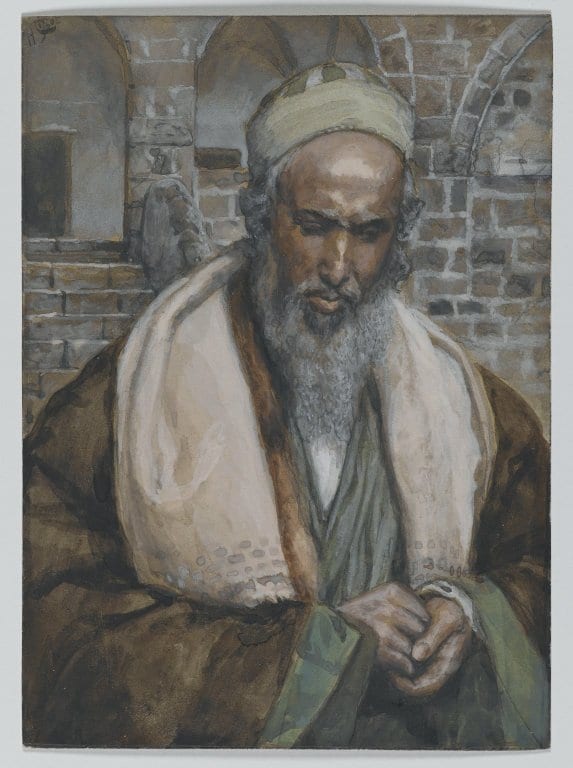
Photo credit: Saint Luke, by James Tissot (1836-1902) [public domain / Wikimedia Commons]

***
Previous Post

February 11, 2021
Debate on Fascist Facebook Censorship & Cancel Culture
Next Post

February 12, 2021 Pearce's Potshots #16: Does St. Paul Justify Lying?
Browse Our Archives
Select a Category & Last Things About Me Anti-Catholicism Atheism & Agnosticism Baptism and Sacramentalism Bible and Tradition Blessed Virgin Mary Books by Dave Armstrong C. S. Lewis Calvinism & General Protestantism Catholic Apologetics Catholic Apologists Catholic conversion Catholic converts Christmas Church (Ecclesiology) Church History Conversion and Converts Development of Doctrine Eastern Orthodoxy Ecumenism & Christian Unity Eucharist & Liturgy Fathers of the Church French Translations G. K. Chesterton Hell Hell & Satan Hell & Satan & Last Things Heresies & Comparative Religion Holistic Health Inquisition & Crusades & Scandals James White Jews & Judaism & Old Testament John Calvin John Henry Newman Liberal / Modernist Theology Life Issues Literary Resume Lutheranism Mariology Martin Luther Music Orthodoxy Papacy & Infallibility Personal Page Philosophy & Science Political & Ethical & Moral Issues Protestant Persecution & Intolerance Protestantism Purgatory Purgatory & Penance Romantic & Imaginative Theology Saints & Purgatory & Penance Salvation Salvation & Justification Satan & Last Things Sexuality and Gender Issues Spanish Translations Traditionalism vs. Radical Catholic Reactionaries Traducciones al español / tradução para português Trinitarianism & Christology Uncategorized Videos
Select a Month October 2026 September 2026 August 2026 July 2026 June 2026 May 2026 April 2026 March 2026 February 2026 January 2026 December 2025 November 2025 October 2025 September 2025 August 2025 July 2025 June 2025 May 2025 April 2025 March 2025 February 2025 January 2025 December 2024 November 2024 October 2024 September 2024 August 2024 July 2024 June 2024 May 2024 April 2024 March 2024 February 2024 January 2024 December 2023 November 2023 October 2023 September 2023 August 2023 July 2023 June 2023 May 2023 April 2023 March 2023 February 2023 January 2023 December 2022 November 2022 October 2022 September 2022 August 2022 July 2022 June 2022 May 2022 April 2022 March 2022 February 2022 January 2022 December 2021 November 2021 October 2021 September 2021 August 2021 July 2021 June 2021 May 2021 April 2021 March 2021 February 2021 January 2021 December 2020 November 2020 October 2020 September 2020 August 2020 July 2020 June 2020 May 2020 April 2020 March 2020 February 2020 January 2020 December 2019 November 2019 October 2019 September 2019 August 2019 July 2019 June 2019 May 2019 April 2019 March 2019 February 2019 January 2019 December 2018 November 2018 October 2018 September 2018 August 2018 July 2018 June 2018 May 2018 April 2018 March 2018 February 2018 January 2018 December 2017 November 2017 October 2017 September 2017 August 2017 July 2017 June 2017 May 2017 April 2017 March 2017 February 2017 January 2017 December 2016 November 2016 October 2016 September 2016 August 2016 July 2016 June 2016 May 2016 April 2016 March 2016 February 2016 January 2016 December 2015 November 2015 October 2015 September 2015 August 2015 July 2015 June 2015 May 2015 April 2015 March 2015 February 2015 January 2015 December 2014 November 2014 October 2014 September 2014 August 2014 July 2014 June 2014 April 2014 March 2014 February 2014 January 2014 December 2013 November 2013 October 2013 September 2013 August 2013 July 2013 June 2013 April 2013 March 2013 February 2013 January 2013 December 2012 November 2012 October 2012 September 2012 August 2012 July 2012 June 2012 May 2012 April 2012 March 2012 February 2012 January 2012 December 2011 November 2011 October 2011 September 2011 August 2011 July 2011 June 2011 April 2011 March 2011 February 2011 October 2010 September 2010 August 2010 July 2010 April 2010 March 2010 December 2009 October 2009 August 2009 July 2009 June 2009 May 2009 March 2009 February 2009 October 2008 September 2008 April 2008 March 2008 February 2008 January 2008 December 2007 November 2007 October 2007 May 2007 March 2007 February 2007 January 2007 November 2006 October 2006 September 2006 August 2006 July 2006 June 2006 May 2006 April 2006 March 2006 February 2006 October 2005 June 2005 April 2005 February 2005 July 2004 May 2004 April 2004
Follow Us!
TAKE THE
Religious Wisdom Quiz
Who lived in Ur of the Chaldeans before God called him?
Select your answer to see how you score.
Jacob Abram Isaac Lot
Books by This Author Books by Dave Armstrong
Related posts from Biblical Evidence for Catholicism

A Few "Worst" & "Best" Arguments vs. Protestantism
Biblical Evidence for Catholicism

Jerusalem Council vs. James White & Sola Scriptura
Biblical Evidence for Catholicism

Biblical Perspicuity: Absurd Anti-Catholic "Defense"
Biblical Evidence for Catholicism

50 Biblical Disproofs of "Evident Clearness" of the...
Biblical Evidence for Catholicism
TRENDING AT PATHEOS Catholic

In "Irreplaceable," our book on vocation and technology, Trevor Sutton and I...

I was strolling through the top floor of the brand new Parthenon...

What Does Gêvâh Mean For Kimberley Guifoyle &...
This week, a lot of the news is focused on Kimberly Guilfoyle....

INNER CIRCLE: Profound Mystery (Of Christ In All...
Ephesians 5:31-32 “For this reason, a man will leave his father and...

Do Not Rejoice When Your Enemy Falls: The...
Turning an execution into a public spectacle is a disturbing expression of...

'The Chosen' S6 Trailer: The Passion Gets Very...
Not many watching 'The Chosen' worry about spoilers, but just because they...
view all Catholic blogs
Ad-Free & Subscriber Log-In Subscription Support
- About Us
- 2026 Calendar
- Videos
- Podcasts
- Library of World Religions
- Faith In Media Tracker
- Advertise With Us
- Write for Us
- Privacy Policy
- Terms of Service
- Do Not Sell My Data
- Contact Us
- Radiant Digital
- Manage Newsletter Subscriptions
- Unsubscribe From Notifications
- Sitemap
Copyright 2008-2026, Patheos. All rights reserved.
Subscription Support Ad-Free & Subscriber Log-In
Follow Patheos