
BuddhistCatholicContemplativeEvangelicalGeneral ChristianHinduJewishLatter-day SaintMuslimNew VisionsProgressive Christian
Beliefs
- Buddhist
- Catholic
- Contemplative
- Evangelical
- General Christian
- Hindu
- Jewish
- Latter-day Saint
- More Voices
- Muslim
- New Visions
- Pagan
- Progressive Christian
Topics
- Religion News
- Food and Religion
- Sports and Religion
- Religious Art
- Religious Music and Entertainment
- Religious Events
- History and Religion
- Style and Religion
- Politics and Religion
- Women in Religion
- Recreation Outdoors and Religion
- Business Finance and Religion
- Careers Workplace and Religion
- Education and Religion
- Family Parenting and Religion
- Health Fitness and Religion
- Home and Religion
- Relationships and Religion
- Technology and Religion
- Travel and Religion
Columnists
- Buddhist Columnists
- Business Finance and Religion Columnists
- Careers Workplace and Religion Columnists
- Catholic Columnists
- Contemplative Columnists
- Education and Religion Columnists
- Evangelists Columnists
- Family Parenting and Religion Columnists
- General Christian Columnists
- Health Fitness and Religion Columnists
- Hindu Columnists
- History and Religion Columnists
- Home and Religion Columnists
- Jewish Columnists
- More Voices Columnists
- Latter Day Columnists
- Muslim Columnists
- New Visions Columnists
- Nonreligious Columnists
- Pagan Columnists
- Politics and Religion Columnists
- Progressive Columnists
- Recreation Outdoors and Religion Columnists
- Relationships and Religion Columnists
- Religion News Columnists
- Religious Art Columnists
- Religious Events Columnists
- Religious Music and Entertainment Columnists
- Sports and Religion Columnists
- Style and Religion Columnists
- Technology and Religion Columnists
- Travel and Religion Columnists
- Women in Religion Columnists
Resource Library
- 2026 Calendar
- Library of World Religions
- The 100 Most Holy Places on Earth
- Patheos Answers
- Podcasts
- Videos
- Faith Leaders Database
- Anglican Episcopalian
- Bahai
- Baptist
- Buddhism
- Christianity
- Confucianism
- Eastern Orthodoxy
- Hinduism
- Holiness and Pentecostal
- ISKCON
- Islam
- Judaism
- Lutheran
- Methodist
- The Church of Jesus Christ of Latter-day Saints
- New Age
- Paganism
- Presbytarian and Reformed
- Protestantism
- Religion Behind the Scenes
- Roman Catholic
- Scientology
- Shia Islam
- Sikhism
- Sufism
- Sunni Islam
- Taoism
- Zen
- See all religions
Research Tools
 Ad-Free & Subscriber Log-In Subscription Support
Ad-Free & Subscriber Log-In Subscription Support
Follow Patheos 

- Trending:
- Forgiveness
- |
- Marriage
- |
- Consciousness
- |
- Death Penalty
- |
- Election
- |
- Halloween

-
About
-
Catholic Apologetics
-
Church History
-
Great Apologists
-
Christian Worldview
-
Protestantism & Misc.
- Home
- Catholic
- History and Religion
- Dismantling Whitaker’s Sola Scriptura Arguments
Dismantling Whitaker’s Sola Scriptura Arguments
Last updated on: February 21, 2021 at 4:28 pm by Dave Armstrong
Dismantling Whitaker’s Sola Scriptura Arguments 2021-02-21T16:28:46-04:00 Dave Armstrong
Patheos Explore the world's faith through different perspectives on religion and spirituality! Patheos has the views of the prevalent religions and spiritualities of the world.
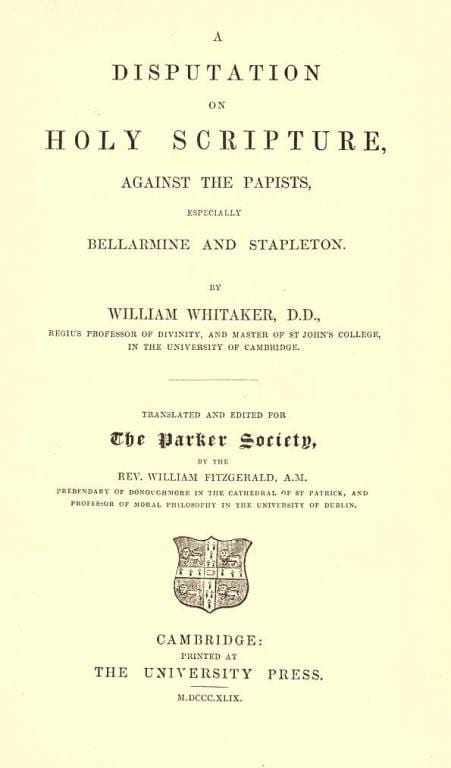
William Whitaker (1548-1595) was a Calvinist Anglican apologist and professor at Cambridge University. His masterwork was Disputation on Holy Scripture: Against the Papists, Especially Bellarmine and Stapleton, published in 1588. I have utilized an online copy published in 1849 by the University Press of Cambridge.
James R. White, the well-known Reformed Baptist apologist, has sold the book on his website, and wrote about it in an ad in 2007 that “his work should be carefully studied by all concerned shepherds of Christ’s flock.”
I shall reply to a portion of his book, from a chapter entitled, “Question the Sixth: Of the Perfection of Scripture, against Unwritten Traditions.” It’s a fair representation of the whole. His words will be indented below.
. . . Matth. xv. 6, “Ye have made the commandment of God of none effect by your traditions;” and the words of Isaiah, c. 29, alleged by Christ in that same chapter, “In vain do they worship me, teaching for doctrines the commandments of men:” and Galat. i. 14, where Paul says that, before his conversion, he was “zealous for the traditions of his elders.” From these and the like places, we reason thus: Christ and the apostles condemn traditions: therefore, they are not to be received; and consequently scripture is sufficient. (pp. 637-638)
The Bible teaches a legitimate apostolic, divine tradition, that is good, and a false ‘tradition of men” over against God. St. Paul contrasts the two in the following passage:
Colossians 2:8 (RSV, as throughout) See to it that no one makes a prey of you by philosophy and empty deceit, according to human tradition, according to the elemental spirits of the universe, and not according to Christ. (cf. 1 Cor 11:2; 2 Thess 2:15; 3:6; Phil 4:9; 2 Tim 1:13-14; 2:2)
In two of Whitaker’s examples above, we see the qualifiers: “your traditions” (i.e., over against God’s); “commandments of men” (i.e., ones that contradict the commandments of God). Galatians 1:14, on the other hand, is a more neutral expression. It’s clear that Paul did not reject all traditions in Judaism. After all, he referred to himself as a “Pharisee” twice, after his conversion to Christianity (Acts 23:6; 26:5).
[I]t is false that the Jews received any traditions from Moses and the prophets. He himself does not prove they did, . . . (p. 638)
It is well-known that the Pharisees accepted the received Jewish oral tradition, and that early Christianity inherited several beliefs (angelology, the resurrection, notions of purgatory and prayer for the dead), including belief in this oral tradition, from that school.
[W]hen Christ objects the commandment of God, and opposes the scriptures to tradition, it is plain that he condemns all unwritten traditions. (p. 639)
Jesus qualifies it by noting that mere men‘s traditions, held in opposition to God, are what should be condemned. If it were a blanket condemnation, He would have simply referred to “tradition.” And why in the world would He also say?:
Matthew 23:2-3a “The scribes and the Pharisees sit on Moses’ seat; [3] so practice and observe whatever they tell you, . . .
“Moses’ Seat” is not a phrase found in the Old Testament. It is found in the (originally oral) Mishna, where a sort of “teaching succession” from Moses on down is taught. Jesus upholds the Pharisees’ teaching authority even though He goes on to say that they are hypocrites, and to not follow what they “do.”
Christ and the apostles always remand us to the scriptures . . . (p. 639)
That’s not true at all. Here are five references in the New Testament that are absent from the Old Testament:
1 Corinthians 10:4 and all drank the same supernatural drink. For they drank from the supernatural Rock which followed them, and the Rock was Christ.
2 Timothy 3:8 As Jannes and Jambres opposed Moses, so these men also oppose the truth, men of corrupt mind and counterfeit faith;
1 Peter 3:19 in which he went and preached to the spirits in prison, (drawn from the Jewish apocalyptic book 1 Enoch (12-16).
Jude 9 But when the archangel Michael, contending with the devil, disputed about the body of Moses, he did not presume to pronounce a reviling judgment upon him, but said, “The Lord rebuke you.”
Jude 14-15 It was of these also that Enoch in the seventh generation from Adam prophesied, saying, “Behold, the Lord came with his holy myriads, to execute judgment on all, and to convict all the ungodly of all their deeds of ungodliness which they have committed in such an ungodly way, and of all the harsh things which ungodly sinners have spoken against him.” (direct quotation of the apocalyptic book 1 Enoch 1:9).
The latter citation is not from any Scripture; yet it is said that Enoch “prophesied.” Thus, authentic, genuine prophecy is not confined to the Old Testament written record. If this is true prophecy (as we know it must be, because it is described as such in inspired revelation), who knows how much more of 1 Enoch or other non-canonical ancient Jewish books also contain true prophecy? That is tradition.
Moreover, the New Testament massively cites passages or thought-patterns or concepts found in the Deuterocanon: books that Protestants and Whitaker reject as canonical (and call the “Apocrypha”). Therefore, these are numerous additional examples of “Christ and the apostles” doing what Whitaker tells us they never supposedly do: citations of something other than what he thinks is Scripture.
The fourth place is taken from Luke xxiv. 25 and 27. Christ, in verse 25, blames the disciples for being slow “to believe all that the prophets have spoken.” But where can those things be found? This appears from verse 27. There it follows: “Beginning at Moses and all the prophets, he expounded to them in all the scriptures the things concerning himself.” Hence we frame the following argument: If all the things that the prophets spoke may be found in the scriptures, then may those also which the apostles spoke be found in the scriptures also. The first is true: therefore also the second. . . . (pp. 643-644)
No passage in the Bible says that the entirety of the prophetic message (let alone the apostolic message) was committed to writing, in the Bible alone. That is simply a tradition of men, invented out of whole cloth. It’s refuted also in the inspired New Testament, in examples we have already seen. How can this be, under Whitaker’s (false) premises? It cannot. His view is overthrown by Holy Scripture itself.
Likewise with Jude 9, which appears as a factual account, having to do with Moses, the devil, and the archangel Michael: nowhere to be seen in the Old Testament. The New Testament was not dictated from above by God. The Bible writers utilized their own knowledge, which was preserved from error and inspired by God.
The seventh place is taken from Acts xvii. 2, 3, where Luke writes that Paul reasoned for three sabbath-days out of the scriptures, . . . that Christ had suffered; so that this was the Christ whom he preached unto them. Paul then discoursed from the scriptures, and confirmed his whole doctrine by the scriptures. Hence we gather the following argument: If Paul used no other evidence than that of scripture in teaching and delivering the gospel, and refuting the Jews; then all testimonies which are requisite either to confirm the true doctrine of the gospel or to refute heresies may be taken out of scripture. The former is true, and therefore the latter. The consequence is manifest. For if any other testimony had been necessary, the apostle would have used it. But he confirmed his doctrine only by the scriptures; . . . Therefore we ought to do likewise. (pp. 645-646)
This is altogether silly, because it’s amply refuted by Paul himself. When preaching to the Athenians (no intellectual slouches themselves, as the founders of philosophy), and doing his best to persuade them of the truth of the gospel, the great apostle didn’t stick to Scripture alone; he cited their own poets and philosophers:
Acts 17:22-28 So Paul, standing in the middle of the Are-op’agus, said: “Men of Athens, I perceive that in every way you are very religious. [23] For as I passed along, and observed the objects of your worship, I found also an altar with this inscription, `To an unknown god.’ What therefore you worship as unknown, this I proclaim to you. [24] The God who made the world and everything in it, being Lord of heaven and earth, does not live in shrines made by man, [25] nor is he served by human hands, as though he needed anything, since he himself gives to all men life and breath and everything. [26] And he made from one every nation of men to live on all the face of the earth, having determined allotted periods and the boundaries of their habitation, [27] that they should seek God, in the hope that they might feel after him and find him. Yet he is not far from each one of us, [28] for `In him we live and move and have our being’; as even some of your poets have said, `For we are indeed his offspring.’
Here he was citing the Greek poet Aratus: (c. 315-240 B. C.) and philosopher-poet Epimenides (6th c. B. C.) – both referring to Zeus. So St. Paul used two Greek pagan poet-philosophers, talking about a false god (Zeus) and “Christianized” their thoughts: applying them to the true God. That’s Pauline apologetic method. He expressly cites these pagan Greek poets and philosophers precisely because that is what his sophisticated Athens audience (including “Epicurean and Stoic philosophers” — 17:18) could understand and relate to. He was using wise apologetic method and strategy.
Paul also cited the Greek dramatist Menander (c.342-291 B.C.) at 1 Corinthians 15:33: “bad company ruins good morals”. Thus, Whitaker’s claim that Paul used no unbiblical testimony is shown from Holy Scripture (three times) to be a falsehood.
The eighth place is taken from Acts xviii. 24 and 28. Apollos was mighty in the scriptures, and refuted the Jews forcibly, . . . out of the scriptures. We may argue here as in the former case: If Apollos made use only of the scriptures in refuting the Jews and confirming the doctrine of the gospel, then the gospel may be confirmed and heresies refuted by the scriptures alone. The former is true, and consequently the latter also. (p. 646)
But the text doesn’t say that Apollos “made use only of the scriptures” (my italics). Acts 18:28 describes him as “showing by the scriptures that the Christ was Jesus.” But it doesn’t say that he made no arguments besides ones drawn from Scripture. To show that the Messiah (often mentioned in the Old Testament) was Jesus was something specifically related to the Bible and to the Jews (over against the Gentiles). So that is to be expected.
But in Acts 18:25 it states: “he spoke and taught accurately the things concerning Jesus.” Unless he was prooftexting the Old Testament messianic texts, and only doing that (as in 18:28), virtually anything else about what Jesus was doing or teaching was based on present eyewitness accounts, and was not “arguing from the Bible” (the Gospels not having yet been written) but rather, from experience (i.e., oral tradition at that point). Thus, it is quite likely and plausible (though not certain) that he also talked about things other than biblical texts.
It may be a fine point but it is a crucial technical distinction. Whitaker merely reads into the text what he already assumes. It’s not present in the text. The text is consistent with a hypothetical scenario whereby only Scripture was used, but it doesn’t prove that or disallow another scenario. It’s not conclusive in and of itself.
But God hath nowhere promised that he will save and protect unwritten traditions from being lost: consequently, the church and tradition are not parallel cases. I can produce innumerable testimonies and promises wherewith God hath bound himself to the church to preserve it: let them produce any such promises of God respecting the preservation of traditions. Now this they cannot do. Secondly, I confess that God preserved his doctrine from Adam to Moses orally transmitted, that is, in the form of unwritten tradition. It cannot be denied. But then it was amongst exceeding few persons: for the great majority had corrupted this doctrine. (p. 652)
This is a fascinating study in illogic and cognitive dissonance. Whitaker denies that apostolic tradition could be preserved. Then he turns around and concedes that there was indeed an oral tradition and doctrine from Adam to Moses: an extraordinary concession indeed! He says that is possible and factual, but apostolic tradition, with the fuller revelation of the new covenant, and an indwelling and guiding Holy Spirit is not.
Whether it was preserved by a few or ten million is irrelevant. It was preserved by God. New Testament tradition is indicated in many passages that I have already alluded to in the course of this series of refutations. It is always casually assumed to exist and to be authoritative.
Besides, God frequently and familiarly shewed himself to the holy fathers who then lived; conversed with them, and often renewed and restored the doctrine orally delivered, and brought it back to its integrity and purity, when not preserved from all corruption even by those godly men themselves. . . . But there is the greatest difference between those things and ours; . . . (p. 652)
The Bible says that we have far more privileges and access to God than the patriarchs of old. They were only selectively filled with the Holy Spirit, but every Christian is now. We have a much fuller, developed revelation. We have the appearance of Jesus, and all His teaching. We have a Church that even Whitaker grants is protected by God and indefectible.
Thirdly, the fact of Moses having written his heavenly doctrine is a point of great importance against tradition, and strongly confirmatory of our opinion. For if God had seen that religion could have been preserved entire and uncorrupted without the scriptures, he would not have enjoined Moses to consign it in the lasting monuments of written records . . . (pp. 652-653)
More self-serving straw men . . . The argument is not over whether Scripture is necessary. No Catholic has ever denied it. The argument is whether there is such a thing as an authoritative Christian tradition. Apparently, Whitaker, not able to grasp this, thinks that in defending tradition, we must somehow denigrate Scripture, as if it were a zero sum game.
Therefore, tradition could be defended to such an extent that Scripture is conceivably ditched altogether. But we haven’t ever thought or done so! It is Protestantism that has (quite contrary to Sacred Scripture) ditched binding tradition and an authoritative infallible Church.
[this article was published in Catholic Answers Magazine (July-Aug 2020), with the title, “Dismantling a Classic Sola Scriptura Argument”]
***
Photo credit: scan of 1849 (Cambridge) cover of William Whitaker’s book, Disputation on Holy Scripture, at Internet Archive.
***
Summary: William Whitaker (1548-1595) was a Calvinist Anglican apologist and author of the much-ballyhooed “Disputation on Holy Scripture”. I refute several of its arguments for sola Scriptura.
Previous Post
February 20, 2021
My "Lost" Cartoon Tracts (with Artist Dan Grajek)
Next Post
February 22, 2021 The Biblical Basis of Apologetics (Defense of Christianity)
Browse Our Archives
Select a Category & Last Things About Me Anti-Catholicism Atheism & Agnosticism Baptism and Sacramentalism Bible and Tradition Blessed Virgin Mary Books by Dave Armstrong C. S. Lewis Calvinism & General Protestantism Catholic Apologetics Catholic Apologists Catholic conversion Catholic converts Christmas Church (Ecclesiology) Church History Conversion and Converts Development of Doctrine Eastern Orthodoxy Ecumenism & Christian Unity Eucharist & Liturgy Fathers of the Church French Translations G. K. Chesterton Hell Hell & Satan Hell & Satan & Last Things Heresies & Comparative Religion Holistic Health Inquisition & Crusades & Scandals James White Jews & Judaism & Old Testament John Calvin John Henry Newman Liberal / Modernist Theology Life Issues Literary Resume Lutheranism Mariology Martin Luther Music Orthodoxy Papacy & Infallibility Personal Page Philosophy & Science Political & Ethical & Moral Issues Protestant Persecution & Intolerance Protestantism Purgatory Purgatory & Penance Romantic & Imaginative Theology Saints & Purgatory & Penance Salvation Salvation & Justification Satan & Last Things Sexuality and Gender Issues Spanish Translations Traditionalism vs. Radical Catholic Reactionaries Traducciones al español / tradução para português Trinitarianism & Christology Uncategorized Videos
Select a Month October 2026 September 2026 August 2026 July 2026 June 2026 May 2026 April 2026 March 2026 February 2026 January 2026 December 2025 November 2025 October 2025 September 2025 August 2025 July 2025 June 2025 May 2025 April 2025 March 2025 February 2025 January 2025 December 2024 November 2024 October 2024 September 2024 August 2024 July 2024 June 2024 May 2024 April 2024 March 2024 February 2024 January 2024 December 2023 November 2023 October 2023 September 2023 August 2023 July 2023 June 2023 May 2023 April 2023 March 2023 February 2023 January 2023 December 2022 November 2022 October 2022 September 2022 August 2022 July 2022 June 2022 May 2022 April 2022 March 2022 February 2022 January 2022 December 2021 November 2021 October 2021 September 2021 August 2021 July 2021 June 2021 May 2021 April 2021 March 2021 February 2021 January 2021 December 2020 November 2020 October 2020 September 2020 August 2020 July 2020 June 2020 May 2020 April 2020 March 2020 February 2020 January 2020 December 2019 November 2019 October 2019 September 2019 August 2019 July 2019 June 2019 May 2019 April 2019 March 2019 February 2019 January 2019 December 2018 November 2018 October 2018 September 2018 August 2018 July 2018 June 2018 May 2018 April 2018 March 2018 February 2018 January 2018 December 2017 November 2017 October 2017 September 2017 August 2017 July 2017 June 2017 May 2017 April 2017 March 2017 February 2017 January 2017 December 2016 November 2016 October 2016 September 2016 August 2016 July 2016 June 2016 May 2016 April 2016 March 2016 February 2016 January 2016 December 2015 November 2015 October 2015 September 2015 August 2015 July 2015 June 2015 May 2015 April 2015 March 2015 February 2015 January 2015 December 2014 November 2014 October 2014 September 2014 August 2014 July 2014 June 2014 April 2014 March 2014 February 2014 January 2014 December 2013 November 2013 October 2013 September 2013 August 2013 July 2013 June 2013 April 2013 March 2013 February 2013 January 2013 December 2012 November 2012 October 2012 September 2012 August 2012 July 2012 June 2012 May 2012 April 2012 March 2012 February 2012 January 2012 December 2011 November 2011 October 2011 September 2011 August 2011 July 2011 June 2011 April 2011 March 2011 February 2011 October 2010 September 2010 August 2010 July 2010 April 2010 March 2010 December 2009 October 2009 August 2009 July 2009 June 2009 May 2009 March 2009 February 2009 October 2008 September 2008 April 2008 March 2008 February 2008 January 2008 December 2007 November 2007 October 2007 May 2007 March 2007 February 2007 January 2007 November 2006 October 2006 September 2006 August 2006 July 2006 June 2006 May 2006 April 2006 March 2006 February 2006 October 2005 June 2005 April 2005 February 2005 July 2004 May 2004 April 2004
Follow Us!
TAKE THE
Religious Wisdom Quiz
What did Jesus say before raising Lazarus?
Select your answer to see how you score.
"Go in peace!" "Lazarus, come out!" "Rise and walk!" "Be healed!"
Books by This Author Books by Dave Armstrong
Related posts from Biblical Evidence for Catholicism

A Few "Worst" & "Best" Arguments vs. Protestantism
Biblical Evidence for Catholicism

Deuterocanon & Javier Perdomo's Straw Men
Biblical Evidence for Catholicism

St. Athanasius & the Deuterocanon (vs. Javier Perdomo)
Biblical Evidence for Catholicism

Jerusalem Council vs. James White & Sola Scriptura
Biblical Evidence for Catholicism
TRENDING AT PATHEOS Catholic

In "Irreplaceable," our book on vocation and technology, Trevor Sutton and I...

I was strolling through the top floor of the brand new Parthenon...

What Does Gêvâh Mean For Kimberley Guifoyle &...
This week, a lot of the news is focused on Kimberly Guilfoyle....

INNER CIRCLE: Profound Mystery (Of Christ In All...
Ephesians 5:31-32 “For this reason, a man will leave his father and...

Do Not Rejoice When Your Enemy Falls: The...
Turning an execution into a public spectacle is a disturbing expression of...

'The Chosen' S6 Trailer: The Passion Gets Very...
Not many watching 'The Chosen' worry about spoilers, but just because they...
view all Catholic blogs
Ad-Free & Subscriber Log-In Subscription Support
- About Us
- 2026 Calendar
- Videos
- Podcasts
- Library of World Religions
- Faith In Media Tracker
- Advertise With Us
- Write for Us
- Privacy Policy
- Terms of Service
- Do Not Sell My Data
- Contact Us
- Radiant Digital
- Manage Newsletter Subscriptions
- Unsubscribe From Notifications
- Sitemap
Copyright 2008-2026, Patheos. All rights reserved.
Subscription Support Ad-Free & Subscriber Log-In
Follow Patheos