
BuddhistCatholicContemplativeEvangelicalGeneral ChristianHinduJewishLatter-day SaintMuslimNew VisionsProgressive Christian
Beliefs
- Buddhist
- Catholic
- Contemplative
- Evangelical
- General Christian
- Hindu
- Jewish
- Latter-day Saint
- More Voices
- Muslim
- New Visions
- Pagan
- Progressive Christian
Topics
- Religion News
- Food and Religion
- Sports and Religion
- Religious Art
- Religious Music and Entertainment
- Religious Events
- History and Religion
- Style and Religion
- Politics and Religion
- Women in Religion
- Recreation Outdoors and Religion
- Business Finance and Religion
- Careers Workplace and Religion
- Education and Religion
- Family Parenting and Religion
- Health Fitness and Religion
- Home and Religion
- Relationships and Religion
- Technology and Religion
- Travel and Religion
Columnists
- Buddhist Columnists
- Business Finance and Religion Columnists
- Careers Workplace and Religion Columnists
- Catholic Columnists
- Contemplative Columnists
- Education and Religion Columnists
- Evangelists Columnists
- Family Parenting and Religion Columnists
- General Christian Columnists
- Health Fitness and Religion Columnists
- Hindu Columnists
- History and Religion Columnists
- Home and Religion Columnists
- Jewish Columnists
- More Voices Columnists
- Latter Day Columnists
- Muslim Columnists
- New Visions Columnists
- Nonreligious Columnists
- Pagan Columnists
- Politics and Religion Columnists
- Progressive Columnists
- Recreation Outdoors and Religion Columnists
- Relationships and Religion Columnists
- Religion News Columnists
- Religious Art Columnists
- Religious Events Columnists
- Religious Music and Entertainment Columnists
- Sports and Religion Columnists
- Style and Religion Columnists
- Technology and Religion Columnists
- Travel and Religion Columnists
- Women in Religion Columnists
Resource Library
- 2026 Calendar
- Library of World Religions
- The 100 Most Holy Places on Earth
- Patheos Answers
- Podcasts
- Videos
- Faith Leaders Database
- Anglican Episcopalian
- Bahai
- Baptist
- Buddhism
- Christianity
- Confucianism
- Eastern Orthodoxy
- Hinduism
- Holiness and Pentecostal
- ISKCON
- Islam
- Judaism
- Lutheran
- Methodist
- The Church of Jesus Christ of Latter-day Saints
- New Age
- Paganism
- Presbytarian and Reformed
- Protestantism
- Religion Behind the Scenes
- Roman Catholic
- Scientology
- Shia Islam
- Sikhism
- Sufism
- Sunni Islam
- Taoism
- Zen
- See all religions
Research Tools
 Ad-Free & Subscriber Log-In Subscription Support
Ad-Free & Subscriber Log-In Subscription Support
Follow Patheos 

- Trending:
- Forgiveness
- |
- Marriage
- |
- Consciousness
- |
- Death Penalty
- |
- Election
- |
- Halloween

-
About
-
Catholic Apologetics
-
Church History
-
Great Apologists
-
Christian Worldview
-
Protestantism & Misc.
- Home
- Catholic
- History and Religion
- Dialogue: Prayer For & To the Dead (w Dr. Lydia McGrew)
Dialogue: Prayer For & To the Dead (w Dr. Lydia McGrew)
Last updated on: February 17, 2021 at 2:18 pm by Dave Armstrong
Dialogue: Prayer For & To the Dead (w Dr. Lydia McGrew) 2021-02-17T14:18:44-04:00 Dave Armstrong
Patheos Explore the world's faith through different perspectives on religion and spirituality! Patheos has the views of the prevalent religions and spiritualities of the world.
Dr. Lydia McGrew is a traditional Anglican philosopher. I am very fond of her and her work. I posted a little quotation from St. John Henry Newman (as an Anglican) about prayer for the dead and tagged her on Facebook. She showed up and we got into a great discussion (always the case with her). Her words will be in blue.
*****
Anglican Newman on St. Paul’s Prayer for the Dead (Onesiphorus)
[W]hat does St Paul mean when he says of Onesiphorus ’The Lord grant him to find mercy of the Lord in that day?’ [2 Tim 1:16-18; cf. 4:19] Did his prayer go for nothing? To say that he prayed that Onesiphorus might so conduct himself on earth as to receive mercy at the Judgment seems a refinement; not to say that from the run of the passage Onesiphorus seems to be dead when St Paul wrote.
— Letters & Diaries, vol. 10; To Anthony John Hanmer, 16 March 1844
*
I’m not convinced he was dead.
*
That’s one way to get out of it. See:
*
Was Onesiphorus Dead When Paul Prayed for Him?: Data from 16 Protestant Commentaries (1992-2016) [3-20-17]
*
Also, prayers for the dead are not the same as prayers to the dead.
*
Yep.
*
At this point I lean towards accommodating some type of prayers for the dead, though carefully kept in check so that they don’t assume knowledge we don’t have (about how or whether they are effective). I have much bigger hesitations about prayers to the dead.
*
Fair enough, given your overall position.
*
Was Peter praying for the dead with regard to Tabitha? If not, what was he praying for in 9:40?:
*
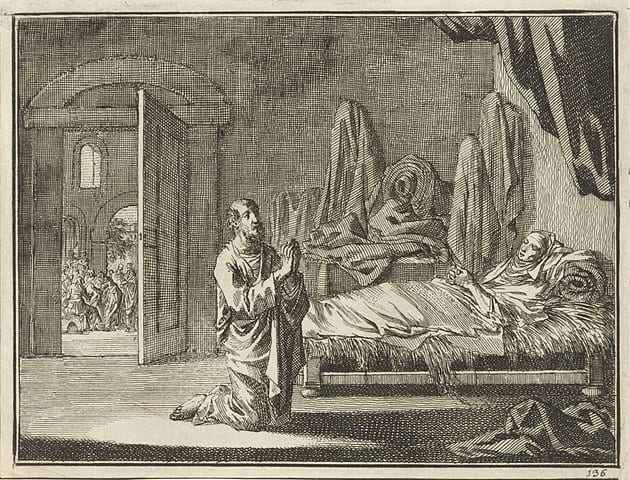
Acts 9:36-37, 40 (RSV) Now there was at Joppa a disciple named Tabitha, which means Dorcas. She was full of good works and acts of charity. [37] In those days she fell sick and died; and when they had washed her, they laid her in an upper room. . . . [40] But Peter put them all outside and knelt down and prayed; then turning to the body he said, “Tabitha, rise.” And she opened her eyes, and when she saw Peter she sat up.
*
And did Jesus pray for a dead man, Lazarus? If not, what was He praying for in 11:41?:
*
John 11:41-44 So they took away the stone. And Jesus lifted up his eyes and said, “Father, I thank thee that thou hast heard me. [42] I knew that thou hearest me always, but I have said this on account of the people standing by, that they may believe that thou didst send me.” [43] When he had said this, he cried with a loud voice, “Laz’arus, come out.” [44] The dead man came out, his hands and feet bound with bandages, and his face wrapped with a cloth. Jesus said to them, “Unbind him, and let him go.”
*
Elijah and Elisha also prayed for the dead before they were raised; therefore, they prayed for the dead, and it is recorded in Scripture:
*
Elijah: 1 Kings 17:17-24 (17:21: “Then he stretched himself upon the child three times, and cried to the LORD, “O LORD my God, let this child’s soul come into him again.”).
*
Elisha: 2 Kings 4:18-37 (4:33: “So he went in and shut the door upon the two of them, and prayed to the LORD.”).
*
They’re all certainly talking to / addressing dead people, which many Protestants tell us the Bible and Christianity absolutely forbid.
*
I don’t think you’re helping your case with situations where a prophet (or God Incarnate) prays for the resurrection of a dead person. Those are not the situation we are in and are not what is usually meant by prayers for the dead. What is meant by that is prayer for his state in the afterlife. I’m not, as I said, entirely closed to epistemically modest prayers for his state in the afterlife, but I think those should be kept sharply distinct from an apostle’s prayer asking God to enable him to raise someone from the dead to ordinary life here on earth–a literal miracle.
*
Sure there is a difference, but I never denied that there was. So what were Jesus and Peter praying for when they prayed? What is it if it wasn’t prayer for a dead person: to rise from the dead? And that is undeniably a species of prayer for the dead: just a special, very rare kind.
*
Those are not the situation we are in
*
Jesus rather matter-of-factly refers to raising people from the dead:
*
Matthew 10:8 Heal the sick, raise the dead, cleanse lepers, cast out demons. You received without paying, give without pay.
*
One may argue that these were His first disciples, and that He specifically gave them “authority” (10:1), but the rest of the chapter is usually applied to the Christian believer in general.
*
Lots of people have been raised from the dead in Catholic history.
*
I just think that’s a red herring. It isn’t even what Protestants and Catholics are debating when they differ about prayers for the dead. By the way, it’s very interesting to me that neither Protestant nor Catholic doctrine provides for an afterlife that is metaphysically indeterminate as far as whether or not the person is eventually going to go to heaven. In both systems, that is determined at the time of death. But let’s admit that the places where we are most inclined (psychologically) to pray for someone dead are the places where we are worried about whether he was saved, died in a state of grace, etc.
*
In fact, the Pauline prayer you quote above seems to be a prayer about Onesiphorus’s ultimate spiritual destiny. If it’s legitimate and effective to pray for someone to be ultimately saved after that person has died, both Protestant and Catholic theologies are going to have to come up with an explanation for this–perhaps the prayer’s affecting some timeless reality or something. Or else introduce a literally metaphysically ambiguous state after death, which neither system now has.
*
Interesting point (I’ll have to think more about that). You still don’t tell me what Jesus and Peter were praying for and how it is not “prayer for the dead.” Special cases (granted). Nevertheless, it’s still a legitimate consideration and related to the overall question at hand. There are always rare or special cases with regard to anything.
*
It’s just an ambiguity on the term. I do not at all see that it provides evidence for the effectiveness of prayers for the dead in the relevant sense that Catholics and Protestants debate over. It isn’t something you would pray for everyone, for example, whereas if prayers for the dead in the relevant sense are legit, one could pray them for everyone, or at least for all Christian dead, at a minimum. Prayers for a resurrection also have a completely clear meaning, which prayers for the dead in the relevant sense don’t have. And so forth.
*
I guess I would posit one of two scenarios in Paul’s prayer for Onesiphorus (“may the Lord grant him to find mercy from the Lord on that Day”):
*
- By “mercy” he might mean “less ‘time’ in purgatory”; whereby God would extend mercy with regard to the degree of temporal punishment for sins; i.e., Onesiphorus would get to heaven in an easier fashion.
*
- Or it is a retroactive prayer regarding Onesiphorus’ salvation: applied backwards in time (from our perspective), but able to be prayed because God is outside of time and can apply our prayers to the past.
*
But they did pray for the dead, right? In this case, they prayed that they would be raised, which is a species of prayer for the dead. I am not denying that it is a special case. I’m not claiming for the argument more than it delivers.
*
I think it’s irrelevant to the question of whether or not there is such a thing as an effective prayer for someone’s better state in the afterlife. A prayer for a resurrection is a prayer for an event in this world–either as a sign to others, or to send a person back here because he’s needed here, or both.
*
So by this response you keep making I will assume that you grant that it is a species of prayer for the dead, but a very rare one, so that it has no analogy or relevance to “run-of-the-mill” / “normative” [in some Christian traditions] prayers for the dead in purgatory.
*
I say it proves what it proves. It’s an example of one particular type of prayer for dead people, and we have four examples in Holy Scripture: Elijah, Elisha, St. Peter, and Jesus.
*
Intercessory requests made to dead people are of course taught by Jesus in his story (not parable!) of Lazarus and the rich man (Luke 16). Abraham is prayed to and asked to grant two requests. His answer was “no” in both cases, but he never rebuked the rich man for praying to him or asking him to intercede to God.
*
In other words, a refusal to grant a prayer request is conceptually distinct from a denial that the request ought to be made at all to a [dead] creature, as opposed to God.
*
Therefore, the practice is proper, and (rather explicitly and undeniably) taught by Jesus Himself.
*
King Saul also made a petitionary request of Samuel (though he summoned him in a sinful way: through a medium). Nevertheless, it really was Samuel, and Saul did make a petition: “I am in great distress; for the Philistines are warring against me, and God has turned away from me and answers me no more, either by prophets or by dreams; therefore I have summoned you to tell me what I shall do” (1 Samuel 28:15).
*
Again, Samuel didn’t say, “why are you asking me; don’t you know you can only ask God for things and not dead human beings?” Instead, Samuel said: “Why then do you ask me, since the LORD has turned from you and become your enemy?” (1 Sam 28:16). In other words, in effect he says, “why are you praying at all: whether to me as an intermediary, or to God, since you have rebelled against God and He has turned from you also?”
*
None of this shows that we must never communicate with at all, or ask the intercession of, notable dead people like Samuel or Abraham. All it shows is that they turned down the requests (but because they were against God’s will, rather than due to a supposed prohibition against such a thing ever happening at all).
*
Related Reading
*
Dialogue with an Anglican on “Praying to Mary,” Patron Saints, Etc. (vs. Dr. Lydia McGrew) [11-10-14]
*
***
*
Photo credit: Tabitha is raised from the dead by Peter’s prayer (1712), by Jan Luyken (1649-1712 ) [Wikimedia Commons / Creative Commons CC0 1.0 Universal Public Domain Dedication]

*
***
Previous Post

February 16, 2021
Thomas Howard Quotations
Next Post

February 18, 2021 Catholic Apologetics Potpourri
Browse Our Archives
Select a Category & Last Things About Me Anti-Catholicism Atheism & Agnosticism Baptism and Sacramentalism Bible and Tradition Blessed Virgin Mary Books by Dave Armstrong C. S. Lewis Calvinism & General Protestantism Catholic Apologetics Catholic Apologists Catholic conversion Catholic converts Christmas Church (Ecclesiology) Church History Conversion and Converts Development of Doctrine Eastern Orthodoxy Ecumenism & Christian Unity Eucharist & Liturgy Fathers of the Church French Translations G. K. Chesterton Hell Hell & Satan Hell & Satan & Last Things Heresies & Comparative Religion Holistic Health Inquisition & Crusades & Scandals James White Jews & Judaism & Old Testament John Calvin John Henry Newman Liberal / Modernist Theology Life Issues Literary Resume Lutheranism Mariology Martin Luther Music Orthodoxy Papacy & Infallibility Personal Page Philosophy & Science Political & Ethical & Moral Issues Protestant Persecution & Intolerance Protestantism Purgatory Purgatory & Penance Romantic & Imaginative Theology Saints & Purgatory & Penance Salvation Salvation & Justification Satan & Last Things Sexuality and Gender Issues Spanish Translations Traditionalism vs. Radical Catholic Reactionaries Traducciones al español / tradução para português Trinitarianism & Christology Uncategorized Videos
Select a Month October 2026 September 2026 August 2026 July 2026 June 2026 May 2026 April 2026 March 2026 February 2026 January 2026 December 2025 November 2025 October 2025 September 2025 August 2025 July 2025 June 2025 May 2025 April 2025 March 2025 February 2025 January 2025 December 2024 November 2024 October 2024 September 2024 August 2024 July 2024 June 2024 May 2024 April 2024 March 2024 February 2024 January 2024 December 2023 November 2023 October 2023 September 2023 August 2023 July 2023 June 2023 May 2023 April 2023 March 2023 February 2023 January 2023 December 2022 November 2022 October 2022 September 2022 August 2022 July 2022 June 2022 May 2022 April 2022 March 2022 February 2022 January 2022 December 2021 November 2021 October 2021 September 2021 August 2021 July 2021 June 2021 May 2021 April 2021 March 2021 February 2021 January 2021 December 2020 November 2020 October 2020 September 2020 August 2020 July 2020 June 2020 May 2020 April 2020 March 2020 February 2020 January 2020 December 2019 November 2019 October 2019 September 2019 August 2019 July 2019 June 2019 May 2019 April 2019 March 2019 February 2019 January 2019 December 2018 November 2018 October 2018 September 2018 August 2018 July 2018 June 2018 May 2018 April 2018 March 2018 February 2018 January 2018 December 2017 November 2017 October 2017 September 2017 August 2017 July 2017 June 2017 May 2017 April 2017 March 2017 February 2017 January 2017 December 2016 November 2016 October 2016 September 2016 August 2016 July 2016 June 2016 May 2016 April 2016 March 2016 February 2016 January 2016 December 2015 November 2015 October 2015 September 2015 August 2015 July 2015 June 2015 May 2015 April 2015 March 2015 February 2015 January 2015 December 2014 November 2014 October 2014 September 2014 August 2014 July 2014 June 2014 April 2014 March 2014 February 2014 January 2014 December 2013 November 2013 October 2013 September 2013 August 2013 July 2013 June 2013 April 2013 March 2013 February 2013 January 2013 December 2012 November 2012 October 2012 September 2012 August 2012 July 2012 June 2012 May 2012 April 2012 March 2012 February 2012 January 2012 December 2011 November 2011 October 2011 September 2011 August 2011 July 2011 June 2011 April 2011 March 2011 February 2011 October 2010 September 2010 August 2010 July 2010 April 2010 March 2010 December 2009 October 2009 August 2009 July 2009 June 2009 May 2009 March 2009 February 2009 October 2008 September 2008 April 2008 March 2008 February 2008 January 2008 December 2007 November 2007 October 2007 May 2007 March 2007 February 2007 January 2007 November 2006 October 2006 September 2006 August 2006 July 2006 June 2006 May 2006 April 2006 March 2006 February 2006 October 2005 June 2005 April 2005 February 2005 July 2004 May 2004 April 2004
Follow Us!
TAKE THE
Religious Wisdom Quiz
What did Jesus do for Lazarus in Bethany?
Select your answer to see how you score.
Healed his blindness Turned him invisible Raised him from the dead Fed him
Books by This Author Books by Dave Armstrong
Related posts from Biblical Evidence for Catholicism

Bible & Catholicism on Mortal Sin (vs. John...
Biblical Evidence for Catholicism

Does Catholic Intercession of Saints Require Omniscience?
Biblical Evidence for Catholicism

Eternal Hell: Biblical? 25 Verses Say So
Biblical Evidence for Catholicism

Capabilities of Heavenly Saints: Protestant Commentaries
Biblical Evidence for Catholicism
TRENDING AT PATHEOS Catholic

Janie Learns the Way of the Cross: A...
Teaching children about Jesus' Passion can be challenging. Many parents and educators...

Looking For Good Catholic Writing - October 2026
He alone extends the heavens, and he walks upon the waves of...

In "Irreplaceable," our book on vocation and technology, Trevor Sutton and I...

I was strolling through the top floor of the brand new Parthenon...

What Does Gêvâh Mean For Kimberley Guifoyle &...
This week, a lot of the news is focused on Kimberly Guilfoyle....

INNER CIRCLE: Profound Mystery (Of Christ In All...
Ephesians 5:31-32 “For this reason, a man will leave his father and...
view all Catholic blogs
Ad-Free & Subscriber Log-In Subscription Support
- About Us
- 2026 Calendar
- Videos
- Podcasts
- Library of World Religions
- Faith In Media Tracker
- Advertise With Us
- Write for Us
- Privacy Policy
- Terms of Service
- Do Not Sell My Data
- Contact Us
- Radiant Digital
- Manage Newsletter Subscriptions
- Unsubscribe From Notifications
- Sitemap
Copyright 2008-2026, Patheos. All rights reserved.
Subscription Support Ad-Free & Subscriber Log-In
Follow Patheos