
BuddhistCatholicContemplativeEvangelicalGeneral ChristianHinduJewishLatter-day SaintMuslimNew VisionsProgressive Christian
Beliefs
- Buddhist
- Catholic
- Contemplative
- Evangelical
- General Christian
- Hindu
- Jewish
- Latter-day Saint
- More Voices
- Muslim
- New Visions
- Pagan
- Progressive Christian
Topics
- Religion News
- Food and Religion
- Sports and Religion
- Religious Art
- Religious Music and Entertainment
- Religious Events
- History and Religion
- Style and Religion
- Politics and Religion
- Women in Religion
- Recreation Outdoors and Religion
- Business Finance and Religion
- Careers Workplace and Religion
- Education and Religion
- Family Parenting and Religion
- Health Fitness and Religion
- Home and Religion
- Relationships and Religion
- Technology and Religion
- Travel and Religion
Columnists
- Buddhist Columnists
- Business Finance and Religion Columnists
- Careers Workplace and Religion Columnists
- Catholic Columnists
- Contemplative Columnists
- Education and Religion Columnists
- Evangelists Columnists
- Family Parenting and Religion Columnists
- General Christian Columnists
- Health Fitness and Religion Columnists
- Hindu Columnists
- History and Religion Columnists
- Home and Religion Columnists
- Jewish Columnists
- More Voices Columnists
- Latter Day Columnists
- Muslim Columnists
- New Visions Columnists
- Nonreligious Columnists
- Pagan Columnists
- Politics and Religion Columnists
- Progressive Columnists
- Recreation Outdoors and Religion Columnists
- Relationships and Religion Columnists
- Religion News Columnists
- Religious Art Columnists
- Religious Events Columnists
- Religious Music and Entertainment Columnists
- Sports and Religion Columnists
- Style and Religion Columnists
- Technology and Religion Columnists
- Travel and Religion Columnists
- Women in Religion Columnists
Resource Library
- 2026 Calendar
- Library of World Religions
- The 100 Most Holy Places on Earth
- Patheos Answers
- Podcasts
- Videos
- Faith Leaders Database
- Anglican Episcopalian
- Bahai
- Baptist
- Buddhism
- Christianity
- Confucianism
- Eastern Orthodoxy
- Hinduism
- Holiness and Pentecostal
- ISKCON
- Islam
- Judaism
- Lutheran
- Methodist
- The Church of Jesus Christ of Latter-day Saints
- New Age
- Paganism
- Presbytarian and Reformed
- Protestantism
- Religion Behind the Scenes
- Roman Catholic
- Scientology
- Shia Islam
- Sikhism
- Sufism
- Sunni Islam
- Taoism
- Zen
- See all religions
Research Tools
 Ad-Free & Subscriber Log-In Subscription Support
Ad-Free & Subscriber Log-In Subscription Support
Follow Patheos 

- Trending:
- Forgiveness
- |
- Marriage
- |
- Consciousness
- |
- Death Penalty
- |
- Election
- |
- Halloween

-
About
-
Catholic Apologetics
-
Church History
-
Great Apologists
-
Christian Worldview
-
Protestantism & Misc.
- Home
- Catholic
- History and Religion
- Apostasy of Disciples (Jn 6:66) & Protestant Commentaries
Apostasy of Disciples (Jn 6:66) & Protestant Commentaries
Last updated on: June 6, 2026 at 12:43 am by Dave Armstrong
Apostasy of Disciples (Jn 6:66) & Protestant Commentaries 2026-06-06T00:43:42-04:00 Dave Armstrong
Patheos Explore the world's faith through different perspectives on religion and spirituality! Patheos has the views of the prevalent religions and spiritualities of the world.
John 6:60-67 (RSV) Many of his disciples, when they heard it, said, “This is a hard saying; who can listen to it?” [61] But Jesus, knowing in himself that his disciples murmured at it, said to them, “Do you take offense at this? [62] Then what if you were to see the Son of man ascending where he was before? [63] It is the spirit that gives life, the flesh is of no avail; the words that I have spoken to you are spirit and life. [64] But there are some of you that do not believe.” For Jesus knew from the first who those were that did not believe, and who it was that would betray him. [65] And he said, “This is why I told you that no one can come to me unless it is granted him by the Father.” [66] After this many of his disciples drew back and no longer went about with him. [67] Jesus said to the twelve, “Do you also wish to go away?”
As I will argue in this paper, Catholics contend that these “disciples” (Jn 6:66) left because they refused to accept Jesus’ explicit teaching about the real presence and transubstantiation, with regard to the sacrament of the Holy Eucharist. Many Protestants, on the other hand, contend (among other things) that they misunderstood His teaching, and therefore left Him. I will address the utter inadequacy of the explanations of many Protestant commentaries in interpreting this passage.
This methodology was used in my book, The Catholic Verses: 95 Bible Passages That Confound Protestants (2004). See its introduction (included with the book link) for further elaboration on that. The book is about Protestant special pleading and eisegesis (improperly reading into scriptural passages what isn’t there) when they come across biblical passages that plainly teach distinctively Catholic doctrine and contradict their own.
1) “Generic Gospel” Explanation
Many may be expected to be offended by the doctrines of the gospel. Having no spirituality of mind, and really understanding nothing of the gospel, they may be expected to take offence and turn back. . . . We should honestly inquire whether we have been led to make a profession of religion by the hope of any temporal advantage, by any selfish principle, or by mere excited animal feeling. (Barnes’ Notes)
Such is the malice of men, that they bring about their own destruction, even in hearing the very doctrine of salvation, . . . (Geneva Study Bible)
There is seen in this Gospel a continual departure and a deepening faith. (Pulpit Commentary)
He again states that faith is an uncommon and remarkable gift of the Spirit of God, that we may not be astonished that the Gospel is not received in every place and by all. For, being ill qualified to turn to our advantage the course of events, we think more meanly of the Gospel, because the whole world does not assent to it. . . . no man, whatever may be his acuteness, can arrive at faith by his own sagacity; for all are blind, until they are illuminated by the Spirit of God, and therefore they only partake of so great a blessing whom the Father deigns to make partakers of it. (Calvin’s Commentaries)
This discourse is not about the gospel of God’s saving grace itself, or the gospel per se. Rather, it’s centered on the Holy Eucharist: as, assuredly, a key means to salvation and eternal life, but still only related to transubstantiation. It’s clear that these disciples were rejecting that specific aspect of Jesus’ teachings. These commentaries refuse to deal with this plain fact in the text.
2) “Temporal King / Powerful Messiah” Explanation
[T]hey withdrew themselves from his ministry, they dropped their profession of faith in him, and relinquished him as a Saviour and Redeemer: for finding that he would not be made king, nor set up for a temporal redeemer; . . . (Gill’s Exposition of the Entire Bible)
[They left] on this account, because of these words of Jesus, John 6:61 ff., which so thoroughly undeceived them as regarded their earthly Messianic hopes. (Meyer’s NT Commentary)
Probably there is a general reference to their carnal ideas about the Messiah: it is “in our Lord’s refusal to assume the outward insignia of the Messianic dignity, and in His persistent spiritualisation of the Messianic idea” that we must seek “the ultimate cause” of the defection of so many disciples. (Cambridge Bible for Schools and Colleges)
Great crowds are following Him to be healed and to be fed, while the politically inclined have at last made a distinct effort to make Him a king, to force Him into a collision with the authorities. His proper work is in danger of being lost sight of. He finds it necessary to sift the crowds who follow Him. And He does so by addressing them in terms which can be acceptable only to truly spiritual men-by plainly assuring them that He was among them, not to give them political privileges and the bread that perisheth, but the bread that endureth. They found Him to be what they would call an impracticable dreamer. They profess to go away because they cannot understand Him; but they understand Him well enough to see He is not the person for their purposes. They seek earth, and heaven is thrust upon them. (Expositor’s Bible Commentary)
Meyer, more correctly, . . . On account of this discourse, “which disappointed their carnal messianic hopes.” (Lange Commentary)
These commentaries miss the overall point, as the text / discourse was also not about Jesus refusing to be a king or “temporal redeemer.” The explicit clue in the text regarding what was disputed and disbelieved is John 6:52: “The Jews then disputed among themselves, saying, ‘How can this man give us his flesh to eat?’ ” That was being disputed and rejected by those who decided to leave.
3) Non-Eucharistic Explanation
When he says, the flesh of the Son of man, the expression is emphatic; for he reproves them for their contempt, which arose from perceiving that he resembled other men. The meaning therefore is: “Despise me as much as you please, on account of the mean and despicable appearance of my flesh, still that despicable flesh contains life; and if you are destitute of it, you will nowhere else find any thing else to quicken you.” The ancients fell into a gross error by supposing that little children were deprived of eternal life, if they did not dispense to them the eucharist, that is, the Lord’s Supper; for this discourse does not relate to the Lord’s Supper, but to the uninterrupted communication of the flesh of Christ, which we obtain apart from the use of the Lord’s Supper. (Calvin’s Commentaries)
Dr. John Lightfoot . . . showed that “eating” and “drinking” were used by Jesus metaphorically, . . . (William Kelly)
It is the spirit that quickeneth – It is the spiritual sense only of my words that is to be attended to, and through which life is to be attained, 2 Corinthians 3:6. Such only as eat and drink what I have mentioned, in a spiritual sense, are to expect eternal life. The flesh profiteth nothing – If ye could even eat my flesh and drink my blood, this would not avail for your salvation. These words contain a caution that the hearers should not understand his words in the strict literal sense, as if his body were really Bread, and as if his flesh and blood were really to be eaten and drank. . . . our Lord’s words here do not refer to any new point of doctrine which he was then inculcating, but to what he had spoken concerning his being the living bread, and concerning the eating of his flesh, and drinking of his blood, in the preceding verses. (Adam Clarke)
It is a wonderful discourse on His incarnation, His sacrificial, atoning death, and the blessed assurances given to those who believe on Him. (Gaebelein’s Annotated Bible)
Many of these commentaries imply that Jesus was frequently misunderstood, and usually didn’t correct people’s misperceptions. Thus, they contend that John 6 is an instance of Jesus was merely speaking metaphorically (which His hearers didn’t grasp).
But it’s untrue that Jesus didn’t correct misunderstandings. He did on many recorded occasions; for example: John 3:1-15 (Nicodemus and the meaning of “born again”), Matthew 13:36-51 (explanation of the parable of the tares), Matthew 15:10-20 (what defiles a man), Matthew 16:5-12 (metaphorical use of leaven), Matthew 17:9-13 (parallel of Elijah and John the Baptist), Matthew 19:24-26 (camel through the eye of a needle and rich men), Mark 4:33-34 and Luke 8:9-15 (meaning of parables in general), Luke 24:13-27 (Jesus’ teaching about Himself to the two disciples on the road to Emmaus), John 4:31-34 (metaphorical meaning of meat), John 8:21-32 (His own divinity), John 10:1-9 (parable of the Good Shepherd), and John 11:8-15 (sleep as symbolic of death). Another example is the entire Chapter 16 of John, where the disciples did not understand, and Jesus explained at length to clarify, and then they did understand.
Yet Jesus did not explain in this instance; He merely repeated with more force. And it is the only recorded instance (other than Judas) of any of His disciples ceasing to follow Him. The plausible reason is because He knew that they were questioning and would not have accepted any further explanation anyway. We know this from the hard evidence of John 6:64: “Jesus knew from the first who those were that did not believe”.
This theme appears elsewhere in John, too (see 8:27, 43-47; 12:37-40). Jesus is emphasizing that some people don’t “understand” because they don’t want to: they lack faith; they can’t “bear” His word, and they are burdened with undue skepticism and led by the devil, the father of lies. This is what happened in John 6 with those disciples who left Him. It’s a theme in the Synoptic Gospels as well (see Matt 13:13, 19; Lk 5:21-22).
Jesus often explained and corrected His disciples who misunderstood and who were willing to listen. Therefore, John 6 makes sense only in terms of interpreting it as an instance where it was not an innocent misunderstanding (mistaking a supposed figurative discourse for a literal one), but rather, a deliberate refusal to believe (understanding but not accepting).
The argument hinges on the clear distinction between how Jesus talked to open-minded and closed-minded people, and between how He talked to disciples and the masses. It’s beyond ludicrous to think that Jesus would have allowed anyone to stop being His disciple based on a misunderstanding of supposed figurative or symbolic language for literal. He would have corrected them.
Not explaining because He knew it would be futile is perfectly consistent with His behavior in other such scenarios. The disciples were constantly misunderstanding Jesus, and He corrected and educated them over and over. We know that Jesus thought this about them because of what He said: “Do you take offense at this?” (John 6:61; meaning, of course, that they did, because He knew their hearts).
Language of not believing and betrayal doesn’t apply to misunderstandings. Therefore, it makes no sense to think that He let them stop being His disciples based on a supposed misunderstanding. Jesus tells His disciples what His parables mean, but not the larger crowds. This is explicitly stated in Matthew 13:10-11 and Luke 8:9-10. And note that the “disciples” were not just the Twelve, but included also at least the “seventy” mentioned in Luke 10:1 ff.: sent out to preach the gospel and heal the sick (10:9) and to cast out demons (10:17).
Jesus “rejoiced” upon their enthusiastic report and thanked His Father, “that thou hast hidden these things from the wise and understanding and revealed them to babes . . .” (10:21): language quite similar to the parables being understood by disciples and not all the masses at large.
Therefore, He would surely have revealed this teaching to these disciples who deserted Him if they had merely misunderstood it. But He did not, because He knew that they understood, but were hardhearted. What they rejected was eucharistic realism. It requires more faith than symbolism or mystical, spiritual presence. They didn’t yet have it, and they decided not to try to stick around in order to get it. They had had enough.
Let us pray that we never fall into this grave error.
***
Related Reading
Debate with a Protestant on John 6 & the Eucharist (vs. C. Michael Patton) [12-4-08]
John 6, the Eucharist, & Parables (Dialogue) [8-16-09]
Did Jesus’ “Hard Saying” (Jn 6) Make Disciples Leave? [3-5-19]
***
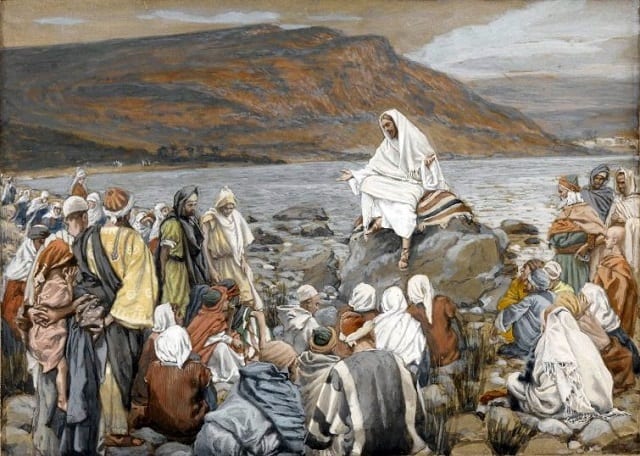
Photo credit: Jesus Teaches the People by the Sea, by James Tissot (1836-1902) [public domain / Wikimedia Commons]

***
Protestant commentaries & John 6
Protestants & the real presence
Protestants & transubstantiation
Previous Post

January 26, 2021
Recommended Catholic Books (Six Lists)
Next Post

January 28, 2021 Should Catholic Women Teach Men? YES!
Browse Our Archives
Select a Category & Last Things About Me Anti-Catholicism Atheism & Agnosticism Baptism and Sacramentalism Bible and Tradition Blessed Virgin Mary Books by Dave Armstrong C. S. Lewis Calvinism & General Protestantism Catholic Apologetics Catholic Apologists Catholic conversion Catholic converts Christmas Church (Ecclesiology) Church History Conversion and Converts Development of Doctrine Eastern Orthodoxy Ecumenism & Christian Unity Eucharist & Liturgy Fathers of the Church French Translations G. K. Chesterton Hell Hell & Satan Hell & Satan & Last Things Heresies & Comparative Religion Holistic Health Inquisition & Crusades & Scandals James White Jews & Judaism & Old Testament John Calvin John Henry Newman Liberal / Modernist Theology Life Issues Literary Resume Lutheranism Mariology Martin Luther Music Orthodoxy Papacy & Infallibility Personal Page Philosophy & Science Political & Ethical & Moral Issues Protestant Persecution & Intolerance Protestantism Purgatory Purgatory & Penance Romantic & Imaginative Theology Saints & Purgatory & Penance Salvation Salvation & Justification Satan & Last Things Sexuality and Gender Issues Spanish Translations Traditionalism vs. Radical Catholic Reactionaries Traducciones al español / tradução para português Trinitarianism & Christology Uncategorized Videos
Select a Month October 2026 September 2026 August 2026 July 2026 June 2026 May 2026 April 2026 March 2026 February 2026 January 2026 December 2025 November 2025 October 2025 September 2025 August 2025 July 2025 June 2025 May 2025 April 2025 March 2025 February 2025 January 2025 December 2024 November 2024 October 2024 September 2024 August 2024 July 2024 June 2024 May 2024 April 2024 March 2024 February 2024 January 2024 December 2023 November 2023 October 2023 September 2023 August 2023 July 2023 June 2023 May 2023 April 2023 March 2023 February 2023 January 2023 December 2022 November 2022 October 2022 September 2022 August 2022 July 2022 June 2022 May 2022 April 2022 March 2022 February 2022 January 2022 December 2021 November 2021 October 2021 September 2021 August 2021 July 2021 June 2021 May 2021 April 2021 March 2021 February 2021 January 2021 December 2020 November 2020 October 2020 September 2020 August 2020 July 2020 June 2020 May 2020 April 2020 March 2020 February 2020 January 2020 December 2019 November 2019 October 2019 September 2019 August 2019 July 2019 June 2019 May 2019 April 2019 March 2019 February 2019 January 2019 December 2018 November 2018 October 2018 September 2018 August 2018 July 2018 June 2018 May 2018 April 2018 March 2018 February 2018 January 2018 December 2017 November 2017 October 2017 September 2017 August 2017 July 2017 June 2017 May 2017 April 2017 March 2017 February 2017 January 2017 December 2016 November 2016 October 2016 September 2016 August 2016 July 2016 June 2016 May 2016 April 2016 March 2016 February 2016 January 2016 December 2015 November 2015 October 2015 September 2015 August 2015 July 2015 June 2015 May 2015 April 2015 March 2015 February 2015 January 2015 December 2014 November 2014 October 2014 September 2014 August 2014 July 2014 June 2014 April 2014 March 2014 February 2014 January 2014 December 2013 November 2013 October 2013 September 2013 August 2013 July 2013 June 2013 April 2013 March 2013 February 2013 January 2013 December 2012 November 2012 October 2012 September 2012 August 2012 July 2012 June 2012 May 2012 April 2012 March 2012 February 2012 January 2012 December 2011 November 2011 October 2011 September 2011 August 2011 July 2011 June 2011 April 2011 March 2011 February 2011 October 2010 September 2010 August 2010 July 2010 April 2010 March 2010 December 2009 October 2009 August 2009 July 2009 June 2009 May 2009 March 2009 February 2009 October 2008 September 2008 April 2008 March 2008 February 2008 January 2008 December 2007 November 2007 October 2007 May 2007 March 2007 February 2007 January 2007 November 2006 October 2006 September 2006 August 2006 July 2006 June 2006 May 2006 April 2006 March 2006 February 2006 October 2005 June 2005 April 2005 February 2005 July 2004 May 2004 April 2004
Follow Us!
TAKE THE
Religious Wisdom Quiz
Who asked Jesus, "What is truth?"
Select your answer to see how you score.
Caiaphas Pilate Nicodemus Herod
Books by This Author Books by Dave Armstrong
Related posts from Biblical Evidence for Catholicism

Three More Anti-Catholic Lies About Catholicism (#6-4)
Biblical Evidence for Catholicism

Top Ten Anti-Catholic Lies (#10-7)
Biblical Evidence for Catholicism

The Mass & Development of Doctrine (vs. Wes...
Biblical Evidence for Catholicism

Miraculous Eucharist (vs. Francois Turretin #4)
Biblical Evidence for Catholicism
TRENDING AT PATHEOS Catholic

I was strolling through the top floor of the brand new Parthenon...

What Does Gêvâh Mean For Kimberley Guifoyle &...
This week, a lot of the news is focused on Kimberly Guilfoyle....

INNER CIRCLE: Profound Mystery (Of Christ In All...
Ephesians 5:31-32 “For this reason, a man will leave his father and...

Do Not Rejoice When Your Enemy Falls: The...
Turning an execution into a public spectacle is a disturbing expression of...

'The Chosen' S6 Trailer: The Passion Gets Very...
Not many watching 'The Chosen' worry about spoilers, but just because they...

The purpose-driven labor priest
A labor activist reads Rick Warren and it gets me wondering about...
view all Catholic blogs
Ad-Free & Subscriber Log-In Subscription Support
- About Us
- 2026 Calendar
- Videos
- Podcasts
- Library of World Religions
- Faith In Media Tracker
- Advertise With Us
- Write for Us
- Privacy Policy
- Terms of Service
- Do Not Sell My Data
- Contact Us
- Radiant Digital
- Manage Newsletter Subscriptions
- Unsubscribe From Notifications
- Sitemap
Copyright 2008-2026, Patheos. All rights reserved.
Subscription Support Ad-Free & Subscriber Log-In
Follow Patheos