
BuddhistCatholicContemplativeEvangelicalGeneral ChristianHinduJewishLatter-day SaintMuslimNew VisionsProgressive Christian
Beliefs
- Buddhist
- Catholic
- Contemplative
- Evangelical
- General Christian
- Hindu
- Jewish
- Latter-day Saint
- More Voices
- Muslim
- New Visions
- Pagan
- Progressive Christian
Topics
- Religion News
- Food and Religion
- Sports and Religion
- Religious Art
- Religious Music and Entertainment
- Religious Events
- History and Religion
- Style and Religion
- Politics and Religion
- Women in Religion
- Recreation Outdoors and Religion
- Business Finance and Religion
- Careers Workplace and Religion
- Education and Religion
- Family Parenting and Religion
- Health Fitness and Religion
- Home and Religion
- Relationships and Religion
- Technology and Religion
- Travel and Religion
Columnists
- Buddhist Columnists
- Business Finance and Religion Columnists
- Careers Workplace and Religion Columnists
- Catholic Columnists
- Contemplative Columnists
- Education and Religion Columnists
- Evangelists Columnists
- Family Parenting and Religion Columnists
- General Christian Columnists
- Health Fitness and Religion Columnists
- Hindu Columnists
- History and Religion Columnists
- Home and Religion Columnists
- Jewish Columnists
- More Voices Columnists
- Latter Day Columnists
- Muslim Columnists
- New Visions Columnists
- Nonreligious Columnists
- Pagan Columnists
- Politics and Religion Columnists
- Progressive Columnists
- Recreation Outdoors and Religion Columnists
- Relationships and Religion Columnists
- Religion News Columnists
- Religious Art Columnists
- Religious Events Columnists
- Religious Music and Entertainment Columnists
- Sports and Religion Columnists
- Style and Religion Columnists
- Technology and Religion Columnists
- Travel and Religion Columnists
- Women in Religion Columnists
Resource Library
- 2026 Calendar
- Library of World Religions
- The 100 Most Holy Places on Earth
- Patheos Answers
- Podcasts
- Videos
- Faith Leaders Database
- Anglican Episcopalian
- Bahai
- Baptist
- Buddhism
- Christianity
- Confucianism
- Eastern Orthodoxy
- Hinduism
- Holiness and Pentecostal
- ISKCON
- Islam
- Judaism
- Lutheran
- Methodist
- The Church of Jesus Christ of Latter-day Saints
- New Age
- Paganism
- Presbytarian and Reformed
- Protestantism
- Religion Behind the Scenes
- Roman Catholic
- Scientology
- Shia Islam
- Sikhism
- Sufism
- Sunni Islam
- Taoism
- Zen
- See all religions
Research Tools
 Ad-Free & Subscriber Log-In Subscription Support
Ad-Free & Subscriber Log-In Subscription Support
Follow Patheos 

- Trending:
- Forgiveness
- |
- Marriage
- |
- Consciousness
- |
- Death Penalty
- |
- Election
- |
- Halloween

-
About
-
Catholic Apologetics
-
Church History
-
Great Apologists
-
Christian Worldview
-
Protestantism & Misc.
- Home
- Catholic
- History and Religion
- Seidensticker Folly #66: Biblical “Evidence-Less Faith”?
Seidensticker Folly #66: Biblical “Evidence-Less Faith”?
Last updated on: December 9, 2020 at 12:32 pm by Dave Armstrong
Seidensticker Folly #66: Biblical “Evidence-Less Faith”? 2020-12-09T12:32:50-04:00 Dave Armstrong
Patheos Explore the world's faith through different perspectives on religion and spirituality! Patheos has the views of the prevalent religions and spiritualities of the world.
Atheist and anti-theist Bob Seidensticker runs the influential Cross Examined blog. He asked me there, on 8-11-18: “I’ve got 1000+ posts here attacking your worldview. You just going to let that stand? Or could you present a helpful new perspective that I’ve ignored on one or two of those posts?” He added in June 2017 in a combox: “If I’ve misunderstood the Christian position or Christian arguments, point that out. Show me where I’ve mischaracterized them.” Delighted to oblige his wishes . . .
Bob (for the record) virtually begged and pleaded with me to dialogue with him in May 2018, via email. But by 10-3-18, following massive, childish name-calling attacks against me, encouraged by Bob on his blog, he banned me from commenting there. I also banned him for violation of my rules for discussion, but (unlike him) provided detailed reasons for why it was justified.
Bob’s cowardly hypocrisy knows no bounds. On 6-30-19, he was chiding someone for something very much like his own behavior: “Spoken like a true weasel trying to run away from a previous argument. You know, you could just say, ‘Let me retract my previous statement of X’ or something like that.” Yeah, Bob could! He still hasn’t yet uttered one peep in reply to — now — 65 of my critiques of his atrocious reasoning.
Bible-Basher Bob reiterated and rationalized his intellectual cowardice yet again on 10-17-20: “Every engagement with him [yours truly] devolves into pointlessness. I don’t believe I’ve ever learned anything from him. But if you find a compelling argument of his, summarize it for us.” And again the next day: “He has certainly not earned a spot in my heart, so I will pass on funding his evidence-free project. Like you, I also find that he’s frustrating to talk with. Again, I evaluate such conversations as useful if I can learn something–find a mistake in my argument, uncover an error I made in Christians’ worldview, and so on. Dave is good at bluster, and that’s about it.”
Bible-Basher Bob’s words will be in blue. To find these posts, follow this link: “Seidensticker Folly #” or see all of them linked under his own section on my Atheism page.
*****
In his post, Faith, the Other F-Word? (2 of 2) (11-25-20, and recycled, as so often, from an earlier one dated 7-13-16), Bible-Basher Bob states:
What does faith mean? Does it mean belief firmly grounded in evidence? That’s the definition in vogue among many conservative apologists (and discussed in part 1). But there’s another definition that is also popular.
Now, I’m happy and delighted to give Bob credit for at least noting in his first part that the Bible has passages about “evidential faith” or “reasonable faith” or faith and reason considered together as parts of the whole picture. But then he goes on to erroneously assert that there is another biblical motif that supposedly contradicts this:
Faith definition 2: belief held not primarily because of evidence and little shaken in the face of contrary evidence; that is, belief neither supported nor undercut by evidence. This would be a belief that can’t be shaken by a change in evidence (such as, “I won’t give up my faith in Jesus for any reason”). Evidence for one’s belief can be nonexistent, or it can actually oppose one’s belief (as in blind faith), or evidence can simply be insufficient to firmly ground the belief.
What he describes is blind faith, or technically, fideism, and there are indeed some Christians who espouse this. But they have never been in the mainstream, and (most importantly), I would contend that the Bible itself doesn’t teach it, as I have written about several times:
Atheist Myths: “Christianity vs. Science & Reason” (vs. “drunkentune”) [1-3-07]
Passionate Defense of Religious Truths: The Biblical Data [6-4-07]
The Certitude of Faith According to Cardinal Newman [9-30-08]
Dialogue on Reason & Faith, w Theological Liberal [1-19-10]
Christianity: Crucial to the Origin of Science [8-1-10]
Christians or Theists Founded 115 Scientific Fields [8-20-10]
Simultaneously Dumb & Smart Christians, Atheists, & Scientists [10-9-15]
Implicit (Extra-Empirical) Faith, According to John Henry Newman [12-18-15]
On Mystery & Reason in Theology [4-5-16]
Is Christianity Unfalsifiable? Is Empiricism the Only True Knowledge? [5-6-17]
Apologetics Doesn’t Mean Being Sorry for Your Faith [National Catholic Register, 6-6-17]
Reason, Science, & Logic Not the Exclusive Possessions of Atheists (7-24-17)
Dialogue with Atheist: Are Christians “Unscientific”? [5-27-19]
Apologetics = Anti-Faith or Absolute “Certainty”? (Or, “Does Christianity Reduce to Mere Philosophy or Rationalism?”) [7-5-20]
Seidensticker Folly #44: Historic Christianity & Science [8-29-20]
See many more articles along these lines on my Philosophy & Science and Catholic & General Christian Apologetics web pages.
Faith definition 2: belief held not primarily because of evidence and little shaken in the face of contrary evidence; that is, belief neither supported nor undercut by evidence. This would be a belief that can’t be shaken by a change in evidence (such as, “I won’t give up my faith in Jesus for any reason”). Evidence for one’s belief can be nonexistent, or it can actually oppose one’s belief (as in blind faith), or evidence can simply be insufficient to firmly ground the belief.
Again, let’s start with the Bible to find support for this evidence-less faith:
Now faith is being sure of what we hope for and certain of what we do not see. . . . And without faith it is impossible to please God, because anyone who comes to Him must believe that He exists and that He rewards those who earnestly seek Him (Hebrews 11:1–6).
Then Jesus told [Doubting Thomas], “You believe because you have seen me. Blessed are those who believe without seeing me.” (John 20:29)
The Hebrews passage has no need of evidence, and the statement of Jesus celebrates those who believe despite a lack of evidence.
This reasoning takes insufficient account of the relevant data of context and of related cross-referenced verses. The author of Hebrews states: “Now faith is the assurance of things hoped for, the conviction of things not seen” (11:1, RSV). This is one aspect of faith, which is different from reason but not opposed to it: neither logically nor in the biblical / Hebraic worldview.
Atheist scientists believe in things “not seen” just as every Christian does: for example, they believe in, for example, dark matter: at the moment a very mysterious thing indeed, yet scientists are sure it makes up “approximately 85% of the matter in the universe and about a quarter of its total mass–energy density” (Wikipedia). It “has not yet been observed directly.”
It’s deduced from other empirical evidence, but then that’s exactly how Christian faith is also. Scientists have not (and likely cannot ever) observe the moment of the Big Bang when the universe began. Yet they believe in it. They can have an “assurance”and “conviction of things not seen.” Therefore, this clause in Hebrews is not antithetical at all to reason or empirical observation. To make out that it is is simply illogical and an improper interpretation.
“. . . whoever would draw near to God must believe that he exists” (Heb 1:6). This may sound at first sight like blind, raw, unaccompanied faith, apart from reason, but it’s not so, either. St. Paul in Romans 1 grounds such faith in reason and observation:
Romans 1:19-20 (RSV) For what can be known about God is plain to them, because God has shown it to them. [20] Ever since the creation of the world his invisible nature, namely, his eternal power and deity, has been clearly perceived in the things that have been made. So they are without excuse;
Hebrews 11:3 closely echoes the thought of Romans 1:19-20: “By faith we understand that the world was created by the word of God, so that what is seen was made out of things which do not appear.” This is a primitive, basic form of the argument from design, or teleological argument: one of the classic theistic proofs. Even if one disagrees with it, they can’t deny that it is an argument of some sort of reason, and not merely blind faith. God revealed Himself in His creation. This is more than ever true today: the more we learn about the marvels of the universe and of the even more amazing microscopic world.
Even Albert Einstein thought it was self-evident that there was design in the universe, brought about by some sort of “God” (in his own opinion, a pantheistic one, but still a notion far from atheism). And philosopher David Hume, who is thought to have demolished this theistic proof, accepted one form of the teleological argument. They’re basically expressing what Paul did in Romans 1.
So Hebrews 11 fits together with Romans 1 insofar as the former says that we “must believe that” God “exists” and the latter says that we can’t help believing this by simply observing the universe and the nearby material world. This is why the vast majority of people in the world and in world history have been religious. It’s the default position.” People have to unlearn it.
The rest of the Book of Hebrews is not at all averse to the world of observable reasons to believe in Jesus Christ and Christianity. It starts out with the incarnation of Jesus (chapter 1), then states that “God also bore witness by signs and wonders and various miracles and by gifts of the Holy Spirit” (2:4). That’s observable stuff: like the miracles of Jesus and His resurrection and post-resurrection appearances. Even atheists call for wondrous miracles that they claim would theoretically prove His existence. Well, God has done that and continues to do so. But if the atheist doesn’t see it himself or herself, they refuse to believe it, and no amount of credible testimony can sway them.
Hebrews 13:6 refers to Jesus’ resurrection, which was compelling evidence for the more than 500 people who saw Him alive after He died: “the God of peace who brought again from the dead our Lord Jesus . . . Thus, there is no evidence that the Book of Hebrews, understood as a whole, has “no need of evidence.”
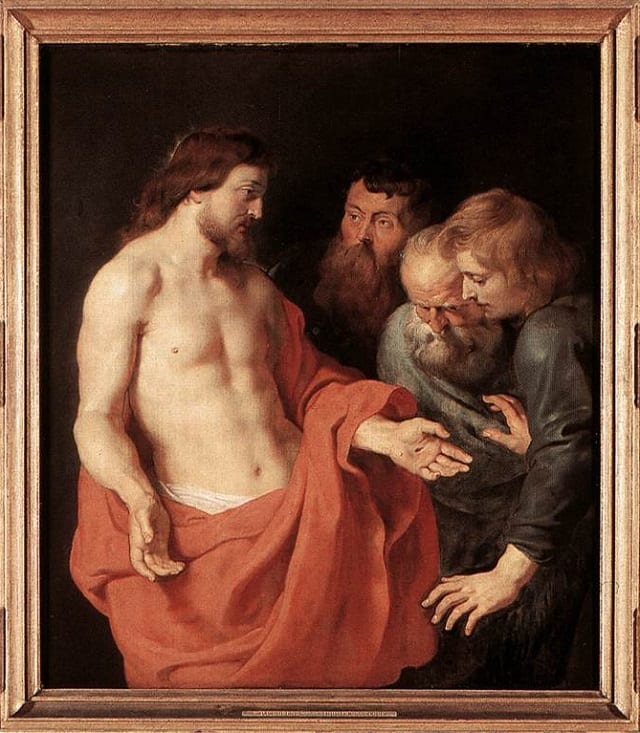
As for Doubting Thomas, this is no proof that Jesus was averse to such “apologetic” evidence, either, since (we must remember), Jesus decided to appear after His death specifically to Him, in order to prove the point to him. His statement about faith does not wipe that out. He was simply making the point that there was enough evidence already to believe that He was the Messiah and God incarnate. There is the evidence tied into faith, and there is a demand for evidence that goes beyond what is necessary. Jesus was concerned with the latter. I wrote elsewhere about Doubting Thomas:
Christianity requires belief in a number of things difficult to grasp and accept, but we accept them based on the authority of revelation. Doubting Thomas didn’t believe that Jesus could rise from the dead, even though Our Lord had often predicted it in the presence of the disciples. He had to see it for himself.
It is striking how Jesus is merciful and understanding enough to appear for Thomas’ sake. He knew his faith was weak, and so He offered a little “extra” to help him along. Thomas had an overly empirical mindset (he had said he had to put his finger in Jesus’ side, then he would believe: John 20:25). So Jesus, condescending to the limitations of the overly skeptical mentality, allowed him to do that (20:27).
This results (rather dramatically) in Thomas calling Jesus “God”: one of the most remarkable instances of proclamation of the divinity of Jesus in the New Testament (20:28). But after all this, Jesus nevertheless says, “Have you believed because you have seen me? Blessed are those who have not seen and yet believe.” (20:29). He came to Thomas because he was weak, but at the same time He made it clear that this would not be the norm, and that believers would have to exercise faith and not demand empirical proof.
And in another paper I observed:
He came back in one of His Resurrection appearances precisely to persuade Thomas. Thus, it is hardly a proof of supposed Christian “blind faith” to cite this story. Quite the contrary: the whole point of that story was to show that there is such a thing as excessive demands for proof (which Jesus and Paul talk about a lot), not that proof itself is unnecessary or frowned-upon.
The purpose of most of Jesus’ miracles (including, ultimately, His own Resurrection) was also to give testimony to His claims to be God, which is hardly a ringing endorsement of “blind faith” either, but rather, empirical evidence right before people’s eyes (much as atheists are constantly demanding today).
Dialoguing with an atheist about miracles, I stated:
Jesus performed miracles, too. But He also stated:
Matthew 12:38-40 (RSV): Then some of the scribes and Pharisees said to him, “Teacher, we wish to see a sign from you.” [39] But he answered them, “An evil and adulterous generation seeks for a sign; but no sign shall be given to it except the sign of the prophet Jonah. [40] For as Jonah was three days and three nights in the belly of the whale, so will the Son of man be three days and three nights in the heart of the earth.
Mark 8:12 And he sighed deeply in his spirit, and said, “Why does this generation seek a sign? . . .”
The sign of Jonah was referring to His Resurrection. But of course, many refused to believe in Jesus even though they saw Him perform many miracles. They denied that they were from God:
Mark 3:22-26 And the scribes who came down from Jerusalem said, “He is possessed by Be-el’zebul, and by the prince of demons he casts out the demons.” [23] And he called them to him, and said to them in parables, “How can Satan cast out Satan? [24] If a kingdom is divided against itself, that kingdom cannot stand. [25] And if a house is divided against itself, that house will not be able to stand. [26] And if Satan has risen up against himself and is divided, he cannot stand, but is coming to an end.
So these miracles you demand before you will believe, weren’t good enough for these people. They simply dismissed them, just as many dismissed the Resurrection when it happened, coming up with many idiotic theories to try to rationalize it away.
Jesus is not opposed to observable, empirical evidence at all. He stated that His Resurrection would be the prime example of this. He only condemns the excessive demands for proof all the time. It’s like one spouse in a happy marriage asking a million times if the spouse loves him or her. At some point we must believe in faith a thing that has been demonstrated over and over. That‘s what Jesus is saying. And so the New Testament sums up this attitude of Jesus in the following manner:
Acts 1:3 To them [the apostles] he presented himself alive after his passion by many proofs, appearing to them during forty days, and speaking of the kingdom of God.
Jesus habitually used reason and logic in His discourses, including even socratic method. So did St. Paul. The New Testament describes him not just as preaching the gospel, but also as “arguing” with Jews and Greeks alike (Acts 17:2; 17; 18:4, 19; 19:9; 24:25).
Of course, Bob isn’t swayed by any of the evidences for God, which is why he is an atheist:
[T]he data is in for God, and that hypothesis fails for lack of evidence, just like the leprechaun and Zeus hypotheses. . . . If God exists, he’d be happy to see me challenging empty Christian claims.
He challenges, makes manifestly ridiculous comparisons to Zeus and leprechauns, an apologist like me defends the Christian and biblical views, and then Bob ignores that, since he only wants to preach atheism, and has no interest whatsoever in interacting with Christian apologists unless he feels that he can make them look dumb and stupid. No dialogue ever really takes place. If he can’t answer particular challenges, on the other hand, he ignores and flees for the hills, as he has done with me for over two years: ignoring now 65 of my refutations of his fallacious, ignorant treatments.
I really don’t expect this time to be any different. So I ask: “which is more impressive and indicative of a robust confidence in the plausibility and reasonableness and factuality of one’s position: dealing with opposing views in great detail, point-by-point, and precisely showing how they fail and how one’s own viewpoint is superior, or preaching to the choir and ignoring anyone who dares to disagree?” Which of those two approaches suggests (oh, the irony!) blind faith more than the other?
Yes: it’s Bob‘s approach that has more blind faith than anything I believe or defend, because he puts himself into a bubble and allows no one who disagrees in: lest they show how ludicrous Bob’s beliefs are, after being closely scrutinized. That’s the very definition of the sociological “true believer”: impervious to any outside critique, and wrapped up in the pretense that in fact, there are none; that one’s own position is absolutely invulnerable to any imaginable criticism.
***
*
Photo credit: The Incredulity of St Thomas, or The Rockox Triptych: central portion (bet. 1613 and 1615), by Peter Paul Rubens (1577-1640) [public domain / Wikimedia Commons]

*
***
alleged biblical contradictions
Previous Post

December 8, 2020
John Lennon: Christian Right Before His Death?
Next Post

December 9, 2020 Kwasniewski vs. Pope Francis Re "Fundamentalism"
Browse Our Archives
Select a Category & Last Things About Me Anti-Catholicism Atheism & Agnosticism Baptism and Sacramentalism Bible and Tradition Blessed Virgin Mary Books by Dave Armstrong C. S. Lewis Calvinism & General Protestantism Catholic Apologetics Catholic Apologists Catholic conversion Catholic converts Christmas Church (Ecclesiology) Church History Conversion and Converts Development of Doctrine Eastern Orthodoxy Ecumenism & Christian Unity Eucharist & Liturgy Fathers of the Church French Translations G. K. Chesterton Hell Hell & Satan Hell & Satan & Last Things Heresies & Comparative Religion Holistic Health Inquisition & Crusades & Scandals James White Jews & Judaism & Old Testament John Calvin John Henry Newman Liberal / Modernist Theology Life Issues Literary Resume Lutheranism Mariology Martin Luther Music Orthodoxy Papacy & Infallibility Personal Page Philosophy & Science Political & Ethical & Moral Issues Protestant Persecution & Intolerance Protestantism Purgatory Purgatory & Penance Romantic & Imaginative Theology Saints & Purgatory & Penance Salvation Salvation & Justification Satan & Last Things Sexuality and Gender Issues Spanish Translations Traditionalism vs. Radical Catholic Reactionaries Traducciones al español / tradução para português Trinitarianism & Christology Uncategorized Videos
Select a Month October 2026 September 2026 August 2026 July 2026 June 2026 May 2026 April 2026 March 2026 February 2026 January 2026 December 2025 November 2025 October 2025 September 2025 August 2025 July 2025 June 2025 May 2025 April 2025 March 2025 February 2025 January 2025 December 2024 November 2024 October 2024 September 2024 August 2024 July 2024 June 2024 May 2024 April 2024 March 2024 February 2024 January 2024 December 2023 November 2023 October 2023 September 2023 August 2023 July 2023 June 2023 May 2023 April 2023 March 2023 February 2023 January 2023 December 2022 November 2022 October 2022 September 2022 August 2022 July 2022 June 2022 May 2022 April 2022 March 2022 February 2022 January 2022 December 2021 November 2021 October 2021 September 2021 August 2021 July 2021 June 2021 May 2021 April 2021 March 2021 February 2021 January 2021 December 2020 November 2020 October 2020 September 2020 August 2020 July 2020 June 2020 May 2020 April 2020 March 2020 February 2020 January 2020 December 2019 November 2019 October 2019 September 2019 August 2019 July 2019 June 2019 May 2019 April 2019 March 2019 February 2019 January 2019 December 2018 November 2018 October 2018 September 2018 August 2018 July 2018 June 2018 May 2018 April 2018 March 2018 February 2018 January 2018 December 2017 November 2017 October 2017 September 2017 August 2017 July 2017 June 2017 May 2017 April 2017 March 2017 February 2017 January 2017 December 2016 November 2016 October 2016 September 2016 August 2016 July 2016 June 2016 May 2016 April 2016 March 2016 February 2016 January 2016 December 2015 November 2015 October 2015 September 2015 August 2015 July 2015 June 2015 May 2015 April 2015 March 2015 February 2015 January 2015 December 2014 November 2014 October 2014 September 2014 August 2014 July 2014 June 2014 April 2014 March 2014 February 2014 January 2014 December 2013 November 2013 October 2013 September 2013 August 2013 July 2013 June 2013 April 2013 March 2013 February 2013 January 2013 December 2012 November 2012 October 2012 September 2012 August 2012 July 2012 June 2012 May 2012 April 2012 March 2012 February 2012 January 2012 December 2011 November 2011 October 2011 September 2011 August 2011 July 2011 June 2011 April 2011 March 2011 February 2011 October 2010 September 2010 August 2010 July 2010 April 2010 March 2010 December 2009 October 2009 August 2009 July 2009 June 2009 May 2009 March 2009 February 2009 October 2008 September 2008 April 2008 March 2008 February 2008 January 2008 December 2007 November 2007 October 2007 May 2007 March 2007 February 2007 January 2007 November 2006 October 2006 September 2006 August 2006 July 2006 June 2006 May 2006 April 2006 March 2006 February 2006 October 2005 June 2005 April 2005 February 2005 July 2004 May 2004 April 2004
Follow Us!
TAKE THE
Religious Wisdom Quiz
Who prayed for rain after a long drought and sent his servant to look seven times?
Select your answer to see how you score.
Elijah Isaiah Samuel Hosea
Books by This Author Books by Dave Armstrong
Related posts from Biblical Evidence for Catholicism

Why Wes Huff (and Everyone) Should Be Catholic
Biblical Evidence for Catholicism

God, Modern Physics, & Dark Energy: An Analogy
Biblical Evidence for Catholicism

Invocation of Saints: Catholic Scholars vs. Me? Nope!
Biblical Evidence for Catholicism

My “Number Articles”: Alphabetized by Topic
Biblical Evidence for Catholicism
TRENDING AT PATHEOS Catholic

I was strolling through the top floor of the brand new Parthenon...

What Does Gêvâh Mean For Kimberley Guifoyle &...
This week, a lot of the news is focused on Kimberly Guilfoyle....

INNER CIRCLE: Profound Mystery (Of Christ In All...
Ephesians 5:31-32 “For this reason, a man will leave his father and...

Do Not Rejoice When Your Enemy Falls: The...
Turning an execution into a public spectacle is a disturbing expression of...

'The Chosen' S6 Trailer: The Passion Gets Very...
Not many watching 'The Chosen' worry about spoilers, but just because they...

The purpose-driven labor priest
A labor activist reads Rick Warren and it gets me wondering about...
view all Catholic blogs
Ad-Free & Subscriber Log-In Subscription Support
- About Us
- 2026 Calendar
- Videos
- Podcasts
- Library of World Religions
- Faith In Media Tracker
- Advertise With Us
- Write for Us
- Privacy Policy
- Terms of Service
- Do Not Sell My Data
- Contact Us
- Radiant Digital
- Manage Newsletter Subscriptions
- Unsubscribe From Notifications
- Sitemap
Copyright 2008-2026, Patheos. All rights reserved.
Subscription Support Ad-Free & Subscriber Log-In
Follow Patheos