
BuddhistCatholicContemplativeEvangelicalGeneral ChristianHinduJewishLatter-day SaintMuslimNew VisionsProgressive Christian
Beliefs
- Buddhist
- Catholic
- Contemplative
- Evangelical
- General Christian
- Hindu
- Jewish
- Latter-day Saint
- More Voices
- Muslim
- New Visions
- Pagan
- Progressive Christian
Topics
- Religion News
- Food and Religion
- Sports and Religion
- Religious Art
- Religious Music and Entertainment
- Religious Events
- History and Religion
- Style and Religion
- Politics and Religion
- Women in Religion
- Recreation Outdoors and Religion
- Business Finance and Religion
- Careers Workplace and Religion
- Education and Religion
- Family Parenting and Religion
- Health Fitness and Religion
- Home and Religion
- Relationships and Religion
- Technology and Religion
- Travel and Religion
Columnists
- Buddhist Columnists
- Business Finance and Religion Columnists
- Careers Workplace and Religion Columnists
- Catholic Columnists
- Contemplative Columnists
- Education and Religion Columnists
- Evangelists Columnists
- Family Parenting and Religion Columnists
- General Christian Columnists
- Health Fitness and Religion Columnists
- Hindu Columnists
- History and Religion Columnists
- Home and Religion Columnists
- Jewish Columnists
- More Voices Columnists
- Latter Day Columnists
- Muslim Columnists
- New Visions Columnists
- Nonreligious Columnists
- Pagan Columnists
- Politics and Religion Columnists
- Progressive Columnists
- Recreation Outdoors and Religion Columnists
- Relationships and Religion Columnists
- Religion News Columnists
- Religious Art Columnists
- Religious Events Columnists
- Religious Music and Entertainment Columnists
- Sports and Religion Columnists
- Style and Religion Columnists
- Technology and Religion Columnists
- Travel and Religion Columnists
- Women in Religion Columnists
Resource Library
- 2026 Calendar
- Library of World Religions
- The 100 Most Holy Places on Earth
- Patheos Answers
- Podcasts
- Videos
- Faith Leaders Database
- Anglican Episcopalian
- Bahai
- Baptist
- Buddhism
- Christianity
- Confucianism
- Eastern Orthodoxy
- Hinduism
- Holiness and Pentecostal
- ISKCON
- Islam
- Judaism
- Lutheran
- Methodist
- The Church of Jesus Christ of Latter-day Saints
- New Age
- Paganism
- Presbytarian and Reformed
- Protestantism
- Religion Behind the Scenes
- Roman Catholic
- Scientology
- Shia Islam
- Sikhism
- Sufism
- Sunni Islam
- Taoism
- Zen
- See all religions
Research Tools
 Ad-Free & Subscriber Log-In Subscription Support
Ad-Free & Subscriber Log-In Subscription Support
Follow Patheos 

- Trending:
- Forgiveness
- |
- Marriage
- |
- Consciousness
- |
- Death Penalty
- |
- Election
- |
- Halloween

-
About
-
Catholic Apologetics
-
Church History
-
Great Apologists
-
Christian Worldview
-
Protestantism & Misc.
- Home
- Catholic
- History and Religion
- Pastor Aeternus (1870): Can a Pope Ever Make Heresy Binding?
Pastor Aeternus (1870): Can a Pope Ever Make Heresy Binding?
Last updated on: March 8, 2024 at 1:05 am by Dave Armstrong
Pastor Aeternus (1870): Can a Pope Ever Make Heresy Binding? 2024-03-08T01:05:36-04:00 Dave Armstrong
Patheos Explore the world's faith through different perspectives on religion and spirituality! Patheos has the views of the prevalent religions and spiritualities of the world.
Dr. Robert Fastiggi and Ron Conte; edited by Dave Armstrong, in Response to Timothy Flanders
This is an excerpt from my much longer paper, Dialogue #7 w 1P5 Columnist Timothy Flanders (Highlighting Papal Indefectibility, Pastor Aeternus from Vatican I in 1870, & the “Charitable Anathema”) [12-1-20]. Timothy Flanders’ words will be in blue.
*****
Did Vatican I Dogmatize Pighius?
You have countered my assertions by stating that any concept of error contained in a Magisterial Act is contrary to the First Vatican Council which you quote at length. You seem to assert that Vatican I dogmatized Pighius’ sententia regarding a heretical pope. His opinion was that a pope can never be a heretical [sic]. It is simply impossible. This was the opinion defended by Bellarmine, which he says is sententia probabilis in his famous passage on the five opinions on the question of a heretical pope. You seem to assert that Vatican I raised this sententia from probabilis to de fide at Vatican I. Please clarify if I’ve misunderstood you.
That is approximately Dr. Robert Fastiggi’s opinion, and I got this opinion from him (in fact, after he expressed it forcefully on your own webcast). I either didn’t realize it was in Vatican I or had forgotten it. He would be in a position to know, as editor and translator of the latest Denzinger and also the revision of Ludwig Ott. I think we can trust his scholarly authority on this, and the conciliar text seems utterly clear and unambiguous to me. Not that I claim to be any sort of expert on it . . . But it adopted and confirmed Bellarmine’s view on one point, not that of Pighius (which Bellarmine partially disagreed with), as Bishop Gasser clarified in his Relatio in 1870. More on that below.
This assertion, however, cannot be proved by simply quoting the passage you did from Vatican I. The phrases you bolded have been used by the Holy See for centuries, and known to the same theologians who argued against Pighius, and continued to do so after 1870. (I am relying here on the work of Mr. Ryan Grant, Bellarmine’s foremost English translator.) Ott even seems to say otherwise when he talks about the decisions of the Holy See:
The ordinary and usual form of Papal teaching activity is not infallible[.] … Nevertheless they are normally to be accepted with an inner assent which is based on the high supernatural authority of the Holy See (assensus religiosus). The so-called silentium obsequiosum, i.e. reverent silence, does not generally suffice. By way of exception, the obligation of inner assent may cease if a competent expert, after a renewed scientific investigation of all grounds, arrives at the positive conviction that the decision rests on an error.[3]
It’s apparent (in the second word) that Ott is talking about the ordinary magisterium there. But Pastor aeternus is referring to the extraordinary magisterium:
. . . matters concerning the faith. This was to ensure that any damage suffered by the faith should be repaired in that place above all where the faith can know no failing. (Ch., 4, 4) . . .
For the Holy Spirit was promised to the successors of Peter not so that they might, by his revelation, make known some new doctrine, but that, by his assistance, they might religiously guard and faithfully expound the revelation or deposit of faith transmitted by the apostles. Indeed, their apostolic teaching was embraced by all the venerable fathers and reverenced and followed by all the holy orthodox doctors, for they knew very well that this See of St. Peter always remains unblemished by any error, . . . (Ch. 4, 6)
These portions lead up to the famous climax which defines papal infallibility. The preceding sections obviously refer in context to the same sort of thing: the highest levels of infallibility.
Since (ultimately) the particular canonical and dogmatic aspects of this matter are above my pay grade, I wrote to Dr. Fastiggi and he sent me three short articles he wrote about Cardinal Bellarmine and conciliar and papal indefectibility, and a long one about the larger topic, from a talk he presented in about 2003 (personally approved of by Cardinal Dulles, who was in attendance). He wrote about the question of papal statements that are part of the ordinary magisterium:
[T]eachings of the extraordinary papal magisterium are infallible as well as definitive judgments by the Pope. The question of the possibility of error in ordinary papal teachings is a delicate matter. In my article I cite Vatican I’s affirmation that “in the Apostolic See the Catholic religion has always been preserved immaculate and sacred doctrine honored” (Denz.-H, 3066) and the “See of St. Peter always remains untainted by any error” (Denz.-H, 3070). Ordinary teachings of the papal magisterium are not definitive, and they are subject revision or reform. This is why the Congregation for the Doctrine of the Faith in its 1990 instruction, Donum Veritatis, speaks of such magisterial teachings as pertaining to matters “per se not irreformable.” If a papal teaching is not irreformable, it is subject to revision or change. For example, Pope Innocent I in 405 allowed for the use of juridical torture by Christian magistrates. Nicholas I, however, in 866 taught that neither divine nor human law allows such torture (cf. Denz.-H, 648). Innocent IV, however, approved the use of torture by the Inquisition in 1252. In 1993, though, John Paul II included torture among the acts which are intrinsically evil (Veritatis Splendor, no. 80). We can look back and say that Popes Innocent I and Innocent IV were in error about torture, but they were not opposing any definitive teaching on the subject at the times when they made their judgments. Their judgments were not irreformable, and when they made these judgments they were not opposing any settled truths of the faith.
It would take a long time to deal with all these matters in the depth they deserve, but these are some basic responses . . .
The divine protection of the pope that the Church adheres to clearly doesn’t include everything the pope proclaims. Hence, even though I have defended Pope Francis 178 times, I freely disagreed with him on several political matters when I commented (otherwise glowingly) on Fratelli tutti. And that’s because his opinion on political matters is not magisterial and has no binding authority. It’s not his domain (not in the fullest authoritative sense). He himself made clear that his opinions on science can also be disagreed with, in his encyclical Laudato si, and sure enough, in-between my almost endless praise of it, I respectfully disagreed with the Holy Father on nuclear energy and global warning.
In order to prove your assertion, you would need to show that Vatican I intended to address the well-known discussion on heretical popes and make a definitive pronouncement on this subject. However, the assertions of these theologians mentioned by Bellarmine and held by others before and after the Council are not addressed anywhere.
The council is under no obligation to do so, though I suspect in the discussions about the documents, those things were brought up.
Moreover, as Mr. Grant mentions in the above-linked discussion, the Acta show that the Council Fathers discussed whether to define one of the sententiae on the subject, but declined to do so.
You seem to assert that the dogma of indefectibility hinges on an alleged dogma of Pighius’ sententia, but this has not been proven. A good point to strengthen your case would be prove that Bellarmine (who held to Pighius) believed that if Pighius was wrong, then indefectibility was compromised. But this seems a tenuous claim, since he admits the other sententiae besides Pighius, and never accuses these others as compromising indefectibility.
I assert that the sententiae mentioned by Bellarmine have not been defined by the Magisterium. The most we can say about them is that one of them may be more probable than the others, but none of them can be said to be sententia communis, before or after Vatican I. I have not seen any evidence to the contrary, but as always I’m willing to be corrected.
Von Hildebrand Agreed with Davies on Vatican II
You assert that Deitrich Von Hildebrand “loved” Vatican II. It is true that in his first two books on the crisis you quote in your linked article, he made no direct critique of Vatican II but seems to place all the blame on the liberal interpreters of the same. To this I would not disagree in principle as I have said, but I do not say those who follow Lefebvre’s opinion of the Council are acting schismatically nor irrationally, since Vatican I did not dogmatize Pighius or your assertion about indefectibility.
I shall now happily yield to Dr. Fastiggi’s scholarly knowledge of dogmatics in order to present a full and adequate reply to your challenge. In one of his papers that I already cited above, he mentioned relevant magisterial material in Denzinger 3066 and 3070. He also referred in his personal letter to me, to “the indefectibility of Catholic doctrine under the special charism of truth and never-failing faith of the successor of Peter (D-H, 3071).”
Here is Denzinger 3071, from Pastor aeternus: from the latest revision (a copy of which always sits immediately to the right of my writing desk):
Now this charism of truth and of never-failing faith was conferred upon Peter and his successors in this chair in order that they might perform their supreme office for the salvation of all; that by them the whole flock of Christ might be kept away from the poisonous bait of error and be nourished by the food of heavenly doctrine; that, the occasion of schism being removed, the whole Church might be preserved as one and, resting on her foundation, might stand stand firm against the gates of hell.
For comparison’s sake, here is the translation from chapter 4, section 7, from the version of Pastor aeternus online at EWTN:
This gift of truth and never-failing faith was therefore divinely conferred on Peter and his successors in this See so that they might discharge their exalted office for the salvation of all, and so that the whole flock of Christ might be kept away by them from the poisonous food of error and be nourished with the sustenance of heavenly doctrine. Thus the tendency to schism is removed and the whole Church is preserved in unity, and, resting on its foundation, can stand firm against the gates of hell.
In another paper of his, Dr. Fastiggi stated, regarding Bellarmine and Suárez:
What these two Jesuit theologians believed could not happen was confirmed by Vatican I’s affirmation of the “charism of truth and of never-failing faith” conferred upon Peter and his successors” (Denz.-H, 3071). We need to thank God for this charism given to Peter and his successors and have faith it this special charism.
Dr. Fastiggi’s paper from his 2003 talk is entitled, “The Petrine Ministry and the Indefectibility of the Church.” It was eventually published in Called to Holiness and Communion: Vatican II on The Church (edited by Fr. Steven Boguslawski, O.P. and Robert Fastiggi, Ph.D., University of Scranton Press, 2009). In it, he stated:
In the post-Tridentine era, theologians such as Bellarmine (1542-1621) and Suárez (1548-1617) affirm both the indefectibility of the Church as a whole and the necessity of the Petrine office for maintaining this indefectibility in doctrine. . . .
The Doctor Eximius [Suárez] [91] likewise upholds the indispensability of the Petrine office for the Church’s indefectibility. He observes that “the Roman Church” can refer either to the particular Church of Rome or to the See of the Roman Pontiff who, when assuming the posture of the teacher of the universal Church, can never err or depart from the faith. [92] For this reason, “the faith of the Roman Church is the Catholic faith, and the Roman Church has never departed from this faith nor could she ever so depart because the chair of Peter presides over her.” [93] . . .
To be sure, the Petrine ministry is not the only means for insuring ecclesial unity. Much could also be said about the indispensable role of Mary who is “intimately united to the Church” [186] and who cares for the faithful “by her maternal charity.” [187] The central point of this essay, however, is that the Petrine office is essential to the indefectible structure of the Catholic Church. As a “visible source and foundation” [188] of ecclesial communion, the Roman Pontiff fulfills a divinely ordained service of unity. Without the Petrine ministry, the Church would be lacking an essential aspect of what Christ willed for His Church on earth. Without the Petrine office, the Church ceases to be indefectible.
[Footnotes:
91 Pope Paul V (r. 1605-1621) bestowed upon Suárez the title of Doctor Eximius, the Exceptional or Uncommon Doctor.
92 Cf. Suárez, Defensio Fidei Catholicae Adversus Anglicanae Sectae Errores, chap. 5, no. 5-6 in Vivès ed., vol. 24, 21-22.
93 Ibid., chap. 5, no. 7; Vivès*,* vol. 24, 22.
[ . . . ]
186 Lumen gentium, 63
187 Ibid., 62.
188 Ibid., 18.
In his correspondence with me, he also recommended an article by Ron Conte, noting that he didn’t “always agree” with Ron (nor do I), but that “he understands papal authority and indefectibility very well.” In “Bellarmine, Taylor Marshall, and Ryan Grant on Papal Faith” (8-1-20), Ron commented:
First, a review of what Bellarmine says.
In the book On the Roman Pontiff, book 2, chapter 30, Saint Robert Bellarmine considers a proposition called “the tenth argument”.
“The tenth argument. A Pope can be judged and deposed by the Church in the case of heresy; as is clear from Dist. 40, can. Si Papa: therefore, the Pontiff is subject to human judgment, at least in some case.”
He begins by saying there are five opinions on the matter.
- “The first is of Albert Pighius, who contends that the Pope cannot be a heretic, and hence would not be deposed in any case: such an opinion is probable, and can easily be defended, as we will show in its proper place.”
This opinion was that of Saint Robert Bellarmine as well as Pighius, and it was adopted and confirmed . . . by the First Vatican Council. When Bishop Vincent Gasser, in his relatio before the Council, says that the Council adopted the opinion of Bellarmine, not any extreme opinion of Pighius and his school, he means this opinion, where Bellarmine and Pighius happen to agree. . . .
And now we come to the fifth opinion, like the first, accepted by Bellarmine. But this fifth opinion is only “the fifth true opinion” if it is the case that Popes can commit or teach heresy. Bellarmine thinks that God does not permit this. He says the first opinion, that Popes cannot teach or commit heresy is probable and easily defended. And since this fifth opinion is predicated on a Pope being heretical, something excluded by Vatican I, it is only an intellectual exercise. One cannot base an accusation against Pope Francis on this fifth opinion.
Marshall and Grant
Dr. Taylor Marshall and Ryan Grant discuss Bellarmine on whether a Pope can be a heretic, in this video. Let’s consider what they say.
Taylor Marshall and Ryan Grant opine that a manifestly heretical Pope could be deposed by an Ecumenical Council. They note that the “first opinion” is the one held by Bellarmine, that a Pope cannot teach or commit heresy. This opinion is dismissed by them, in a common but erroneous manner, by accusing various Popes of grave failures of faith, including Honorius, John 22, and Marcellinus.
The enemies of the Church accused Pope Marcellinus of apostasy, of sacrificing to the pagan gods, which would be a grave sin against faith, even if under duress. But this is also the type of sin which the grace of God prevents. For if the Rock on which the Church is founded, whose faith is never failing, could, even exteriorly and under duress, worship pagan gods, the Church would not be indefectible. For many souls would be lost, following this example of the Pope. Therefore, based on the teaching of Vatican I, we must conclude that Marcellinus was innocent. See my previous post. He was falsely accused by the enemies of the Church, as a way to convince his flock to behave similarly. The fact that this Pope was a Saint who died a martyr, rather than worship pagan gods, is also proof of his innocence. The story that he worshipped false gods exteriorly, repented, and then died rather than commit the same act again is fiction.
But when Marcellinus was accused, he offered to be judged by an Ecumenical Council. Yet the Cardinals and Bishops refused to judge him, saying: “For the first See is not judged by anyone.” And his innocence is defended in this article in the old Catholic Encyclopedia. It is impossible that Marcellinus committed the grave sins against faith of which he is accused, as it is contrary to . . . Vatican I. And even from a mere human perspective, the accusations are untrustworthy and the account clearly spurious.
So Marshall and Grant err gravely by using their own fallible opinions to judge and condemn past Popes for grave sins against faith. Basing a theological opinion on a prudential judgment is a weak argument.
It is interesting to note that, before Vatican I declared the never failing faith of the Pope, they considered the past history of the Popes, looking for any Pope who failed in faith. They found none. Honorius was rather easily defended, as Cardinal Manning states. And the same was true for the other Popes. And the fathers of that Council were well aware of the writings of Bellarmine defending the Popes against accusations of failure of faith. Since the Council did not find any Popes guilty of heresy, this is further proof that the Council intended to define that Popes cannot commit heresy.
The First Vatican Council phrased this . . . in positive terms, that each Pope has a charism from God of truth and a never-failing faith. This is better than merely saying that Popes do not commit heresy and do not teach heresy; it is a fuller statement which includes the negative, but also includes the positive gift. The Pope has a charism from God ordered inexorably toward truth and faith. Unfailing in truth. Unfailing in faith. That is the Vicar of Christ, guided by the Holy Spirit.
But Marshall and Grant err gravely by claiming that the First Vatican Council did not deal with the question of whether a Pope could commit or teach heresy. Grant states: “the Magisterium of the Church punted on the issue, refused to define it….” But if that is true, Mr. Grant, then what is the meaning of this charism of truth and a never failing faith? Grant ignores the teaching entirely. He gives no explanation. . . .
[I]f Grant believes that Vatican I did not decide the question of whether Popes can teach heresy, what does he think “this charism of truth and never failing faith” means? How can a Pope have a divinely conferred charism of truth and never failing faith, and also teach material heresy and commit formal heresy? Grant does not address the question. This is typical of the papal accusers. . . .
Teaching heresy from the Chair of Peter is an exceedingly grave failure of faith. It would do grave harm to the indefectibility of the Church. And so the grace of God does not permit this to happen.
The never failing faith of the Pope, the definition of Vatican I, certainly implies that the Pope cannot be a heretic, as then his faith would have failed. Also, the teaching that each Pope has the gift of truth implies that he cannot teach heresy. For material heresy is contrary to truth and formal heresy is contrary to a never failing faith. Thus the gift of truth and never failing faith utterly prevents any type of heresy, material or formal, in any valid Roman Pontiff. . . .
Consider the following argument. (1) If a Pope commits heresy, he would be automatically cut off from the Church and would lose his authority. (2) If God permits Popes to commit heresy, then the faithful would not know which Popes were valid and which teachings to believe. (3) Not knowing which teachings to believe, makes it all the more difficult to determine which Popes have committed heresy. (4) Councils are only valid if approved by a valid Pope. (5) Not knowing which Popes are valid causes us to not know which Councils are valid. (6) The end of this process is that the faithful would have no way to know which Popes and Councils were valid and which teachings to believe. They would be like lost sheep, and the Church would utterly lose Her indefectibility. (7) Therefore, God does not permit Popes to commit heresy.
The argument is predicated on the true premise that IF a Pope commits heresy, he is no longer the valid Pope. So the proposition is true, in the abstract, but also counter-factual. It is like the assertion: If Christ has not risen, then our faith is in vain. Christ has risen. But it is still true that IF He has not risen, then our faith would be in vain.
Marshall and Grant unfortunately take opinion five as if it were factual, as if a Pope could teach or commit heresy, and be deposed by an Ecumenical Council. This is not possible, as the Roman Pontiff is above the authority of an Ecumenical Council. . . .
Since the Roman Pontiff governs the whole Church, he also governs the body of Bishops and any Ecumenical Councils. This implies that Councils may not depose a Pope.
“Since the Roman pontiff, by the divine right of the apostolic primacy, governs the whole church, we likewise teach and declare that he is the supreme judge of the faithful, and that in all cases which fall under ecclesiastical jurisdiction recourse may be had to his judgment. The sentence of the apostolic see (than which there is no higher authority) is not subject to revision by anyone, nor may anyone lawfully pass judgment thereupon. And so they stray from the genuine path of truth who maintain that it is lawful to appeal from the judgments of the Roman pontiffs to an ecumenical council as if this were an authority superior to the Roman pontiff.” [Vatican I, Pastor Aeternus, chapter 3, n. 8] . . .
I am a fan of Ryan Grant’s work. Grant’s contribution to scholarship is invaluable to the Church. But he is not a competent theologian. The ability to understand and write theology is a gift. No matter how intelligent you may be, if you don’t have that gift, then you will not be a good theologian. Despite Grant’s own admission that he is not a theologian, he delves into theology by implying that a Pope can be a heretic and can be deposed by an Ecumenical Council.
Bishop Vincent Gasser, in his famous Relatio on infallibility at Vatican I, noted:
As far as the doctrine set forth in the Draft goes, the Deputation is unjustly accused of wanting to raise an extreme opinion, viz., that of Albert Pighius, to the dignity of a dogma. For the opinion of Albert Pighius, which Bellarmine indeed calls pious and probable, was that the Pope, as an individual person or a private teacher, was able to err from a type of ignorance but was never able to fall into heresy or teach heresy. To say nothing of the other points, let me say that this is clear from the very words of Bellarmine, both in the citation made by the reverend speaker and also from Bellarmine himself who, in book 4, chapter VI, pronounces on the opinion of Pighius in the following words: “It can be believed probably and piously that the supreme Pontiff is not only not able to err as Pontiff but that even as a particular person he is not able to be heretical, by pertinaciously believing something contrary to the faith.” From this, it appears that the doctrine in the proposed chapter is not that of Albert Pighius or the extreme opinion of any school, but rather that it is one and the same which Bellarmine teaches in the place cited by the reverend speaker and which Bellarmine adduces in the fourth place and calls most certain and assured, or rather, correcting himself, the most common and certain opinion. (section 40)
You wrote: “Vatican I did not dogmatize Pighius or your assertion about indefectibility.” In fact, it adopted and affirmed one portion of St. Robert Bellarmine‘s argument that agreed only in part with Pighius, and disagreed in part. That it in fact affirmed the notion that the pope could not ever bind the Church to error or heresy, is, to me, quite clear also in the inexorable logic (or logical result) of the wording: about which Ron Conte drives home the point in, I think, devastating and unanswerable fashion.
If you or my friend Ryan Grant, or Dr. Taylor Marshall disagree with Ron’s take, then by all means, take a shot at refuting it. I think you will end up in a tangled mess of self-contradiction. Something to seriously ponder, for sure . . . Dr. Fastiggi summarizes the clear Church teaching in this regard:
Any well-formed Catholic knows how essential the papacy is for the Catholic Church. To be a Catholic is to be in communion with the Roman Pontiff. Vatican II teaches that those fully incorporated in the Church “are united with her as part of her visible bodily structure and through her with Christ, who rules her through the Supreme Pontiff and the bishops” (Lumen gentium, 14). The authority of the pope comes from Christ, and it is divinely protected. Vatican I clearly teaches that “the See of St. Peter always remains untainted by any error according to the divine promise of our Lord and Savior made to the prince of his disciples” (Denz.-H 3070; cf. Lk 22:32). This means that Christ and the Holy Spirit will insure that “in the Apostolic See” the Catholic religion will “always be preserved immaculate and sacred doctrine honored” (Denz.-H 3066; cf. the formula of Pope Hormisdas; Denz.-H 363–365). . . .
Popes, of course, can make mistakes in their prudential judgments, and they are liable to sin in their personal lives. Although popes teach with authority, not all of their doctrinal judgments are irreformable. The Congregation for the Doctrine of the Faith [CDF], in its 1990 instruction, Donum veritatis, acknowledged as much. . . .
Pope Francis has admitted his mistakes in regard to sex abuse in Chile, and he has also expressed his openness to constructive criticism. Some critics of Francis, however, go beyond constructive criticism and try to undermine his moral and doctrinal authority at every turn. . . .
Although prudential papal judgments require attentive consideration, papal teachings on faith and morals must be adhered to with “religious submission of mind and will” even when the pope is not speaking ex cathedra. (Lumen gentium 25). This religious submission “must be shown in such a way that his supreme magisterium is acknowledged with reverence,” and “the judgments made by him are sincerely adhered to, according to his manifest mind and will” (Lumen gentium 25). Many papal critics, however, fail to manifest proper reverence toward Pope Francis’s teaching authority. They appear to trust their own judgments more than they trust the Holy Spirit’s guidance of the successor of Peter. (“Pope Francis and Papal Authority under Attack”, La Stampa / Vatican Insider, 2-18-19)
***
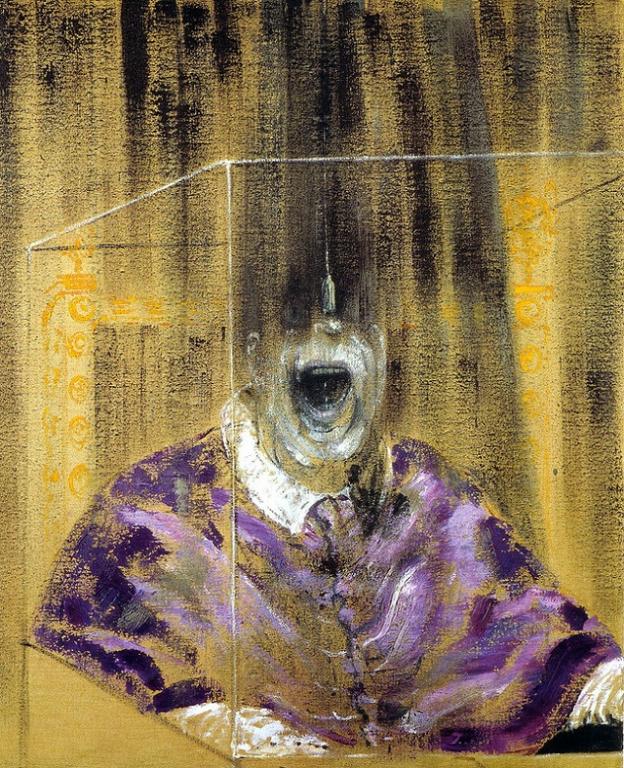
Photo credit: Portion of Head VI (1949) by Francis Bacon (1909-1992): reinterpretation of a portrait of Pope Innocent IX from 1650 by the Spanish painter Diego Velazquez (1599-1660) [Flickr / CC BY-NC 2.0 license]
***
Traditionalism vs. Radical Catholic Reactionaries
Previous Post
December 1, 2020
Dialogue #7 w 1P5 Columnist Timothy Flanders
Next Post
December 2, 2020 "Amadeus" & Historical Accuracy in Biopics
Browse Our Archives
Select a Category & Last Things About Me Anti-Catholicism Atheism & Agnosticism Baptism and Sacramentalism Bible and Tradition Blessed Virgin Mary Books by Dave Armstrong C. S. Lewis Calvinism & General Protestantism Catholic Apologetics Catholic Apologists Catholic conversion Catholic converts Christmas Church (Ecclesiology) Church History Conversion and Converts Development of Doctrine Eastern Orthodoxy Ecumenism & Christian Unity Eucharist & Liturgy Fathers of the Church French Translations G. K. Chesterton Hell Hell & Satan Hell & Satan & Last Things Heresies & Comparative Religion Holistic Health Inquisition & Crusades & Scandals James White Jews & Judaism & Old Testament John Calvin John Henry Newman Liberal / Modernist Theology Life Issues Literary Resume Lutheranism Mariology Martin Luther Music Orthodoxy Papacy & Infallibility Personal Page Philosophy & Science Political & Ethical & Moral Issues Protestant Persecution & Intolerance Protestantism Purgatory Purgatory & Penance Romantic & Imaginative Theology Saints & Purgatory & Penance Salvation Salvation & Justification Satan & Last Things Sexuality and Gender Issues Spanish Translations Traditionalism vs. Radical Catholic Reactionaries Traducciones al español / tradução para português Trinitarianism & Christology Uncategorized Videos
Select a Month October 2026 September 2026 August 2026 July 2026 June 2026 May 2026 April 2026 March 2026 February 2026 January 2026 December 2025 November 2025 October 2025 September 2025 August 2025 July 2025 June 2025 May 2025 April 2025 March 2025 February 2025 January 2025 December 2024 November 2024 October 2024 September 2024 August 2024 July 2024 June 2024 May 2024 April 2024 March 2024 February 2024 January 2024 December 2023 November 2023 October 2023 September 2023 August 2023 July 2023 June 2023 May 2023 April 2023 March 2023 February 2023 January 2023 December 2022 November 2022 October 2022 September 2022 August 2022 July 2022 June 2022 May 2022 April 2022 March 2022 February 2022 January 2022 December 2021 November 2021 October 2021 September 2021 August 2021 July 2021 June 2021 May 2021 April 2021 March 2021 February 2021 January 2021 December 2020 November 2020 October 2020 September 2020 August 2020 July 2020 June 2020 May 2020 April 2020 March 2020 February 2020 January 2020 December 2019 November 2019 October 2019 September 2019 August 2019 July 2019 June 2019 May 2019 April 2019 March 2019 February 2019 January 2019 December 2018 November 2018 October 2018 September 2018 August 2018 July 2018 June 2018 May 2018 April 2018 March 2018 February 2018 January 2018 December 2017 November 2017 October 2017 September 2017 August 2017 July 2017 June 2017 May 2017 April 2017 March 2017 February 2017 January 2017 December 2016 November 2016 October 2016 September 2016 August 2016 July 2016 June 2016 May 2016 April 2016 March 2016 February 2016 January 2016 December 2015 November 2015 October 2015 September 2015 August 2015 July 2015 June 2015 May 2015 April 2015 March 2015 February 2015 January 2015 December 2014 November 2014 October 2014 September 2014 August 2014 July 2014 June 2014 April 2014 March 2014 February 2014 January 2014 December 2013 November 2013 October 2013 September 2013 August 2013 July 2013 June 2013 April 2013 March 2013 February 2013 January 2013 December 2012 November 2012 October 2012 September 2012 August 2012 July 2012 June 2012 May 2012 April 2012 March 2012 February 2012 January 2012 December 2011 November 2011 October 2011 September 2011 August 2011 July 2011 June 2011 April 2011 March 2011 February 2011 October 2010 September 2010 August 2010 July 2010 April 2010 March 2010 December 2009 October 2009 August 2009 July 2009 June 2009 May 2009 March 2009 February 2009 October 2008 September 2008 April 2008 March 2008 February 2008 January 2008 December 2007 November 2007 October 2007 May 2007 March 2007 February 2007 January 2007 November 2006 October 2006 September 2006 August 2006 July 2006 June 2006 May 2006 April 2006 March 2006 February 2006 October 2005 June 2005 April 2005 February 2005 July 2004 May 2004 April 2004
Follow Us!
TAKE THE
Religious Wisdom Quiz
Who was the major prophet during King Hezekiah's reign in Judah?
Select your answer to see how you score.
Daniel Ezekiel Jeremiah Isaiah
Books by This Author Books by Dave Armstrong
Related posts from Biblical Evidence for Catholicism

Was Peter "Any Old" Apostle? 10 Anti-Papal Arguments
Biblical Evidence for Catholicism

11 Protestant Objections to Papal Authority Debunked
Biblical Evidence for Catholicism

Matthew 16 & the Papacy (vs. Patrick O'Brien)
Biblical Evidence for Catholicism
Inspired Prophets: An Analogy to Infallible Popes
Biblical Evidence for Catholicism
TRENDING AT PATHEOS Catholic

Janie Learns the Way of the Cross: A...
Teaching children about Jesus' Passion can be challenging. Many parents and educators...

Looking For Good Catholic Writing - October 2026
He alone extends the heavens, and he walks upon the waves of...

In "Irreplaceable," our book on vocation and technology, Trevor Sutton and I...

I was strolling through the top floor of the brand new Parthenon...

What Does Gêvâh Mean For Kimberley Guifoyle &...
This week, a lot of the news is focused on Kimberly Guilfoyle....

INNER CIRCLE: Profound Mystery (Of Christ In All...
Ephesians 5:31-32 “For this reason, a man will leave his father and...
view all Catholic blogs
Ad-Free & Subscriber Log-In Subscription Support
- About Us
- 2026 Calendar
- Videos
- Podcasts
- Library of World Religions
- Faith In Media Tracker
- Advertise With Us
- Write for Us
- Privacy Policy
- Terms of Service
- Do Not Sell My Data
- Contact Us
- Radiant Digital
- Manage Newsletter Subscriptions
- Unsubscribe From Notifications
- Sitemap
Copyright 2008-2026, Patheos. All rights reserved.
Subscription Support Ad-Free & Subscriber Log-In
Follow Patheos