
BuddhistCatholicContemplativeEvangelicalGeneral ChristianHinduJewishLatter-day SaintMuslimNew VisionsProgressive Christian
Beliefs
- Buddhist
- Catholic
- Contemplative
- Evangelical
- General Christian
- Hindu
- Jewish
- Latter-day Saint
- More Voices
- Muslim
- New Visions
- Pagan
- Progressive Christian
Topics
- Religion News
- Food and Religion
- Sports and Religion
- Religious Art
- Religious Music and Entertainment
- Religious Events
- History and Religion
- Style and Religion
- Politics and Religion
- Women in Religion
- Recreation Outdoors and Religion
- Business Finance and Religion
- Careers Workplace and Religion
- Education and Religion
- Family Parenting and Religion
- Health Fitness and Religion
- Home and Religion
- Relationships and Religion
- Technology and Religion
- Travel and Religion
Columnists
- Buddhist Columnists
- Business Finance and Religion Columnists
- Careers Workplace and Religion Columnists
- Catholic Columnists
- Contemplative Columnists
- Education and Religion Columnists
- Evangelists Columnists
- Family Parenting and Religion Columnists
- General Christian Columnists
- Health Fitness and Religion Columnists
- Hindu Columnists
- History and Religion Columnists
- Home and Religion Columnists
- Jewish Columnists
- More Voices Columnists
- Latter Day Columnists
- Muslim Columnists
- New Visions Columnists
- Nonreligious Columnists
- Pagan Columnists
- Politics and Religion Columnists
- Progressive Columnists
- Recreation Outdoors and Religion Columnists
- Relationships and Religion Columnists
- Religion News Columnists
- Religious Art Columnists
- Religious Events Columnists
- Religious Music and Entertainment Columnists
- Sports and Religion Columnists
- Style and Religion Columnists
- Technology and Religion Columnists
- Travel and Religion Columnists
- Women in Religion Columnists
Resource Library
- 2026 Calendar
- Library of World Religions
- The 100 Most Holy Places on Earth
- Patheos Answers
- Podcasts
- Videos
- Faith Leaders Database
- Anglican Episcopalian
- Bahai
- Baptist
- Buddhism
- Christianity
- Confucianism
- Eastern Orthodoxy
- Hinduism
- Holiness and Pentecostal
- ISKCON
- Islam
- Judaism
- Lutheran
- Methodist
- The Church of Jesus Christ of Latter-day Saints
- New Age
- Paganism
- Presbytarian and Reformed
- Protestantism
- Religion Behind the Scenes
- Roman Catholic
- Scientology
- Shia Islam
- Sikhism
- Sufism
- Sunni Islam
- Taoism
- Zen
- See all religions
Research Tools
 Ad-Free & Subscriber Log-In Subscription Support
Follow Patheos 

- Trending:
- Advent
- |
- Forgiveness
- |
- Thanksgiving
- |
- Election
- |
- Seasonal Holidays
- |
- Marriage

-
About
-
Catholic Apologetics
-
Church History
-
Great Apologists
-
Christian Worldview
-
Protestantism & Misc.
- Home
- Catholic
- History and Religion
- Kwasniewski vs. Cdl. Newman Re Pope- & Council-Bashing
Kwasniewski vs. Cdl. Newman Re Pope- & Council-Bashing
Last updated on: June 6, 2026 at 12:43 am by Dave Armstrong
Kwasniewski vs. Cdl. Newman Re Pope- & Council-Bashing 2026-06-06T00:43:23-04:00 Dave Armstrong
Patheos Explore the world's faith through different perspectives on religion and spirituality! Patheos has the views of the prevalent religions and spiritualities of the world.
Dr. Peter Kwasniewski is a radical Catholic reactionary writer and speaker. I am replying to his article, “Pope Francis to canonize a cardinal who criticized a Vatican Council and hoped for ‘another pope’” (Lifesite News, 3-12-19). His words will be in blue; those of St. John Henry Cardinal Newman in green.
*****
Newman was anxious about such corruption taking place at the First Vatican Council concerning the proposed definition of papal infallibility—a belief on which he thought the less said, the better, not because he did not accept the pope as the God-given teacher of Christians and the final court of appeal, but because he knew that a party of “ultramontanes” was busy pushing a theologically unsound, philosophically unreasonable, historically untenable, and ecclesiastically damaging version of papal inerrancy that threatened to confuse the pope’s office with divine revelation itself, rather than seeing him more modestly as the guardian of tradition and the arbiter of controversy.
This much is true, and I have no quibble with it. It’s important to understand the following six things regarding Cardinal Newman and the First Vatican Council: particularly Pastor aeternus, which defined papal infallibility at the highest magisterial and dogmatic level:
Newman had accepted papal infallibility for many years before this: even stretching back to his Anglican days before 1845 (as I have thoroughly documented, over against anti-Catholic Protestant polemicists who groundlessly claimed otherwise).
He was an inopportunist as to the definition, even though he believed in the doctrine. All that meant was that in his own opinion, the right time had not yet come for the doctrine to be defined ex cathedra. As an analogous example today: I have fully accepted the doctrine of Mary Mediatrix since I converted in 1990 (I’ve enthusiastically defended it probably more than ten times), and indeed it is deeply entrenched in Catholic tradition. But I’m an inopportunist as to its being dogmatically defined. It may be that I’ll change my mind as time goes on. It’s a subjective and spiritual thing. But whatever the Church dogmatically decrees, I accept wholeheartedly in faith and obedience.
At the same time, Newman made it clear that if the council in 1870 did define the doctrine, he would bow to its authority, as greater than himself; and in fact he did do this. (“I saw the new Definition yesterday, and am pleased at its moderation—that is, if the doctrine in question is to be defined at all. The terms are vague and comprehensive; and, personally, I have no difficulty in admitting it.” — Letter to the Duke of Norfolk, ch. 8, 1875; Letter to Ambrose Phillipps de Lisle, 24 July 1870 / “I see nothing in the Definition which necessarily contradicts Scripture, Tradition, or History” — Letter of 27 July 1870 / “the wording of the Dogma has nothing very difficult in it. It expresses what, as an opinion, I have ever held myself with a host of other Catholics.” — Letter to O’Neill Daunt, 7 August 1870 / “Within the last few years I have been obliged to adopt a similar course towards those who said I could not receive the Vatican Decrees. I sent a sharp letter to the Guardian” — Letter to Sir William Henry Cope, 13 February 1875)
St. Cardinal Newman was concerned (beforehand and even after Pastor aeternus but before the end of the council) about the extent of the decree as related to papal power and jurisdiction, as Dr. Kwasniewski alluded to above: because of the undue and troubling influence at that time of the Ultramontane party, which wanted a more sweeping definition than actually occurred, by God’s guiding providence.
He also excoriated certain aspects of how council members and other advocates in the Catholic world behaved in deliberating upon and promulgating its decrees. This is an altogether distinct question from the decrees themselves, which he accepted. (“I deeply lament the violence which has been used in this matter” — Letter to Mrs. Wilson, 20 October 1870 / “it is impossible to deny that it was done with an imperiousness and overbearing wilfulness, which has been a great scandal” — Letter to Mrs. William Froude, c. Oct. 1871 / “right ends are often prosecuted by very unworthy means” — Letter to the Duke of Norfolk, ch. 8, 1875)
Moreover, he was also somewhat concerned after the decree was passed, as to exactly how papal infallibility will be construed, defined in particulars, and exercised in practice.
I shall primarily be dealing with the issue in #6 below, in my reply.
[W]e might find the following excerpt from one of Newman’s letters ironic and timely. On August 21, 1870, a little over a month after the July 18 promulgation of Pastor Aeternus, Newman wrote to his dear friend Ambrose St. John:
I have various things to say about the Definition . . . [T]o me the serious thing is this, that, whereas it has not been usual to pass definition except in case of urgent and definite necessity, this definition, while it gives the Pope power, creates for him, in the very act of doing so, a precedent and a suggestion to use his power without necessity, when ever he will, when not called on to do so. I am telling people who write to me to have confidence—but I don’t know what I shall say to them, if the Pope did so act. And I am afraid moreover, that the tyrant majority [NB: this is how Newman refers to the bishops at Vatican I who voted for the definition!] is still aiming at enlarging the province of Infallibility. I can only say if all this takes place, we shall in matter of fact be under a new dispensation. But we must hope, for one is obliged to hope it, that the Pope will be driven from Rome, and will not continue the Council, or that there will be another Pope. It is sad he should force us to such wishes. Our friends seem to me to have made the fight at Rome something of a game or prize fight—but I may be wrong.
It is striking to see a soon-to-be-canonized saint entertaining such deep misgivings about an ecumenical Council lawfully convoked, about conciliar acts lawfully promulgated, and especially about the reigning Pope, who he hopes will be driven out of Rome or be replaced by a better Pope.
This is an extreme and distorted interpretation of the above, in light of all the many other related things that Cardinal Newman expressed (many of which I will cite below).
Newman, though a saint, was still a human being; saints are not perfect, and he seems (my take) to have had a momentary weakness of faith in this instance, writing to his best friend. He was simply worried (as we all are at times) about how the decree would work out in practice. The Church was on new dogmatic ground (though familiar traditional ground) and no one knew the future. And so Newman worried aloud: “this definition, while it gives the Pope power, creates . . . a precedent and a suggestion to use his power without necessity, . . . I don’t know what I shall say to them, if the Pope did so act.” [my italics and bolding] . . . “the tyrant majority [i.e., Ultramontanes; not necessarily referring only the bishops at the council] is still aiming at enlarging the province of Infallibility.” [my bolding]
In other words, he was concerned that more conciliar proclamations might move the “fine points” and working of papal infallibility in practice beyond where he thought it should go, and beyond that which Church history bore witness to with regard to papal exercise. But it didn’t happen. God was in control. In any event, this is not opposition to the council itself, but rather, fear of possible future less-than-ideal proclamations.
“I can only say if all this takes place, we shall in matter of fact be under a new dispensation.” [my italics and bolding] It had not yet happened, but he envisioned a possible undesired future where it did or could happen. He’s talking only hypotheticals. Famously, even St. Paul mentions a similar scenario in passing:
1 Corinthians 15:14-20 (RSV) if Christ has not been raised, then our preaching is in vain and your faith is in vain. [15] We are even found to be misrepresenting God, because we testified of God that he raised Christ, whom he did not raise if it is true that the dead are not raised. [16] For if the dead are not raised, then Christ has not been raised. [17] If Christ has not been raised, your faith is futile and you are still in your sins. [18] Then those also who have fallen asleep in Christ have perished. [19] If for this life only we have hoped in Christ, we are of all men most to be pitied. [20] But in fact Christ has been raised from the dead, the first fruits of those who have fallen asleep.
It’s quite easy for us, with 150 years of hindsight not to worry about such things, because in God’s providence, popes have not abused the divinely granted and Church-proclaimed power of infallibility, and in fact they have taken the greatest pains to abide by the sensus fidelium and the expressed desires of bishops as well. Only one dogma has been proclaimed at the highest level by a pope since that time: the Bodily Assumption of Mary in 1950. I wrote about this in my paper:
Blessed Pope Pius IX, in his Apostolic Constitution Ineffabilis Deus, (8 December 1854) in which he defined ex cathedra the dogma of the Immaculate Conception, noted the sought-after (overwhelming) consensus of the bishops:
[O]n February 2, 1849, we sent an Encyclical Letter from Gaeta to all our venerable brethren, the bishops of the Catholic world, that they should offer prayers to God and then tell us in writing what the piety and devotion of their faithful was in regard to the Immaculate Conception of the Mother of God. . . .
We were certainly filled with the greatest consolation when the replies of our venerable brethren came to us. For, replying to us with a most enthusiastic joy, exultation and zeal, they not only again confirmed their own singular piety toward the Immaculate Conception of the most Blessed Virgin, and that of the secular and religious clergy and of the faithful, but with one voice they even entreated us to define our supreme judgment and authority the Immaculate Conception of the Virgin.
After consulting theologians Blessed Pope Pius IX consulted 603 bishops and 546 (91%) had responded affirmatively. Four or five thought it couldn’t be defined, 24 were “inopportunists” (i.e., believed that the time was not right, independently of the truth of the doctrine), and ten wanted a more indirect definition.
So in fact he was acting quite collegially and not “autocratically” 16 years before the definition, and Newman need not have worried so much. But he may not have known the facts above, and Pope Pius IX did have, so some think, a certain imperialistic streak.
Ven. Pope Pius XII — following the lead of earlier popes — acted in precisely the same way when he defined the Assumption. According to Alan Schreck (Catholic and Christian, Ann Arbor, Michigan: Servant Books, 1984, 180):
In the hundred years before Pope Pius’ declaration, the popes had received petitions from 113 cardinals, 250 bishops, 32,000 priests and religious brothers, 50,000 religious women, and 8 million lay people, all requesting that the Assumption be recognized officially as a Catholic teaching.
That’s no “top-down dictatorship.” It’s anything but. But hindsight is 20-20, as they say. Newman didn’t have this vantage-point in 1870. He was in the midst of perhaps the high-watermark of the Ultramontanes, who seemed like they would get their way. God saw to it that they didn’t. But we never know what the future will hold. Newman was still concerned how the papal infallibility proclamation would work out “on the ground” and in particulars. Hence, in his diary, Newman wrote in 1870, after the definition was passed:
[N]othing has been passed as to what is meant by ‘ex cathedra’ – and this falls back to the Bishops and the Church to determine quite as much as before. Really therefore nothing has been passed of consequence. (Letters and Diaries, XXV, 219, cited in Ker, John Henry Newman: A Biography, Oxford University Press, 1988, 658)
And in 1872:
[A]s regards the force, limits, and consequents of the recent definitions, we have as yet nothing better to guide us, from the necessity of the case, than the Dublin Review and the Civilta Cattolica. We have yet to learn what is precisely meant by ‘inspiration’, as applied to a book, and in what cases and under what conditions the Pope is infallible. (Letter to Lord Howard of Glossop, 27 April 1872)
This shows what his concern was: the nuts and bolts and different levels of infallibility in the magisterium: which is an extraordinarily complicated issue (which I’ve also dealt with as an apologist: mostly citing others).
Newman, writing on 21 August 1870, while the council was still in session (it adjourned a month later on 20 September 1870), wrote that if the Ultramontane extremists somehow got their way (even after the papal infallibility definition), that “we must hope, for one is obliged to hope it, that the Pope will be driven from Rome, and will not continue the Council, or that there will be another Pope.” It’s all hypotheticals which didn’t come to pass.
Thus, in no way is this analogous to an obstinate quasi-schismatic reactionary like Peter Kwasniewski, who thinks the pope is a heretic, that Vatican II is well-nigh worthless, as is the ordinary form / Pauline / “New” Mass. Newman does none of these things. He accepted what the council taught and was pleased by the new definition. He was worried about further events that never occurred. He had a momentary lapse of faith, which is no sin, or if so, not a serious one. What Dr. Kwasniewski asserts regarding St. Cardinal Newman are outright falsehoods; bearing false witness:
entertaining such deep misgivings about an ecumenical Council lawfully convoked,
Newman did no such thing, as just shown.
about conciliar acts lawfully promulgated,
Again, he did not do this. If Dr. Kwasniewski disagrees, then let him attempt to prove it.
and especially about the reigning Pope, who he hopes will be driven out of Rome or be replaced by a better Pope.
He was only talking about this IF Blessed Pope Pius IX had exceeded his proclaimed papal power, which he did not do. We can easily see what Cardinal Newman thought of the First Vatican Council and ecumenical councils in general, before and after 1870:
Of course what the General Council speaks is the word of God . . . (Letter to J. Walker of Scarborough, 10 Nov. 1867)
I have a firm belief, and have had all along, that a Greater power than that of any man or set of men will over-rule the deliberations of the Council to the determination of Catholic and Apostolic truth, and that what its Fathers eventually proclaim with one voice will be the Word of God. (Letter to the editor of The Standard, 15 March 1870)
. . . holding, as I do, the absolute divinity of any formal dogma, which an Ecumenical Council, as a Council, declares . . . (Letter to Sir John Simeon, 24 March 1870)
The Church is the Mother of high and low, of the rulers as well as of the ruled. Securus judicat orbis terrarum. If she declares by her various voices that the Pope is infallible in certain matters, in those matters infallible he is. What Bishops and people say all over the earth, that is the truth, whatever complaint we may have against certain ecclesiastical proceedings. Let us not oppose ourselves to the universal voice. (Letter to Père Hyacinthe, 24 November 1870)
As little as possible was passed at the Council—nothing about the Pope which I have not myself always held. (Letter to Mrs. William Froude, c. Oct. 1871)
I underwent then, no change of mind as regards the truth of the doctrine of the Pope’s infallibility in consequence of the Council.(Letter to the Guardian, 12 September 1872, in reply to John Moore Capes)
[I]ts definition of the Pope’s Infallibility was nothing short of the upshot of numberless historical facts looking that way, and of the multitudinous mind of theologians acting upon them. (LD xxix, 118; Letter to William Froude, 29 April 1879)
All that is supposedly “deep misgivings” about Vatican I? It’s an untrue and outrageous accusation! Can anyone in their right mind imagine a reactionary pope- and council-basher like Dr. Kwasnieski saying:
“I have a firm belief, and have had all along, that a Greater power than that of any man or set of men over-ruled the deliberations of the Second Vatican Council to the determination of Catholic and Apostolic truth, and that what its Fathers proclaimed with one voice was the Word of God.”
“Of course what Vatican II speaks is the word of God . . .”
“Vatican II passed nothing which I have not myself always held.”
“The teachings of the Second Vatican Council are nothing short of the upshot of numberless historical facts looking that way, and of the multitudinous mind of theologians acting upon them.”
Of course they cannot. And what did Cardinal Newman personally think of Blessed Pope Pius IX?:
The Pope treated us as if we were the only people in the world he had to care for. He is a most wonderful Pope. (Letter to William Monsell, 11 Feb. 1856)
The Holy Father himself is a true friend to me and to us . . . (Letter to Edward Bellasis, 6 Nov. 1857)
If ever there was a Pontiff, who had a claim on our veneration by his virtues, on our affection by his personal beating, and on our devotion by his sufferings, whose nature it is to show kindness, and whose portion it is to reap disappointment, it is his present Holiness. If ever a Pope deserved to live in the hearts of his own subjects, and to inspire at home the homage which he commands abroad, it is Pius the Ninth. From the hour that he ascended the throne he has aimed at the welfare of his States, temporal as well as spiritual, and up to this day he has gained in return little else than calumny and ingratitude. How great is his trial! but it is the lot of Popes, as of other men, to receive in their generation the least thanks, where they deserve the most. (Letter to Viscount Feilding, 13 Feb. 1860)
[N]o one can have been more loyal to the Holy See than I am. I love the Pope personally into the bargain. (Letter to Emily Bowles, 19 May 1863)
I believe the Pope is my friend, as he ever has been; but he is besieged by people of all sorts who have ever acted an unfriendly part towards me. (Letter to Mark Pattison, 4 Jan. 1867)
Later, it’s true, according to Newman biographies, that he became critical of the pope, but note that he came to know (unlike in his cited letter above from Dr. Kwasniewski and his temporary human lapse) that God would constrain any personal excesses of papal power:
We have come to a climax of tyranny. It is not good for a pope to live 20 years. It is anomaly and bears no good fruit; he becomes a god, has no one to contradict him, does not know facts, and does cruel things without meaning it. (sometime in 1870-1871; cited in Ker, ibid., p. 659)
The present pope cannot live long — he has lived too long — but, did he live Methusaleh’s age, he could not in his acts go beyond the limit which God has assigned to him — nor has he, though he wished it. (sometime in 1870-1871; cited in Ker, ibid., p. 658; my bolding)
Even so, Pope Pius IX (though an Ultramontane) asked Newman (the very opposite of that) to be a theological consultant at Vatican I. Newman refused, solely due to being too busy with other projects, including the Grammar of Assent.
Of course these real and hypothetical criticisms of the pope are perfectly permissible, and come under the category of the peccability of popes (lack of moral perfection) rather than infallibility (preservation by God from theological error when authoritatively proclaiming and binding the Church to any belief). So they are neither a disproof of Newman’s very high view of popes, nor any support for reactionary quasi-schismatic, quasi-heretical, and false, groundless charges of heresy made about Pope Francis. Both liberals and reactionaries have tried to enlist St. Cardinal Newman on their side for 130 years, and they invariably fail (believe me, I know, as a Newman devotee and frequent defender). This time is no different.
I myself love Pope Francis and have defended him 180 times. Yet I (somewhat and partially analogous to Newman and Pius IX) have publicly criticized him in at least one non-theological respect having to do with his behavior (the two things are not incompatible at all, because they are apples and oranges):
I am, however, definitely increasingly alarmed at . . . some of his actions (especially dismissals of people) that appear to be imperious and expressive of a dislike even of respectful honest disagreements. (9-24-17)
[H]e seems to be “imperious” in personal manner and management style. (12-29-17)
[H]e is not a perfect human being . . . (12-29-17)
I’ve also stated that he appears to be somewhat “imperious” in demeanor. (4-13-18)
Is Francis perfect? No. Maybe he is imperious, or too scolding. He has faults like all of us. He’s confessing something . . . (5-3-20)
This is the only such personal criticism I have made of Pope Francis, if I recall correctly. And even so I qualify it, to make it clear that I am not positively asserting this, with supposed certainty (“appear[s] to be” / “seems to be” / “Maybe . . .”). Cardinal Newman was, of course, fully aware of these crucial distinctions, and wrote about papal peccability and lack of impeccability:
As to the scandalous lives of some Popes, to which you refer, we not only allow but glory in, as showing the Divine Care of the Church, that, even in the case of those very men, the See of Peter spoke truth, not falsehood – As in Balaam, as in Eli, as in Caiaphas, as in Judas, God was glorified, so has He been glorified, in that respect in which the Pope is His appointed teacher, in Alexander VI and Leo Tenth. They have never spoken false doctrine. But as to the cases of Liberius, Honorius etc, they are doubtful. For myself I do not see that Honorius, any more than Liberius, spoke any heresy ex Cathedra. (Letter to Mrs. Helbert, 10 Sep. 1869)
Doubtless, there is a great deal to deplore in the history of the Popes – but there is a bright side as well as a dark – and the bright side is, to say the least, as prominent as the dark. Protestant historians acknowledge it, and have expressed their admiration of the Popedom as an institution, and have been grateful for its beneficial operation and influence as sincerely as Catholics. . . . I detest many things historically connected with the Popes as much as you can; – but what I feel is this, that a Universal Church cannot, by the laws of human society, be held together without a head. (Letter to Anna Whitty, 9 Sep. 1870)
Even Caiphas prophesied; and Gregory XIII was not quite Caiphas. (Letter to the Editor of The Times, 9 September 1872)
The temporal prosperity, success, talent, renown of the papacy did not make me a Catholic, and its errors and misfortunes have no power to unsettle me. (Letter to John Rickards Mozley, 4 April 1875)
Infallibility and impeccability are ideas altogether separable. (Letter to Robert Charles Jenkins, 2 Dec. 1875)
No actions of a Pope are infallible, even St. Peter committed an act of dissimulation [Gal 2:11-13]. (Letter to Mrs. William Robinson Clark, 27 Sep. 1876)
Those who today have misgivings about the convoking of Vatican II by John XXIII, about various and sundry elements in the sixteen conciliar documents issued under Paul VI, and about the conduct of Pope Francis may take comfort in knowing that such difficulties of mind and problems of conscience are not incompatible with the Catholic Faith or with the foundational virtues of humility and obedience.
Not on the basis of the example of Cardinal Newman: who said nothing at all against the conciliar decrees of Vatican I. When he did criticize Blessed Pope Pius IX in the latter’s later years, it was on a behavioral basis, not a theological one (which should be rare and by the right people, but is permissible). He didn’t accuse him of being a heretic, or of deliberately guiding the Church in the wrong direction, as the reactionaries habitually treat Pope Francis: uncharitably assuming that he is some sort of theological ignoramus. Cardinal Newman merely had a moment of weakness that was contradicted by what he said on the same topics before and after. Dr. Kwasniewski can’t enlist Newman for his unworthy quasi-schismatic cause.
Rather than making this failed argument, Dr. Kwasniewski ought to ponder his seeming disbelief in the indefectibility of the pope, which Vatican I made abundantly clear in Pastor aeternus. He’s guilty of not only approaching closely to schism, but also heresy. I’ve written about this twice now:
Pastor Aeternus (1870): Can a Pope Ever Make Heresy Binding? (Dr. Robert Fastiggi and Ron Conte; edited by Dave Armstrong, in Response to Timothy Flanders) [12-1-20]
In extreme contrast to Cardinal Newman’s pious and orthodox views, Dr. Kwasniewski not only rejects Pope Francis and Vatican II, but (no surprise to me), also Vatican I and several other earlier ecumenical councils. He actually wrote the following outrageous comment in an article dated 12-11-19):
To Fr. Longenecker’s question, then — “What shall we do about Vatican II?” — I suggest we leave it alone, leave it behind, leave it in peace, along with Lyons I, Lateran V, and other councils you’ve never heard of, and turn our minds and hands to better things ahead: . . .
If I might change the conversation, I would say a more pressing question is: “What shall we do about Vatican I?” This past Sunday, December 8, marked the 150th anniversary of the opening of a council that would forever change the way Catholics perceived and interacted with the papacy — the impetus for a runaway hyperpapalism capable of leveling centuries of tradition. In many ways, we are more threatened today by the spirit of Vatican I, which it will take a mighty exorcism to drive away.
***
ADDENDUM: It turns out that Dr. Kwasniewski has edited a 524-page book of Newman quotations (I have edited three: one / two / three, which add up to 1072 pages). This suggests a good working knowledge of Cardinal Newman’s thinking, which makes it all the more reprehensible for him to charge Cardinal Newman with the same serious mistakes that he makes regarding council and popes. Cardinal Newman can no more be fit into the “reactionary” hole than he can be forced into the “theological liberal” category.
***
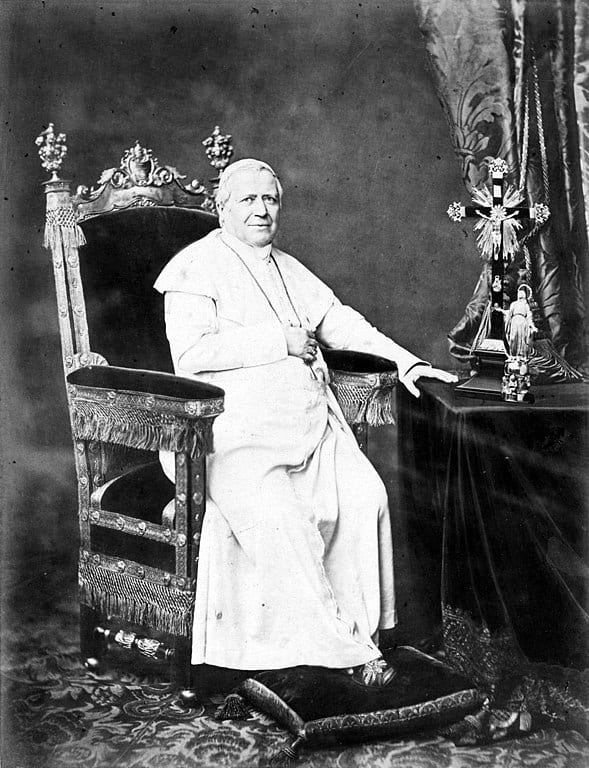
Photo credit**:** Pope Pius IX (c. 1864) [public domain / Wikimedia Commons]

***
Traditionalism vs. Radical Catholic Reactionaries
Radical Catholic Reactionaries
Previous Post
December 2, 2020
"Amadeus" & Historical Accuracy in Biopics
Next Post

December 4, 2020 Peter Kwasniewski: Gotta Exorcise Vatican I (1870)
Browse Our Archives
Select a Category & Last Things About Me Anti-Catholicism Atheism & Agnosticism Baptism and Sacramentalism Bible and Tradition Blessed Virgin Mary Books by Dave Armstrong C. S. Lewis Calvinism & General Protestantism Catholic Apologetics Catholic Apologists Catholic conversion Catholic converts Christmas Church (Ecclesiology) Church History Conversion and Converts Development of Doctrine Eastern Orthodoxy Ecumenism & Christian Unity Eucharist & Liturgy Fathers of the Church French Translations G. K. Chesterton Hell Hell & Satan Hell & Satan & Last Things Heresies & Comparative Religion Holistic Health Inquisition & Crusades & Scandals James White Jews & Judaism & Old Testament John Calvin John Henry Newman Liberal / Modernist Theology Life Issues Literary Resume Lutheranism Mariology Martin Luther Music Orthodoxy Papacy & Infallibility Personal Page Philosophy & Science Political & Ethical & Moral Issues Protestant Persecution & Intolerance Protestantism Purgatory Purgatory & Penance Romantic & Imaginative Theology Saints & Purgatory & Penance Salvation Salvation & Justification Satan & Last Things Sexuality and Gender Issues Spanish Translations Traditionalism vs. Radical Catholic Reactionaries Traducciones al español / tradução para português Trinitarianism & Christology Uncategorized Videos
Select a Month November 2026 October 2026 September 2026 August 2026 July 2026 June 2026 May 2026 April 2026 March 2026 February 2026 January 2026 December 2025 November 2025 October 2025 September 2025 August 2025 July 2025 June 2025 May 2025 April 2025 March 2025 February 2025 January 2025 December 2024 November 2024 October 2024 September 2024 August 2024 July 2024 June 2024 May 2024 April 2024 March 2024 February 2024 January 2024 December 2023 November 2023 October 2023 September 2023 August 2023 July 2023 June 2023 May 2023 April 2023 March 2023 February 2023 January 2023 December 2022 November 2022 October 2022 September 2022 August 2022 July 2022 June 2022 May 2022 April 2022 March 2022 February 2022 January 2022 December 2021 November 2021 October 2021 September 2021 August 2021 July 2021 June 2021 May 2021 April 2021 March 2021 February 2021 January 2021 December 2020 November 2020 October 2020 September 2020 August 2020 July 2020 June 2020 May 2020 April 2020 March 2020 February 2020 January 2020 December 2019 November 2019 October 2019 September 2019 August 2019 July 2019 June 2019 May 2019 April 2019 March 2019 February 2019 January 2019 December 2018 November 2018 October 2018 September 2018 August 2018 July 2018 June 2018 May 2018 April 2018 March 2018 February 2018 January 2018 December 2017 November 2017 October 2017 September 2017 August 2017 July 2017 June 2017 May 2017 April 2017 March 2017 February 2017 January 2017 December 2016 November 2016 October 2016 September 2016 August 2016 July 2016 June 2016 May 2016 April 2016 March 2016 February 2016 January 2016 December 2015 November 2015 October 2015 September 2015 August 2015 July 2015 June 2015 May 2015 April 2015 March 2015 February 2015 January 2015 December 2014 November 2014 October 2014 September 2014 August 2014 July 2014 June 2014 April 2014 March 2014 February 2014 January 2014 December 2013 November 2013 October 2013 September 2013 August 2013 July 2013 June 2013 April 2013 March 2013 February 2013 January 2013 December 2012 November 2012 October 2012 September 2012 August 2012 July 2012 June 2012 May 2012 April 2012 March 2012 February 2012 January 2012 December 2011 November 2011 October 2011 September 2011 August 2011 July 2011 June 2011 April 2011 March 2011 February 2011 October 2010 September 2010 August 2010 July 2010 April 2010 March 2010 December 2009 October 2009 August 2009 July 2009 June 2009 May 2009 March 2009 February 2009 October 2008 September 2008 April 2008 March 2008 February 2008 January 2008 December 2007 November 2007 October 2007 May 2007 March 2007 February 2007 January 2007 November 2006 October 2006 September 2006 August 2006 July 2006 June 2006 May 2006 April 2006 March 2006 February 2006 October 2005 June 2005 April 2005 February 2005 July 2004 May 2004 April 2004
Follow Us!
TAKE THE
Religious Wisdom Quiz
Before feeding 5,000 people with five loaves and two fish, what did Jesus do first?
Select your answer to see how you score.
Taught Blessed the Children Passed the food out Gave thanks
Books by This Author Books by Dave Armstrong
Related posts from Biblical Evidence for Catholicism
Was Peter "Any Old" Apostle? 10 Anti-Papal Arguments
Biblical Evidence for Catholicism
Jesus Founded the [Catholic] Church. If Not Him,...
Biblical Evidence for Catholicism
Jerusalem Council vs. James White & Sola Scriptura
Biblical Evidence for Catholicism
11 Protestant Objections to Papal Authority Debunked
Biblical Evidence for Catholicism
TRENDING AT PATHEOS Catholic

An Advent Calendar, and a Tree full of...
I've spent the weekend deeply invested in internet drama about a $150...

How to Have Financial Transparency in Marriage
Despite the fact that financial issues and money problems are the number...
The Healing Power of Forgiveness in Marriage
Learning how to give and accept apologies are essential ingredients of a...

The West's Christian Moral Inheritance: A Legacy Denied
Whether we like it or not, our environment matters, shaping us both...

How Does Tôḏâ Connect Florida & Thanksgiving?
The big news this weekend has been about the continued flooding on...

Were Early Christians Drinking Psychedelic Wine?
The Secret Sacrament the Church Took Away The early Christian church was...
view all Catholic blogs
Ad-Free & Subscriber Log-In Subscription Support
- About Us
- 2026 Calendar
- Videos
- Podcasts
- Library of World Religions
- Faith In Media Tracker
- Advertise With Us
- Write for Us
- Privacy Policy
- Terms of Service
- Do Not Sell My Data
- Contact Us
- Radiant Digital
- Manage Newsletter Subscriptions
- Unsubscribe From Notifications
- Sitemap
Copyright 2008-2026, Patheos. All rights reserved.
Subscription Support Ad-Free & Subscriber Log-In
Follow Patheos