
BuddhistCatholicContemplativeEvangelicalGeneral ChristianHinduJewishLatter-day SaintMuslimNew VisionsProgressive Christian
Beliefs
- Buddhist
- Catholic
- Contemplative
- Evangelical
- General Christian
- Hindu
- Jewish
- Latter-day Saint
- More Voices
- Muslim
- New Visions
- Pagan
- Progressive Christian
Topics
- Religion News
- Food and Religion
- Sports and Religion
- Religious Art
- Religious Music and Entertainment
- Religious Events
- History and Religion
- Style and Religion
- Politics and Religion
- Women in Religion
- Recreation Outdoors and Religion
- Business Finance and Religion
- Careers Workplace and Religion
- Education and Religion
- Family Parenting and Religion
- Health Fitness and Religion
- Home and Religion
- Relationships and Religion
- Technology and Religion
- Travel and Religion
Columnists
- Buddhist Columnists
- Business Finance and Religion Columnists
- Careers Workplace and Religion Columnists
- Catholic Columnists
- Contemplative Columnists
- Education and Religion Columnists
- Evangelists Columnists
- Family Parenting and Religion Columnists
- General Christian Columnists
- Health Fitness and Religion Columnists
- Hindu Columnists
- History and Religion Columnists
- Home and Religion Columnists
- Jewish Columnists
- More Voices Columnists
- Latter Day Columnists
- Muslim Columnists
- New Visions Columnists
- Nonreligious Columnists
- Pagan Columnists
- Politics and Religion Columnists
- Progressive Columnists
- Recreation Outdoors and Religion Columnists
- Relationships and Religion Columnists
- Religion News Columnists
- Religious Art Columnists
- Religious Events Columnists
- Religious Music and Entertainment Columnists
- Sports and Religion Columnists
- Style and Religion Columnists
- Technology and Religion Columnists
- Travel and Religion Columnists
- Women in Religion Columnists
Resource Library
- 2026 Calendar
- Library of World Religions
- The 100 Most Holy Places on Earth
- Patheos Answers
- Podcasts
- Videos
- Faith Leaders Database
- Anglican Episcopalian
- Bahai
- Baptist
- Buddhism
- Christianity
- Confucianism
- Eastern Orthodoxy
- Hinduism
- Holiness and Pentecostal
- ISKCON
- Islam
- Judaism
- Lutheran
- Methodist
- The Church of Jesus Christ of Latter-day Saints
- New Age
- Paganism
- Presbytarian and Reformed
- Protestantism
- Religion Behind the Scenes
- Roman Catholic
- Scientology
- Shia Islam
- Sikhism
- Sufism
- Sunni Islam
- Taoism
- Zen
- See all religions
Research Tools
 Ad-Free & Subscriber Log-In Subscription Support
Ad-Free & Subscriber Log-In Subscription Support
Follow Patheos 

- Trending:
- Forgiveness
- |
- Marriage
- |
- Consciousness
- |
- Death Penalty
- |
- Election
- |
- Halloween

-
About
-
Catholic Apologetics
-
Church History
-
Great Apologists
-
Christian Worldview
-
Protestantism & Misc.
- Home
- Catholic
- History and Religion
- Demons, Gadara, & Biblical Numbers (vs. JMS Pearce)
Demons, Gadara, & Biblical Numbers (vs. JMS Pearce)
Last updated on: June 5, 2026 at 11:57 pm by Dave Armstrong
Demons, Gadara, & Biblical Numbers (vs. JMS Pearce) 2026-06-05T23:57:29-04:00 Dave Armstrong
Patheos Explore the world's faith through different perspectives on religion and spirituality! Patheos has the views of the prevalent religions and spiritualities of the world.
Atheist and anti-theist Jonathan M. S. Pearce’s “About” page states: “Pearce is a philosopher, author, blogger, public speaker and teacher from Hampshire in the UK. He specialises in philosophy of religion, but likes to turn his hand to science, psychology, politics and anything involved in investigating reality.” His words will be in blue.
*****
Jonathan wrote a paper called “On Harmonising Biblical Contradictions” (7-23-17). I replied with “Gadarenes, Gerasenes, Swine, & Atheist Skeptics” (7-25-17). He then counter-replied with “The Demons! The Demons! Replying to Armstrong on Biblical Contradictions” (7-29-17). This is my reply to the latter.
Problem 2 – one or two demons
Problem 2
I will start with Problem 2 because Dave appears not to have even read my original piece, deferring to the very argument I decry. . . .
The number of demons are multiple in all accounts (Mk 5:9-12; Mt 8:31; Lk 8:30-33), so that is a non-issue as well. Why, then, does Jonathan wonder about “one or two demons”? It’s neither. It is “many.”
Wow. Okay, so he starts out by attacking my logic, and then says that they all state many. But the passages are very explicit, as I quoted them:
[he then merely reposts the passages as he did in his first piece: Mark 5:1-2; Matthew 8:28; and Luke 8:26-27]
Note that at this point in the argument he is discussing how many demons were mentioned in these stories, not men (that comes later). He claims I didn’t even read his arguments, but I did, which is why I denied that the issue of either one or two men and one or more demons involves technical logical contradiction. Hence, in the larger citation of my words one can see how I included both:
The “one or two” [men / demons] supposed “contradiction” is clearly not one at all, by the rules of logic.
But (again) here at this point, following Jonathan’s own progression of argument, he mentioned only the numbers of demons. Readers will note that the passages I list, having to do with the incident, are from the latter parts of the accounts, where all mention multiple demons. That‘s what I was referring to. Mark 5:9 (RSV, as throughout) has the demons saying “we are many”. 5:12-13 add “they begged him” / “Send us . . . let us . . .” / “he gave them leave” / “unclean spirits”. So there are multiple demons involved, not one. Matthew 8:31 (and 8:32) are very similar, mentioning “demons” and using plural forms of words several times. Luke 8:30-33 is also the same, mentioning “many demons” and “the demons” etc.
This was my reply to “one or two demons.” Even that is an inaccurate way to describe the passage. The question is whether there was one demon or many. All three gospels fully agree that there were many. So Jonathan’s query as to supposed contradictoriness is literally nonsensical. There is no “problem” here. It may be, however, that Jonathan was mistakenly using the term “demons” to refer to the men. The proper term to use is “demoniacs” or “demon-possessed men.”
Then right after citing his three passages (needlessly, since I saw them already in his first piece), he goes right into the supposed “contradiction” of one or two men (depending on which Gospel report one reads):
Whether you like it or not, Jesus was either met by one man or two. I couldn’t give a withered fig as to whether this is remotely important or not, but it is a contradiction.
Once again, it is not a contradiction, and I explained why in what he already cited from me. He doesn’t seem to grasp it, so here it is again:
Mentioning one is as easily explained as saying that one writer drew from a (non-infallible) oral tradition in which one was mentioned, and the second from a tradition that mentioned two. Even those weren’t necessarily contradictory. In order to be, one account would have to say “only one” and the other “two.” That would be a logical contradiction. But they don’t . . .
This basic fact of the nature of a numerical contradiction remains true, no matter how much Jonathan prattles on about how folks ought to talk about numbers (“bastardisation of the English language” etc.). He also wastes much ink arguing with another apologist, J. P. Holding. He’s more than able to defend himself. I defend my own arguments, thank you.
But there are additional observations about this that may be helpful: having to do with emphasis. The Thy Word is True website (“Demoniacs: One or Two?”) gives a perfectly plausible explanation that I think Jonathan hasn’t considered (nor did I myself before I read it; but it makes perfect sense):
[I]n Matthew 8:28, it is giving an extra information, that there was a second demon-possessed person. One was the leader of the two. Of course, one of the two was possessed by “Legion”. Yet, it is also possible that these “legion” of demons possessed both of the unfortunate men. Whatever the case, the thing is that only one of the two demon-possessed men responded to Jesus Christ after He set them free from the demons and cast the demons into the group of swine.
[I will use RSV for the Bible citations in this quote]
Mark 5:18-19 And as he was getting into the boat, the man who had been possessed with demons begged him that he might be with him. [19] But he refused, and said to him, “Go home to your friends, and tell them how much the Lord has done for you, and how he has had mercy on you.”
Luke 8:38-39 The man from whom the demons had gone begged that he might be with him; but he sent him away, saying, [39] “Return to your home, and declare how much God has done for you.” And he went away, proclaiming throughout the whole city how much Jesus had done for him.
This is why only Mark and Luke mention only one demon-possessed person because only he was of significance to the story. Only he gave thanks to Jesus Christ our Lord for setting him free from Satan’s minions. The other was not mentioned because he probably gave no thanks to Jesus Christ and ran off still stuck in his evil ways. Now look at the man who did respond to Jesus Christ.
Luke 8:35 Then people went out to see what had happened, and they came to Jesus, and found the man from whom the demons had gone, sitting at the feet of Jesus, clothed and in his right mind; and they were afraid.
Matthew does not mention that this man expressed appreciation and a desire to follow and be with Jesus. So the key to the difference is “Mark and Luke mention only one demon-possessed person because only he was of significance to the story. Only he gave thanks to Jesus Christ . . .”
Gleason L. Archer, author of the wonderful (but to atheists, notorious and infamous) Encyclopedia of Bible Difficulties (Grand Rapids, Michigan: Zondervan, 1982) approaches the same question differently, but still similarly:
Mark and Luke center attention on the more prominent and outspoken of the two, the one whose demonic occupants called themselves “Legion.”
As a seminary professor I have occasionally had small elective courses containing only two students. In some cases i remember only one of them with any distinctness, simply because he was the more brilliant and articulate of the two. If I were to compose a set of memoirs and speak of only one of my two-student class, I could hardly be charged with contradicting the historical fact that there were actually two of them in the elective course. (p. 325).
Likewise, Mark and Luke don’t contradict the other two because they mention only one man anymore than a baseball player contradicts himself in reminiscing: “I distinctly remember a person who expressed extreme gratefulness when I gave them my autograph on opening day.” He may also mention scores of others who were also there getting his autograph or he may not. But in any event, it’s not a contradiction to mention one person only. It would be only if he said, “this person was the only one there that day getting my autograph.”
Luke takes the same approach in the story of the healing of blind Bartimaeus. Archer elaborates:
Matthew was concerned to mention all who were involved in this episode . . . Matthew is content to record that actual scene of healing, whereas Luke gives particular attention to the entire proceedings, from the moment that Bartimaeus first heard about Jesus’ arrival — a feature only cursorily suggested by Mark 10:46 — because he is interested in the beggar’s persistence in request before the cure was actually performed on him. As for the second blind beggar, neither Mark nor Luke find him significant enough to mention; presumably he was the more colorless personality of the two. (Ibid., p. 333)
Jonathan then moves onto the “Gadarene / Gerasene / Gergesene” issue. Here, he chose to ignore the subtlest and most detailed portions of my argument: mostly citing experts. Therefore, I’ll post it again (between the two sets of five asterisks) — repetition being a great teacher!:
*****
Here are the actual descriptions (RSV):
Mark 5:1 . . . the country of the Ger’asenes.
Luke 8:26 . . . the country of the Ger’asenes . . .
Matthew 8:28 . . . the country of the Gadarenes . . .
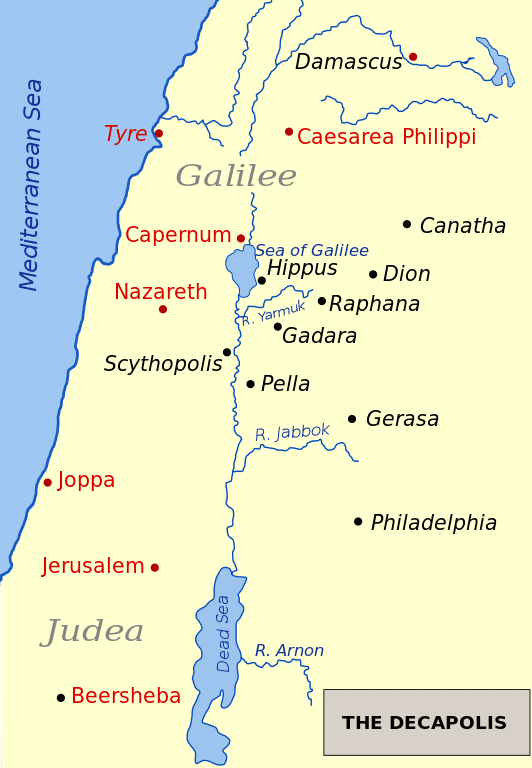
Note that the texts don’t say Gerasa or Gadara, so they aren’t necessarily referring just to one of the cities. They all say “country of . . .” (in the sense of region, not “nation”). “Gerasenes” could have had a sense of reference to the entire region (as well as to a city: just as “New Yorker” can refer to the state or city), and “Gadarenes” likely was a reference to the most prominent city of the region at the time. Smith’s Bible Dictionary provides what I find to be a quite plausible explanation (not “special pleading” at all), and analogous to how we still use place names today:
These three names are used indiscriminately to designate the place where Jesus healed two demoniacs. The first two are in the Authorized Version. (Matthew 8:28; Mark 5:1; Luke 8:26) In Gerasenes in place of Gadarenes. The miracle referred to took place, without doubt, near the town of Gergesa, the modern Kersa, close by the eastern shore of the Sea of Galilee, and hence in the country of Gergesenes. But as Gergesa was a small village, and little known, the evangelists, who wrote for more distant readers, spoke of the event as taking place in the country of the Gadarenes, so named from its largest city, Gadara; and this country included the country of the Gergesenes as a state includes a county. The Gerasenes were the people of the district of which Gerasa was the capital. This city was better known than Gadara or Gergesa; indeed in the Roman age no city of Palestine was better known. “It became one of the proudest cities of Syria.” It was situated some 30 miles southeast of Gadara, on the borders of Peraea and a little north of the river Jabbok. It is now called Jerash and is a deserted ruin. The district of the Gerasenes probably included that of the Gadarenes; so that the demoniac of Gergesa belonged to the country of the Gadarenes and also to that of the Gerasenes, as the same person may, with equal truth, be said to live in the city or the state, or in the United States. For those near by the local name would be used; but in writing to a distant people, as the Greeks and Romans, the more comprehensive and general name would be given.
The Biblical Training site (“Gerasenes”) elaborates:
The fact that Matthew places the healing of “Legion” in the “country of the Gadarenes” whereas Mark and Luke place it in the “country of the Gerasenes” may be harmonized on the historical grounds that geographical boundaries overlapped, and on the exegetical consideration that “country” embraced a wide area around the cities.
It’s simply alternate names for the same area: thus not contradictory at all. I think the coup de grâce is to look up the Greek word for “country” in these passages, to see what latitude of meaning it has. In all three instances the word is chōra (Strong’s word #5561). Thayer’s Greek Lexicon defines it as “the space lying between two places or limits . . . region or country.” The Sea of Galilee was clearly one of the limits.
In Luke 2:8 it is applied to the city of Bethlehem; in Acts 18:23 to Galatia and Phrygia. In Mark 1:5 it is used of “the land of Judaea” (KJV) and in Acts 10:39,to “land of the Jews” (KJV). In Acts 8:1 we have the “regions of Judaea and Samaria” (KJV), and in Acts 16:6, Galatia alone. Thus it is not always used of one specific country (nation), but rather, usually to regions or areas of either small (Bethlehem) or large (Judaea and Samaria) size, including regions surrounding large cities.
All of this sure seems perfectly consistent with calling the same area the “country” (chōra) of either the Gerasenes or the Gadarenes, after the two major cities.
*****
Maybe this time Jonathan will grapple with these portions. His blithely passing over all this material is a classic example of what I meant when I wrote on his blog two days ago:
I think what happened in 2017 is that I saw that you were not addressing my arguments in full, but rather, taking shots at a few carefully selected ones and ignoring the others. And so I must have decided (one makes such decisions when there are many possible topics to write about) not to reply further. It looks like you only addressed (at all) two of my four Christmas-related posts and blew off my papers on “Contradictory” Genealogies of Christ? and Bethlehem & Nazareth “Contradictions”.
Obviously, then, you selected what you would spend time on, just as I did. I do give you credit, on the other hand, for at least doing that, in light of the behavior of many of your cohorts like Seidensticker, Madison, Loftus et al, who absolutely refuse to engage, other than with insults. And you haven’t banned me. Kudos!
Just for good measure, I’ll add a bit more material that Jonathan can choose to either again ignore or actually address. Gleason Archer tackles this “problem”:
[I]t is entirely possible that the political control of this region was centered in Gadara as the capital city. Hence it would be called “the land of the Gadarenes.” . . . (Ibid., p. 325).
The site Evidence for Christianity focuses on the different intended audiences for the Synoptic Gospels:
On the eastern side of the Sea of Galilee (actually to the Southeast) there are two cities. One is Gadara. The other is Gerasa. Gadara is the chief Jewish city of the area, so the more Jewish-oriented Matthew naturally calls this the region of the Gadarenes. The principle Graeco-Roman city in the area known as the Decapolis, was Gerasa . . . The more Roman-oriented Mark and the more Greek-oriented Luke naturally call the region, Gerasa and tell us the demoniac came from the region of the Gerasenes. Both cities are to the Southeast of the Sea of Galilee. Gerasa is larger, but is farther from the Sea. It was the chief city of the area. Gadara was closer, but not as significant a city. There is no contradiction here. If someone lived in the city of Norwalk, California, a suburb of Los Angeles, some would say that the person lived in Norwalk. Others would say that he or she lived in Los Angeles. If speaking to someone from Europe, surely they would say Los Angeles, but if speaking to someone from LA county, they would say Norwalk. This is not contradiction. It is a different description of the same facts, adapted to the audience of the facts.
Apologetics Press basically concurs:
Matthew, Mark, and Luke were writing of the same general area. The Roman city Gerasa was a famous city that would have been familiar to a Gentile audience, but Gadara, as the capital city of the Roman province of Perea, was the chief of the ten cities in Decapolis . . ., so even those who lived in Gerasa could have been called Gadarenes. The stamp of a ship on Gadarene coins suggests that the region called Gadara probably extended to Galilee . . .
Logic & Light comes at it from a different (and fascinating) angle:
Dr. Timothy McGrew persuasively argues that “country of the Gerasenes” refers not to Gerasa, but to the town of Kursi (which was in the region of Gadara). [Alleged Historical Errors in the Gospels, published online, 2012, pg. 52-53] He makes this argument based on the fact that the original Aramaic names for Gerasa and Kursi would have been spelled very similarly if not identically. Therefore, the identification with Gerasa is potentially due to an early copyist mistake or misinterpretation of Kursi.
Dr. McGrew’s theory is strongly supported by the geography of Kursi and early church history. Kursi is on the eastern shore of the Sea of Galilee and has a steep hill that runs directly into the water . . .
In addition, the early church, through the 3rd century church father Origen, identified Kursi as the town in which this miracle occurred. Further, an early 5th century Christian monastery was built in Kursi and seems to have been located there to commemorate this event.
I think all these attempts to harmonize the seeming contradiction are plausible and respectable. Jonathan will likely disagree. But then it gets down to an extremely complex discussion of why and how people differ on relative plausibility. In any event, I think the language Jonathan uses in his second post on the topic towards Christians who may believe explanations like the above (“disingenuous” / “scenarios that are unbelievably unlikely”) is unwarranted. As always, I appeal to fair-minded readers, attempting to be rational and objective, to make up their own minds. Both sides have been presented here.
***
Photo credit: Map of the Decapolis; Nichalp (12-14-05) [Wikimedia Commons / Creative Commons Attribution-Share Alike 2.5 Generic license]

***
Non-Contradictory Biblical Numbers
Previous Post

December 18, 2020
Dual Fulfillment of Prophecy & the Virgin Birth (vs. JMS Pearce)
Next Post
December 19, 2020 Jesus the "Nazarene" Redux (vs. Jonathan M. S. Pearce)
Browse Our Archives
Select a Category & Last Things About Me Anti-Catholicism Atheism & Agnosticism Baptism and Sacramentalism Bible and Tradition Blessed Virgin Mary Books by Dave Armstrong C. S. Lewis Calvinism & General Protestantism Catholic Apologetics Catholic Apologists Catholic conversion Catholic converts Christmas Church (Ecclesiology) Church History Conversion and Converts Development of Doctrine Eastern Orthodoxy Ecumenism & Christian Unity Eucharist & Liturgy Fathers of the Church French Translations G. K. Chesterton Hell Hell & Satan Hell & Satan & Last Things Heresies & Comparative Religion Holistic Health Inquisition & Crusades & Scandals James White Jews & Judaism & Old Testament John Calvin John Henry Newman Liberal / Modernist Theology Life Issues Literary Resume Lutheranism Mariology Martin Luther Music Orthodoxy Papacy & Infallibility Personal Page Philosophy & Science Political & Ethical & Moral Issues Protestant Persecution & Intolerance Protestantism Purgatory Purgatory & Penance Romantic & Imaginative Theology Saints & Purgatory & Penance Salvation Salvation & Justification Satan & Last Things Sexuality and Gender Issues Spanish Translations Traditionalism vs. Radical Catholic Reactionaries Traducciones al español / tradução para português Trinitarianism & Christology Uncategorized Videos
Select a Month October 2026 September 2026 August 2026 July 2026 June 2026 May 2026 April 2026 March 2026 February 2026 January 2026 December 2025 November 2025 October 2025 September 2025 August 2025 July 2025 June 2025 May 2025 April 2025 March 2025 February 2025 January 2025 December 2024 November 2024 October 2024 September 2024 August 2024 July 2024 June 2024 May 2024 April 2024 March 2024 February 2024 January 2024 December 2023 November 2023 October 2023 September 2023 August 2023 July 2023 June 2023 May 2023 April 2023 March 2023 February 2023 January 2023 December 2022 November 2022 October 2022 September 2022 August 2022 July 2022 June 2022 May 2022 April 2022 March 2022 February 2022 January 2022 December 2021 November 2021 October 2021 September 2021 August 2021 July 2021 June 2021 May 2021 April 2021 March 2021 February 2021 January 2021 December 2020 November 2020 October 2020 September 2020 August 2020 July 2020 June 2020 May 2020 April 2020 March 2020 February 2020 January 2020 December 2019 November 2019 October 2019 September 2019 August 2019 July 2019 June 2019 May 2019 April 2019 March 2019 February 2019 January 2019 December 2018 November 2018 October 2018 September 2018 August 2018 July 2018 June 2018 May 2018 April 2018 March 2018 February 2018 January 2018 December 2017 November 2017 October 2017 September 2017 August 2017 July 2017 June 2017 May 2017 April 2017 March 2017 February 2017 January 2017 December 2016 November 2016 October 2016 September 2016 August 2016 July 2016 June 2016 May 2016 April 2016 March 2016 February 2016 January 2016 December 2015 November 2015 October 2015 September 2015 August 2015 July 2015 June 2015 May 2015 April 2015 March 2015 February 2015 January 2015 December 2014 November 2014 October 2014 September 2014 August 2014 July 2014 June 2014 April 2014 March 2014 February 2014 January 2014 December 2013 November 2013 October 2013 September 2013 August 2013 July 2013 June 2013 April 2013 March 2013 February 2013 January 2013 December 2012 November 2012 October 2012 September 2012 August 2012 July 2012 June 2012 May 2012 April 2012 March 2012 February 2012 January 2012 December 2011 November 2011 October 2011 September 2011 August 2011 July 2011 June 2011 April 2011 March 2011 February 2011 October 2010 September 2010 August 2010 July 2010 April 2010 March 2010 December 2009 October 2009 August 2009 July 2009 June 2009 May 2009 March 2009 February 2009 October 2008 September 2008 April 2008 March 2008 February 2008 January 2008 December 2007 November 2007 October 2007 May 2007 March 2007 February 2007 January 2007 November 2006 October 2006 September 2006 August 2006 July 2006 June 2006 May 2006 April 2006 March 2006 February 2006 October 2005 June 2005 April 2005 February 2005 July 2004 May 2004 April 2004
Follow Us!
TAKE THE
Religious Wisdom Quiz
What book of the Bible comes after Genesis?
Select your answer to see how you score.
Deuteronomy Exodus Leviticus Numbers
Books by This Author Books by Dave Armstrong
Related posts from Biblical Evidence for Catholicism

A Few "Worst" & "Best" Arguments vs. Protestantism
Biblical Evidence for Catholicism

Deuterocanon & Javier Perdomo's Straw Men
Biblical Evidence for Catholicism

St. Athanasius & the Deuterocanon (vs. Javier Perdomo)
Biblical Evidence for Catholicism

Jerusalem Council vs. James White & Sola Scriptura
Biblical Evidence for Catholicism
TRENDING AT PATHEOS Catholic

In "Irreplaceable," our book on vocation and technology, Trevor Sutton and I...

I was strolling through the top floor of the brand new Parthenon...

What Does Gêvâh Mean For Kimberley Guifoyle &...
This week, a lot of the news is focused on Kimberly Guilfoyle....

INNER CIRCLE: Profound Mystery (Of Christ In All...
Ephesians 5:31-32 “For this reason, a man will leave his father and...

Do Not Rejoice When Your Enemy Falls: The...
Turning an execution into a public spectacle is a disturbing expression of...

'The Chosen' S6 Trailer: The Passion Gets Very...
Not many watching 'The Chosen' worry about spoilers, but just because they...
view all Catholic blogs
Ad-Free & Subscriber Log-In Subscription Support
- About Us
- 2026 Calendar
- Videos
- Podcasts
- Library of World Religions
- Faith In Media Tracker
- Advertise With Us
- Write for Us
- Privacy Policy
- Terms of Service
- Do Not Sell My Data
- Contact Us
- Radiant Digital
- Manage Newsletter Subscriptions
- Unsubscribe From Notifications
- Sitemap
Copyright 2008-2026, Patheos. All rights reserved.
Subscription Support Ad-Free & Subscriber Log-In
Follow Patheos