
BuddhistCatholicContemplativeEvangelicalGeneral ChristianHinduJewishLatter-day SaintMuslimNew VisionsProgressive Christian
Beliefs
- Buddhist
- Catholic
- Contemplative
- Evangelical
- General Christian
- Hindu
- Jewish
- Latter-day Saint
- More Voices
- Muslim
- New Visions
- Pagan
- Progressive Christian
Topics
- Religion News
- Food and Religion
- Sports and Religion
- Religious Art
- Religious Music and Entertainment
- Religious Events
- History and Religion
- Style and Religion
- Politics and Religion
- Women in Religion
- Recreation Outdoors and Religion
- Business Finance and Religion
- Careers Workplace and Religion
- Education and Religion
- Family Parenting and Religion
- Health Fitness and Religion
- Home and Religion
- Relationships and Religion
- Technology and Religion
- Travel and Religion
Columnists
- Buddhist Columnists
- Business Finance and Religion Columnists
- Careers Workplace and Religion Columnists
- Catholic Columnists
- Contemplative Columnists
- Education and Religion Columnists
- Evangelists Columnists
- Family Parenting and Religion Columnists
- General Christian Columnists
- Health Fitness and Religion Columnists
- Hindu Columnists
- History and Religion Columnists
- Home and Religion Columnists
- Jewish Columnists
- More Voices Columnists
- Latter Day Columnists
- Muslim Columnists
- New Visions Columnists
- Nonreligious Columnists
- Pagan Columnists
- Politics and Religion Columnists
- Progressive Columnists
- Recreation Outdoors and Religion Columnists
- Relationships and Religion Columnists
- Religion News Columnists
- Religious Art Columnists
- Religious Events Columnists
- Religious Music and Entertainment Columnists
- Sports and Religion Columnists
- Style and Religion Columnists
- Technology and Religion Columnists
- Travel and Religion Columnists
- Women in Religion Columnists
Resource Library
- 2026 Calendar
- Library of World Religions
- The 100 Most Holy Places on Earth
- Patheos Answers
- Podcasts
- Videos
- Faith Leaders Database
- Anglican Episcopalian
- Bahai
- Baptist
- Buddhism
- Christianity
- Confucianism
- Eastern Orthodoxy
- Hinduism
- Holiness and Pentecostal
- ISKCON
- Islam
- Judaism
- Lutheran
- Methodist
- The Church of Jesus Christ of Latter-day Saints
- New Age
- Paganism
- Presbytarian and Reformed
- Protestantism
- Religion Behind the Scenes
- Roman Catholic
- Scientology
- Shia Islam
- Sikhism
- Sufism
- Sunni Islam
- Taoism
- Zen
- See all religions
Research Tools
 Ad-Free & Subscriber Log-In Subscription Support
Ad-Free & Subscriber Log-In Subscription Support
Follow Patheos 

- Trending:
- Forgiveness
- |
- Marriage
- |
- Consciousness
- |
- Death Penalty
- |
- Election
- |
- Halloween

-
About
-
Catholic Apologetics
-
Church History
-
Great Apologists
-
Christian Worldview
-
Protestantism & Misc.
- Home
- Catholic
- History and Religion
- Moses & Aaron & Their Staff(s): Biblical Contradictions?
Moses & Aaron & Their Staff(s): Biblical Contradictions?
Last updated on: November 21, 2020 at 11:45 pm by Dave Armstrong
Moses & Aaron & Their Staff(s): Biblical Contradictions? 2020-11-21T23:45:25-04:00 Dave Armstrong
Patheos Explore the world's faith through different perspectives on religion and spirituality! Patheos has the views of the prevalent religions and spiritualities of the world.
vs. Dr. Steven DiMattei
Dr. Steven DiMattei is a biblical scholar and author, formally trained in the New Testament and early Christianity, with M.A degrees in Classics and Comparative Literature as well. Rumor has it that he is an atheist, but I haven’t been able to confirm that on his site. He put up a website called Contradictions in the Bible. It seems inactive now (or he has lost interest or moved onto other things: who knows?), but the themes are things I really enjoy discussing and debating, and his articles are still online for all to see; thus fair game for critique — and stimulating food for thought, too. There is almost nothing I like to discuss and think about more than the interpretation of the Bible. Steven wrote in a post dated 5-7-16:
One of my reasons in choosing the word “defend” to describe my aims as a biblical scholar and author was in part to attract Christian apologists to my work and hopefully to get them to read these ancient texts on their terms and from within their own cultural contexts and to create a conversation around the biblical texts, their authors, and their competing beliefs, messages, worldviews, theologies, etc. As you can imagine this has proven quite difficult, nay impossible. Many Christian apologists and fundamentalists just cannot read, or simply identify, the text on its own terms separate from the beliefs and assumptions about the text handed-down through this collection of ancient literature’s title, “the Holy Book.”
Here I am: an apologist quite willing to engage in conversation. It takes two. So we’ll see if Steven is willing to follow through on his stated desire. I have had my own long history (in almost 40 years of apologetics) of “difficult, nay impossible” attempts to discuss matters with many people who tend to be of a few particular belief-systems, though I have no problem talking with anyone who is civil and can stick to a topic. I don’t just say this, I have a demonstrable record of doing it, which is evident on my blog, with its 1000+ dialogues. But as I said, dialogue takes two, and I would add that it also requires a degree of at least minimal mutual respect. Steven’s words will be in blue.
*****
Steven makes a great deal about these alleged biblical contradictions in at least three articles:
#92. Does the staff turn into a snake OR a serpent? (Ex 4:3 vs Ex 7:9-10)
I think his fundamental fallacy, spread throughout these articles and many others, is thinking in “either/or” (hyper-rationalistic) terms, as opposed to the “both/and” outlook, which typifies the biblical and ancient Hebrew outlook. We shall see how this is a wrong path and frequent source of confusion in his arguments, and indeed, massively in scores of arguments about alleged biblical contradictions from all sorts of biblical skeptics (I’ve refuted these errors in particulars scores of times, myself).
Exodus 4:2, 7:15, 7:20, 9:23, and 10:13 all indicate that the staff or rod involved in producing Yahweh’s signs was Moses’ staff, perhaps even his personal shepherd’s staff. Indeed 4:2, which introduces the staff in the narrative, seems to imply that it was already on Moses’ person: “‘What’s this in your hand?’ ‘A staff.’”
However, Ex 7:10, 7:12, 7:19, 8:1, and 8:12 refer to the same staff now as “Aaron’s staff” and, more surprisingly, depict Aaron, not Moses, performing the famous rod-to-snake, err -serpent (see #92) sign. But if that weren’t enough then there is the reference in Ex 4:20 to the staff as—literally—“the god’s staff.” So whose staff was this: Yahweh’s, Moses’ or Aaron’s? [#91]
I would say, “why must we necessarily choose?” It could refer to one and the same. The Wikipedia article, “Staff of Moses” observed:
Relation to Aaron’s rod
Because Aaron’s rod and Moses’ rod are both given similar, seemingly interchangeable, powers, Rabbinical scholars debated whether or not the two rods were one and the same. According to the Midrash Yelammedenu (Yalḳ. on Ps. ex. § 869):
the staff with which Jacob crossed the Jordan is identical with that which Judah gave to his daughter-in-law, Tamar (Gen. xxxii. 10, xxxviii. 18). It is likewise the holy rod with which Moses worked (Ex. iv. 20, 21), with which Aaron performed wonders before Pharaoh (Ex. vii. 10), and with which, finally, David slew the giant Goliath (I Sam. xvii. 40). David left it to his descendants, . . .
It has to be understood also that Aaron functioned as Moses’ assistant or representative:
Exodus 4:10-16 (RSV) But Moses said to the LORD, “Oh, my Lord, I am not eloquent, either heretofore or since thou hast spoken to thy servant; but I am slow of speech and of tongue.” [11] Then the LORD said to him, “Who has made man’s mouth? Who makes him dumb, or deaf, or seeing, or blind? Is it not I, the LORD? [12] Now therefore go, and I will be with your mouth and teach you what you shall speak.” [13] But he said, “Oh, my Lord, send, I pray, some other person.” [14] Then the anger of the LORD was kindled against Moses and he said, “Is there not Aaron, your brother, the Levite? I know that he can speak well; and behold, he is coming out to meet you, and when he sees you he will be glad in his heart. [15] And you shall speak to him and put the words in his mouth; and I will be with your mouth and with his mouth, and will teach you what you shall do. [16] He shall speak for you to the people; and he shall be a mouth for you, and you shall be to him as God.
Hence, the phrase “Moses and Aaron” appears 64 times in the RSV, in the [Protestant 66 book) Old Testament: all but five of these instances in Exodus, Leviticus, and Numbers. The great bulk of these in Exodus occur in chapters 4-12, then there are only four more instances in chapters 16, 24, and 40. Basically, then, the usage is almost confined to the first third of the book. It’s as if Moses gained more confidence over time and started speaking and acting on his own as time went on. Wikipedia, “Aaron” comments:
According to the Book of Exodus, Aaron first functioned as Moses’ assistant. Because Moses complained that he could not speak well, God appointed Aaron as Moses’ “prophet” (Exodus 4:10-17; 7:1). At the command of Moses, he let his rod turn into a snake. Then he stretched out his rod in order to bring on the first three plagues. After that, Moses tended to act and speak for himself.
During the journey in the wilderness, Aaron was not always prominent or active. At the battle with Amalek, he was chosen with Hur to support the hand of Moses that held the “rod of God”. When the revelation was given to Moses at biblical Mount Sinai, he headed the elders of Israel who accompanied Moses on the way to the summit. While Joshua went with Moses to the top, however, Aaron and Hur remained below to look after the people. From here on in Exodus, Leviticus and Numbers, Joshua appears in the role of Moses’ assistant while Aaron functions instead as the first high priest.
The initial relationship of Moses and Aaron– ordained by God — is typified in the following passage:
Exodus 4:27-30 The LORD said to Aaron, “Go into the wilderness to meet Moses.” So he went, and met him at the mountain of God and kissed him. [28] And Moses told Aaron all the words of the LORD with which he had sent him, and all the signs which he had charged him to do. [29] Then Moses and Aaron went and gathered together all the elders of the people of Israel. [30] And Aaron spoke all the words which the LORD had spoken to Moses, and did the signs in the sight of the people.
It is not unbiblical or “unHebraic” at all for the Bible to refer to creatures as representatives of other creatures or of God Himself. I wrote in another article of mine:
Another fascinating motif in Scripture is “the angel of the Lord”: who is sometimes referred to as God Himself; other times as His direct representative. In one passage (Judges 13:15-22), we see reference to God (13:16, 19, 22), but also to the angel of the Lord as His direct representative (13:15-18, 20-21 and in the larger passage, 13:3, 6, 9, 13). The angel is honored (v. 17), they fall on their faces to worship (v. 20) and at length the angel is equated with God as His visible manifestation (v. 22). But the difference between the angel and God is highlighted by the angel being described as a “man of God” (13:6, 8) and “the man” (13:10-11).
Elsewhere, the angel of the Lord is equated with God (theophany) in Genesis 31:11-13 and Judges 2:1, but differentiated from God as well, as a representative: (2 Sam 24:16; 1 Ki 19:6-7; 2 Ki 19:35; Dan 3:25, 28; 6:23; Zech 1:8-14). Even with Moses and the burning bush, there is a reference to “the Angel of the Lord” (Ex 3:2) and yet two verses later, “God called to him out of the bush.”
We also see an equation of God’s work and the work of men who follow Him (“both/and”), in St. Paul and the Gospel of Mark:
Mark 16:20 And they went forth and preached everywhere, while the Lord worked with them and confirmed the message by the signs that attended it. Amen.
1 Corinthians 3:9 For we are God’s fellow workers; . . .
1 Corinthians 15:10 But by the grace of God I am what I am, and his grace toward me was not in vain. On the contrary, I worked harder than any of them, though it was not I, but the grace of God which is with me.
1 Corinthians 15:58 Therefore, my beloved brethren, be steadfast, immovable, always abounding in the work of the Lord, knowing that in the Lord your labor is not in vain.
Ephesians 2:10 For we are his workmanship, created in Christ Jesus for good works, which God prepared beforehand, that we should walk in them.
Philippians 2:12-13 Therefore, my beloved, as you have always obeyed, so now, not only as in my presence but much more in my absence, work out your own salvation with fear and trembling; for God is at work in you, both to will and to work for his good pleasure.
Because of this sort of “both/and” thinking, the idea that the staff or rod could be both Moses’ staff and God’s (and/or also Aaron’s) at the same time is perfectly biblical. Steven himself acknowledges at least this possibility:
Granted some of these references are to be understood metaphorically (e.g. Isa 30-32; Ezek 30:24-25), but others clearly are not, such as the reference in Ex 4:20 to “the god’s staff.” [RSV: “rod of God”] There is nothing metaphorical about this; apparently it is the rod that Moses holds in his hand (4:2-5). . . .
Thus it is not inconceivable that Moses’ rod is some sort of divine staff, or perhaps an extension of Yahweh’s staff, . . . [#91]
A further related biblical passage bears this out:
Exodus 17:9 And Moses said to Joshua, “Choose for us men, and go out, fight with Am’alek; tomorrow I will stand on the top of the hill with the rod of God in my hand.”
It is simultaneously God’s and it is Moses’ rod or staff. In biblical thinking this is not a contradiction, as shown by analogy above. God calls this same staff of Moses “your rod” (Ex 14:16) and He also refers to “the rod of Aaron” (Num 17:10; cf. 17:6, 8).
It is apparent what the Priestly writer is up to. Moses is relegated to the position of Yahweh’s mouthpiece. And this is the traditional view. It is Moses who communicates verbally with Yahweh and it is Moses who conveys verbally Yahweh’s commandments and wishes. Even in P’s plague narrative Yahweh commands Moses to tell Aaron to take up his staff and perform the sign. [#91]
If Moses can be God‘s “mouthpiece” then by the same token and by analogy, Aaron could be Moses’ mouthpiece and act on his behalf as a representative, with his rod. No problem. No “contradiction.” Nor is it a contradiction later on when Moses habitually acts on his own, with the staff, or rod (Ex 9:23; 10:13; 14:16 cf. 14:21, 26-27). The important thing is that God is in control of the whole thing and His will is accomplished through the words and actions of Moses and Aaron, as His representatives (and Aaron as Moses’ spokesman or mouthpiece or representative / assistant). Where Steven and others see supposed “contradictions” we see men of God working together in concert with God, to do His will, because God was at work in them, both to will and to work for his good pleasure (Phil 2:12-13).
Steven doesn’t fully understand this, so he attempts to create yet another of his innumerable proposed “biblical contradictions” in his piece #105 (see above). Here is the complete passage that he thinks is self-contradictory:
Exodus 7:14-20 Then the LORD said to Moses, “Pharaoh’s heart is hardened, he refuses to let the people go. [15] Go to Pharaoh in the morning, as he is going out to the water; wait for him by the river’s brink, and take in your hand the rod which was turned into a serpent. [16] And you shall say to him, `The LORD, the God of the Hebrews, sent me to you, saying, “Let my people go, that they may serve me in the wilderness; and behold, you have not yet obeyed.” [17] Thus says the LORD, “By this you shall know that I am the LORD: behold, I will strike the water that is in the Nile with the rod that is in my hand, and it shall be turned to blood, [18] and the fish in the Nile shall die, and the Nile shall become foul, and the Egyptians will loathe to drink water from the Nile.”” [19] And the LORD said to Moses, “Say to Aaron, `Take your rod and stretch out your hand over the waters of Egypt, over their rivers, their canals, and their ponds, and all their pools of water, that they may become blood; and there shall be blood throughout all the land of Egypt, both in vessels of wood and in vessels of stone.'” [20] Moses and Aaron did as the LORD commanded; in the sight of Pharaoh and in the sight of his servants, he lifted up the rod and struck the water that was in the Nile, and all the water that was in the Nile turned to blood.
It’s quite obvious (the “both/and” biblical / Hebraic thinking that I have explained, being understood prior to interpreting this passage), that Aaron is Moses’ representative. This was already fully explained three chapters earlier. I reiterate the key part of it:
Exodus 4:15-16 And you shall speak to him and put the words in his mouth; and I will be with your mouth and with his mouth, and will teach you what you shall do. [16] He shall speak for you to the people; and he shall be a mouth for you, . . .
With this interpretative / exegetical / cross-referenced understanding and background, the meaning of Exodus 7:14-20 is quite clear. When God says to Moses, “you shall say to him . . .” (7:16), it’s understood that this could or would include Aaron as his spokesman (4:15-16). In case anyone misses this aspect, God specifically tells Moses to “Say to Aaron” [the same stuff God told him to do] (7:19). Then the text summarizes that they worked in concert (“Moses and Aaron did as the LORD commanded . . .”: 7:20). It’s fascinating that after mentioning both, the text states, “he lifted up the rod . . ” We can’t immediately tell which one did it. But the context of 7:19 strongly suggests that Aaron did: according to his role as assistant. There simply is no difficulty. Steven will have to strike this off of his long “dirty laundry list” of alleged biblical “contradictions” (or else explain to us how what I have argued is incorrect and false).
In case anyone missed the “arrangement” the same thing happens in the next chapter. God told Moses to warn Pharaoh of the plague of frogs (8:1-4). Then God tells Moses to tell Aaron to stretch out his hand, to cause the plague to start (8:5-6). It’s a joint effort. Even Pharaoh knows this, since it is reported, “Pharaoh called Moses and Aaron” (8:8). He addressed both of them. Moses alone answered (8:9-11). Yet the text says that Pharaoh “would not listen to them” (8:15). Then God tells Moses to tell Aaron to cause the plague of gnats (8:16), and again the narrative notes that Pharaoh “would not listen to them” (8:19). They’re workin’ together to do God’s will. It’s no “contradiction” at all. Even Pharaoh (in effect serving as a “hostile witness”) knows it, but our beloved biblical skeptics do not.
Exodus 9 continues the notice of joint effort. God sometimes says what He says to Moses alone (9:1, 12-13, 22), and also sometimes to “Moses and Aaron” (9:8). When God speaks to only one of them; it’s almost always to Moses, as the leader. Then it’s reported that “Moses said to Aaron” (16:9, 33; 32:21). The only time God speaks directly to Aaron alone in the book of Exodus, He says, “Go into the wilderness to meet Moses” (4:27). The same pattern holds in Leviticus. It’s always Moses telling Aaron what God told him, except one time, where God is instructing Aaron of his duties as high priest, which is a different function altogether: one that he alone does, and not Moses (see Ex 10:8-11). Even then, Moses informs Aaron of additional instructions (10:12-15).
[W]hat Yahweh had commanded in Exodus 7:14-18 was not done. Moses did not strike the Nile with his staff. Aaron did, and with his own staff! [#105]
But Steven doesn’t comprehend what has just been explained. I don’t think it’s rocket science. It’s simply taking the Bible at face value, on its own terms. But prior (overly “critical”) bias interferes with that goal. He goes on to indulge in great speculation about how all this is supposedly designed, and is contradictory. But he never considers the factors that I bring to bear above, which are all (I think) plausible exegetical arguments as to how the text can be plausibly harmonized and synthesized. I think he needs to.
Lastly, Steven (using fallacious documentary hypothesis categories and analysis) wants to make an issue of whether the staff was turned into a snake or serpent, in his piece #92 (see above):
Not only do the Elohist and Priestly sources disagree on whose staff we’re talking about: Moses’ or Aaron’s (#91), but they also use different terms when it comes to describing the serpent or snake it turns into. In E (4:3) the staff becomes a snake (nahash) [Strong’s word #5175], but in P (7:10) it becomes a serpent (tannîn) [Strong’s word #8577]. Each author chose a different term, and the Priestly writer might have even had a reason for changing nahash to tannin.
Gill’s Exposition of the Entire Bible comments on Exodus 7:10:
and Aaron cast down his rod before Pharaoh, and it became a serpent: or a “dragon”, as the Septuagint version; this word is sometimes used of great whales, Genesis 1:21 and of the crocodile, Ezekiel 29:3 and it is very likely the crocodile is meant here, as Dr. Lightfoot thinks; since this was frequent in the Nile, the river of Egypt, where the Hebrew infants had been cast, and into whose devouring jaws they fell, and which also was an Egyptian deity.
Barnes’ Notes on the Bible adds:
Here a more general term, תנין tannı̂yn, is employed, which in other passages includes all sea or river monsters, and is more specially applied to the crocodile as a symbol of Egypt. It occurs in the Egyptian ritual, nearly in the same form, “Tanem,” as a synonym of the monster serpent which represents the principle of antagonism to light and life.
Ellicott’s Commentary for English Readers interprets Exodus 4:3:
(3) A serpent.—The word here used (nakhash) is a generic one for a snake of any kind, and tells us nothing as to the species. A different word (tannin) is used in Exodus 7:10, while nakhash recurs in Exodus 7:15. Tannin is, like nakhash, a generic term.
The third comment above provides, I think, the best answer to the false conundrum raised by Steven. A generic term doesn’t contradict a more specific term. It would be like references to the same item as “book” and “romance novel paperback”. They don’t contradict, since “paperback” is a species of “book” and “romance novel” is a type of literature in a book (whether hardback or not). Strong’s Concordance defines nahash as “serpent” and tannin as “serpent, dragon, sea monster.” We see, then, that an acceptable translation of both is “serpent”: and thus RSV renders all five of the Exodus passages in question as “serpent.”
The Amplified Bible, which was designed to bring out the literal meanings of words in context, is fascinating in this regard:
Exodus 4:3 . . . a serpent [the symbol of royal and divine power worn on the crown of the Pharaohs] . . . ][“serpent” used for 7:9-10, 12, 15]
The second point made is as important and instructive as the first. The author of Exodus clearly uses the terms as synonyms in some sense (whether generic or not), since he utilizes nahash at 4:3 and 7:15 and tannin at 7:9-10, 12: all (except 4:3, in which God gives a “sneak preview”) referring to exactly the same incident. Thus, within three verses of each other (7:12 and 7:15), the author uses two Hebrew words for the same object. And this is supposed to be a “contradiction”? It’s not. It would be like saying “paperback” and “book.” I could say, for example, about my own books: “my first book is a paperback.” The two words refer to the same thing.
Taking a look at the many Bible translations in my library, I see that the RSV practice of using “serpent” for both 7:12 and 7:15 is followed by at least six major versions (Knox, Douay/Rheims, NASB, KJV, ASV, Jewish 1917; while NRSV uses “snake” twice). In other instances where there are different terms, they can clearly be harmonized with each other as referring to the same thing in different ways:
snake / serpent: Confraternity, NAB
serpent / snake: NEB, REB
reptile / snake: Moffatt, Goodspeed
In none of these instances is there the slightest contradiction. If we look up serpent at Dictionary.com, the very first definition it gives is “snake.” Merriam-Webster Online states first: “1a archaic : a noxious creature that creeps, hisses, or stings” and then “snake.” Snake in the same source is first defined as “any of numerous limbless scaled reptiles (suborder Serpentes . . .” and in Dictionary.com first, similarly, as “any of numerous limbless, scaly, elongate reptiles of the suborder Serpentes . . .”
It’s all much ado about nothing. These are the absurd lengths biblical skeptics will go to find a (or any!) zealously sought-after, notorious “biblical contradiction.” It’s a case study in misguided zeal blinding one. Straining at gnats, Steven thinks he is milking this “rod motif” for all it’s worth and comes up with another of his so-called “contradictions”:
Here he writes:
[T]oday’s contradiction is more a doublet than anything else. . . . Yahweh originally commands Moses to perform the signs in front of the people so that they believe Moses (4:5, 4:17), then he commands Moses to do them in front of Pharaoh (4:21).
And how is that a contradiction, pray tell? Signs and miracles always had this dual purpose: to embolden and strengthen the faith of the believers (e.g., Ex 4:8-9, 30-31; 10:2; Num 14:11, 22; Dt 4:34; 7:19; 26:8; Josh 24:17) and to persuade unbelievers that there was a God Who did such things (e.g., Ex 7:3, 9-10; 10:1; Dt 6:22; 11:3; 34:11). This is a common occurrence all through the Bible, and it’s not a contradiction. After Moses parted the Red Sea, the Bible states:
Exodus 14:31 And Israel saw the great work which the LORD did against the Egyptians, and the people feared the LORD; and they believed in the LORD and in his servant Moses.
Moses and Aaron simply “killed two birds” (persuading the Hebrews and the Egyptians of God’s power and faithfulness) with one “stone” (signs and wonders by means of the “rod of God”).
Case closed . . .
***
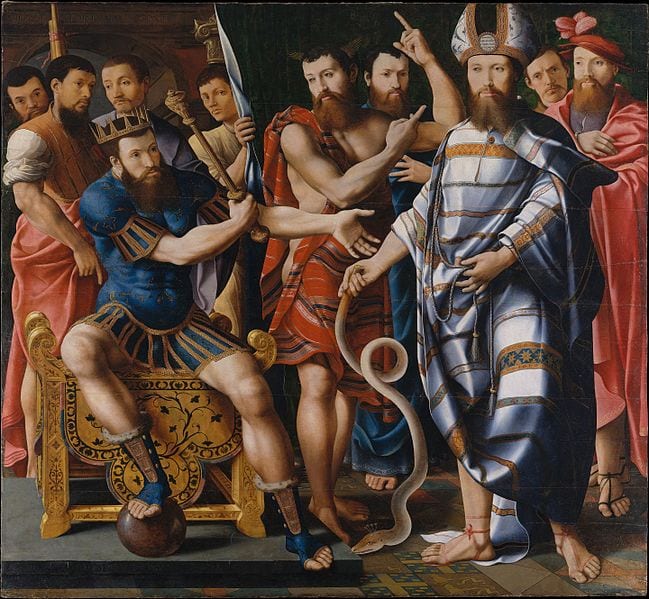
Photo credit: Moses and Aaron before Pharaoh (1537), by Master of the Dinteville Allegory [public domain / Wikimedia Commons]

***
Jews & Judaism & Old Testament
Previous Post

November 21, 2020
Dialogue on Biblical Views Re Following Jesus & Riches
Next Post
November 23, 2020 Golden Calf & Cherubim: Biblical Contradiction?
Browse Our Archives
Select a Category & Last Things About Me Anti-Catholicism Atheism & Agnosticism Baptism and Sacramentalism Bible and Tradition Blessed Virgin Mary Books by Dave Armstrong C. S. Lewis Calvinism & General Protestantism Catholic Apologetics Catholic Apologists Catholic conversion Catholic converts Christmas Church (Ecclesiology) Church History Conversion and Converts Development of Doctrine Eastern Orthodoxy Ecumenism & Christian Unity Eucharist & Liturgy Fathers of the Church French Translations G. K. Chesterton Hell Hell & Satan Hell & Satan & Last Things Heresies & Comparative Religion Holistic Health Inquisition & Crusades & Scandals James White Jews & Judaism & Old Testament John Calvin John Henry Newman Liberal / Modernist Theology Life Issues Literary Resume Lutheranism Mariology Martin Luther Music Orthodoxy Papacy & Infallibility Personal Page Philosophy & Science Political & Ethical & Moral Issues Protestant Persecution & Intolerance Protestantism Purgatory Purgatory & Penance Romantic & Imaginative Theology Saints & Purgatory & Penance Salvation Salvation & Justification Satan & Last Things Sexuality and Gender Issues Spanish Translations Traditionalism vs. Radical Catholic Reactionaries Traducciones al español / tradução para português Trinitarianism & Christology Uncategorized Videos
Select a Month October 2026 September 2026 August 2026 July 2026 June 2026 May 2026 April 2026 March 2026 February 2026 January 2026 December 2025 November 2025 October 2025 September 2025 August 2025 July 2025 June 2025 May 2025 April 2025 March 2025 February 2025 January 2025 December 2024 November 2024 October 2024 September 2024 August 2024 July 2024 June 2024 May 2024 April 2024 March 2024 February 2024 January 2024 December 2023 November 2023 October 2023 September 2023 August 2023 July 2023 June 2023 May 2023 April 2023 March 2023 February 2023 January 2023 December 2022 November 2022 October 2022 September 2022 August 2022 July 2022 June 2022 May 2022 April 2022 March 2022 February 2022 January 2022 December 2021 November 2021 October 2021 September 2021 August 2021 July 2021 June 2021 May 2021 April 2021 March 2021 February 2021 January 2021 December 2020 November 2020 October 2020 September 2020 August 2020 July 2020 June 2020 May 2020 April 2020 March 2020 February 2020 January 2020 December 2019 November 2019 October 2019 September 2019 August 2019 July 2019 June 2019 May 2019 April 2019 March 2019 February 2019 January 2019 December 2018 November 2018 October 2018 September 2018 August 2018 July 2018 June 2018 May 2018 April 2018 March 2018 February 2018 January 2018 December 2017 November 2017 October 2017 September 2017 August 2017 July 2017 June 2017 May 2017 April 2017 March 2017 February 2017 January 2017 December 2016 November 2016 October 2016 September 2016 August 2016 July 2016 June 2016 May 2016 April 2016 March 2016 February 2016 January 2016 December 2015 November 2015 October 2015 September 2015 August 2015 July 2015 June 2015 May 2015 April 2015 March 2015 February 2015 January 2015 December 2014 November 2014 October 2014 September 2014 August 2014 July 2014 June 2014 April 2014 March 2014 February 2014 January 2014 December 2013 November 2013 October 2013 September 2013 August 2013 July 2013 June 2013 April 2013 March 2013 February 2013 January 2013 December 2012 November 2012 October 2012 September 2012 August 2012 July 2012 June 2012 May 2012 April 2012 March 2012 February 2012 January 2012 December 2011 November 2011 October 2011 September 2011 August 2011 July 2011 June 2011 April 2011 March 2011 February 2011 October 2010 September 2010 August 2010 July 2010 April 2010 March 2010 December 2009 October 2009 August 2009 July 2009 June 2009 May 2009 March 2009 February 2009 October 2008 September 2008 April 2008 March 2008 February 2008 January 2008 December 2007 November 2007 October 2007 May 2007 March 2007 February 2007 January 2007 November 2006 October 2006 September 2006 August 2006 July 2006 June 2006 May 2006 April 2006 March 2006 February 2006 October 2005 June 2005 April 2005 February 2005 July 2004 May 2004 April 2004
Follow Us!
TAKE THE
Religious Wisdom Quiz
I am the resurrection and the life. Whoever believes in me will live, even though they do what?
Select your answer to see how you score.
Suffer Die Fall Sin
Books by This Author Books by Dave Armstrong
Related posts from Biblical Evidence for Catholicism

A Few "Worst" & "Best" Arguments vs. Protestantism
Biblical Evidence for Catholicism

Jerusalem Council vs. James White & Sola Scriptura
Biblical Evidence for Catholicism

Biblical Perspicuity: Absurd Anti-Catholic "Defense"
Biblical Evidence for Catholicism

50 Biblical Disproofs of "Evident Clearness" of the...
Biblical Evidence for Catholicism
TRENDING AT PATHEOS Catholic

The First Eucharistic Controversy: Christ’s Real Presence
For Catholics, the Eucharist is the source and summit of the Christian...

How to Make a Decision When You Can't...
Main point: It’s much more valuable to stay close to God so...

Archdiocese Hosts Military Marriage Retreat in Germany
RASTATT, Germany — The transient military lifestyle, with its frequent deployments and...

Nearly every morning, I make the drive to Detroit with my high-school-age...

The Real AI Story Is Adoption Without Trust
Artificial intelligence has crossed a political threshold. It is no longer a...

A new article, written by Jeff Lindsay and Gale L. Pooley,...
view all Catholic blogs
Ad-Free & Subscriber Log-In Subscription Support
- About Us
- 2026 Calendar
- Videos
- Podcasts
- Library of World Religions
- Faith In Media Tracker
- Advertise With Us
- Write for Us
- Privacy Policy
- Terms of Service
- Do Not Sell My Data
- Contact Us
- Radiant Digital
- Manage Newsletter Subscriptions
- Unsubscribe From Notifications
- Sitemap
Copyright 2008-2026, Patheos. All rights reserved.
Subscription Support Ad-Free & Subscriber Log-In
Follow Patheos