
BuddhistCatholicContemplativeEvangelicalGeneral ChristianHinduJewishLatter-day SaintMuslimNew VisionsProgressive Christian
Beliefs
- Buddhist
- Catholic
- Contemplative
- Evangelical
- General Christian
- Hindu
- Jewish
- Latter-day Saint
- More Voices
- Muslim
- New Visions
- Pagan
- Progressive Christian
Topics
- Religion News
- Food and Religion
- Sports and Religion
- Religious Art
- Religious Music and Entertainment
- Religious Events
- History and Religion
- Style and Religion
- Politics and Religion
- Women in Religion
- Recreation Outdoors and Religion
- Business Finance and Religion
- Careers Workplace and Religion
- Education and Religion
- Family Parenting and Religion
- Health Fitness and Religion
- Home and Religion
- Relationships and Religion
- Technology and Religion
- Travel and Religion
Columnists
- Buddhist Columnists
- Business Finance and Religion Columnists
- Careers Workplace and Religion Columnists
- Catholic Columnists
- Contemplative Columnists
- Education and Religion Columnists
- Evangelists Columnists
- Family Parenting and Religion Columnists
- General Christian Columnists
- Health Fitness and Religion Columnists
- Hindu Columnists
- History and Religion Columnists
- Home and Religion Columnists
- Jewish Columnists
- More Voices Columnists
- Latter Day Columnists
- Muslim Columnists
- New Visions Columnists
- Nonreligious Columnists
- Pagan Columnists
- Politics and Religion Columnists
- Progressive Columnists
- Recreation Outdoors and Religion Columnists
- Relationships and Religion Columnists
- Religion News Columnists
- Religious Art Columnists
- Religious Events Columnists
- Religious Music and Entertainment Columnists
- Sports and Religion Columnists
- Style and Religion Columnists
- Technology and Religion Columnists
- Travel and Religion Columnists
- Women in Religion Columnists
Resource Library
- 2026 Calendar
- Library of World Religions
- The 100 Most Holy Places on Earth
- Patheos Answers
- Podcasts
- Videos
- Faith Leaders Database
- Anglican Episcopalian
- Bahai
- Baptist
- Buddhism
- Christianity
- Confucianism
- Eastern Orthodoxy
- Hinduism
- Holiness and Pentecostal
- ISKCON
- Islam
- Judaism
- Lutheran
- Methodist
- The Church of Jesus Christ of Latter-day Saints
- New Age
- Paganism
- Presbytarian and Reformed
- Protestantism
- Religion Behind the Scenes
- Roman Catholic
- Scientology
- Shia Islam
- Sikhism
- Sufism
- Sunni Islam
- Taoism
- Zen
- See all religions
Research Tools
 Ad-Free & Subscriber Log-In Subscription Support
Ad-Free & Subscriber Log-In Subscription Support
Follow Patheos 

- Trending:
- Forgiveness
- |
- Marriage
- |
- Consciousness
- |
- Death Penalty
- |
- Election
- |
- Halloween

-
About
-
Catholic Apologetics
-
Church History
-
Great Apologists
-
Christian Worldview
-
Protestantism & Misc.
- Home
- Catholic
- History and Religion
- God in Heaven & in His Temple: Contradiction?
God in Heaven & in His Temple: Contradiction?
Last updated on: December 6, 2020 at 1:24 pm by Dave Armstrong
God in Heaven & in His Temple: Contradiction? 2020-12-06T13:24:32-04:00 Dave Armstrong
Patheos Explore the world's faith through different perspectives on religion and spirituality! Patheos has the views of the prevalent religions and spiritualities of the world.
vs. Dr. Steven DiMattei
Dr. Steven DiMattei is a biblical scholar and author, formally trained in the New Testament and early Christianity, with M.A degrees in Classics and Comparative Literature as well. Rumor has it that he is an atheist, but I haven’t been able to confirm that on his site. He put up a website called Contradictions in the Bible. It seems inactive now (or he has lost interest or moved onto other things: who knows?), but the themes are things I really enjoy discussing and debating, and his articles are still online for all to see; thus fair game for critique — and stimulating food for thought, too. There is almost nothing I like to discuss and think about more than the interpretation of the Bible. Steven wrote in a post dated 5-7-16:
One of my reasons in choosing the word “defend” to describe my aims as a biblical scholar and author was in part to attract Christian apologists to my work and hopefully to get them to read these ancient texts on their terms and from within their own cultural contexts and to create a conversation around the biblical texts, their authors, and their competing beliefs, messages, worldviews, theologies, etc. As you can imagine this has proven quite difficult, nay impossible. Many Christian apologists and fundamentalists just cannot read, or simply identify, the text on its own terms separate from the beliefs and assumptions about the text handed-down through this collection of ancient literature’s title, “the Holy Book.”
Here I am: an apologist quite willing to engage in conversation. It takes two. So we’ll see if Steven is willing to follow through on his stated desire. I have had my own long history (in almost 40 years of apologetics) of “difficult, nay impossible” attempts to discuss matters with many people who tend to be of a few particular belief-systems, though I have no problem talking with anyone who is civil and can stick to a topic. I don’t just say this, I have a demonstrable record of doing it, which is evident on my blog, with its 1000+ dialogues. But as I said, dialogue takes two, and I would add that it also requires a degree of at least minimal mutual respect. Steven’s words will be in blue.
*****
I am critiquing Steven’s article: #151. Does Yahweh dwell among the people, in the Temple OR not? (Ex 25:8, 29:45 vs Deut 12:11, 12:21; Acts 7:48) (5-31-13).
The fundamental reply to this is what I have stated in my second of now four replies to Steven’s reasoning:
I think his fundamental fallacy, spread throughout these articles and many others, is thinking in “either/or” (hyper-rationalistic) terms, as opposed to the “both/and” outlook, which typifies the biblical and ancient Hebrew outlook. We shall see how this is a wrong path and frequent source of confusion in his arguments, and indeed, massively in scores of arguments about alleged biblical contradictions from all sorts of biblical skeptics (I’ve refuted these errors in particulars scores of times, myself).
Steven, playing his usual documentary theory game, attempts to argue that there are contradictory motifs in Scripture: God present in heaven and God present in His temple:
One or the central and most important theological tenets of the Priestly theocracy was that Yahweh dwelt among the people, tented in the Tabernacle which was at the center of their camp. . . .
This whole priestly and cultic ideology is completely absent in the Deuteronomic literature. The main reason being that the Deuteronomic scribes—who were non-Aaronid Levites (see #152)—have vastly different ideas about what religion is. The cult played a minor role, if any, in the Deuteronomic literature. But beyond this, the Deuteronomists would have vehemently disagreed with the Priestly writer’s ideology that Yahweh dwelt among the people.
For the Deuteronomist, Yahweh dwelt in heaven. To preserve the holiness of the Temple dwelling, the Deuteronomist claimed that merely Yahweh’s name resided there, not his glory nor presence as the Priestly writer: “the place that Yahweh, your god, will choose to tent his name.”
In fact, both things are true. It’s the biblical “both/and.” The Old Testament taught that God was omnipresent (everywhere):
1 Kings 8:27 (RSV) But will God indeed dwell on the earth? Behold, heaven and the highest heaven cannot contain thee…. (cf. 2 Chr 2:6)
Psalm 139:7-8 Whither shall I go from thy Spirit? Or whither shall I flee from thy presence? [8] If I ascend to heaven, thou art there! If I make my bed in Sheol, thou art there!
Jeremiah 23:24 Can a man hide himself in secret places so that I cannot see him? says the LORD. Do I not fill heaven and earth? says the LORD.
At the same time, the Bible says that God dwells in heaven and also on the earth:
Deuteronomy 4:39 the LORD is God in heaven above and on the earth beneath; there is no other.
Joshua 2:11 . . . the LORD your God is he who is God in heaven above and on earth beneath.
Isaiah 66:1 Thus says the LORD: “Heaven is my throne and the earth is my footstool; . . .
And in heaven:
1 Samuel 2:10 The adversaries of the LORD shall be broken to pieces; against them he will thunder in heaven. . . .
1 Kings 8:30 . . . hear thou in heaven thy dwelling place . . . [+ seven more times in the chapter; 2 Chr 6:27]
2 Chronicles 20:6 . . . art thou not God in heaven? . . .
2 Chronicles 30:27 . . . their prayer came to his holy habitation in heaven.
Daniel 2:28 . . . there is a God in heaven . . .
That said, the Bible also talks about God being specially present: in the burning bush, more generally on Mt. Sinai, in the pillars of fire and smoke, between the wings of the cherubim on top of the ark of the covenant, in the temple and prior tabernacle, by means of the angel of the Lord and in the consecrated Eucharist and the indwelling of the Holy Spirit, in Christian belief. It’s not a contradiction because God is everywhere in the first place; therefore He can (non-contradictorily) be said to be in any particular place as well, and He can teach His people that He chooses to be “specially” present in certain places for the purpose of worship and His people feeling closer to Him. See my papers:
Bible On God’s Special Presence Prior to the Incarnation [2011]
Biblical Evidence for Worship of God Via an Image [6-24-11]
The Biblical Understanding of Holy Places and Things [National Catholic Register, 4-11-17]
Bible on Holy Places & Things [1-8-08]
Dialogue: Real Presence vs. [?] Holy Spirit’s Indwelling [8-15-09]
Eucharistic Adoration: Idolatry or Biblical? (vs. Calvin #47) [12-2-09]
Worshiping God Through Images is Entirely Biblical [National Catholic Register, 12-23-16]
Eucharistic Adoration: Explicit & Undeniable Biblical Analogies [2-1-19]
Intriguing Biblical Analogies to Eucharistic Adoration [National Catholic Register, 2-13-19]
Thus, He can be said to be specially present in His tabernacle and temple:
Exodus 25:8 And let them make me a sanctuary, that I may dwell in their midst.
Exodus 29:42-43 It shall be a continual burnt offering throughout your generations at the door of the tent of meeting before the LORD, where I will meet with you, to speak there to you. [43] There I will meet with the people of Israel, and it shall be sanctified by my glory
Deuteronomy 12:11 then to the place which the LORD your God will choose, to make his name dwell there, thither you shall bring all that I command you: your burnt offerings and your sacrifices, your tithes and the offering that you present, and all your votive offerings which you vow to the LORD.
Deuteronomy 12:21 If the place which the LORD your God will choose to put his name there is too far from you, . . . [26] . . . you shall go to the place which the LORD will choose, (cf. 14:23-25; 16:2, 6, 11; 26:2)
The last four passages are those that Steven presents as supposedly being contradictory to each other. Supposedly the so-called “Deuteronomist” taught that God dwelt only in heaven, and that His “name” dwelling in the temple is essentially different and lesser than what is described in Exodus 25:8 and 29:42-43. But Steven apparently has no comprehension of what God’s “name” meant to the ancient Jews: it’s a far more robust concept than a mere minimalistic abstract thing. According to the International Standard Bible Encyclopedia (“Name”):
The “name of God was therefore not a mere word, but the whole of” the Divine manifestation, the character of God as revealed in His relations to His people and in His dealings with them (Ex 9:16; Jos 7:9; 9:9, etc.). The “name of Yahweh” was proclaimed to Moses on Mt. Sinai, “Yah, Yahweh, a God merciful and gracious, slow to anger, and abundant in lovingkindness and truth,” etc. (Ex 34:6); the name Yahweh (so revealed) was (Ex 3:15) His “memorial Name”. His sole Deity was such an important element in His name that De 6:4 f was termed the “Shema” (from shema`, “hear,” the first word in De 6:4), the first article of Israelite faith, taught to all the children, written on the phylacteries, and still recited as the first act in public and private worship “twice a day by every adult male Jew.” Where Yahweh is said to record His name, or to put His name in a place (or person), some special Divine manifestation is implied, making the place or person sacred to Him (Ex 20:24; 1Ki 8:16). His “name” was in the angel of His Presence (Ex 23:21); what He does is “for his great name’s sake,” in fidelity to and vindication of His revealed character and covenant relationship (2Ch 6:32; Ps 25:11); the great things He should do would be “for a name” (Isa 55:13); He would give His people a new name, “an everlasting name” (Isa 56:5); to be “called by” the name of Yahweh is “to be his people” (2Ch 7:14; Isa 43:7); it implies “protection,” etc. (Isa 63:19; Jer 14:8-9); to “call upon” the name of Yahweh was “to worship him” as God (Ge 21:33; 26:25, etc.); “to confess” His name, to “acknowledge him” (1Ki 8:33,35); to love, trust, act in, etc., “the name,” was to love, trust, etc., Yahweh Himself (Ps 5:11; 7:17). Very frequently, especially in the Psalms and prophecies of Isaiah and Jeremiah, “the name” of God stands for “God himself”; to “forget his name” was “to depart from him” (Jer 23:27); “to minister, prophesy, or speak” in His name signified Divine appointment, inspiration, authority (Jer 11:21; 14:14-15, etc.); we have “swearing by” or “in” the name of Yahweh (De 6:13); to take His name “in vain” was to swear falsely (Ex 20:7; Le 19:12); we have “blessing” in His name (De 10:8); “cursing” (2Ki 2:24). In Le 24:11, we have the case of one who “blasphemed the Name, and cursed,” the penalty for which was death by stoning (24:13-16). [my added bolding]
Steven, then, completely misses all this. He tries to make a distinction and contradiction where there is none. If God’s “name” dwells in the temple, He Himself is specially present there. This is what the Bible teaches.
Moreover, Deuteronomy, too, teaches that God was not confined to heaven, but also specially present in the burning bush, Mt. Sinai, the pillars of fire and cloud, the tabernacle and/or temple, the ark of the covenant, the Israelite’s “camp”, and that He was “with” them in battles:
Deuteronomy 4:36 Out of heaven he let you hear his voice, that he might discipline you; and on earth he let you see his great fire, and you heard his words out of the midst of the fire.
Deuteronomy 5:4 The LORD spoke with you face to face at the mountain, out of the midst of the fire,
Deuteronomy 9:10 And the LORD gave me the two tables of stone written with the finger of God; and on them were all the words which the LORD had spoken with you on the mountain out of the midst of the fire on the day of the assembly.
Deuteronomy 10:8 At that time the LORD set apart the tribe of Levi to carry the ark of the covenant of the LORD, to stand before the LORD to minister to him and to bless in his name, to this day.
Deuteronomy 12:18 but you shall eat them before the LORD your God in the place which the LORD your God will choose . . .
Deuteronomy 16:16 “Three times a year all your males shall appear before the LORD your God at the place which he will choose: at the feast of unleavened bread, at the feast of weeks, and at the feast of booths. They shall not appear before the LORD empty-handed; [31:11 is identical]
Deuteronomy 20:1 “When you go forth to war against your enemies, and see horses and chariots and an army larger than your own, you shall not be afraid of them; for the LORD your God is with you, who brought you up out of the land of Egypt.
Deuteronomy 20:4 for the LORD your God is he that goes with you, to fight for you against your enemies, to give you the victory.’
Deuteronomy 23:14 Because the LORD your God walks in the midst of your camp, to save you and to give up your enemies before you, therefore your camp must be holy, that he may not see anything indecent among you, and turn away from you.
Deuteronomy 31:6 Be strong and of good courage, do not fear or be in dread of them: for it is the LORD your God who goes with you; he will not fail you or forsake you.”
Deuteronomy 31:8 It is the LORD who goes before you; he will be with you, he will not fail you or forsake you; do not fear or be dismayed.”
Deuteronomy 31:14 And the LORD said to Moses, “Behold, the days approach when you must die; call Joshua, and present yourselves in the tent of meeting, that I may commission him.” . . .
Deuteronomy 31:15 And the LORD appeared in the tent in a pillar of cloud; and the pillar of cloud stood by the door of the tent.
Deuteronomy 33:16 . . . the favor of him that dwelt in the [burning] bush . . .
All of this is utterly contrary to Steven’s nonsense: “the Deuteronomists would have vehemently disagreed with the Priestly writer’s ideology that Yahweh dwelt among the people. For the Deuteronomist, Yahweh dwelt in heaven. To preserve the holiness of the Temple dwelling, the Deuteronomist claimed that merely Yahweh’s name resided there, not his glory nor presence . . .”
He is forced now to say, “well, those are simply non-Deuteronomist portions later added to the book of Deuteronomy . . .” It’s the “answer” to everything (hostile or contrary interpolated texts). But when a particular ploy or theory or fiction is used for every conceivable difficulty, it is soon seen that it is in fact the solution of no difficulty. A thing can explain too much as well as too little. It’s just not plausible. It’s on the level of a conspiracy theory. In this case, it’s in effect the conspiracy theory against the inspiration and infallibility of the Holy Bible: God’s revelation to man.
It is instructive to imagine the Priestly writer’s worldview: Yahweh dwells among the people. Furthermore, his presence sat in the inner shrine, the Holy of Holies above the golden cherubim (Ex 25:22). Thus for the Priestly writer the whole space was a sacred space, and as such demanded strict holiness.
Yeah, and it is the same for the so-called “Deuteronomist”: as just massively shown. Elsewhere, Steven refers to “the Levite-led scribes who wrote the book of Deuteronomy.” And in his article, “The Deuteronomist,” Steve opines:
The book of Deuteronomy, like many of the Bible’s books, was composed in stages and by different authors living in different historical eras. Despite this fact, Deuteronomy displays a remarkable unity in its style, theology, and message. This is largely because the various revisions and additions that the book of Deuteronomy underwent were done by a specific scribal school, which we shall label as the Deuteronomic school, and its authors the Deuteronomists.
He goes on to posit many more supposed divergences from other parts of the Torah / Pentateuch, but it just won’t do. We have now seen how his claims regarding Deuteronomy are massively refuted in all the texts I provided not far above.
***
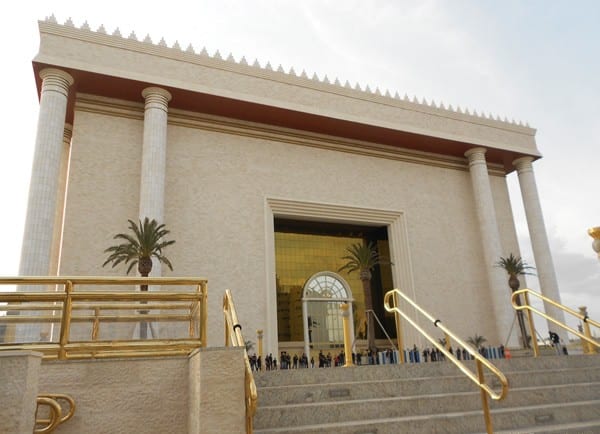
Photo credit: replica of Solomon’s Temple in Sao Paulo, Brazil. Ferf10 (9-1-14) [Wikimedia Commons / Creative Commons Attribution-Share Alike 4.0 International license]

***
Jews & Judaism & Old Testament
Previous Post
November 23, 2020
Golden Calf & Cherubim: Biblical Contradiction?
Next Post

November 24, 2020 Seidensticker Folly #63: Answer Comfort But Never Armstrong?
Browse Our Archives
Select a Category & Last Things About Me Anti-Catholicism Atheism & Agnosticism Baptism and Sacramentalism Bible and Tradition Blessed Virgin Mary Books by Dave Armstrong C. S. Lewis Calvinism & General Protestantism Catholic Apologetics Catholic Apologists Catholic conversion Catholic converts Christmas Church (Ecclesiology) Church History Conversion and Converts Development of Doctrine Eastern Orthodoxy Ecumenism & Christian Unity Eucharist & Liturgy Fathers of the Church French Translations G. K. Chesterton Hell Hell & Satan Hell & Satan & Last Things Heresies & Comparative Religion Holistic Health Inquisition & Crusades & Scandals James White Jews & Judaism & Old Testament John Calvin John Henry Newman Liberal / Modernist Theology Life Issues Literary Resume Lutheranism Mariology Martin Luther Music Orthodoxy Papacy & Infallibility Personal Page Philosophy & Science Political & Ethical & Moral Issues Protestant Persecution & Intolerance Protestantism Purgatory Purgatory & Penance Romantic & Imaginative Theology Saints & Purgatory & Penance Salvation Salvation & Justification Satan & Last Things Sexuality and Gender Issues Spanish Translations Traditionalism vs. Radical Catholic Reactionaries Traducciones al español / tradução para português Trinitarianism & Christology Uncategorized Videos
Select a Month October 2026 September 2026 August 2026 July 2026 June 2026 May 2026 April 2026 March 2026 February 2026 January 2026 December 2025 November 2025 October 2025 September 2025 August 2025 July 2025 June 2025 May 2025 April 2025 March 2025 February 2025 January 2025 December 2024 November 2024 October 2024 September 2024 August 2024 July 2024 June 2024 May 2024 April 2024 March 2024 February 2024 January 2024 December 2023 November 2023 October 2023 September 2023 August 2023 July 2023 June 2023 May 2023 April 2023 March 2023 February 2023 January 2023 December 2022 November 2022 October 2022 September 2022 August 2022 July 2022 June 2022 May 2022 April 2022 March 2022 February 2022 January 2022 December 2021 November 2021 October 2021 September 2021 August 2021 July 2021 June 2021 May 2021 April 2021 March 2021 February 2021 January 2021 December 2020 November 2020 October 2020 September 2020 August 2020 July 2020 June 2020 May 2020 April 2020 March 2020 February 2020 January 2020 December 2019 November 2019 October 2019 September 2019 August 2019 July 2019 June 2019 May 2019 April 2019 March 2019 February 2019 January 2019 December 2018 November 2018 October 2018 September 2018 August 2018 July 2018 June 2018 May 2018 April 2018 March 2018 February 2018 January 2018 December 2017 November 2017 October 2017 September 2017 August 2017 July 2017 June 2017 May 2017 April 2017 March 2017 February 2017 January 2017 December 2016 November 2016 October 2016 September 2016 August 2016 July 2016 June 2016 May 2016 April 2016 March 2016 February 2016 January 2016 December 2015 November 2015 October 2015 September 2015 August 2015 July 2015 June 2015 May 2015 April 2015 March 2015 February 2015 January 2015 December 2014 November 2014 October 2014 September 2014 August 2014 July 2014 June 2014 April 2014 March 2014 February 2014 January 2014 December 2013 November 2013 October 2013 September 2013 August 2013 July 2013 June 2013 April 2013 March 2013 February 2013 January 2013 December 2012 November 2012 October 2012 September 2012 August 2012 July 2012 June 2012 May 2012 April 2012 March 2012 February 2012 January 2012 December 2011 November 2011 October 2011 September 2011 August 2011 July 2011 June 2011 April 2011 March 2011 February 2011 October 2010 September 2010 August 2010 July 2010 April 2010 March 2010 December 2009 October 2009 August 2009 July 2009 June 2009 May 2009 March 2009 February 2009 October 2008 September 2008 April 2008 March 2008 February 2008 January 2008 December 2007 November 2007 October 2007 May 2007 March 2007 February 2007 January 2007 November 2006 October 2006 September 2006 August 2006 July 2006 June 2006 May 2006 April 2006 March 2006 February 2006 October 2005 June 2005 April 2005 February 2005 July 2004 May 2004 April 2004
Follow Us!
TAKE THE
Religious Wisdom Quiz
Who was King Saul's father?
Select your answer to see how you score.
Job Rehoboam Methuselah Kish
Books by This Author Books by Dave Armstrong
Related posts from Biblical Evidence for Catholicism

A Few "Worst" & "Best" Arguments vs. Protestantism
Biblical Evidence for Catholicism

Jerusalem Council vs. James White & Sola Scriptura
Biblical Evidence for Catholicism

Biblical Perspicuity: Absurd Anti-Catholic "Defense"
Biblical Evidence for Catholicism

50 Biblical Disproofs of "Evident Clearness" of the...
Biblical Evidence for Catholicism
TRENDING AT PATHEOS Catholic

Swimfan: Forgotten Aughts Pleasures
This is a recovery effort. In 2002, My Big Fat Greek Wedding...

Top Three Anti-Catholic Lies About Catholicism
This is my initial transcript for the video, "THE 3 WORST...

Pope Leo Celebrates Mass for Nurses & Docs...
I don't have any idea how he did it, but Pope Leo...

The Sermon on the Mount, Part I: Matthew...
The Sermon on the Mount, Part I (Matthew 4:12-5:12) St. Matthew moves...

What's up from Crossway: Reviewing some of their latest A few weeks...

Janie Learns the Way of the Cross: A...
Teaching children about Jesus' Passion can be challenging. Many parents and educators...
view all Catholic blogs
Ad-Free & Subscriber Log-In Subscription Support
- About Us
- 2026 Calendar
- Videos
- Podcasts
- Library of World Religions
- Faith In Media Tracker
- Advertise With Us
- Write for Us
- Privacy Policy
- Terms of Service
- Do Not Sell My Data
- Contact Us
- Radiant Digital
- Manage Newsletter Subscriptions
- Unsubscribe From Notifications
- Sitemap
Copyright 2008-2026, Patheos. All rights reserved.
Subscription Support Ad-Free & Subscriber Log-In
Follow Patheos