
BuddhistCatholicContemplativeEvangelicalGeneral ChristianHinduJewishLatter-day SaintMuslimNew VisionsProgressive Christian
Beliefs
- Buddhist
- Catholic
- Contemplative
- Evangelical
- General Christian
- Hindu
- Jewish
- Latter-day Saint
- More Voices
- Muslim
- New Visions
- Pagan
- Progressive Christian
Topics
- Religion News
- Food and Religion
- Sports and Religion
- Religious Art
- Religious Music and Entertainment
- Religious Events
- History and Religion
- Style and Religion
- Politics and Religion
- Women in Religion
- Recreation Outdoors and Religion
- Business Finance and Religion
- Careers Workplace and Religion
- Education and Religion
- Family Parenting and Religion
- Health Fitness and Religion
- Home and Religion
- Relationships and Religion
- Technology and Religion
- Travel and Religion
Columnists
- Buddhist Columnists
- Business Finance and Religion Columnists
- Careers Workplace and Religion Columnists
- Catholic Columnists
- Contemplative Columnists
- Education and Religion Columnists
- Evangelists Columnists
- Family Parenting and Religion Columnists
- General Christian Columnists
- Health Fitness and Religion Columnists
- Hindu Columnists
- History and Religion Columnists
- Home and Religion Columnists
- Jewish Columnists
- More Voices Columnists
- Latter Day Columnists
- Muslim Columnists
- New Visions Columnists
- Nonreligious Columnists
- Pagan Columnists
- Politics and Religion Columnists
- Progressive Columnists
- Recreation Outdoors and Religion Columnists
- Relationships and Religion Columnists
- Religion News Columnists
- Religious Art Columnists
- Religious Events Columnists
- Religious Music and Entertainment Columnists
- Sports and Religion Columnists
- Style and Religion Columnists
- Technology and Religion Columnists
- Travel and Religion Columnists
- Women in Religion Columnists
Resource Library
- 2026 Calendar
- Library of World Religions
- The 100 Most Holy Places on Earth
- Patheos Answers
- Podcasts
- Videos
- Faith Leaders Database
- Anglican Episcopalian
- Bahai
- Baptist
- Buddhism
- Christianity
- Confucianism
- Eastern Orthodoxy
- Hinduism
- Holiness and Pentecostal
- ISKCON
- Islam
- Judaism
- Lutheran
- Methodist
- The Church of Jesus Christ of Latter-day Saints
- New Age
- Paganism
- Presbytarian and Reformed
- Protestantism
- Religion Behind the Scenes
- Roman Catholic
- Scientology
- Shia Islam
- Sikhism
- Sufism
- Sunni Islam
- Taoism
- Zen
- See all religions
Research Tools
 Ad-Free & Subscriber Log-In Subscription Support
Ad-Free & Subscriber Log-In Subscription Support
Follow Patheos 

- Trending:
- Forgiveness
- |
- Marriage
- |
- Consciousness
- |
- Death Penalty
- |
- Election
- |
- Halloween

-
About
-
Catholic Apologetics
-
Church History
-
Great Apologists
-
Christian Worldview
-
Protestantism & Misc.
- Home
- Catholic
- History and Religion
- Dialogue on Biblical Views Re Following Jesus & Riches
Dialogue on Biblical Views Re Following Jesus & Riches
Last updated on: November 21, 2020 at 12:09 pm by Dave Armstrong
Dialogue on Biblical Views Re Following Jesus & Riches 2020-11-21T12:09:54-04:00 Dave Armstrong
Patheos Explore the world's faith through different perspectives on religion and spirituality! Patheos has the views of the prevalent religions and spiritualities of the world.
vs. Dr. Steven DiMattei
Dr. Steven DiMattei is a biblical scholar and author, formally trained in the New Testament and early Christianity, with M.A degrees in Classics and Comparative Literature as well. Rumor has it that he is an atheist, but I haven’t been able to confirm that on his site. He put up a website called Contradictions in the Bible. It seems inactive now (or he has lost interest or moved onto other things: who knows?), but the themes are things I really enjoy discussing and debating, and his articles are still online for all to see; thus fair game for critique — and stimulating food for thought, too. There is almost nothing I like to discuss and think about more than the interpretation of the Bible. Steven wrote in a post dated 5-7-16:
One of my reasons in choosing the word “defend” to describe my aims as a biblical scholar and author was in part to attract Christian apologists to my work and hopefully to get them to read these ancient texts on their terms and from within their own cultural contexts and to create a conversation around the biblical texts, their authors, and their competing beliefs, messages, worldviews, theologies, etc. As you can imagine this has proven quite difficult, nay impossible. Many Christian apologists and fundamentalists just cannot read, or simply identify, the text on its own terms separate from the beliefs and assumptions about the text handed-down through this collection of ancient literature’s title, “the Holy Book.”
Here I am: an apologist quite willing to engage in conversation. It takes two. So we’ll see if Steven is willing to follow through on his stated desire. I have had my own long history (in almost 40 years of apologetics) of “difficult, nay impossible” attempts to discuss matters with many people who tend to be of a few particular belief-systems, though I have no problem talking with anyone who is civil and can stick to a topic. I don’t just say this, I have a demonstrable record of doing it, which is evident on my blog, with its 1000+ dialogues. But as I said, dialogue takes two, and I would add that it also requires a degree of at least minimal mutual respect. Steven’s words will be in blue.
***
This is a response to his very thought-provoking article, “In Defense of Jesus: A Challenge To Those Claiming To ‘Follow Jesus’ (part I)” (10-27-18).
Like many, I have grown tired of hearing overzealous Christian apologists and fundamentalists claim that they “follow Jesus” or are “followers of Jesus.”
As a professional Catholic and general Christian apologist myself, I would simply note that apologists and “fundamentalists” (real or imagined) do not have a monopoly on either ignorance or misguided zeal. But let’s hear the man out and see how strong his case is.
I’m tired of people glibly using soundbites and catchphrases to justify and promote their own agendas and beliefs with no accountability, especially when this irresponsibleness misrepresents and defames the biblical texts, or Jesus himself and what he stood for, at least according to the extant traditions about him.
Yeah, me, too. We’re very much in agreement on this general principle, but I suspect that it works itself out in very different ways from our two differing perspectives.
So I ask anew: What does it actually mean to “follow Jesus”? What does Jesus himself, or the extant traditions about him, say about this matter? Do Christian apologists even know?
I think I do, after 43 years of intense study of the Bible and defending it and Christianity.
And more importantly, are they being honest to Jesus?
I believe I am (to speak just for myself, as a representative of one of the groups Steven is focusing on). I know I have always sought to be an honest, committed, non-hypocritical, and knowledgeable follower of Jesus, but we all fall short, of course, in many ways, because it’s such a sublime and lofty ideal. But at least to truly and honestly seek this from the very depths of one’s heart and soul — all by virtue of God’s boundless mercy and grace always — is a good start.
Some of the first words Jesus speaks in the gospels to his disciples are “Follow me!” (Mk 1:16, 2:14; Matt 4:19, 8:22, 9:9; Lk 5:11, 5:27, 9:59-62; Jn 1:43).
At heart these words express an imminent socioeconomic imperative: immediately stop what you’re doing, leave your job, your livelihood, and even your family, and “follow me!” And indeed, this is what the disciples are depicted doing in every account—immediately leaving behind jobs, possessions, social status, family, and even social and familial obligations.
Well, to start with (a very important consideration), we need to consider whom Jesus’ words apply to in this instance. I deny that it is required of every Christian to leave their families, or to be single and celibate. That is the higher calling of what Catholics call the “evangelical counsels.” Some are called to that; most of us are not. St. Paul makes these distinctions clear in 1 Corinthians 7.
I contend that what is being referred to in the passages above is the “above and beyond” discipleship of those who are apostles: a select group of individuals that were present and required only during the period of the very early Church. Not all disciples are apostles. In fact, 99.99999999999999% are not. The Bible repeatedly refers to the initial group of the disciples of Jesus, as “the twelve”.
Even this select group was not necessarily required to completely forsake their families. Peter is still caring for his mother-in-law (for whom he sought healing (Mt 8:14; Mk 1:30; Lk 4:38). Paul is still contending about “apostles”: “Do we not have the right to be accompanied by a wife, as the other apostles and the brothers of the Lord and Cephas?” (1 Cor 9:5: RSV, as throughout). If it’s not an absolute break even for them, it’s certainly no universal requirement of every Christian follower.
The initial disciples (of the twelve) who were fishermen indeed “left their nets” (Mt 4:20; Mk 1:18) and concentrated on a radical faith-led Christian ministry. But Peter and several other disciples were fishing again after the death of Jesus. Indeed, in one of His post-Resurrection appearances, this is how Jesus found them (Jn 21:1-11). Jesus not only did not chastise them for returning to their previous work (as if this violated being His “follower”); He asked them, “Children, have you any fish?” (Jn 21:5).
Moreover, Paul was still making tents for a living after becoming an apostle (“they worked, for by trade they were tentmakers”: Acts 18:3), even though he argued that he had the right to be supported by other Christians in his work of evangelism (1 Cor 9:1-15). He himself renounced these rights (9:12, 15, 18), but it doesn’t follow that all Christians must do so.
When Jesus encountered the Roman centurion who asked that He heal his servant, He said about him, “Truly, I say to you, not even in Israel have I found such faith” (Mt 8:10). But He didn’t require him to forsake his military assignment in order to (implied) be His follower, who had great faith. He said nothing about that, just as John the Baptist didn’t tell Roman soldiers to cease being soldiers. He merely told them, when they specifically asked: “Rob no one by violence or by false accusation, and be content with your wages” (Lk 3:14).
The message is clear: Following Jesus means to immediately “forsake all” and “leave everything behind.”
It’s a total commitment, but not necessarily a complete forsaking of all existing familial and employment situations, as just shown.
this is what ‘having faith’ truly means in these ancient texts—abandon one’s job, bank account(s), future plans, social stability and status, familial and social obligations, entitlements, etc.
Why is Paul still making tents, then? Why were several of the twelve initial disciples still fishing after Jesus died? Why does Paul say that apostles have a right to be accompanied by wives? Just a few of the questions I would ask . . .
1. “Do not store up treasures for yourself on earth.” (Mat 6:19; Lk 12:21, 33) . . . Or, in a modern sense: Do not save anything on earth!
It’s a general principle: don’t live for money; don’t idolatrously place your allegiance to it higher than your allegiance to Me.” But it’s not against all money, or else Jesus couldn’t have taught the parable of the talents (Mt 25:14–30); which was specifically about not only having money but making interest and profit in investing it.
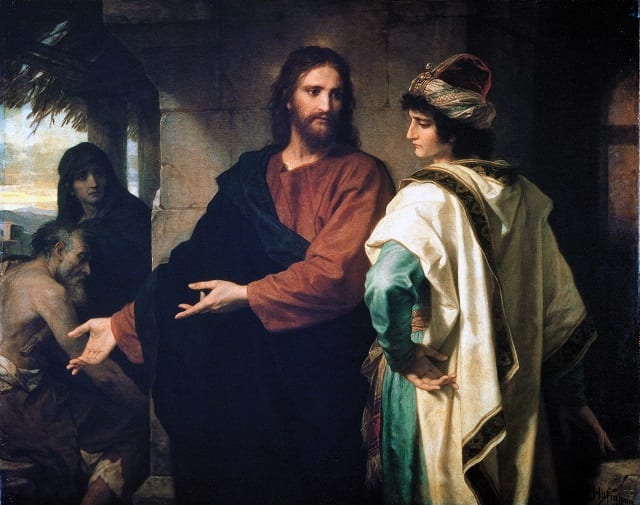
All of the gospels’ “Sell as much as you have . . . and come follow me” stories (Mk 10:17-25; Matt 19:16-24; Lk 18:18-30)
Again, we have to look at who this applies to. These are all the same story: of the rich young ruler who asked what he must to do obtain eternal life. There is no indication whatsoever that what Jesus required of him is required of every Christian believer (to literally sell all they have or own). This man had made money his idol, and so he was required to give it up. So we go back to Paul making tents again. He wasn’t living solely on faith, like the birds of the air. He was providing for himself. That’s fine. We can have money and jobs and even be wealthy, as long as we don’t place them above God.
Joseph of Arimathea is casually referred to as a “rich man” without the slightest hint of condemnation (Mt 27:57) and is even called in the same passage “a disciple of Jesus.” Therefore, a rich person can be a disciple. There is no contradiction. Period. End of story. Jesus was buried in his tomb, that he wouldn’t have owned if he wasn’t rich. I’ve been in it. Praise God for Joseph of Arimathea and his riches and generosity! The Bible condemns the “delight in riches” (Mk 4:19), not all riches per se. Paul didn’t condemn riches, but only wrong use or view of riches:
1 Timothy 6:17-18 As for the rich in this world, charge them not to be haughty, nor to set their hopes on uncertain riches but on God who richly furnishes us with everything to enjoy. [18] They are to do good, to be rich in good deeds, liberal and generous,
And the same Jesus Who told the disciples, going out preaching, to “Carry no purse, no bag, no sandals” (Lk 10:4) later said, ” ‘When I sent you out with no purse or bag or sandals, did you lack anything?’ They said, ‘Nothing.’ He said to them, ‘But now, let him who has a purse take it, and likewise a bag. And let him who has no sword sell his mantle and buy one’ ” (Lk 22:35-36).
3 & 4. “You cannot serve God and money/wealth [mamona]!”
This saying, found in both Matthew and Luke (Matt 6:21; Lk 16:13), means exactly what it says, and is yet another requirement for following Jesus that demands one to denounce and abandon a life conceived, built, and valued upon socioeconomic principles.
Well, yes: if by this one mans that we must not make money our idol. It doesn’t mean that we have no money at all, or jobs or insurance or savings or investments, etc. The view that we must not have any of those things is what is “fundamentalism” . . .
Jesus’ followers are to abandon any and all means of procuring a socio-economic livelihood, or more accurately conceiving of a livelihood in socio-economic terms. Matters of clothing, food, drink, shelter, etc. are not to be sought out.
Really? Why did Paul make tents? Why did John the Baptist tell Roman soldiers to be content with their wages? Why did the disciples start fishing again after Jesus’ death, and why didn’t Jesus condemn them for doing so? Why is the rich man Joseph of Arimathea commended in the Bible with no slightest hint of any condemnation? Why would Jesus’ disciples consent to His being laid in a rich man’s grave? After all, He said He had nowhere to lay His head. Why did Paul not tell all rich people to give up all they owned (1 Tim 6:17-18)? Why did Jesus tell His disciples to carry a purse and buy a sword? How in the world could Jesus teach the parable of the talents, if all these claims are true? Lots of questions . . .
[O]ur goal as modern readers of these ancient texts—all of us—is to set modern beliefs aside and to enter into the worldview and messages conveyed in these ancient text, to listen and acknowledge their messages and even competing beliefs to those of our own, and lastly to understand the world from which the Jesus movement emerged and Jesus’ reaction to that—not to hypocritically claim that we believe the same or are followers of Jesus, because we need to justify our own guilt and fragility in accepting a world where we are all servants of mammon. Being honest to these ancient texts, and here being honest to Jesus, means listening to his counter-cultural message, acknowledging it, and grappling with it, and attempting to historically understand it—not to feign allegiance to it, or unabashedly manipulate Jesus’ saying so that they conform to our own socioeconomic beliefs and lifestyle.
Amen! This is all good and true except for the legalistic slant put on it: that no one can even seek a job or plan for the future, etc. People served mammon in Jesus’ time, and they massively do so today. They ought not do so. It’s idolatry. But we still have to make a living and provide for loved ones. Nothing whatsoever in the Bible condemns any of that. It condemns serving money — the god of mammon — and making it one’s idol.
***
Photo credit: Christ and the Rich Young Ruler (1889), by Heinrich Hofmann (1824-1911) [public domain / Wikimedia Commons]

***
Political & Ethical & Moral Issues
Previous Post

November 19, 2020
Cardinal Newman on Catholic Conversion & Converts
Next Post
November 21, 2020 Moses & Aaron & Their Staff(s): Biblical Contradictions?
Browse Our Archives
Select a Category & Last Things About Me Anti-Catholicism Atheism & Agnosticism Baptism and Sacramentalism Bible and Tradition Blessed Virgin Mary Books by Dave Armstrong C. S. Lewis Calvinism & General Protestantism Catholic Apologetics Catholic Apologists Catholic conversion Catholic converts Christmas Church (Ecclesiology) Church History Conversion and Converts Development of Doctrine Eastern Orthodoxy Ecumenism & Christian Unity Eucharist & Liturgy Fathers of the Church French Translations G. K. Chesterton Hell Hell & Satan Hell & Satan & Last Things Heresies & Comparative Religion Holistic Health Inquisition & Crusades & Scandals James White Jews & Judaism & Old Testament John Calvin John Henry Newman Liberal / Modernist Theology Life Issues Literary Resume Lutheranism Mariology Martin Luther Music Orthodoxy Papacy & Infallibility Personal Page Philosophy & Science Political & Ethical & Moral Issues Protestant Persecution & Intolerance Protestantism Purgatory Purgatory & Penance Romantic & Imaginative Theology Saints & Purgatory & Penance Salvation Salvation & Justification Satan & Last Things Sexuality and Gender Issues Spanish Translations Traditionalism vs. Radical Catholic Reactionaries Traducciones al español / tradução para português Trinitarianism & Christology Uncategorized Videos
Select a Month October 2026 September 2026 August 2026 July 2026 June 2026 May 2026 April 2026 March 2026 February 2026 January 2026 December 2025 November 2025 October 2025 September 2025 August 2025 July 2025 June 2025 May 2025 April 2025 March 2025 February 2025 January 2025 December 2024 November 2024 October 2024 September 2024 August 2024 July 2024 June 2024 May 2024 April 2024 March 2024 February 2024 January 2024 December 2023 November 2023 October 2023 September 2023 August 2023 July 2023 June 2023 May 2023 April 2023 March 2023 February 2023 January 2023 December 2022 November 2022 October 2022 September 2022 August 2022 July 2022 June 2022 May 2022 April 2022 March 2022 February 2022 January 2022 December 2021 November 2021 October 2021 September 2021 August 2021 July 2021 June 2021 May 2021 April 2021 March 2021 February 2021 January 2021 December 2020 November 2020 October 2020 September 2020 August 2020 July 2020 June 2020 May 2020 April 2020 March 2020 February 2020 January 2020 December 2019 November 2019 October 2019 September 2019 August 2019 July 2019 June 2019 May 2019 April 2019 March 2019 February 2019 January 2019 December 2018 November 2018 October 2018 September 2018 August 2018 July 2018 June 2018 May 2018 April 2018 March 2018 February 2018 January 2018 December 2017 November 2017 October 2017 September 2017 August 2017 July 2017 June 2017 May 2017 April 2017 March 2017 February 2017 January 2017 December 2016 November 2016 October 2016 September 2016 August 2016 July 2016 June 2016 May 2016 April 2016 March 2016 February 2016 January 2016 December 2015 November 2015 October 2015 September 2015 August 2015 July 2015 June 2015 May 2015 April 2015 March 2015 February 2015 January 2015 December 2014 November 2014 October 2014 September 2014 August 2014 July 2014 June 2014 April 2014 March 2014 February 2014 January 2014 December 2013 November 2013 October 2013 September 2013 August 2013 July 2013 June 2013 April 2013 March 2013 February 2013 January 2013 December 2012 November 2012 October 2012 September 2012 August 2012 July 2012 June 2012 May 2012 April 2012 March 2012 February 2012 January 2012 December 2011 November 2011 October 2011 September 2011 August 2011 July 2011 June 2011 April 2011 March 2011 February 2011 October 2010 September 2010 August 2010 July 2010 April 2010 March 2010 December 2009 October 2009 August 2009 July 2009 June 2009 May 2009 March 2009 February 2009 October 2008 September 2008 April 2008 March 2008 February 2008 January 2008 December 2007 November 2007 October 2007 May 2007 March 2007 February 2007 January 2007 November 2006 October 2006 September 2006 August 2006 July 2006 June 2006 May 2006 April 2006 March 2006 February 2006 October 2005 June 2005 April 2005 February 2005 July 2004 May 2004 April 2004
Follow Us!
TAKE THE
Religious Wisdom Quiz
How many disciples did Jesus have?
Select your answer to see how you score.
Thirty Seven One hundred Twelve
Books by This Author Books by Dave Armstrong
Related posts from Biblical Evidence for Catholicism

Bible & Catholicism on Mortal Sin (vs. John...
Biblical Evidence for Catholicism

Dialogue on Eternal Security / Absolute Assurance
Biblical Evidence for Catholicism

"Faith Alone" Dialogue with a Calvinist
Biblical Evidence for Catholicism

Exegesis of 75 NT Faith [Alone?] & Works...
Biblical Evidence for Catholicism
TRENDING AT PATHEOS Catholic

In "Irreplaceable," our book on vocation and technology, Trevor Sutton and I...

I was strolling through the top floor of the brand new Parthenon...

What Does Gêvâh Mean For Kimberley Guifoyle &...
This week, a lot of the news is focused on Kimberly Guilfoyle....

INNER CIRCLE: Profound Mystery (Of Christ In All...
Ephesians 5:31-32 “For this reason, a man will leave his father and...

Do Not Rejoice When Your Enemy Falls: The...
Turning an execution into a public spectacle is a disturbing expression of...

'The Chosen' S6 Trailer: The Passion Gets Very...
Not many watching 'The Chosen' worry about spoilers, but just because they...
view all Catholic blogs
Ad-Free & Subscriber Log-In Subscription Support
- About Us
- 2026 Calendar
- Videos
- Podcasts
- Library of World Religions
- Faith In Media Tracker
- Advertise With Us
- Write for Us
- Privacy Policy
- Terms of Service
- Do Not Sell My Data
- Contact Us
- Radiant Digital
- Manage Newsletter Subscriptions
- Unsubscribe From Notifications
- Sitemap
Copyright 2008-2026, Patheos. All rights reserved.
Subscription Support Ad-Free & Subscriber Log-In
Follow Patheos