
BuddhistCatholicContemplativeEvangelicalGeneral ChristianHinduJewishLatter-day SaintMuslimNew VisionsProgressive Christian
Beliefs
- Buddhist
- Catholic
- Contemplative
- Evangelical
- General Christian
- Hindu
- Jewish
- Latter-day Saint
- More Voices
- Muslim
- New Visions
- Pagan
- Progressive Christian
Topics
- Religion News
- Food and Religion
- Sports and Religion
- Religious Art
- Religious Music and Entertainment
- Religious Events
- History and Religion
- Style and Religion
- Politics and Religion
- Women in Religion
- Recreation Outdoors and Religion
- Business Finance and Religion
- Careers Workplace and Religion
- Education and Religion
- Family Parenting and Religion
- Health Fitness and Religion
- Home and Religion
- Relationships and Religion
- Technology and Religion
- Travel and Religion
Columnists
- Buddhist Columnists
- Business Finance and Religion Columnists
- Careers Workplace and Religion Columnists
- Catholic Columnists
- Contemplative Columnists
- Education and Religion Columnists
- Evangelists Columnists
- Family Parenting and Religion Columnists
- General Christian Columnists
- Health Fitness and Religion Columnists
- Hindu Columnists
- History and Religion Columnists
- Home and Religion Columnists
- Jewish Columnists
- More Voices Columnists
- Latter Day Columnists
- Muslim Columnists
- New Visions Columnists
- Nonreligious Columnists
- Pagan Columnists
- Politics and Religion Columnists
- Progressive Columnists
- Recreation Outdoors and Religion Columnists
- Relationships and Religion Columnists
- Religion News Columnists
- Religious Art Columnists
- Religious Events Columnists
- Religious Music and Entertainment Columnists
- Sports and Religion Columnists
- Style and Religion Columnists
- Technology and Religion Columnists
- Travel and Religion Columnists
- Women in Religion Columnists
Resource Library
- 2026 Calendar
- Library of World Religions
- The 100 Most Holy Places on Earth
- Patheos Answers
- Podcasts
- Videos
- Faith Leaders Database
- Anglican Episcopalian
- Bahai
- Baptist
- Buddhism
- Christianity
- Confucianism
- Eastern Orthodoxy
- Hinduism
- Holiness and Pentecostal
- ISKCON
- Islam
- Judaism
- Lutheran
- Methodist
- The Church of Jesus Christ of Latter-day Saints
- New Age
- Paganism
- Presbytarian and Reformed
- Protestantism
- Religion Behind the Scenes
- Roman Catholic
- Scientology
- Shia Islam
- Sikhism
- Sufism
- Sunni Islam
- Taoism
- Zen
- See all religions
Research Tools
 Ad-Free & Subscriber Log-In Subscription Support
Ad-Free & Subscriber Log-In Subscription Support
Follow Patheos 

- Trending:
- Forgiveness
- |
- Marriage
- |
- Consciousness
- |
- Death Penalty
- |
- Election
- |
- Halloween

-
About
-
Catholic Apologetics
-
Church History
-
Great Apologists
-
Christian Worldview
-
Protestantism & Misc.
- Home
- Catholic
- History and Religion
- Dialogue: Acts 9:40 and Prayers for (not to) the Dead
Dialogue: Acts 9:40 and Prayers for (not to) the Dead
Last updated on: June 6, 2026 at 12:43 am by Dave Armstrong
Dialogue: Acts 9:40 and Prayers for (not to) the Dead 2026-06-06T00:43:23-04:00 Dave Armstrong
Patheos Explore the world's faith through different perspectives on religion and spirituality! Patheos has the views of the prevalent religions and spiritualities of the world.
Luke Wayne has been a writer and researcher for the large Protestant online forum CARM since January of 2016. He is an elder at the Mission Church in South Jordan, Utah and holds a Masters of Arts in Theological Studies from Midwestern Baptist College and a Masters in Divinity from Midwestern Baptist Theological Seminary.
I’m responding to his article, “Does Acts 9:40 support praying to dead saints?” Luke’s words will be in blue.
*****
Acts 9:40 (RSV) But Peter put them all outside and knelt down and prayed; then turning to the body he said, “Tabitha, rise.” And she opened her eyes, and when she saw Peter she sat up.
No, Acts 9:40 does not in any way support the practice of praying to dead saints. . . . it is not even remotely related to the idea of praying to dead saints.
I’m not sure that Catholics very often argue (if at all) that the passage establishes this. Perhaps that’s why Luke doesn’t cite any Catholic actually making the argument he claims that we make. It is used, however, as a biblical proof of prayer for the dead, and of the notion of permissible contact with the dead in general (since Peter directly spoke to a dead person and commanded this dead girl to “rise”).
Peter prays before directing his words toward the girl. He is clearly praying to God. He is not praying to the girl to raise herself. . . . Being dead, she is the one in need of help, . . .
Exactly! He’s praying to God on behalf of the dead: that this particular dead person would be raised: one of the things many (not all) Protestants claim is unbiblical and can never be done.
The argument is that, when Peter says, “Tabitha, arise,” he is speaking to a dead girl and expecting her to hear him and respond.
In other words, he is doing a thing that many Protestants (especially of the Reformed / Calvinist variety) claim is absolutely forbidden in the Bible: all contact with the dead whatsoever. So, for example, Reformed Baptist James White: one of the foremost critics of Catholicism writing today, argued in a review of my book, The One-Minute Apologist, dated 6-19-07:
[T]he prohibition of contact with the dead is specifically in the context of people living on earth seeking to have contact with those who have “passed from this world”! This kind of argumentation leaves the prohibition of contact with the dead meaningless and undefined. (italics his own)
Peter had “contact with the dead” in talking to the dead person Tabitha and commanding her to rise. This is what White claims is prohibited in the Bible. And this is what the passage proves that is contrary to at least White’s brand of Protestantism (and, I think Luke’s [some sort of] Baptist theology, too). Why, then, is Peter doing it? The surrounding biblical text doesn’t condemn him for doing so. See also my paper, “Does God Forbid All Contact with the Dead?”
Jesus raised others through verbal commands as well.
Luke gives the example of Lazarus, which is another example of praying for the dead. Lazarus was dead / Jesus prayed for him / Thus, Jesus [an example to and model for us] prayed for the dead. Jesus talked to / payed for another young man in Luke 7:14-15.
There is no sense whatsoever in which these passages represent prayers to the dead.
We fully agree. They represent prayer for the dead and contact with the dead: two things that many if not most Protestants forbid and claim to be things forbidden by Holy Scripture.
When prayer does feature in such stories, it is always prayer to God, never to any dead intermediaries.
Actually, in a story told by Jesus about Lazarus and the rich man, who are both in Hades (Sheol), the rich man prays to Abraham, not God. So if this is bad theology, then Jesus Himself was in serious error. Apparently Our Lord would have flunked out of Protestant seminary.
The very fact that Roman Catholics feel they need to turn to strained connections like this to argue their point illustrates how alien such practices are to churches of the New Testament.
We don’t. It’s the case, rather, that Luke is caricaturing good solid Catholic biblical arguments and fighting a straw man. As one who has used this passage and similar ones in a published book (The Catholic Verses), I would know how Catholic apologists use the passage. I did as follows:
[I]t seems utterly indisputable that here St. Peter literally prayed for a dead person, as far as that goes. When the Bible tells us that he “prayed,” it was obviously for the purpose of bringing her back to life (and she was dead when he prayed it). It’s possible also that he might have prayed something like, “Lord, if it be your will to keep her, so be it; your will be done, but if she can be brought back to her grieving family . . . “ Either way, he is undeniably praying for a dead person, which Protestants say is not permitted, and supposedly not recorded in the Bible. . . .
Protestants would no doubt argue in reply that this was the Lord Jesus and an even more unique case, but we are commanded to imitate Him (including in prayer; e.g., the Lord’s Prayer), and it remains an example of prayer for the dead. The Bible informs us that the disciples raised people from the dead (Mt 11:5, Lk 7:22) and that Jesus told them that they would be able to, and should, do so (Mt 10:8). So they went out and did it, with (presumably) the use of prayer for that end. Thus, they prayed for the dead. We have an example of Peter doing just that. . . .
If dead saints are not too far “out of reach” to be prayed for and raised from the dead back to earthly life, then I submit that they aren’t too distant for us to pray for their souls while in purgatory (assuming – as Catholics do on several biblical grounds – that there is such a thing). . . .
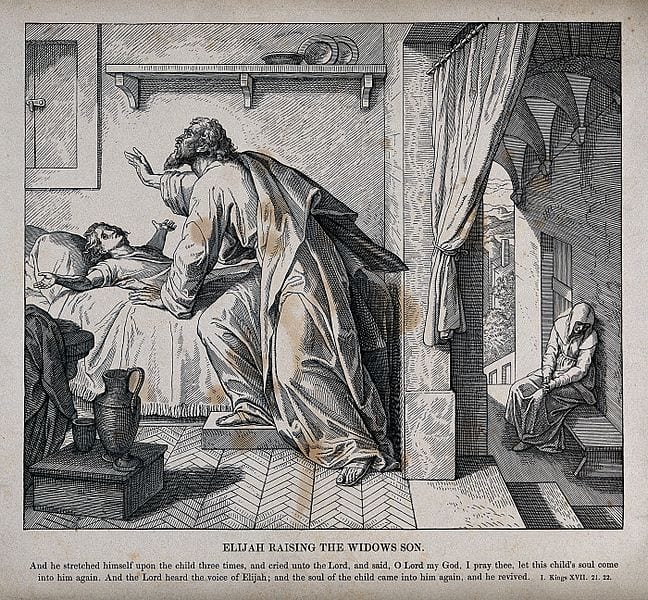
[John] Calvin . . . directed the reader (and jogged my own memory) to yet another biblical account of prayers for the dead: that of Elijah, as recorded in 1 Kings 17:17-24:
Then he stretched himself upon the child three times, and cried to the Lord, ‘O Lord my God, let this child’s soul come into him again.’ And the Lord hearkened to the voice of Elijah; and the soul of the child came into him again, and he revived. ([Commentaries] 17:21-22)
. . . Until someone can explain to me how it is possible to pray to raise a person from the dead without simultaneously praying for the dead (i.e., that same dead person), then I will insist henceforth that the practice of praying for the dead is explicitly taught and shown by literal example in both Testaments.
Further related reading:
New (?) Biblical Argument in Favor of Prayers for the Dead
***
Photo credit: The widow’s son ecstatically returns to life in response to Elijah’s prayer. Wood engraving. [Wikimedia Commons / Creative Commons Attribution 4.0 International license]

***
Previous Post

November 10, 2020
Is Worship of God Through an Image Biblical?
Next Post

November 13, 2020 Catholics Do NOT Worship Mary Like God (vs. Matt Slick)
Browse Our Archives
Select a Category & Last Things About Me Anti-Catholicism Atheism & Agnosticism Baptism and Sacramentalism Bible and Tradition Blessed Virgin Mary Books by Dave Armstrong C. S. Lewis Calvinism & General Protestantism Catholic Apologetics Catholic Apologists Catholic conversion Catholic converts Christmas Church (Ecclesiology) Church History Conversion and Converts Development of Doctrine Eastern Orthodoxy Ecumenism & Christian Unity Eucharist & Liturgy Fathers of the Church French Translations G. K. Chesterton Hell Hell & Satan Hell & Satan & Last Things Heresies & Comparative Religion Holistic Health Inquisition & Crusades & Scandals James White Jews & Judaism & Old Testament John Calvin John Henry Newman Liberal / Modernist Theology Life Issues Literary Resume Lutheranism Mariology Martin Luther Music Orthodoxy Papacy & Infallibility Personal Page Philosophy & Science Political & Ethical & Moral Issues Protestant Persecution & Intolerance Protestantism Purgatory Purgatory & Penance Romantic & Imaginative Theology Saints & Purgatory & Penance Salvation Salvation & Justification Satan & Last Things Sexuality and Gender Issues Spanish Translations Traditionalism vs. Radical Catholic Reactionaries Traducciones al español / tradução para português Trinitarianism & Christology Uncategorized Videos
Select a Month October 2026 September 2026 August 2026 July 2026 June 2026 May 2026 April 2026 March 2026 February 2026 January 2026 December 2025 November 2025 October 2025 September 2025 August 2025 July 2025 June 2025 May 2025 April 2025 March 2025 February 2025 January 2025 December 2024 November 2024 October 2024 September 2024 August 2024 July 2024 June 2024 May 2024 April 2024 March 2024 February 2024 January 2024 December 2023 November 2023 October 2023 September 2023 August 2023 July 2023 June 2023 May 2023 April 2023 March 2023 February 2023 January 2023 December 2022 November 2022 October 2022 September 2022 August 2022 July 2022 June 2022 May 2022 April 2022 March 2022 February 2022 January 2022 December 2021 November 2021 October 2021 September 2021 August 2021 July 2021 June 2021 May 2021 April 2021 March 2021 February 2021 January 2021 December 2020 November 2020 October 2020 September 2020 August 2020 July 2020 June 2020 May 2020 April 2020 March 2020 February 2020 January 2020 December 2019 November 2019 October 2019 September 2019 August 2019 July 2019 June 2019 May 2019 April 2019 March 2019 February 2019 January 2019 December 2018 November 2018 October 2018 September 2018 August 2018 July 2018 June 2018 May 2018 April 2018 March 2018 February 2018 January 2018 December 2017 November 2017 October 2017 September 2017 August 2017 July 2017 June 2017 May 2017 April 2017 March 2017 February 2017 January 2017 December 2016 November 2016 October 2016 September 2016 August 2016 July 2016 June 2016 May 2016 April 2016 March 2016 February 2016 January 2016 December 2015 November 2015 October 2015 September 2015 August 2015 July 2015 June 2015 May 2015 April 2015 March 2015 February 2015 January 2015 December 2014 November 2014 October 2014 September 2014 August 2014 July 2014 June 2014 April 2014 March 2014 February 2014 January 2014 December 2013 November 2013 October 2013 September 2013 August 2013 July 2013 June 2013 April 2013 March 2013 February 2013 January 2013 December 2012 November 2012 October 2012 September 2012 August 2012 July 2012 June 2012 May 2012 April 2012 March 2012 February 2012 January 2012 December 2011 November 2011 October 2011 September 2011 August 2011 July 2011 June 2011 April 2011 March 2011 February 2011 October 2010 September 2010 August 2010 July 2010 April 2010 March 2010 December 2009 October 2009 August 2009 July 2009 June 2009 May 2009 March 2009 February 2009 October 2008 September 2008 April 2008 March 2008 February 2008 January 2008 December 2007 November 2007 October 2007 May 2007 March 2007 February 2007 January 2007 November 2006 October 2006 September 2006 August 2006 July 2006 June 2006 May 2006 April 2006 March 2006 February 2006 October 2005 June 2005 April 2005 February 2005 July 2004 May 2004 April 2004
Follow Us!
TAKE THE
Religious Wisdom Quiz
Who fell out of a window and was restored to life by Paul?
Select your answer to see how you score.
Silas Barnabas Eutychus Timothy
Books by This Author Books by Dave Armstrong
Related posts from Biblical Evidence for Catholicism

Bible & Catholicism on Mortal Sin (vs. John...
Biblical Evidence for Catholicism

Does Catholic Intercession of Saints Require Omniscience?
Biblical Evidence for Catholicism

Eternal Hell: Biblical? 25 Verses Say So
Biblical Evidence for Catholicism

Capabilities of Heavenly Saints: Protestant Commentaries
Biblical Evidence for Catholicism
TRENDING AT PATHEOS Catholic

In "Irreplaceable," our book on vocation and technology, Trevor Sutton and I...

I was strolling through the top floor of the brand new Parthenon...

What Does Gêvâh Mean For Kimberley Guifoyle &...
This week, a lot of the news is focused on Kimberly Guilfoyle....

INNER CIRCLE: Profound Mystery (Of Christ In All...
Ephesians 5:31-32 “For this reason, a man will leave his father and...

Do Not Rejoice When Your Enemy Falls: The...
Turning an execution into a public spectacle is a disturbing expression of...

'The Chosen' S6 Trailer: The Passion Gets Very...
Not many watching 'The Chosen' worry about spoilers, but just because they...
view all Catholic blogs
Ad-Free & Subscriber Log-In Subscription Support
- About Us
- 2026 Calendar
- Videos
- Podcasts
- Library of World Religions
- Faith In Media Tracker
- Advertise With Us
- Write for Us
- Privacy Policy
- Terms of Service
- Do Not Sell My Data
- Contact Us
- Radiant Digital
- Manage Newsletter Subscriptions
- Unsubscribe From Notifications
- Sitemap
Copyright 2008-2026, Patheos. All rights reserved.
Subscription Support Ad-Free & Subscriber Log-In
Follow Patheos