
BuddhistCatholicContemplativeEvangelicalGeneral ChristianHinduJewishLatter-day SaintMuslimNew VisionsProgressive Christian
Beliefs
- Buddhist
- Catholic
- Contemplative
- Evangelical
- General Christian
- Hindu
- Jewish
- Latter-day Saint
- More Voices
- Muslim
- New Visions
- Pagan
- Progressive Christian
Topics
- Religion News
- Food and Religion
- Sports and Religion
- Religious Art
- Religious Music and Entertainment
- Religious Events
- History and Religion
- Style and Religion
- Politics and Religion
- Women in Religion
- Recreation Outdoors and Religion
- Business Finance and Religion
- Careers Workplace and Religion
- Education and Religion
- Family Parenting and Religion
- Health Fitness and Religion
- Home and Religion
- Relationships and Religion
- Technology and Religion
- Travel and Religion
Columnists
- Buddhist Columnists
- Business Finance and Religion Columnists
- Careers Workplace and Religion Columnists
- Catholic Columnists
- Contemplative Columnists
- Education and Religion Columnists
- Evangelists Columnists
- Family Parenting and Religion Columnists
- General Christian Columnists
- Health Fitness and Religion Columnists
- Hindu Columnists
- History and Religion Columnists
- Home and Religion Columnists
- Jewish Columnists
- More Voices Columnists
- Latter Day Columnists
- Muslim Columnists
- New Visions Columnists
- Nonreligious Columnists
- Pagan Columnists
- Politics and Religion Columnists
- Progressive Columnists
- Recreation Outdoors and Religion Columnists
- Relationships and Religion Columnists
- Religion News Columnists
- Religious Art Columnists
- Religious Events Columnists
- Religious Music and Entertainment Columnists
- Sports and Religion Columnists
- Style and Religion Columnists
- Technology and Religion Columnists
- Travel and Religion Columnists
- Women in Religion Columnists
Resource Library
- 2026 Calendar
- Library of World Religions
- The 100 Most Holy Places on Earth
- Patheos Answers
- Podcasts
- Videos
- Faith Leaders Database
- Anglican Episcopalian
- Bahai
- Baptist
- Buddhism
- Christianity
- Confucianism
- Eastern Orthodoxy
- Hinduism
- Holiness and Pentecostal
- ISKCON
- Islam
- Judaism
- Lutheran
- Methodist
- The Church of Jesus Christ of Latter-day Saints
- New Age
- Paganism
- Presbytarian and Reformed
- Protestantism
- Religion Behind the Scenes
- Roman Catholic
- Scientology
- Shia Islam
- Sikhism
- Sufism
- Sunni Islam
- Taoism
- Zen
- See all religions
Research Tools
 Ad-Free & Subscriber Log-In Subscription Support
Ad-Free & Subscriber Log-In Subscription Support
Follow Patheos 

- Trending:
- Forgiveness
- |
- Marriage
- |
- Consciousness
- |
- Death Penalty
- |
- Election
- |
- Halloween

-
About
-
Catholic Apologetics
-
Church History
-
Great Apologists
-
Christian Worldview
-
Protestantism & Misc.
- Home
- Catholic
- History and Religion
- Catholics Do NOT Worship Mary Like God (vs. Matt Slick)
Catholics Do NOT Worship Mary Like God (vs. Matt Slick)
Last updated on: November 13, 2020 at 2:59 pm by Dave Armstrong
Catholics Do NOT Worship Mary Like God (vs. Matt Slick) 2020-11-13T14:59:20-04:00 Dave Armstrong
Patheos Explore the world's faith through different perspectives on religion and spirituality! Patheos has the views of the prevalent religions and spiritualities of the world.
This is a reply to Matt Slick: Presbyterian pastor and head of the large and influential anti-Catholic Protestant CARM discussion forum. I am responding to his article, “Do Catholics Worship Mary?” (2-7-19). His words will be in blue.
*****
Let’s define worship before we see if the Roman Catholic church advocates the worship of Mary.
Worship: “in its most general sense is homage paid to a person or a thing. In this sense we may speak of hero-worship, worship of the emperor, of demons, of the angels, even of relics, and especially of the Cross.[“]
Pastor Slick cites The Catholic Encyclopedia (“Christian Worship”). But unfortunately he engages in a little sleight-of-hand, by selectively citing (out of context) only what he wants to, for his own polemical purposes. This was only “the most general sense.” The article then goes on to carefully differentiate worship / adoration from veneration. Because Pastor Slick apparently can’t grasp (or accept) these distinctions, he proceeds with false premises throughout his article. Here’s what he deliberately did not cite:
There are several degrees of this worship:
if it is addressed directly to God, it is superior, absolute, supreme worship, or worship of adoration, or, according to the consecrated theological term, a worship of latria. This sovereign worship is due to God alone; addressed to a creature it would become idolatry.
When worship is addressed only indirectly to God, that is, when its object is the veneration of martyrs, of angels, or of saints, it is a subordinate worship dependent on the first, and relative, in so far as it honours the creatures of God for their peculiar relations with Him; it is designated by theologians as the worship of dulia, a term denoting servitude, and implying, when used to signify our worship of distinguished servants of God, that their service to Him is their title to our veneration . . .
As the Blessed Virgin has a separate and absolutely supereminent rank among the saints, the worship paid to her is called hyperdulia . . . [see also the articles on Dulia, Latria, Images, Saints, Relics, Adoration]
To be fair, Pastor Slick does cite some of this at the end of his paper, but it is chopped up and not presented in full, in context (the second and third paragraphs completely omitted). This will not do; it’s shoddy research and dishonest argumentation.
Honor and homage of created persons or angels is clearly taught in Scripture. For example:
1 Peter 2:17 (RSV) Honor all men. Love the brotherhood. Fear God. Honor the [even the pagan, anti-Christian, persecuting] emperor.
For many more biblical examples of such honoring and veneration, see:
The Imitation of St. Paul & the Veneration of Saints [2004]
Biblical Evidence for Veneration of Saints [2013]
Bible on the Veneration of Angels & Men [9-10-15]
Angel Gabriel’s “Hail” (Lk 1:28): Veneration of Mary? [3-8-19]
Catholics attribute to Mary both physical (altars, bowing down, feasts, locations )
We don’t sacrifice to Mary. This is what an “altar” has to do with: the Sacrifice of the Mass, which is making present the sacrifice of our Lord and Savior Jesus Christ on the cross. As for feasts, Protestants also express great honor and homage to their founders: Martin Luther, John Calvin et al and many great Christian figures throughout history (like John Wesley and Billy Graham). They make a great deal over “Reformation Day” (October 31). I don’t see how these things are any fundamentally different from Catholic feast days (more on this aspect below).
and spiritual (adoration, devotion to, entrust to, glory due to, looking to, prayer to, worship of) aspects of worship. . . .
“Ascribe to the LORD the glory due His name; . . . ” (1 Chron. 16:29).
The Catholic article Pastor Slick cited expressly denies (see above) that adoration and worship per se can be given to anyone but God, and states that if it is done, it’s idolatry (we totally agree with Protestants in this respect). Thus, Catholic doctrine is being deliberately misrepresented (a very common occurrence in anti-Catholic treatments of Mary). As for glory, the Bible repeatedly states that God shares it with His creatures.
The point is that Roman Catholics say they do not worship Mary, but they do the very things that are consistent with worship. In other words, they do everything consistent with the essence of worship while denying that they actually do it.
Only the most pathetically ignorant, nominal Catholic would ever do this (such uninformed people can be found in any and every Christian group). It’s a very basic teaching — constantly reiterated — that any Catholic who knows anything understands. Pastor Slick would certainly say that lying and bearing false witness is wrong: indeed, this is one of the Ten Commandments. Yet he shamelessly lies about Catholic teaching on Mary. It’s unconscionable. And he will one day stand and give account before God for this lying, if he and countless other anti-Catholics don’t repent of it. I warn him and others like him for their own good, in charity.
Pastor Slick shows photographs of several statues of Mary, and makes out that this is undeniably idolatry (that it couldn’t be otherwise). Yet a case from the Bible can be made for the use of statues and other religious images:
The Bronze Serpent: Example of Proper Use of Images [Feb. 2012]
“Graven Images”: Unbiblical Iconoclasm (vs. John Calvin) [Oct. 2012]
Biblical Idolatry: Authentic & Counterfeit Conceptions [2015]
How Protestant Nativity Scenes Proclaim Catholic Doctrine [12-15-13; expanded for publication at National Catholic Register: 12-17-17]
Newsflash!: Catholicism Utterly Opposes Idolatry, Too [1-18-17]
“Armstrong vs. Geisler” #9: Images & Relics [3-2-17]
Statues in Relation to Bowing, Prayer, & Worship in Scripture [12-26-17]
Biblical Evidence for Veneration of Saints and Images [National Catholic Register, 10-23-18]
Was Moses’ Bronze Serpent an Idolatrous “Graven Image?” [National Catholic Register, 2-17-20]
St. Newman vs. Inconsistent Protestant Iconoclasts [3-21-20]
“Turretinfan” Calls a Statue of Jesus Christ an “Idol” (While His Buddy Bishop James White Praises the Statues of “Reformers” Calvin, Farel, Beza, and Knox) [6-8-10; rev. 6-24-20]
Pastor Slick acts as if bowing before a statue must be idolatry. Yet the Bible presents an acceptable bowing before men and angels, as veneration and honor (a statue simply represents a person):
Venerating & Bowing Before Angels & Men: Biblical? [11-10-14]
“Armstrong vs. Geisler” #8: Veneration; Bowing to Creatures [3-2-17]
Pastor Slick cites 1 Corinthians 7:35 (“undistracted devotion to the Lord”) and makes out that no one can be devoted to anything but God. Yet the Bible states that King David was devoted to the temple:
1 Chronicles 29:3 Moreover, in addition to all that I have provided for the holy house, I have a treasure of my own of gold and silver, and because of my devotion to the house of my God I give it to the house of my God:
Twice in the very same book (one in the same chapter) St. Paul refers to devotions to things other than only God:
1 Corinthians 7:5 . . . that you may devote yourselves to prayer . . .
1 Corinthians 16:15 . . . they have devoted themselves to the service of the saints;
Jesus casually assumes that a person can be devoted to their master (Mt 6:24; Lk 16:13). And there are other instances:
Acts 1:14 All these with one accord devoted themselves to prayer, . . .
Acts 2:42 And they devoted themselves to the apostles’ teaching and fellowship, to the breaking of bread and the prayers.
Acts 6:4 But we will devote ourselves to prayer and to the ministry of the word.”
1 Timothy 4:12-15 Let no one despise your youth, but set the believers an example in speech and conduct, in love, in faith, in purity. [13] Till I come, attend to the public reading of scripture, to preaching, to teaching. [14] Do not neglect the gift you have, which was given you by prophetic utterance when the council of elders laid their hands upon you. [15] Practice these duties, devote yourself to them, so that all may see your progress.
1 Timothy 5:10 and she must be well attested for her good deeds, as one who has brought up children, shown hospitality, washed the feet of the saints, relieved the afflicted, and devoted herself to doing good in every way
Isn’t it sad that a Presbyterian minister can be so ignorant of God’s Holy Word: the Bible? He didn’t have five minutes to do a search like this? In the very example he gives of supposedly illegitimate “devotion” (citing the Catechism), it’s made crystal clear:
This very special devotion . . . differs essentially from the adoration which is given to the incarnate Word and equally to the Father and the Holy Spirit . . . (CCC #971)
Does he not have eyes to see? Is he unable to draw the most basic distinctions? But this is what anti-Catholicism does to an otherwise sound mind.
Pastor Slick cites 1 Peter 4:19, which says that we “entrust” our souls to God. Then he tries to make out that “entrusting ourselves to her prayer” (CCC #2677) is somehow contrary to this, even though (again!) the same passage — that he himself cites — states that “we abandon ourselves to the will of God together with her.” The Bible says that mere men are entrusted with many things: “the oracles of God” (Rom 3:2), an apostolic “commission” (1 Cor 9:17; 2 Tim 1:12), “the message of reconciliation” (2 Cor 5:19), the “gospel” (Gal 2:7; 1 Thess 2:4; 1 Tim 1:11; Titus 1:3), the apostolic [oral] tradition or “commandment” or “truth” (1 Tim 6:14, 20; 2 Tim 1:14; 2:2).
So we can’t “entrust” ourselves to prayers of the holiest woman who ever lived; the mother of God the Son: Second Person of the Trinity, according to James 5:16 (“The prayer of a righteous man has great power in its effects.”)? St. Paul said that his followers could trust his teaching, too (1 Cor 7:25).
I imagine Pastor Slick would then reply that we can’t ask dead people to pray for us, let alone “entrust” ourselves to them. Why, then, does Jesus teach that it was fine to pray to a dead man (Abraham) and ask him to intercede (Luke 16)? Why is it that King Saul could talk to the dead prophet Samuel and ask him for requests? Samuel never said that he couldn’t do so; he simply refused to answer his petitionary request for a military victory (1 Sam 28:3-25). And how is it that dead men in heaven (Rev 5:8) and angels (Rev 8:3-4) somehow have possession of our prayers, to present to God, if we haven’t asked them to intercede for us?
Pastor Slick then argues that because there was a “feast to the Lord” (Ex 32:5), therefore there can’t be a feast to anyone else or anything. This is clearly false, and absurd as well. The Jews in New Testament celebrated many feasts, and Jesus and the disciples observed them (see Jn 4:45; 5:1; 12:20), and there is much biblical evidence for holy days. The apostles in Jerusalem celebrated Shavuot or the Feast of Weeks or Pentecost (Acts 2:1). This was when the tongues of fire came upon their heads and people spoke different languages. It didn’t celebrate God directly, but rather, the wheat harvest (Ex 34:22).
Jesus celebrated Sukkot (or the Feast of Tabernacles or Festival of Booths): see John 7:1–52. It celebrates the fall harvest and also the exodus of the Jews from Egypt. All feasts were ultimately in praise of the Lord, just as all veneration of saints and angels is praise of God their creator (praising a great painting is in effect praise of the painter of the painting). So what is the (biblical) problem with celebrating Mary the mother of Jesus, or any saint with a feast? There is none that I can see.
Pastor Slick notes the passage, “So our eyes look to the Lord our God, Until He shall be gracious to us,” (Psalm 123:2). Yes, of course. He applies the usual fallacious Protestant either/or reasoning: because we ultimately look to God, we can’t (so were told) look to anyone else. It’s not true, and it’s not biblical. The New Testament states twice that we can even look to ourselves (Gal 6:1; 2 Jn 1:8). We can look to ourselves but not to the magnificent example of the Blessed Virgin Mary? Pastor Slick cites the Catechism, #972 (what he cited is in blue):
After speaking of the Church, her origin, mission, and destiny, we can find no better way to conclude than by looking to Mary. In her we contemplate what the Church already is in her mystery on her own “pilgrimage of faith,” and what she will be in the homeland at the end of her journey.
How is this a whit different from looking to the heroes of the faith (all dead) in Hebrews 11?:
Hebrews 11:1-40
Now faith is the assurance of things hoped for, the conviction of things not seen.
[2] For by it the men of old received divine approval.
[3] By faith we understand that the world was created by the word of God, so that what is seen was made out of things which do not appear.
[4] By faith Abel offered to God a more acceptable sacrifice than Cain, through which he received approval as righteous, God bearing witness by accepting his gifts; he died, but through his faith he is still speaking.
[5] By faith Enoch was taken up so that he should not see death; and he was not found, because God had taken him. Now before he was taken he was attested as having pleased God.
[6] And without faith it is impossible to please him. For whoever would draw near to God must believe that he exists and that he rewards those who seek him.
[7] By faith Noah, being warned by God concerning events as yet unseen, took heed and constructed an ark for the saving of his household; by this he condemned the world and became an heir of the righteousness which comes by faith.
[8] By faith Abraham obeyed when he was called to go out to a place which he was to receive as an inheritance; and he went out, not knowing where he was to go.
[9] By faith he sojourned in the land of promise, as in a foreign land, living in tents with Isaac and Jacob, heirs with him of the same promise.
[10] For he looked forward to the city which has foundations, whose builder and maker is God.
[11] By faith Sarah herself received power to conceive, even when she was past the age, since she considered him faithful who had promised.
[12] Therefore from one man, and him as good as dead, were born descendants as many as the stars of heaven and as the innumerable grains of sand by the seashore.
[13] These all died in faith, not having received what was promised, but having seen it and greeted it from afar, and having acknowledged that they were strangers and exiles on the earth.
[14] For people who speak thus make it clear that they are seeking a homeland.
[15] If they had been thinking of that land from which they had gone out, they would have had opportunity to return.
[16] But as it is, they desire a better country, that is, a heavenly one. Therefore God is not ashamed to be called their God, for he has prepared for them a city.
[17] By faith Abraham, when he was tested, offered up Isaac, and he who had received the promises was ready to offer up his only son,
[18] of whom it was said, “Through Isaac shall your descendants be named.”
[19] He considered that God was able to raise men even from the dead; hence, figuratively speaking, he did receive him back.
[20] By faith Isaac invoked future blessings on Jacob and Esau.
[21] By faith Jacob, when dying, blessed each of the sons of Joseph, bowing in worship over the head of his staff.
[22] By faith Joseph, at the end of his life, made mention of the exodus of the Israelites and gave directions concerning his burial.
[23] By faith Moses, when he was born, was hid for three months by his parents, because they saw that the child was beautiful; and they were not afraid of the king’s edict.
[24] By faith Moses, when he was grown up, refused to be called the son of Pharaoh’s daughter,
[25] choosing rather to share ill-treatment with the people of God than to enjoy the fleeting pleasures of sin.
[26] He considered abuse suffered for the Christ greater wealth than the treasures of Egypt, for he looked to the reward.
[27] By faith he left Egypt, not being afraid of the anger of the king; for he endured as seeing him who is invisible.
[28] By faith he kept the Passover and sprinkled the blood, so that the Destroyer of the first-born might not touch them.
[29] By faith the people crossed the Red Sea as if on dry land; but the Egyptians, when they attempted to do the same, were drowned.
[30] By faith the walls of Jericho fell down after they had been encircled for seven days.
[31] By faith Rahab the harlot did not perish with those who were disobedient, because she had given friendly welcome to the spies.
[32] And what more shall I say? For time would fail me to tell of Gideon, Barak, Samson, Jephthah, of David and Samuel and the prophets —
[33] who through faith conquered kingdoms, enforced justice, received promises, stopped the mouths of lions,
[34] quenched raging fire, escaped the edge of the sword, won strength out of weakness, became mighty in war, put foreign armies to flight.
[35] Women received their dead by resurrection. Some were tortured, refusing to accept release, that they might rise again to a better life.
[36] Others suffered mocking and scourging, and even chains and imprisonment.
[37] They were stoned, they were sawn in two, they were killed with the sword; they went about in skins of sheep and goats, destitute, afflicted, ill-treated —
[38] of whom the world was not worthy — wandering over deserts and mountains, and in dens and caves of the earth.
[39] And all these, though well attested by their faith, did not receive what was promised,
[40] since God had foreseen something better for us, that apart from us they should not be made perfect.
All this, and yet it is supposedly impermissible to “look” as an example of the godly Christian to Mary: the mother of our Lord Jesus Christ? It’s ludicrous.
“This twofold movement of prayer to Mary has found a privileged expression in the Ave Maria: Hail Mary [or Rejoice, Mary]: . . .” (CCC 2676)
Most of the Hail Mary is right from Scripture:
“Hail Mary, full of grace, the Lord is with you” (Luke 1:28 RSV, Catholic edition)
As to this translation, Baptist Greek scholar A. T. Robertson stated:
“Highly favoured” (kecharitomene). Perfect passive participle of charitoo and means endowed with grace (charis), enriched with grace as in Ephesians. 1:6, . . . The Vulgate gratiae plena “is right, if it means ‘full of grace which thou hast received‘; wrong, if it means ‘full of grace which thou hast to bestow‘” (Plummer). (Word Pictures of the New Testament, II, 13)
So far, it is not a prayer, but praise, or veneration, from the angel Gabriel to Mary (right in Scripture).
“Blessed are you among women, and blessed is the fruit of your womb [Jesus]!” (Luke 1:42: from Elizabeth, the mother of John the Baptist; again it is veneration, not a prayer]
“Holy Mary, Mother of God, pray for us sinners now, and at the hour of our death.”
Even now, it’s not a prayer, meaning that we are seeking answers directly from Mary rather than God. No, it’s asking her to intercede on our behalf (“pray for us” as opposed to “answer our prayer request yourself”), to God. None of this is “worship.” It’s not even prayer. As for asking a human being to pray (or in only a strictly limited sense, praying to [or through] them as a “conduit” to God), I already went through that above. Repetition is a fine teacher, so here it is again (worded slightly differently):
Jesus taught that it was fine to pray to a dead man (Abraham) and ask him to intercede (Luke 16). Saul talked to the dead prophet Samuel and asked him for requests. Samuel never said that he couldn’t do so; he simply refused to answer his request for a military victory (1 Sam 28:3-25). Dead men in heaven (Rev 5:8) and angels (Rev 8:3-4) somehow have possession of our prayers, to present to God: because (so it is reasonably surmised) we have asked them to intercede for us.
All that is the Bible, not me, or some Catholic dogma that is thought to be “anti-biblical” and not grounded in Holy Scripture. Pastor Slick and all Protestants have to grapple with it. They claim to be especially “biblical” Christians. Very well, then: I challenge them to get to work. I have provided tons of Scripture to ponder. It all has to be interpreted somehow by them.
As for “mother of God”: see the following biblical and Christian history argumentation:
Mary Mother of God: Protestant Founders Agree (Luther, Zwingli, Calvin, Bullinger, and Lutheranism) [10-10-08]
“Mother of God”: Quick, Effective Biblical Proof [12-11-08]
John Calvin’s Objection to the Term, “Mother of God” [5-9-13]
Mary the Mother of God: Idolatry or Plainly Biblical? [10-8-15]
Martin Luther vs. Nestorius Regarding “Mother of God” [3-28-18]
How to Correct Some Misunderstandings About Mary (“Mother of God”) [National Catholic Register, 2-20-19]
On the Title “Mother of God” / Theotokos (vs. Steve Hays) [5-14-20]
Conclusion: Pastor Slick has failed to establish even a single one of his many points. Catholics do not teach the propriety or allowance of worshiping and adoring Mary as they worship and adore God alone. It’s simply a lie and an outrageous one (bearing false witness) to assert this. But it’s been happening these past five centuries and there is no indication that it will end (at least not in the tiny minority of Protestant anti-Catholics) anytime soon.
All we can do is educate such deluded people and speak truth to them, with a profuse use of Bible passages in order to achieve that end.
***
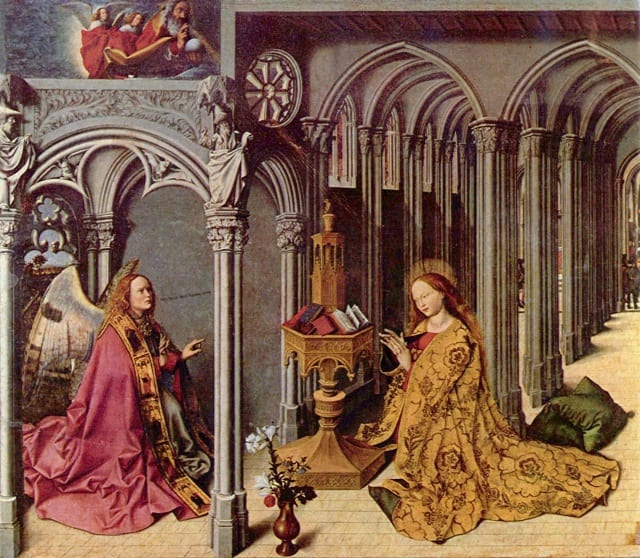
Photo credit: The Annunciation (1444), by Barthélemy d’Eyck (fl. 1444-1469) [public domain / Wikimedia Commons]

***
Previous Post
November 11, 2020
Dialogue: Acts 9:40 and Prayers for (not to) the Dead
Next Post

November 14, 2020 Defense of John Lennon Contra Scathing Critique
Browse Our Archives
Select a Category & Last Things About Me Anti-Catholicism Atheism & Agnosticism Baptism and Sacramentalism Bible and Tradition Blessed Virgin Mary Books by Dave Armstrong C. S. Lewis Calvinism & General Protestantism Catholic Apologetics Catholic Apologists Catholic conversion Catholic converts Christmas Church (Ecclesiology) Church History Conversion and Converts Development of Doctrine Eastern Orthodoxy Ecumenism & Christian Unity Eucharist & Liturgy Fathers of the Church French Translations G. K. Chesterton Hell Hell & Satan Hell & Satan & Last Things Heresies & Comparative Religion Holistic Health Inquisition & Crusades & Scandals James White Jews & Judaism & Old Testament John Calvin John Henry Newman Liberal / Modernist Theology Life Issues Literary Resume Lutheranism Mariology Martin Luther Music Orthodoxy Papacy & Infallibility Personal Page Philosophy & Science Political & Ethical & Moral Issues Protestant Persecution & Intolerance Protestantism Purgatory Purgatory & Penance Romantic & Imaginative Theology Saints & Purgatory & Penance Salvation Salvation & Justification Satan & Last Things Sexuality and Gender Issues Spanish Translations Traditionalism vs. Radical Catholic Reactionaries Traducciones al español / tradução para português Trinitarianism & Christology Uncategorized Videos
Select a Month October 2026 September 2026 August 2026 July 2026 June 2026 May 2026 April 2026 March 2026 February 2026 January 2026 December 2025 November 2025 October 2025 September 2025 August 2025 July 2025 June 2025 May 2025 April 2025 March 2025 February 2025 January 2025 December 2024 November 2024 October 2024 September 2024 August 2024 July 2024 June 2024 May 2024 April 2024 March 2024 February 2024 January 2024 December 2023 November 2023 October 2023 September 2023 August 2023 July 2023 June 2023 May 2023 April 2023 March 2023 February 2023 January 2023 December 2022 November 2022 October 2022 September 2022 August 2022 July 2022 June 2022 May 2022 April 2022 March 2022 February 2022 January 2022 December 2021 November 2021 October 2021 September 2021 August 2021 July 2021 June 2021 May 2021 April 2021 March 2021 February 2021 January 2021 December 2020 November 2020 October 2020 September 2020 August 2020 July 2020 June 2020 May 2020 April 2020 March 2020 February 2020 January 2020 December 2019 November 2019 October 2019 September 2019 August 2019 July 2019 June 2019 May 2019 April 2019 March 2019 February 2019 January 2019 December 2018 November 2018 October 2018 September 2018 August 2018 July 2018 June 2018 May 2018 April 2018 March 2018 February 2018 January 2018 December 2017 November 2017 October 2017 September 2017 August 2017 July 2017 June 2017 May 2017 April 2017 March 2017 February 2017 January 2017 December 2016 November 2016 October 2016 September 2016 August 2016 July 2016 June 2016 May 2016 April 2016 March 2016 February 2016 January 2016 December 2015 November 2015 October 2015 September 2015 August 2015 July 2015 June 2015 May 2015 April 2015 March 2015 February 2015 January 2015 December 2014 November 2014 October 2014 September 2014 August 2014 July 2014 June 2014 April 2014 March 2014 February 2014 January 2014 December 2013 November 2013 October 2013 September 2013 August 2013 July 2013 June 2013 April 2013 March 2013 February 2013 January 2013 December 2012 November 2012 October 2012 September 2012 August 2012 July 2012 June 2012 May 2012 April 2012 March 2012 February 2012 January 2012 December 2011 November 2011 October 2011 September 2011 August 2011 July 2011 June 2011 April 2011 March 2011 February 2011 October 2010 September 2010 August 2010 July 2010 April 2010 March 2010 December 2009 October 2009 August 2009 July 2009 June 2009 May 2009 March 2009 February 2009 October 2008 September 2008 April 2008 March 2008 February 2008 January 2008 December 2007 November 2007 October 2007 May 2007 March 2007 February 2007 January 2007 November 2006 October 2006 September 2006 August 2006 July 2006 June 2006 May 2006 April 2006 March 2006 February 2006 October 2005 June 2005 April 2005 February 2005 July 2004 May 2004 April 2004
Follow Us!
TAKE THE
Religious Wisdom Quiz
Who denied Jesus three times before the rooster crowed?
Select your answer to see how you score.
Paul John Peter Judas
Books by This Author Books by Dave Armstrong
Related posts from Biblical Evidence for Catholicism

Three More Anti-Catholic Lies About Catholicism (#6-4)
Biblical Evidence for Catholicism

Top Ten Anti-Catholic Lies (#10-7)
Biblical Evidence for Catholicism

Does Catholic Intercession of Saints Require Omniscience?
Biblical Evidence for Catholicism

Capabilities of Heavenly Saints: Protestant Commentaries
Biblical Evidence for Catholicism
TRENDING AT PATHEOS Catholic

The Sermon on the Mount, Part I: Matthew...
The Sermon on the Mount, Part I (Matthew 4:12-5:12) St. Matthew moves...

What's up from Crossway: Reviewing some of their latest A few weeks...

Janie Learns the Way of the Cross: A...
Teaching children about Jesus' Passion can be challenging. Many parents and educators...

Looking For Good Catholic Writing - October 2026
He alone extends the heavens, and he walks upon the waves of...

In "Irreplaceable," our book on vocation and technology, Trevor Sutton and I...

I was strolling through the top floor of the brand new Parthenon...
view all Catholic blogs
Ad-Free & Subscriber Log-In Subscription Support
- About Us
- 2026 Calendar
- Videos
- Podcasts
- Library of World Religions
- Faith In Media Tracker
- Advertise With Us
- Write for Us
- Privacy Policy
- Terms of Service
- Do Not Sell My Data
- Contact Us
- Radiant Digital
- Manage Newsletter Subscriptions
- Unsubscribe From Notifications
- Sitemap
Copyright 2008-2026, Patheos. All rights reserved.
Subscription Support Ad-Free & Subscriber Log-In
Follow Patheos