
BuddhistCatholicContemplativeEvangelicalGeneral ChristianHinduJewishLatter-day SaintMuslimNew VisionsProgressive Christian
Beliefs
- Buddhist
- Catholic
- Contemplative
- Evangelical
- General Christian
- Hindu
- Jewish
- Latter-day Saint
- More Voices
- Muslim
- New Visions
- Pagan
- Progressive Christian
Topics
- Religion News
- Food and Religion
- Sports and Religion
- Religious Art
- Religious Music and Entertainment
- Religious Events
- History and Religion
- Style and Religion
- Politics and Religion
- Women in Religion
- Recreation Outdoors and Religion
- Business Finance and Religion
- Careers Workplace and Religion
- Education and Religion
- Family Parenting and Religion
- Health Fitness and Religion
- Home and Religion
- Relationships and Religion
- Technology and Religion
- Travel and Religion
Columnists
- Buddhist Columnists
- Business Finance and Religion Columnists
- Careers Workplace and Religion Columnists
- Catholic Columnists
- Contemplative Columnists
- Education and Religion Columnists
- Evangelists Columnists
- Family Parenting and Religion Columnists
- General Christian Columnists
- Health Fitness and Religion Columnists
- Hindu Columnists
- History and Religion Columnists
- Home and Religion Columnists
- Jewish Columnists
- More Voices Columnists
- Latter Day Columnists
- Muslim Columnists
- New Visions Columnists
- Nonreligious Columnists
- Pagan Columnists
- Politics and Religion Columnists
- Progressive Columnists
- Recreation Outdoors and Religion Columnists
- Relationships and Religion Columnists
- Religion News Columnists
- Religious Art Columnists
- Religious Events Columnists
- Religious Music and Entertainment Columnists
- Sports and Religion Columnists
- Style and Religion Columnists
- Technology and Religion Columnists
- Travel and Religion Columnists
- Women in Religion Columnists
Resource Library
- 2026 Calendar
- Library of World Religions
- The 100 Most Holy Places on Earth
- Patheos Answers
- Podcasts
- Videos
- Faith Leaders Database
- Anglican Episcopalian
- Bahai
- Baptist
- Buddhism
- Christianity
- Confucianism
- Eastern Orthodoxy
- Hinduism
- Holiness and Pentecostal
- ISKCON
- Islam
- Judaism
- Lutheran
- Methodist
- The Church of Jesus Christ of Latter-day Saints
- New Age
- Paganism
- Presbytarian and Reformed
- Protestantism
- Religion Behind the Scenes
- Roman Catholic
- Scientology
- Shia Islam
- Sikhism
- Sufism
- Sunni Islam
- Taoism
- Zen
- See all religions
Research Tools
 Ad-Free & Subscriber Log-In Subscription Support
Ad-Free & Subscriber Log-In Subscription Support
Follow Patheos 

- Trending:
- Forgiveness
- |
- Marriage
- |
- Consciousness
- |
- Death Penalty
- |
- Election
- |
- Halloween

-
About
-
Catholic Apologetics
-
Church History
-
Great Apologists
-
Christian Worldview
-
Protestantism & Misc.
- Home
- Catholic
- History and Religion
- St. Peter Listed First in Lists of Disciples: A Debate
St. Peter Listed First in Lists of Disciples: A Debate
Last updated on: October 13, 2020 at 6:33 pm by Dave Armstrong
St. Peter Listed First in Lists of Disciples: A Debate 2020-10-13T18:33:52-04:00 Dave Armstrong
Patheos Explore the world's faith through different perspectives on religion and spirituality! Patheos has the views of the prevalent religions and spiritualities of the world.
Anti-Catholic Protestant polemicist Jason Engwer and I have debated questions like this several times. I wrote one of my better-known papers in 1994, as an article in The Catholic Answer. It was in my first book in 1996 and has been on my blog from its beginning in 1997:
50 New Testament Proofs for Peter’s Primacy & the Papacy
Jason critiqued it and I counter-responded:
Reply to Critique of “50 NT Proofs for the Papacy” [3-14-02]
Then he did a semi-satirical piece, in response to my arguments in this vein, arguing for a “Pauline papacy” rather than a Petrine papacy, and I refuted that as well:
Refutation of a Satirical “Pauline Papacy” Argument [9-30-03]
Yesterday on his blog, Tribalblogue, he brushed off a similar piece, and opined (his words in blue henceforth):
Andrew Before Peter
Several years ago, I wrote a post responding to the popular Roman Catholic claim that Peter is always mentioned first in lists of the apostles. Something that I didn’t mention there is that Papias lists several of the apostles in the early second century, and he places Andrew before Peter (in Eusebius, Church History, 3:39:4).
*
The latter passage reads:
If, then, any one came, who had been a follower of the elders, I questioned him in regard to the words of the elders,—what Andrew or what Peter said, or what was said by Philip, or by Thomas, or by James, or by John, or by Matthew, or by any other of the disciples of the Lord, . . .
First of all, my argument in this regard, and that of, I submit, likely most Catholic apologists who use it, is a biblical argument, not a patristic one. I think Jason would readily agree that Scripture is inspired revelation, whereas patristic utterances are not, so they are in different categories, to put it mildly.
Secondly, note where St. John is in Eusebius’ list. It hardly makes sense to rank Andrew higher than John (let alone Peter), or for Philip or Thomas to be regarded as “higher” than St. John. So this argument is a non-starter.
Jason linked yesterday to his article, “Peter Is Always Listed First” (11-23-14), to which I will now respond.
Peter Is Always Listed First …except when he isn’t.
“Paul…Apollos…Cephas…Christ” (1 Corinthians 1:12)
“the rest of the apostles…the brothers of the Lord…Cephas” (1 Corinthians 9:5)
“James…Cephas…John” (Galatians 2:9)
1 Corinthians 1:12 is not a list of the apostles in the first place (obviously not, since Jesus Christ is included), so it is a non sequitur in this discussion. Paul was commenting upon how different Christians were followers of different persons.
1 Corinthians 9:5 is also not a list and is equally irrelevant, except for the fact that Peter (“Cephas”) is singled out by name, which implies, if anything, that he is preeminent. Otherwise, why mention his name and none of the others’ names? This argument was in my original list of 50 Petrine arguments:
- Peter is often spoken of as distinct among apostles (Mk 1:36; Lk 9:28,32; Acts 2:37; 5:29; 1 Cor 9:5).
Jason, completely missing this aspect, takes another tack:
Similarly, Peter’s last position in 1 Corinthians 9:5 can’t be explained by an appeal to ascending authority. It would be ridiculous to argue that the brothers of the Lord had more authority than the apostles.
No one I know is making such an argument in the first place, so it’s neither here nor there.
Jason wrote, later in this article:
What if 1 Corinthians 1:12 is listing individuals in ascending order, so that Peter had the highest rank below Christ? That’s doubtful, given that Apollos would then be above Paul. In 1 Corinthians 3:4-6, Paul changes the order between Apollos and himself from one verse to another. And any appeal to alleged Pauline humility to explain Paul’s position in the list of 1 Corinthians 1:12 wouldn’t explain why Paul so often mentions himself first, such as in the passage I cited above from 1 Corinthians 3. It’s doubtful that Apollos would be above Paul in an ascending list, and it’s doubtful that humility led Paul to place himself below Apollos. Most likely, the list in 1 Corinthians 1:12 isn’t placing the individuals in an order of authority.
He thus effectively refutes himself. This isn’t a “list” per se at all: certainly not of rank, since Apollos couldn’t possibly be higher than Paul, and so it’s irrelevant to the present discussion. Thanks, Jason!
I noted in my original paper:
Peter’s name occurs first in all lists of apostles (Mt 10:2; Mk 3:16; Lk 6:14; Acts 1:13). Matthew even calls him the “first” (10:2). Judas Iscariot is invariably mentioned last.
Peter is almost without exception named first whenever he appears with anyone else. In one (only?) example to the contrary, Galatians 2:9, where he (“Cephas”) is listed after James and before John, he is clearly preeminent in the entire context (e.g., 1:18-19; 2:7-8).
Peter’s name is always the first listed of the “inner circle” of the disciples (Peter, James and John – Mt 17:1; 26:37,40; Mk 5:37; 14:37).
Commenting further on Galatians 2:9 in a combox comment, I observed:
In ten places in the New Testament (RSV), Peter is listed first whenever he is mentioned along with James and John, and sometimes, in addition to them, other disciples as well:
Matthew 10:2 The names of the twelve apostles are these: first, Simon, who is called Peter, and Andrew his brother; James the son of Zeb’edee, and John his brother;
Matthew 17:1 And after six days Jesus took with him Peter and James and John his brother, and led them up a high mountain apart.
Mark 5:37 And he allowed no one to follow him except Peter and James and John the brother of James.
Mark 9:2 And after six days Jesus took with him Peter and James and John, and led them up a high mountain apart by themselves; and he was transfigured before them,
Mark 13:3 And as he sat on the Mount of Olives opposite the temple, Peter and James and John and Andrew asked him privately,
Mark 14:33 And he took with him Peter and James and John, and began to be greatly distressed and troubled.
Luke 6:14 Simon, whom he named Peter, and Andrew his brother, and James and John, and Philip, and Bartholomew,
Luke 8:51 And when he came to the house, he permitted no one to enter with him, except Peter and John and James, and the father and mother of the child.
Luke 9:28 Now about eight days after these sayings he took with him Peter and John and James, and went up on the mountain to pray.
Acts 1:13 and when they had entered, they went up to the upper room, where they were staying, Peter and John and James and Andrew, Philip and Thomas, Bartholomew and Matthew, James the son of Alphaeus and Simon the Zealot and Judas the son of James.
Galatians 2:9 is an exception: “James and Cephas and John”. I would guess it is because James was the bishop of Jerusalem. Even so, in the preceding verses (2:7-8) and ones after (2:11-14), only Peter is referred to. And again, Paul refers to him alone in the similar circumstance described in Galatians 1:18: Then after three years I went up to Jerusalem to visit Cephas, and remained with him fifteen days.” He adds, almost as a sort of “footnote” in the next verse: “But I saw none of the other apostles except James the Lord’s brother.”
What if Galatians 2:9 has Peter in the center (the second of three) because of his central authority?
Galatians 2:9 is more than adequately explained by the fuller context, as I just argued above.
Catholics often argue for the papacy by citing Peter’s position at the beginning of lists of the disciples in the gospels and Acts (Matthew 10:1-4, Mark 3:13-9, Luke 6:12-6, Acts 1:13). But why cite those lists and not others, like the ones I’ve quoted above? And why think that Peter’s position in the lists represents his rank in the church? . . . Why should we think that Peter’s position in lists about the pre-Pentecost era reflect the jurisdictional rank of Peter and his alleged successors throughout church history?
Precisely because the argument is about lists of disciples and the scriptural habit of always making St. Peter the first listed in them: which seems to me to clearly imply primacy, along with the many other indications of papal primacy in Scripture, as outlined in my 50 New Testament Proofs article. None of Jason’s three supposed counter-examples are lists of the twelve disciples.
Some Protestant commentaries, expressing exegetical opinions about Matthew 10:2: one of these lists of the disciples, where Peter is first, as always, rendered the opinion that this was not because of primacy or preeminence, but because of being the first disciple called by Jesus. But Peter was not the first one called: Andrew was:
John 1:37-41 The two disciples heard him say this, and they followed Jesus. [38] Jesus turned, and saw them following, and said to them, “What do you seek?” And they said to him, “Rabbi” (which means Teacher), “where are you staying?” [39] He said to them, “Come and see.” They came and saw where he was staying; and they stayed with him that day, for it was about the tenth hour. [40] One of the two who heard John speak, and followed him, was Andrew, Simon Peter’s brother. [41] He first found his brother Simon, and said to him, “We have found the Messiah” (which means Christ).
The second would-be disciple here was probably St. John, because of John’s habit throughout his Gospel of not naming himself (sometimes referring to himself as “the disciple whom Jesus loved”: 13:23; 20:2; 21:7, 20). Assuming this to be true, he would be a second disciple called before St. Peter.
Other prominent Protestant commentaries (at Matthew 10:2), over against Jason’s casual dismissal, agree that Peter being listed first was a significant factor, leading one to conclude that he was the leader of the disciples:
A comparison of the four lists of the Apostles (Matthew 10:2-4, Mark 3:16-19, Luke 6:13-16, Acts 1:13) brings out some interesting facts. (1.) The name of Peter is always first, that of Judas always last. In the former case we recognise acknowledged preeminence. (Ellicott’s Commentary for English Readers; my bolding)
The first is Simon. The further numbering of them ceases, for Matthew mentions them in pairs. The placing of Peter first in all the catalogues of the apostles (Mark 3:16 ff.; Luke 6:14 ff.; Acts 1:13) is not accidental (Fritzsche), . . . This accords with the pre-eminence which he had among the apostles as primus inter pares (Matthew 16:16 ff., Matthew 17:1. Matthew 24:19, Matthew 27:26; Matthew 27:37; Matthew 27:40; Luke 8:45; Luke 9:32; Luke 22:31 f.; John 21:15; Acts 1:15; Acts 2:14; Acts 5:3 f., Matthew 8:14, Matthew 10:5, Matthew 15:7; Galatians 1:18; Galatians 2:7), and which was recognised by Jesus Himself. For that they were arranged in the order of their rank is perfectly obvious, not only from the betrayer being uniformly put last, but also from the fact that in all the catalogues James and John, who along with Peter were the Lord’s most intimate friends, are mentioned immediately after that apostle (and Andrew). (Meyer’s NT Commentary; my bolding)
[A]t the head of the list stands Peter, first not only numerically (Meyer) but in importance, a sure matter of fact, though priestly pretensions based on it are to be disregarded. He is first in all the lists. (Expositor’s Greek Testament; my bolding)
. . . Peter is named first, not without an indication of rank . . . on the primacy of Peter, see Luke 8:45; Luke 9:32; John 1:42; Matthew 16:16; John 21:15; Acts 1:15; Acts 2:14; Acts 8:14; Acts 10:5; Acts 15:7. (Bengel’s Gnomen; my bolding)
Of the twelve (ver. 1, note) apostles (ver. 5, note) are these: The first. This, perhaps, refers to the order of call, Luke 5:1 (Nosgen), but more probably to the leading position that St. Peter held among the twelve. (Pulpit Commentary; my bolding)
The four lists in the gospels and Acts consistently have Peter first and Judas last, except for the list in Acts, in which Judas is irrelevant, but the lists are inconsistent in the middle.
Ellicott’s Commentary (on Matthew 10:2) notes in this regard:
(2.) All the lists divide themselves into three groups of four, the persons in each group being always the same (assuming that the three names, Judas the brother (?) of James, Thaddæus, and Lebbæus, belong to the same person), though the order in each group varies.
(3.) The first group includes the two sons of Jona and the two sons of Zebedee, whose twofold call is related in Matthew 4:18-21, John 1:40. In two lists (Mark and Acts) the name of Andrew stands last; in two (Matt. and Luke) that of John.
I think that is all the more reason to think that Peter always being first means something, as indeed, many Protestant commentators (such as the five cited above) have agreed. Other names appear in different places in the lists (to an extent, within sub-groups, yet Peter is always the first listed: the one certain constant. Surely this is significant.
Why is Judas consistently last? Because he had the lowest church office, with less jurisdiction than the other disciples? No, he’s probably listed last because of his bad character and bad behavior.
That’s a no-brainer everyone can agree on.
Similarly, there could be one or more non-papal reasons for listing Peter first.
Well, Jason, you tell us. You’re the king of throwing out doubts and cynical comments about Anything Catholic (gasp!!!!), but it’s a far different thing to actually produce a plausible, superior thesis to the one accepted by most (that Peter was the leader of the disciples and the early Church). The Protestant commentaries I cited gave us no other reason, except Peter supposedly being called first (which is factually untrue). They agreed. And I think they do because the conclusion they arrive at is rather obvious and indisputable.
In their disciple lists, Matthew and Luke pair Peter and Andrew, whereas Mark doesn’t. Most likely, Matthew and Luke pair the two because the next two listed, James and John, were also brothers. One pair of brothers reminded them of another. Something that insignificant, which has nothing to do with the ranking of church offices, can affect how a list is composed. Likewise, given Peter’s leadership qualities, such as his outspokenness, impulsiveness, and willingness to take risks, it’s easy to see him standing out in people’s minds without the involvement of any papal office.
Now Jason is playing the game that many Protestants play, that I relentlessly critiqued in my book, The Catholic Verses: trying to have it both ways, in attempting to rationalize away clear “Catholic verses.” He acknowledges Peter’s “leadership qualities” while naturally (as a good anti-Catholic) eschewing any association whatsoever (heaven forbid!) with “any papal office.”
At this point in the argument however, the usual Catholic apologetics argument is not (technically or logically) to “prove” that Peter was the first pope; rather, only that he was preeminent among the apostles. Many Protestants and also the Orthodox agree with us on that, while strictly disagreeing with any notion of a pope or ongoing papal office, as indicated by Petrine primacy.
There are some ways Catholics could attempt to get around the passages I quoted at the opening of this post. I’ll address those potential counterarguments below. But even if we accepted those counterarguments, what I’ve outlined above demonstrates that Peter’s alleged papal authority would remain unproven even if he consistently had the position in lists that Catholics claim he had.
It may be technically “unproven”: especially among Protestants who accept the altogether unbiblical notion and tradition of men: that all doctrines accepted by Christians must be explicitly laid out in Scripture. But it is sure consistent with the concept of a papacy, when all the Petrine data is considered as an accumulation of evidences.
If papal authority is supposed to be implied by coming first in a list, by coming last, and by being in the middle, doesn’t that sort of argumentation prove anything and, thus, really prove nothing? If Peter had actually been a Pope, Catholics most likely wouldn’t have to resort to the kind of argumentation they’ve been left with.
The arguments have been made above, including substantial Protestant commentary agreement. Jason’s endless cynical questions have not overcome them. It remains a strong argument, profoundly supported by Scripture again and again. Everything in Scripture is important, and there for a reason.
If you want some examples of Biblical passages that truly reflect the ranking of the apostles, go to 1 Corinthians 12:28, Ephesians 2:20, and Revelation 21:14. The apostles are equals who, together, possess the highest rank in the church.
These are equally irrelevant to our discussion, being merely lists of various Church offices, not the rank among the disciples and apostles: one such group.
Jason shows himself yet again, not just the Cynical King, but the King of the Non Sequitur: hardly a prestigious honor.
***
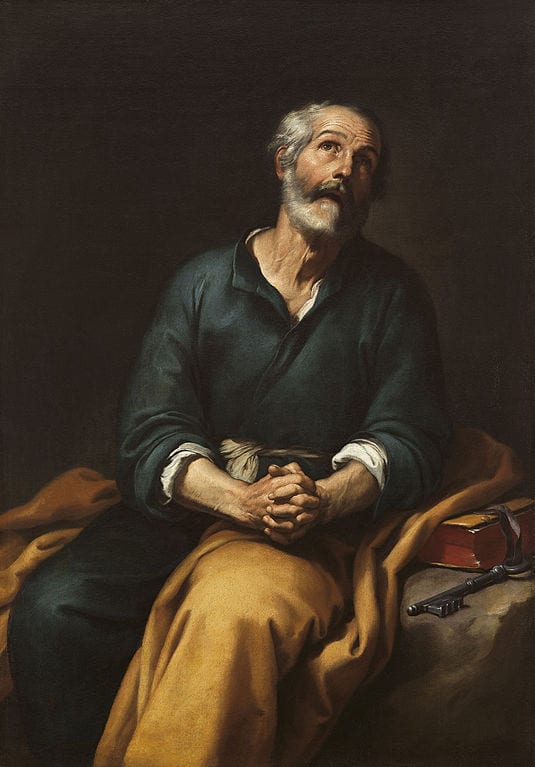
Photo credit: Saint Peter in Tears, by Bartolomé Esteban Murillo (1617-1682) [public domain / Wikimedia Commons]

***
Previous Post
October 10, 2020
Death Penalty, Reactionaries, & a Devious Liar-Pope?
Next Post
October 14, 2020 Anti-Catholic Hypocrisy Re the Term "Anti-Catholic"
Browse Our Archives
Select a Category & Last Things About Me Anti-Catholicism Atheism & Agnosticism Baptism and Sacramentalism Bible and Tradition Blessed Virgin Mary Books by Dave Armstrong C. S. Lewis Calvinism & General Protestantism Catholic Apologetics Catholic Apologists Catholic conversion Catholic converts Christmas Church (Ecclesiology) Church History Conversion and Converts Development of Doctrine Eastern Orthodoxy Ecumenism & Christian Unity Eucharist & Liturgy Fathers of the Church French Translations G. K. Chesterton Hell Hell & Satan Hell & Satan & Last Things Heresies & Comparative Religion Holistic Health Inquisition & Crusades & Scandals James White Jews & Judaism & Old Testament John Calvin John Henry Newman Liberal / Modernist Theology Life Issues Literary Resume Lutheranism Mariology Martin Luther Music Orthodoxy Papacy & Infallibility Personal Page Philosophy & Science Political & Ethical & Moral Issues Protestant Persecution & Intolerance Protestantism Purgatory Purgatory & Penance Romantic & Imaginative Theology Saints & Purgatory & Penance Salvation Salvation & Justification Satan & Last Things Sexuality and Gender Issues Spanish Translations Traditionalism vs. Radical Catholic Reactionaries Traducciones al español / tradução para português Trinitarianism & Christology Uncategorized Videos
Select a Month October 2026 September 2026 August 2026 July 2026 June 2026 May 2026 April 2026 March 2026 February 2026 January 2026 December 2025 November 2025 October 2025 September 2025 August 2025 July 2025 June 2025 May 2025 April 2025 March 2025 February 2025 January 2025 December 2024 November 2024 October 2024 September 2024 August 2024 July 2024 June 2024 May 2024 April 2024 March 2024 February 2024 January 2024 December 2023 November 2023 October 2023 September 2023 August 2023 July 2023 June 2023 May 2023 April 2023 March 2023 February 2023 January 2023 December 2022 November 2022 October 2022 September 2022 August 2022 July 2022 June 2022 May 2022 April 2022 March 2022 February 2022 January 2022 December 2021 November 2021 October 2021 September 2021 August 2021 July 2021 June 2021 May 2021 April 2021 March 2021 February 2021 January 2021 December 2020 November 2020 October 2020 September 2020 August 2020 July 2020 June 2020 May 2020 April 2020 March 2020 February 2020 January 2020 December 2019 November 2019 October 2019 September 2019 August 2019 July 2019 June 2019 May 2019 April 2019 March 2019 February 2019 January 2019 December 2018 November 2018 October 2018 September 2018 August 2018 July 2018 June 2018 May 2018 April 2018 March 2018 February 2018 January 2018 December 2017 November 2017 October 2017 September 2017 August 2017 July 2017 June 2017 May 2017 April 2017 March 2017 February 2017 January 2017 December 2016 November 2016 October 2016 September 2016 August 2016 July 2016 June 2016 May 2016 April 2016 March 2016 February 2016 January 2016 December 2015 November 2015 October 2015 September 2015 August 2015 July 2015 June 2015 May 2015 April 2015 March 2015 February 2015 January 2015 December 2014 November 2014 October 2014 September 2014 August 2014 July 2014 June 2014 April 2014 March 2014 February 2014 January 2014 December 2013 November 2013 October 2013 September 2013 August 2013 July 2013 June 2013 April 2013 March 2013 February 2013 January 2013 December 2012 November 2012 October 2012 September 2012 August 2012 July 2012 June 2012 May 2012 April 2012 March 2012 February 2012 January 2012 December 2011 November 2011 October 2011 September 2011 August 2011 July 2011 June 2011 April 2011 March 2011 February 2011 October 2010 September 2010 August 2010 July 2010 April 2010 March 2010 December 2009 October 2009 August 2009 July 2009 June 2009 May 2009 March 2009 February 2009 October 2008 September 2008 April 2008 March 2008 February 2008 January 2008 December 2007 November 2007 October 2007 May 2007 March 2007 February 2007 January 2007 November 2006 October 2006 September 2006 August 2006 July 2006 June 2006 May 2006 April 2006 March 2006 February 2006 October 2005 June 2005 April 2005 February 2005 July 2004 May 2004 April 2004
Follow Us!
TAKE THE
Religious Wisdom Quiz
Who asked Jesus, "What is truth?"
Select your answer to see how you score.
Caiaphas Pilate Nicodemus Herod
Books by This Author Books by Dave Armstrong
Related posts from Biblical Evidence for Catholicism

Three More Anti-Catholic Lies About Catholicism (#6-4)
Biblical Evidence for Catholicism

Top Ten Anti-Catholic Lies (#10-7)
Biblical Evidence for Catholicism

Was Peter "Any Old" Apostle? 10 Anti-Papal Arguments
Biblical Evidence for Catholicism

Jesus Founded the [Catholic] Church. If Not Him,...
Biblical Evidence for Catholicism
TRENDING AT PATHEOS Catholic

I was strolling through the top floor of the brand new Parthenon...

What Does Gêvâh Mean For Kimberley Guifoyle &...
This week, a lot of the news is focused on Kimberly Guilfoyle....

INNER CIRCLE: Profound Mystery (Of Christ In All...
Ephesians 5:31-32 “For this reason, a man will leave his father and...

Do Not Rejoice When Your Enemy Falls: The...
Turning an execution into a public spectacle is a disturbing expression of...

'The Chosen' S6 Trailer: The Passion Gets Very...
Not many watching 'The Chosen' worry about spoilers, but just because they...

The purpose-driven labor priest
A labor activist reads Rick Warren and it gets me wondering about...
view all Catholic blogs
Ad-Free & Subscriber Log-In Subscription Support
- About Us
- 2026 Calendar
- Videos
- Podcasts
- Library of World Religions
- Faith In Media Tracker
- Advertise With Us
- Write for Us
- Privacy Policy
- Terms of Service
- Do Not Sell My Data
- Contact Us
- Radiant Digital
- Manage Newsletter Subscriptions
- Unsubscribe From Notifications
- Sitemap
Copyright 2008-2026, Patheos. All rights reserved.
Subscription Support Ad-Free & Subscriber Log-In
Follow Patheos