
BuddhistCatholicContemplativeEvangelicalGeneral ChristianHinduJewishLatter-day SaintMuslimNew VisionsProgressive Christian
Beliefs
- Buddhist
- Catholic
- Contemplative
- Evangelical
- General Christian
- Hindu
- Jewish
- Latter-day Saint
- More Voices
- Muslim
- New Visions
- Pagan
- Progressive Christian
Topics
- Religion News
- Food and Religion
- Sports and Religion
- Religious Art
- Religious Music and Entertainment
- Religious Events
- History and Religion
- Style and Religion
- Politics and Religion
- Women in Religion
- Recreation Outdoors and Religion
- Business Finance and Religion
- Careers Workplace and Religion
- Education and Religion
- Family Parenting and Religion
- Health Fitness and Religion
- Home and Religion
- Relationships and Religion
- Technology and Religion
- Travel and Religion
Columnists
- Buddhist Columnists
- Business Finance and Religion Columnists
- Careers Workplace and Religion Columnists
- Catholic Columnists
- Contemplative Columnists
- Education and Religion Columnists
- Evangelists Columnists
- Family Parenting and Religion Columnists
- General Christian Columnists
- Health Fitness and Religion Columnists
- Hindu Columnists
- History and Religion Columnists
- Home and Religion Columnists
- Jewish Columnists
- More Voices Columnists
- Latter Day Columnists
- Muslim Columnists
- New Visions Columnists
- Nonreligious Columnists
- Pagan Columnists
- Politics and Religion Columnists
- Progressive Columnists
- Recreation Outdoors and Religion Columnists
- Relationships and Religion Columnists
- Religion News Columnists
- Religious Art Columnists
- Religious Events Columnists
- Religious Music and Entertainment Columnists
- Sports and Religion Columnists
- Style and Religion Columnists
- Technology and Religion Columnists
- Travel and Religion Columnists
- Women in Religion Columnists
Resource Library
- 2026 Calendar
- Library of World Religions
- The 100 Most Holy Places on Earth
- Patheos Answers
- Podcasts
- Videos
- Faith Leaders Database
- Anglican Episcopalian
- Bahai
- Baptist
- Buddhism
- Christianity
- Confucianism
- Eastern Orthodoxy
- Hinduism
- Holiness and Pentecostal
- ISKCON
- Islam
- Judaism
- Lutheran
- Methodist
- The Church of Jesus Christ of Latter-day Saints
- New Age
- Paganism
- Presbytarian and Reformed
- Protestantism
- Religion Behind the Scenes
- Roman Catholic
- Scientology
- Shia Islam
- Sikhism
- Sufism
- Sunni Islam
- Taoism
- Zen
- See all religions
Research Tools
 Ad-Free & Subscriber Log-In Subscription Support
Ad-Free & Subscriber Log-In Subscription Support
Follow Patheos 

- Trending:
- Forgiveness
- |
- Marriage
- |
- Consciousness
- |
- Death Penalty
- |
- Election
- |
- Halloween

-
About
-
Catholic Apologetics
-
Church History
-
Great Apologists
-
Christian Worldview
-
Protestantism & Misc.
- Home
- Catholic
- History and Religion
- Prayer to Creatures Proven from Holy Scripture
Prayer to Creatures Proven from Holy Scripture
Last updated on: October 1, 2020 at 5:10 pm by Dave Armstrong
Prayer to Creatures Proven from Holy Scripture 2020-10-01T17:10:01-04:00 Dave Armstrong
Patheos Explore the world's faith through different perspectives on religion and spirituality! Patheos has the views of the prevalent religions and spiritualities of the world.
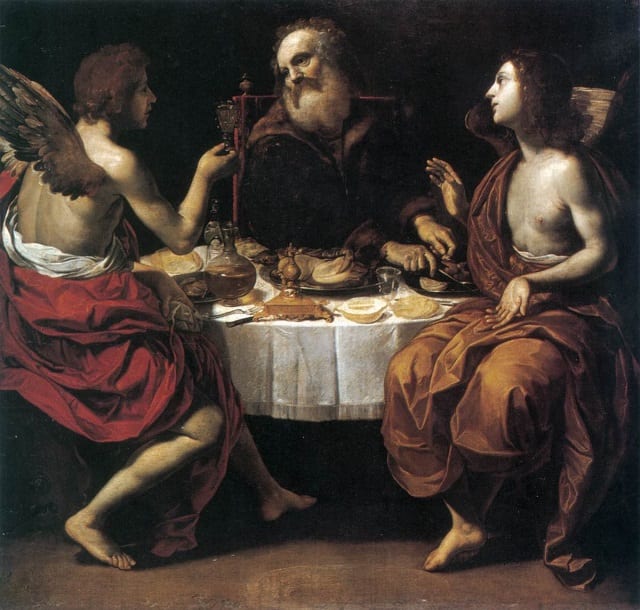
This is a reply to Matt Slick: Presbyterian pastor and head of the large and influential anti-Catholic Protestant CARM discussion forum. I am responding to his article, “Is praying to the saints biblical?” His words will be in blue.
*****
One of the erroneous teachings of the Roman Catholic Church is the doctrine of praying to the saints. Catholicism teaches that it is okay to offer prayers not only to God but also to creatures such as Mary, Joseph, and others who have entered heaven. Is it biblical to pray to anyone other than God? We firmly hold that it is not biblical and that to pray to anyone other than God is idolatrous. . . .
There is no biblical teaching at all that states we are to pray to those who once were alive on earth and are now in heaven. . . .
Worship includes prayer. Therefore, no one should pray to any created thing.
Biblically, prayer is always offered to God and is a form of worship. All religions view prayer as an act of worship to their god(s) since they contain petitions, confession of sin, requests of intercession, etc.,–things which are received and answered by God and not by created things. Also, prayer is not the same thing as talking to someone face-to-face. Prayer is a humble petition to the Lord and not to a friend who’s in the same room with you or on the other end of the phone–or in heaven. Prayer is offered to God–never to any created thing. To do so is to offer worship that should only be directed to God, which is idolatry. Prayer should be offered only to God, and the Roman Catholic Church needs to repent of its false and idolatrous practice of praying to the saints.
That’s odd. Pastor Slick must read a different Bible than I do. Jesus’ story (not technically a parable, because they don;t have proper names) of Lazarus and the rich man (traditionally known as “Dives”) is found in Luke 16:19-31. It’s a remarkable argument for the Catholic belief in invocation of saints and asking saints to intercede. And it goes directly against Protestantism, which strongly upholds the following two propositions:
- It is improper to “pray” to anyone but God, and
- It is improper to ask anyone but God to fulfill (i.e., have the power and ability to bring about) an intercessory request. By definition, no one but God can do so.
These are exactly the sorts of considerations concerning which the Luke 16 passage is relevant. The rich man literally prays to Abraham in the passage and asks him to send someone to warn his five brothers, so they can repent and not end up in his miserable state (on the “bad” side of the two divisions in Hades described in the passage). Here is the entire passage:
Luke 16:19-31 (RSV) “There was a rich man, who was clothed in purple and fine linen and who feasted sumptuously every day. [20] And at his gate lay a poor man named Laz’arus, full of sores, [21] who desired to be fed with what fell from the rich man’s table; moreover the dogs came and licked his sores. [22] The poor man died and was carried by the angels to Abraham’s bosom. The rich man also died and was buried; [23] and in Hades, being in torment, he lifted up his eyes, and saw Abraham far off and Laz’arus in his bosom. [24] And he called out, `Father Abraham, have mercy upon me, and send Laz’arus to dip the end of his finger in water and cool my tongue; for I am in anguish in this flame.’ [25] But Abraham said, `Son, remember that you in your lifetime received your good things, and Laz’arus in like manner evil things; but now he is comforted here, and you are in anguish. [26] And besides all this, between us and you a great chasm has been fixed, in order that those who would pass from here to you may not be able, and none may cross from there to us.’ [27] And he said, `Then I beg you, father, to send him to my father’s house, [28] for I have five brothers, so that he may warn them, lest they also come into this place of torment.’ [29] But Abraham said, `They have Moses and the prophets; let them hear them.’ [30] And he said, `No, father Abraham; but if some one goes to them from the dead, they will repent.’ [31] He said to him, `If they do not hear Moses and the prophets, neither will they be convinced if some one should rise from the dead.'”
It matters not if both men are dead; the rich man still can’t do what he did, according to Protestant categories of thought and theology. And how is it that the rich man prays to Abraham, when supposedly no one can pray to or ask to fulfill a request to anyone but God? The rich man actually makes two such requests, and then repeats the second, after Abraham refused it:
- Luke 16:24 And he called out, `Father Abraham, have mercy upon me, and send Laz’arus to dip the end of his finger in water and cool my tongue; for I am in anguish in this flame.’
- Luke 16:27-28 And he said, `Then I beg you, father, to send him to my father’s house, for I have five brothers, so that he may warn them, lest they also come into this place of torment.’
- Luke 16:30 And he said, `No, father Abraham; but if some one goes to them from the dead, they will repent.’
How can that be within Protestant theology? No one has ever adequately explained this to me, and I’ve written about this passage many times on my blog and in my books. Abraham appears in the story to be able to fulfill prayer requests by his own powers. Why is the whole story about Dives asking Abraham for requests, rather than going directly to God and asking Him? God is never even mentioned in the entire story (!). Because it’s not a parable, Abraham doesn’t represent God (no one represents anybody); he is literally the same Abraham of the Old Testament.
Abraham’s double refusal to fulfill Dives’ prayer request doesn’t prove that he shouldn’t have been prayed to in the first place. If that were the case, then he certainly would have said something like, “You can’t pray to me! Pray only to God!” – just as apostles and angels alike refused worship that was appropriate only for God. Remember, this is Jesus telling the story, and He didn’t rebuke any false theology in it.
*
This just isn’t how it’s supposed to be, from a Protestant perspective, and Pastor Slick’s specific (rather typical) argument above. All the emphases are wrong, and there are serious theological errors, committed by Jesus Himself (i.e., from their perspective). It creates huge problems for Protestant theology and biblical inspiration alike; even for Christology (if Jesus Himself is dead wrong about something so central to faith as prayer).
Nor is this the only instance of biblically and God-sanctioned prayer to the dead, or (more specifically) asking them to intercede:
1 Samuel 28:15-16 Then Samuel said to Saul, “Why have you disturbed me by bringing me up?” Saul answered, “I am in great distress; for the Philistines are warring against me, and God has turned away from me and answers me no more, either by prophets or by dreams; therefore I have summoned you to tell me what I shall do.” And Samuel said, “Why then do you ask me, since the LORD has turned from you and become your enemy?”
The principle / scenario here is the same as in the rich man Dives praying to Abraham, above: Samuel could properly be petitioned or, in effect, “prayed to” but he also could refuse the request, and he did so. As Samuel explained, he didn’t question the asking as wrong and sinful, but rather, refused because the request to save Saul was against God’s expressed will: which Samuel also knew about, as a departed saint. Moreover, Samuel knew (after his death) that Saul was to be defeated in battle the next day and would die (1 Sam 28:18-19).
And there is a third biblical proof:
Matthew 27:46-50 And about the ninth hour Jesus cried with a loud voice, “Eli, Eli, la’ma sabach-tha’ni?” that is, “My God, my God, why hast thou forsaken me?” [47] And some of the bystanders hearing it said, “This man is calling Eli’jah.” [48] And one of them at once ran and took a sponge, filled it with vinegar, and put it on a reed, and gave it to him to drink. [49] But the others said, “Wait, let us see whether Eli’jah will come to save him.” [50] And Jesus cried again with a loud voice and yielded up his spirit. (cf. Mk 15:34-36)
The “bystanders” are presented as allies of Jesus, since one of them gave Him a drink, in the next verse (Matthew 27:48). The next verse (27:49) again shows that this was common belief at the time: “But the others said, ‘Wait, let us see whether Eli’jah will come to save him.’”
Thus, it was believed that one could pray to a dead person such as Elijah (who had already appeared with Jesus at the transfiguration), and that he had power to come and give aid; to “save” a person (in this case, Jesus from a horrible death). It’s not presented as if they are wrong, and in light of other related Scriptures it is more likely that they are correct in thinking that this was a permitted scenario.
Jesus, after all , had already referred to Elijah, saying that he was the prototype for John the Baptist (Mt 11:14; 17:10-13; cf. Lk 1:17 from the angel Gabriel), and it could also have been known that Elijah and Moses appeared with Jesus at the transfiguration (Mt 17:1-6), if these were His followers.
Angels are also creatures, and the Bible shows us that they can be prayed to, and answer prayer, as well. In the Old Testament, Lot makes such a request of two angels, who were sent by God to destroy Sodom and Gomorrah (Gen 19:13):
Genesis 19:20 “Behold, yonder city is near enough to flee to, and it is a little one. Let me escape there . . . and my life will be saved!”
One of them grants his “prayer” (19:21): “Behold, I grant you this favor also, that I will not overthrow the city of which you have spoken.” Someone might say, “but the angel wasn’t in heaven.” Location makes no difference: the angel still fulfilled an intercessory request. Angels can talk to us from heaven. For example:
Genesis 21:17-18 And God heard the voice of the lad; and the angel of God called to Hagar from heaven, and said to her, “What troubles you, Hagar? Fear not; for God has heard the voice of the lad where he is. [18] Arise, lift up the lad, and hold him fast with your hand; for I will make him a great nation.”
And we know that angels pray to God for us:
Zechariah 1:12-13 Then the angel of the LORD said, `O LORD of hosts, how long wilt thou have no mercy on Jerusalem and the cities of Judah, against which thou hast had indignation these seventy years?’ [13] And the LORD answered gracious and comforting words to the angel who talked with me. (cf. Rev 8:3-4)
When Jacob wrestled with the angel (Gen 32:24-29), he asked him to bless him (32:26), and the angel did so (32:29). Moreover, when Jacob (Israel) blessed his sons Joseph and Manasseh, he not only asked God to bless them, but also an angel (“the angel who has redeemed me from all evil, bless the lads”: Gen 48:16).
These four express biblical proofs present a host of problems for the stated position of Pastor Slick, above: which is the standard Protestant position for virtually all except for high Church Anglicans or Anglo-Catholics. He not only said that no one could or should be prayed to but God, and certainly not dead men and saints (which the above passages decisively refute); he also claimed that such prayer or petition is part and parcel of worship, and that to do this to anyone besides God is, therefore, “not biblical” and “idolatrous.”
But it’s not worship, anymore than our asking others on earth to pray for us is worship. So Pastor Slick is in a very uncomfortable position of having to explain the above passages and synthesize them with his false tradition of men. If we can’t and ought not pray to anyone but God, why does Jesus Himself teach that Abraham could be prayed to?
Why does the Old Testament teach that the dead prophet Samuel could be prayed to and petitioned by King Saul? Why does the New Testament not rebuke the reported opinion that Jesus might have been calling to (praying to) the prophet Elijah from the cross? And why does Lot pray to an angel and even get a request fulfilled by the angel?
Moreover, Pastor Slick argues: “prayer . . . contain[s] petitions, . . . requests of intercession, etc.,–things which are received and answered by God and not by created things.” Really? This is simply untrue as well. We have seen that both Abraham (as taught and sanctioned by Jesus) and Samuel received petitionary or intercessory requests after they were dead, and did not rebuke the askers for requesting them (as they would have to do if Pastor Slick were right, just as creatures refused worship (Slick himself gave the example of this in Revelation 19:10, in his article).
And we saw how the notion of Jesus asking Elijah for help was commonplace and also not rebuked as wrong by the author of the Gospel of Matthew. Lot not only made a request of an angel, but received an answer. So Pastor Slick’s additional assertion is also false.
***
Photo credit: Lot Entertaining the Two Angels, by Rutilio Manetti (1571-1639) [public domain / Web Gallery of Art]
***
Previous Post

October 1, 2020
Sore Losers?: Hillary & Dems or Trump & the GOP?
Next Post
October 7, 2020 Seidensticker Folly #58: Jesus Erred on Time of 2nd Coming?
Browse Our Archives
Select a Category & Last Things About Me Anti-Catholicism Atheism & Agnosticism Baptism and Sacramentalism Bible and Tradition Blessed Virgin Mary Books by Dave Armstrong C. S. Lewis Calvinism & General Protestantism Catholic Apologetics Catholic Apologists Catholic conversion Catholic converts Christmas Church (Ecclesiology) Church History Conversion and Converts Development of Doctrine Eastern Orthodoxy Ecumenism & Christian Unity Eucharist & Liturgy Fathers of the Church French Translations G. K. Chesterton Hell Hell & Satan Hell & Satan & Last Things Heresies & Comparative Religion Holistic Health Inquisition & Crusades & Scandals James White Jews & Judaism & Old Testament John Calvin John Henry Newman Liberal / Modernist Theology Life Issues Literary Resume Lutheranism Mariology Martin Luther Music Orthodoxy Papacy & Infallibility Personal Page Philosophy & Science Political & Ethical & Moral Issues Protestant Persecution & Intolerance Protestantism Purgatory Purgatory & Penance Romantic & Imaginative Theology Saints & Purgatory & Penance Salvation Salvation & Justification Satan & Last Things Sexuality and Gender Issues Spanish Translations Traditionalism vs. Radical Catholic Reactionaries Traducciones al español / tradução para português Trinitarianism & Christology Uncategorized Videos
Select a Month October 2026 September 2026 August 2026 July 2026 June 2026 May 2026 April 2026 March 2026 February 2026 January 2026 December 2025 November 2025 October 2025 September 2025 August 2025 July 2025 June 2025 May 2025 April 2025 March 2025 February 2025 January 2025 December 2024 November 2024 October 2024 September 2024 August 2024 July 2024 June 2024 May 2024 April 2024 March 2024 February 2024 January 2024 December 2023 November 2023 October 2023 September 2023 August 2023 July 2023 June 2023 May 2023 April 2023 March 2023 February 2023 January 2023 December 2022 November 2022 October 2022 September 2022 August 2022 July 2022 June 2022 May 2022 April 2022 March 2022 February 2022 January 2022 December 2021 November 2021 October 2021 September 2021 August 2021 July 2021 June 2021 May 2021 April 2021 March 2021 February 2021 January 2021 December 2020 November 2020 October 2020 September 2020 August 2020 July 2020 June 2020 May 2020 April 2020 March 2020 February 2020 January 2020 December 2019 November 2019 October 2019 September 2019 August 2019 July 2019 June 2019 May 2019 April 2019 March 2019 February 2019 January 2019 December 2018 November 2018 October 2018 September 2018 August 2018 July 2018 June 2018 May 2018 April 2018 March 2018 February 2018 January 2018 December 2017 November 2017 October 2017 September 2017 August 2017 July 2017 June 2017 May 2017 April 2017 March 2017 February 2017 January 2017 December 2016 November 2016 October 2016 September 2016 August 2016 July 2016 June 2016 May 2016 April 2016 March 2016 February 2016 January 2016 December 2015 November 2015 October 2015 September 2015 August 2015 July 2015 June 2015 May 2015 April 2015 March 2015 February 2015 January 2015 December 2014 November 2014 October 2014 September 2014 August 2014 July 2014 June 2014 April 2014 March 2014 February 2014 January 2014 December 2013 November 2013 October 2013 September 2013 August 2013 July 2013 June 2013 April 2013 March 2013 February 2013 January 2013 December 2012 November 2012 October 2012 September 2012 August 2012 July 2012 June 2012 May 2012 April 2012 March 2012 February 2012 January 2012 December 2011 November 2011 October 2011 September 2011 August 2011 July 2011 June 2011 April 2011 March 2011 February 2011 October 2010 September 2010 August 2010 July 2010 April 2010 March 2010 December 2009 October 2009 August 2009 July 2009 June 2009 May 2009 March 2009 February 2009 October 2008 September 2008 April 2008 March 2008 February 2008 January 2008 December 2007 November 2007 October 2007 May 2007 March 2007 February 2007 January 2007 November 2006 October 2006 September 2006 August 2006 July 2006 June 2006 May 2006 April 2006 March 2006 February 2006 October 2005 June 2005 April 2005 February 2005 July 2004 May 2004 April 2004
Follow Us!
TAKE THE
Religious Wisdom Quiz
Who was the first woman?
Select your answer to see how you score.
Sarah Eve Mary Deborah
Books by This Author Books by Dave Armstrong
Related posts from Biblical Evidence for Catholicism

Three More Anti-Catholic Lies About Catholicism (#6-4)
Biblical Evidence for Catholicism

Bible & Catholicism on Mortal Sin (vs. John...
Biblical Evidence for Catholicism

Top Ten Anti-Catholic Lies (#10-7)
Biblical Evidence for Catholicism

Does Catholic Intercession of Saints Require Omniscience?
Biblical Evidence for Catholicism
TRENDING AT PATHEOS Catholic

In "Irreplaceable," our book on vocation and technology, Trevor Sutton and I...

I was strolling through the top floor of the brand new Parthenon...

What Does Gêvâh Mean For Kimberley Guifoyle &...
This week, a lot of the news is focused on Kimberly Guilfoyle....

INNER CIRCLE: Profound Mystery (Of Christ In All...
Ephesians 5:31-32 “For this reason, a man will leave his father and...

Do Not Rejoice When Your Enemy Falls: The...
Turning an execution into a public spectacle is a disturbing expression of...

'The Chosen' S6 Trailer: The Passion Gets Very...
Not many watching 'The Chosen' worry about spoilers, but just because they...
view all Catholic blogs
Ad-Free & Subscriber Log-In Subscription Support
- About Us
- 2026 Calendar
- Videos
- Podcasts
- Library of World Religions
- Faith In Media Tracker
- Advertise With Us
- Write for Us
- Privacy Policy
- Terms of Service
- Do Not Sell My Data
- Contact Us
- Radiant Digital
- Manage Newsletter Subscriptions
- Unsubscribe From Notifications
- Sitemap
Copyright 2008-2026, Patheos. All rights reserved.
Subscription Support Ad-Free & Subscriber Log-In
Follow Patheos