
BuddhistCatholicContemplativeEvangelicalGeneral ChristianHinduJewishLatter-day SaintMuslimNew VisionsProgressive Christian
Beliefs
- Buddhist
- Catholic
- Contemplative
- Evangelical
- General Christian
- Hindu
- Jewish
- Latter-day Saint
- More Voices
- Muslim
- New Visions
- Pagan
- Progressive Christian
Topics
- Religion News
- Food and Religion
- Sports and Religion
- Religious Art
- Religious Music and Entertainment
- Religious Events
- History and Religion
- Style and Religion
- Politics and Religion
- Women in Religion
- Recreation Outdoors and Religion
- Business Finance and Religion
- Careers Workplace and Religion
- Education and Religion
- Family Parenting and Religion
- Health Fitness and Religion
- Home and Religion
- Relationships and Religion
- Technology and Religion
- Travel and Religion
Columnists
- Buddhist Columnists
- Business Finance and Religion Columnists
- Careers Workplace and Religion Columnists
- Catholic Columnists
- Contemplative Columnists
- Education and Religion Columnists
- Evangelists Columnists
- Family Parenting and Religion Columnists
- General Christian Columnists
- Health Fitness and Religion Columnists
- Hindu Columnists
- History and Religion Columnists
- Home and Religion Columnists
- Jewish Columnists
- More Voices Columnists
- Latter Day Columnists
- Muslim Columnists
- New Visions Columnists
- Nonreligious Columnists
- Pagan Columnists
- Politics and Religion Columnists
- Progressive Columnists
- Recreation Outdoors and Religion Columnists
- Relationships and Religion Columnists
- Religion News Columnists
- Religious Art Columnists
- Religious Events Columnists
- Religious Music and Entertainment Columnists
- Sports and Religion Columnists
- Style and Religion Columnists
- Technology and Religion Columnists
- Travel and Religion Columnists
- Women in Religion Columnists
Resource Library
- 2026 Calendar
- Library of World Religions
- The 100 Most Holy Places on Earth
- Patheos Answers
- Podcasts
- Videos
- Faith Leaders Database
- Anglican Episcopalian
- Bahai
- Baptist
- Buddhism
- Christianity
- Confucianism
- Eastern Orthodoxy
- Hinduism
- Holiness and Pentecostal
- ISKCON
- Islam
- Judaism
- Lutheran
- Methodist
- The Church of Jesus Christ of Latter-day Saints
- New Age
- Paganism
- Presbytarian and Reformed
- Protestantism
- Religion Behind the Scenes
- Roman Catholic
- Scientology
- Shia Islam
- Sikhism
- Sufism
- Sunni Islam
- Taoism
- Zen
- See all religions
Research Tools
 Ad-Free & Subscriber Log-In Subscription Support
Ad-Free & Subscriber Log-In Subscription Support
Follow Patheos 

- Trending:
- Forgiveness
- |
- Marriage
- |
- Consciousness
- |
- Death Penalty
- |
- Election
- |
- Halloween

-
About
-
Catholic Apologetics
-
Church History
-
Great Apologists
-
Christian Worldview
-
Protestantism & Misc.
- Home
- Catholic
- History and Religion
- Communion of Saints, Scripture, & Anti-Catholic Doug Mabry
Communion of Saints, Scripture, & Anti-Catholic Doug Mabry
Last updated on: September 21, 2020 at 11:51 am by Dave Armstrong
Communion of Saints, Scripture, & Anti-Catholic Doug Mabry 2020-09-21T11:51:12-04:00 Dave Armstrong
Patheos Explore the world's faith through different perspectives on religion and spirituality! Patheos has the views of the prevalent religions and spiritualities of the world.
With Emphasis Particularly on the Saul and [Dead] Samuel Incident
As a preliminary, let me explain again the logical structure of biblical arguments in favor of the communion of saints and invocation of the saints in heaven:
We ought to pray for each other (much biblical proof).
The prayer of a righteous man has great power in its effects (James 5:16-18).
Therefore it makes eminent sense to ask more righteous people to pray for us (implied in same passage).
Dead saints are more alive than we ourselves are (e.g., Mt 22:32).
Dead saints are aware of what happens on the earth (Heb 12:1 etc.), and indeed, are portrayed as praying for us in heaven (Rev 6:9-10).
Dead saints are exceptionally, if not wholly, righteous and holy, since they have been delivered from sin and are present with God (21:27, 22:14).
Therefore, it is perfectly sensible and wise to ask them to pray on our behalf to God.
In my Reply to James White on Communion of Saints [6-20-07], a closely related issue came up that often does in such criticisms: whether God desires contact at all between those on earth and those in heaven (a larger category than simply invocation of the saints). This is a presuppositional issue that is related to invocation of the saints. The mini-argument would run as follows:
A. God desires contact between those in heaven and those on earth (this is a prior, or hidden assumption lying behind #7 above).
B. A is a necessary prerequisite for the notion of invocation or intercession of the saints. In other words, if A is untrue, then B also will be, since B is a sub-group or subset of A.
Note, then, that to support A with biblical examples, as I did, is not at all the same as supporting the full-blown doctrine of the invocation of the saints. Far from it. It is only supporting the necessary prior premise or antecedent premise. This is a fundamental logical distinction. James White expressly denied A above, in these words:
[T]he prohibition of contact with the dead is specifically in the context of people living on earth seeking to have contact with those who have “passed from this world”! This kind of argumentation leaves the prohibition of contact with the dead meaningless and undefined.
This can be annihilated with one biblical example, from St. Peter, who contacted the dead when He raised Tabitha, saying, “Tabitha, rise” (Acts 9:36-41). Who was he talking to? Well, Tabitha, of course: a dead person! You can’t get much more straightforward and plain than that. Therefore, the Bible offers explicit proof that we can have contact with the dead in a certain sense, essentially different from necromancy, use of mediums, and so forth. The opposite argument against invocation of saints, then, from this perspective, is as follows:
X. God prohibits and forbids all contact between those in heaven and those on earth (passages against necromancy, occult arts, etc. are advanced as proof of this).
Y. X is a necessary prerequisite for the notion of invocation or intercession of the saints. Therefore, because X is untrue, Y is also untrue, since Y is a sub-group or subset of X. Case closed; there is no invocation of the saints, according to the Bible.
Besides the Tabitha example, I provided many more in my response, that would utterly contradict and overthrow the claim (White’s claim, and that of most Protestants) of X:
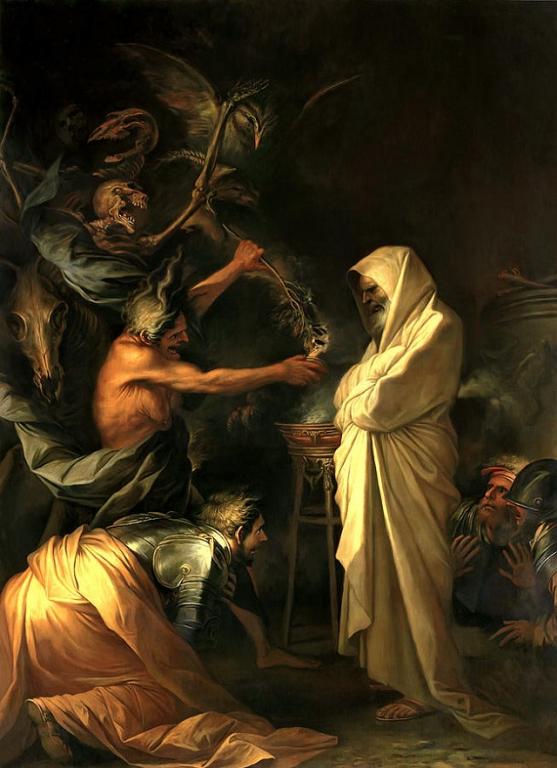
A) 1 Samuel 28:12,14-15 (Samuel): the prophet Samuel appeared to King Saul to prophesy his death. The current consensus among biblical commentators (e.g., The New Bible Commentary, The Wycliffe Bible Commentary) is that it was indeed Samuel the prophet, not an impersonating demon (since it happened during a sort of seance with the so-called “witch or medium of Endor”). This was the view of, e.g., St. Justin Martyr, Origen, and St. Augustine, among others. Ecclesiasticus (Sirach) 6:19-20 reinforces the latter interpretation: “Samuel . . . after he had fallen asleep he prophesied and revealed to the king his death, and lifted up his voice out of the earth in prophecy, to blot out the wickedness of the people.”
B) Matthew 17:1-3 (the Transfiguration: Moses and Elijah): . . . Jesus took with him Peter and James and John his brother, and led them up a high mountain apart. And he was transfigured before them, and his face shone like the sun, and his garments became white as light. And behold, there appeared to them Moses and Elijah, talking with him. (see also Mark 9:4 and Luke 9:30-31)
C) Matthew 27:52-53 (raised bodies after the crucifixion): . . . the tombs also were opened, and many bodies of the saints who had fallen asleep were raised, and coming out of the tombs after his resurrection they went into the holy city and appeared to many.
D) Revelation 11:3, 6 (the “Two Witnesses”): And I will grant my two witnesses power to prophesy for one thousand two hundred and sixty days . . . they have power to shut the sky, that no rain may fall . . . and they have power over the waters to turn them into blood, and to smite the earth with every plague . . .
These two witnesses are killed (11:7-9), were raised after “three and a half days” and “stood up on their feet” (11:11), and then “went up to heaven in a cloud” (11:12). Many Church Fathers thought these two were Enoch and Elijah, because both of them didn’t die; thus this would explain their dying after this appearance on earth. Some Protestant commentators think the two witnesses are Moses and Elijah, because of the parallel to the Transfiguration, and also similarities with the plagues of Egypt and the fact that Elijah also stopped the rain for three-and-a-half years (James 5:17).
We must conclude based on the above passages that contact between heaven and earth is God’s will; otherwise He wouldn’t have permitted it in these instances. The Catholic belief in more interconnection between heaven and earth cannot be ruled out as “unbiblical”. One has to try other arguments to refute our beliefs in this regard.
With that background in mind, let’s now examine how some anti-Catholics butcher my arguments, misrepresent them, and engage in a classic, downright quixotic example of flailing away against mere straw men.
First, let’s take a look at a post (“A Quick Reply to the One Minute Man”) [link now defunct] from Douglas Mabry [aka, “Gojira”] (words in blue henceforth), who cites my biblical evidence of A-D above:
[in response to my refutation of White’s “review”] Let’s take a quick look at his first. His major problem here is question begging. He is assuming something he actually didn’t offer any evidence of, which, of course, is building a case for invoking the intercession of the saints.
Nope. Absolutely not. I’m not question-begging in the slightest. I’m simply producing biblical data that contradicts the assertion of proposition X above (as opposed to trying to prove the whole notion of invocation of saints from this one passage and other related ones). X claims that God doesn’t desire any contact between heaven and earth. The example of Samuel appearing contradicts that. I make my intention for this argument very clear in the way I introduced it:
But White is assuming here something that is quite unbiblical itself: the notion that God wants us to have no contact at all with those who have died. Why would he think this? I provided much evidence to the contrary in one of my papers:
So I guess Mabry suffers from poor reading comprehension and logical acumen, since I plainly laid it all out for the reader but he missed it.
What he does offer is if this was actually Samuel or not. That, however, is not the primary importance he should be concerning himself with in regards to this passage.
To the contrary, it is supremely important, because if a Protestant attempts to claim that this was not Samuel, but only an impersonating demon, then my argument (i.e., my actual one, not Mabry’s twisted caricature) would be undercut. Therefore, it is relevant to establish that it was literally Samuel the prophet, appearing to Saul.
He first needs to establish whether or not it is even okay for Saul to seek the consultation of the dead or not. Consulting the dead is condemned in the Law, as is witchcraft and necromancy.
I don’t need to “establish that because I already believe it. I condemned the occultic sort of “consultation of the dead” in the very section of my book that White was critiquing, that I cited in my reply under consideration. It’s not at issue. What Catholics are saying is that not all “contact with the dead, or those in heaven” is of the same nature as this prohibited sort. Anti-Catholics usually assume that the occultic type of “contact” is a category that takes in all conceivable contact whatsoever. But it is not.
Dave Armstrong is either unaware of, or completely disregards, the witness of the Law in this matter. It does not take a brain surgeon to see that. In fact, that would be the first thing that anyone remotely familiar with the scriptures would point out.
This is where the humorous and dense, obtuse nature of this critique starts to become quite apparent (and it only gets worse, folks), since I dealt with this very thing in the same reply that Mabry is critiquing. So now he is mocking me for being a fool and an idiot because I supposedly am “unaware of” the very thing that I expressly address and condemn in the same paper! A curious methodology indeed . . . One is forced, then, to conclude either that:
- Douglas Mabry did not read my reply in its entirety,
or
- Douglas Mabry is deliberately lying about me when he writes asinine things like this that are disconnected from reality.
As I always extend the benefit of charity, I opt for #1: Mabry doesn’t bother to read what he is critiquing (which is silly and absurd enough, of course). Here is what I cited from my book again, since Mabry obviously missed it the first time around:
A Protestant Might Further Object:
It is not clear how these Catholic practices are any different from the séances, magic, witchcraft, and necromancy forbidden by the Bible. When you come down to it, Catholics are still messing around with dead spirits.
The One-Minute Apologist Says:
Catholics fully agree that these things are prohibited, but deny that the Communion of Saints is a practice included at all in those condemnations.
The difference is in the source of the supernatural power and the intention. When a Christian on earth asks a saint to pray for him (directly supported by the biblical indications above), God is the one whose power makes the relationship between departed and living members of the Body of Christ possible. The medium in a séance, on the other hand, is trying to use her own occultic powers to “conjure up” the dead — opening up the very real possibility of demonic counterfeit. Catholics aren’t “conjuring” anyone; we’re simply asking great departed saints to pray for us. If they are aware of the earth, then God can also make it possible for them to “hear” and heed our prayer requests. If this weren’t the case, then saints and angels in heaven wouldn’t be portrayed as they are in Scripture: intensely active and still involved in earthly affairs.
(p. 121)
Merely introducing this passage in the way Armstrong has is as desperate as it is humorous.
I’m willing to let readers make their own decision whether the humor and desperation here originates with me or with Doug Mabry.
Comments under this post are equally dense and obtuse and out to sea:
“Scribe”: Dave Armstrong’s “One Minute” apologies are more like light years of sychophantic [sic] discourses . . . it is funny how Dave tries to impose a methodological prescription out of wicked King Saul’s reprehensible act of necromancy…that brother is “reaching”.
Gordan illustrates the same exact logical fallacy I have highlighted above: On the Mount of Transfiguration, the most that is proved is that Moses and Elijah are “alive to God” as you said in the post. Again, the question is begged: if the old saints are alive, heck, it must be okay to pray to them. But nothing could be plainer: this passage says not a scribble at all about praying to saints. It doesn’t even hint at it.
Exactly! DUH!!!!! Never said that it did . . . see the above explanations of how the larger biblical argument works, and the function and scope of this particular sub-argument.
Emboldened by Mabry’s profound critique, “Mr. Incredible” (see photo above) writes a guest post that is likewise filled with marvels of illogical thinking. He cites my use of the Mount of Transfiguration passage, then Gordan’s comment on it, and writes:
Amen. One would be hard pressed to find anywhere in the text where either Moses or Elijah spoke anything at all to Peter, John, or James.
That’s irrelevant to my argument, which had to do solely with “contact between heaven and earth”. But even if the point were relevant, in my other three references to similar events, there is much communication: Samuel talks to Saul, the Two Witnesses in Revelation preach and testify, and the bodies raised from the dead after the Crucifixion “appeared to many” (and it is quite reasonable to assume they spoke and communicated, rather than just walking around like a bunch of deaf and dumb zombies or Frankenstein).
And of course, the opposite is true as well — you do not see either Peter, John or James approaching Moses or Elijah. It is kind of a Duh thing to build a case for prayers to the saints using this passage when Peter, John, or James didn’t actually asked [sic] anything or converse with Moses or Elijah to begin with.
See my logical explanation at the beginning of my post. It’s passing ridiculous and ludicrous to accuse me of making stupid “duh” arguments, when the person making the charge doesn’t have a clue as to what I was actually arguing for in this instance. Again, we have dirt-poor reading and logical prowess exhibited in spades (pun half-intended).
Scribe then returns for another shot in the dark. He goes after my use of Matthew 27:52-53 (dead bodies rising and walking around):
How one can extrapolate any form of prescription as a modus operandi for communion with the dead from this passage is beyond me.
Me too! Shows the same stupefaction in elementary logical matters . . . There is nothing like a person who is, in fact, ignorant and/or grossly misinformed about something, thinking he is wiser than someone else whom he mistakenly portrays as an ignoramus and mocks and pillories, with condescension. It’s equal parts sad and hilarious, as so much of anti-Catholicism.
One would have to foist upon it a prejudicial theological bias foreign to its contextual basis.
Indeed one would if they were to actually argue as the caricature presented here suggests.
[omitted comment having nothing particularly to do with my argument]
Bottom line: this verse has nothing to with Armstrong’s eisegetical assertions that would posit a position in favor of his view…
All it has to do with is a refutation of assertion X, noted above. No more, no less.
Armstrong ultimately butchers the Matthew 27:52,53 to arrive at a conclusion that is simply not there . . .
Is that so? Repetition is a great teacher. So let’s now go over for the third time what I claimed for the text, and ask whether this was unreasonable or controversial to the slightest degree:
My claim for the passage I cite:
“But White is assuming here something that is quite unbiblical itself: the notion that God wants us to have no contact at all with those who have died.”
Passage cited as counter-evidence for White’s denial and evidence for my assertion:
Matthew 27:52-53: . . . the tombs also were opened, and many bodies of the saints who had fallen asleep were raised, and coming out of the tombs after his resurrection they went into the holy city and appeared to many.
Perhaps these critics can tell me: how does Matthew 27:52-53 contradict in the slightest the claim I actually made for it (as opposed to the imaginary, mythical things these guys wrongly believe that I made)? I don’t see how it is even arguable. About all that White and these anti-Catholic cronies of his might be able to do with this is sophistically argue that God doesn’t want us to seek contact with dead saints, but does, however, initiate such contact Himself in extraordinary instances and situations (i.e., to somehow distinguish the two as completely different in essence, with one being “bad” and the other “good”).
But that breaks down, too, because Peter deliberately initiated contact with the dead Tabitha, when he talked to her and told her to rise from the dead. That is not rebuked anywhere in the Bible (where, alas, was James White to rebuke Pope Peter when he needed to be rebuked and upbraided for his “unbiblical” practices?).
And it is implausible anyway to say that, on the one hand, God doesn’t want us to contact the dead, when it is a plain fact that He Himself caused it to happen on at least four occasions, exactly the sort of “contact” that is (morally) indistinguishable from instances of our initiating contact. In other words, the following association of propositions and events do not exactly fit together with all that much coherence:
- God wants no one to initiate contact with dead saints.
1A. Yet He sent the dead Samuel to rebuke Saul for his sins.
1B. Yet He sent Moses and Elijah to meet with Jesus on a mountain, in plain sight of Peter, James, and John.
1C. Yet He allowed dead bodies of the departed to resurrect and walk around Jerusalem appearing to many after the Crucifixion.
1D. Yet He will send at the end of the age the Two Witnesses referred to in Revelation (thought by many commentators to be either Moses and Elijah or Enoch and Elijah) to talk to many people for three-and-a-half years (!!!).
This is, technically, an argument from plausibility, not absolutely necessary logical connections (imagine how our anti-Catholic friends will distort this if I don’t spell it out from the outset), but it still has considerable force. I would say that if #1 above were indeed true, as White and Mabry and anti-Catholics assume and assert, it would be (arguably or speculatively) implausible for God to allow 1A, 1B, 1C, and 1D to occur, as they send a message quite arguably at odds with proposition #1.
To illustrate by analogy, it would be like saying, as a parent, “children shouldn’t seek to have ice cream, because that is an altogether evil thing, and therefore forbidden by parents.” But then the same parent gives the children ice cream twice a week. Would it really make sense to claim that it was evil for the children to seek an “evil” thing, while the parents themselves provide the “evil” thing themselves, that they told the children never to seek, on grounds that it was wicked to do so? Is that not a radically mixed message, and a bit incoherent?
Likewise, in the present case. Therefore, there is an indirect relation between these events and invocation of saints. But I only claim as much as I originally did: this biblical evidence unarguably, indisputably disproves the claim that God wants no such contact or communication at all.
–no different than the Charismatics misinterpretation and appropriation of the book of Acts to spuriously support their wild-eyed conceptions about the function of the Holy Spirit.
This is no argument, but merely a poor attempt at guilt-by-association.
More can be touched on regarding my misgivings concerning the interpretation offered by Armstrong but this is supposed to be a “quick reply” to Mr. Armstrong. ;-)
I’m sure much more could be written. But will it make any sense at all? That’s the obvious question, having seen the atrocious, pathetic “arguments” offered thus far. I struggled with whether I should give these “critiques” the dignity of any reply at all, but they were such classic cases of anti-Catholic lack of comprehension of Catholic arguments, and thoroughly illogical thinking, that I simply couldn’t resist.
Watch to see if our misguided anti-Catholic friends respond any further. Will they attempt to wiggle out of the trap they have set for themselves by logic (that I simply pointed out) and make a counter-argument to truly overcome mine, or will they simply mock and yuck it up amongst themselves, in back-slapping ignorant bliss, and pretend that nothing I have argued makes any more sense than their gibberish? You know which scenario I think is far more likely. :-)
I would urge my readers, though, not to just laugh at how lousy these “arguments” are (no one can fault you for doing that!), but to also incorporate the analysis of these “logical whoppers” into your approach when you run across anti-Catholics in the future. Always be on the lookout for these basic errors. What may appear to have some strength at first can quickly be turned around and shown to be completely fallacious and illogical.
* * *
These people frequently miss the most elementary logical and exegetical distinctions, but then turn around and accuse Catholics of the stupidity that is actually descriptive of what they are doing, . . .
One would be hard pressed to find just where I had called Catholics stupid. My reply, as well as those that followed, were directly to one person. This is Dave making a smoke screen by use of dishonesty. Can he point to any one place where I said Catholics are stupid?
Sure, I’d be happy to:
Dave Armstrong is either unaware of, or completely disregards, the witness of the Law in this matter. It does not take a brain surgeon to see that. In fact, that would be the first thing that anyone remotely familiar with the scriptures would point out.
Now, as usual with anti-Catholics, one must become legalistic and nitpickingly ridiculous to even waste one’s time playing these word games. Like the JW who thinks he has a great argument by noting that the word “Trinity” isn’t in the Bible, Doug thinks that because he didn’t use the word stupid, I am being dishonest in describing what he wrote with regard to myself in that way. But the remark above qualifies quite nicely: I’m so stupid I don’t even know that the Bible condemns necromancy (even though I noted that in the same entry in my book that White criticized, and cited those words).
“It does not take a brain surgeon to see that.” In other words, this is a sarcastic way of saying that anyone with any brains at all would know it (i.e., assuming that I am “remotely familiar with the scriptures”), so if I (allegedly) don’t, well now, that makes me pretty stupid, doesn’t it?, and it follows that I am not up on biblical teaching to the most elementary degree. Yet Doug objects to my describing these words as calling me “stupid” and indeed, accuses me of “dishonesty” in so arguing.
Indeed, I have taken a couple of rebukes (and rightly so) for being infantile in trashing Mr. Armstrong, but unless he is vain enough to equate himself as the totality of all Catholics, his dishonest antics are of an infantile level that I have not even descended.
Doesn’t take long for anti-Catholics to locate nefarious motives and unsavory methods in any Catholic reply to their asinine nonsense.
This is how cunning Dave is.
Yes, gotta watch us clever, devious, “jesuitical” Catholics!
. . . and after naming me stupid in about three different ways . . .
In describing how you have densely mischaracterized and misunderstood my argument and have engaged in name-calling and claimed that I am being dishonest, I would describe that as “stupid” any day of the week, because sin is the stupidest thing one can do. I make no bones about calling that stupid, but you try to deny what you really think about Catholics (and myself as one of that species), and if I call you on it, then you immediately claim I am dishonest.
Get a life. I do admit that I was stupid to even respond to your puerile inanities in the first place, but I suppose there is some value in showing a typical example of anti-Catholic “argument.”
* * *
And here is Doug’s reply, amply confirming my opinion that it was foolish to deal with him at all (what else is new with anti-Catholics? Is it ever otherwise?):
What stupendious [sic], unrefutable [sic] response has Mr. Armstrong given my reply? Well, he simply has a meltdown: [then he cites my two paragraphs above as proof-positive of my supposed “meltdown”]
***
It just goes on and on: the discussion about my initial response to James White’s critique of my arguments for the communion of saints gets more and more convoluted every day. More often than not, the Protestant critics have not even properly presented what my arguments were. They have too often misunderstood them at a fundamental level. I’ve already taken great pains to illustrate exactly how they have done this, but apparently to no avail.
It is still occurring on Douglas Mabry’s blog. I decided to try one more time to clarify and correct these critics, because they have not yet grasped my argument, and so think they have found a weak spot that doesn’t exist, because they have assumed things that I did not and which were no part of my argument.
Now, note that I do not say that this is done deliberately. My general approach to such things is to note that we are all prone to be so biased towards our own position that this often brings about the strong tendency to not properly or fully understand opposing positions. That in turn leads to construction of straw men, frustration and unfruitful stalemates of discussions (because constructive, forward-moving discussion absolutely requires both sides understanding their opponents’ arguments in order to progress and achieve anything: however little or minor.
So Doug is (I would assume in charity, as I habitually try to do) simply a victim of his own presuppositions and assumptions about Catholicism and Catholic apologetics. I will explain once more how my argument works. After that, there is nothing else I can do.
Mabry takes another shot at what he thinks is my argument with regard to the prophet Samuel:
[I]n scripture we see many times where angels (consider Gabriel being sent to Mary, the angel being sent to John in the Revelation) contact humans. I don’t think Mr. Armstrong would go there, since that would have zero support in advancing his “argument,” as there was no intercession or invocation sought by any of the visited humans. But still, one wishes that Mr. Armstrong were just a little more tidy in his presentation.
To read Mr. Armstrong’s disclaimer [against all occult arts, necromancy, etc.], and yet see him attempt a passage that does not support his thesis still leaves me wondering if Mr. Armstrong is actually aware of how badly the scriptures condemn the practice that he actually wrote in favor of, or if he does, then he must disregard it to use a passage that he is question begging to begin with.
Again, Mabry doesn’t grasp the nature of my argument regarding Samuel and how it works, and so he falsely perceives a contradiction that is not there at all. As I stated, I oppose everything that is opposed in Old Testament injunctions against the occult arts, such as seances, mediums: the whole nine yards. Having been involved myself in some occultic nonsense in my secularist / semi-pagan days in the 70s, I am particularly aware of the wickedness and non-biblical nature of such things, and have denounced them at every turn.
Not only am I quite aware of biblical prohibitions of these things, but I have been so my entire time of doing serious apologetics (26 years, or maybe longer than Douglas Mabry has been alive). Yet he continues to make out that I am not aware of this stuff, or the extent of it in the Bible. What does it take?
Mr. Armstrong states that he has condemned the practice of consulting the dead, and that this is not an issue.
Correct.
Now, Mr. Armstrong uses this passage [1 Samuel 28] in a positive manner to build his “argument.” Yet Mr. Armstrong also says that he condemns the occult practices mentioned in the passage. Let’s see how this works out in regards to his premise.
Because God desires contact between those in heaven and those on earth, He did or did not consider it sin for Saul to ask his servants to “Seek out for me a woman who is a medium, that I may go to her and inquire of her.”
Of course God considered it a sin for Saul to seek the assistance of a medium, as I have repeatedly stated. It was expressly condemned in the Mosaic Law.
For Saul to actually converse with Samuel this is the route that he had to take.
Here is where Mabry’s misunderstandings really start to affect his argument for the worse, so that it digresses into straw-men bashing. I was not arguing for the entire process of the medium as the way to get to Samuel at all. No one can find any such argument in any of my papers or books — and this was made very clear in my sweeping condemnations of occultic practices, in the same section of my book, The One-Minute Apologist, that James White critiqued.
What I was arguing for was simply one aspect of this event: the fact (held by many commentators — hence my mention of two) that the real prophet Samuel seems to have appeared to Saul, to prophesy to him and tell him the truth, as no demon would have done. Now, if true (and many Protestant commentators think this is what happened), it would be an evidence in favor (as I have stated) of the proposition that “God (at least at times) wants contact to occur between departed saints and people on earth.”
We know absolutely that this was the case at the Transfiguration and those who rose from their graves after the crucifixion and (most probably) the Two Witnesses in Revelation, so if this case holds also, then it would merely be one of four such instances in Scripture. This premise of God desiring such contact is only a precursor for the communion of saints: not the entirety of the communion of saints.
Hence when Mabry and others think I am trying to prove the whole ball of wax from this passage, they are all wet, because I never intended to do any such thing, and I think I made this quite clear. If not before, then certainly now, beyond all doubt, since this is my third crack at it, and third reiteration and clarification of the same argument. Therefore, it’s not my exegetical deficiency or lack of comprehension of biblical prohibitions against occultism, but rather, Mabry’s logical shortcomings and difficulty in comprehending opposing positions (not helped at all by the strongest bias against them, coming from a hostile anti-Catholic outlook in the first place).
As one may recall, Mr. Armstrong would most naturally say that he condemns to the practice that Saul set out to do. Yet on the other hand, since Mr. Armstrong used the example of Saul and Samuel in a positive manner, the events leading up to their interaction would be necessary for that interaction to take place.
Not at all. God simply chose to intervene in the midst of a forbidden practice by allowing Samuel to appear to Saul and rebuke him. God can do whatever He wants. He made a donkey talk once, didn’t He? Does Doug Mabry think that God can’t cause a departed saint who is more alive than all of us are, to come back to earth to rebuke a king for his own good? How is it necessary for me to accept a seance in order for me to accept the fact that Samuel really appeared? It’s not at all.
So does Mr. Armstrong condemn this or not?
I condemn (for the umpteenth time) the wicked occultic practice.
To remain consistent in his positive use of this passage, he would have to either disregard what is condemned in this passage, or he must be very much unaware of the sin taking place.
Absolutely not. I don’t have to do, either. It’s a logical fallacy. I condemn what was wrong and should be condemned, but that plays no part in my argument, because my argument was only that the real Samuel appeared, and that this is one proof that God desires a contact between those in heaven and those on earth. Period. End of sentence.
Again, Mr. Armstrong has stated that the interaction between Saul and Samuel is a positive in establishing the likelihood of prayer to the (departed, dead from our point of view) saints for intercession.
Nope. I argued that Samuel’s appearance (not the means to supposedly “contact” him) establishes a necessary premise for same (desired contact between heaven and earth). Once again, Mabry has not grasped the nature of my argument. And this is the last time I will explain it. If he doesn’t get it now, he never will.
Yet the apparent contradiction remains for Mr. Armstrong to unravel.
I just did, for the second time. There ain’t no contradiction at all.
Just how does he condemn as sin the actions leading up to the interaction Saul sought, and his use of that interaction as part of a positive establishment of his argument and thesis?
Simple: by denying that I used the means “Saul sought” as any part of my argument in the first place. This is a red herring; a straw man.
But it is here that one must make another interesting observation. Notice that no actual intercession took place. There was only the repetition of what Samuel had already told Saul. There was no invocation on the part of Saul to Samuel that he go before God. Yet this would seem to go against the very grain of what Mr. Armstrong seeks to establish.
It’s completely irrelevant, since the argument only sought to prove desired contact between heaven and earth. That can take place without one word being uttered by the people on earth. But in this instance, Saul did indeed talk to Samuel. It was a two-way conversation. Saul actually wanted to know what Samuel thought, even though he went about it in a forbidden way (1 Sam 28:15). It’s not exactly like asking a saint to pray for one but I never stated that it was in the first place, so that’s neither here nor there. Mabry has simply assumed that I have some such illogical notion in my head that is not there.
Once more, one wonders if Mr. Armstrong is aware, or if he just disregards, the prohibition and condemnation placed on the use of mediums and the consultation of the dead.
And once more I reiterate that I am fully aware of such things. Man, this is tedious. . . . Lord, grant me supreme patience . . .
In fact, Mr. Armstrong either ignored or overlooked this one passage of scripture given in my initial response:
13 So Saul died for his breach of faith. He broke faith with the LORD in that he did not keep the command of the LORD, and also consulted a medium, seeking guidance. 14 He did not seek guidance from the LORD. Therefore the LORD put him to death and turned the kingdom over to David the son of Jesse. 1 Chronicles 10:13-14
Contrary to Mr. Armstrong attempting a positive case for the invocation or intercession of departed saints, we see how God saw this event. It is a true pity that Mr. Armstrong cannot.
I don’t have to “ignore” something I already assume, and which has nothing directly to do with my argument. Saul was wicked and died by God’s will and hand. I’m supposedly ignorant of this? How ridiculous is that? Any dolt or imbecile who read the Old Testament and had a fourth-grade reading comprehension would know this.
Commenter Carrie repeated the same fallacies noted above:
Using an act that is condemned by scripture, both directly and indirectly, to make an arguement [sic] looks really bad.
First, you have to prove that the spirit was truly Samuel.
Indeed, and I did that by citing two reputable Protestant commentaries. More on that below . . .
Second, any awareness by the spirit of the earthly happenings could have come entirely from God for that moment.
God makes all things possible. That forms no argument against what I am saying. It’s simply a truism. I’ve noted again and again that it is because of God’s power that the saints can be aware of the earth and our intercessory requests at all.
I don’t believe that the witch actually conjured up Samuel . . .
Neither do I.
. . . and that his message was his own based on his “awareness” of the situation.
He was certainly aware. If you say that is because God made him aware, I say “of course.” But he was still aware, and that is what I am trying to establish, among other things in my overall apologetic for the communion of saints.
God was 100% behind that encounter.
Samuel being His prophet in the first place, of course He was, How could He not be? That’s as silly as saying that “Dave Armstrong was 100% behind his daughter telling the truth to her brother when her brother was doing something wrong.” Would anyone be foolish enough to think that a parent would not be “behind” such a thing? But in this case, God not only approved, but made the whole thing possible in the first place.
Since it has been made a sticking point as to whether this was really Samuel or not, I shall cite some Protestant scholars, starting with one of my original two sources (I don’t have the other in my library any longer):
The narrative strongly suggests that this really was Samuel, and not a mere apparition or hallucination. The foreknowledge and uncompromising statements attributed to him in the verses that follow also stamp him as being genuinely Samuel. (Eerdmans Bible Commentary [formerly New Bible Commentary], edited by D. Guthrie and J.A. Motyer, Grand Rapids, Michigan: Eerdmans, third revised edition, 1970, 301)
[M]any eminent writers (considering that the apparition came before her arts were put into practice; that she herself was surprised and alarmed; that the prediction of Saul’s own death and the defeat of his forces was confidently made), are of the opinion that Samuel really appeared. (Jamieson, Fausset, and Brown Commentary, Grand Rapids, Michigan: Zondervan,1961, from 1864 original, 227)
The whole shows that it was no human fraud or trick. Though the woman could not cause Samuel’s being sent, yet Saul’s inquiry might be the occasion of it. The woman’s surprise and terror proved that it was an unusual and unexpected appearance. Saul had despised Samuel’s solemn warnings in his lifetime, yet now that he hoped, as in defiance of God, to obtain some counsel and encouragement from him, might not God permit the soul of his departed prophet to appear to Saul, to confirm his former sentence, and denounce his doom? The expression, “Thou and thy sons shall be with me,” means no more than that they shall be in the eternal world. There appears much solemnity in God’s permitting the soul of a departed prophet to come as a witness from heaven, to confirm the word he had spoken on earth. (1Sa 28:20-25) (Matthew Henry Commentary)
That Samuel did appear on this occasion, is most evident from the text; nor can this be denied from any legitimate mode of interpretation: and it is as evident that he was neither raised by the power of the devil nor the incantations of the witch, for the appearances which took place at this time were such as she was wholly unacquainted with. Her familiar did not appear; and from the confused description she gives, it is fully evident that she was both surprised and alarmed at what she saw, being so widely different from what she expected to see. (Adam Clarke Commentary)
As will be seen, we regard the apparition of Samuel not as trickery by the woman, but as real – nor yet as caused by the devil, but as allowed and willed of God. A full discussion of our reasons for this view would be evidently out of place. (Edersheim’s Bible History)
***
There is no need to go through all of Dave’s missive; there is really nothing new in his presentation.
Of course not. Translation: “I don’t know how to reply to Dave’s clarifications (without conceding the point altogether) and I can’t ever admit I’m wrong or uninformed with regard to a lowly Catholic and his stupid arguments, so I’ll play the game of pretending that there is nothing new here and that Dave merely babbles his arguments over and over, ad nauseam.”
He continues question begging and missing the point.
An excellent quick way to avoid the consequences of one’s own arguments: make sweeping statements about the other guy, utterly irregardless of their relationship to reality and the truth of the matter.
His post might be summed up thus: No one has understood his argument, lest of all me; that he really does condemn the practices talked about in the Samuel passage; that it really was Samuel who was brought up.
I really really really really DO condemn them! What must I do, swear an oath on John Calvin’s grave, clutching an original Latin copy of the Institutes before the man will believe me?
Let’s go ahead and point out that Mr. Armstrong is not arguing for the “whole ball of wax” as he put it. What he is attempting is arguing for a logical foundation for the intercession of the saints.
Yeah, that would work, since it is the truth, and since I already did so myself.
That is the argument Dave has presented that he claims no one understands.
I never claimed (to my knowledge) that no one understood it: only that Mabry and Carrie and whoever else has made their wrongheaded comments on my argument do not accurately understand it. But the extreme exaggeration works well for the purpose of playing to the crowd, doesn’t it? That makes me out to be unreasonable and eccentric, rather than Mabry not comprehending my argument, as is actually the case.
When dealing with Dave Armstrong, it is important to remember that no matter how well one presents his argument back to him, there is a good chance that Dave will say that you never understood it.
This is downright delicious (and is the one statement that was absolutely beyond my power to resist — so pregnant with comedic possibilities was it; hence the present reply). Let’s see how this peculiar reasoning works:
Dave makes argument x.
Anti-Catholic John Doe argues in a way that makes it obvious to Dave that he didn’t properly understand argument x.
So Dave says that Doe has misunderstood x and goes on to clarify the proper understanding of x and exactly how Doe misunderstood x.
John Doe comes back with the claim that Dave routinely makes the claim that people misunderstand his arguments.
At this point we must determine:
a) Does Dave simply say this as a tactic even though it is not true?
or
b) Is it actually true that Doe did indeed misunderstand argument x?
If 5a obtains, then Doe has to establish this extraordinary charge with some semblance of plausible evidence, rather than merely assert it, and that — it seems to me — would be rather difficult to do without returning to the argument itself and demonstrating it with rational argument. In effect, then, it simply forces him back to the argument where he should have been in the first place.
If 5b obtains, on the other hand, then it is beyond ridiculous for John Doe to complain that it is improper for Dave to claim that his argument x was misunderstood when in fact it truly was misunderstood. What?: is Dave supposed to pretend that his argument x wasn’t misunderstood when it actually was? Of what possible use would that be?
Moreover, 5b entails a scenario whereby Person B claims to understand Person A’s argument x better than Person A himself does, and that is manifestly absurd, for it is hardly possible for Person B to know more about the motivation and reasoning chain of Person A regarding A’s argument x than Person A knows.
Ergo: either way, Doe’s “reply” is utterly inadequate: it is groundless and completely lacking in any substance or force in scenario 5a and ludicrously absurd and self-evidently false in scenario 5b.
The rest of his post is far too asinine to waste any further time on. Surely you get the idea by now. It repeats things that I have already answered. Once that happens, you know your opponent is firing blanks (or a squirt gun, as it were).
I read something today in C.S. Lewis that perfectly describes the mentality that so many anti-Catholics display when “dialoguing” with Catholics:
You can invent a simpler proof, that is, a simpler concatenation of intuitable truths. But when you come to an absolute inability to see any one of the self-evident steps out of which the proof is built, then you can do nothing . . . the supposed inability is usually a refusal to see, resulting either from some passion which wants not to see the truth in question or else from sloth which does not want to think at all. But when the inability is real, the argument is at an end. (The Weight of Glory, New York: Macmillan / Collier Books, revised and expanded edition, 1980, edited by Walter Hooper, New York: “Why I Am Not a Pacifist,” p. 35)
***
(originally posted on 7-8-07)
Photo credit: Saul and the Witch of Endor, by Salvator Rosa (1615-1673) [public domain / Wikimedia Commons]

***
Previous Post

September 19, 2020
Reply to Anti-Catholic Chris Bayack vs. Steve Ray (Pt. II)
Next Post

September 22, 2020 Hilary White Wants to Trash & Bury Vatican II; I Defend It
Browse Our Archives
Select a Category & Last Things About Me Anti-Catholicism Atheism & Agnosticism Baptism and Sacramentalism Bible and Tradition Blessed Virgin Mary Books by Dave Armstrong C. S. Lewis Calvinism & General Protestantism Catholic Apologetics Catholic Apologists Catholic conversion Catholic converts Christmas Church (Ecclesiology) Church History Conversion and Converts Development of Doctrine Eastern Orthodoxy Ecumenism & Christian Unity Eucharist & Liturgy Fathers of the Church French Translations G. K. Chesterton Hell Hell & Satan Hell & Satan & Last Things Heresies & Comparative Religion Holistic Health Inquisition & Crusades & Scandals James White Jews & Judaism & Old Testament John Calvin John Henry Newman Liberal / Modernist Theology Life Issues Literary Resume Lutheranism Mariology Martin Luther Music Orthodoxy Papacy & Infallibility Personal Page Philosophy & Science Political & Ethical & Moral Issues Protestant Persecution & Intolerance Protestantism Purgatory Purgatory & Penance Romantic & Imaginative Theology Saints & Purgatory & Penance Salvation Salvation & Justification Satan & Last Things Sexuality and Gender Issues Spanish Translations Traditionalism vs. Radical Catholic Reactionaries Traducciones al español / tradução para português Trinitarianism & Christology Uncategorized Videos
Select a Month October 2026 September 2026 August 2026 July 2026 June 2026 May 2026 April 2026 March 2026 February 2026 January 2026 December 2025 November 2025 October 2025 September 2025 August 2025 July 2025 June 2025 May 2025 April 2025 March 2025 February 2025 January 2025 December 2024 November 2024 October 2024 September 2024 August 2024 July 2024 June 2024 May 2024 April 2024 March 2024 February 2024 January 2024 December 2023 November 2023 October 2023 September 2023 August 2023 July 2023 June 2023 May 2023 April 2023 March 2023 February 2023 January 2023 December 2022 November 2022 October 2022 September 2022 August 2022 July 2022 June 2022 May 2022 April 2022 March 2022 February 2022 January 2022 December 2021 November 2021 October 2021 September 2021 August 2021 July 2021 June 2021 May 2021 April 2021 March 2021 February 2021 January 2021 December 2020 November 2020 October 2020 September 2020 August 2020 July 2020 June 2020 May 2020 April 2020 March 2020 February 2020 January 2020 December 2019 November 2019 October 2019 September 2019 August 2019 July 2019 June 2019 May 2019 April 2019 March 2019 February 2019 January 2019 December 2018 November 2018 October 2018 September 2018 August 2018 July 2018 June 2018 May 2018 April 2018 March 2018 February 2018 January 2018 December 2017 November 2017 October 2017 September 2017 August 2017 July 2017 June 2017 May 2017 April 2017 March 2017 February 2017 January 2017 December 2016 November 2016 October 2016 September 2016 August 2016 July 2016 June 2016 May 2016 April 2016 March 2016 February 2016 January 2016 December 2015 November 2015 October 2015 September 2015 August 2015 July 2015 June 2015 May 2015 April 2015 March 2015 February 2015 January 2015 December 2014 November 2014 October 2014 September 2014 August 2014 July 2014 June 2014 April 2014 March 2014 February 2014 January 2014 December 2013 November 2013 October 2013 September 2013 August 2013 July 2013 June 2013 April 2013 March 2013 February 2013 January 2013 December 2012 November 2012 October 2012 September 2012 August 2012 July 2012 June 2012 May 2012 April 2012 March 2012 February 2012 January 2012 December 2011 November 2011 October 2011 September 2011 August 2011 July 2011 June 2011 April 2011 March 2011 February 2011 October 2010 September 2010 August 2010 July 2010 April 2010 March 2010 December 2009 October 2009 August 2009 July 2009 June 2009 May 2009 March 2009 February 2009 October 2008 September 2008 April 2008 March 2008 February 2008 January 2008 December 2007 November 2007 October 2007 May 2007 March 2007 February 2007 January 2007 November 2006 October 2006 September 2006 August 2006 July 2006 June 2006 May 2006 April 2006 March 2006 February 2006 October 2005 June 2005 April 2005 February 2005 July 2004 May 2004 April 2004
Follow Us!
TAKE THE
Religious Wisdom Quiz
Which book of the Bible contains the most chapters of any prophetic book?
Select your answer to see how you score.
Daniel Ezekiel Isaiah Jeremiah
Books by This Author Books by Dave Armstrong
Related posts from Biblical Evidence for Catholicism

Top Three Anti-Catholic Lies About Catholicism
Biblical Evidence for Catholicism

Three More Anti-Catholic Lies About Catholicism (#6-4)
Biblical Evidence for Catholicism

Bible & Catholicism on Mortal Sin (vs. John...
Biblical Evidence for Catholicism

Top Ten Anti-Catholic Lies (#10-7)
Biblical Evidence for Catholicism
TRENDING AT PATHEOS Catholic

The First Eucharistic Controversy: Christ’s Real Presence
For Catholics, the Eucharist is the source and summit of the Christian...

What a Stop Sign Can Teach Us About...
How to Make a Decision When You Can't Hear God Main point:...

Archdiocese Hosts Military Marriage Retreat in Germany
RASTATT, Germany — The transient military lifestyle, with its frequent deployments and...

Nearly every morning, I make the drive to Detroit with my high-school-age...

The Real AI Story Is Adoption Without Trust
Artificial intelligence has crossed a political threshold. It is no longer a...

A new article, written by Jeff Lindsay and Gale L. Pooley,...
view all Catholic blogs
Ad-Free & Subscriber Log-In Subscription Support
- About Us
- 2026 Calendar
- Videos
- Podcasts
- Library of World Religions
- Faith In Media Tracker
- Advertise With Us
- Write for Us
- Privacy Policy
- Terms of Service
- Do Not Sell My Data
- Contact Us
- Radiant Digital
- Manage Newsletter Subscriptions
- Unsubscribe From Notifications
- Sitemap
Copyright 2008-2026, Patheos. All rights reserved.
Subscription Support Ad-Free & Subscriber Log-In
Follow Patheos