
BuddhistCatholicContemplativeEvangelicalGeneral ChristianHinduJewishLatter-day SaintMuslimNew VisionsProgressive Christian
Beliefs
- Buddhist
- Catholic
- Contemplative
- Evangelical
- General Christian
- Hindu
- Jewish
- Latter-day Saint
- More Voices
- Muslim
- New Visions
- Pagan
- Progressive Christian
Topics
- Religion News
- Food and Religion
- Sports and Religion
- Religious Art
- Religious Music and Entertainment
- Religious Events
- History and Religion
- Style and Religion
- Politics and Religion
- Women in Religion
- Recreation Outdoors and Religion
- Business Finance and Religion
- Careers Workplace and Religion
- Education and Religion
- Family Parenting and Religion
- Health Fitness and Religion
- Home and Religion
- Relationships and Religion
- Technology and Religion
- Travel and Religion
Columnists
- Buddhist Columnists
- Business Finance and Religion Columnists
- Careers Workplace and Religion Columnists
- Catholic Columnists
- Contemplative Columnists
- Education and Religion Columnists
- Evangelists Columnists
- Family Parenting and Religion Columnists
- General Christian Columnists
- Health Fitness and Religion Columnists
- Hindu Columnists
- History and Religion Columnists
- Home and Religion Columnists
- Jewish Columnists
- More Voices Columnists
- Latter Day Columnists
- Muslim Columnists
- New Visions Columnists
- Nonreligious Columnists
- Pagan Columnists
- Politics and Religion Columnists
- Progressive Columnists
- Recreation Outdoors and Religion Columnists
- Relationships and Religion Columnists
- Religion News Columnists
- Religious Art Columnists
- Religious Events Columnists
- Religious Music and Entertainment Columnists
- Sports and Religion Columnists
- Style and Religion Columnists
- Technology and Religion Columnists
- Travel and Religion Columnists
- Women in Religion Columnists
Resource Library
- 2026 Calendar
- Library of World Religions
- The 100 Most Holy Places on Earth
- Patheos Answers
- Podcasts
- Videos
- Faith Leaders Database
- Anglican Episcopalian
- Bahai
- Baptist
- Buddhism
- Christianity
- Confucianism
- Eastern Orthodoxy
- Hinduism
- Holiness and Pentecostal
- ISKCON
- Islam
- Judaism
- Lutheran
- Methodist
- The Church of Jesus Christ of Latter-day Saints
- New Age
- Paganism
- Presbytarian and Reformed
- Protestantism
- Religion Behind the Scenes
- Roman Catholic
- Scientology
- Shia Islam
- Sikhism
- Sufism
- Sunni Islam
- Taoism
- Zen
- See all religions
Research Tools
 Ad-Free & Subscriber Log-In Subscription Support
Ad-Free & Subscriber Log-In Subscription Support
Follow Patheos 

- Trending:
- Forgiveness
- |
- Marriage
- |
- Consciousness
- |
- Death Penalty
- |
- Election
- |
- Halloween

-
About
-
Catholic Apologetics
-
Church History
-
Great Apologists
-
Christian Worldview
-
Protestantism & Misc.
- Home
- Catholic
- History and Religion
- Viganò’s Outrageous Lie Re Pope Benedict XVI & Tradition
Viganò’s Outrageous Lie Re Pope Benedict XVI & Tradition
Last updated on: June 6, 2026 at 12:43 am by Dave Armstrong
Viganò’s Outrageous Lie Re Pope Benedict XVI & Tradition 2026-06-06T00:43:04-04:00 Dave Armstrong
Patheos Explore the world's faith through different perspectives on religion and spirituality! Patheos has the views of the prevalent religions and spiritualities of the world.
Unwillingness to Make Even Rudimentary Efforts to Consult Context or to Understand a Pope’s Overall Thinking
Shortly I will document how truly outrageous and absolutely groundless this flat-out lying about Pope Benedict XVI is. But I’d like to note at the outset, how this confirms several of the elements regarding radical Catholic reactionaries, that I have been pointing out for many years now:
Part and parcel of the reactionary mindset and mentality is antipathy towards Vatican II.
The hostility towards popes preceded, and extends far beyond Pope Francis. I’ve documented this over and over. Here we see once again that the reactionaries will trash and slander Pope Benedict XVI: whom they used to consider their hero, darling, and champion. But since he dared to not implement their agenda in toto, had the gall to resign, and (above all) to not condemn and trash his successor (quite the contrary), they have thrown him out into the garbage, and it’s now open season: as evidenced by this very calumny. And this is also true of Pope St. John XXIII, Pope St. Paul VI, and Pope St. John Paul II: all of whom committed the “unpardonable sin” of being advocates of Vatican II. If one points out that they are saints, then the reactionaries will simply attack the validity of their canonizations.
I’ve often noted how reactionaries think like both Protestants and Catholic dissidents / liberals. Most prominently is the “either/or” mindset. For the reactionary, Vatican II simply can’t be regarded as in “continuity” with tradition (Pope Benedict’s own constant emphasis). It has to be seen as “revolutionary” or in “rupture” with that tradition. Because Pope Benedict’s view is the polar opposite of that, he had to be discarded. It was inevitable. At first it was reluctant, and with mixed feelings, but now it’s all-out war.
Reactionaries (as is utterly obvious by now) seem to be almost constitutionally unable to fairly represent their theological opponents. If one must lie about opponents and misrepresent their thinking (create straw men to war against), and the facts of the matter, in order to bolster their own opinions, then the latter must not be worth very much. This exhibits (perhaps surprisingly, but truly) a marked lack of self-confidence.
As I’ve been noting in several recent articles, Abp. Viganò has become increasingly unbalanced, irrational, unhinged, and conspiratorial. The present instance is yet more evidence of that. His credibility is virtually zero at this point, in my opinion.
The current farce and fiasco occurs in the pages of the good ol’ reactionary rag The Remnant, in the article, “Archbishop Viganò: On Vatican II & Bishop Barron’s Word on Fire” (Michael J. Matt, 8-15-20). Matt temporarily exhibits a rare ecumenical, irenic attitude as regards Bishop Barron: “I have benefited from some of his lectures in the past and do not wish to call into question his sincerity.” That’s more than a former pope gets from Abp. Viganò. Then Matt goes after a recent initiative by Bishop Barron to defend Vatican II:
[I]t does strike me as a not-so-veiled attempt to disqualify (if not vilify) traditional Catholic resistance to the disastrous and non-binding novelties of the Second Vatican Council.
Matt then decided to write to the illustrious archbishop for his thoughts. Words of Abp. Viganò below will be in blue.
I will focus . . . on the introductory passage from Benedict XVI:
To defend the true tradition of the Church today means to defend the Council. […] We must remain faithful to the today of the Church, not the yesterday or tomorrow. And this today of the Church is the documents of Vatican II, without reservations that amputate them and without arbitrariness that distorts them.”
The Holy Father states apodictically that “to defend the true tradition of the Church today means to defend the Council” and that “we must remain faithful to the today of the Church.” These two propositions, which complement one another, find no support in the Tradition, since the Church’s present is always indissolubly linked to her past.
. . . there is no Church only of today, in which yesterday is now irremediably past and tomorrow has not yet happened: what Christ taught yesterday, we repeat today and His Vicars will profess tomorrow; what the Martyrs witnessed to yesterday, we guard today and our children will confess tomorrow.
Then there is another proposition that “we must remain faithful to the today of the Church, not the yesterday or tomorrow,” which significantly was adopted by the proponents of Vatican II precisely in order to erase the past, affirm the conciliar revolution in the today of that time, and prepare the crisis of that tomorrow in which we now find ourselves. And the Innovators who wanted that Council, carried it out precisely with “the reservations that amputated” the uninterrupted Magisterium of the Church and “the arbitrariness that distorted it” — paraphrasing Ratzinger’s words.
I do not see why what the Innovators accomplished with Vatican II yesterday, to the detriment of Tradition, cannot apply to them today: those who, in the name of being pastoral, did not hesitate to demolish the doctrinal, moral, liturgical, spiritual and disciplinary edifice of the old religion – as they call it – in the name of the Council, today would dare to claim for their daring innovations, that obsequious submission and that defence that they did not want to apply to two thousand years of infallible Magisterium. And we are to show unconditional support not for Tradition, but for the only event that has contradicted and adulterated that Tradition. It seems to me that this line of reasoning, if only from a purely logical point of view, doesn’t have much credibility, and limits itself to reaffirming that self-referentiality of the conciliar church, in rupture with the uninterrupted teaching of the Supreme Pontiffs who preceded it.
Moreover, it seems to me that Benedict XVI’s quotation is also in contradiction with that hermeneutic of continuity, according to which the Council should be accepted not as a rupture with the Church’s past, but precisely in continuity with it: but if there is no Church of yesterday, to what does the continuity of the supposed conciliar hermeneutic refer? . . .
[U]nfortunately, defending Vatican II is more important than defending the perennial depositum fidei.
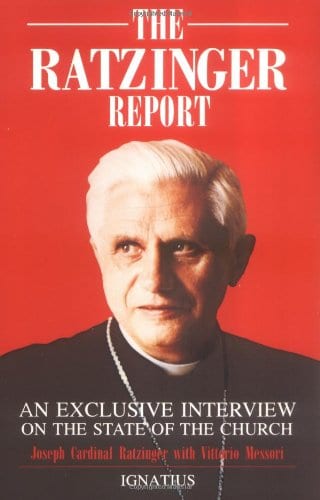
Do you see what he is attempting to do here? He wants to make out that Cardinal Ratzinger (this was a citation form his Ratzinger Report in 1985) thinks Vatican II was a more-or-less complete revolution, which did away with the prior existing tradition of the Church. Nothing could be further from the truth, and if Abp. Viganò (achieving the scholarly standards of a sharp sophomore in college) had simply read more context, he would see that. But instead, he would rather cynically second-guess a pope’s words, and give them a meaning that never crossed then Cardinal Ratzinger’s mind.
Bishop Barron, in the document under consideration, “Vatican II FAQs” already refuted this fallacious, defamatory interpretation (“8. Is Vatican II in continuity with tradition, or a rupture?”):
These terms originate in an address given by Pope Benedict XVI in 2005. In that speech, he contrasts two “hermeneutics,” or ways of interpreting, Vatican II. On the one hand is “the hermeneutic of discontinuity or rupture,” the idea that Vatican II is a split or break with Catholic tradition. On the other hand is “the hermeneutic of reform,” or continuity, the idea that Vatican II is consistent with Catholic tradition.
Both those on the extreme “left” and the extreme “right” have interpreted Vatican II as a rupture—a good rupture and a bad rupture, respectively.
But Pope Benedict XVI championed the hermeneutic of continuity, saying: “The Church, both before and after the Council, was and is the same Church, one, holy, catholic and apostolic, journeying on through time.” Vatican II was not a break or rupture; it must be interpreted in continuity with the tradition that came before.
I have myself, highlighted for many years now, Cardinal Ratzinger’s 1985 statement (The Ratzinger Report, San Francisco: Ignatius, 1985, 28-29, 31) that Vatican II has precisely the same authority as the Council of Trent. The Ratzinger quotation above was part of my larger citation. One Rod Halvorsen, in the combox of Matt’s article, ran across my citation, which I pasted into another article of mine, where I was defending Vatican II against reactionary Paolo Pasqualucci. Here is the quotation. Readers can readily see that the future Pope Benedict XVI was not running down sacred tradition in the slightest (my bolding added):
It must be stated that Vatican II is upheld by the same authority as Vatican I and the Council of Trent, namely, the Pope and the College of Bishops in communion with him, and that also with regard to its contents, Vatican II is in the strictest continuity with both previous councils and incorporates their texts word for word in decisive points . . .
Whoever accepts Vatican II, as it has clearly expressed and understood itself, at the same time accepts the whole binding tradition of the Catholic Church, particularly also the two previous councils . . . It is likewise impossible to decide in favor of Trent and Vatican I but against Vatican II. Whoever denies Vatican II denies the authority that upholds the other two councils and thereby detaches them from their foundation. And this applies to the so-called ‘traditionalism,’ also in its extreme forms. Every partisan choice destroys the whole (the very history of the Church) which can exist only as an indivisible unity.
To defend the true tradition of the Church today means to defend the Council. It is our fault if we have at times provided a pretext (to the ‘right’ and ‘left’ alike) to view Vatican II as a ‘break’ and an abandonment of the tradition. There is, instead, a continuity that allows neither a return to the past nor a flight forward, neither anachronistic longings nor unjustified impatience. We must remain faithful to the today of the Church, not the yesterday or tomorrow. And this today of the Church is the documents of Vatican II, without reservations that amputate them and without arbitrariness that distorts them . . .
I see no future for a position that, out of principle, stubbornly renounces Vatican II. In fact in itself it is an illogical position. The point of departure for this tendency is, in fact, the strictest fidelity to the teaching particularly of Pius IX and Pius X and, still more fundamentally, of Vatican I and its definition of papal primacy. But why only popes up to Pius XII and not beyond? Is perhaps obedience to the Holy See divisible according to years or according to the nearness of a teaching to one’s own already-established convictions?
Pope Benedict is — far from being an opponent — in fact, an enthusiastic, zealous defender and upholder of the sacred tradition of the Catholic Church. No one who reads the above could possibly deny that. Many other similar statements could easily be produced to bolster these. But it is an insult to my intelligence and that of every orthodox Catholic to even consider doing such a thing. The above is sufficient to nail down the point.
But Abp. Viganò prefers to do what every heretic and Catholic dissident and (well-meaning but mistaken) Protestant does to Holy Scripture: he yanks one statement out of context that only appears at first glance to support his own prior position; then ignores all context and all other related thoughts. This is unconscionable, and in fact is the mortal sin of bearing false witness against another: in this instance, a pope.
Abp. Viganò also scathingly condemned Vatican II in a letter published on 8-10-20 in The Remnant:
If it is possible for this Pope to be “for all practical purposes schismatic” – and I would say also heretical – why could not that Council also have been so, despite the fact that both one and the other were instituted by Our Lord to confirm the brethren in Faith and Morals? I ask you, what prevents the Acts of Vatican II from deviating from the path of Tradition, when the Supreme Pastor himself can deny the teaching of his Predecessors? And if the persona Papae is in schism with the papacy, why could a council that wanted to be pastoral and abstained from promulgating dogmas not be able to contradict the other canonical councils, entering into a de facto schism with the Catholic Magisterium?
It’s true that this situation is a hapax, a case that in itself has never been seen in the history of the Church; but if this applies to the papacy – in a crescendo from Roncalli to Bergoglio [see how it is all popes since Pius XII?] – I do not see why it could not apply for Vatican II, which precisely thanks to the recent popes has set itself as an event in itself, and as such has been used by its proponents? . . .
Vatican II is both an ecumenical council and a “devil council” [conciliabolo], it retains the appearance of being a single Council, when in reality there are two. And I would add: one council was legitimate and orthodox and was aborted from birth with the subversion of the preparatory schemes, and one council was illegitimate and heretical (or at least favens haeresim) and is the one to which all of the Innovators refer, including Bergoglio, in order to legitimize their doctrinal, moral and liturgical deviations. . . .
[T]he “container-council” was used to give apparent authority to a deliberately subversive event, exactly as today, right before our eyes, the Vicar of Christ is used to give apparent authoritativeness to a deliberately subversive operation. In both cases, the innate sense of respect towards the Church of Christ on the part of the faithful and the clergy is being used as an infernal stratagem – a Trojan horse introduced into the Sacred Citadel – in order to dissuade every form of dutiful dissent, every criticism, every legitimate denunciation.
This outlook is also manifestly hypocritical and pharisaical. Abp. Viganò and his fellow reactionaries falsely accuse Pope Benedict XVI and non-reactionary orthodox Catholics of supposedly thumbing our collective noses at all sacred tradition prior to Vatican II; in other words, of espousing one period of Catholic tradition and doctrinal development and ignoring another time period.
But in fact, this is mere projection of exactly their own error: they reject and ignore the recent period of Catholic doctrinal development (Vatican II and the popes of the last 60-odd years), while accepting past development: as if the Holy Spirit decided in 1958 to no longer guide the Catholic Church and protect her from doctrinal error (and that is precisely the error of the Pharisees in Jesus’ time). This is absurd, and what Pope Benedict in particular has vigorously opposed.
Shame on him. And shame all the more on all those who continue to uphold Abp. Viganò as some kind of reactionary champion or hero, because he attacks popes, Vatican II, the ordinary form Mass, and ecumenism (all four classic marks of the reactionary).
But Abp. Viganò was not always of this mind. Sometime in the last seven years he underwent a radical change of mind. He had — apparently — gotten hold of the material of the usual reactionary suspects and started being influenced by them. We are what we eat. On 11 November 2013 in an address to the USCCB Fall General Assembly in Baltimore, he unreservedly sung the praises of Pope Francis:
Certainly, my brothers, no one can dispute the clear fact that our present Holy Father himself, as the Supreme Teacher, is giving us by, his own witness, an example of how to live a life attuned to the values of the Gospel. While each of us must take into consideration our adaptability to the many different circumstances and cultures in which we live and the people whom we serve, there has to be a noticeable life style characterized by simplicity and holiness of life. This is a sure way to bring our people to an awareness of the truth of our message.
He was also almost ecstatic in his praise of Vatican II, and the three pope-saints: John XXIII, Paul VI, and John Paul II:
All of us who have been called to the ministry of bishop by Pope John Paul II, and many who have been ordained by him, are looking forward to his canonization, as well as the canonization of Pope John XXIII this coming April.
There was already, by that time, plenty of criticism towards Pope Francis from the reactionaries, but Viganò seemed completely immune to it or unaware of it. My book in defense of Pope Francis was published just two months later, and it dealt with nine different trumped-up controversies in as many chapters. In July 2013, for example occurred the thoroughly distorted and unjust accusations regarding homosexuality and Pope Francis saying (taken wildly out of context, of course), “who am I to judge?” This was what helped turn Phil Lawler and Patrick Coffin against the pope, and to become pope-bashers.
Almost exactly a year later, in another address to the same assembly, Abp. Viganò was still an avid fan of Francis and the other “conciliar” popes:
Indeed, this is the year of the three popes, marked by the recent beatification of Blessed Paul VI and previously the dual canonizations of St. John XXIII and St. John Paul II. We who had the privilege of knowing them recognize how inspiring their lives were for our vocation and for our ministry. . . .
The morning after his election as pope, our Holy Father Francis, in speaking to the Cardinals, said: “Build up the Church, the Bride of Christ, the cornerstone of which is the same Lord. With every movement in our lives, let us build!” His vision is obviously one of renewal. Perhaps in ways to which we are not accustomed…not just holding on to conventional modes of evangelization, but primarily by evangelizing through a ministry of personal conversion, forgiveness, compassion and healing.
And again in November 2015 to the same gathering of bishops, Abp. Viganò (back when he still thought and spoke like an obedient, orthodox Catholic) highly praised Pope Francis:
All of us here are still amazed at the incredible recent visit of our Holy Father in the United States. . . .
On every occasion when he spoke, His Holiness gave a significant message that left a deep impression on the minds and hearts of his listeners.
Note that Abp. Viganò has claimed that he had informed Pope Francis “in 2013 about McCarrick’s alleged sexual misconduct with priests and seminarians.” This was the ostensible reason he became disenchanted with him. Yet the address cited above in 2013 probably occurred after this confrontation, and the 2014 and 2015 addresses certainly did. What gives? Something just ain’t right there; something doesn’t add up. Something very significant and tragic happened since that time.
But in any event, the wisdom of Pope Francis in ignoring this man’s constant (Satan-like) false accusations is manifest all the more every day. I think he knew he would self-destruct and implode over time, as the fanatical, hysterical, conspiratorial reactionary that he turned out to be. And indeed, it is happening right before our eyes. The pope simply understood his glaring, serious faults before all of us, who have seen them gradually unfolding in his ever more ludicrous, ridiculous “statements”: issued — paranoid — from some secluded, unknown basement (perhaps in Michael Matt’s house, for all we know).
Revelation 21:8 (RSV) But as for the cowardly, the faithless, the polluted, as for murderers, fornicators, sorcerers, idolaters, and all liars, their lot shall be in the lake that burns with fire and sulphur, which is the second death.”
***
Photo credit: book cover image from Amazon page for the book.
***
Traditionalism vs. Radical Catholic Reactionaries
Cardinal Ratzinger & tradition
indefectibility of the Catholic Church
Radical Catholic Reactionaries
Previous Post

August 20, 2020
Prayer for the Dead (vs. Calvin #57)
Next Post

August 21, 2020 Objections Re the Catholic Ban on Contraception
Browse Our Archives
Select a Category & Last Things About Me Anti-Catholicism Atheism & Agnosticism Baptism and Sacramentalism Bible and Tradition Blessed Virgin Mary Books by Dave Armstrong C. S. Lewis Calvinism & General Protestantism Catholic Apologetics Catholic Apologists Catholic conversion Catholic converts Christmas Church (Ecclesiology) Church History Conversion and Converts Development of Doctrine Eastern Orthodoxy Ecumenism & Christian Unity Eucharist & Liturgy Fathers of the Church French Translations G. K. Chesterton Hell Hell & Satan Hell & Satan & Last Things Heresies & Comparative Religion Holistic Health Inquisition & Crusades & Scandals James White Jews & Judaism & Old Testament John Calvin John Henry Newman Liberal / Modernist Theology Life Issues Literary Resume Lutheranism Mariology Martin Luther Music Orthodoxy Papacy & Infallibility Personal Page Philosophy & Science Political & Ethical & Moral Issues Protestant Persecution & Intolerance Protestantism Purgatory Purgatory & Penance Romantic & Imaginative Theology Saints & Purgatory & Penance Salvation Salvation & Justification Satan & Last Things Sexuality and Gender Issues Spanish Translations Traditionalism vs. Radical Catholic Reactionaries Traducciones al español / tradução para português Trinitarianism & Christology Uncategorized Videos
Select a Month October 2026 September 2026 August 2026 July 2026 June 2026 May 2026 April 2026 March 2026 February 2026 January 2026 December 2025 November 2025 October 2025 September 2025 August 2025 July 2025 June 2025 May 2025 April 2025 March 2025 February 2025 January 2025 December 2024 November 2024 October 2024 September 2024 August 2024 July 2024 June 2024 May 2024 April 2024 March 2024 February 2024 January 2024 December 2023 November 2023 October 2023 September 2023 August 2023 July 2023 June 2023 May 2023 April 2023 March 2023 February 2023 January 2023 December 2022 November 2022 October 2022 September 2022 August 2022 July 2022 June 2022 May 2022 April 2022 March 2022 February 2022 January 2022 December 2021 November 2021 October 2021 September 2021 August 2021 July 2021 June 2021 May 2021 April 2021 March 2021 February 2021 January 2021 December 2020 November 2020 October 2020 September 2020 August 2020 July 2020 June 2020 May 2020 April 2020 March 2020 February 2020 January 2020 December 2019 November 2019 October 2019 September 2019 August 2019 July 2019 June 2019 May 2019 April 2019 March 2019 February 2019 January 2019 December 2018 November 2018 October 2018 September 2018 August 2018 July 2018 June 2018 May 2018 April 2018 March 2018 February 2018 January 2018 December 2017 November 2017 October 2017 September 2017 August 2017 July 2017 June 2017 May 2017 April 2017 March 2017 February 2017 January 2017 December 2016 November 2016 October 2016 September 2016 August 2016 July 2016 June 2016 May 2016 April 2016 March 2016 February 2016 January 2016 December 2015 November 2015 October 2015 September 2015 August 2015 July 2015 June 2015 May 2015 April 2015 March 2015 February 2015 January 2015 December 2014 November 2014 October 2014 September 2014 August 2014 July 2014 June 2014 April 2014 March 2014 February 2014 January 2014 December 2013 November 2013 October 2013 September 2013 August 2013 July 2013 June 2013 April 2013 March 2013 February 2013 January 2013 December 2012 November 2012 October 2012 September 2012 August 2012 July 2012 June 2012 May 2012 April 2012 March 2012 February 2012 January 2012 December 2011 November 2011 October 2011 September 2011 August 2011 July 2011 June 2011 April 2011 March 2011 February 2011 October 2010 September 2010 August 2010 July 2010 April 2010 March 2010 December 2009 October 2009 August 2009 July 2009 June 2009 May 2009 March 2009 February 2009 October 2008 September 2008 April 2008 March 2008 February 2008 January 2008 December 2007 November 2007 October 2007 May 2007 March 2007 February 2007 January 2007 November 2006 October 2006 September 2006 August 2006 July 2006 June 2006 May 2006 April 2006 March 2006 February 2006 October 2005 June 2005 April 2005 February 2005 July 2004 May 2004 April 2004
Follow Us!
TAKE THE
Religious Wisdom Quiz
Who prayed in a den of lions?
Select your answer to see how you score.
Elijah Noah Daniel David
Books by This Author Books by Dave Armstrong
Related posts from Biblical Evidence for Catholicism

Was Peter "Any Old" Apostle? 10 Anti-Papal Arguments
Biblical Evidence for Catholicism

Jesus Founded the [Catholic] Church. If Not Him,...
Biblical Evidence for Catholicism

Jerusalem Council vs. James White & Sola Scriptura
Biblical Evidence for Catholicism

11 Protestant Objections to Papal Authority Debunked
Biblical Evidence for Catholicism
TRENDING AT PATHEOS Catholic

Swimfan: Forgotten Aughts Pleasures
This is a recovery effort. In 2002, My Big Fat Greek Wedding...

Top Three Anti-Catholic Lies About Catholicism
This is my initial transcript for the video, "THE 3 WORST...

Pope Leo Celebrates Mass for Nurses & Docs...
I don't have any idea how he did it, but Pope Leo...

The Sermon on the Mount, Part I: Matthew...
The Sermon on the Mount, Part I (Matthew 4:12-5:12) St. Matthew moves...

What's up from Crossway: Reviewing some of their latest A few weeks...

Janie Learns the Way of the Cross: A...
Teaching children about Jesus' Passion can be challenging. Many parents and educators...
view all Catholic blogs
Ad-Free & Subscriber Log-In Subscription Support
- About Us
- 2026 Calendar
- Videos
- Podcasts
- Library of World Religions
- Faith In Media Tracker
- Advertise With Us
- Write for Us
- Privacy Policy
- Terms of Service
- Do Not Sell My Data
- Contact Us
- Radiant Digital
- Manage Newsletter Subscriptions
- Unsubscribe From Notifications
- Sitemap
Copyright 2008-2026, Patheos. All rights reserved.
Subscription Support Ad-Free & Subscriber Log-In
Follow Patheos