
BuddhistCatholicContemplativeEvangelicalGeneral ChristianHinduJewishLatter-day SaintMuslimNew VisionsProgressive Christian
Beliefs
- Buddhist
- Catholic
- Contemplative
- Evangelical
- General Christian
- Hindu
- Jewish
- Latter-day Saint
- More Voices
- Muslim
- New Visions
- Pagan
- Progressive Christian
Topics
- Religion News
- Food and Religion
- Sports and Religion
- Religious Art
- Religious Music and Entertainment
- Religious Events
- History and Religion
- Style and Religion
- Politics and Religion
- Women in Religion
- Recreation Outdoors and Religion
- Business Finance and Religion
- Careers Workplace and Religion
- Education and Religion
- Family Parenting and Religion
- Health Fitness and Religion
- Home and Religion
- Relationships and Religion
- Technology and Religion
- Travel and Religion
Columnists
- Buddhist Columnists
- Business Finance and Religion Columnists
- Careers Workplace and Religion Columnists
- Catholic Columnists
- Contemplative Columnists
- Education and Religion Columnists
- Evangelists Columnists
- Family Parenting and Religion Columnists
- General Christian Columnists
- Health Fitness and Religion Columnists
- Hindu Columnists
- History and Religion Columnists
- Home and Religion Columnists
- Jewish Columnists
- More Voices Columnists
- Latter Day Columnists
- Muslim Columnists
- New Visions Columnists
- Nonreligious Columnists
- Pagan Columnists
- Politics and Religion Columnists
- Progressive Columnists
- Recreation Outdoors and Religion Columnists
- Relationships and Religion Columnists
- Religion News Columnists
- Religious Art Columnists
- Religious Events Columnists
- Religious Music and Entertainment Columnists
- Sports and Religion Columnists
- Style and Religion Columnists
- Technology and Religion Columnists
- Travel and Religion Columnists
- Women in Religion Columnists
Resource Library
- 2026 Calendar
- Library of World Religions
- The 100 Most Holy Places on Earth
- Patheos Answers
- Podcasts
- Videos
- Faith Leaders Database
- Anglican Episcopalian
- Bahai
- Baptist
- Buddhism
- Christianity
- Confucianism
- Eastern Orthodoxy
- Hinduism
- Holiness and Pentecostal
- ISKCON
- Islam
- Judaism
- Lutheran
- Methodist
- The Church of Jesus Christ of Latter-day Saints
- New Age
- Paganism
- Presbytarian and Reformed
- Protestantism
- Religion Behind the Scenes
- Roman Catholic
- Scientology
- Shia Islam
- Sikhism
- Sufism
- Sunni Islam
- Taoism
- Zen
- See all religions
Research Tools
 Ad-Free & Subscriber Log-In Subscription Support
Ad-Free & Subscriber Log-In Subscription Support
Follow Patheos 

- Trending:
- Forgiveness
- |
- Marriage
- |
- Consciousness
- |
- Death Penalty
- |
- Election
- |
- Halloween

-
About
-
Catholic Apologetics
-
Church History
-
Great Apologists
-
Christian Worldview
-
Protestantism & Misc.
- Home
- Catholic
- History and Religion
- Seidensticker Folly #44: Historic Christianity & Science
Seidensticker Folly #44: Historic Christianity & Science
Last updated on: June 6, 2026 at 12:43 am by Dave Armstrong
Seidensticker Folly #44: Historic Christianity & Science 2026-06-06T00:43:04-04:00 Dave Armstrong
Patheos Explore the world's faith through different perspectives on religion and spirituality! Patheos has the views of the prevalent religions and spiritualities of the world.
Atheist and anti-theist Bob Seidensticker, who was “raised Presbyterian”, runs the influential Cross Examined blog. He asked me there, on 8-11-18: “I’ve got 1000+ posts here attacking your worldview. You just going to let that stand? Or could you present a helpful new perspective that I’ve ignored on one or two of those posts?” He also made a general statement on 6-22-17: “Christians’ arguments are easy to refute . . . I’ve heard the good stuff, and it’s not very good.” He added in the combox: “If I’ve misunderstood the Christian position or Christian arguments, point that out. Show me where I’ve mischaracterized them.” Such confusion would indeed be predictable, seeing that Bob himself admitted (2-13-16): “My study of the Bible has been haphazard, and I jump around based on whatever I’m researching at the moment.”
Bob (for the record) virtually begged and pleaded with me to dialogue with him in May 2018, via email. But by 10-3-18, following massive, childish name-calling attacks against me, encouraged by Bob on his blog (just prior to his banning me from it), his opinion was as follows: “Dave Armstrong . . . made it clear that a thoughtful intellectual conversation wasn’t his goal. . . . [I] have no interest in what he’s writing about.”
And on 10-25-18, utterly oblivious to the ludicrous irony of his making the statement, Bob wrote in a combox on his blog: “Someone who’s not a little bit driven to investigate cognitive dissonance will just stay a Christian, fat ‘n sassy and ignorant.” Again, Bob mocks some Christian in his combox on 10-27-18: “You can’t explain it to us, you can’t defend it, you can’t even defend it to yourself. Defend your position or shut up about it. It’s clear you have nothing.” And again on the same day: “If you can’t answer the question, man up and say so.” And on 10-26-18: “you refuse to defend it, after being asked over and over again.” And again: “You’re the one playing games, equivocating, and being unable to answer the challenges.”
Bob’s cowardly hypocrisy knows no bounds. Again, on 6-30-19, he was chiding someone for something very much like he himself: “Spoken like a true weasel trying to run away from a previous argument. You know, you could just say, ‘Let me retract my previous statement of X’ or something like that.” Yeah, Bob could! He still hasn’t yet uttered one peep in reply to — now — 41 of my critiques of his atrocious reasoning.
Bible-Basher Bob’s words will be in blue. To find these posts, follow this link: “Seidensticker Folly #” or see all of them linked under his own section on my Atheism page.
*****
Bob presents a completely warped, cynical, jaded, ignorant, one-sided alt-version of the history of early science in his post, “When Christianity Was in Charge, This Is What We Got” (8-10-18). In this disgraceful, outlandish piece, he wrote:
When Christianity was in charge, the world was populated by mystical creatures, we had little besides superstition to explain the caprices of nature, and natural disasters were signs of God’s anger.
Christianity’s goal isn’t to create the internet, GPS, airplanes, or antibiotics. It isn’t to improve life with warm clothes or safe water. It isn’t to eliminate diseases like smallpox or polio. It’s to convince people to believe in a story that has no evidence. . . .
But if Christianity is just what you do if there’s no science, why is it still here? . . . Superstition in a world before science was the scaffold that supported the arch of religion. Science has now dismantled the scaffold of superstition, but it’s too late because the arch of religion has already calcified in place.
It’s the twenty-first century, and yet the guiding principles for Christians’ lives come from the fourteenth, back when the sun orbited the earth, disease had supernatural causes, and the world was populated by Sciapods, Blemmyes, and bonnacons.
I have documented “33 Empiricist Christian Thinkers Before 1000 AD”. As one example among many, both Augustine and Aquinas opposed astrology. On the other hand, many great early scientists (also Christians) were obsessed with astrology, including Galileo, Kepler, and Tycho Brahe, while Isaac Newton (an Arian) was fascinated with alchemy.
For examples of “scientific Christians” long before modern science was born, see Hermann of Reichenau (1013–1054) and Adelard of Bath (c. 1080-c. 1152). When modern science did get off the ground, of course it was Christianity that was overwhelmingly in the forefront of that. Christians or theists founded 115 scientific fields. There were at least 244 priest-scientists. And here are 152 lay Catholic scientists. 35 lunar craters were named to honor Jesuit scientists.
The so-called “Enlightenment” (the supposedly “reasonable” people), by contrast, murdered Lavoisier, the father of chemistry, and several other prominent French scientists and philosophers (namely, Philippe-Frédéric de Dietrich, Nicolas de Condorcet, Jean Baptiste Gaspard Bochart de Saron, Guillaume-Chrétien de Lamoignon de Malesherbes, and Félix Vicq d’Azyr). The murderous spree against scientists was later revived by the Soviet and Chinese atheist Communists.
Galileo, on the other hand (the only example of a “scientific martyr” that we ever seem to hear about) lived his life under house arrest in luxurious palaces of his supporters. by the way, St. Robert Bellarmine showed that he had a more accurate understanding of scientific method than Galileo did. Galileo and other scientists of his general time, got many things wrong, too (just as some in the Church had, in condemning Galileo’s premature overconfidence).
Seidensticker directly replied to the above paragraph: “That’s weird–you’d think that since the Church wasn’t just another big human bureaucracy but instead was guided by the omniscient Creator of the universe that it would look different somehow.”
Exactly! That’s why the Catholic Church produced modern science, including heliocentrism (formulated by the Catholic Copernicus). One (sub-infallible) Catholic tribunal at one point of our history, got science wrong (while a pious Catholic who was wrongly persecuted: Galileo, got some major things right, but also other things wrong, and another Catholic, Bellarmine, had the more modern, accurate understanding of scientific method).
Big wow. We would expect to see this. It’s no disproof whatever of our claims. But such things are clearly beyond your capacity to understand, in the blindness of your bigotry.
As for the sun going around the earth, it need not be pointed out that Nicolaus Copernicus was the key figure who changed that, and he was a Catholic cleric, and his work was enthusiastically supported by the pope of the time and the Church (though later with Galileo there were some silly things said). Even a cursory glance at Wikipedia (“Heliocentrism”) reveals that there were forerunners of heliocentrism in earlier Catholics:
European scholarship in the later medieval period actively received astronomical models developed in the Islamic world and by the 13th century was well aware of the problems of the Ptolemaic model. In the 14th century, bishop Nicole Oresme [c. 1320-1382] discussed the possibility that the Earth rotated on its axis, while Cardinal Nicholas of Cusa [1401-1464] in his Learned Ignorance asked whether there was any reason to assert that the Sun (or any other point) was the center of the universe. In parallel to a mystical definition of God, Cusa wrote that “Thus the fabric of the world (machina mundi) will quasi have its center everywhere and circumference nowhere.” . . .
The state of knowledge on planetary theory received by Copernicus [1473-1543] is summarized in Georg von Peuerbach‘s Theoricae Novae Planetaru (printed in 1472 by Regiomontanus [1436-1476] ). By 1470, the accuracy of observations by the Vienna school of astronomy, of which Peuerbach and Regiomontanus were members, was high enough to make the eventual development of heliocentrism inevitable, and indeed it is possible that Regiomontanus did arrive at an explicit theory of heliocentrism before his death in 1476, some 30 years before Copernicus. . . .
Another possible source for Copernicus’s knowledge of this mathematical device is the Questiones de Spera of Nicole Oresme, who described how a reciprocating linear motion of a celestial body could be produced by a combination of circular motions similar to those proposed by al-Tusi.
I wrote about bishop Nicole Oresme and Cardinal Nicholas of Cusa at length in my 2010 book, Science and Christianity: Close Partners or Mortal Enemies?:
Nicholas Oresme (c. 1323-1382; bishop) Oresme conceived the idea of employing what we should now call rectangular co-ordinates . . . and thus forestalls Descartes in the invention of analytical geometry. . . . In opposition to the Aristotelean theory of weight, according to which the natural location of heavy bodies is the centre of the world, and that of light bodies the concavity of the moon’s orb, he proposes the following: The elements tend to dispose themselves in such manner that, from the centre to the periphery their specific weight diminishes by degrees. He thinks that a similar rule may exist in worlds other than this. This is the doctrine later substituted for the Aristotelean by Copernicus and his followers . . . But Oresme had a much stronger claim to be regarded as the precursor of Copernicus when one considers what he says of the diurnal motion of the earth, . . . He begins by establishing that no experiment can decide whether the heavens move form east to west or the earth from west to east; for sensible experience can never establish more than one relative motion. He then shows that the reasons proposed by the physics of Aristotle against the movement of the earth are not valid . . . [source: Catholic Encyclopedia: ”Nicole Oresme”] He wrote influential works on mathematics, physics, and astronomy. In his Livre du ciel et du monde Oresme discussed a range of evidence for and against the daily rotation of the Earth on its axis. From astronomical considerations, he maintained that if the Earth were moving and not the celestial spheres, all the movements that we see in the heavens that are computed by the astronomers would appear exactly the same as if the spheres were rotating around the Earth. He rejected the physical argument that if the Earth were moving the air would be left behind causing a great wind from east to west. In his view the Earth, Water, and Air would all share the same motion. As to the scriptural passage that speaks of the motion of the sun, he concludes that “this passage conforms to the customary usage of popular speech” and is not to be taken literally. He also noted that it would be more economical for the small Earth to rotate on its axis than the immense sphere of the stars. [source: Wikipedia bio] His work provided some basis for the development of modern mathematics and science. Oresme brilliantly argues against any proof of the Aristotelian theory of a stationary Earth and a rotating sphere of the fixed stars and showed the possibility of a daily axial rotation of the Earth. He was a determined opponent of astrology, which he attacked on religious and scientific grounds. He states – more than 300 years before Robert Hooke (1635–1703) and Newton – that atmospheric refraction occurs along a curve and proposes to approximate the curved path of a ray of light in a medium of uniformly varying density, in this case the atmosphere, by an infinite series of line segments each representing a single refraction. [source: Stanford Encyclopedia of Philosophy bio] In the whole of his argument in favor of the Earth’s motion Oresme is both more explicit and much clearer than that given two centuries later by Copernicus. He was also the first to assume that color and light are of the same nature. He asserted methodological naturalism: “there is no reason to take recourse to the heavens, the last refuge of the weak, or demons, or to our glorious God as if He would produce these effects directly, more so than those effects whose causes we believe are well known to us.” [source: Wikipedia: ”Science in the Middle Ages”] He also showed how to interpret the difficulties encountered in “the Sacred Scriptures wherein it is stated that the sun turns, etc. It might be supposed that here Holy Writ adapts itself to the common mode of human speech, as also in several places, for instance, where it is written that God repented Himself, and was angry and calmed Himself and so on, all of which is, however, not to be taken in a strictly literal sense”. Finally, Oresme offered several considerations favourable to the hypothesis of the Earth’s daily motion. In order to refute one of the objections raised by the Peripatetics against this point, Oresme was led to explain how, in spite of this motion, heavy bodies seemed to fall in a vertical line; he admitted their real motion to be composed of a fall in a vertical line and a diurnal rotation identical with that which they would have if bound to the Earth. This is precisely the principle to which Galileo was afterwards to turn. He adopted Buridan’s theory of dynamics in its entirety. [source: Catholic Encyclopedia: ”History of Physics”] “Most of the essential elements in both his [i.e., Copernicus’] criticism of Aristotle and his theory of motion can be found in earlier scholastic writers, particularly in Oresme.” [source: Thomas Kuhn, The Copernican Revolution (New York: Vintage Books / Random House, 1959), p. 154] [pp. 64-66 in my book][ . . . ]
Nicholas of Cusa (1401–1464; cardinal) Nicholas anticipated many later ideas in mathematics, cosmology, astronomy, and experimental science while constructing his own original version of systematic Neoplatonism. In Book II of On Learned Ignorance he holds that the natural universe is characterized by change or motion; it is not static in time and space. But finite change and motion, ontologically speaking, are also matters of more and less and have no fixed maximum or minimum. This “ontological relativity” leads Cusanus to some remarkable conclusions about the earth and the physical universe, based not on empirical observation but on metaphysical grounds. The earth is not fixed in place at some given point because nothing is utterly at rest; nor can it be the exact physical center of the natural universe, even if it seems nearer the center than “the fixed stars.” Because the universe is in motion without fixed center or boundaries, none of the spheres of the Aristotelian and Ptolemaic world picture are exactly spherical. None of them has an exact center, and the “outermost sphere” is not a boundary. Cusanus thus shifts the typical medieval picture of the created universe toward later views, but on ontological grounds. The natural universe itself, as a contracted image of God, has a physical center that can be anywhere and a circumference that is nowhere. [source: Stanford Encyclopedia of Philosophy bio] Cusanus said that no perfect circle can exist in the universe (opposing the Aristotelean model, and also Copernicus’ later assumption of circular orbits), thus opening the possibility for Kepler’s model featuring elliptical orbits of the planets around the Sun. He made important contributions to the field of mathematics by developing the concepts of the infinitesimal and of relative motion. He was the first to use concave lenses to correct myopia. His writings were essential for Leibniz’s discovery of calculus as well as Cantor’s later work on infinity. [source: Wikipedia bio] The astronomical views of the cardinal are scattered through his philosophical treatises. The earth is a star like other stars [spherical], is not the centre of the universe, is not at rest, nor are its poles fixed. The celestial bodies are not strictly spherical, nor are their orbits circular. The difference between theory and appearance is explained by relative motion. [source: Catholic Encyclopedia bio] “Copernicus . . . had probably at least heard of the very influential treatise in which the fifteenth-century Cardinal, Nicholas of Cusa, derived the motion of the earth from the plurality of worlds in an unbounded Neoplatonic universe. The earth’s motion had never been a popular concept, but by the sixteenth century it was scarcely unprecedented.” [source: Thomas Kuhn, The Copernican Revolution (New York: Vintage Books / Random House, 1959), p. 144] [pp. 66-67 in my book]
Bob is Exhibit #1 of what C. S. Lewis called “chronological snobbery” and what G. K. Chesterton has written about:
[T]here is something odd in the fact that when we reproduce the Middle Ages it is always some such rough and half-grotesque part of them that we reproduce. But why is it that we mainly remember the Middle Ages by absurd things? Few modern people know what a mass of illuminating philosophy, delicate metaphysics, clear and dignified social morality exists in the serious scholastic writers of mediaeval times. But we seem to have grasped somehow that the ruder and more clownish elements in the Middle Ages have a human and poetical interest. We are delighted to know about the ignorance of mediaevalism; we are contented to be ignorant about its knowledge. We forget that Parliaments are mediaeval, that all our Universities are mediaeval, that city corporations are mediaeval, that gunpowder and printing are mediaeval, that half the things by which we now live, and to which we look for progress, are mediaeval. (Illustrated London News, “The True Middle Ages,” 14 July 1906, when Chesterton was still an Anglican, not yet a Catholic)
It was perhaps the one real age of progress in all history. Men have seldom moved with such rapidity and such unity from barbarism to civilisation as they did from the end of the Dark Ages to the times of the universities and the parliaments, the cathedrals and the guilds. (The New Jerusalem, 1920, ch. 12)
The medieval world did not talk about Plato and Cicero as fools occupied with futilities; yet that is exactly how a more modern world talked of the philosophy of Aquinas and sometimes even of the purely philosophic parts of Dante. (The Spice of Life and Other Essays, “The Camp and the Cathedral” [1922] )
I have never maintained that mediaeval things were all good; it was the bigots who maintained that mediaeval things were all bad. (Illustrated London News, “Mediaeval Robber Barons and Other Myths,” 26 May 1923)
They started by saying that mediaeval life was utterly miserable; they find out that it was frequently cheerful; so they make an attempt to represent its cheerfulness as a wild revolt that demonstrates its misery. Every impossibility is possible, except the possibility that the whole assumption about the Middle Ages is wrong. (Illustrated London News, “More Myths, Mediaeval and Victorian,” 2 June 1923)
***
(originally posted on 8-11-18)
*
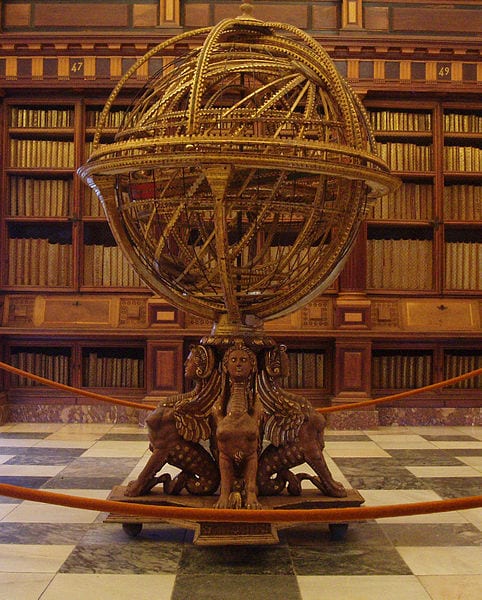
Photo credit: Armillary sphere, constructed by Antonio Santucci, c. 1582. Wikipedia: “The armillary sphere was introduced to Western Europe via Al-Andalus in the late 10th century with the efforts of Gerbert d’Aurillac, the later Pope Sylvester II (r. 999–1003). Pope Sylvester II applied the use of sighting tubes with his armillary sphere in order to fix the position of the pole star and record measurements for the tropics and equator.” [Wikimedia Commons / Creative Commons Attribution-Share Alike 3.0 Unported license]

*
***
Previous Post
August 28, 2020
Seidensticker Folly #43: Intellectual Cowardice & Hypocrisy
Next Post

August 29, 2020 Seidensticker Folly #45: "Zombies" & Clueless Atheists
Browse Our Archives
Select a Category & Last Things About Me Anti-Catholicism Atheism & Agnosticism Baptism and Sacramentalism Bible and Tradition Blessed Virgin Mary Books by Dave Armstrong C. S. Lewis Calvinism & General Protestantism Catholic Apologetics Catholic Apologists Catholic conversion Catholic converts Christmas Church (Ecclesiology) Church History Conversion and Converts Development of Doctrine Eastern Orthodoxy Ecumenism & Christian Unity Eucharist & Liturgy Fathers of the Church French Translations G. K. Chesterton Hell Hell & Satan Hell & Satan & Last Things Heresies & Comparative Religion Holistic Health Inquisition & Crusades & Scandals James White Jews & Judaism & Old Testament John Calvin John Henry Newman Liberal / Modernist Theology Life Issues Literary Resume Lutheranism Mariology Martin Luther Music Orthodoxy Papacy & Infallibility Personal Page Philosophy & Science Political & Ethical & Moral Issues Protestant Persecution & Intolerance Protestantism Purgatory Purgatory & Penance Romantic & Imaginative Theology Saints & Purgatory & Penance Salvation Salvation & Justification Satan & Last Things Sexuality and Gender Issues Spanish Translations Traditionalism vs. Radical Catholic Reactionaries Traducciones al español / tradução para português Trinitarianism & Christology Uncategorized Videos
Select a Month October 2026 September 2026 August 2026 July 2026 June 2026 May 2026 April 2026 March 2026 February 2026 January 2026 December 2025 November 2025 October 2025 September 2025 August 2025 July 2025 June 2025 May 2025 April 2025 March 2025 February 2025 January 2025 December 2024 November 2024 October 2024 September 2024 August 2024 July 2024 June 2024 May 2024 April 2024 March 2024 February 2024 January 2024 December 2023 November 2023 October 2023 September 2023 August 2023 July 2023 June 2023 May 2023 April 2023 March 2023 February 2023 January 2023 December 2022 November 2022 October 2022 September 2022 August 2022 July 2022 June 2022 May 2022 April 2022 March 2022 February 2022 January 2022 December 2021 November 2021 October 2021 September 2021 August 2021 July 2021 June 2021 May 2021 April 2021 March 2021 February 2021 January 2021 December 2020 November 2020 October 2020 September 2020 August 2020 July 2020 June 2020 May 2020 April 2020 March 2020 February 2020 January 2020 December 2019 November 2019 October 2019 September 2019 August 2019 July 2019 June 2019 May 2019 April 2019 March 2019 February 2019 January 2019 December 2018 November 2018 October 2018 September 2018 August 2018 July 2018 June 2018 May 2018 April 2018 March 2018 February 2018 January 2018 December 2017 November 2017 October 2017 September 2017 August 2017 July 2017 June 2017 May 2017 April 2017 March 2017 February 2017 January 2017 December 2016 November 2016 October 2016 September 2016 August 2016 July 2016 June 2016 May 2016 April 2016 March 2016 February 2016 January 2016 December 2015 November 2015 October 2015 September 2015 August 2015 July 2015 June 2015 May 2015 April 2015 March 2015 February 2015 January 2015 December 2014 November 2014 October 2014 September 2014 August 2014 July 2014 June 2014 April 2014 March 2014 February 2014 January 2014 December 2013 November 2013 October 2013 September 2013 August 2013 July 2013 June 2013 April 2013 March 2013 February 2013 January 2013 December 2012 November 2012 October 2012 September 2012 August 2012 July 2012 June 2012 May 2012 April 2012 March 2012 February 2012 January 2012 December 2011 November 2011 October 2011 September 2011 August 2011 July 2011 June 2011 April 2011 March 2011 February 2011 October 2010 September 2010 August 2010 July 2010 April 2010 March 2010 December 2009 October 2009 August 2009 July 2009 June 2009 May 2009 March 2009 February 2009 October 2008 September 2008 April 2008 March 2008 February 2008 January 2008 December 2007 November 2007 October 2007 May 2007 March 2007 February 2007 January 2007 November 2006 October 2006 September 2006 August 2006 July 2006 June 2006 May 2006 April 2006 March 2006 February 2006 October 2005 June 2005 April 2005 February 2005 July 2004 May 2004 April 2004
Follow Us!
TAKE THE
Religious Wisdom Quiz
What city did David capture and make the capital of Israel?
Select your answer to see how you score.
Bethlehem Samaria Jerusalem Hebron
Books by This Author Books by Dave Armstrong
Related posts from Biblical Evidence for Catholicism

God, Modern Physics, & Dark Energy: An Analogy
Biblical Evidence for Catholicism

General Debate on Christianity with an Atheist
Biblical Evidence for Catholicism

Parting of the Red Sea & Lake Erie...
Biblical Evidence for Catholicism

Can Atheists Be Saved? Surprising Biblical Data
Biblical Evidence for Catholicism
TRENDING AT PATHEOS Catholic

I was strolling through the top floor of the brand new Parthenon...

What Does Gêvâh Mean For Kimberley Guifoyle &...
This week, a lot of the news is focused on Kimberly Guilfoyle....

INNER CIRCLE: Profound Mystery (Of Christ In All...
Ephesians 5:31-32 “For this reason, a man will leave his father and...

Do Not Rejoice When Your Enemy Falls: The...
Turning an execution into a public spectacle is a disturbing expression of...

'The Chosen' S6 Trailer: The Passion Gets Very...
Not many watching 'The Chosen' worry about spoilers, but just because they...

The purpose-driven labor priest
A labor activist reads Rick Warren and it gets me wondering about...
view all Catholic blogs
Ad-Free & Subscriber Log-In Subscription Support
- About Us
- 2026 Calendar
- Videos
- Podcasts
- Library of World Religions
- Faith In Media Tracker
- Advertise With Us
- Write for Us
- Privacy Policy
- Terms of Service
- Do Not Sell My Data
- Contact Us
- Radiant Digital
- Manage Newsletter Subscriptions
- Unsubscribe From Notifications
- Sitemap
Copyright 2008-2026, Patheos. All rights reserved.
Subscription Support Ad-Free & Subscriber Log-In
Follow Patheos