
BuddhistCatholicContemplativeEvangelicalGeneral ChristianHinduJewishLatter-day SaintMuslimNew VisionsProgressive Christian
Beliefs
- Buddhist
- Catholic
- Contemplative
- Evangelical
- General Christian
- Hindu
- Jewish
- Latter-day Saint
- More Voices
- Muslim
- New Visions
- Pagan
- Progressive Christian
Topics
- Religion News
- Food and Religion
- Sports and Religion
- Religious Art
- Religious Music and Entertainment
- Religious Events
- History and Religion
- Style and Religion
- Politics and Religion
- Women in Religion
- Recreation Outdoors and Religion
- Business Finance and Religion
- Careers Workplace and Religion
- Education and Religion
- Family Parenting and Religion
- Health Fitness and Religion
- Home and Religion
- Relationships and Religion
- Technology and Religion
- Travel and Religion
Columnists
- Buddhist Columnists
- Business Finance and Religion Columnists
- Careers Workplace and Religion Columnists
- Catholic Columnists
- Contemplative Columnists
- Education and Religion Columnists
- Evangelists Columnists
- Family Parenting and Religion Columnists
- General Christian Columnists
- Health Fitness and Religion Columnists
- Hindu Columnists
- History and Religion Columnists
- Home and Religion Columnists
- Jewish Columnists
- More Voices Columnists
- Latter Day Columnists
- Muslim Columnists
- New Visions Columnists
- Nonreligious Columnists
- Pagan Columnists
- Politics and Religion Columnists
- Progressive Columnists
- Recreation Outdoors and Religion Columnists
- Relationships and Religion Columnists
- Religion News Columnists
- Religious Art Columnists
- Religious Events Columnists
- Religious Music and Entertainment Columnists
- Sports and Religion Columnists
- Style and Religion Columnists
- Technology and Religion Columnists
- Travel and Religion Columnists
- Women in Religion Columnists
Resource Library
- 2026 Calendar
- Library of World Religions
- The 100 Most Holy Places on Earth
- Patheos Answers
- Podcasts
- Videos
- Faith Leaders Database
- Anglican Episcopalian
- Bahai
- Baptist
- Buddhism
- Christianity
- Confucianism
- Eastern Orthodoxy
- Hinduism
- Holiness and Pentecostal
- ISKCON
- Islam
- Judaism
- Lutheran
- Methodist
- The Church of Jesus Christ of Latter-day Saints
- New Age
- Paganism
- Presbytarian and Reformed
- Protestantism
- Religion Behind the Scenes
- Roman Catholic
- Scientology
- Shia Islam
- Sikhism
- Sufism
- Sunni Islam
- Taoism
- Zen
- See all religions
Research Tools
 Ad-Free & Subscriber Log-In Subscription Support
Ad-Free & Subscriber Log-In Subscription Support
Follow Patheos 

- Trending:
- Forgiveness
- |
- Marriage
- |
- Consciousness
- |
- Death Penalty
- |
- Election
- |
- Halloween

-
About
-
Catholic Apologetics
-
Church History
-
Great Apologists
-
Christian Worldview
-
Protestantism & Misc.
- Home
- Catholic
- History and Religion
- Cdl. Newman, Vatican I & II, & Papal Infallibility (Clarification)
Cdl. Newman, Vatican I & II, & Papal Infallibility (Clarification)
Last updated on: July 10, 2020 at 3:50 pm by Dave Armstrong
Cdl. Newman, Vatican I & II, & Papal Infallibility (Clarification) 2020-07-10T15:50:09-04:00 Dave Armstrong
Patheos Explore the world's faith through different perspectives on religion and spirituality! Patheos has the views of the prevalent religions and spiritualities of the world.
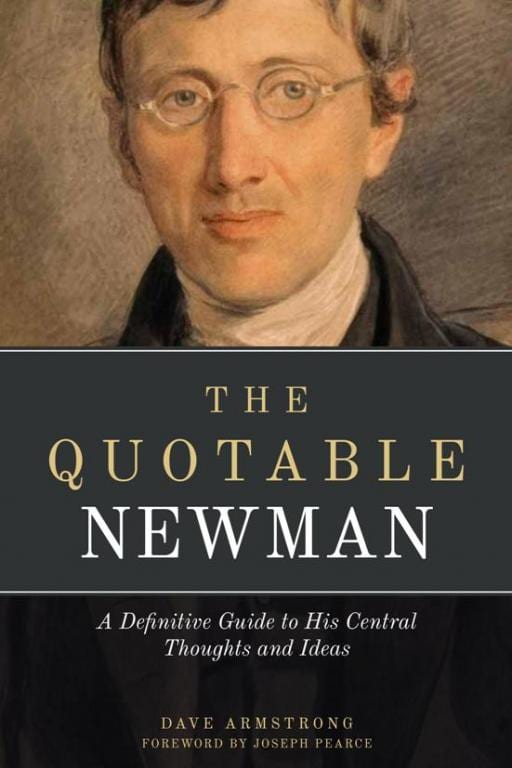
[see book and purchase information]
St. John Henry Cardinal Newman fully accepted (indeed, was pleased with) the decree on papal infallibility, defined at Vatican I (lest anyone would try to deny this, as many Protestants erroneously attempt to do). See my paper: John Henry Newman on Papal Infallibility Prior to 1870 (Classic Anti-Catholic Lies: George Salmon, James White, David T. King et al) [8-11-11].
There seems to be a lot of misconceptions and confusion about Ultramontanism. That strain of thought did indeed seem to be in a numerical majority at Vatican I (if we are talking about counting heads of bishops). At any rate, it was a powerful influence. The actual dogmatic decree on papal infallibility, however, was not Ultramontane at all. It was actually a defeat of Ultramontanism, and Newman himself stated as much. Despite this fact, the nature of the decree is often wrongly conflated to represent a manifestation of that which it actually opposed. Newman biographer Ian Ker describes the true relationship of Ultramontanism, the First Vatican Council, and Newman’s thought (blue emphasis added):
[I]n a letter of March 1870, . . . he pointed out that however infallible the Pope might turn out to be, his pronouncements would still require interpretation. The same was true of a Council’s definitions, which – just as ‘lawyers explain acts of Parliament’ – had to be explained by theologians. Obvious as the fact might be, the conclusion to be drawn from it had serious consequences for the fantasies of extreme Ultramontanism. ‘Hence, I have never been able to see myself that the ultimate decision rests with any but the general Catholic intelligence’ . . . (Later, in the Letter to the Duke of Norfolk, he was careful to emphasize that he simply meant that the whole Church ratified a definition as ‘authentic’, not that the ‘subsequent reception’ actually entered into the ‘necessary conditions’ of a dogmatic decision.) In the same private letter he also noted that abstract definitions could not ‘determine particular fact’: the doctrine, for example, that there was no salvation outside the Church did not apply to people in ‘invincible ignorance’ . . .
He continued to insist after the definition that ‘the voice of the Schola Theologorum, of the whole Church diffusive’ would ‘in time make itself heard’, and that ‘Catholic instincts and ideas’ would eventually ‘assimilate and harmonize’ it into the wider context of Catholic belief . . .
In defining doctrines, Popes and Councils enjoyed an ‘active infallibility’, but more was involved in the infallibility of the Church than that, since a ‘passive infallibility’ belonged to the whole Catholic people, who had to determine the force and meaning of these doctrinal definitions . . . (Ian Ker, John Henry Newman: A Biography, Oxford University Press, 1988, 681-682, citing Difficulties of Anglicans, II, 372; further references: The Letters and Diaries of John Henry Newman [LD], edited by Charles Stephen Dessain [London: 1961-1972], XXV, 71, 284, 447; XXVII, 338)
In his diary, Newman wrote in 1870, after the definition was passed (which he had opposed, as an “inopportunist”) that all Catholic theologians had always held:
. . . that what the Pope said ex cathedra, was true when the Bishops had received it – what has been passed, is to the effect that what he determines ex cathedra is true independently of the reception by the Bishops – but nothing has been passed as to what is meant by ‘ex cathedra’ – and this falls back to the Bishops and the Church to determine quite as much as before. Really therefore nothing has been passed of consequence. Again, the degree is linked to ‘faith and morals’ – whereas what the Ultra party wished to pass was political principles. (LD, XXV, 219, in Ker, ibid., 658; blue emphasis added)
Biographer Ian Ker continues:
Closer study of the definition showed that the Council had only taught the moderate view of infallibility which Ryder, for example, had maintained against Ward . . .
There was no doubting the Ultramontane party was deeply disappointed that the definition could not be used, in particular, to enforce rigorously the Syllabus of Errors . . .
As usual, too, Newman refused to ignore what was true and acceptable in a development which he deplored for other reasons. Disgust with Ultramontame excesses should not be allowed to obscure the original, valid, Ultramontanism of, for example, Montalembert, who had opposed Gallicanism as allowing the state to interfere with the spiritual independence of the Church. The freedom of the local Church from political domination depended on Rome’s central authority.
. . . He was sure that it was divine intervention which had prevented the extreme Ultramontanes, including the Pope, from getting through a much stronger definition. It was a pity that Dollinger and others persisted in exaggerating what actually had been defined . . .
The Ultramontanes had not achieved all that they wanted at the Council.
[Newman thought] It was simply playing into the hands of the extremists to exaggerate the terms of the definition, which in fact had been a ‘defeat’ for the Ultramontanes. (Ker, ibid., 658-660, 662, 665; for the last statement, see LD, XXV, 438)
This hardly represents a scenario whereby Pastor Aeternus is somehow “Ultramontane” whereas similar proclamations of Vatican II are not, and are supposedly instances of (you guessed it) what some might call “rectification” of earlier dogmatic statements. In fact, Vatican II is perfectly harmonious and not contrary to Vatican I in this regard (or any other).
It merely clarifies what came earlier, as we should fully expect, and as Newman himself would both expect and predict. It wouldn’t have surprised him in the least. Nor should it surprise anyone else who knows the history of doctrine in this regard. This is how it works. This is how the Mind of the Church operates. Ian Ker describes how Newman would have likely viewed the developments of Vatican II. Newman practically prophesied Vatican II:
In the event, however, of ‘a false interpretation’ of the infallibility definition, then ‘another Leo will be given us for the occasion’. The reference is to Pope St. Leo’s Council of Chalcedon, which, ‘without of course touching the definition’ of the preceding Council of Ephesus, ‘trimmed the balance of doctrine by completing it’. The warning is an exact prophecy of the theology of ‘creeping infallibility’ that came in the wake of the First Vatican Council, and of the Second Vatican Council, which Pope John XXIII convoked nearly a hundred years later. (Ker, ibid., 683-684, citing Difficulties of Anglicans, II, 307)
Ker points out how Newman’s orthodox Catholic position disagreed with the excesses of the Old Catholic “left” (who wanted to deny papal infallibility) and the Ultramontanist “right” (who wanted it to be far broader than was decided by the Council):
As regards the relation between history and theology, Newman is unequivocal in his criticism of Dollinger and his followers . . . ‘I think them utterly wrong in what they have done and are doing; and, moreover, I agree as little in their view of history as in their acts.’ It is not a matter of questioning the accuracy of their historical knowledge, but ‘their use of the facts they report’ and ‘that special stand-point from which they view the relations existing between the records of History and the communications of Popes and Councils’. Newman sums up the essence of the problem: ‘They seem to me to expect from History more than History can furnish.’ The opposite was true of the Ultramontanes, who simply found history an embarrassing inconvenience. . . .
Newman’s carefully nuanced judgement mocks both the intransigence of Pio Nono and the inconsistency of a politician like Gladstone. (Ker, ibid., 684-685, citing Difficulties of Anglicans, II, 309, 311-312)
Vatican I and Vatican II had different emphases, of course, but “exclusively” is too exaggerated of a description. This is merely one of the frequent distressing Protestant false dichotomies, when discussing the Catholic Church. For Pastor Aeternus also states:
We condemn and reprobate the opinions of those who hold that the communication between the supreme Head and the pastors and their flocks can lawfully be impeded . . . (Chapter III)
Also:
[T]he Roman Pontiffs, according to the exigencies of times and circumstances, sometimes assembling ecumenical councils, or asking for the mind of the Church scattered throughout the world, sometimes by particular synods, sometimes using other helps which divine Providence supplied, defined as to be held those things which with the help of God they had recognized as conformable with the sacred Scriptures and Apostolic traditions. For the Holy Spirit was not promised to the successors of Peter, that by His revelation they might make known new doctrine, but that by His assistance they might inviolably keep and faithfully expound the revelation or deposit of faith delivered through the Apostles.
Therefore, the notion of collegiality and interaction between popes and lessers in the Church was already present, and was nothing new. It had been there all along. But obviously, in a decree, the purpose of which is to define the exact nature of the infallibility of the pope, the infallibility of the pope will be the main focus! That much is clear, but in any event, Vatican II simply developed what came before.
Pope Pius IX, an Ultramontanist himself, nevertheless relied upon extensive surveys of the bishops and priests and religious of the world before defining the Immaculate Conception of Mary as dogma in 1854, 16 years before Vatican I.
That is hardly “functioning apart” from the faithful. The same thing occurred after the definition, in 1950, when Pope Pius XII did the same thing prior to declaring as irreformable dogma, Mary’s Assumption. So the popes and the Church have understood this. It happened before 1870, and it happened before 1965, when Vatican II ended. But at no time was the pope “bound to the faithful,” if by that is meant the ability of the faithful to overturn infallible papal decrees.
It’s true that additional insights have been gained over a nearly hundred-year span of time. But the notions were already present in Vatican I. The development proceeded exactly as Cardinal Newman would have envisioned it. But the historical continuity and utter consistency of Vatican I and Vatican II is plainly evident in Lumen Gentium itself.
For example, in an explicit discussion of collegiality (Chapter III, section 22), complete with many ancient references, the Council casually reasserts papal primacy, headship, and infallibility. There is no possibility of the sensus fidelium, or even united bishops (as in heretical conciliarism) overturning a truly infallible papal decree:
The college or body of bishops has for all that no authority unless united with the Roman Pontiff . . . For the Roman Pontiff . . . has full, supreme and universal power over the whole Church, a power which he can always exercise unhindered . . . Together with their head, the Supreme Pontiff, and never apart from him, they have supreme and full authority over the universal Church; but this power cannot be exercised without the agreement of the Roman Pontiff.
Far from watering down papal primacy, Vatican II asserts it with far more force than even Vatican I did, over and over, in many different ways. No one can have any doubt as to relative power of bishops and the pope. The pope can act unilaterally and in an irreformable fashion (after consulting with bishops). The bishops cannot do so without the pope. Therefore, the pope’s authority is supreme and final in the Church. Nothing has changed.
This is Vatican I teaching. And it is ancient practice, merely developed through the centuries. Papal supremacy and infallibility is nothing new; neither is collegiality and the sensus fidelium and Mind of the Church. But the latter elements received a fresh “hearing” and explication at Vatican II, which is an absolutely delightful turn of events, in my opinion, and which creates more common ground with other Christians.
I profoundly disagree again. No “correction” occurred at Vatican II, unless it is regarded as strictly referring to emphasis (insofar as one emphasis chosen over another may be regarded as a “correction” — it seems to me much more a matter of prudence and timing rather than doctrine). Doctrine was not rectified, but emphases were, and that is a common occurrence throughout Church history; not exclusive to Vatican II at all.
Secondly, the mature developmental principles of Newman were those of his Essay on Development, written as an Anglican, but almost entirely consistent with his later Catholic beliefs. Nothing in either Vatican I or Vatican II contradicts those principles. Therefore, one might discuss Newman’s ideas as those of his Anglican period; yet in this instance they do not differ from his Catholic period (at least if we are talking about his classic 1845 expression of his theory of doctrinal development).
***
(originally 12-10-05)
***
Previous Post
July 7, 2020
"Higher" Hapless Haranguing of Hypothetical Hittites (19th C.)
Next Post
July 8, 2020 Should God the Father be Visually Depicted in Paintings?
Browse Our Archives
Select a Category & Last Things About Me Anti-Catholicism Atheism & Agnosticism Baptism and Sacramentalism Bible and Tradition Blessed Virgin Mary Books by Dave Armstrong C. S. Lewis Calvinism & General Protestantism Catholic Apologetics Catholic Apologists Catholic conversion Catholic converts Christmas Church (Ecclesiology) Church History Conversion and Converts Development of Doctrine Eastern Orthodoxy Ecumenism & Christian Unity Eucharist & Liturgy Fathers of the Church French Translations G. K. Chesterton Hell Hell & Satan Hell & Satan & Last Things Heresies & Comparative Religion Holistic Health Inquisition & Crusades & Scandals James White Jews & Judaism & Old Testament John Calvin John Henry Newman Liberal / Modernist Theology Life Issues Literary Resume Lutheranism Mariology Martin Luther Music Orthodoxy Papacy & Infallibility Personal Page Philosophy & Science Political & Ethical & Moral Issues Protestant Persecution & Intolerance Protestantism Purgatory Purgatory & Penance Romantic & Imaginative Theology Saints & Purgatory & Penance Salvation Salvation & Justification Satan & Last Things Sexuality and Gender Issues Spanish Translations Traditionalism vs. Radical Catholic Reactionaries Traducciones al español / tradução para português Trinitarianism & Christology Uncategorized Videos
Select a Month October 2026 September 2026 August 2026 July 2026 June 2026 May 2026 April 2026 March 2026 February 2026 January 2026 December 2025 November 2025 October 2025 September 2025 August 2025 July 2025 June 2025 May 2025 April 2025 March 2025 February 2025 January 2025 December 2024 November 2024 October 2024 September 2024 August 2024 July 2024 June 2024 May 2024 April 2024 March 2024 February 2024 January 2024 December 2023 November 2023 October 2023 September 2023 August 2023 July 2023 June 2023 May 2023 April 2023 March 2023 February 2023 January 2023 December 2022 November 2022 October 2022 September 2022 August 2022 July 2022 June 2022 May 2022 April 2022 March 2022 February 2022 January 2022 December 2021 November 2021 October 2021 September 2021 August 2021 July 2021 June 2021 May 2021 April 2021 March 2021 February 2021 January 2021 December 2020 November 2020 October 2020 September 2020 August 2020 July 2020 June 2020 May 2020 April 2020 March 2020 February 2020 January 2020 December 2019 November 2019 October 2019 September 2019 August 2019 July 2019 June 2019 May 2019 April 2019 March 2019 February 2019 January 2019 December 2018 November 2018 October 2018 September 2018 August 2018 July 2018 June 2018 May 2018 April 2018 March 2018 February 2018 January 2018 December 2017 November 2017 October 2017 September 2017 August 2017 July 2017 June 2017 May 2017 April 2017 March 2017 February 2017 January 2017 December 2016 November 2016 October 2016 September 2016 August 2016 July 2016 June 2016 May 2016 April 2016 March 2016 February 2016 January 2016 December 2015 November 2015 October 2015 September 2015 August 2015 July 2015 June 2015 May 2015 April 2015 March 2015 February 2015 January 2015 December 2014 November 2014 October 2014 September 2014 August 2014 July 2014 June 2014 April 2014 March 2014 February 2014 January 2014 December 2013 November 2013 October 2013 September 2013 August 2013 July 2013 June 2013 April 2013 March 2013 February 2013 January 2013 December 2012 November 2012 October 2012 September 2012 August 2012 July 2012 June 2012 May 2012 April 2012 March 2012 February 2012 January 2012 December 2011 November 2011 October 2011 September 2011 August 2011 July 2011 June 2011 April 2011 March 2011 February 2011 October 2010 September 2010 August 2010 July 2010 April 2010 March 2010 December 2009 October 2009 August 2009 July 2009 June 2009 May 2009 March 2009 February 2009 October 2008 September 2008 April 2008 March 2008 February 2008 January 2008 December 2007 November 2007 October 2007 May 2007 March 2007 February 2007 January 2007 November 2006 October 2006 September 2006 August 2006 July 2006 June 2006 May 2006 April 2006 March 2006 February 2006 October 2005 June 2005 April 2005 February 2005 July 2004 May 2004 April 2004
Follow Us!
TAKE THE
Religious Wisdom Quiz
I am the resurrection and the life. Whoever believes in me will live, even though they do what?
Select your answer to see how you score.
Suffer Die Fall Sin
Books by This Author Books by Dave Armstrong
Related posts from Biblical Evidence for Catholicism

Was Peter "Any Old" Apostle? 10 Anti-Papal Arguments
Biblical Evidence for Catholicism

Jesus Founded the [Catholic] Church. If Not Him,...
Biblical Evidence for Catholicism

Jerusalem Council vs. James White & Sola Scriptura
Biblical Evidence for Catholicism

11 Protestant Objections to Papal Authority Debunked
Biblical Evidence for Catholicism
TRENDING AT PATHEOS Catholic

The First Eucharistic Controversy: Christ’s Real Presence
For Catholics, the Eucharist is the source and summit of the Christian...

How to Make a Decision When You Can't...
Main point: It’s much more valuable to stay close to God so...

Archdiocese Hosts Military Marriage Retreat in Germany
RASTATT, Germany — The transient military lifestyle, with its frequent deployments and...

Nearly every morning, I make the drive to Detroit with my high-school-age...

The Real AI Story Is Adoption Without Trust
Artificial intelligence has crossed a political threshold. It is no longer a...

A new article, written by Jeff Lindsay and Gale L. Pooley,...
view all Catholic blogs
Ad-Free & Subscriber Log-In Subscription Support
- About Us
- 2026 Calendar
- Videos
- Podcasts
- Library of World Religions
- Faith In Media Tracker
- Advertise With Us
- Write for Us
- Privacy Policy
- Terms of Service
- Do Not Sell My Data
- Contact Us
- Radiant Digital
- Manage Newsletter Subscriptions
- Unsubscribe From Notifications
- Sitemap
Copyright 2008-2026, Patheos. All rights reserved.
Subscription Support Ad-Free & Subscriber Log-In
Follow Patheos